A subscription to JoVE is required to view this content. Sign in or start your free trial.

Method Article

Fluorescent Reporter-Based Paralysis Assay: A Technique to Assess Age-Associated Progressive Formation of Polyglutamine Fluorescent Reporter and Associated Paralysis in Caenorhabditis elegans

1K views

⸱

July 8th, 2025

In This Article

Abstract

Source: Lazaro-Pena, M. I. et al. Quantifying Tissue-Specific Proteostatic Decline in Caenorhabditis elegans. J. Vis. Exp. (2021)

This video demonstrates an in vivo imaging-based assay to determine proteostasis decline due to aging. The assay uses Caenorhabditis elegans expressing polyglutamine YFP-fusion protein in body wall muscles to measure the age-associated aggregation of polyglutamine and induction of proteotoxicity, leading to paralysis.
Protocol

1. Measuring the decline in proteostasis in muscle tissue by using polyglutamine-expressing animals

NOTE: Two methods can be used to identify proteostasis decline in muscle cells: imaging the formation of protein aggregates during aging (1.1) and measuring the proteotoxicity these aggregates cause with age through the onset of paralysis (1.2).

  1. Imaging polyglutamine aggregate formation in the muscle during aging
    NOTE: The age-dependent progression of protein aggregation in the muscle cells is imaged using polyglutamine (polyQ) repeats fused to a yellow fluorescent protein ....

Access restricted. Please log in or start a trial to view this content.

Results

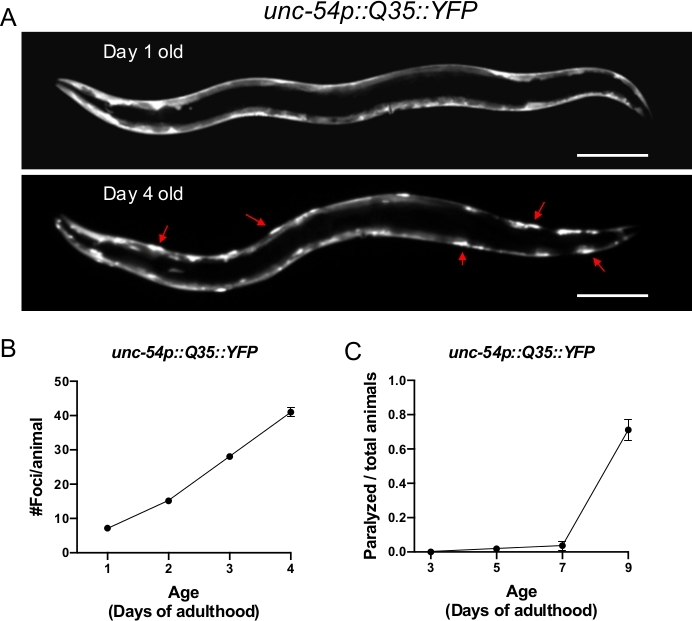
C. elegans expressing YFP showing age-related paralysis increase; graphs depict focal and paralysis data.
Figure 1: Expression of polyQ::YFP within C. elegans muscle results in progressive foci accumulation and paralysis during aging. (A) C. elegans unc-54p::Q35::YFP expression at days 1 and 4 of adulthood (u.......

Access restricted. Please log in or start a trial to view this content.

Disclosures

No conflicts of interest declared.

Materials

List of materials used in this article
NameCompanyCatalog NumberComments
Glass microscope slidesVWR160004-422
Sodium Azide, CAS #26628-22-8Sigma-AldrichS2002
Zeiss Axio Imager M2m microscope with AxioVision v4.8.2.0 softwareZeiss
Zeiss StemiSV11 M2 Bio Quad microscopeZeiss

Tags

Polyglutamine AggregationFluorescent Reporter AssayParalysis MeasurementProteostasis DeclineFluorescence MicroscopyBody Wall MusclesSodium Azide ImmobilizationFoci CountingAge-Associated Toxicity