NOTE: The standard laboratory line Oregon R was used as a WT control. All flies were reared on standard cornmeal-molasses medium (containing molasses, agar, yeast, cornmeal, tegosept, propionic acid, and water) at room temperature with 12/12 h light/dark circadian rhythm.
1. Preparing for the assay
- Collect female flies (0-2 days old, non-virgin) under CO2 anesthesia and allow them to recover on standard cornmeal food for at least 3 days before experiments.
- Starve the flies for ~24 h at room temperature (~23 °C) in vials containing a laboratory wipe tissue soaked with ~2 mL of deionized water.
- Prepare the fly food with bromophenol blue (BPB) as follows:
- Melt the fly food in a microwave and then let it cool until it is lukewarm.
- Add 1 mL of 4% BPB to 1 mL of lukewarm food and mix well.
- Using a pipet, add the fly food containing BPB into a single dot (~200 µL) in the center of a Petri dish.
2. Gut acidification monitoring assay
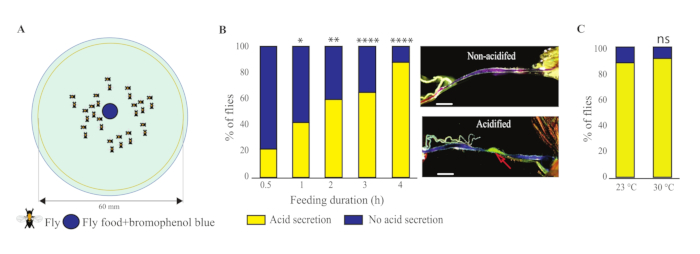
- Transfer starved flies into a Petri dish containing single dots (200 µL) of fly food supplemented with 2% bromophenol blue (BPB). Allow the flies to forage for 4 h at room temperature while exposed to light.
- After 4 h, collect the flies and anesthetize them on ice; surgically isolate their guts.
- Perform the surgery in 1x phosphate-buffered saline (PBS) with forceps under a stereomicroscope (see the Table of Materials). Isolate the gut by holding the thorax with a pair of forceps and pulling down the abdomen with a second pair until the CCR of the gut is visible, taking care to ensure that the intestine remains attached at both ends.
- Determine acidification of the gut by examining the color of the CCR of the gut (Figure 1C; yellow indicates acidified, and blue indicates not acidified).
- Count only those flies that show robust BPB staining in their guts.
- Calculate the percentage using the following equation:
Percentage of flies with acidified guts = number of flies acidified × 100 / (number of flies acidified + number of flies non-acidified)
NOTE: A percentage of 0 indicates that no flies acidified their gut, whereas a percentage of 100 indicates all flies acidified their gut.