A subscription to JoVE is required to view this content. Sign in or start your free trial.

Method Article

Nuclear Magnetic Resonance to Study Atomic Level Protein-Protein Interactions

1.2K views

July 8th, 2025

In This Article

Abstract

Source: Winkelaar, G., et al. Measuring Interactions of Globular and Filamentous Proteins by Nuclear Magnetic Resonance Spectroscopy (NMR) and Microscale Thermophoresis (MST). J. Vis. Exp. (2018).

This video describes the nuclear magnetic resonance spectroscopy technique to study protein-protein interactions between 15N-labeled wild-type and mutant envoplakin proteins and the unlabeled vimentin protein. The successful interaction between wild-type envoplakin and vimentin leads to extensive line broadening and peak disappearance in the NMR spectra, whereas the absence of an interaction between the mutated envoplakin and vimentin results in well-resolved peaks in the NMR spectra.
Protocol

1. NMR Methods

  1. NMR Sample Preparation
    1. Purify 15N-labeled wild-type or R1914E E-PRD protein using 20 mM Tris-HCl, 1 mM DTT, pH 7. Protein stock solutions usually range from 0.3 to 1 mM with volumes of about 1 mL.
      NOTE: Protein can be concentrated to >100 µM using an MWCO 3 kDa, 5 mL centrifugal ultrafiltration device to bring the concentration into a suitable range for sample preparation.
    2. Purify a sample of unlabeled VimRod protein using 20 mM Tris-HCl, 1 mM DTT, pH 7.
    3. In a final volume of 500 µL, add wild-type or mutant E-PRD protein to a final concentratio....

Access restricted. Please log in or start a trial to view this content.

Results

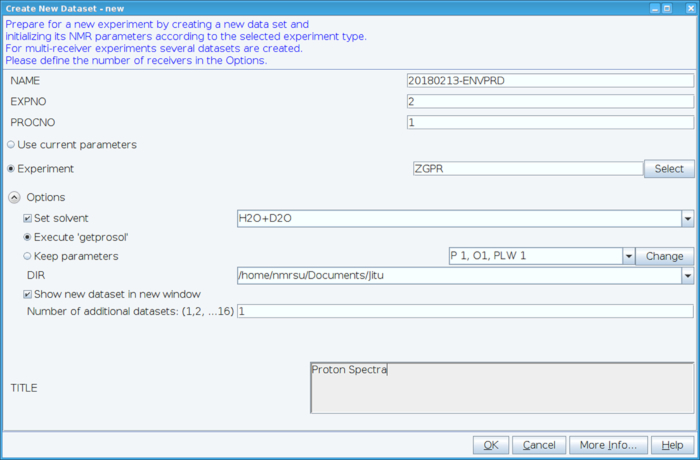
NMR setup interface for proton spectra experiment with solvent H2O+D2O and parameters selection.
Figure 1: Screen Capture of the Setup of the NMR Experiment. The window shown is used to set up a standard experiment to collect an HSQC dataset. Experiment parameters are read adjacent to Experiment. The ZGPR experiment shown is chosen as an initial experi.......

Access restricted. Please log in or start a trial to view this content.

Disclosures

No conflicts of interest declared.

Materials

List of materials used in this article
NameCompanyCatalog NumberComments
Ammonium chloride (<sup>15</sup>N, 99%)Cambridge Isotope LaboratoriesNLM-467Isotope labelling for NMR
D<sub>2</sub>O, Deuterium Oxide (D, 99.8%)Cambridge Isotope LaboratoriesDLM-2259NMR sample preparation
DSS, Sodium 2,2-dimethyl-2- silapentane-5-sulfonate-D6 (D,98%)Cambridge Isotope LaboratoriesDLM-8206Reference for NMR
Precision 5 mm NMR Tubes, 7&rdquo; longSJM/DeuterotubesBOROECO-5-7NMR tubes
NMR spectrometer (14.1 Tesla)BrukerAcquisition of NMR data
TCI 5mm z-PFG cryogenic probeBrukerAcquisition of NMR data
Software
Bruker TopSpin 4.0.1BrukerProcessing of NMR data

Tags

NMR Spectroscopy15N Labeled ProteinsChemical Shift AnalysisSpectral Peak BroadeningProtein Interaction DetectionSOFAST HMBC ExperimentMagnetic Field ShimmingReceiver Gain Optimization