A subscription to JoVE is required to view this content. Sign in or start your free trial.

Method Article

Reporter Gene Repression Assay to Study Translational Regulation of a Target Gene

1.1K views

July 8th, 2025

In This Article

Abstract

Source: Katz, N., et al. An Assay for Quantifying Protein-RNA Binding in Bacteria. J. Vis. Exp. (2019)

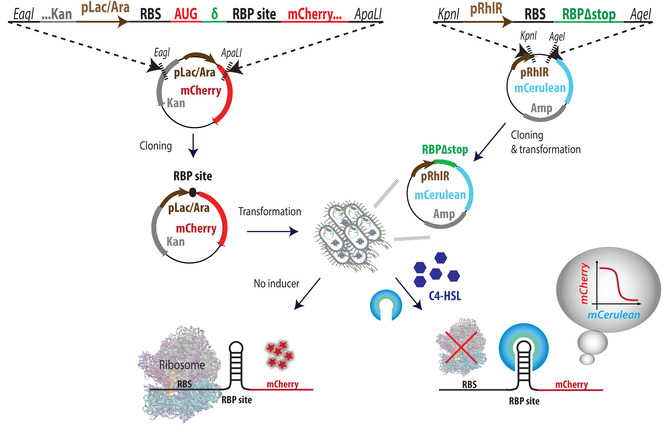
This video demonstrates an in vivo assay in bacteria to study the interaction of RNA-binding proteins (RBPs) with RNA. The bacterial cells are transformed with two plasmid constructs — a binding-site plasmid encoding an mRNA containing a fluorescent reporter gene downstream of an RBP-binding site — while an RBP plasmid expresses the RBP proteins under the control of an inducer. Upon inducer-mediated increase in RBP production, the RBPs bind to the mRNA, resulting in translational repression of the reporter via inhibition of ribosome binding.
Protocol

1. System Preparation

  1. Design of binding-site plasmids
    1. Design the binding site cassette as depicted in Figure 1. Each minigene contains the following parts (5' to 3'): Eagl restriction site, ∼40 bases of the 5' end of the kanamycin (Kan) resistance gene, pLac-Ara promoter, ribosome binding site (RBS), AUG of the mCherry gene, a spacer (δ), an RBP binding site, 80 bases of the 5' end of the mCherry gene, and an ApaLI restriction site.
      NOTE: To increase the success rate of the assay, design three binding-site cassettes for each binding site, with spacers consist....

Access restricted. Please log in or start a trial to view this content.

Results

Genetic circuit diagram showing cloning, transformation, and ribosome binding site regulation.
Figure 1: Overview of system design and cloning steps. Illustration of the cassette design for the binding site plasmid (left) and RBP-mCerulean plasmid (right). The next step is consecutive transformations of both plasmids into competent E. coli cel.......

Access restricted. Please log in or start a trial to view this content.

Disclosures

No conflicts of interest declared.

Materials

List of materials used in this article
NameCompanyCatalog NumberComments
Ampicillin sodium saltSIGMAA9518
Magnesium sulfate (MgSO4)ALFA AESAR33337
48 platesAxygenP-5ML-48-C-S
8-lane platesAxygenRESMW8I
96-well platesAxygenP-DW-20-C
96-well plates for plate readerPerkin Elmer6005029
ApaLINEBR0507
Binding site sequencesGen9 Inc. and Twist Biosciencesee Table 1
<em>E. coli</em> TOP10 cellsInvitrogenC404006
Eagl-HFNEBR3505
GlycerolBIO LAB71205
IncubatorTECANLiconic incubator
Kanamycin solfateSIGMAK4000
KpnI- HFNEBR0142
LigaseNEBB0202S
Liquid-handling robotic systemTECANEVO 100, MCA 96-channel
MATLAB analysis softwareMathworks
Multi-pipette 8 lanesAxygenBR703710
N-butanoyl-L-homoserine lactone (C<sub>4</sub>-HSL)CaymanK40982552 019
PBS bufferBiological Industries020235A
Plate readerTECANInfinite F200 PRO
Q5 HotStart PolymeraseNEBM0493
RBP sequencesAddgene27121 &amp; 40650see Table 2
Sodium Chloride (NaCl)BIO LAB190305
SV Gel and PCR Clean-Up SystemPromegaA9281
TryptoneBD211705

Tags

Reporter Gene AssayRNA Binding ProteinsBacterial Expression SystemFluorescent Reporter GeneInducible PromoterFluorescence MeasurementDose Response CurvePlasmid TransformationPlate Reader