1. Preparation of human embryonic stem cells (hESC)-qualified Basement Membrane Matrix-coated Plates
- Slowly thaw the hESC-qualified basement membrane matrix (see Table of Materials) solution at 4 °C for at least 2–3 h or overnight to avoid formation of a gel.
- To prepare basement membrane matrix-coated plates, dilute matrix in cold Dulbecco's Modified Eagle Medium with F12 (DMEM+F12) to a 2% final concentration. Mix well and coat each well of a 6 well plate with 1 mL of the diluted matrix solution.
- Incubate the basement membrane matrix-coated plates at room temperature (RT) for at least 3 h or at 4 °C overnight.
NOTE: Plates with basement membrane matrix can be stored at 4 °C for 1 week before the matrix solution is removed and plates are used.
2. Adaptation of Colony type hESCs to Single cell hESC Culture
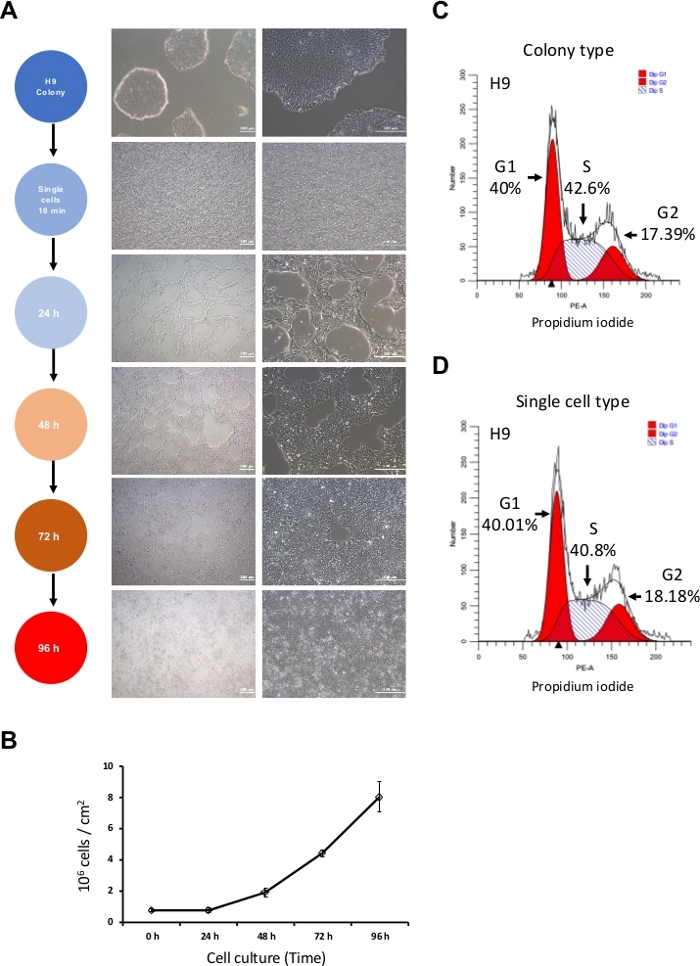
- To passage the feeder-free cultures of colony type H9 (WA09) hESCs grown on the basement membrane matrix, aspirate the medium from the wells (Figure 1A).
- Wash 1x with 1 mL of DPBS. Add 1 mL of dispase solution (1 U/mL) per well and incubate at 37 °C for 20 min.
- Remove the dispase, wash the cells 1x gently with 2 mL of DMEM/F12, remove the medium, and add 2 mL of DMEM/F12 to each plate.
- Gently detach colonies by gently pipetting up and down and transfer to a 15 mL tube.
- Centrifuge the pellets for 2 min at 370 x g and aspirate the medium.
- To dissociate the cell pellets into single cells, add 2 mL of cell detachment solution (1x concentration, see Table of Materials) and incubate at 37 °C for 10 min.
- Centrifuge cells for 2 min at 370 x g and remove the detachment solution.
- Add fresh mTeSR1 human ESC medium and dissociate the cells into single cells by gentle pipetting up and down.
- To adapt colony type hESCs to a single-cell type culture, plate approximately 1.5–2.0 x 10⁶ hESCs into each well of the basement membrane matrix-coated 6 well plate in 2 mL of mTeSR1 containing 10 μM ROCK inhibitor for 24 h (Figure 1A).
- After 24 h, replace the hESC medium with fresh mTeSR1 without ROCK inhibitor and allow the hESCs to grow as a single-cell type for 3 days. Change the medium daily.
- On day 4, when cultures reach nearly 100% confluency, dissociate cells in detachment solution, then replate as described in step 2.6.
NOTE: The ROCK inhibitor improves cell survival during the initial 24 h of single-cell type hESC culture.
3. Differentiation of Single-cell Type hESCs Into NPCs (Figure 2)
- To induce NPC differentiation, dissociate single-cell type hESCs with 1 mL of detachment solution (1x) and incubate for 10 min at 37 °C.
- Centrifuge the cells for 2 min at 370 x g and remove the detachment solution supernatant. Add 1 mL of DMEM/F12 and resuspend cells by gentle pipetting.
- Plate cells on a basement membrane matrix-coated 6 well plate at a density of 2 x 10⁵ cells/well in 2 mL of mTeSR1 containing 10 μM ROCK inhibitor.
- After 24 h, replace the culture medium with a neural induction medium (DMEM with 1% B27 minus vitamin A) supplemented with 1 μM dorsomorphin and 5 μM SB431542.
- Change the medium every other day during the first 4 days of neural induction, then every day until reaching confluence at day 7 (Figure 2B).
NOTE: (1) Dorsomorphin inhibits the BMP pathway by targeting ALK2,3,6 receptors and also inhibits AMPK; SB431542 is an inhibitor of the TGFβ/Activin pathway by targeting ALK5,7. (2) The same protocol was tested with another ESC line (WA01), which yielded similar results as WA09. (3) We have generally used Matrigel for the basement membrane matrix; however, cells can be cultured on Geltrex and then differentiated into NPCs with very similar results as indicated by the expression of several NPC markers (Figure 3D, E). Handle Geltrex in the same manner as Matrigel (see section 1).