A subscription to JoVE is required to view this content. Sign in or start your free trial.

Method Article

Differentiation of a Human Neuroblastoma Cell Line into Mature Neurons

1.4K views

⸱

July 8th, 2025

In This Article

Abstract

Source: Shipley, M. M., et al. Differentiation of the SH-SY5Y Human Neuroblastoma Cell Line. J. Vis. Exp. (2016).

This video demonstrates a technique for transforming undifferentiated SH-SY5Y neuroblastoma cells into fully differentiated mature neurons using a systematic passaging technique. This involves culturing the cells in a series of media with gradually decreasing serum levels to inhibit the proliferation of epithelial-like cells while promoting the differentiation and proliferation of neuron-like cells. Additionally, the media is supplemented with retinoic acid and specific growth factors that induce terminal differentiation of neuron-like cells into mature neurons exhibiting an extensive branched morphology.
Protocol

1. General Considerations

  1. See the Table of Materials/Equipment for a list of necessary reagents. Perform all steps under strict aseptic conditions.
  2. Use heat-inactivated fetal bovine serum (hiFBS) for all media preparations that include FBS. To heat-inactivate, warm a 50 ml aliquot of FBS at 56 °C for 30 min, inverting every 10 min (see also Table 1).
    NOTE: When FBS is used without heat-inactivation, the epithelial-like phenotype progresses more quickly throughout cultures of SH-SY5Y cells.
  3. Prior to use, allow media to warm and equilibrate in an incubator to ....

Access restricted. Please log in or start a trial to view this content.

Results

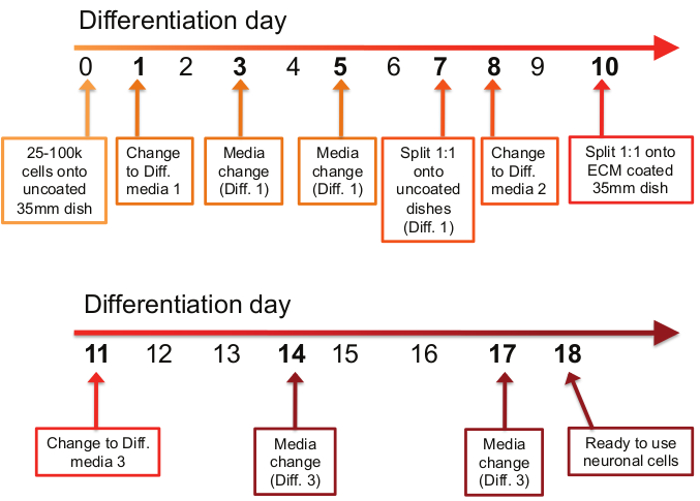
Differentiation timeline diagram for neuronal cells; details media changes and split protocols.
Figure 1: Timetable of differentiation procedure. The differentiation process consists of 11 steps spread out over the course of an 18 day period. On the first day of the differentiation protocol (day 0), between 25,000 and 100,000 cells are plated onto unco.......

Access restricted. Please log in or start a trial to view this content.

Disclosures

No conflicts of interest declared.

Materials

List of materials used in this article
NameCompanyCatalog NumberComments
B-27ThermoFisher Scientific17504-044See Table 1 for preparation
Brain-Derived Neurotrophic Factor (BDNF)SigmaSRP3014 (10 μg)/B3795 (5 μg)See Table 1 for preparation
dibutyryl cyclic AMP (db-cAMP)SigmaD0627See Table 1 for preparation
DMSOATCC4-X-
Minimum Essential Medium Eagle (EMEM)SigmaM5650-
Fetal Bovine Serum (FBS)HycloneSH30071.03See Table 1 for preparation
GlutamaxILife Technologies35050-061-
GlutamineHycloneSH30034.01-
Potassium Chloride (KCl)Fisher ScientificBP366-1See Table 1 for preparation
MaxGel Extracellular Matrix (ECM) solutionSigmaE0282See step 11 of the protocol
NeurobasalLife Technologies21103-049-
Penicillin/Streptomycin (Pen/Strep)Life Technologies15140-122-
Retinoic acid (RA)SigmaR2625Should be stored in the dark at 4 °C because this reagent is light sensitive
SH-SY5Y CellsATCCCRL-2266-
0.5% Trypsin + EDTALife Technologies15400-054-
Falcon 35 mm TC dishesFalcon (A Corning Brand)353001-

Explore More Articles

Neuroblastoma Cell DifferentiationSH-SY5Y Neuronal DifferentiationRetinoic Acid TreatmentSerum Deprivation MethodTrypsin-EDTA DetachmentExtracellular Matrix CoatingNeuronal Growth FactorsHemocytometer Cell CountingPassaging TechniqueMature Neuron Morphology