Method Article

Utilizing Multielectrode Arrays to Measure Synaptic Physiology in 3D Coculture Spheres

July 8th, 2025

In This Article

Abstract

Loading...
$$\rightleftharpoonup{xx}$$ $$\longleftharp{xx}$$, $$\longrightharp{xx}$$,

Source: Cvetkovic, C., et al. Synaptic Microcircuit Modeling with 3D Cocultures of Astrocytes and Neurons from Human Pluripotent Stem Cells. J. Vis. Exp. (2018)

This video demonstrates the procedure of using the multielectrode array (MEA) to measure synaptic physiology in 3D coculture spheres. This method allows to understand the neural network dynamics and synaptic network burst activity within the 3D spheres.

Protocol

Loading...
$$\rightleftharpoonup{xx}$$ $$\longleftharp{xx}$$, $$\longrightharp{xx}$$,

Measurement of Live Synaptic Physiology with Multielectrode Arrays (MEAs)

1. Prepare MEAs for cell culture.

  1. Clean the surface of each MEA with 1 mL of detergent for 1 h. Rinse with sterile deionized (DI) water, rinse with 70% ethanol to sterilize, and then air dry in a biosafety cabinet under UV light.
    NOTE: MEAs can be stored in DI water at 4 °C under sterile conditions until use.
  2. Prepare a 0.5 mg/mL solution of poly-ornithine (PLO) by dissolving 50 mg of PLO into 100 mL of boric acid buffer. Coat the surface of each MEA with 1 mL of PLO to render it hydrophilic and incubate at 37 °C for a minimum of 4 h. Remove the PLO and wash the surface with DI water.
  3. Dilute extracellular matrix (ECM) coating solution with basal (DMEM/F12) media to prepare a 1 mg/mL stock solution. For a working solution, resuspend 3 mL of ECM stock into 33 mL of pre-chilled DMEM/F12 media, bringing the total volume to 36 mL for a concentration of 80 µg/mL.
  4. Add 1 mL of ECM working solution to each MEA and incubate at 37 °C for a minimum of 4 h.
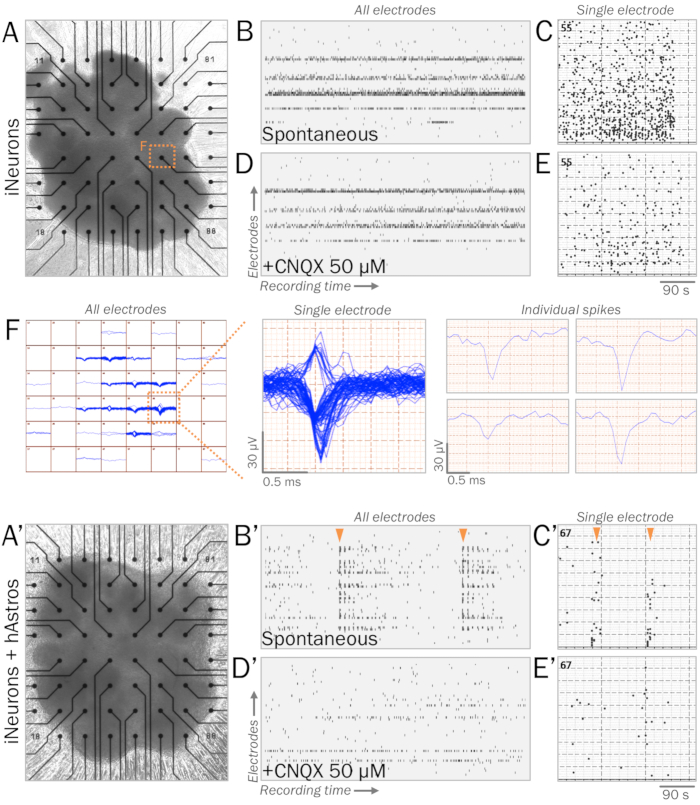
  5. Remove the ECM and place the spheres in 1.5 mL of media on a MEA surface, ensuring that the spheres are positioned on top of the electrode array (Figures 1A, 1A'). Allow the media to adhere for 2 days. Change half of the media every 2–3 days (or more often if needed), ensuring that the spheres are not disturbed.
    NOTE: The addition of growth factors may improve culture survival and maturation.

2. Measure the electrical activity of neural spheres.

  1. Set up a multielectrode array (MEA) system with a temperature-controlled headstage. Create a software program with a 5 Hz high-pass filter, a 200 Hz low-pass filter, and a spike threshold of 5x standard deviation (SD).
  2. Place the MEA on headstage and record spontaneous electrical activity (Figure 1B, B'). Save raw data, including spike frequency and amplitude, for statistical analysis.
    NOTE: A perfusion system may be utilized with the MEA to add pharmacological agents or to increase the flow of fresh media for long-term recording. As desired, additional post-processing of spikes may be performed.
Access restricted. Please log in or start a trial to view this content.

Results

Loading...
$$\rightleftharpoonup{xx}$$ $$\longleftharp{xx}$$, $$\longrightharp{xx}$$,

Neuronal activity recording via microelectrode arrays, iNeurons, hAstros, CNQX effect, spike analysis.
Figure 1: Representative live synaptic physiology of neural spheres on multielectrode arrays (MEAs). (A, A') MEAs are utilized to measure the live synaptic physiology of neural spheres. Spheres of iNeurons (A) or cocultures of iNeuron...

Access restricted. Please log in or start a trial to view this content.

Disclosures

Loading...
$$\rightleftharpoonup{xx}$$ $$\longleftharp{xx}$$, $$\longrightharp{xx}$$,
No conflicts of interest declared.

Materials

List of materials used in this article
NameCompanyCatalog NumberComments
DMEM/F12Thermofisher10565-042With GlutaMAX supplement
Anti/antiThermofisher15240062
B27Thermofisher17504044Media Supplement
HeparinSigmaH3149-50KUWorking concentration: 2 mg/mL
Matrigel membrane matrixCorning354230ECM coating solution. Working concentration: 80 ug/ml. Prepare on ice and ensure that pipettes, tubes, and media are pre-chilled.
MEA 2100 SystemMultichannel SystemsMEA2100
N2Thermofisher17502048Media Supplement
Poly-l-ornithine (PLO)SigmaP3655-100MGWorking concentration: 0.5 mg/mL

Reprints and Permissions

Request permission to reuse the text or figures of this JoVE article

Request Permission

Tags

Multielectrode Array3D Coculture SpheresNeural Network DynamicsExtracellular Matrix CoatingPoly ornithine TreatmentTemperature controlled Head StageSpontaneous Electrical ActivityNeural Junction CommunicationHuman Pluripotent Stem Cells

Related Articles