A subscription to JoVE is required to view this content. Sign in or start your free trial.

Method Article

Navigational Behavior of Drosophila Larvae in Response to Optogenetic Stimulation of Olfactory Sensory Neurons

764 views

July 8th, 2025

In This Article

Abstract

Source: Clark, D. A., et al. Tracking Drosophila Larval Behavior in Response to Optogenetic Stimulation of Olfactory Neurons. J. Vis. Exp. (2018).

This video demonstrates a study of the navigational behavior of Drosophila larvae in response to optogenetic stimulation of olfactory sensory neurons (ORNs). Transgenic Drosophila larvae expressing light-sensitive ion channels in the ORNs are placed on agarose within a behavior arena. Optogenetic stimulation with light opens the channels, causing a cation influx that triggers the transmission of the signal to the brain, and the navigation behavior is recorded.
Protocol

1. Building a Behavior Arena and Preparing Hardware to Enable Optogenetic Stimulation in the Behavior Arena

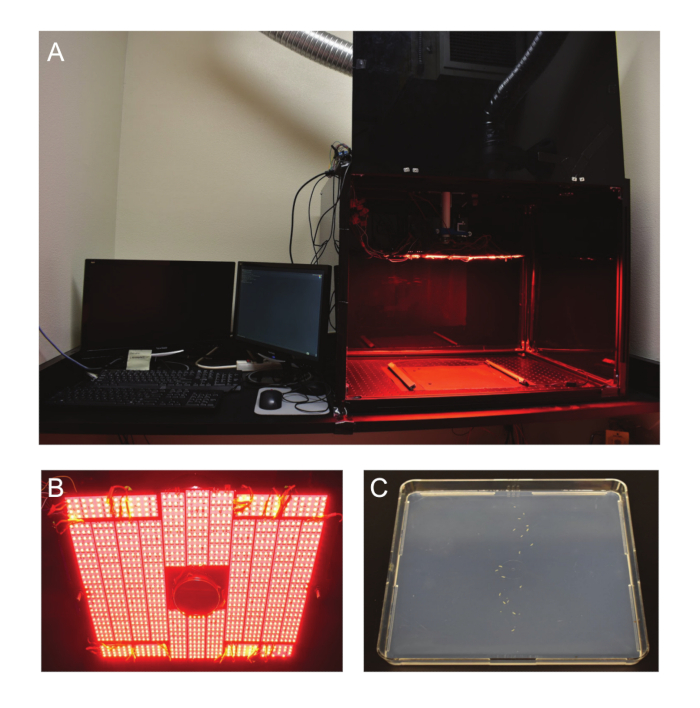
  1. To build a light-deprived behavior arena, construct a box with a dimension of 89 x 61 x 66 cm3 (35" L x 24" W x 26" H) made of black colored plexiglass acrylic sheets (3 mm thick) (see Table of Materials). Materials to build such a box should be available at local hardware stores. Place this box on a table-top in the behavior room (Figure 1A).
  2. Mount a monochrome universal serial bus (USB) 3.0 charge-coupled device (CCD) camera fitted with an infrared (IR) long-pass 830 nm filter and an 8 mm F1.4 C-mount lens (see Table of Materials) to the center of the ceiling of the black box. Place two infra-red light-emitting diode (LED) strips (see Table of Materials) on the table-top in order to illuminate the larvae in the dark arena (Figure 1A).
  3. To build the LED platform, obtain a 22 cm × 22 cm square Aluminum plate (preferably spray painted with a matte black finish to eliminate any reflections). In the center of the plate, using a metal cutter, cut a hole that is large enough to fit around the CCD camera.
  4. Cover the metal plate with red LED strip lights (see Table of Materials). Solder LED light strip wires in series and feed the strip wires into an optocoupler relay controlled by a Raspberry Pi 2B microprocessor (see Table of Materials) (Figure 1B and 2).
  5. Install and configure Ubuntu Mate/Raspian Jesse/Linux based operating system on the Raspberry Pi processor before connecting the optocoupler relay to the LED strips. Attach a power supply to power the LED strips and the optocoupler (Figure 2) (see Table of Materials). Mount the LED platform around the CCD camera (Figure 1B).
    NOTE: Ubuntu Mate v16.04 operating system is freely available. A set of simple Python based commands can be easily adapted to program patterns of LED light stimuli (see file of syntax).
  6. Ensure homogenous irradiance at various points in the behavior arena. Measure the absolute irradiance at the surface of the arena with the help of a Spectrometer and determine it to be ~1.3 W/m2 throughout the surface of the arena.
    NOTE: At this intensity, no significant changes were observed in temperature over the course of the experiments. Another study used a higher irradiance of ~1.9 W/m2 and observed no changes in temperature over the course of the experiments.

2. Preparation of Drosophila Larvae for Behavior Analyses

  1. Maintain the flies on standard fly food (see Table of Materials) at 25 °C, 50-60% relative humidity (RH), and a 12 h/12 h light/dark cycle.
  2. In order to express CsChrimson in a single pair of ORNs, cross virgin females from a UAS-IVS-CsChrimson line to males from an OrX-Gal4 line ('X' corresponds to one of 21 larval odor receptor (Or) genes that are uniquely expressed in each of 21 pairs of ORNs).
    1. Alternately, in order to express CsChrimson in all 21 larval ORNs, cross virgin females from a UAS-IVS-CsChrimson line to males from an Orco-Gal4 line ('Orco' is the co-receptor that is expressed in all 21 ORNs).
    2. Use UAS-IVS-CsChrimson line by itself as a control in these experiments.
      NOTE: The fly stocks listed here are all available at the Bloomington Drosophila Stock Center (see Table of Materials).
  3. Once male and female flies in a cross are allowed to mate and lay eggs for 48 h, transfer adults to a fresh vial.
    1. To the surface of the food vial containing eggs, add 400 µL of a mixture containing 400 µM all-trans retinal (ATR) dissolved in dimethyl sulfoxide (DMSO) and 89 mM sucrose dissolved in distilled water.
      NOTE: The small amount of sucrose promotes larval feeding of the ATR solution. ATR is a cofactor required for upregulating of CsChrimson expression. ATR is light sensitive.
    2. Once ATR is added to the food vials containing eggs, incubate the vials in the dark for an additional 72 h.
      NOTE: While this study and the above two studies have not observed effects on larval behavior due to ATR feeding, it is recommended controlling for the effects of ATR feeding by subjecting test lines to the same amount of the above mixture that does not contain ATR.
  4. Extract third-instar larvae (~120 h after egg laying) from the surface of fly food by floating them using a high density (15%) sucrose solution. Using a P1000 micropipette separate the larvae floating on the surface of the sucrose solution into a 1000 mL glass beaker.
  5. Wash larvae 3–4 times by exchanging 800 mL fresh distilled water in the glass beaker each time. Allow larvae to rest for 10 min before subjecting them to the behavior assay.

3. Behavior Assay

  1. Maintain consistent temperature (between 22–25 °C) and humidity (between 50 and 60% RH) in the behavior room.
  2. Prepare larval crawling medium by pouring 150 mL of melted agarose (1.5%) into a 22 cm x 22 cm square Petri dish. One Petri dish is poured for each trial of the assay, 8–10 trials per experiment. Allow agarose to solidify and cool for 1–2 h in the Petri dishes before using them in the behavior assay.
    1. Transfer no more than 20 of the prepped third-instar larvae to the center of Petri dish (Figure 1C). Cover the Petri dish with its lid. Place the Petri dish in the behavior arena under the CCD camera.
      NOTE: Depending on the experiment, behavior assays are typically carried out for 3–5 min. If an odorant is used in the assay to provide guidance cues, it has been observed that the resulting odor gradient remains stable for approximately 5 min. Longer assay times are not recommended. Deleterious effects on larvae due to dehydration or from prolonged 630 nm red-light exposure have not been observed within these time points.
  3. Turn ON the 850 nm infra-red LED light source to visualize larvae in the video. Start the CCD camera to record larval movement.
  4. Using the software associated with the Raspberry Pi processor, program the procedure to administer appropriate patterns of red light stimulation.
    NOTE: A set of simple Python based commands can be easily adapted to program patterns of LED light stimuli (see file of syntax).

Access restricted. Please log in or start a trial to view this content.

Results

Fluorescence imaging setup, red LED array, growth analysis; diagram with computer, LED chamber, petri dish.
Figure 1: Behavior arena and larval crawling medium. (A) Front view of the black-box behavior arena. The open door of the arena reveals a CCD camera suspended from the ceiling of the box. (B) Bottom view of a metal platform conta...

Access restricted. Please log in or start a trial to view this content.

Disclosures

No conflicts of interest declared.

Materials

List of materials used in this article
NameCompanyCatalog NumberComments
Video camera to capture larval movement
CCD CameraEdmund Optics106215
M52 to M55 Filter Thread AdapterEdmund Optics59-446
2" Square Threaded Filter Holder for Imaging LensesEdmund Optics59-445
RG-715, 2" Sq. Longpass FilterEdmund Optics46-066
Electronics for optogenetic setup
Raspberry Pi 2BRASPBERRY-PI.orgRPI2-MODB-V1.2
3 Channel programmable power supplynewegg.com9SIA3C62037092
8 Channel optocoupler relayamazon.com6454319
630nm Quad-row LED strip lightsenvironmentallights.comred3528-450-reel
850nm LED stripsenvironmentallights.comwp-4000K-CC5050-60x2-kit
Software
Ubuntu MATE v16.04Nubuntuhttps://github.com/yslo/nubuntu
Other items
Plexiglass black acrylicHome DepotMC1184848bl
Fly food and other reagents
Nutrifly fly foodGenesee Scientific66-112
Agarose powderGenesee Scientific20-102
22cm X 22cm square petri-dishVWR Inc.25382-327
DMSOSigma-AldrichD2650
SucroseSigma-Aldrich84097
All trans-retinalSigma-AldrichR2500
Flies
UAS-IVS-CsChrimsonBloomington Drosophila Stock Center55134
Orco-Gal4Bloomington Drosophila Stock Center26818
Or42a-Gal4Bloomington Drosophila Stock Center9970
Or7a-Gal4Bloomington Drosophila Stock Center23907

Tags

Behavior ArenaAgarose PreparationCCD Camera RecordingRun Length AnalysisTemperature Humidity ControlLight Wavelength ExposureCation Influx Measurement