A subscription to JoVE is required to view this content. Sign in or start your free trial.

Method Article

Staircase Test for Motor Function Assessment in a Hemiparkinsonian Rat

889 views

July 8th, 2025

In This Article

Abstract

Source: Rattka, M, et al., A Novel Approach to Assess Motor Outcome of Deep Brain Stimulation Effects in the Hemiparkinsonian Rat: Staircase and Cylinder Test. J. Vis. Exp. (2016).

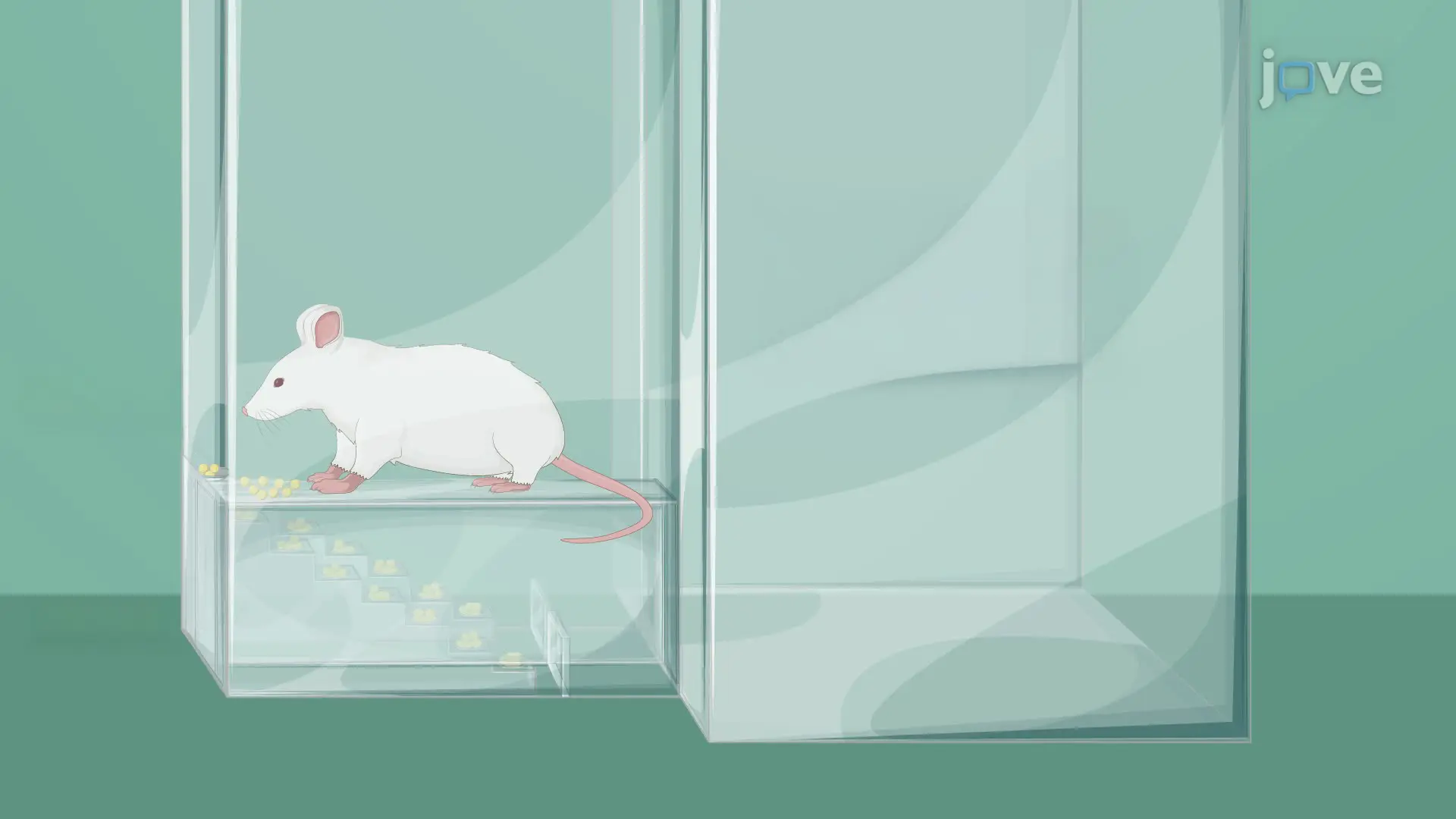
This video demonstrates the staircase test to assess motor function in a hemiparkinsonian rat with a right brain lesion. The lesion disrupts dopamine signaling, impairing left paw control, which results in more pellets remaining on the left stairs, indicating motor dysfunction.
Protocol

All procedures involving animal models have been reviewed by the local institutional animal care committee and the JoVE veterinary review board.

1. Staircase Test (Figure 1)

  1. Acquisition Phase
    1. One day prior to the training familiarize the animals with the pellets used in the Staircase test.
      1. Optional: To increase the animal's motivation use a dietary restriction (10-15 g of standard laboratory chow to maintain body weight at 90% of the free feeding level). However, this is not obligatory to achieve a positive training effect. This study was conducted without food restriction.
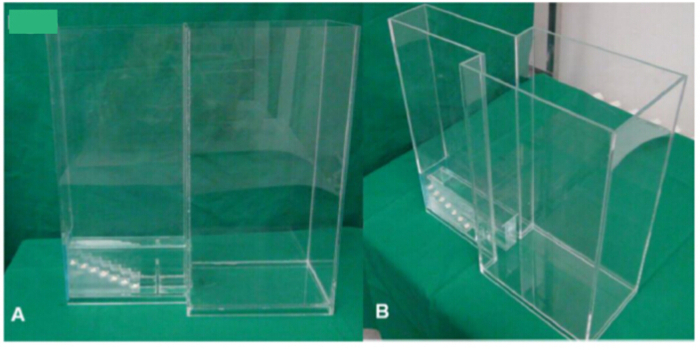
    2. Prepare a clear plastic glass staircase box (height: 34.5 cm, length: 35.5 cm, width: 12 cm, and narrow compartment 6 cm) by cleaning the box with a 0.1% acetic acid solution. NOTE: The staircase box is a two-compartment box with a raised platform and two stairs in the narrow compartment. The left steps on the stairs in the narrow compartment can be reached only with the left paw, and the right steps only with the right paw.
      NOTE: The standard staircase boxes consist of two compartments with a lid. If they are to be used for experiments with rats stimulated via cable, use a high box without a lid.
    3. Remove the staircase and fill the wells on each step with eight 45 mg pellets.
    4. Insert the staircase and put eight additional pellets on the heightened platform.
    5. Place the rat in the transport box.
    6. Transport the rat from the home cage to the staircase box using the transport box.
    7. Place the rat in the staircase box (Figure 2).
    8. After five minutes, remove the animal from the staircase box and put it back into the home cage using the transport box.
    9. Note how many pellets were eaten from the platform and (eventually) from the right and left staircases.
    10. Refill the staircase by filling the wells on each step with eight 45 mg pellets.
    11. Clean the staircase box with a 0.1% acetic acid solution and place the additional pellets on the platform.
    12. Repeat this procedure (acquisition phase) three days in a row.
      NOTE: All experiments described were performed on male Sprague Dawley rats. The duration of the different training modules can differ in rats of different strains, sexes, and vender.
  2. Free Choice Test
    1. Clean the staircase box with a 0.1% acetic acid solution.
    2. Remove the staircase and fill the wells on each step with eight 45 mg pellets.
    3. Place the rat in the transport box.
    4. Transport the rat from the home cage to the staircase box using the transport box.
    5. Place the rat in the staircase box.
    6. After five minutes, remove the animal from the staircase box and put it back into the home cage using the transport box.
      Note how many pellets were eaten from the right and left staircase.
    7. NOTE: If the animals still have problems with grasping pellets, add some more on the platform where they can be easily reached.
    8. Refill the staircase by filling the wells on each step with eight 45 mg pellets.
    9. Clean the staircase box with a 0.1% acetic acid solution for the next animal.
    10. Repeat this procedure (free choice phase) three days in a row.
      NOTE: The presented results were obtained by training conducted without a resting period between modules. Some groups prefer a resting day for consolidation, to support the training process.
  3. Forced Choice Test
    1. Clean the staircase box with a 0.1% acetic acid solution.
    2. Remove the staircase and fill the wells on each step on the left staircase with eight (first three days of the module) or four (consecutive three days of the module) 45 mg pellets.
      1. Perform the forced choice test on the side, where the impairment will occur.
        NOTE: We perform the Parkinson's lesion on the right hemisphere and therefore train selectively the left paw.
    3. Place the rat in the transport box.
    4. Transport the rat from the home cage to the staircase box using the transport box.
    5. Place the rat in the staircase box.
    6. After five minutes, remove the animal from the staircase box and put it back into the home cage using the transport box.
    7. Note how many pellets were eaten from the left staircase.
    8. Refill the staircase by filling the wells on each step with eight or four 45 mg pellets (the number of pellets depends on the training day).
    9. Clean the staircase box with a 0.1% acetic acid solution for the next animal.
    10. Repeat this procedure (forced choice phase) six days in a row.
  4. Data Acquisition
    1. Perform the experiment as described for the forced choice module (four pellets in each well on the left staircase) on two consecutive days. Calculate the success rate (number of pellets eaten) as a mean of the two days.

Access restricted. Please log in or start a trial to view this content.

Results

Double-chamber plexiglass setup for gas diffusion experiment; left and right chamber views shown.
Figure 1: Staircase test setup. The staircase box arranged with pellets on the left staircase. (A) side view, (B) view from above.

Access restricted. Please log in or start a trial to view this content.

Disclosures

No conflicts of interest declared.

Materials

List of materials used in this article
NameCompanyCatalog NumberComments
Staircase box witout lidGlas Keil, Germanycustom made
Dustless precision pellets, 45 mgBio ServF0021

Tags

Food Pellet CountingLeft Paw ImpairmentRight Hemisphere LesionDopamine Signaling DisruptionAcquisition PhaseFree Choice PhasePlastic Staircase Box