Method Article

Inducing Thrombotic Stroke Through Hypoxia and Ischemia in a Mouse Model

July 8th, 2025

In This Article

Abstract

Loading...
$$\rightleftharpoonup{xx}$$ $$\longleftharp{xx}$$, $$\longrightharp{xx}$$,

Source: Sun, Y. Y., et al., A Thrombotic Stroke Model Based On Transient Cerebral Hypoxia-ischemia. J. Vis. Exp. (2015).`

This video demonstrates the procedure of replicating a thrombotic stroke in a mouse model by blocking the right common carotid artery and exposing the mouse to a low-oxygen environment. This process reduces blood and oxygen flow to the brain, causing blood clot formation and brain damage.
Protocol

Loading...
$$\rightleftharpoonup{xx}$$ $$\longleftharp{xx}$$, $$\longrightharp{xx}$$,

All procedures involving animal models have been reviewed by the local institutional animal care committee and the JoVE veterinary review board.

1. Setup

  1. Prepare the surgical bed on a warming pad connected to a heat pump at 37 °C for at least 15 minutes before the surgery. Place a neck roll using the barrel of a 3 ml syringe on the surgical bed. Prepare the anesthesia gas with 2% isoflurane in medical air.
  2. Prepare autoclaved forceps, scissors, micro needle holders, a hemostat, cotton swabs, and sutures. Also, prepare tissue glue and eye ointment.
  3. Set up the hypoxia system and temperature controllers with a heating lamp and rectal probe. Prepare hypoxia gas with 2% isoflurane in 7.5% O2 balanced by 92.5% N2.
  4. One hour before surgery, mice are analgesized by subcutaneous injection of a slow-release Meloxicam (4.0 mg/kg).

2. Transient Cerebral Hypoxia-ischemia (Figure 1B)

  1. Anesthetize 10-13 week-old male C57BL/6 mice weighing 22 to 30 g in the anesthesia induction chamber with 3% isoflurane until the animal is unresponsive to foot squeeze, and then remove the hair on the right neck using an electronic shaver.
  2. Place mice on the surgical bed connected with 2% isoflurane in medical air at a flow rate of 2 L/min. Secure forelimbs stretched out along neck roll at sides using medical tape.
  3. Clean the surgical site for incision with betadine followed by alcohol and then cotton swabs.
  4. Under a dissecting microscope, make a 0.5 cm right-cervical incision using straight forceps and micro scissors about 0.2 cm lateral from the midline skin.
  5. Use a pair of finely serrated forceps to pull apart the fascia and tissue to expose the right common carotid artery (RCCA). Carefully separate the RCCA from the vagal nerve using a pair of fine smooth forceps.
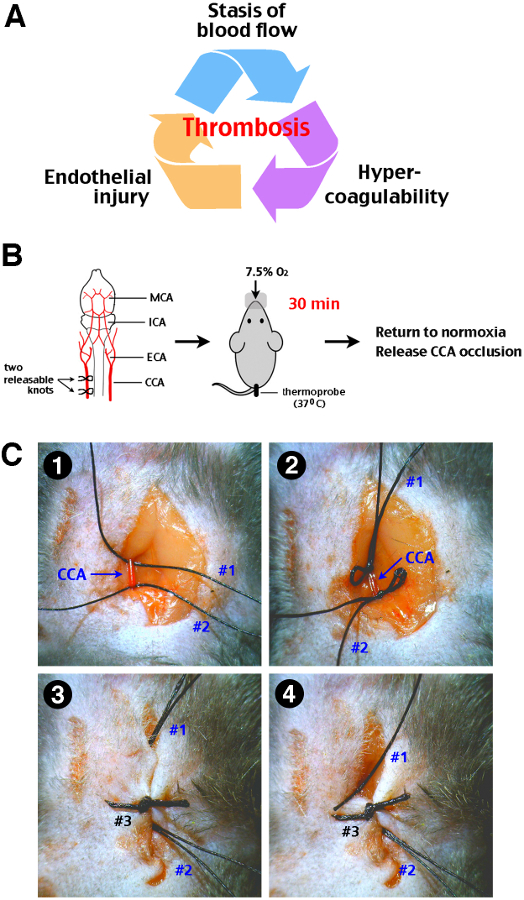
  6. Live knot two precut 5-0 silk sutures (releasable) on the RCCA, and then sew up the skin using 4-0 Nylon monofilament sutures (Figure 1C).
  7. Apply eye ointment on both eyes to prevent dryness.
  8. Quickly transfer the mice to the hypoxia system and put their noses and mouths in a face mask with 2% isoflurane in 7.5% O2 at a flow rate of 0.5-1 L/min for 30 min.
    1. During hypoxia, use temperature controllers with heating lamps to control the rectal temperature at 37.5 ± 0.5 °C. Monitor the respiratory rate at 80-120 breaths/min. Maintaining the body temperature above 37 °C during hypoxia is important to create consistent brain infarction. Low respiratory rate usually happens after 20 minutes of hypoxia. Remove the face mask and allow normal air supply if the respiratory rate drops below 40. This takes 1-2 minutes and does not count toward the 30-minute hypoxia duration

Access restricted. Please log in or start a trial to view this content.

Results

Loading...
$$\rightleftharpoonup{xx}$$ $$\longleftharp{xx}$$, $$\longrightharp{xx}$$,

Thrombosis cycle diagram, hypoxia experiment setup, CCA occlusion surgery sequence images.
Figure 1: Procedure of transient cerebral hypoxia-ischemia (tHI) insult in adult mice. (A) Virchow's triad that propels thrombosis includes stasis of blood flow, endothelial injury, and hypercoagulability of the blood. (B) A schematic diagram of the tHI stroke pr...

Access restricted. Please log in or start a trial to view this content.

Disclosures

Loading...
$$\rightleftharpoonup{xx}$$ $$\longleftharp{xx}$$, $$\longrightharp{xx}$$,
No conflicts of interest declared.

Materials

List of materials used in this article
NameCompanyCatalog NumberComments
Adult male miceCharles RiverC57BL/610~13 weeks old (22~30 g)
Mobile Laboratory Animal Anesthesia SystemVetEquip901807Anesthesia
Medical air (Compressed) air tankAirgasUN1002Anesthesia
IsofluranePiramal HealthcareNDC 66794-013-25Anesthesia
Multi-Station Lab Animal Anesthesia SystemSurgivetV703501Hypoxia system
7.5% O2 balanced by 92.5% N2 tankAirgasUN1956Hypoxia system
Temperature Controller with heating lampCole ParmerEW-89000-10Temperature controllers
Rectal probeCole ParmerNCI-00141PGTemperature controllers
Dissecting microscopeOlympusSZ40Surgical setup
Heat pump with warming padGaymarTP700Surgical setup
Fine curved forceps (serrated)FST11370-31Surgical instrument
Fine curved forceps (smooth)FST11373-12Surgical instrument
micro scissorsFST15000-03Surgical instrument
micro needle holdersFST12060-01Surgical instrument
Halsted-Mosquito hemostatsFST13008-12Surgical instrument
5-0 silk sutureHarvard Apparatus624143Surgical supplies
4-0 Nylon monofilament sutureLOOK766BSurgical supplies
Tissue glueAbbott LaboratoriesNC9855218Surgical supplies
Puralube Vet ointmentFisherNC0138063Eye dryness prevention

Reprints and Permissions

Request permission to reuse the text or figures of this JoVE article

Request Permission

Tags

Thrombotic Stroke ModelCarotid Artery LigationHypoxia ChamberCerebral IschemiaBlood Clot FormationSurgical ProcedureAnesthetized MouseTemperature MonitoringSurgical Incision

Related Articles