The video demonstrates the neuroprotective activity of low-dose atmospheric pressure plasma treatment in glucose-deprived neuroblastoma cells by modulating oxidative stress and enhancing cell viability.
A subscription to JoVE is required to view this content. Sign in or start your free trial.
Method Article
Assessing Atmospheric Pressure Plasma Treatment in Glucose-Deprived Neuroblastoma Cells
618 views
⸱
August 7th, 2025
In This Article
Abstract
Protocol
1. APPJ (Atmospheric Pressure Plasma Jet) treatment of SH-SY5Y
- Adjust the distance between the nozzle of the quartz tube and the platform where the 96-well plate will be placed to 3 cm. Ensure that the beam can touch the surface of the culture medium.
NOTE: The distance is not measured from the bottom of the plate. It is first adjusted to 3 cm between the nozzle of the quartz tube and the platform used to place the 96-well plate. - Before the APPJ (Atmospheric Pressure Plasma Jet) treatment, change the culture medium in each well except the control wells to RPMI 1640 without glucose medium.
- Place the plate under the APPJ nozzle and ensure that the jets can shoot vertically into each well.
- Treat cells in separate wells with APPJ for 0 s, 1 s, 2 s, 4 s, 8 s, and 12 s.
NOTE: APPJ is generated by ionizing helium (Figure 1). The cells injured by glucose deprivation are treated by 4 s and 8 s helium flow to eliminate the effects of helium on cells. All the treatments should be performed in triplicate.
2. Cell Viability Assay
NOTE: Do not change the medium in this step.
- After the APPJ treatment, incubate the cells for 1 h in a cell incubator.
- Add 10 µL of Cell Counting Kit-8 (CCK-8) solution to each well.
- Incubate the cells at 37 °C for 4 h.
NOTE: The SH-SY5Y cell line is sensitive to glucose deprivation conditions. Cell viability decreases to nearly 50% after 1 h of glucose deprivation, which is the optimum cell viability condition for pharmacodynamics studies. CCK-8 has no cytotoxicity to cells, and cells are incubated with CCK-8 reagent for another 4 h in the glucose deprivation conditions after APPJ treatment to check cell viability. After 8 h of glucose deprivation and APPJ treatment, the protective effect of APPJ was significantly reduced because the long duration of glucose deprivation led to severe damage to the SH-SY5Y cells. There was no evidence of living cells after 24 h of glucose deprivation. - Measure the absorbance at 450 nm with a microplate reader.
Access restricted. Please log in or start a trial to view this content.
Results
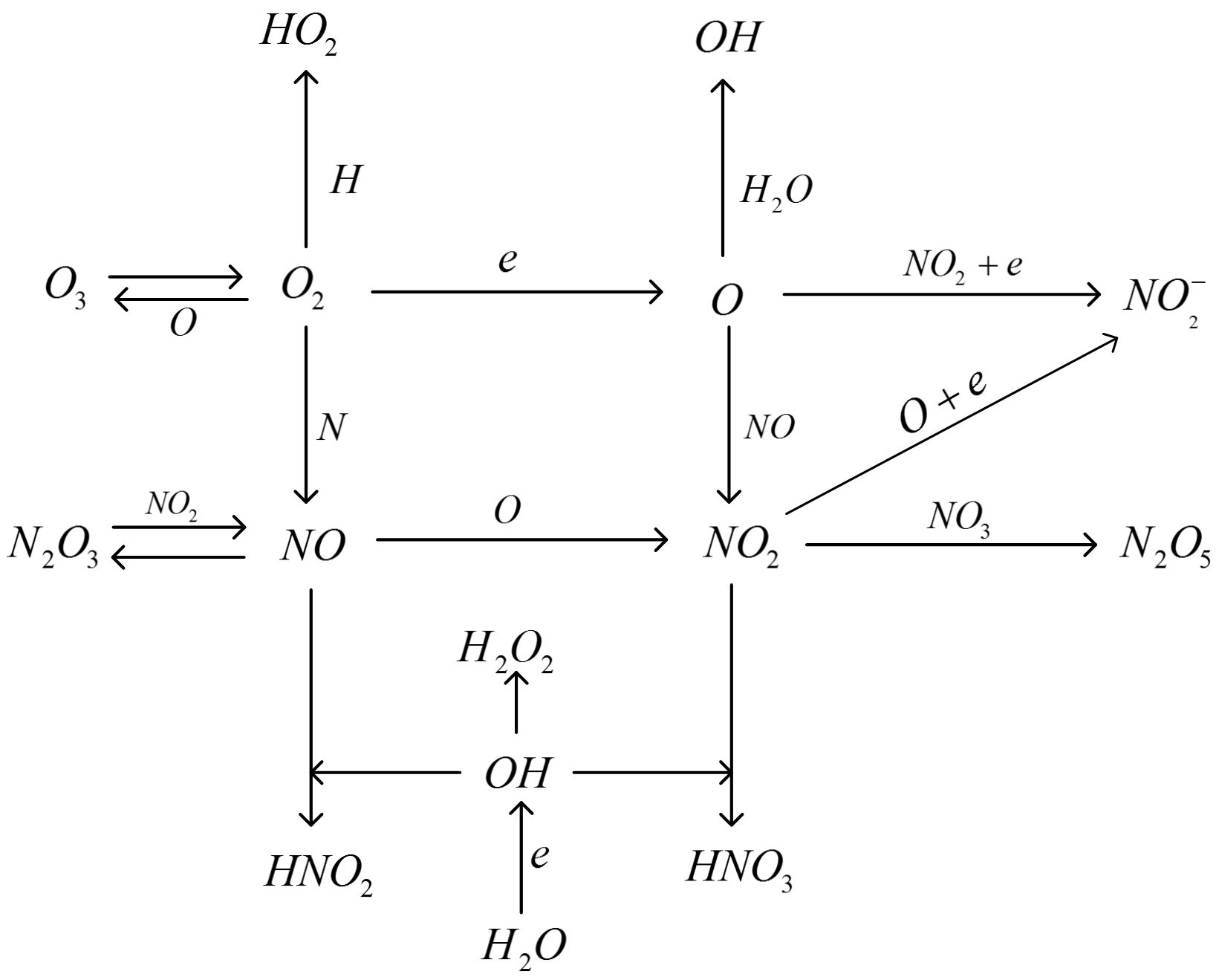
Figure 1: Typical RNS (Reactive nitrogen species) and ROS (Reactive oxygen species) reactions in APP...
Access restricted. Please log in or start a trial to view this content.
Materials
| Name | Company | Catalog Number | Comments |
|---|---|---|---|
| SH-SY5Y cell line | China Center for Type Culture Collection | 3111C0001CCC000026 | |
| RPMI 1640 medium | Thermo Scientific | 21875091 | Stored at 4 °C |
| RPMI 1640 medium no glucose | Thermo Scientific | 11879020 | Stored at 4 °C |
| Fetal calf serum | Thermo Scientific | 16000044 | Stored at -20 °C |
| 96 wells plate | corning | 3599 | |
| Cell Counting Kit-8 (CCK-8) | Dojindo Laboratories | CK04 | Stored at 4 °C |
| Microplate reader | Tecan | M200 Pro | For measuring the absorbance at 450 nm |
| High – voltage Power Amplifier | Trek | PD06087 | For amplifing the power |
| Function Signal Generator | MaZe Electronics Science&Technology | AT30120 | For providing the specific signal |
| High – Voltage Probe | Tektronix | P6015A | For detecting high voltage |
| Digital Oscilloscope | Tektronix | DPO4104B | For displaying the signal |
