Drosophila melanogaster is a powerful model organism for exploring the molecular basis of longevity regulation. This protocol will discuss the steps involved in generating a reproducible, population-based measurement of longevity as well as potential pitfalls and how to avoid them.
Method Article
Measurement of Lifespan in Drosophila melanogaster
In This Article
Summary
Abstract
Aging is a phenomenon that results in steady physiological deterioration in nearly all organisms in which it has been examined, leading to reduced physical performance and increased risk of disease. Individual aging is manifest at the population level as an increase in age-dependent mortality, which is often measured in the laboratory by observing lifespan in large cohorts of age-matched individuals. Experiments that seek to quantify the extent to which genetic or environmental manipulations impact lifespan in simple model organisms have been remarkably successful for understanding the aspects of aging that are conserved across taxa and for inspiring new strategies for extending lifespan and preventing age-associated disease in mammals.
The vinegar fly, Drosophila melanogaster, is an attractive model organism for studying the mechanisms of aging due to its relatively short lifespan, convenient husbandry, and facile genetics. However, demographic measures of aging, including age-specific survival and mortality, are extraordinarily susceptible to even minor variations in experimental design and environment, and the maintenance of strict laboratory practices for the duration of aging experiments is required. These considerations, together with the need to practice careful control of genetic background, are essential for generating robust measurements. Indeed, there are many notable controversies surrounding inference from longevity experiments in yeast, worms, flies and mice that have been traced to environmental or genetic artifacts1-4. In this protocol, we describe a set of procedures that have been optimized over many years of measuring longevity in Drosophila using laboratory vials. We also describe the use of the dLife software, which was developed by our laboratory and is available for download (http://sitemaker.umich.edu/pletcherlab/software). dLife accelerates throughput and promotes good practices by incorporating optimal experimental design, simplifying fly handling and data collection, and standardizing data analysis. We will also discuss the many potential pitfalls in the design, collection, and interpretation of lifespan data, and we provide steps to avoid these dangers.
Protocol
We recommend storing experimental foods, yeast paste, and grape agar plates that appear in the protocol at 4 °C and using them within 1-2 months as long as mold and dryness have not set in. Standard environmental conditions for both the larval and adult stage involve maintenance of flies in an incubator at 25 °C with a 12:12 hr light dark cycle and 60% relative humidity.
1. Preparation of Experimental Food
- For larval growth, we use a modified Caltech Medium5, which is abbreviated in this protocol as CT.
- We recommend a diet for adult Drosophila (SY) that consists of sugar (sucrose) and yeast (lyophilized whole brewer's yeast) in a 2% agar base, that has been boiled, supplemented with antibiotics and anti-fungal agents, and distributed (10 ml per vial)6. Food should be allowed to solidify and evaporate for 12-24 hr prior to storage. Because the nutrient environment can substantially impact longevity, consistency in cooking processes is essential both within an experiment and for comparison between experiments.
- If a pharmacological agent is to be added to the adult food, this drug can be mixed into a small batch of food and layered (2 ml) on the food surface, with control vials receiving layers containing vehicle alone.
2. Preparation of a Live Yeast Paste
Combine 5-6 ml of water with 3 g of active dry yeast and mix well. The consistency of the yeast paste should be that of a smooth peanut butter.
3. Preparation of a Grape Agar Plate
- Add a packet of a grape agar premix in 500 ml of distilled water in a 1,000 ml flask and follow the instructions on the packet to dissolve the grape agar mix.
- Carefully pour a thick layer of the mixture into 100 mm Petri dishes while avoiding bubble formation. One packet of premix produces approximately 14 grape agar plates.
- Let the media cool and solidify in room temperature with lids on for 15 min. Plates can be kept at 4 °C, wrapped in plastic wrap, or used immediately.
4. Collection of Synchronized Eggs
All media used in this protocol, i.e. yeast, grape agar plates, CT and 10% SY food, should be at room temperature.
- Spread a 2-3 cm diameter layer of yeast paste on a grape agar plate and set aside.
- Place a large egg collection cage on a CO2 pad with the mesh-side down to anesthetize the flies. Nitrogen-based anesthesia is an alternative to CO2, used by some laboratories, that can produce high quality results7.
- Using a funnel, transfer 150-200 pairs of flies into the egg collection cage.
- Place the grape agar plate to cover the open end of the cage and secure with an end cap.
- Lay the cage on its side until flies wake up. Then, keep the cage, grape agar plate side down, in the incubator overnight.
- On the next day, swap the grape plate with a newly yeasted grape plate. Only put about 1 cm diameter of yeast paste onto the surface of the plate. Discard the 1st day grape plate.
- Allow embryos to collect on the surface of the grape agar plate for 16-22 hr. Once done, collect the grape agar plate and discard the parent flies.
- Wash the surface of the grape agar plates with 1x Phosphate Buffered Saline (PBS). Eggs can be mobilized by gently scraping with a cotton swab. Take care not to scratch, damage, or scrape thin pieces of agar off the surface of the plate. With the aid of a funnel, pour the washed eggs into a 15 ml conical tube.
- Let the eggs settle to the bottom of the tube and pour off the supernatant, being careful not to lose any eggs. The remaining volume should be around 2-3 ml.
- Add 8-10 ml of PBS to the tube and repeat the above step 2-3 more times to thoroughly wash the eggs until the supernatant is clear. Getting rid of residual yeast is the key in this step.
- After the wash, drain all supernatant until remaining volume is 2 ml. Aliquot 32 μl of eggs into CT bottles using a wide-bore pipette tip. Eggs in the pipette tip should be compact, with little to no liquid aspirated. This can be achieved by inserting the pipette tip deep into the egg settlement and quickly releasing the plunger to aspirate.
- Place seeded CT bottles back in the incubator throughout fly development.
5. Collection of Age-matched Adult Flies
- Adults will typically eclose from day 9 onward. Discard the flies that emerged on the first day and place bottles back in the incubator overnight. This practice will avoid inadvertent selection for early emergents and allow for the collection of a maximum number of synchronized flies.
- 16-22 hr later, transfer the day-old adult flies into 10% SY food bottles. If needed, another batch can be collected the next day.
- Return flies back into the incubator and allow flies to reach sexual maturity and mate for two days. Record the day of transfer to 10% SY bottles as the first day of adulthood.
6. Sorting Flies and Setting up Longevity Experiment
- Anesthetize small groups of flies on the anesthetic pad, then sort males and females into two groups using a paintbrush. If using CO2, it is critical to minimize exposure to prevent possible long-lasting health issues that can compromise the integrity of the longevity experiment.
- Place 30 flies of the same gender into individual vials. Assuming no balancer chromosomes in the population and healthy progeny, each bottle should produce around 3-4 vials of each sex. Aliquoting flies into individual vials should take no more than 3-4 min, so that, in total, flies are only exposed to anesthesia for a maximum of 9-10 min.
- Repeat steps 6.1-6.2 until there are 8-10 vial replicates for each gender and experimental treatment.
7. Setting Up the Excel spreadsheet to Track the Longevity Experiment
- We recommend randomizing vial position rather than grouping vials by experimental condition in order to avoid bias associated with the vial location in the incubator and to obscure the vial identity to the experimenter. To do this, first assign a randomized numerical ID to each vial in a spreadsheet program, then arrange the vials in trays by ID number. If you are using the dLife experiment management software, follow the tutorial on experiment setup to generate the ID number for each vial.
- (Optional) If you are using an RFID reader or barcode reader in association with dLife, attach an RFID or barcode tag to each vial and associate the tag with the vial's numerical ID in dLife. The program will recognize each vial when scanned with a reader and guide one to record the data in the correct location in a spreadsheet. Usage of a tag reader in conjunction with dLife significantly reduces data collection time and recording error.
8. Maintaining the Longevity Experiment
The vials containing fresh food should be at room temperature for each transfer.
- During the experimental period, transfer flies onto new vials containing fresh food every 2 days (young females), or 3 times a week (males or females >3 weeks of age). This step will ensure that the feeding environment for young females is not disrupted by the presence of larvae. This transfer should be completed without anesthesia, which can induce acute mortality, particularly in older flies (Pletcher, personal observations).
- During each vial transfer, record the age, count the dead flies in the old vial, and the dead flies that are carried to the new vial. Record this information separately in two columns in a spreadsheet (either dLife or your own spreadsheet). This will ensure that the carried flies are not double-counted. The total number of deaths (dead + carried) should at least equal the number of carried flies from the previous transfer. Subtract the number of previously carried flies from the total number of deaths to determine the number of new deaths.
- A fly is considered right-censored if it left the experiment prior to natural death through escape or accidental death. Animals exiting the experiment in this way should be entered into a separate column on the day that the fly exited the experiment. Censored flies are not recorded as dead (see below).
- Continue to repeat steps 8.1-8.2 until the last survivor is dead. Be aware that as the flies age, some flies may lie on their back and appear dead due to their inactiveness. Therefore when counting carried (dead) flies, tap on the side of the vials to determine if there are leg movements. If so, these flies are still alive. In the case where flies remain stuck to the food in the old vial but alive, they should not be counted as dead and should be rescued by further tapping of the vial to dislodge the fly. Censoring such flies should be used with caution as it may result in experimental bias.
9. Data Analysis
- The survivorship curve displays the probability that an individual survives to a given age and is typically calculated using a Kaplan-Meier approach (Figure 1)8. In the absence of right-censored data, the formula can be simplified such that age-specific survivorship at age x (Sx) is determined by dividing the number of individuals alive at the start of a census time at age x (Nx) by the total number of flies in the experiment (N0); Sx=Nx/N0. 9.2) Survivorship curves are the most common form of data presentation, and they can be tested for equality between groups using a log-rank test. Reasonable inference can be drawn from as few as 50-100 individuals in a cohort. Survivorship is a cumulative measure, however, and therefore deaths that are not aging-related, such as those early in life, will depress survivorship throughout the lifespan making it difficult to ascertain effects specific to aging.
- A second data visualization method is the age-specific mortality function, which displays the risk of dying through each age interval and presents a more nuanced description of survival data9,10. Mortality measures are independent from one age to another, and the shape of the mortality curve is useful for inference about the dynamics of aging, particularly when treatments are adjusted during adult life. Estimates of age-specific mortality, however, lack both precision and accuracy with small sample sizes, and often require several-to-many hundreds of individuals per cohort for a reliable estimate11.
- Other methods for estimating longevity differences include parametric (e.g. Gompertz) and semi-parametric (e.g. Cox regression) models. These models can be powerful but should be applied with caution because of the assumptions made about the shape of the mortality curves and the nature of treatment effects, which could lead to incorrect inference11,12.
Results
A simplified scheme of the protocol is presented in Figure 1, where key steps are outlined. The synchronization part of the protocol can be used for various assays that require age-matched adult flies.
Typical survivorship curves of wild-type flies are shown in Figure 2a, using the dLife experiment management software (Figure 2b,c). Adult males usually live shorter, with both populations achieving a mean and median longevity of >50 days on a 10% SY food at 25 °C. Note that survivorship remains high in the early part of the experiment and then declines exponentially.
Drosophila lifespan is affected by environmental conditions, such as temperature and diet. Figure 3a shows that adult males typically live markedly shorter as temperature is increased. Likewise, the effect of diet on lifespan is presented in Figure 3b: Adult female flies on a less concentrated diet (5% SY) typically live significantly longer than those on a more concentrated diet (15% SY).
The density of cohorts during development can influence adult lifespan and alter developmental timing. Here we show an example of how different densities of synchronized eggs affect larval development. As shown in Figure 4, adult fly yield is poor and the food surface is susceptible to drying when the number of eggs is too low. On the other end of the spectrum, larval development is retarded in over-crowded bottles, and the yield of adult flies is reduced.
The survivorship curve of the cohort as a whole can be influenced significantly by anomalous vial effects, as shown in Figure 5. Irregular survival data for individual vials may have several causes, such as poor food quality or bacterial/fungal accumulation and infection. While such anomalous deaths can skew the population survivorship measure, there is not a straightforward metric for appropriately determining that a vial should be excluded from the experiment. These situations are therefore best avoided by good handling practices and mitigated by using a large sample size.
Figure 6 shows examples of vial conditions that can lead to anomalous deaths. In general, any condition that can lead to small crevasses where flies may get stuck and die should be avoided. Examples include: bubbles in the food, dryness in the food that leads to shrinking away from the vial wall, and cracking in the food are shown in Figure 5a (a mild example with a single bubble), Figure 5b, and Figure 5c, respectively. Excessively dry food, as shown in Figure 5b and Figure 5c should be carefully flipped during transfers, as the food can dislodge and collapse onto the flies in the new vial. Bacterial growth on the surface of the food can lead to infection or physical entrapment and thus may increase mortality. Some bacteria on the surface of the food appear transparent and shiny as if there is perspiration from the food (not shown), while other types of bacteria will manifest as white colonies (Figure 5d). Vials exhibiting any of these conditions should be noted and further considered when the data are interpreted. In general, we emphasize that careful attention to husbandry in both the larval and adult stages can support the longevity and health of adult flies and reduce the occurrence of problems leading to ambiguous causes of death in later life.
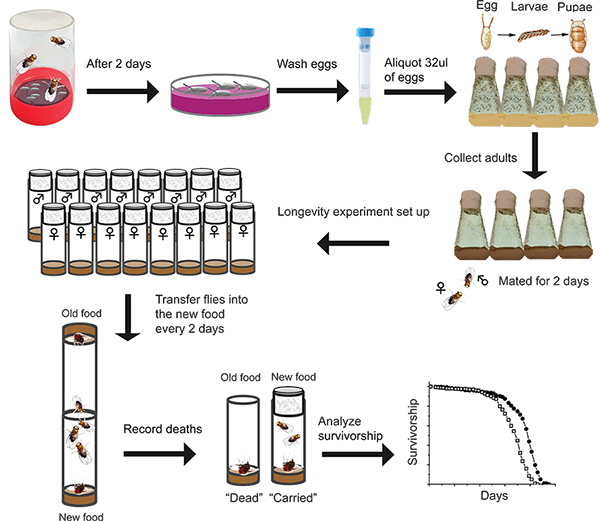
Figure 1. Simplified schematic of a Drosophila lifespan assay.
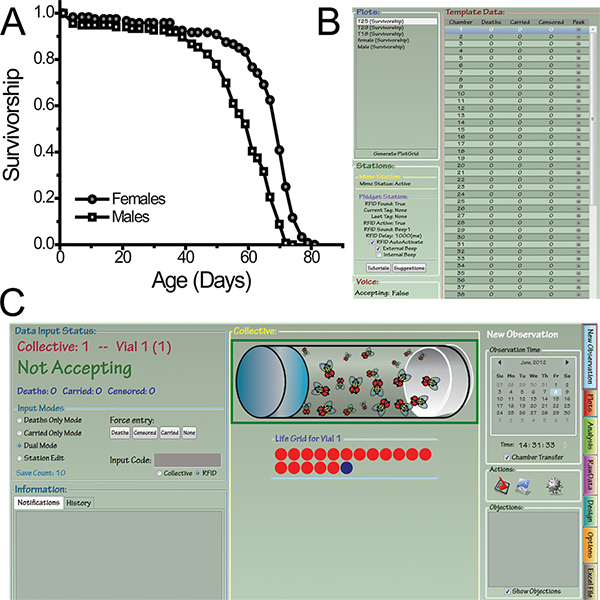
Figure 2. (A) Representative lifespan curves of w1118 control female (circles) and male (squares) adult flies at 25 °C on a SY10% food. (B,C) Representative screen shots of the dLife software.
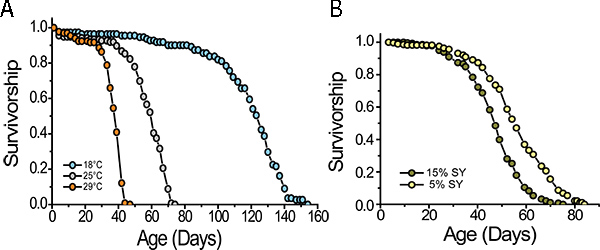
Figure 3. Effects of temperature (A) and diet (B) on adult lifespan. A. Adult control (Canton S) male flies were maintained through adulthood at 18 °C, 25 °C, or 29 °C. B. Adult control (w1118) female flies were exposed to either a 15% SY or 5% SY diet.
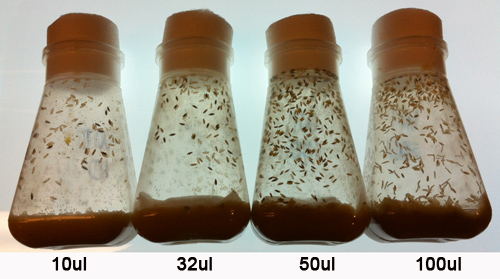
Figure 4. Day 9 of development (at 25 °C) of synchronized eggs, aliquoted in CT food bottles. Volume of the embryo-containing aliquot is as shown beneath each bottle.

Figure 5. Representative plot from the dLife software showing survivorship by vial. The arrow indicates a single anomalous vial within a group.
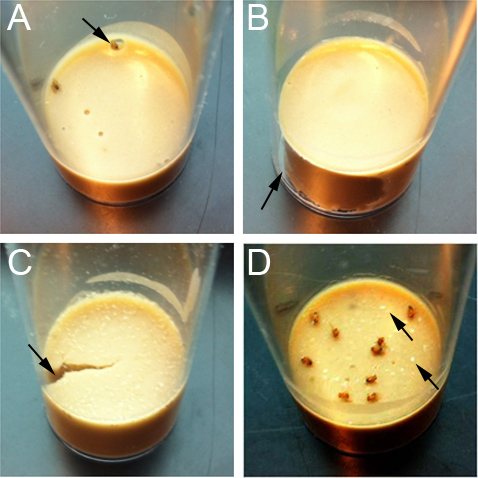
Figure 6. Examples of suboptimal food quality. A. Bubbles on the food surface. B. Food shrunk away from the edge of the vial. C. Cracks in the food. D. Bacteria accumulation on the surface of the food.
Discussion
The protocol presented here describes a method for producing reproducible measurements of adult longevity in Drosophila that is adaptable for assessment of genetic, pharmacological, and environmental interventions. Crucial aspects of the protocol include carefully controlling the larval development environment, minimizing adult stress, and minimizing bias across experimental groups and controls. We also present the use of the dLife lifespan experiment management software. By simply attaching a bar code or RFID tag to each vial, the dLife program will assist in data acquisition for each measurement and in plotting the survivorship curve. While it is currently most suitable for studies of fly lifespan using vials, this experiment management tool could be easily adapted for use in other organisms, with different types of population chambers, or for additional measures of survival, including stress resistance and drug toxicity.
Prior to commencing any longevity assessment, one must first carefully control the production of parental stocks. Genetic variability is an important factor, as is the health of parental strains. These factors have led to considerable public controversy associated with early studies that reported putative longevity regulators13. The researcher has several options to minimize effects attributable to variability in genetic background. For genetic manipulations, all genetically altered strains should be background-controlled through either backcrossing to a control strain (at least 6 times) or using inducible systems (e.g., temperature sensitive alleles or drug-inducible transgene expression). The GeneSwitch and Tet-on systems14,15 are popular and allow direct comparison of flies with the same genetic background in which the transgene is either induced or not induced. For all inducible systems, appropriate contemporaneous controls are required to avoid confounds associated with the inducer. Failure to control for genetic background nearly always results in hybrid vigor, which can extend lifespan in the F1 generation of a cross between two different strains for reasons unrelated to the intended manipulation 13. This factor is of particular concern when using the GAL4-UAS system. For environmental interventions (e.g., drug treatment, diet, temperature, etc.), it is advisable to study the effects of the intervention on more than one strain. Finally, both parental age16 and stress17 can influence the longevity of the F1 generation, and for this reason, healthy young adults should be chosen for egg production.
Important aspects of controlling the larval/pupal environment include the prevention of overcrowding and the maintenance of a controlled environment with strict regulation of light-dark periods, humidity, and temperature. These factors will affect both the timing of development and the physical quality of the resulting adults. Adverse larval environments, such as high larval density, may lead to activation of stress-inducible factors (e.g., heat shock protein expression) that are known to influence adult longevity18.
During the adult phase, careful attention to the environment remains essential. The choice of diet alone can greatly influence lifespan and can interact with genetic factors to produce diet-specific effects on longevity. Furthermore, some common food base alternatives (yeast extract instead of lyophilized whole brewer's yeast) can dramatically shorten lifespan19, leaving open the possibility that the food itself is causing organismal stress that may impair the assessment of longevity. In this article, we have highlighted potential sources of stress in the dietary environment including physical anomalies in the food (e.g., bubbles, foam, cracks, bacteria, etc.) that can physically entrap the animals. Regular replacement of old food with fresh food (at least three times each week) can overcome many of these difficulties. Furthermore, temperature20, humidity (personal observations), lighting21, and the presence of conspecifics (social environment)22 can all modulate lifespan, and attention to controlling these factors within the experiment is important to avoid bias in the results. While the number of flies within a vial decreases with time, we have found that the use of anesthesia to adjust the number of flies can increase mortality in an age-dependent manner (Pletcher, personal observations), and we do not recommended this procedure. The precise position of the vials in an incubator is also a factor, even in a seemingly controlled environment. Randomized physical distribution of experimental groups with controls can mitigate bias associated with vial placement and is required for proper statistical inference. Even with carefully controlled conditions, slight differences can be observed between experiments and the use of within-experiment controls is essential.
Alternative feeding approaches have been proposed for lifespan analysis including a capillary feeder approach (CAFE method)23. This method excels in the ability to provide precise measurements of food consumption, but it results in markedly short-lived flies24. Potential stresses associated with the feeding environment must be considered when assessing the combined relationship between diet and genetic factors in overall longevity.
Demographic analysis, including the calculation of survivorship and mortality curves can reveal much information about the dynamics of the aging population. A typical survivorship curve will remain relatively flat for a long period early in life and increase its rate of decline at older ages, which corresponds to a period of low mortality followed by a period of an exponential increase in mortality. A stressful environment will usually manifest as an excess of early deaths in the population and an anomalous dip in the survivorship curve. While such a result may indicate significant differences between treatments, it will not normally be robust to replication. We therefore recommend at least two independent (i.e., non-contemporaneous) replicate experiments be executed before any firm conclusion are drawn. It may be that additional effort toward increasing the sample size, controlling the husbandry conditions, and improving the health of parental stocks is required.
Right-censoring (removing animals from the experiment that escape or are presumed dead from accidental causes) of animals that die from stressful environmental conditions should be applied with extreme caution. Strictly speaking, censoring must occur randomly across experimental treatments, and if the experimental intervention modulates stress sensitivity, one could inadvertently apply treatment-level selection to the population. As a general rule, avoiding the presence of factors that could produce ambiguous early death (primarily associated with the food source) is better than censoring, and censoring should only be applied to organisms that were observed to die or escape during physical handling.
A final consideration is the assessment of statistical significance. While large cohort sample sizes provide impressive power to distinguish small differences between treatments, the potential biological significance of such a difference must also be considered. With reasonably sized longevity experiments, differences as low as 1-2% are often highly statistically significant, but the overall impact of the intervention on health status may be minor. Therefore, both statistical and biological significance must be considered when interpreting the overall results of the experiment. Inference about the aging process from survival experiments can be augmented by measures of age-related declines in behavioral or physiological health measures, including climbing ability25 and gastrointestinal wall integrity7.
In summary, the Drosophila model organism an appealing choice for studying mechanisms of aging. With careful experimental technique, robust demographic analysis can provide insight into the impact of pharmacological and genetic factors on the aging process.
Disclosures
No conflicts of interest declared.
Acknowledgements
This work was supported by funding from the Ellison Medical Foundation (SDP, http://www.ellisonfoundation.org/index.jsp), NIH K01AG031917 (NJL, http://www.nih.gov/), NIH 5T32GM007315-35 (JR) and NIH R01AG030593 (SDP). This work utilized the resources of the Drosophila Aging Core (DAC) of the Nathan Shock Center of Excellence in the Biology of Aging funded by the National Institute of Aging P30-AG-013283 (http://www.nih.gov/). The authors would like to thank the Pletcher Laboratory for helpful discussions and particularly Brian Chung for critical reading of the manuscript. We would like to acknowledge Nick Asher and Kathryn Borowicz for assistance with data collection.
Materials
| Name | Company | Catalog Number | Comments |
|---|---|---|---|
| Active Dry Yeast | Fleishmann’s Yeast | 2192 | |
| Grape Agar Powder Premix | Genesee Scientific | 47-102 | |
| Large Embryo Collection Cages | Genesee Scientific | 59-101 | |
| Large Replacement End Caps | Genesee Scientific | 59-103 | |
| 6 oz Square Bottom Bottles, polypropylene | Genesee Scientific | 32-130 | |
| Flugs Closures for Stock Bottles | Genesee Scientific | 49-100 | |
| Drosophila Vials, Wide, Polystrene | Genesee Scientific | 32-117 | |
| Flugs Closures for Wide Vials | Genesee Scientific | 49-101 | |
| Wide Orifice Aardvark Pipet Tips, 200 ul | Denville Scientific | P1105-CP | |
| Flystuff Flypad, Standard Size | Genesee Scientific | 59-114 | |
| BD Falcon 15 ml Conical Centrifuge Tubes | Fisher Scientific | 14-959-70C | |
| Fisherbrand Petri Dishes with Clear Lids, Raised Ridge; 100 O.D. x 15 mm H; | Fisher Scientific | 08-757-12 | |
| Kimax* Colorware Flasks 1,000 ml yellow | Fisher Scientific | 10-200-47 | |
| PBS pH 7.4 10x | Invitrogen | 70011044 | |
| Gelidium Agar | Mooragar | n/a | |
| Brewer's Yeast | MP Biomedicals | 0290331280 | |
| Granulated Sugar | Kroger | n/a | |
| Tegosept | Genesee Scientific | 20-266 | Fly Food Preservative |
| Propionic Acid, 99% | Acros Organics | 149300025 | Fly Food Preservative |
| Kanamycin Sulfate | ISC BioExpress | 0408-10G | |
| Tetracycline HCl | VWR | 80058-724 |
References
- Toivonen, J. M., et al. No influence of Indy on lifespan in Drosophila after correction for genetic and cytoplasmic background effects. PLoS Genet. 3, e95(2007).
- Spencer, C. C., Howell, C. E., Wright, A. R., Promislow, D. E. Testing an 'aging gene' in long-lived drosophila strains: increased longevity depends on sex and genetic background. Aging Cell. 2, 123-130 (2003).
- Burnett, C., et al. Absence of effects of Sir2 overexpression on lifespan in C. elegans and Drosophila. Nature. 477, 482-485 (2011).
- Bokov, A. F., et al. Does reduced IGF-1R signaling in Igf1r+/- mice alter aging? PLoS One. 6, e26891(2011).
- Lewis, E. B. A new standard food medium. Drosophila Information Service. 34, 117-118 (1960).
- Skorupa, D. A., Dervisefendic, A., Zwiener, J., Pletcher, S. D. Dietary composition specifies consumption, obesity, and lifespan in Drosophila melanogaster. Aging Cell. 7, 478-490 (2008).
- Rera, M., et al. Modulation of longevity and tissue homeostasis by the Drosophila PGC-1 homolog. Cell Metab. 14, 623-634 (2011).
- Kaplan, E. L., Meier, P. Nonparametric Estimation from Incomplete Observations. Journal of the American Statistical Association. 53, 457-481 (1958).
- Pletcher, S. D. Mitigating the Tithonus Error: Genetic Analysis of Mortality Phenotypes. Sci. Aging Knowl. Environ. 2002, pe14(2002).
- Pletcher, S. D., Khazaeli, A. A., Curtsinger, J. W. Why do life spans differ? Partitioning mean longevity differences in terms of age-specific mortality parameters. J. Gerontol. A Biol. Sci. Med. Sci. 55, 381-389 (2000).
- Promislow,, Tatar,, Pletcher,, Carey, Below-threshold mortality: implications for studies in evolution, ecology and demography. Journal of Evolutionary Biology. 12, 314-328 (1999).
- Pletcher, Model fitting and hypothesis testing for age-specific mortality data. Journal of Evolutionary Biology. 12, 430-439 (1999).
- Partridge, L., Gems, D. Benchmarks for ageing studies. Nature. 450, 165-167 (2007).
- Roman, G., Endo, K., Zong, L., Davis, R. L. P[Switch], a system for spatial and temporal control of gene expression in Drosophila melanogaster. Proceedings of the National Academy of Sciences of the United States of America. 98, 12602-12607 (2001).
- Ford, D., et al. Alteration of Drosophila life span using conditional, tissue-specific expression of transgenes triggered by doxycyline or RU486/Mifepristone. Exp. Gerontol. 42, 483-497 (2007).
- Priest, N. K., Mackowiak, B., Promislow, D. E. The role of parental age effects on the evolution of aging. Evolution. 56, 927-935 (2002).
- Smith, E. M., et al. Feeding Drosophila a biotin-deficient diet for multiple generations increases stress resistance and lifespan and alters gene expression and histone biotinylation patterns. J. Nutr. 137, 2006-2012 (2007).
- Sorensen, J. G., Loeschcke, V. Larval crowding in Drosophila melanogaster induces Hsp70 expression, and leads to increased adult longevity and adult thermal stress resistance. J. Insect Physiol. 47, 1301-1307 (2001).
- Bass, T. M., et al. Optimization of dietary restriction protocols in Drosophila. J. Gerontol. A Biol. Sci. Med. Sci. 62, 1071-1081 (2007).
- Miquel, J., Lundgren, P. R., Bensch, K. G., Atlan, H. Effects of temperature on the life span, vitality and fine structure of Drosophila melanogaster. Mechanisms of Ageing and Development. 5, 347-370 (1976).
- Pittendrigh, C. S., Minis, D. H. Circadian systems: longevity as a function of circadian resonance in Drosophila melanogaster. Proceedings of the National Academy of Sciences of the United States of America. 69, 1537-1539 (1972).
- Joshi, A., Mueller, L. D. Adult crowding effects on longevity in Drosophila melanogaster: Increase in age-dependent mortality. Current Science. 72, 255-260 (1997).
- Ja, W. W., et al. Prandiology of Drosophila and the CAFE assay. Proceedings of the National Academy of Sciences of the United States of America. 104, 8253-8256 (2007).
- Lee, K. P., et al. Lifespan and reproduction in Drosophila: New insights from nutritional geometry. Proceedings of the National Academy of Sciences of the United States of America. 105, 2498-2503 (2008).
- Gargano, J. W., Martin, I., Bhandari, P., Grotewiel, M. S. Rapid iterative negative geotaxis (RING): a new method for assessing age-related locomotor decline in Drosophila. Experimental gerontology. 40, 386-395 (2005).
Reprints and Permissions
