This protocol describes the method of gene trap insertional mutagenesis using Gal4-VP16 as the primary reporter and GFP/RFP as secondary reporters in zebrafish. Approximately one in ten high-expressing F0 fish yield gene trap progeny co-expressing GFP and RFP. The screening procedure can be readily scaled to adapt to the size of the laboratory performing the insertional mutagenesis screen.
Method Article
Gene Trapping Using Gal4 in Zebrafish
In This Article
Summary
Abstract
Large clutch size and external development of optically transparent embryos make zebrafish an exceptional vertebrate model system for in vivo insertional mutagenesis using fluorescent reporters to tag expression of mutated genes. Several laboratories have constructed and tested enhancer- and gene-trap vectors in zebrafish, using fluorescent proteins, Gal4- and lexA- based transcriptional activators as reporters 1-7. These vectors had two potential drawbacks: suboptimal stringency (e.g. lack of ability to differentiate between enhancer- and gene-trap events) and low mutagenicity (e.g. integrations into genes rarely produced null alleles). Gene Breaking Transposon (GBTs) were developed to address these drawbacks 8-10. We have modified one of the first GBT vectors, GBT-R15, for use with Gal4-VP16 as the primary gene trap reporter and added UAS:eGFP as the secondary reporter for direct detection of gene trap events. Application of Gal4-VP16 as the primary gene trap reporter provides two main advantages. First, it increases sensitivity for genes expressed at low expression levels. Second, it enables researchers to use gene trap lines as Gal4 drivers to direct expression of other transgenes in very specific tissues. This is especially pertinent for genes with non-essential or redundant functions, where gene trap integration may not result in overt phenotypes. The disadvantage of using Gal4-VP16 as the primary gene trap reporter is that genes coding for proteins with N-terminal signal sequences are not amenable to trapping, as the resulting Gal4-VP16 fusion proteins are unlikely to be able to enter the nucleus and activate transcription. Importantly, the use of Gal4-VP16 does not pre-select for nuclear proteins: we recovered gene trap mutations in genes encoding proteins which function in the nucleus, the cytoplasm and the plasma membrane.
Introduction
Insertional mutagenesis has proven to be a powerful approach to dissecting gene function in various model systems from unicellular organisms like bacteria and yeast to multicellular organisms such as mice and plants. Any exogenous DNA (virus, transposon or plasmid) may serve as a mutagen by interrupting essential elements of genes such as exons or promoters. The effective target of such simple approaches is exceedingly small in large complex genomes, since exons comprise only 1-3% of a typical vertebrate genome. Small effective target size can be overcome by very high vector integration rates, as exemplified by the tremendous success of retroviral insertional mutagenesis in zebrafish 11,12. In contrast, introns comprise about 20-30% of vertebrate genomes. In zebrafish, transposon-based insertional mutagenesis vectors which effectively introduce null- or severe hypomorphic mutations upon integration into introns have been named "gene breaking transposons" (GBTs) 8-10. For efficient gene trap integration, they use a minimal Tol2 transposon 13,14. Mutagenicity of GBTs relies on fish-derived splice acceptor and transcriptional termination/polyadenylation sequences. The elements responsible for GBT mutagenicity are flanked by direct loxP sites for excision by Cre recombinase. Thus, injection of Cre mRNA leads to efficient reversion of GBT-induced mutations, even though some transposon sequences remain at the integration locus 9,10.
The recently published GBT vectors use mRFP as the gene trap reporter 9,10, leading to two potential shortcomings. First, it is not known what fraction of zebrafish genes are expressed at a high enough level to be detected by direct fluorescent reporter fusion proteins. Second, only a small subset of genes are expected to have essential functions. It has been estimated that there are only 1,400-2,400 genes required for zebrafish development 15,16. Most gene trap mutants are not expected to display overt phenotypes and therefore will have limited utility. To overcome these two limitations, we have modified GBT-R15 9,10 to use with Gal4-VP16 as the primary gene trap reporter (Balciuniene et al. in preparation). As with AUG-less mRFP in GBT-R15, the translation start site was removed from Gal4-VP16. For direct detection of gene trap events, our vectors contain an eGFP reporter under the control of 14x Gal4 UAS 17,18.
Several additional features are engineered into our bipartite gene trap vector. The UAS:eGFP cassette is flanked by direct FRT sites (grey chevrons in Figure 1). Injection of Flp recombinase mRNA leads to excision of the UAS:eGFP cassette, leaving the gene trap mutation unmarked by eGFP fluorescence. It can then be used in transgenic lines which mark specific tissues or developmental events by GFP fluorescence. As in other GBTs, the whole gene trap cassette is flanked by direct loxP sites (open pentagons in Figure 1). This makes gene trap events reversible by expression of Cre recombinase, readily establishing proof of causality relationship between a specific gene trap integration and observed phenotype (Figure 2). Finally, the gene trap cassette is flanked by inverted I-SceI meganuclease sites (black triangles in Figure 1). In Drosophila, transposon integrations are often converted to deletions (deficiencies) by imprecise excision of the P element. There is no evidence that excision of Tol2 transposon (or any other transposon active in vertebrates such as Sleeping Beauty, PiggyBac or Ac/Ds) can lead to deletions. We therefore included I-SceI sites as a potential surrogate method for induction of deletions, even though there is no evidence that I-SceI can induce deletions in zebrafish. It should be noted that while I-SceI meganuclease can be used to facilitate transgenesis in zebrafish, DNA cleavage by I-SceI meganuclease is used to study DNA repair mechanisms, including error-prone non-homologous end joining, in yeast and mammalian cells 19-22.
Integration of our gene trap vector can lead to eGFP expression by two different mechanisms. The first is a true gene trap event (Figure 1C): the vector integrates into a gene (IMG for Insertionally Mutated Gene), a fusion transcript between the 5' of the endogenous IMG transcript and the Gal4-VP16 is made and translated into a fusion protein containing the N-terminus of the protein encoded by IMG and Gal4-VP16. This fusion protein binds to the 14x UAS and activates transcription of eGFP. The second, less desirable event is an enhancer trap (Figure 1D): the minimal promoter in front of eGFP falls under the control of an enhancer near the integration site, leading to production of eGFP in the absence of Gal4-VP16 production. In our estimate, 30-50% of eGFP expression events are due to an enhancer trap and 50-70% are due to a gene trap 23(Balciuniene et al. in preparation). To distinguish between these two classes of events, we have made a 14xUAS:mRFP transgenic line (Figure 1B), for convenience marked by lens-specific γCry:GFP (Balciuniene et al. in preparation). Gene trap events are verified by co-expression of GFP and RFP (compare C and D in Figure 2).
In our pilot screen, we recovered over 40 gene trap events after screening 270 F0 fish injected with a mixture of transposon DNA and transposase mRNA. Two of our gene trap integrations have occurred into genes with previously published chemically-induced mutants: nsf and flr. The phenotypes of our insertional mutants nsftpl6 and flrtpl24 are superficially indistinguishable from the phenotypes of the corresponding chemically-induced mutants. We also noted that gene trap events appear biased toward the introns near the 5' end of genes, thus increasing the probability of null alleles. We do observe some degree of UAS silencing (variegation) in all of our gene trap lines, and some loci are clearly more susceptible to variegation than others. We do not believe that UAS silencing is a significant problem for propagation of gene trap lines, as we have been able to easily propagate all of our gene trap lines through at least five generations by selecting for GFP expression alone.
Protocol
1. Production of the F0 Generation by Microinjection of the Gene Trap.
We have found that embryos of different genetic backgrounds display different tolerances to this procedure, with pet-store-based wild type and Tuebingen - Long Fin (TLF) being the most tolerant while AB and Tuebingen strains have poorer survival.
- Preparation of transposon DNA. Prepare GBT-B1 (pDB783, Balciuniene et al. in preparation) plasmid DNA using standard QIAprep miniprep kit (Qiagen 27106). It is essential to include the PB wash step (which is optional in QIAprep procedure), otherwise the miniprep DNA will be contaminated by RNase A, leading to degradation of the transposase mRNA. Before injection, dilute the DNA in RNase-free water (Ambion AM9937) to 10 ng/μl.
- Preparation of transposase mRNA. Linearize pT3TS/Tol2 (pDB600) 13 using XbaI and transcribe the linearized DNA using a mMessage Machine T3 (Ambion AM1348) in vitro transcription kit. We have modified the in vitro transcription reaction by adding 0.5 μl of RiboLock RNase inhibitor (ThermoFisher Fermentas EO0381). After the DNase treatment step, purify mRNA using an RNeasy MinElute kit (Qiagen 74204). Assess the quality of the in vitro transcribed mRNA by agarose gel electrophoresis. Dilute the mRNA in RNase-free water to 40 ng/μl, and store as 2 μl aliquots at -80 °C.
- Preparation of the microinjection mix. Before injection, add 8 μl of diluted transposon DNA to a 2 μl aliquot of transposase mRNA.
- Microinjection. Inject 3 nl of DNA/RNA mixture into the yolk of 1 cell zebrafish embryos using standard microinjection techniques, aiming for the yolk/blastomere interface. Collect embryos every 20 min to ensure injection at 1 cell stage. In our experience, a skillful person can easily inject 1,000 embryos in 1-1.5 hr.
- After injection, run 5 μl of leftover injection solution on a 1% agarose gel for quality control, to ensure that the transposase mRNA has not been degraded.
- Injected embryo care. In late afternoon, remove unfertilized and abnormal embryos and distribute embryos to 60-80 per 100 mm Petri dish. Abnormal and dead embryos are removed at 1 day post fertilization (dpf), 2 dpf and 3 dpf.
- Screening for GFP expression. Screen embryos without overt defects for GFP fluorescence at 3 dpf (Figure 3). Screening can be done either on a stereomicroscope equipped with fluorescence (we use Nikon a SMZ1500) or on an upright microscope (we use a Zeiss AxioImager with a 5X Fluar objective). Low GFP expression indicates either unsuccessful injection or degradation of transposase RNA due to RNase contamination (Figure 3A). Select about 30% of the brightest embryos which either have GFP expression in multiple tissues or in a high percentage of cells of a specific tissue (compare Figures 3B and 3C). From an injection of 1,000 embryos, we usually have up to 100 developmentally-normal, high-GFP-expressing embryos.
- Raise selected F0 embryos using standard zebrafish rearing procedures. It is reasonable to expect that 20-30% of the injected embryos selected for rearing will survive to adulthood.
2. Maintenance of the UAS:mRFP Tester Line.
We have generated a 14xUAS:mRFP line marked by lens-specific γCry:GFP. Since UAS is subject to silencing through DNA methylation, it is important to select fish with low levels of silencing to propagate the stock.
- Set up individual UAS:mRFP homozygotes for mating with one of our most reliable Gal4 gene trap lines, nsftpl6 (Balciuniene et al. in preparation).
- On the next day, transfer the UAS:mRFP fish which gave embryos to individual static tanks, while the embryos are collected and cleaned.
- Screen embryos for GFP and RFP fluorescence at 1 dpf and 3 dpf.
- Intercross fish which gave embryos with high mRFP expression to establish the next generation of UAS:mRFP line.
3. Screening of the F0 Fish.
- Cross individual F0 with the homozygous UAS:mRFP fish (Figure 4). We usually inject our GBTs into lines with wild-type or leopard pigmentation patterns, and our homozygous UAS:mRFP line is in brass background. Therefore GBT-injected F0 fish can be readily distinguished from the UAS:mRFP fish, eliminating the need to record whether the F0 being screened was a male or a female as well as potential errors resulting from mistakes in recording and/or determining the sex of each fish. Personnel with very limited experience, such us undergraduate students, are therefore able to set up and break down fish matings. This approach has a disadvantage that two different genetic backgrounds are being used, potentially complicating interpretation of loss of function phenotypes.
- On the next day, return the brass UAS:mRFP fish to their tank. Place the F0 fish which gave embryos into individual static tanks (we use Hagen Exo Terra Faunarium Small, but any small tank can be used for this purpose) while embryos are collected and screened.
- Clean and transfer collected embryos into new Petri dishes (<100 per dish) in the afternoon of day 0.
- Screen embryos for GFP and RFP fluorescence at 1 dpf, 2 dpf and 3 dpf. Pull embryos positive for both GFP and RFP out, sort them by GFP/RFP expression pattern (if more than one pattern is observed in a clutch) and raise them to establish F1 generation.
- Euthanize the F0 fish which produced only negative embryos (out of a total number of 50-100 embryos).
- Cross the F0 fish which produced GFP/RFP-positive progeny again to get a second batch of positives.
4. Screening of the F1 Fish.
The F1 fish are screened to establish F2 families, to document gene trap expression pattern and to freeze batches of embryos for molecular identification of gene trap loci by 5' RACE and inverse PCR.
- Cross individual F1 fish with the homozygous UAS:mRFP fish (Figure 4).
- Next day, place the F1 fish that gave embryos into individual static tanks while the embryos are collected and screened.
- Screen embryos for GFP and RFP fluorescence at 1 dpf, 2 dpf and 3 dpf. Separate and photograph embryos positive for both GFP and RFP 24.
- At 5 dpf, freeze batches of 20 GFP/RFP-positive and 20 GFP/RFP-negative embryos for identification of insertionally mutated genes by inverse PCR and 5' RACE 9,10. Raise remaining GFP/RFP-positive embryos to establish F2 generation.
Results
In a successful injection, at least 80% of the embryos injected with the gene trap DNA/ Tol2 transposase mRNA mix display some degree of GFP fluorescence (Figure 3). When the brightest GFP-positive embryos (Figure 3C) are selected to establish the F0 pool, about one in 10 screened F0 fish will yield gene trap progeny. Among the F0 fish from which gene trap events are recovered, most transmit a single gene trap event in addition to several non-expressing transposon integrations. However, we have established up to four gene trap lines from a single F0 individual. GFP/RFP expression patterns in gene trap lines range from extremely tissue specific (for example in olfactory bulbs) to fairly ubiquitous.
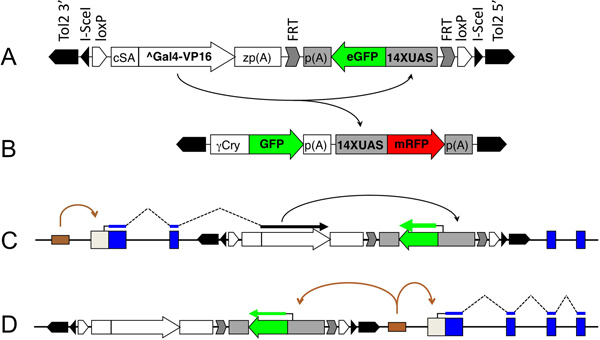
Figure 1. The Gal4-containing bipartite gene trap vector GBT-B1 and its applications. A. Components of the Gal4-containing gene trap vector: Tol2 5' and Tol2 3', minimal Tol2 transposon ends 13; cSA, Carp β-Actin splice acceptor 8; ^Gal4-VP16, AUG-less Gal4-VP16; zp(A), zebrafish β-Actin 3' UTR and poly(A) elements from GBT-R15 9,10. 14XUAS, eGFP and SV40 p(A) are components of UAS:eGFP expression cassette 17,18. The arrow indicates activation of UAS:eGFP by Gal4-VP16 produced by the gene trap. B. The 14XUAS:mRFP transgene marked by a lens-specific γCry:GFP cassette. The arrow indicates activation of UAS:mRFP by Gal4-VP16 in trans. C. Gene trap event. Blue boxes are exons. Splicing is indicated by dashed line. D. Enhancer trap event. Integration of the vector near an enhancer (brown box) may place the minimal eGFP promoter under the control of this enhancer (brown arrow). This would result in a tissue-specific expression of eGFP, but since Gal4-VP16 is not made, mRFP expression would not be activated.
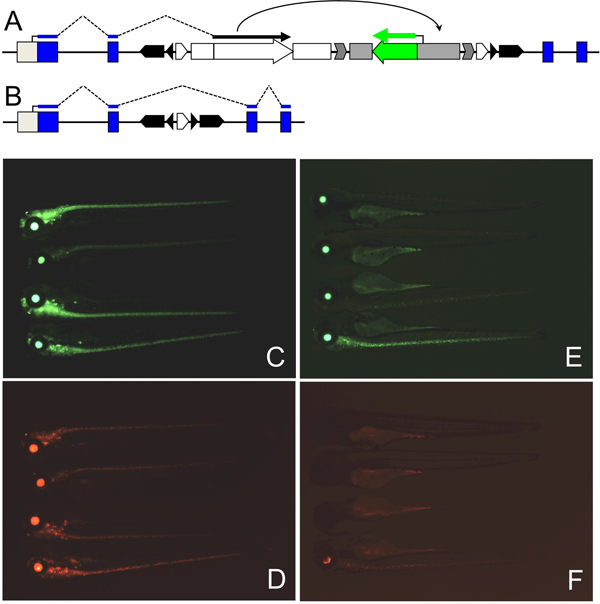
Figure 2. Reversion of gene trap events using Cre recombinase. A, B. Diagram of a gene trap mutation (A) and Cre-reverted gene trap allele (B). C, D. Co-expression of GFP (C) and RFP (D) in the nervous system of the nsftpl6 gene trap line. E, F. Injection of Cre RNA into nsftpl6 embryos leads to loss of GFP (E) and RFP (F) expression. Note that there is no reduction of GFP expression in the lens, as expected.
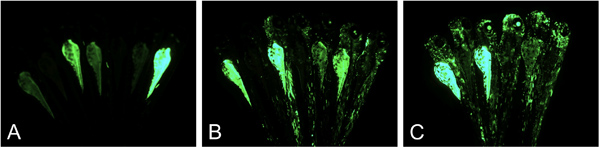
Figure 3. Embryos injected with the GBT-B1 (pDB783) gene trap. A. Embryos injected with pGBT-B1 (pDB783) alone display little GFP fluorescence in the body. B, C. Embryos injected with pGBT-B1 and Tol2 transposase mRNA: a random group of embryos (B) and high-expressors selected for rearing (C).

Figure 4. Experimental outline for establishment of Gal4 gene trap lines. Partly overlapping red/green structures indicate co-expression of GFP and RFP, while green alone indicates mosaicism for gene trap or enhancer trap events.
Discussion
The gene trap vectors and methodology described here are already being used in several independent laboratories. In our experience, there are two critical steps in the process. The first critical step is to achieve high rates of gene trap integration in injected F0 embryos. Failure at this step can often be attributed to RNase contamination of the injection reagents, especially the miniprep DNA. It is also very important to inject embryos at the 1 cell stage for gene trap experiments. In our experience, Tol2-mediated transgenesis is very efficient, making it possible to obtain transgenic lines even when injecting later than the 1 cell stage or with lower quality DNA. Substandard injections are much more problematic when carrying out gene trap mutagenesis, since only a small fraction of vector integrations result in effective gene trap events. The second critical step is to ascertain gene trap events by crossing to our UAS:mRFP line. Absence of mRFP expression is almost always indicative of an enhancer trap event. However, sometimes the lack of mRFP expression may indicate silencing of the 14x UAS. It is therefore important to maintain the UAS:mRFP line in a non-silenced state by propagating the next generation using individuals with high RFP expression when crossed to nsftpl6.
We can foresee making several improvements to our gene trap vectors and protocol. The first is to use a less repetitive UAS in the gene trap construct. It has been shown that a 5x UAS is sufficient to achieve full activation in cell culture experiments, and that less repetitive UAS sequences are less susceptible to methylation and silencing 6,25. It may also be possible to design gene trap vectors for fully conditional mutagenesis, in analogy to the vectors used by the international mouse gene trap consortium and recently adapted for zebrafish 2,26,27. Another improvement would be to use a different transposon system, for example Sleeping Beauty 28, to generate a UAS:mRFP reporter line. This would enable injection of Tol2-based gene traps directly into the reporter line and screening of F0s by incrossing. Furthermore, this would eliminate the use of two different genetic backgrounds, making the interpretation of loss of function phenotypes more straightforward. Even with these improvements, the general Gal4 gene trap protocol presented here would still be fully applicable.
Disclosures
These authors have nothing to disclose.
Acknowledgements
We thank Dr. Jennifer Emtage for critical reading of the manuscript, Ryan Gill for technical assistance and help with zebrafish care and Dr. Stephen C. Ekker (Mayo Clinic, Rochster, Minnesota) for reagents. Our work has been supported by Temple University College of Science and Technology and the National Institutes of Health (R01-HD061749).
Materials
| Name | Company | Catalog Number | Comments |
|---|---|---|---|
| Miniprep Kit | Qiagen | 27104 | Optional PB wash step is a must |
| XbaI restriction enzyme | ThermoFisher | ER0681 | |
| mMessage Machine T3 | Ambion | AM1348 | |
| RiboLock RNase Inhibitor | ThermoFisher | EO0381 | |
| RNeasy MinElute | Qiagen | 74204 | Can be replaced by phenol extraction and precipitation. Do not use LiCl! |
| Nuclease-free water | Ambion | AM9937 | Has to be non-DEPC treated |
| Borosilicate glass capiliaries for microinjection needles | World Precision Instruments | 1B100F-4 | |
| Microcapiliaries for calibration | Drummond Scientific | 1-000-0010 | |
| Microloader tips | Eppendorf | 5242 956.003 | |
| Needle puller * | Sutter Instruments | P-87 | |
| Stereomicroscope for microinjection * | Nikon | SMZ1500 | We also use Wild 5M and Olympus SZ61 with transmitted light stand |
| Picoinjector * | Harvard Instruments | Pli-90 | We also use Pli-100 |
| Screening microscope with GFP/RFP fluorescence * | Zeiss | Zeiss AxioImager | 5X Fluar objective has sufficient working distance |
| Screening microscope with GFP/RFP fluorescence * | Nikon | SMZ1500 | |
| * We suggest this equipment only because we successfully use it in our laboratory. In each category, several comparable options from multiple manufacturers are available. |
References
- Balciunas, D., et al. Enhancer trapping in zebrafish using the Sleeping Beauty transposon. BMC Genomics. 5 (1), 62(2004).
- Trinh le, A., et al. A versatile gene trap to visualize and interrogate the function of the vertebrate proteome. Genes Dev. 25 (21), 2306-2320 (2011).
- Kawakami, K., et al. A transposon-mediated gene trap approach identifies developmentally regulated genes in zebrafish. Dev Cell. 7 (1), 133-144 (2004).
- Emelyanov, A., Parinov, S. Mifepristone-inducible LexPR system to drive and control gene expression in transgenic zebrafish. Dev Biol. 320 (1), 113-121 (2008).
- Ellingsen, S., et al. Large-scale enhancer detection in the zebrafish genome. Development. 132 (17), 3799-3811 (2005).
- Distel, M., Wullimann, M. F., Koster, R. W. Optimized Gal4 genetics for permanent gene expression mapping in zebrafish. Proc Natl Acad Sci U S A. 106 (32), 13365-13370 (2009).
- Davison, J. M., et al. Transactivation from Gal4-VP16 transgenic insertions for tissue-specific cell labeling and ablation in zebrafish. Dev Biol. 304 (2), 811-824 (2007).
- Sivasubbu, S., et al. Gene-breaking transposon mutagenesis reveals an essential role for histone H2afza in zebrafish larval development. Mech Dev. 123 (7), 513-529 (2006).
- Clark, K. J., et al. In vivo protein trapping produces a functional expression codex of the vertebrate proteome. Nat Methods. 8 (6), 506-512 (2011).
- Petzold, A. M., et al. Nicotine response genetics in the zebrafish. Proc Natl Acad Sci U S A. 106 (44), 18662-18667 (2009).
- Gaiano, N., et al. Insertional mutagenesis and rapid cloning of essential genes in zebrafish. Nature. 383 (6603), 829-832 (1996).
- Amsterdam, A., Hopkins, N. Mutagenesis strategies in zebrafish for identifying genes involved in development and disease. Trends Genet. 22 (9), 473-478 (2006).
- Balciunas, D., et al. Harnessing a high cargo-capacity transposon for genetic applications in vertebrates. PLoS Genet. 2 (11), e169(2006).
- Urasaki, A., Morvan, G., Kawakami, K. Functional dissection of the Tol2 transposable element identified the minimal cis-sequence and a highly repetitive sequence in the subterminal region essential for transposition. Genetics. 174 (2), 639-649 (2006).
- Haffter, P., et al. The identification of genes with unique and essential functions in the development of the zebrafish, Danio rerio. Development. 123, 1-36 (1996).
- Amsterdam, A., et al. Identification of 315 genes essential for early zebrafish development. Proc Natl Acad Sci U S A. 101 (35), 12792-12797 (2004).
- Scheer, N., Campos-Ortega, J. A. Use of the Gal4-UAS technique for targeted gene expression in the zebrafish. Mech Dev. 80 (2), 153-158 (1999).
- Koster, R. W., Fraser, S. E. Tracing transgene expression in living zebrafish embryos. Dev Biol. 233 (2), 329-346 (2001).
- Rouet, P., Smih, F., Jasin, M. Introduction of double-strand breaks into the genome of mouse cells by expression of a rare-cutting endonuclease. Mol Cell Biol. 14 (12), 8096-8106 (1994).
- Thermes, V., et al. I-SceI meganuclease mediates highly efficient transgenesis in fish. Mech Dev. 118 (1-2), 91-98 (2002).
- Lisby, M., Mortensen, U. H., Rothstein, R. Colocalization of multiple DNA double-strand breaks at a single Rad52 repair centre. Nat Cell Biol. 5 (6), 572-577 (2003).
- Bennardo, N., Cheng, A., Huang, N., Stark, J. M. Alternative-NHEJ is a mechanistically distinct pathway of mammalian chromosome break repair. PLoS Genet. 4 (6), e1000110(2008).
- Rehn, K., Wong, K. S., Balciunas, D., Sumanas, S. Zebrafish enhancer trap line recapitulates embryonic aquaporin 1a expression pattern in vascular endothelial cells. Int J Dev Biol. 55 (6), 613-618 (2011).
- Petzold, A. M., et al. SCORE imaging: specimen in a corrected optical rotational enclosure. Zebrafish. 7 (2), 149-154 (2010).
- Akitake, C. M., Macurak, M., Halpern, M. E., Goll, M. G. Transgenerational analysis of transcriptional silencing in zebrafish. Dev Biol. 352 (2), 191-201 (2011).
- Boniface, E. J., Lu, J., Victoroff, T., Zhu, M., Chen, W. FlEx-based transgenic reporter lines for visualization of Cre and Flp activity in live zebrafish. Genesis. 47 (7), 484-491 (2009).
- Skarnes, W. C., et al. A public gene trap resource for mouse functional genomics. Nat Genet. 36 (6), 543-544 (2004).
- Davidson, A. E., et al. Efficient gene delivery and gene expression in zebrafish using the Sleeping Beauty transposon. Dev Biol. 263 (2), 191-202 (2003).
Reprints and Permissions
