High-definition transcranial direct current stimulation (HD-tDCS), with its 4x1-ring montage, is a noninvasive brain stimulation technique that combines both the neuromodulatory effects of conventional tDCS with increased focality. This article provides a systematic demonstration of the use of 4x1 HD-tDCS, and the considerations needed for safe and effective stimulation.
Method Article
Technique and Considerations in the Use of 4x1 Ring High-definition Transcranial Direct Current Stimulation (HD-tDCS)
* These authors contributed equally
In This Article
Summary
Abstract
High-definition transcranial direct current stimulation (HD-tDCS) has recently been developed as a noninvasive brain stimulation approach that increases the accuracy of current delivery to the brain by using arrays of smaller "high-definition" electrodes, instead of the larger pad-electrodes of conventional tDCS. Targeting is achieved by energizing electrodes placed in predetermined configurations. One of these is the 4x1-ring configuration. In this approach, a center ring electrode (anode or cathode) overlying the target cortical region is surrounded by four return electrodes, which help circumscribe the area of stimulation. Delivery of 4x1-ring HD-tDCS is capable of inducing significant neurophysiological and clinical effects in both healthy subjects and patients. Furthermore, its tolerability is supported by studies using intensities as high as 2.0 milliamperes for up to twenty minutes.
Even though 4x1 HD-tDCS is simple to perform, correct electrode positioning is important in order to accurately stimulate target cortical regions and exert its neuromodulatory effects. The use of electrodes and hardware that have specifically been tested for HD-tDCS is critical for safety and tolerability. Given that most published studies on 4x1 HD-tDCS have targeted the primary motor cortex (M1), particularly for pain-related outcomes, the purpose of this article is to systematically describe its use for M1 stimulation, as well as the considerations to be taken for safe and effective stimulation. However, the methods outlined here can be adapted for other HD-tDCS configurations and cortical targets.
Introduction
Transcranial direct current stimulation (tDCS) is a noninvasive brain stimulation technique capable of modifying neuronal resting membrane potential and the level of spontaneous neuronal firing in the area of stimulation as well as in interconnected neural networks 1 including the endogenous μ-opioid system 2, thereby modulating cortical excitability. The neuromodulatory effects of tDCS, combined with its low cost, simple application and portability, have led to its extensive use over the past decade in a wide variety of settings. These have included neurophysiological studies, cognitive and behavioral interventions and patient studies assessing disorders such as chronic pain, depression, migraine, stroke, Parkinson's disease and tinnitus 3. However, delivery of direct current (DC) is performed using large pads, most commonly between 25-35 cm2, which stimulate relatively broad areas of cerebral cortex located between the anode and cathode 4. Therefore, focal stimulation of target cortical regions, not involving stimulation of neighboring anatomical areas, is difficult to achieve with this technique. Several approaches have been investigated in order to "shape" current flow by varying inter-electrode distance 5 and increasing/decreasing pad size to decrease/increase modulation in cortical regions under the electrode 6. Nevertheless, efforts to further target current flow while avoiding shunting of current between electrodes 7,8 remain of interest.
High-Definition (HD)-tDCS is a newly developed intervention that uses arrays of smaller, specially designed electrodes 9. Different configurations have been tested, which can be modified in order to improve stimulation of targets 10. Among them is the 4x1-ring configuration, a montage that uses a center electrode overlying the target cortical region surrounded by four return electrodes 4. The center electrode defines the polarity of the stimulation as either anodal or cathodal, and the radii of the return electrodes confine the area undergoing excitability modulation. Brain modeling studies show that the area of cortex undergoing modulation using the 4x1 HD-tDCS configuration is more restricted as compared to the standard bipolar montage of conventional tDCS 4. Moreover, its focality is robust to tissue (modeling) parameters 11. Clinical neurophysiologic studies using 4x1-ring transcranial electrical stimulation confirm focal current delivery 12.
The potential applications of this intervention are similar to those of conventional tDCS. Behavioral and neurophysiologic studies using 4x1-ring HD-tDCS over the primary motor cortex (M1) report changes in cortical excitability 13 and after-effects that may outlast those by induced by conventional tDCS 14. Current studies using 4x1-ring HD-tDCS support its tolerability in both healthy subjects 13-15 and patients 16 when intensities as high as 2.0 milliamperes (mA) are delivered for up to twenty minutes. Although HD-tDCS is well tolerated, it is important to use only devices and electrodes that have been specifically tested for this purpose.
The objective of this article is to provide a systematic demonstration of the use of 4x1-ring electrodes for HD-tDCS. Stimulation of the M1 was chosen, as it is the most common montage used in different clinical research settings. However, the methods outlined can be adapted for targeting of other brain regions such as the dorsolateral prefrontal cortex (DLPFC). As will be shown here, correct electrode positioning is simple to perform but important in order to accurately stimulate target cortical regions. We hope this demonstration will contribute to support and increase the rigor of future HD-tDCS trials, which will provide further evidence on the mechanisms and applications of this novel intervention.
Protocol
1. Contraindications and Special Considerations
- Prior to device setup, confirm that the participant does not have any contraindications for HD-tDCS. It seems reasonable to assume that these contraindications are the same as for conventional tDCS (Table 1). Other special considerations, such as patient medications, should also be taken into account. For instance, central nervous system-acting drugs might change the desired effects of the stimulation.
- Inspect the participant's scalp thoroughly for cutaneous lesions, such as cuts or inflammatory signs. Avoid stimulating areas of the scalp that show such lesions. Additionally, stimulation should be avoided in patients with skull defects or metallic implants. If the purpose of the trial is to specifically study this patient population, additional precautions and special dose consideration should be taken into account (e.g. with computational forward models) 17.
2. Materials
- Ensure that all the necessary materials are readily available (Table 2).
- Embed the plastic HD casings in the modular electroencephalogram (EEG) recording cap. The center electrode should correspond to the target area, in this demonstration the M1, and the radius of the four return electrodes should be adjusted based on the protocol that is being studied. In this demonstration, we use a radius of approximately 7.5 cm, with the center electrode placed over M1 and the return electrodes' location corresponding roughly to Cz, F3, T7 and P3 in the International 10-20 EEG system 18.
- Before each stimulation session, turn on the conventional tDCS device (Soterix 1x1 Low-intensity DC Stimulator) and the Multichannel Stimulation Adapter and check that the batteries are charged. A "low battery" indicator on either device will illuminate if that is not the case, indicating that the batteries need to be replaced. After checking battery charge, the devices can be turned off until immediately before the stimulation. The conventional tDCS device is a battery-operated device that delivers DC with an intensity of a few mA. A current-controlled and not a voltage-controlled stimulator is preferred due to changing electrode impedance. The use of power adapters is always discouraged for safety reasons, in order to avoid accidental delivery of larger intensities. The operation of this device was described in our previous article 19. By connecting the conventional tDCS device to the Multichannel Stimulation Adapter (Figure 1), DC is delivered along the 4x1 HD-tDCS configuration allowing for neuromodulation restricted to the desired area.
- Prior to each session, visually inspect the electrodes before use for signs of unusual wear or damage. The HD-tDCS electrodes are reusable, but have a limited number of total applications (see Discussion). Electrode assemblies used for HD-tDCS should have been specifically designed or tested for this purpose. The approach demonstrated in this article uses Ag/AgCl sintered ring electrodes (Figure 2). The use of these electrodes, in combination with appropriate electrically conductive gel and HD plastic casings, has been shown to minimize changes in stimulation electrode potential and pH changes in the gel while producing no significant heating 9,20, therefore resulting in a safer and more effective approach as compared to other types of electrodes.
- Connect the cables of five Ag/AgCl sintered ring electrodes to the matching receivers on the 4x1 adapter output cable. The center electrode will be the one defining the polarity of the stimulation as either anodal or cathodal. Make sure to connect the center electrode lead to the center receiver plug. Then, connect the remaining electrodes into the surrounding plugs. It should be noted that the arrangement of the four return electrodes in the receiver plugs is not critical, as they will all be the same polarity.
3. Measurements
Head measurement and localization of the area of stimulation are identical to those for conventional tDCS, as explained in our previous article 19. The steps will be described again in detail for further clarification.
- Have the participant sit comfortably in a chair, which may have a headrest.
- The stimulation site is determined by the protocol of interest for the researchers, since stimulation of different areas results in distinct effects. Most commonly, the International 10-20 EEG system 18 is utilized for head measurements, as described below.
- First, localize the vertex (Cz).
- In order to do this, measure the distance from the nasion to the inion and divide the distance by half. The nasion is the spot at the junction of the forehead and the nasal bones, and the inion is the most prominent point of the occipital bone (Figure 3). Mark the spot as a line, using an oil pencil or a nontoxic water-based marker.
- Secondly, measure the distance between the left and right pre-auricular points (i.e. the area anterior to the tragus). Divide this distance by half, and mark the spot with a line. Now connect both lines to create a cross. The point at which both lines intersect corresponds to Cz.
- Depending on the protocol being studied, identify the target site on the head.
- In order to stimulate over the primary motor cortex (M1), calculate 20% of the distance from Cz to the left or right pre-auricular point, beginning the measurement at Cz (Figure 3). For a more precise determination of this area, the use of adjunct methods such as neuronavigation systems or transcranial magnetic stimulation (TMS) may be suitable.
4. Skin Preparation
- Prepare the skin at the stimulation site by separating the hair. An alcohol swab may be used in order to help remove sebum or hair products from the scalp. Do not abrade the skin. Ensure that no skin lesions are present.
5. Electrode Positioning and Device Setup
- After measuring head dimensions and preparing the skin, find the mark corresponding to the M1.
- Next, keeping the M1 mark in sight, place the modular EEG recording cap on the subject's head while holding the center plastic casing over the mark. To keep the M1 cross mark on the scalp in sight, one can move the hair around before placing the HD casing over it. Ensure that the cap fits snugly but comfortably, and adjust the position of the four return plastic casings. Although other approaches are certainly feasible, in a previous trial 16 we positioned the return electrodes in a radius of approximately 7.5 cm from M1. Their locations corresponded roughly to Cz, F3, T7 and P3 (Figure 4). Then adjust the straps of the EEG cap.
- Using a measuring tape, confirm that the inter-electrode distance is adequate based upon the study protocol.
- Using the end of a wooden cotton swab, separate the hair through the opening in the plastic casing until the scalp is exposed. Repeat under each casing.
- Introduce approximately 1.5 ml of electrically conductive gel through the opening of each plastic casing, beginning at the scalp surface. Application of the gel can be achieved using a plastic syringe. Carefully avoid spreading gel beyond the circumference of the plastic casing, as this may lead to shunting of electrical current and inadequate current flow (Figure 5).
- Next, with its rough surface facing down and the smooth rounded surface facing up, position one Ag/AgCl sintered ring electrode in each HD plastic casing. Using the syringe or the plunger as a guide if necessary, lower the ring electrode until it rests on the base of the plastic casing.
- Add some more gel to cover the electrode, and then use the caps provided with the HD plastic casings to lock the electrodes in place (Figure 6). This cap will keep the electrode in place throughout the stimulation. Rotate the cap to lock it in position. If the plastic cap does not turn easily do not use excessive force. Re-adjust the electrode as described in 5.6, and then attempt to lock the cap in place. The cap of the HD plastic casing is designed to turn easily if the Ag/AgCl sintered ring electrode is inserted fully and in its proper positioning.
- To reduce tension on the electrode cables, loop them around each plastic casing and tape them to the chair or to the subject's clothes (Figure 7).
- Connect the rounded end of the output cable to the 4x1 Adapter output port.
- Use the input cable to connect the 4x1 Multichannel Stimulation Adapter to the conventional tDCS device. Connect the cone-plug end of the input cable to the 4x1 Adapter input port and connect the other end of the input cable (two banana-type plugs) to the output port of the conventional tDCS device. Importantly, the cable that is labeled as "Center" is the one that will define DC polarity delivered from the center electrode as either anodal or cathodal. Note that when using the 4x1 Multichannel Stimulation Adapter in combination with the conventional tDCS device there is no switch or button for selecting center-anode or center-cathode. This polarity is determined through the process of connecting the connector cable banana-type plugs to the conventional tDCS device outputs, as described above. In tDCS and HD-tDCS, "anode" refers to the relatively positive terminal where positive current flows into the body. On the other hand, the "cathode" is the relative negative terminal where positive current then exits the body.
- When the connections are ready, turn on both devices.
- Ensure that the impedance values are within an adequate range by turning the "Mode select" knob in the 4x1 Multichannel Stimulation Adapter to "Scan". The device will then scan the electrodes, showing the impedance of one electrode at a time in the display window. The "Lead toggle" button can be used to toggle this automatic switching of the electrodes in the display. The button can be pressed to lock the display on the selected electrode, and examine the impedance. Then, it can be pressed again to allow the device to change the electrode displayed. The 4x1 Multichannel Stimulation Adapter device will measure impedance in "quality units". The contact quality is normalized to these "quality units" by the test circuit based on the fact that electrode resistance is non-linear to the electrode-interface electrochemical processes 21, and that electrode resistance (impedance) can therefore be misleading. For example, the resistance apparently measured is completely dependent on the test current 22. Lower "quality units" values are desirable. Although no strict guidelines are available to date, values lower than or equal to 1.50 to 2.0 "quality units" have been used as a cutoff in previous studies 15,16 .
Do not activate the conventional tDCS device while the 4x1 Multichannel Stimulation Adapter is in "Scan" (impedance check) mode, as stimulation will not be delivered to the subject.
- If impedance values are beyond these desired limits, open the cap of the plastic casing containing the electrode showing high impedance and remove the Ag/AgCl sintered ring electrode. Follow the procedures as described above (i.e. 5.4-5.7) to adjust the hair and electrode to obtain optimal impedance. Check the impedance again, as noted in 5.12. Once the target quality value is achieved, replace the cap on the casing. Repeat the same procedure for other electrodes as needed. Optimal quality indication may vary from subject to subject, but a quality indicator higher in one electrode than in the others may indicate poor contact in that electrode.
- Once the impedance quality for all electrodes is confirmed to be within the desired range, turn the "Mode select" knob in the 4x1 Multichannel Stimulation Adapter from "Scan" to "Pass". This setting allows the current to pass from the conventional tDCS device through the electrodes into the 4x1 device. The operator is now ready to begin the stimulation.
6. Stimulation
- Ensure that the participant is seated comfortably in the chair and remains awake during the stimulation.
- HD-tDCS is now applied using the controls of the conventional tDCS device as shown in our previous article 19. Confirm the duration and intensity of stimulation being delivered, and adjust the device as needed. In addition, determine the mode of the session (sham or active stimulation). If the sham mode is chosen, the device will automatically deliver current for a period of thirty seconds only. This approach has been reported to be successful for blinding of participants in both conventional tDCS 23 and HD-tDCS 15 trials.
- Initiate the HD-tDCS session by pressing the "Start" button of the conventional tDCS device. The "Start" light will flash as DC intensity is ramped up and then light continuously when target current is reached. The timer will then show the remaining time and the "True Current" indicator will show the current intensity delivered to the center electrode and the four return electrodes combined.
- It might be the case that subjects indicate discomfort, itching or tingling during the initial stimulation period 24. Should these symptoms be too uncomfortable, it is recommended that the current intensity be manually ramped down by 0.2-0.5 mA for a few seconds using the "Relax" feature until the subject feels comfortable. Immediately after, the current intensity should be gradually increased back to the original dose. The abovementioned sensations typically tend to fade away after a few minutes of stimulation.
7. After the Procedure
- After the session is complete, resistances across all channels can be measured again if desired. Open the plastic caps and gently remove the Ag/AgCl sintered ring electrodes from the casings. If necessary, use the blunt end of a cotton swab to avoid tugging on the electrode wires. Electrodes should be washed gently with tap water in order to remove gel and then dried before storing.
- Next, remove the EEG cap with the embedded plastic casings. Do not remove the EEG cap with the plastic caps closed, as the participant's hair may be caught in the caps and/or casings. The plastic casings should then be washed to remove gel, and dried with a paper towel.
- Using a paper towel, remove the remaining gel from the subject's head. Since the gel is hydrosoluble, some water may be used to help remove it.
- It is recommended to ask the participant to fill out a questionnaire after each stimulation session to monitor for any adverse events (Table 3).
Results
If the electrodes are positioned appropriately and the impedance values are within an adequate range, DC will flow from the anode to the multiple cathodes (for anode center 4x1 HD-tDCS) for the duration of the stimulation. The target current intensity will be delivered by the conventional tDCS device and shown in the "True current" indicator. Similarly, if the sham mode is chosen, the device will automatically stop delivering DC approximately thirty seconds after its initiation, and the indicator will show cessation of DC delivery (Figure 8).
It is common for participants to report itching, tingling or a slight burning sensation upon initiation of the stimulation. These phenomena are frequently observed during both sham and active HD-tDCS 15,16 and should indicate that DC is being delivered as intended. However, they typically tend to fade away after the first few minutes of stimulation.
It is typically assumed that brain areas with more current flow are more likely to be modulated while regions will little or negligible current flow will not be directly affected. As such, the focal current flow produced by 4x1-HD-tDCS would be expected to produce localized neuromodulation. Computational models 4,14,15 have shown that 4x1-ring HD-tDCS results in more focal brain stimulation as compared with conventional tDCS (Figure 9). As reported by Datta, et al. 4,11, the area of cortical excitability modulation induced by 4x1-ring HD-tDCS was restricted within the ring perimeter, and the peak of electrical field was under the center electrode. In contrast, conventional tDCS caused stimulation of different other regions such as the ipsilateral temporal and bilateral frontal lobes, and the electrical field peaked midway between the two electrodes instead of underneath one of them.
HD-tDCS is a novel technique and therefore its effects have not been studied as extensively as those of conventional tDCS. However, its potential applications are similar, with others still to be explored. Current studies using 4x1-ring HD-tDCS show that in healthy volunteers it can significantly decrease heat and cold sensory thresholds, and lead to a marginal analgesic effect for cold pain thresholds (Figure 10) 15. In addition, it can cause significant changes in cortical excitability, as measured using motor evoked potentials 13,14 (Figure 11). In fibromyalgia patients, active 4x1-ring HD-tDCS induced a significant reduction in perceived pain (Figure 12) and significantly increased mechanical detection thresholds as compared to sham 16.
Studies comparing HD-tDCS and conventional tDCS will be important in order to elucidate the effects of each intervention. However, a single ten-minute session of anodal HD-tDCS at 2.0 mA has already been reported by Kuo, et al. 14 to exert more prominent, longer-lasting excitatory after-effects and more tolerable stimulation than conventional tDCS (Figure 13), supporting its use in research and potentially in clinical settings.
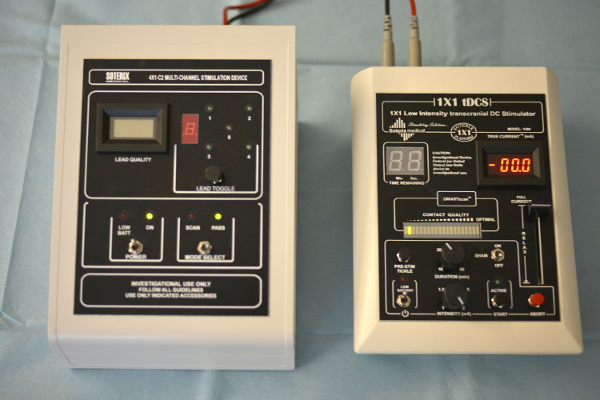
Figure 1. 4x1 Multichannel Stimulation Adapter (left) connected to conventional tDCS device (right).
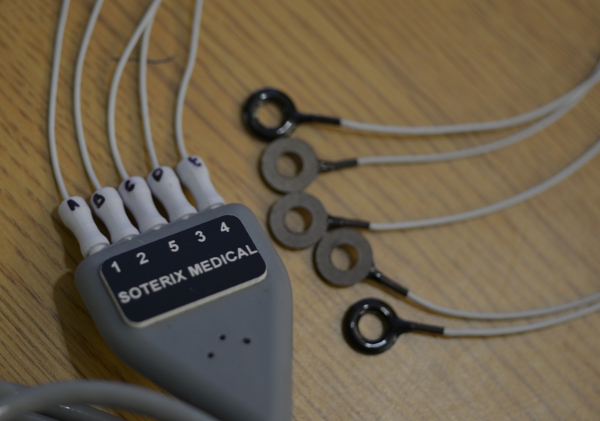
Figure 2. Ag/AgCl sintered ring electrodes, with smooth rounded (black) and rough surfaces. Electrodes are connected to the matching receivers on the 4x1 adapter output cable.

Figure 3. Anatomical landmarks (left) and primary motor cortex (M1) localization based on the International 10-20 EEG System (right).
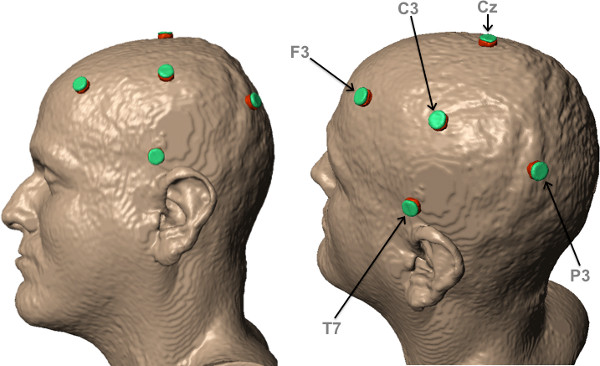
Figure 4. Proposed positioning for HD electrodes based on the 10-20 EEG System. Other montages may also be tested.
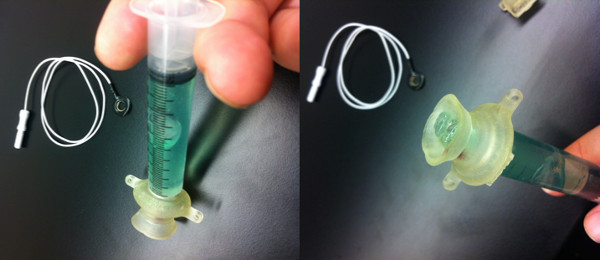
Figure 5. Electrical gel application (left). In order to prevent current from shunting between electrodes, care should be taken to avoid spread of electrical gel beyond the limits of the plastic casing (right).
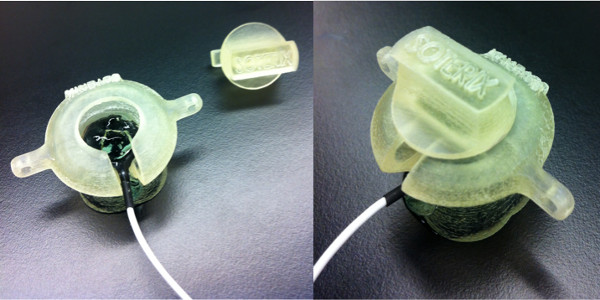
Figure 6. Placement of ring electrode in plastic casing. The rough surface of the electrode should face down and the smooth rounded surface face up. The ring electrode should then be lowered until it rests on the base of the plastic casing (left) and the cap locked in position (right).

Figure 7. Sample 4x1 HD-tDCS setup.
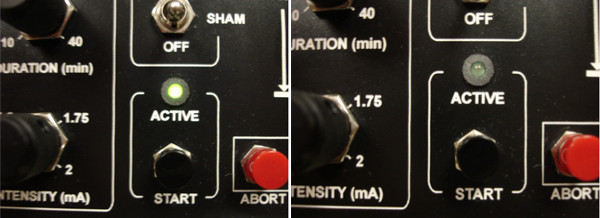
Figure 8. Delivery of active (left) and sham (right) mode by conventional tDCS device. From DaSilva, et al. 19.

Figure 9. Computational model comparison between primary motor cortex 4x1-ring HD-tDCS (above) and conventional tDCS using a standard bipolar sponge montage (below). Click here to view larger figure.
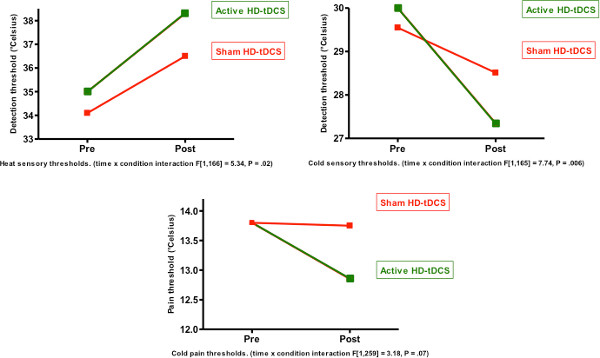
Figure 10. Heat and cold sensory thresholds and cold pain thresholds measured in healthy subjects before (pre) and after (post) 4x1-ring HD-tDCS. The protocol consisted on delivery of 2mA of active anodal HD-tDCS or sham stimulation to the primary motor cortex for 20 min. Modified from Borckardt, et al. 15. Click here to view larger figure.
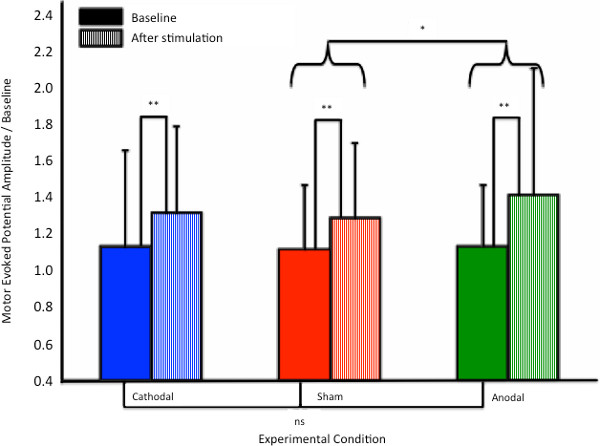
Figure 11. Effects of 4x1-ring HD-tDCS on motor evoked potentials (MEP) amplitude in healthy subjects. The protocol consisted on delivery of 1mA of active anodal HD-tDCS or sham stimulation to the primary motor cortex for 20 min. MEP were measured before and after stimulation, and the amplitude of the latter normalized to that of baseline. Whiskers represent standard deviations. Modified from Caparelli-Daquer, et al. 13.
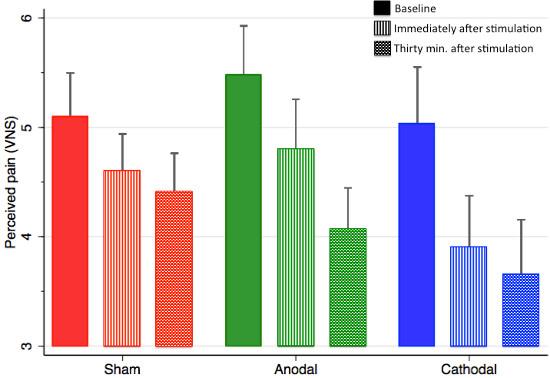
Figure 12. Effects of 4x1-ring HD-tDCS on perceived pain in fibromyalgia patients. Patients were asked to rate their overall pain using a visual numerical scale before, immediately and 30 min after stimulation. The protocol consisted of single sessions of active anodal and cathodal HD-tDCS, delivered to the left primary motor cortex (2mA for 20 min) and sham stimulation. Whiskers represent standard error. Modified from Villamar, et al. 16.
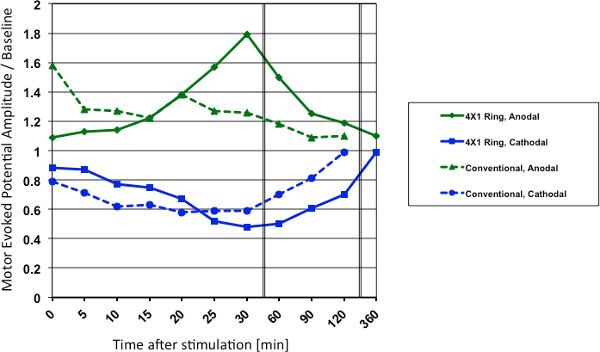
Figure 13. Comparison of the aftereffects induced by anodal and cathodal stimulation using conventional tDCS and 4x1-ring HD-tDCS. Motor evoked potential (MEP) amplitude was measured before and after delivery of 2mA of conventional tDCS or 4x1 HD-tDCS for 10 min. Sequential assessments were performed to evaluate the time course of aftereffects. MEP amplitude post-stimulation was normalized to that of baseline. Modified from Kuo, et al. 14.
| Have you ever… | Had an adverse reaction to TMS/tDCS? |
| Had a seizure? | |
| Had an unexplained loss of consciousness? | |
| Had a stroke? | |
| Had a serious head injury? | |
| Had surgery to your head? | |
| Had any brain related, neurological illnesses? | |
| Had any illness that may have caused brain injury? | |
| Do you suffer from frequent or severe headaches? | |
| Do you have any metal in your head (outside the mouth) such as shrapnel, surgical clips, or fragments from welding? | |
| Do you have any implanted medical devices such as cardiac pacemakers or medical pumps? | |
| Are you taking any medications? | |
| Are you pregnant, or are you sexually active and not sure whether you might be pregnant? | |
| Does anyone in your family have epilepsy? | |
| Do you need any further explanations on tDCS/HD-tDCS or its associated risks? |
Table 1. Screening for contraindications and special considerations before tDCS / HD-tDCS.
| Materials | One conventional tDCS device |
| One 4x1 Multichannel Stimulation Adapter | |
| Four 9-volt batteries | |
| One modular electroencephalogram recording cap | |
| Five Ag/AgCl sintered ring electrodes | |
| Five specially-designed HD plastic casings and their respective caps | |
| One plastic plunger | |
| Cables | |
| One measuring tape | |
| One wooden cotton swab | |
| Electrically conductive gel | |
| One 3- or 5-ml syringe | |
| Adhesive tape | |
| Paper towels |
Table 2. Materials.
| Did you experience any of the following symptoms or side effects? | Enter a value (1-4) in the space below. 1-Absent 2-Mild 3-Moderate 4-Severe | If present, do you think this is related to HD-tDCS? 1-None 2-Remote 3-Possible 4-Probable 5-Definite | Notes |
| Headache | |||
| Neck pain | |||
| Scalp pain | |||
| Scalp burns | |||
| Tingling | |||
| Skin redness | |||
| Sleepiness | |||
| Trouble concentrating | |||
| Acute mood change | |||
| Other (specify): |
Table 3. Adverse effect screening following HD-tDCS.
Discussion
Critical Steps
Aspects to be checked prior to starting the procedure
Before starting the stimulation, researchers should make sure that the participant has no contraindications for HD-tDCS. Table 1 lists some important considerations to be taken into account and summarizes the most important contraindications, including presence of metallic implants or devices in the head, severe brain injuries or significant skin lesions. The researcher should inspect for presence of the latter within the 4x1-ring perimeter while preparing for electrode placement. We do not recommend application of the technique if such lesions exist. This is important as, though skin lesions have not been reported when using the HD electrodes and casings shown in this article, skin damage has been reported after delivery of several consecutive sessions of conventional tDCS 3, particularly if performed over a period of 14 days 25.
The presence of metallic implants or defects in the skull or brain parenchyma can significantly modify current flow 17,26 and result in stimulation of cortical regions other than those intended. For safety reasons, stimulation should be avoided in patients with implanted medical devices. Relative contraindications include presence of epilepsy or history of a stroke, unless the study is specifically focused on studying these conditions. HD-tDCS should be avoided in pregnant women due to lack of data on safety.
It is of utmost importance to check the polarity of the cables when connecting the 4x1 Multichannel Stimulation Adapter to the conventional tDCS device. Failure to do so may result in delivering the wrong type of stimulation to the participant. Make sure that the cable labeled as "Center", which may often be red, is plugged to the correct terminal (anode or cathode).
The operator should also visually inspect the Ag/AgCl sintered ring electrodes for evidence of deposition of electrolysis products before each use and replace them if indicated. After each active stimulation session, products of electrochemical reactions tend to build up on the rough surface on the bottom of the electrodes. For this reason, it is recommended that each electrode be located in the center of the 4x1 configuration for two active stimulation sessions only. Subsequently, it can be rotated and used as one of the return electrodes. Once each of the five electrodes in a set has served as the center electrode twice, it is recommended to use a new set of electrodes. It is straightforward to label each electrode and record the number of uses in order to rotate them in a coordinated manner. In addition to tolerability, the (limited) rotation of electrodes is also intended to avoid a high-impedance case where current will not be divided equally across the four return electrodes. The operator is responsible for checking contact quality prior to the stimulation (as explained in Steps 5.12 to 5.14), and ensuring that no abnormally high resistance values are observed.
It might occur that participants move their heads excessively or inadvertently pull the cables and dislodge or break them. For this reason, it is advisable to loop each cable around its plastic casing and to tape the 4x1 adapter output cable to a surface (i.e. the chair or the participant's clothes).
If desired, it may be possible to add topical anesthetics to the scalp in order to prevent potentially uncomfortable sensations and to enhance blinding of participants in the study. However, it should be kept in mind that, although skin burns have not been reported with HD-tDCS, there could be a small theoretical risk for this adverse effect and the use of topical anesthetics might prevent participants from reporting it during the stimulation. In this demonstration, as well as in our previous studies, we have not used topical anesthetics as any discomfort is generally reported as mild.
As mentioned above, in order to have optimal results it is very important to prevent the electrical gel from spreading beyond the limits of the plastic casing. Otherwise, current might shunt from one electrode to another.
Important considerations during the stimulation
Unless this is required as part of study design, the subject should not be sleeping, reading or otherwise distracted during the stimulation session. This is important as it has been reported that intense cognitive effort, boredom or sleeping, muscle activation and other activities leading to changes in cortical excitability can result in altered and opposed effects of conventional tDCS 27.
Upon initiation of the stimulation, and in order to prevent side effects from sudden start of current flow, the device automatically ramps current up and down over a period of thirty seconds. For similar reasons, do not switch between "Pass" and "Scan" modes while the conventional tDCS device is generating current. It is always advisable to periodically ask subjects whether they feel comfortable with the procedure in order to make sure that the stimulation is proceeding safely.
Stimulation in susceptible populations, including pediatric patients, may require dose adjustment.
Practical aspects after the procedure
In order to collect further evidence on safety and to monitor HD-tDCS effects, we recommend using an adverse effects questionnaire such as the one depicted in Table 3, which should be delivered to participants following each session. Make sure to screen for the presence of the most common adverse effects associated with HD-tDCS, such as discomfort, tingling, itching and burning sensations. Furthermore, the meaningfulness of these data can be improved by also asking for quantitative subjective scores. This can be achieved by having a numeric scale for patients to report the intensity or severity of the adverse effects, for instance from 1 to 5 or from 1 to 10. It is also important to deliver the side effect questionnaire after each sham session. This allows for comparing the frequency of adverse effects associated with both active and sham stimulation. For conventional tDCS, some side effects have been reported to be even more frequent in the sham group 24, headache being one example.
Possible modifications
For 4x1 HD-tDCS, stimulation protocols may be designed involving different target locations, current polarity and intensity, and radius of the ring. As a general rule, increasing 4x1 ring diameter will increase the depth of penetration and maximum intensity under the ring 28. Conversely, reducing ring radius increases focality but decreases induced brain electric field. Therefore, further investigation of optimal dose per indication is warranted.
Although this article is focused on 4x1-ring HD-tDCS, other electrode deployments can also be used, such as 4x2 and 3x3 (dual strip), among others. Though HD-tDCS offers many options for customization, the methods for positioning and preparing electrodes, as described here, should be followed along with using only hardware and accessories that have specifically been tested for this purpose. This includes paying special attention to HD plastic casing design, gel, and electrodes. For example, electrodes other than Ag/AgCl sintered ring have also been tested in order to deliver DC, such as Ag pellet, Ag/AgCl pellet, Ag/AgCl disc and rubber pellet 9. However, both Ag and rubber pellet electrodes induced changes in pH, and increases in temperature and electrode potential were reported for all electrodes except for Ag/AgCl ring and disc. Therefore, it appears that Ag/AgCl ring electrodes may be an effective and safer approach. In the future, modifications of the approach described in this paper may also be used to deliver interventions such as transcranial alternating current stimulation.
Limitations
At this point, the role of 4x1-ring HD-tDCS polarity on cortical excitability remains unclear. Though neurophysiological studies have reported that both 1.0 mA and 2.0 mA of anodal 4x1-ring HD-tDCS led to increases in cortical excitability among healthy subjects 13,14, a wider body of evidence specifically addressing HD-tDCS studies is needed before any generalization can be made. In addition, it is noteworthy that the effects of cortical excitability modulation using 4x1-ring HD-tDCS may be time-dependent, reaching their peak several minutes after the end of the stimulation and not immediately after it 14,16. Therefore, sequential assessments over different time points following the intervention may be needed in order to obtain accurate results.
Disclosures
MF Villamar, MS Volz, AF DaSilva and F Fregni declare no conflicts of interest related to this article. The City University of New York has intellectual property on noninvasive brain stimulation with M Bikson and A Datta as inventors. M Bikson and A Datta have equity in Soterix Medical, Inc.
Acknowledgements
The authors thank Kayleen Weaver for editorial assistance, Alexandre Venturi for volunteering for this video, Dennis Truong for providing one of the figures used in this article, and the Wallace H. Coulter Foundation for the support given to conduct this work. MS Volz is funded by a doctoral scholarship from Deutsche Schmerzgesellschaft e.V. [German chapter of the International Association for the Study of Pain (IASP)].
Materials
| Name | Company | Catalog Number | Comments |
|---|---|---|---|
| One conventional tDCS device (Soterix 1x1 Low-intensity DC Stimulator) | Soterix Medical Inc., New York, NY, USA | 1300A | |
| One 4x1 Multichannel Stimulation Adapter | Soterix Medical Inc., New York, NY, USA | 4X1-C2 | |
| Four 9V batteries | Many manufacturers available | ||
| One modular electr–ncephalogram recording cap | EASYCAP GmbH, Germany | EASYCAP | |
| Five Ag/AgCl sintered ring electrodes | Stens Biofeedback Inc., San Rafael, CA, USA | EL-TP-RNG Sintered | |
| Five specially-designed plastic casings and their respective caps | Soterix Medical Inc., New York, NY, USA | ||
| One plastic plunger | Soterix Medical Inc., New York, NY, USA | PSYR-5 | |
| Cables | Soterix Medical Inc., New York, NY, USA | CSIN-X2 Input Cable, CSOP-D5 Output Cable | |
| One measuring tape | Many manufacturers available | ||
| One wooden cotton swab | Many manufacturers available | ||
| Electrically conductive gel (Sigma Gel) | Parker Laboratories, New Jersey, NJ, USA | 15-25 | |
| One 3- or 5-ml syringe | Many manufacturers available | ||
| Adhesive tape | Many manufacturers available | ||
| Paper towels | Many manufacturers available |
References
- Villamar, M. F., Santos Portilla, A., Fregni, F., Zafonte, R. Noninvasive brain stimulation to modulate neuroplasticity in traumatic brain injury. Neuromodulation. 15, 326-338 (2012).
- Dos Santos, M. F., et al. Immediate effects of tDCS on the μ-opioid system of a chronic pain patient. Front Psychiatry. 3, 1-6 (2012).
- Nitsche, M. A., et al. Transcranial direct current stimulation: state of the art. Brain Stimul. 11, 642-651 (2008).
- Datta, A., et al. Gyri -precise head model of transcranial DC stimulation: Improved spatial focality using a ring electrode versus conventional rectangular pad. Brain Stimul. 2, 201-207 (2009).
- Moliadze, V., Antal, A., Paulus, W. Electrode-distance dependent after-effects of transcranial direct and random noise stimulation with extracephalic reference electrodes. Clinical Neurophysiology: Official Journal of the International Federation of Clinical Neurophysiology. 121, 2165-2171 (2010).
- Nitsche, M. A., et al. Shaping the effects of transcranial direct current stimulation of the human motor cortex. Journal of Neurophysiology. 97, 3109-3117 (2007).
- Dasilva, A. F., et al. tDCS-induced analgesia and electrical fields in pain-related neural networks in chronic migraine. Headache. 52, 1283-1295 (2012).
- Antal, A., et al. Imaging artifacts induced by electrical stimulation during conventional fMRI of the brain. Neuroimage. , (2012).
- Minhas, P., et al. Electrodes for high-definition transcutaneous DC stimulation for applications in drug delivery and electrotherapy, including tDCS. J. Neurosci. Methods. 190, 188-197 (2010).
- Dmochowski, J. P., Datta, A., Bikson, M., Su, Y., Parra, L. C. Optimized multi-electrode stimulation increases focality and intensity at target. J. Neural Eng. 8, 046011(2011).
- Datta, A., Truong, D., Minhas, P., Parra, L. C., Bikson, M. Inter-Individual Variation during Transcranial Direct Current Stimulation and Normalization of Dose Using MRI-Derived Computational Models. Front Psychiatry. 3, 91(2012).
- Edwards, D. J., et al. Physiological and modeling evidence for focal transcranial electrical brain stimulation in humans: a basis for high-definition tDCS. Neuroimage. , Under review (2013).
- A pilot study on effects of 4x1 High-Definition tDCS on motor cortex excitability. Caparelli-Daquer, E. M., et al. 34th Annual International Conference of the IEEE Engineering in Medicine and Biology Society, , IEEE Engineering in Medicine and Biology Society. 735-738 (2012).
- Kuo, H. I., et al. Comparing cortical plasticity induced by conventional and high-definition 4 x 1 ring tDCS: A neurophysiological study. Brain Stimul. , (2012).
- Borckardt, J. J., et al. A pilot study of the tolerability and effects of high-definition transcranial direct current stimulation (HD-tDCS) on pain perception. J. Pain. 13, 112-120 (2012).
- Villamar, M. F., et al. Focal modulation of the primary motor cortex in fibromyalgia using 4x1-ring high-definition transcranial direct current stimulation (HD-tDCS): immediate and delayed analgesic effects of cathodal and anodal stimulation. J. Pain. 14, 371-383 (2013).
- Datta, A., Bikson, M., Fregni, F. Transcranial direct current stimulation in patients with skull defects and skull plates: high-resolution computational FEM study of factors altering cortical current flow. Neuroimage. 52, 1268-1278 (2010).
- Reilly, E. L. Ch. 7. Electroencephalography: Basic Principles, Clinical Applications, and Related Fields. Niedermeyer, E., Lopes da Silva, F. H. , Lippincott Williams & Wilkins. 139-141 (2004).
- DaSilva, A. F., Volz, M. S., Bikson, M., Fregni, F. Electrode positioning and montage in transcranial direct current stimulation. J. Vis. Exp. (51), e2744(2011).
- Bio-heat transfer model of transcranial DC stimulation: comparison of conventional pad versus ring electrode. Conference proceedings. Datta, A., Elwassif, M., Bikson, M. 31st Annual International Conference of the IEEE Engineering in Medicine and Biology Society, , IEEE Engineering in Medicine and Biology Society. 670-673 (2009).
- Merrill, D. R., Bikson, M., Jefferys, J. G. Electrical stimulation of excitable tissue: design of efficacious and safe protocols. J. Neurosci. Methods. 141, 171-198 (2005).
- Hahn, C., et al. Methods for extra-low voltage transcranial direct current stimulation: Current and time dependent impedance decreases. Clinical Neurophysiology: Official Journal of the International Federation of Clinical Neurophysiology. , (2012).
- Gandiga, P. C., Hummel, F. C., Cohen, L. G. Transcranial DC stimulation (tDCS): a tool for double-blind sham-controlled clinical studies in brain stimulation. Clin. Neurophysiol. 117, 845-850 (2006).
- Brunoni, A. R., et al. A systematic review on reporting and assessment of adverse effects associated with transcranial direct current stimulation. Int. J. Neuropsychopharmacol. 14, 1133-1145 (2011).
- Palm, U., Keeser, D., Schiller, C., Fintescu, Z., Nitsche, M., Reisinger,, Padberg, E. Skin lesions after treatment with transcranial direct current stimulation (tDCS). Brain Stimul. 1, 386-387 (2008).
- Datta, A., Baker, J. M., Bikson, M., Fridriksson, J. Individualized model predicts brain current flow during transcranial direct-current stimulation treatment in responsive stroke patient. Brain Stimul. 4, 169-174 (2011).
- Antal A, T. D., Poreisz, C., Paulus, W. Towards unravelling task-related modulations of neuroplastic changes induced in the human motor cortex. Eur. J. Neurosci. 26, 2687-2691 (2007).
- Datta, A., Elwassif, M., Battaglia, F., Bikson, M. Transcranial current stimulation focality using disc and ring electrode configurations: FEM analysis. J. Neural Eng. 5, 163-174 (2008).
Reprints and Permissions
