Pyrosequencing is a versatile technique that facilitates microbial genome sequencing that can be used to identify bacterial species, discriminate bacterial strains, and detect genetic mutations that confer resistance to anti-microbial agents. In this video, the procedure for microbial amplicon generation, amplicon pyrosequencing, and DNA sequence analysis will be demonstrated.
Method Article
Pyrosequencing for Microbial Identification and Characterization
In This Article
Summary
Abstract
Pyrosequencing is a versatile technique that facilitates microbial genome sequencing that can be used to identify bacterial species, discriminate bacterial strains and detect genetic mutations that confer resistance to anti-microbial agents. The advantages of pyrosequencing for microbiology applications include rapid and reliable high-throughput screening and accurate identification of microbes and microbial genome mutations. Pyrosequencing involves sequencing of DNA by synthesizing the complementary strand a single base at a time, while determining the specific nucleotide being incorporated during the synthesis reaction. The reaction occurs on immobilized single stranded template DNA where the four deoxyribonucleotides (dNTP) are added sequentially and the unincorporated dNTPs are enzymatically degraded before addition of the next dNTP to the synthesis reaction. Detection of the specific base incorporated into the template is monitored by generation of chemiluminescent signals. The order of dNTPs that produce the chemiluminescent signals determines the DNA sequence of the template. The real-time sequencing capability of pyrosequencing technology enables rapid microbial identification in a single assay. In addition, the pyrosequencing instrument, can analyze the full genetic diversity of anti-microbial drug resistance, including typing of SNPs, point mutations, insertions, and deletions, as well as quantification of multiple gene copies that may occur in some anti-microbial resistance patterns.
Introduction
Pyrosequencing is a rapid and accurate method to sequence nucleic acids that is based on the principle of "sequencing by synthesis". "Sequencing by synthesis" involves using a single strand DNA template to synthesize the complementary strand one base at a time, and detecting the incorporated base (A, T, G, or C) at each step by detection of a chemiluminescent signal. The pyrosequencing reaction includes template DNA, dNTPs (dATP, dGTP, dTTP, dCTP), DNA polymerase, ATP sulfurylase, luciferin, luciferase, and apyrase. The synthesis reaction is initiated by the addition of one of the four dNTPs and DNA polymerase to the single stranded biotinylated template DNA. DNA polymerase incorporates the complementary dNTP onto the template, with the subsequent release of pyrophosphate (Figure 1). ATP sulfurylase proportionately converts the pyrophosphate to ATP. ATP acts as a catalyst for the luciferase-mediated conversion of luciferin to oxyluciferin, which generates light (Figure 2). The intensity of light is proportional to the number of nucleotides incorporated and determines if one or more specific dNTP's (dATP, dTTP, dGTP, or dCTP) is present on the template strand sequentially (Figure 3). Any unincorporated dNTP is degraded by apyrase prior to addition of the next dNTP for continuation of the synthesis reaction. This "sequencing by synthesis" reaction is repeated with addition of each of the four dNTPs until the DNA sequence of the single stranded DNA template is determined.
To view an animation of the pyrosequencing reaction Click here to view movie.
Protocol
Introduction: A single bacterial colony should be used to inoculate an appropriate culture broth that is incubated overnight. A bacterial pellet is then processed to purify genomic DNA using a commercially available genomic isolation kit. The purified genomic DNA should have a 260/280 (nm) ratio >1.8 to assure that the sample is free of protein contamination. The amount of genomic DNA required for generation of the pyrosequencing template is 10-20 ng.
A. Amplification of the Template
(PyroMark PCR Handbook; www.qiagen.com/handbooks1)
Setting up the PCR reaction
Note: One primer must be biotinylated at its 5' end, and it's recommended that it be HPLC purified for template preparation. We recommend the PyroMark Assay Design Software 2.0 for PCR and sequence primer design that are optimized for short-read sequencing, however, Primer-BLAST (http://www.ncbi.nlm.nih.gov/tools/primer-blast/index.cgi?LINK_LOC=BlastHome) from NCBI can also be used for primer design.
- Thaw all required solutions (listed in Table 1) and mix each thoroughly. Set up the reaction according to Table 1. All work can be done at room temperature.
Note: The PCR Master Mix contains MgCl2 for a final concentration of 1.5 mM, which provides satisfactory results in most cases. If a higher Mg2+ concentration is required, up to 3.5 μl of 25 mM MgCl2 can be added to a reaction.
- Thoroughly mix the reaction mix by gently pipetting up and down, then dispense appropriate volumes into PCR tubes.
- Add template DNA to each PCR tube. We recommend 10 ng of genomic DNA.
- Program the thermal cycler according to Table 2. A final hold at 4 °C is recommended for convenience. If using a thermal cycler without a heated lid, overlay reactions with 100 μl mineral oil.
- Place the PCR tubes in the cycler and start the cycling program.
B. Vacuum Workstation Protocol
Immobilizing the Biotinylated PCR products
- Make a master mix according to Figure 4.
Note: Before pipetting, gently shake the bottle of streptavidin-coated Sepharose beads to ensure a homogenous suspension.
- Depending on the volume of PCR product used, dispense 60-75 μl master mix into each well of a PCR plate to give a total volume of 80 μl per well.
- Add 5-20 μl biotinylated PCR product to each well.
- Seal the wells with strip caps and agitate the PCR plate at 1,400 rpm for 5-10 min at room temperature (15-25 °C) using an orbital shaker.
Denaturation of DNA and addition of sequencing primer
- Dilute the sequencing primers to 0.3 μM with annealing buffer and dispense 25 μl into each well of a reaction plate. Position the plate on the workstation.
- Fill the workstation troughs according to the Figure 5 diagram.
- Turn on the vacuum pump, and make sure the switch on the vacuum tool is set to on (Figure 6). Flush the filter probes with high-purity water (Milli-Q 18.2 MW x cm or equivalent) in trough 5 (Figure 5). Refill the trough with fresh high-purity water for use in step 12.
- Working quickly, position the PCR plate with beads on the workstation. Ensure that both plates are in the same orientation as when the samples were loaded.
- With the vacuum switch ON, lower the vacuum tool into the wells of the PCR plate for 20 sec or until all volume has been aspirated. The beads will be captured by the vacuum tool (Figure 7).
- With the vacuum still ON, flush the tool with 70 % ethanol (trough 1) for 20 sec or until all volume has been aspirated.
- With vacuum ON, flush the tool with denaturation solution (trough 2) for 20 sec or until all volume has been aspirated.
Note: The Denaturation Solution contains sodium hydroxide, which is an eye and skin irritant. Always wear a lab coat, gloves, and protective goggles.
- With vacuum ON, flush the tool with wash buffer (trough 3) for 20 sec or until all volume has been aspirated.
- With vacuum ON, raise the vacuum tool to beyond 90° vertical for 5 sec, to allow all liquid to drain out of the vacuum tool. Turn the pump OFF, and align the vacuum tool with the reaction plate. Lower the vacuum tool into the wells and gently shake from side to side to release the beads into the wells containing sequencing primer.
- In order to clean the vacuum tool, agitate the filter probes in high-purity water (trough 4) for 10 sec.
- Switch the vacuum ON and flush the tool with high-purity water (trough 5) for 20 sec or until all volume has been aspirated.
- Raise the vacuum tool to beyond 90°C vertical for 5 sec, then switch the vacuum OFF and store in the "Parking" position.
Annealing sequencing primer to DNA strands
- Place the reaction plate in a pre-warmed plate holder.
- Heat the plate on a heating block at 80 °C for 2 min.
- Remove the plate from the holder and place on the counter to cool at room temperature for 5 min.
Pyromark Q24 Operation
Note: Switch on the instrument using the power switch located above the power cord. Startup can take up to 1 min.
- Fill a cartridge according to the instructions provided in the PyroMark Gold Q24 Reagents Handbook 2. To determine volumes needed, set up a run file in the instrument software, and under the Tools menu select Pre Run Information
- If the instrument was already on, ensure that it is not performing a run and then open the lid. An audible warning signal will be emitted if the lid is opened when it is unsafe to do so.
- Open the cartridge gate and insert the cartridge with the label facing forward (Figure 8). Ensure that the cartridge is properly inserted (a line should be visible at the front) and close the gate.
- Open the plate-holding frame and position the plate with samples inside the instrument.
- Close the plate-holding frame and the instrument lid (Figure 9).
Starting a run
- Insert the USB stick with the run files created with the instrument software into the USB port at the front of the instrument.
- Select "Run" in the main menu and press "OK".
- Use the scroll arrows to select the desired run file and press "Select".
Note: The instrument will begin dispensing reagents when all preset pressure and temperature levels are reached (this may take several minutes). During a run, the instrument screen displays the pyrogram of the selected well in real-time. Use the scroll arrows to view the pyrogram of other wells.
Completing a run
- When the instrument confirms that the run is finished and the run file has been saved to the USB stick, press "Close".
- Remove the USB stick. If it was removed before the run finished, insert the USB stick. Select "Administration" and then "Copy Unsaved Runs".
- The run file can now be opened and analyzed using the instrument software and compared to a library of known microbes using the Identifire software.
Results
The results of a typical pyrosequencing run using the software shows the location of the forward and reverse primers used for amplicon generation, and the sequencing primer used for the pyrosequencing reaction within the conserved 16S ribosomal sequence (Figure 10).The hypervariable sequence between the primer sites allows for bacterial identification of a large number of bacterial species using the conserved sequencing primer (5'-TACATGCAAGTCGA).As an internal quality control, the DNA sequence bracketing the variable region can be checked to assure that the correct DNA region has been analyzed. The pyrosequencing software allows for comparison and alignment of the generated sequence to an internal database of bacterial ribosomal sequences for bacterial identification. In addition, a sequence can be analyzed to determine mutations that confer antibiotic drug resistance. For example, analysis of mutations in the 23S ribosomal genes of Helicobacter pylori demonstrates two mutation patterns (GAA or AGA) that confer antibiotic resistance (Figure 11). Analysis of multiple isolates from the same patient can be concurrently assayed to track the emergence of drug resistance over time to aid in epidemiological investigations of microbial drug resistance outbreaks.
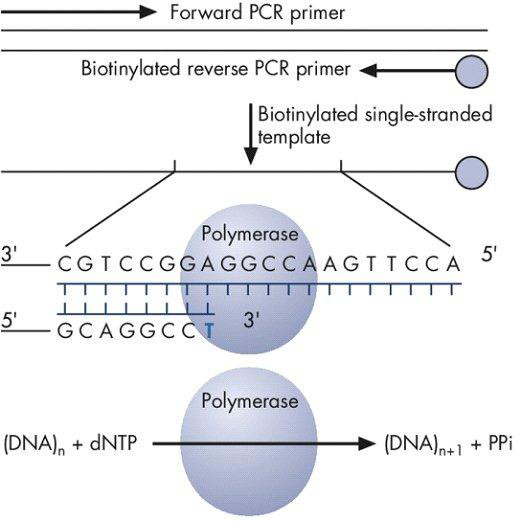
Figure 1. Biotinylated PCR product is used as a template to incorporate dNTPs by DNA polymerase, leading to the generation of pyrophosphate (PPi).

Figure 2. ATP sulfurylase proportionately converts pyrophosphate to ATP. ATP acts as a catalyst for the luciferase-mediated conversion of luciferin to oxyluciferin, which generates light that is proportional to the amount of ATP. The light is recorded as peak on the pyrogram trace and indicates nucleotide incorporation. The unincorporated dNTPs are degraded by apyrase before the next dNTP is added for continuation of the synthesis.
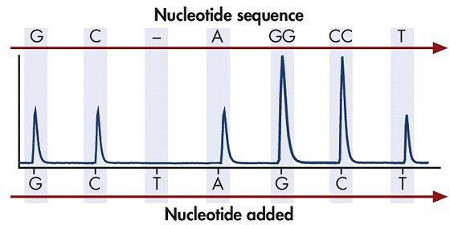
Figure 3. The intensity of light generated indicates if one or more specific dNTP's (dATP, dTTP, dGTP, or dCTP) was incorporated onto the template strand sequentially.
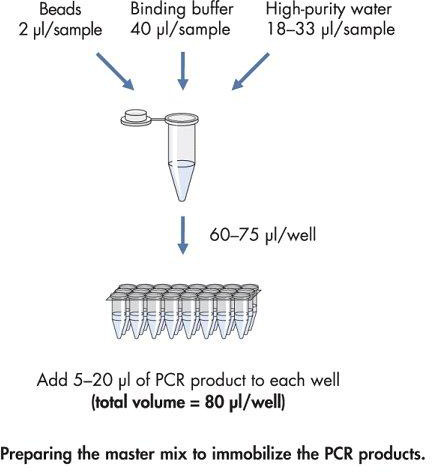
Figure 4. Flow chart for preparation of master mix to immobilize the biotinylated PCR product.

Figure 5. PyroMark workstation, with PCR plate, PyroMark plate, and trough locations.
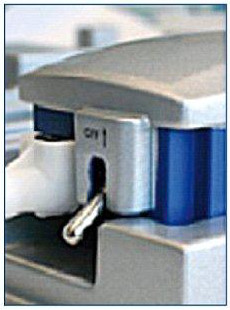
Figure 6. Locations of the Vacuum switch ON and OFF positions.

Figure 7. Vacuum tool. Proper handling of the vacuum tool.

Figure 8. Cartridge gate opened with cartridge in place.

Figure 9. Cartridge properly inserted with gate closed.
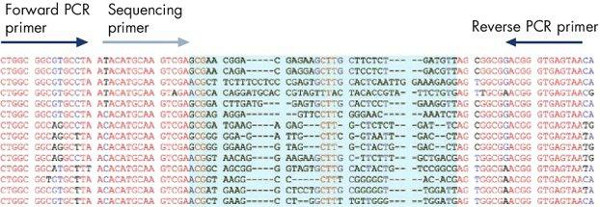
Figure 10. Pyrosequencing based bacterial identification results. PCR primers are designed for conserved regions of the DNA template, and the sequencing primer is positioned immediately upstream of a well-characterized identifying hypervariable DNA sequence within the amplicon (shown in blue).
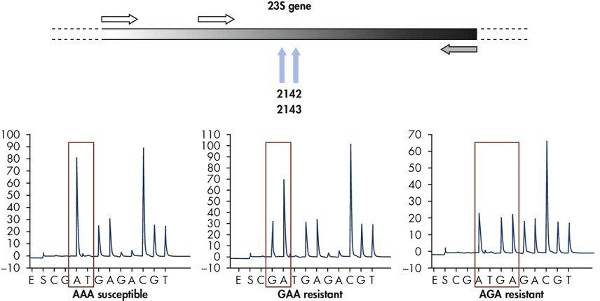
Figure 11. Detection of antibiotic drug resistance in Helicobacter pylori using pyrosequencing. Analysis of mutations in the 23S genes that confer antibacterial resistance in Helicobacter pylori containing GAA or AGA sequences. Click here to view larger figure.
| Component | Volume per reaction | Final concentration |
| Pyro PCR Master Mix, 2x | 12.5 μl | 1x |
| CoralLoad Concentrate, 10x | 2.5 μl | 1x |
| 25 mM MgCl2 (optional) | Variable | ≥1.5 mM |
| Q-Solution, 5x (optional) | 5 μl | 1x |
| Primer A/Primer B | Variable/Variable | 0.2 μM/0.2 μM |
| RNase-free water | Variable | - |
| Total Volume (after adding template DNA) | 25 μl |
Table 1. PCR Reaction Mixture.
| Additional comments | |||
| Initial PCR activation step | 15 min | 95 °C | HotStartTaq DNA Polymerase is activated |
| 3 step cycling: Denaturation | 30 sec | 94 °C | |
| Annealing | 30 sec | 60 °C 56 °C | For genomic DNA For bisulfite converted DNA |
| Extension | 30 sec | 72 °C | |
| Number of cycles | 45 | ||
| Final extension | 10 min | 72 °C |
Table 2. PCR Cycle Specifications.
Discussion
Several new next generation sequencing methods have been commercialized. Three of the most widely used methods are ion semiconductor sequencing, single molecule real time sequencing, and sequencing by synthesis (SBS).3-11 Each of these methods depends on sequencing by synthesis but employ novel platforms for detection of the incorporated nucleotides. In ion semiconductor sequencing, a single strand of DNA serves as a template for the sequencing strand. 12 Polymerase and nucleotides are added sequentially as in pyrosequencing. When a nucleotide is added to the growing DNA strand, a hydrogen ion is released. The hydrogen ion is detected by a field effect transistor based sensor.
Single molecule real time sequencing depends on the zero mode wave guide (ZMW).13 The ZMW is a small structure where a single polymerase molecule is attached to the bottom of the well. It is illuminated in such a way that a florescent molecule can be detected. Each nucleotide is tagged with a fluorescent molecule. As a fluorescently tagged nucleotide is incorporated, a detector identifies the nucleotide. When the next nucleotide is added, the florescent molecule is cleaved.14
Sequencing by synthesis (SBS) uses a unique method to amplify the target DNA such that clusters of unique sequences are generated.15 Single stranded templates are generated and then the complementary strand is synthesized. Each nucleotide is labeled with a fluorescent molecule and after each base addition the fluorescence of the added base is recorded.
Disclosures
Production and Free Access to this article is sponsored by Qiagen.
Authors Ahmed, Durocher, Jessen and Vardi are employees of Qiagen Inc. that produces reagents and instruments used in this article.
Acknowledgements
This project was support in part by Johns Hopkins University, Office of the Provost through the Gateway Science Initiative and Qiagen Inc.
Materials
| Name | Company | Catalog Number | Comments |
|---|---|---|---|
| PyroMark PCR Master Mix, 2x | Qiagen | 978703 | |
| CoralLoad Concentrate, 10x | Qiagen | 978703, 978705 | |
| Q-Solution, 5x | Qiagen | 978703, 978705 | |
| MgCl2, 25 mM | Qiagen | 978703, 978705 | |
| RNase-Free Water | Qiagen | 129112 | |
| Primers | Qiagen | 978776 or 978777 | Primers should be purchased from an established oligonucleotide manufacturer (i.e. QIAGEN Pyromark Custom Assays, IDT, etc). Lyophilized primers should be dissolved in TE to provide a stock solution of 100 μM. |
| Pyromark Gold Q24 Reagents | Qiagen | 970802 | |
| High-purity water (Milli-Q 18.2 MΩ x cm or equivalent) | |||
| Streptavidin Sepharose High Performance Beads | GE Healthcare | 17-5113-07 | |
| PyroMark Annealing Buffer | Qiagen | 979009 | |
| PyroMark Denaturation Solution | Qiagen | 979007 | |
| PyroMark Wash Buffer | Qiagen | 979008 | |
| PyroMark Q24 | Qiagen | 9001514 | |
| PyroMark Q24 Cartridge | Qiagen | 979202 | |
| PyroMark Q96 HS Tip Holder Box | Qiagen | 979105 | |
| PyroMark Q24 Vacuum Workstation | Qiagen | 9001516 | |
| PyroMark Q24 Plate Holder | Qiagen | 9022273 | |
| Orbital shaker | Fisher | 11-675-297 | |
| Heat block | Fisher | 11-718Q |
References
- PyroMark PCR Handbook. , [about 27p.]. Available from: http://www.qiagen.com/handbooks (2009).
- PyroMark Q24 User Manual. , [about 27p.]. Available from: http://www.qiagen.com/handbooks (2012).
- Elahi, E., Ronaghi, M. Pyrosequencing: a tool for DNA sequencing analysis. Methods Mol. Bio. 255, 211-219 (2004).
- Fakhrai-Rad, H., Pourmand, N., Ronaghi, M. Pyrosequencing: and accurate detection platform for single nucleotide polymorphisms. Hum. Mutat. 19 (5), 479-485 (2002).
- Langaee, T., Ronaghi, M. Genetic variation analyses by pyrosequencing. Mutat. Res. 573 (1-2), 96-102 (2005).
- Liu, Z., Lozupone, C., Hamady, M., Bushman, F. D., Knight, R. Short pyrosequencing reads suffice for accurate microbial community analysis. Nucleic Acids Res. 35 (18), e120(2007).
- Novais, R. C., Thorstenson, Y. R. The evolution of Pyrosequencing for microbiology: From genes to genomes. J. Microbiol. Methods. 86 (1), 1-7 (2011).
- J, Metagenomic pyrosequencing and microbial identification. Clin. Chem. 55 (5), 856-866 (2009).
- Quince, C., Lanzen, A., Curtis, T. P., Davenport, R. J., Hall, N., Head, I. M., Read, L. F., Sloan, W. T. Accurate determination of microbial diversity from 454 pyrosequencing data. Nat. Methods. (9), 639-6341 (2009).
- Ronaghi, M., Karamohamed, S., Pettersson, B., Uhlen, M., Nyren, P. Real-time DNA sequencing using detection of pyrophosphate release. Anal. Biochem. 242, 84-89 (1996).
- King, C., Scott-Horton, T. Pyrosequencing: A simple method for accurate genotyping. J. Vis. Exp. (11), e630(2008).
- Rothberg, J. W., Heinz,, et al. An integrated semi-conductor device that enabling non-optical genome sequencing. Nature. 475, 348-352 (2011).
- Levene, M. J., Korlach, J., Turner, S. W., Foquet, M., Craighead, H. G., Webb, W. W. Zero-Mode Waveguides for Single-Molecule Analysis at high concentrations. Science. 299, 682-686 (2003).
- Eid, J., Fehr, A. Real-Time DNA Sequencing from Single Polymerase Molecules. Science. 323, 133-138 (2009).
- Sequencing Technology | Sequencing by Synthesis | Illumina [Internet]. , Illumina. Available from: http://www.illumina.com/technology/sequencing_technology.ilmn (2012).
Reprints and Permissions
