The attachment of virions to a surface is a requirement for single virion imaging by Super-resolution fluorescence imaging or atomic force microscopy (AFM). Here we demonstrate a sample preparation method for controlled adhesion of virions to glass surfaces suitable for use in AFM and super-resolution fluorescence imaging.
Method Article
Sample Preparation for Single Virion Atomic Force Microscopy and Super-resolution Fluorescence Imaging
In This Article
Summary
Abstract
Immobilization of virions to glass surfaces is a critical step in single virion imaging. Here we present a technique adopted from single molecule imaging assays which allows adhesion of single virions to glass surfaces with specificity. This preparation is based on grafting the surface of the glass with a mixture of PLL-g-PEG and PLL-g-PEG-Biotin, adding a layer of avidin, and finally creating virion anchors through attachment of biotinylated virus specific antibodies. We have applied this technique across a range of experiments including atomic force microscopy (AFM) and super-resolution fluorescence imaging. This sample preparation method results in a control adhesion of the virions to the surface.
Introduction
Charge based nonspecific interactions are routinely used for adhesion of virions in atomic force microscopy1,2. These techniques especially work well when used on nonenveloped virions with very stiff capsids3-6. Although these techniques are very effective in immobilizing the sample, they do not prevent nonspecific binding of proteins to the surface. The nonspecific binding can create a problem when attempting to image virions with AFM and super-resolution fluorescence techniques that require incubations of the sample with various antibodies. Here we outline a sample preparation method for specific immobilization of virions.
Poly(ethylene glycol) (PEG) grafted to poly(L-lysine) (PLL) and adsorbed onto a glass surface provides a significant block for the electrostatic interactions of proteins with glass7. Single molecule assays which require immobilization of single molecules on glass surfaces have taken advantage of this property and used it to create a specific PEG based single molecule immobilization technique8-10. This preparation was also used to immobilize clathrin cages onto the glass surface11 as well as creating a homogenous fibronectin coating for control cell adhesion 12.
We have adopted the sample preparation method based on PLL-g-PEG adsorption to glass surfaces from single molecule imaging methodologies and applied it to imaging single virions of vesicular stomatitis virus (VSV). These single virions were imaged using atomic force microscopy (AFM). Similar experiments were also performed on functionalized beads as a control. The virions were also imaged by super-resolution fluorescence microscopy were a VSV-G antibody labeled with Alexa 647 was used to create an image of the envelope of single virions. High resolution fluorescent imaging utilizes localization of single molecules to create an image13-15. fPALM bi-planar imaging allows localization of single molecules with 20 nm in plane and 50 nm resolution along the optical axis15,16. This bi-planar technique was used to image super-resolution fluorescent images present in this study. An alternative technique which has similar results is STORM13,17,18.
Both AFM and super-resolution fluorescent images of VSV anchored to the glass by the procedures outlined in this paper, showed specific binding of virions to the glass with minimum nonspecific interactions19. Here we present the sample preparation protocols for the AFM and super-resolution fluorescent imaging experiments. In brief: Clean glass coverslips are functionalized by adsorbing a mixture of PLL-g-PEG and PLL-g-PEG-biotin. It is typical for this thin film to be engineered to provide between 15-25% functionalized biotin on a coated surface. The coverslips are further incubated with tetrameric avidin. A biotinylated viral antibody is then used to create a unique binding site for the virions. Binding of the antibody can be done in two ways.
The first method is optimized for AFM however it remains suitable for super-resolution fluorescence imaging. In this method the avidin coated surface is treated with biotinylated antibody prior to viral adhesion. The immobilized virions are treated with Alexa 647 labeled antibody to cover the envelope and allow super-resolution fluorescence imaging of the virions.
The second method is to attack the virus in solution with the biotinylated antibody and Alexa 647 labeled antibody prior to adhering the viruses to the avidin treated surface; this method is optimized for super-resolution fluorescence imaging experiments in which recovery of the viral envelope is important. This method has the advantage of allowing uniform antibody coating on the viral surface. The biotinylated antibody may be mixed with Alexa 647 labeled viral antibodies in ratios that allow for sufficient adsorption of the virus to the avidin treated surface while maintaining a high concentration of fluorescent label on the exterior of the viral envelope. These Alexa 647 labeled viral antibodies are not biotinylated and their excess may be rinsed away in order to reduce background noise.
Protocol
1. Chemistry Preparation
- Preparation and storage of PLL-g-PEG-Biotin and avidin:
- Dissolve the polymer PLL-g-PEG-biotin in PBS buffer according to manufacturer's directions at a concentration of 1.0 mg/ml.
- Aliquot according to coverslip size (see Table 1) and store at -80 °C for up to one year.
- Preparation and storage of Avidin/NeutrAvidin
- Dissolve the unlabeled Avidin/NeutrAvidin in PBS buffer according to the manufacturer's directions at a concentration of 1.0 mg/ml.
- Aliquot according to coverslip size (see Table 1) and store at -20 °C for up to 3 years.
- Virus sample preparation: Prepare virus samples according to experimental need and lab protocol prior to this assay. Utilize step 1.3.1 for method 5A, or 1.3.2 for method 5B.
- Prepare virus samples for method 5A in advance of stage 2. Utilize prepared viral samples within 1-2 days of preparation, or aliquot according to cover slip size (see Table 1) then flash freeze in liquid nitrogen and store at -80 °C for up to one year. When thawed, use immediately.
- Prepare virus samples for method 5B similar to 1.3.1. Thaw aliquots of virus in advance of 5B and store at 4 °C no more than 24 hr prior to mixing with antibodies.
- Prepare appropriate biotinylated antibodies for the experiment.
2. Coverslip Cleaning in Preparation for Chemical Treatment
- Place coverslips in an appropriately sized Teflon coverslip rack that holds them in a vertical orientation and submerge them in a beaker filled with filtered (0.2 μm) ethyl alcohol (190 proof).
- Sonicate the coverslips in the filtered ethyl alcohol (190 proof) for 30 min.
- Remove coverslips from alcohol and rinse coverslips extensively with ultrapure water.
- Place rinsed coverslips in a separate clean Teflon rack and beaker filled with 1 M NaOH.
- Sonicate the coverslips in the 1 M NaOH for 30 min.
- Remove coverslips from NaOH and rinse them extensively with ultrapure water.
- Dry the rinsed coverslips with a nitrogen stream, and place them in a clean, dry Teflon rack.
- Inspect the coverslips for any visible film or particles which remain on the coverslip. If any visible material remains, the coverslip has not been properly cleaned and rinsed. If not properly cleaned repeat steps 2.1-2.7.
- Clean the coverslips with oxygen-plasma for 2 min. This step is optional but recommended.
3. Formation of the PLL-g-PEG Thin Film Layer
- Immediately after drying in the nitrogen stream (or the optional oxygen-plasma), place one coverslip horizontally in a sterile Petri dish. Pipet in the center of the coverslip an appropriate amount of thawed PBS buffered PLL-g-PEG-biotin (see Table 1).
- Place another cleaned coverslip atop the fluid in a sandwich method. Note that this method consists of having two coverslips incubate their chemical films by orienting their chemically treated "active faces" towards each other, separated only by the current chemical layer. Make sure there is sufficient fluid such that the volume between the two coverslips is completely filled with fluid, but that no fluid leaks out from between the coverslips (see Table 1). The "active face" henceforth designates coverslip faces which have been in contact with the fluid in the sandwich configuration.
- Place the lid of the Petri dish over the coverslip sandwich and incubate at RT for 45-60 min.
- Remove lid of Petri dish and pick up the sandwich with a pair of tweezers. Be careful not to pinch out excess fluid. Use the thumb and index finger to pinch the sandwich lightly and slide the coverslips in opposite directions horizontally with respect to one another, then separate the two coverslips from each other without touching the active faces.
- Rinse both active faces with ultrapure water by pipetting 25 ml of ultrapure water over the active face 2-4x, and then dry the coverslips with a nitrogen stream. Be sure to note which coverslip faces are active.
- Utilize the coverslips immediately, or store O/N with the active face up in a sterile Petri dish placed in a dust free low humidity environment.
4. Avidin Binding Enhancement
- Place a PLL-g-PEG treated coverslip with active face up in a sterile Petri dish.
- Pipette an appropriate amount of thawed avidin in buffer (prepared in step 1.2) onto the middle of the active face.
- Place another coverslip (active face downward) atop the fluid in the sandwich method. Note the active face of the coverslips. It is important that the active faces be in contact with the fluid during the incubation (see step 3.2).
- Place the lid of the Petri dish over the coverslip sandwich and incubate at RT for 25-30 min.
- Remove the Petri dish lid and separate the two coverslips as described in step 3.4, making sure to keep track of and not touch the active faces.
- Rinse both active faces with ultrapure water by pipetting 25 ml of ultrapure water over the active face 2-4x and then dry the coverslips with a nitrogen stream. Note the active face of the coverslips. Use immediately for the next stage.
IMPORTANT NOTE: There are two distinct methods for completing sample preparation depending on the type of assay the experiment entails. The experimenter should proceed with stage 5A in which the virus is anchored to the glass before any additional antibody treatment required for super-resolution imaging is added. 5B describes an alternative method of labeling the virus in solution before anchoring it to the glass. The representative data in this manuscript is prepared using 5A. An appropriate method should be selected according to experimental assay type.
5A. Active Face Antibody Tether
- Immediately after drying with a nitrogen stream in stage 4.6, place an avidin treated coverslip active face up in a sterile Petri dish.
- Pipette an appropriate amount of thawed biotinylated antibody in buffer onto the middle of the active face (see Table 1).
- Place another coverslip (active face downward) atop the fluid in a sandwich method. Note the active face of the coverslips, it is important the active faces are in contact with the fluid for incubation (see step 3.2.).
- Place the lid of the Petri dish over the coverslip sandwich and incubate at RT for 45-60 min.
- Remove the Petri dish lid and separate the two coverslips as described in step 3.4, making sure to keep track of and not touch the active faces.
- Rinse both active faces with PBS by pipetting 25 ml of PBS over the active face 2-4x, do not dry and use immediately. Be sure to keep track of which coverslip faces are active.
- Place an antibody treated coverslip active face up in a sterile Petri dish, and pipette an appropriate amount of thawed virus in buffer onto the middle of the active face.
- Place another coverslip (active face downward) atop the fluid in a sandwich method. Note the active face, as it is important the active faces are in contact with the fluid for incubation (see step 3.2.).
- Place the lid of the Petri dish over the coverslip sandwich and incubate at RT for 45-60 min.
- Remove the Petri dish lid and separate the two coverslips as described in step 3.4, making sure to keep track of and not touch the active faces.
- Rinse both active faces with PBS by pipetting 25 ml of PBS over the active face 2-4x. Do not dry the coverslips, instead place them in a Teflon rack and beaker filled with PBS immediately. Be sure to keep track of which coverslip faces are active.
- Utilize the prepared samples immediately or store in an appropriate buffer at 4 °C for up to three days without significant loss of integrity.
Important NOTE: If samples are to be used in an AFM assay, the preparation is complete and they can be utilized immediately or stored as described in step 5A.20 - 5A.21. If samples are to be utilized in a super-resolution fluorescence imaging assay, proceed to the antibody labeling described in steps 5A.12 - 5A.19. - Place both virus treated coverslips active face up in a sterile Petri dish and pipet enough protein blocking buffer on the coverslips to bead enough fluid volume to cover the central 95% of the coverslip without flowing any blocking buffer off the coverslip (typically 100 - 200 μl.) Incubate at RT for 60-90 min.
- Carefully remove blocking buffer by removing the coverslips one at a time from the Petri dish and pouring the fluid off of the coverslip into a waste beaker. Be careful not to drop the coverslip.
- Rinse both active faces with PBS by pipetting 25 ml of PBS over the active face 2-4x, do not dry and use immediately. Be sure to keep track of which coverslip faces are active.
- Place a single blocking buffer treated coverslip active face up in a sterile Petri dish, and pipette an appropriate amount of fluorescently labeled viral antibody in buffer onto the middle of the active face.
- Place another coverslip (active face downward) on top the fluid in a sandwich method. Note which face is active, it is important that the active faces are in contact with the fluid for incubation (see step 3.2).
- Place the lid of the Petri dish over the coverslip sandwich and incubate at RT for 30 min.
- Remove the Petri dish lid and separate the two coverslips as described in step 3.4, making sure to keep track of and not touch the active faces.
- Rinse both active faces with PBS by pipetting 25 ml of PBS over the active face 2-4x, do not dry and use immediately. Be sure to keep track of which coverslip faces are active.
- Do not dry the coverslips, instead place them in a Teflon rack within a beaker filled with PBS. Be sure to keep track of which coverslip faces are active.
- Utilize the prepared samples immediately or store in an appropriate buffer at 4 °C for up to three days without significant loss of integrity.
5B. In Solution Antibody Attack
This method is an optional enhancement of the labeling strategy for the super-resolution fluorescent imaging. By applying the in solution attack, better antibody coating on the viral surface can be achieved.
- Mix antibody solutions in ratios according to experiments need. Example 1:4 ratio of 0.01 mg/ml biotinylated antibody to 0.01 mg/ml fluorescently labeled antibody will give a good binding affinity and allow for good envelope recovery in a super-resolution imaging assay.
- Mix equal portions of the antibody and virus solutions respectively prepared in (5B.1) and (1.3). Mix gently by pipetting up and down a few times in the aliquot. This resultant solution can be stored until needed for up to 24 hr at 4 °C.
- Upon completion of step 4.6, place an avidin treated coverslip with active face up in a sterile Petri dish.
- Pipette an appropriate amount of virus with antibody solution (prepared in step 5B.2) onto the middle of the active face.
- Place another coverslip (active face downward) atop the fluid in a sandwich method. Note the active face, as it is important the active faces are in contact with the fluid for incubation (see step 3.2).
- Place the lid of the Petri dish over the coverslip sandwich and incubate at RT for 45-60 min.
- Remove the Petri dish lid and separate the two coverslips as described in step 3.4, making sure to keep track of and not touch the active faces.
- Rinse both active faces with PBS by pipetting 25 ml of PBS over the active face 2-4x. Do not dry the coverslips, instead place them in a Teflon rack and beaker filled with PBS immediately. Be sure to keep track of which coverslip faces are active.
- Utilize prepared samples immediately or store at 4 °C for up to three days without significant loss of integrity.
6. Atomic Force Microscopy Material Property Measurement
- Turn on the AFM lasers and open the AFM software. Select the appropriate scanning mode for the desired assay from the opening dialog. All necessary windows should open by default; if not consult your user's manual in order to open the desired windows.
- Select a cantilever appropriate to the desired measurement and insert it into the cantilever housing according to manufacturer guidelines. There are a wide range of conditions and experiment types for which there are a variety of cantilevers. The experimenter should research cantilevers according to their need.
- Insert the cantilever housing into the AFM head according to manufacturer's guidelines.
- If the sample is to be used under wet conditions, remove the sample from the storage buffer and proceed to step 6.7.
- If the sample is to be used under ambient (dry) conditions, remove the sample from its storage buffer and rinse it briefly by dipping in a beaker of ultrapure water. Note: This will leave a thin hydration layer on the sample which may induce capillary attraction with cantilevers having a low spring constant.
- If the sample is to be utilized in ambient (dry) conditions, gently dry the sample with a nitrogen stream.
- Gently dry the back side of the coverslip with a dust free filter paper, making sure to not touch the active face of the sample.
- Place the sample in the appropriate AFM sample holder, then place the sample on the AFM stage.
- If the sample is to be imaged under wet conditions, pipette a small amount of buffer onto the center of the sample (~10 μl).
- Place the AFM head over the sample.
- If the sample is wet, make sure that the cantilever and AFM tip penetrate the surface layer, and that there are no bubbles between the cantilever and cantilever housing.
- Align the AFM laser with the cantilever in accordance with manufacturer recommendations in order to obtain the optimal signal.
- Measure cantilever resonant frequency and set the scan frequency according to experiment type.
- Lower the AFM tip to the surface and optimize signal settings.
- Perform a 20 μm square AFM scan in the mode of your choosing. Tapping (AC) mode was used in generating representative data. Identify virus candidates by approximate height, which can typically be seen as sharp spikes on the glass surface.
- Select a virus candidate and center the scan head above it.
- Perform a 250 nm square scan (or appropriate super-resolution scan) about the selected virus in order to obtain its topology and orientation.
- Select a point on the virus for the material property measurement (e.g. the center of a spherical virus for a Young's modulus measurement) and perform the measurement according to manufacturer's directions.
7. Super-resolution Imaging Method
- Open the super-resolution imaging software and calibrate the software according to manufacturer's guidelines.
- Calibrate the super-resolution imaging equipment in accordance with manufacturer's directions utilizing fluorescent beads.
- Assemble the sample imaging buffer from stocks just prior to imaging by combining 50 μl of 1 M MEA and 100 μl of 10x Gloxy to 850 μl of stock buffer. Keep imaging buffer on ice for the duration of the experiment.
- Remove a prepared coverslip with sample from its storage buffer and rinse it 5x by dipping it in a beaker of ultrapure water.
- Dry the nonactive coverslip face utilizing a dust free filter paper. Make sure to not touch the active face.
- Insert into an imaging system sample holder and add 250 μl of imaging buffer to the sample holder. It is reasonable to exchange the imaging buffer on the sample every 2 hr to maintain consistent results.
- Cover the sample holder with parafilm to decrease atmospheric interaction with the room environment.
- Place the sample holder into the imaging equipment for imaging.
- Bring the sample into focus utilizing the manufacturer's directions.
- Image the sample according to the super-resolution technique being employed. Be sure to adjust imaging conditions to optimize signal while decreasing simultaneous activations of photo-switchable fluorophores.
IMPORTANT NOTE: Imaging conditions are sample dependent and vary according to experimental need. A typical experiment utilizing Alexa 647 efficiently initialized to their dark state in the imaging buffer can then be photo-activated through application of 405 nm UV light. Images are obtained by exciting a sparse subset of Alexa 647 molecules within a densely labeled sample and localizing each fluorophore with a precision limited primarily by the number of collected photons. This procedure is iterated repeatedly by the software until a desired number of acquisition cycles have happened. The experimenter should have this setting correlate with each fluorophore in the sample having been photo-bleached. - When imaging is completed, shut down the imaging equipment according to manufacturer's directions. The software may be left open for data analysis.
- Data analysis is heavily dependent upon experiment; however, in all cases identify viruses by their full width at half maximum, which is compared to the known virus dimensions, making sure to take into consideration the additional size of fluorescent labels.
- For better visualization, view samples by utilizing either the Isosurface rendering option or the volumetric rendering option, both of which are typically found in super-resolution imaging software.
Results
Single virion imaging using AFM:
The sample preparation protocol outlined above was used in anchoring wild type virions to the glass surface. VSV virions are bullet shaped 180 nm in length and 80 nm in diameter. As there are a variety of virions for which this technique may be applied, the concept is also demonstrated here on biotinylated 36 nm beads as well. The resulting AFM experiments are shown in Figure 1. It is important to note that the VSV virions have a lower Young's modulus (100 MPa) compared to the nonenveloped viruses (GPa). The particular images of single virion VSV were obtained under tapping mode in ambient conditions with a stiff cantilever. The aim has been to deform the virus to the point that the extra protein density within the virus becomes visible as a bump within the AFM image. This method is used to detect the extra protein density within the virus cavity19.
Single virion super resolution imaging:
Alexa 647 labeled VSV-G antibodies were used to coat the envelope of individual VSV virions for super-resolution experiments using method 5A. To demonstrate the tethering density and the low unspecific binding, a large scan of the sample is shown in Figure 2A. The recovery of the viral envelope on a representative virion is shown in Figure 2B (blue isosurface).
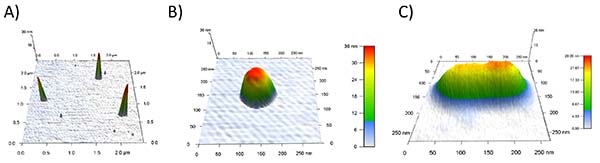
Figure 1. AFM imaging of beads and VSV on the functionalized PEGG surface. AFM scan of 36 nm biotinylated beads (A, B) and a VSV virion (C) anchored to the surface with a biotinylated VSVG antibody. AFM was done in AC air topography scan mode. The tip radius is <25 nm and measurements were carried out under force modulation and light tapping. The tip had a force constant of 3 N/m and resonant frequency 75 kHz with uncertainty of 15 kHz. While the beads retained their height during the AFM scan, the VSV virion has a significantly smaller young’s modulus and is significantly deformed in height. In this image the virion was specifically imaged with a stiff cantilever in tapping mode which produced a small xy convolution (used to determine the tip vs blunt end of the virus) and the height difference between the tip and blunt end of the virus is used to detect extra protein density at the blunt end of the virus19.
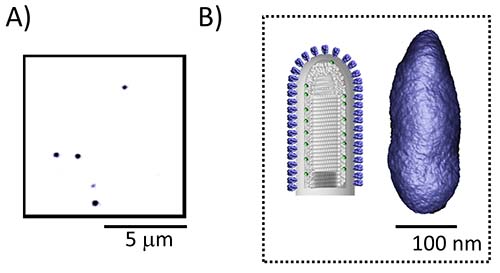
Figure 2. Fluorescence based imaging of VSV virions on the PEGG functionalized surface. A) recombinant VSV virions immobilized on the PEGG surface using a biotinylated anti VSVG antibody imaged in wide field fluorescence. B) High resolution fluorescence reconstruction of the envelope of VSV attached to the PEGG surface through a biotinylated anti VSVG antibody and decorated with Alexa 647 labeled anti-VSVG antibodies (Method 5A was used for creating these images). The blue surface is a 2D isosurface projection. Left shows a model of the bullet shaped virus.
| Coverslip Size | Fluid |
| 40 mm | 65 µl |
| 35 mm | 50 µl |
| 30 mm | 36 µl |
| 25 mm | 25 µl |
| 20 mm | 16 µl |
Table 1. Fluid aliquots according to coverslip size.
Discussion
Single virion imaging with AFM and High-resolution fluorescence imaging can be used as an alternative methodology to CryoEM tomography. Each one of these methodologies has their specific strengths. For example AFM can be done on WT virions with no requirement on tagging the sample or the internal viral proteins. The location of viral structures is deconvolved from their contributions to the elastic properties of the virion.
Single virion super-resolution imaging in combination with the newly developed viral reverse genetic approaches becomes a powerful technique for localizing low copy number viral proteins20. Recombinant viruses with replacement of their proteins with proteins fused to fluorescent proteins can be made and purified using these reverse genetic approaches. Although super-resolution imaging has specificity in part due to the genetic tagging, it requires the use of the mutant viruses.
AFM and super-resolution imaging are complimentary methods that utilize very similar sample preparations. The methods outlined in this paper, which are adopted form earlier single molecule imaging assays, allow anchoring of single virions with little effects on the topology of the virions.
Disclosures
The authors have no competing financial interests in this paper.
Acknowledgements
We thank Dr. Till Böcking for the original single molecule preparation protocol. This work was supported by NSF grant 1121972(SS).
Materials
| Name | Company | Catalog Number | Comments |
|---|---|---|---|
| Glass coverslips (fPALM) | Electron Microscopy Services | 72225-01 | 25 mm Coverslips |
| PLL(20)-g[3.5]-PEG(2)/PEG(3.4)-Biotin (20%) | SuSoS | - | Stock: 0.5 mg/ml in PBS |
| NeutrAvidin biotin-binding protein | Invitrogen | A2666 | Stock: 0.25 mg/ml in PBS |
| Alexa Fluor 647 goat anti-rabbit IgG (H+L) | Invitrogen | A21245 | 1:200 in 0.2 M KPO4, 0.15 M NaCl, 10% Glycol, pH 7.2 buffer |
| α-VSV-G | Invitrogen | ab34774 | 1:200 in 0.2 M KPO4, 0.15 M NaCl, 10% Glycol, pH 7.2 buffer |
| Gluox | Sigma | G2133-250KU | Glucose oxidase type seven from Aspergillius |
| Catalase | Sigma | C40-100mg | Catalase from Bovine liver |
| MEA | Sigma | 30070-10G | Cysteamine (MEA |
| Stock Buffer | 50 mM Tris-HCl (pH 8.0) + 10 mM NaCl + 10% glucose | ||
| NTE | 10 mM Tris pH 7.4, 100 mM NaCl, 66 mM EDTA | ||
| Slide-A-Lyzer, mini dialysis unit | Thermo Scientific | 10,000 MW | |
| Microscope Cover Glass: 35 CIRCLE #1 | Fisherbrand | 35 CIRCLE #1 |
References
- Pang, H. -B., et al. Virion stiffness regulates immature HIV-1 entry. Retrovirology. 10, 4(2013).
- Kol, N., et al. A Stiffness Switch in Human Immunodeficiency Virus. Biophys. J. 92, 1777-1783 (2007).
- Ortega-Esteban, A., et al. Minimizing tip–sample forces in jumping mode atomic force microscopy in liquid. Ultramicroscopy. 114, 56-61 (2012).
- Ortega-Esteban, A., et al. Monitoring dynamics of human adenovirus disassembly induced by mechanical fatigue. Sci. Rep. 3, (2013).
- Hernando-Pérez, M., et al. Physical Virology: Direct Measurement of Phage. phi29 Stiffness Provides Evidence of Internal Pressure (Small 15/2012). Small. 8, 2365-2365 (2012).
- Carrasco, C., et al. DNA-mediated anisotropic mechanical reinforcement of a virus. Proc. Natl. Acad. Sci. U.S.A. 103, 13706-13711 (2006).
- Sofia, S. J., Premnath, V. V., Merrill, E. W. Poly(ethylene oxide) Grafted to Silicon Surfaces: Grafting Density and Protein Adsorption. Macromolecules. 31, 5059-5070 (1998).
- Visnapuu, M. -L., Duzdevich, D., Greene, E. C. The importance of surfaces in single-molecule bioscience. Mol. Biosyst. 4, 394-403 (2008).
- Elenko, M. P., Szostak, J. W., Van Oijen, A. M. Single-molecule binding experiments on long time scales. Rev. Sci. Instrum. 81, (2010).
- van Oijen, A. M., et al. Single-Molecule Kinetics of λ Exonuclease Reveal Base Dependence and Dynamic Disorder. Science. 301, 1235-1238 (2003).
- Böcking, T., Aguet, F., Harrison, S. C., Kirchhausen, T. Single-molecule analysis of a molecular disassemblase reveals the mechanism of Hsc70-driven clathrin uncoating. Nat. Struct. Mol. Biol. 18, 295-301 (2011).
- Cocucci, E., Aguet, F., Boulant, S., Kirchhausen, T. The First Five Seconds in the Life of a Clathrin-Coated Pit. Cell. 150, 495-507 (2012).
- Rust, M. J., Bates, M., Zhuang, X. W. Sub-diffraction-limit imaging by stochastic optical reconstruction microscopy. 3, 793-795 (2006).
- Betzig, E., et al. Imaging intracellular fluorescent proteins at nanometer resolution. Science. 313, 1642-1645 (2006).
- Hess, S. T., Girirajan, T. P. K., Mason, M. D. Ultra-High Resolution Imaging by Fluorescence Photoactivation Localization Microscopy. Biophys. J. 91, 4258-4272 (2006).
- Juette, M. F., et al. Three-dimensional sub-100 nm resolution fluorescence microscopy of thick samples. Nat. Methods. 5, 527-529 (2008).
- Xu, K., Zhong, G., Zhuang, X. Actin, Spectrin, and Associated Proteins Form a Periodic Cytoskeletal Structure in Axons. Science. 339, 452-456 (2013).
- Huang, B., Wang, W., Bates, M., Zhuang, X. Three-Dimensional Super-Resolution Imaging by Stochastic Optical Reconstruction Microscopy. Science. 319, 810-813 (2008).
- Hodges, J., et al. Asymmetric packaging of polymerases within vesicular stomatitis virus. Biochemical and Biophysical Research Communications. 440, 271-276 (2013).
- Lawson, N. D., Stillman, E. A., Whitt, M. A., Rose, J. K. Recombinant vesicular stomatitis viruses from DNA. Proc. Natl. Acad. Sci. U.S.A. 92, 4477-4481 (1995).
Reprints and Permissions
