Most studies involving the Langendorff apparatus use small animal models due to the increased complexity of systems for larger mammals. We describe a Langendorff system for large animal models that allows for use across a range of species, including humans, and relatively easy data acquisition.
Method Article
An Isolated Working Heart System for Large Animal Models
In This Article
Summary
Abstract
Since its introduction in the late 19th century, the Langendorff isolated heart perfusion apparatus, and the subsequent development of the working heart model, have been invaluable tools for studying cardiovascular function and disease1-15. Although the Langendorff heart preparation can be used for any mammalian heart, most studies involving this apparatus use small animal models (e.g., mouse, rat, and rabbit) due to the increased complexity of systems for larger mammals1,3,11. One major difficulty is ensuring a constant coronary perfusion pressure over a range of different heart sizes – a key component of any experiment utilizing this device1,11. By replacing the classic hydrostatic afterload column with a centrifugal pump, the Langendorff working heart apparatus described below allows for easy adjustment and tight regulation of perfusion pressures, meaning the same set-up can be used for various species or heart sizes. Furthermore, this configuration can also seamlessly switch between constant pressure or constant flow during reperfusion, depending on the user’s preferences. The open nature of this setup, despite making temperature regulation more difficult than other designs, allows for easy collection of effluent and ventricular pressure-volume data.
Introduction
Much of our understanding of basic cardiac biology and physiology has come from experiments that utilized the isolated, retrograde-perfused Langendorff heart and the isolated working heart systems. These experimental systems are still widely used today to extend our cardiovascular knowledge of important topics, including ischemia-reperfusion injury2, preconditioning4, cell based therapy for damaged myocardium5,7, the cardiac effects of drugs6,9, and cardiac allograft preservation techniques8,15-18.
While both isolated heart systems can be used for any mammalian species, they are primarily used on small mammals, such as guinea pig, rat, or rabbit3,12,13. Larger animal models, such as pigs and humans, provide more clinically-relevant data, but are less frequently used due to higher cost, greater biological variability, larger volumes of blood perfusion solutions, and bigger pieces of equipment1,12-15. Furthermore, data collection is more difficult, especially for isolated working hearts1,3,12-15. As a result of these complexities, clinically-relevant isolated heart models are rarely used, severely hampering the progress of cardiovascular translational research.
In an attempt to resolve these complexities, the isolated working heart preparation was modified to create a system that can be easily adapted to hearts of different species, including human, under either constant pressure or constant flow Langendorff conditions. The afterload compliance chamber was replaced with a centrifugal pump to simplify the process of adjusting perfusion pressure in Langendorff mode and afterload in working mode. Instead of an enclosed, jacketed reservoir to contain the heart, this system uses an open chamber to make data collection easier, by enabling use of the transapical approach for conductance catheterization. Moreover, this open design allows access for echocardiographic assessment of the heart, further broadening the physiologic parameters that can be measured during these experiments. These improvements will hopefully encourage others to use this system for large animal translational research.
Protocol
1. Building the Langendorff Apparatus (See Figure 1)
- Using 3/8” tubing, connect the heart reservoir to the blood reservoir.
- Ensure that this tubing goes through a roller pump. NOTE: This may require using two 3/8” to 1/4" tubing connectors to create a piece of 1/4" tubing to go through the roller pump.
- Connect the blood reservoir to heater/oxygenator with 3/8” tubing.
- Use 3/8” tubing to connect the heater/oxygenator to a Y-connector.
- Connect one arm of Y-connector to the centrifugal pump, then connect the centrifugal pump to a second Y-connector (all with 3/8” tubing).
- Attach a piece 3/8” tubing securing a hemostasis valve to the upward-facing arm, which will serve as both a bubble trap and means of inserting the pressure transducer.
- Attach a piece of 3/8” tubing to the downward arm. This portion will attach to the aortic cannula (i.e. the afterload line).
- Connect the other arm of the Y-connector to the inflow of the pre-load chamber using 3/8” tubing. Ensure this tubing goes through a second roller pump.
- Connect excess 3/8” tubing to the outflow of this chamber. This portion will attach to the left atrium (i.e. the preload line).
- Connect the oxygen tank and heating apparatus to the heater/oxygenator.
- Clamp the line going from the Y-connector to the pre-load chamber, as this line will not be used until the heart is put into working mode.
2. Pressure-Volume Catheter Preparation
- In a 37 °C water bath, warm a bottle of saline solution.
- Soak the PV conductance catheter and pressure transducer in the warm saline for at least 30 min.
- Turn on the data acquisition systems, allowing both to warm-up for at least 30 min.
3. Preparing the Langendorff Apparatus
- Turn on the oxygen tank, heating apparatus, roller pump connecting the two reservoirs, and centrifugal pump. The heating apparatus should be set to the animal’s body temperature (~36 °C).
- Wash the blood according to manufacturer’s instructions. Slower wash speeds are recommended for more complete removal of waste products from the blood (e.g., excess electrolytes, lysed cellular material).
- Once the blood is washed, check hematocrit level prior to hemodilution.
- Reconstitute the washed red blood cells with normal saline for desired hematocrit concentration (recommended: 20-25%) and add to the Langendorff apparatus.
- Adjust the speeds of the two pumps to begin blood flow through the system (excluding the preload chamber).
- Check the pH and electrolytes of the blood mixture and adjust until physiologic for the species used. NOTE: To prevent deleterious influx of calcium upon reperfusion, the calcium levels on the Langendorff apparatus should initially be kept low (0.3-0.5 mmol/L).
- If there is a decrease in the hematocrit with concurrent increase in potassium, check lactate dehydrogenase and plasma free hemoglobin to rule out hemolysis.
- In case hemolysis does occur, ensure all connections are tight and there are no areas of obvious sheering.
- Attach the Millar catheter into the Secondary Pressure slot of the PowerLab system.
- Calibrate the pressure transducer according to manufacturer’s instructions.
4. Preparing the Heart for Attachment to the Langendorff Apparatus
NOTE: A properly arrested heart should be used for any large animal experiments involving an isolated heart system. Lack of cardioplegic arrest can damage the heart such that it will not produce measureable work. Celsior, or low-potassium University of Wisconsin (UW) solution is recommended, as not only are these solutions similar to those used clinically, but the low potassium of the solution helps prevents hyperkalemia while on the circuit. Volume of cardioplegic solution will depend on heart size, with 1 liter sufficient for porcine hearts.
- Quickly remove the heart from the storage container, pour out any storage solution in the ventricles, blot dry and weigh.
- To help maintain a cold myocardial temperature until the heart is ready for the Langendorff, return the heart to storage container and orient it so that aorta is facing upwards.
- Insert an 3/8” cannula into the aorta and secure with a zip-tie.
5. Attaching the Heart to the Langendorff
- Decrease the centrifugal pump to a slow trickle.
- Trickle the blood into the aorta until it is filled with blood and completely de-aired.
- Carefully attach the aortic cannula to the aortic tubing on the Langendorff. Make note of attachment time.
- Insert the calibrated pressure transducer through the hemostasis valve[DS1] into the native aorta.
- Begin pressure measurements and adjust centrifugal pump speed until desired reperfusion pressure is achieved. NOTE: Pressure may change as coronary resistance changes. Therefore, monitor aortic pressure closely, especially during initial reperfusion.
- Increase temperature on warming unit intramyocardial temperature is measured at 37 °C. NOTE: There will be a delay between adjustments made to warming unit and changes in intramyocardial temperatures. Therefore, temperature changes should be made incrementally.
- Obtain a baseline (T = 0) sample from the venous blood reservoir to measure pH, electrolytes, and other biochemical measurements.
- Insert temperature probe into septum and monitor myocardial temperature. Decrease temperature of warming unit if myocardial temperature rises above 39 °C.
- Take blood samples every 15 min, adjusting the physiologic parameters as desired for the experiment.
- Add approximately 1 mmol of calcium to the blood solution every 5 min, ensuring that ionic calcium is > 0.8 mmol/L prior to the initiation of working mode.
6. Putting the Heart into Working Mode
- Insert an appropriately sized cannula into the left atrium/pulmonary vein. This can be done with either a purse-string suture or zip-tie as appropriate.
- Close any holes in the left atrium that may leak, such as other pulmonary vein origins with suture or staples as needed.
- Adjust the height of the preload chamber such that the column height gives the desired preload pressure. NOTE: Assuming the density of blood/crystalloid mixture is equal to the density of water, 1 mmHg = 1.36 cm of the distance from the aortic valve to the top of the blood level in the preload reservoir (e.g., 15 mmHg = 20.4 cm).
- Unclamp the tubing going to the preload chamber and slowly start the preload roller pump, allowing the preload chamber and preload tubing to fill completely with blood.
- Once the preload tubing is completely de-aired, slowly fill the left atrium and cannula with blood.
- Without allowing any air to enter the system, connect the preload tubing to the left atrial cannula.
7. Obtaining Ventricular Pressure-Volume (PV) Recordings
- Follow the manufacturer’s instructions for pressure and Rho cuvette calibration for the data acquisition systems.
- Place a purse-string suture using a 3-0 polypropylene suture at the left ventricular (LV) apex.
- Using a 16 G needle, make a stab incision within the purse-string.
- Insert the PV conductance catheter into the apical incision. NOTE: Ideal catheter placement will depend on having all sensing electrodes within the LV and two excitation electrodes outside the LV. Ensure that a properly sized animal and catheter have been selected (see Discussion).
- Press the “Start” button in the top right corner to begin recording data and determine how many volume segments are active.
- If all segments are not active, adjust the catheter position until all segments are active. NOTE: Slight twisting of the catheter may be necessary to optimize loop morphology
- If unable to obtain signals in all segments, adjust the location of excitation electrodes and sensing electrodes per manufacturer instructions.
- Once the desired configuration is obtained, follow the manufacturer’s instructions for volume and alpha calibration.
- Using a properly calibrated catheter, obtain at least 30 sec of baseline pressure-volume data. NOTE: These pressure-volume loops will provide volume dependent measurements of cardiac function (e.g., cardiac output, stroke volume).
- Once sufficient loops are obtained, continue to the next step without stopping the data recording, so as to obtain occlusion pressure-volume data.
- Occlude the preload tube slowly using a tubing clamp. NOTE: The pressure-volume loops should begin to become smaller and shift down and to the left. This is called the “walk down”.
- Obtain 10-15 sec of the walk down, then release the tubing clamp to allow for preload to reenter the left atrium. NOTE: These pressure-volume loops will provide volume independent measurements of cardiac function (e.g., preload recruitable stroke work, end systolic pressure-volume relationship).
- Stop recording data by hitting the “Stop” button at the top right corner of the screen.
- Wait at least 5 min before repeating the occlusion.
- Repeat steps 7.7 and 7.8 to obtain replicate measurements.
Results
Figure 1 is a schematic drawing of the circuit, including suggested catheter placement. The important elements of this apparatus include the following: use of a centrifugal pump to control afterload; placement of a pressure catheter (dark blue line) in the aortic root to monitor perfusion pressure; and placement of the pressure-volume (PV) catheter (light blue line) transapically. Although the connections in the figure appear to be straight connections, “Y” connectors are recommended, especially for the preload line.
Figure 2 shows the data obtained from the pressure transducer that is placed in the aortic root of a porcine heart during reperfusion on the circuit, which is consistently between 40-42 mmHg for over 20 min. Changes in the coronary resistance can cause fluctuations in the perfusion pressure (Figure 3). These variations can be minor and gradual, correcting themselves over time (Figure 3a). However, in some cases these variations can be abrupt and require adjustment of the flow through the centrifugal pump to maintain the desired reperfusion pressure (Figure 3b). Because changes can occur, monitoring of the aortic root pressure during reperfusion is required.
By utilizing the transapical stab incision, pressure-volume data can be easily obtained on the isolated heart system. In this experiment, a porcine heart that had been stored in cold (4 °C) preservation solution for 2 hr was used. Upon initial introduction of the PV catheter, the loops were of poor quality (Figure 4a), with multiple areas of crossover and no discernible cardiac cycle components. However, with minimal manipulation of the catheter within the ventricle, the loop morphology improved dramatically (Figure 4b), allowing for measurements to be obtained.
Despite optimization of catheter position, the loops acquired on the ex vivo circuit (Figure 5, top row) may have a different morphology than the in vivo loops (Figure 5, bottom row). These changes to loop morphology are likely due to the different orientation of the heart on the circuit compared to in a supine animal, as well as the lack of the anatomical attachments found within a live animal (such as pericardium). Furthermore, the use of pacing wires to help regulate heart rate (recommended attachment site: interventricular septum) introduces an external electrical current, leading to the spikes seen in the bottom right portion of the ex vivo loops. However, as long as these loops still feature the cardiac cycle components, they can still yield interpretable data. Table 1 lists the multiple functional parameters obtained from these pressure-volume loops using the PV catheter. The cold static storage likely caused some intrinsic damage to the heart, which helps explain some of the changes in the values obtained on the circuit compared to the in-vivo measurements. Some of the variation within the load dependent variables is also due to the likely differences in the preload between the circuit and the live animal.

Figure 1. Diagram of apparatus.

Figure 2. Representative aortic root pressure measurements during reperfusion.
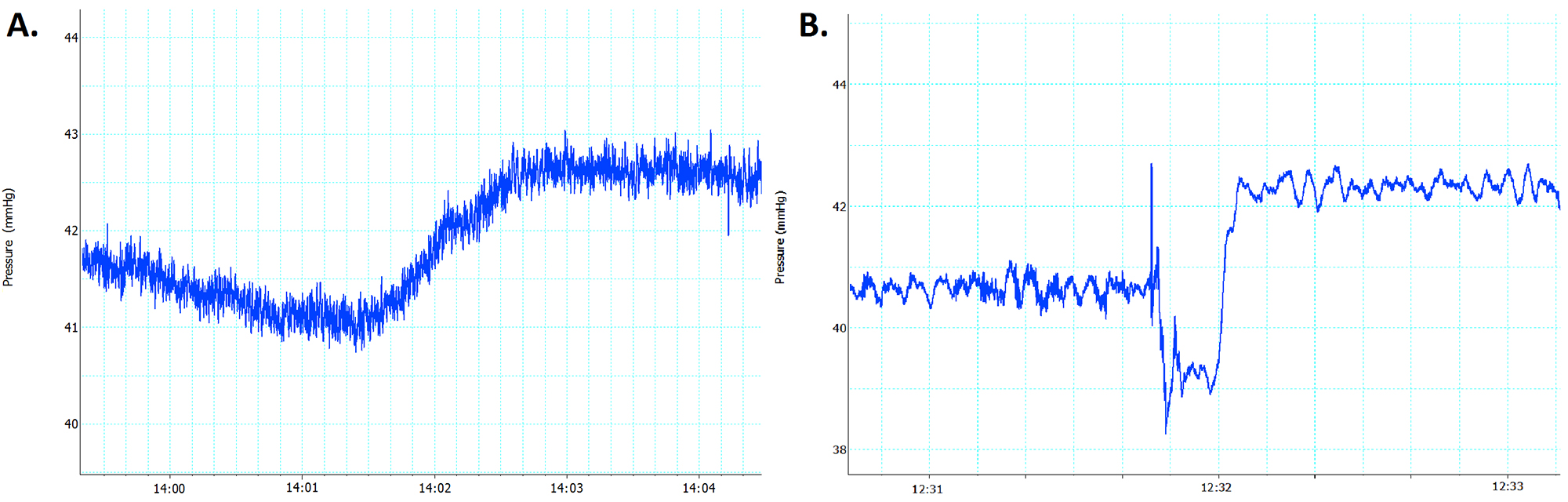
Figure 3. Examples of changes to aortic root pressure that may occur during reperfusion. These changes can be gradual and self-correcting (A), or abrupt and require changes to the settings on the centrifugal pump (B).
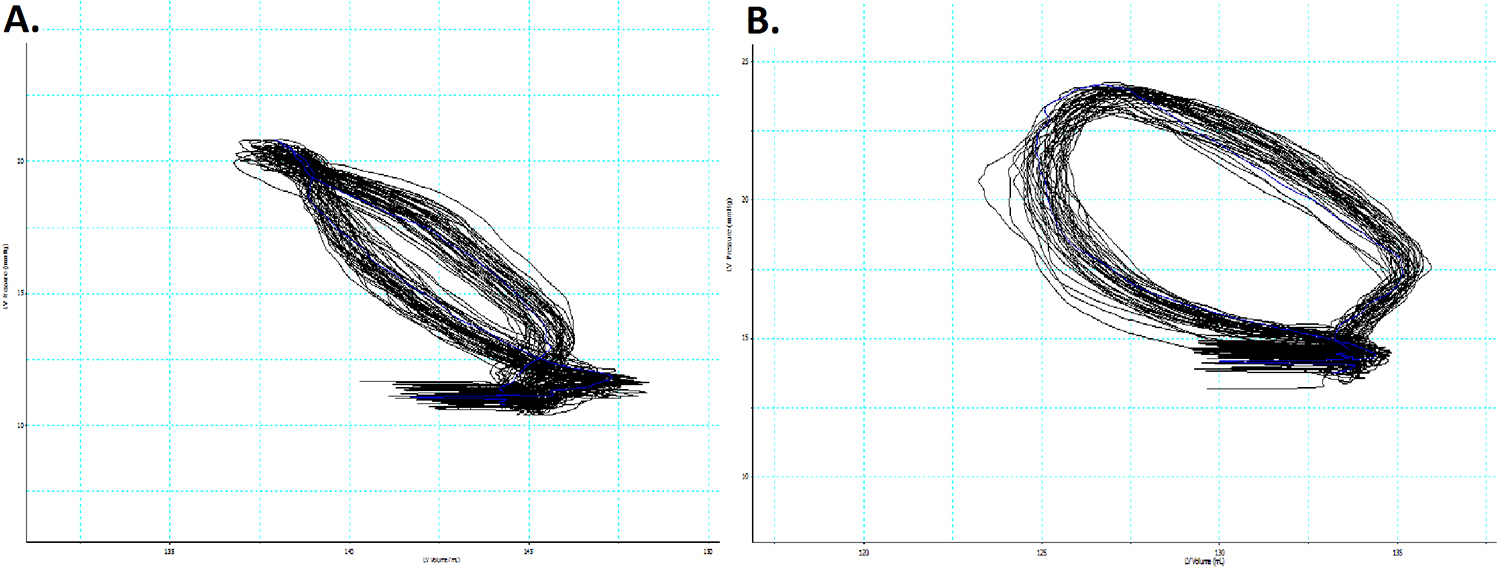
Figure 4. Pressure-volume loops obtained upon initial insertion of the catheter transapically (A) and after minor catheter manipulation (B). Note the improvement of the loop morphology, whereby the loop crossover is eliminated and the elements of the cardiac cycle are recognizable. The spikes in the bottom right portion of both sets of loops are due to the use of a pacer, which introduces an extrinsic electric signal.

Figure 5. Representative pressure-volume measurements taken on the ex vivo circuit (top row), with in vivo measurements (bottom row) for comparison. Again, pacer spikes can be seen in the bottom right of both sets of ex vivo loops.
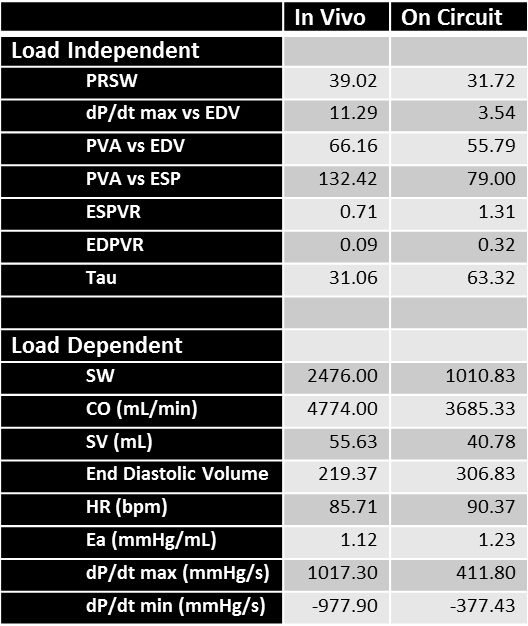
Table 1. Functional parameters obtained for a porcine heart in vivo (left column) and on the working heart apparatus after 2 hr of cold storage (right column). CO: cardiac output; Ea: arterial elastance; EDPVR: End diastolic pressure-volume relationship; EDV: end diastolic volume; ESPVR: End systolic pressure-volume relationship; PRSW: Preload-recruitable stroke work; PVA: pressure-volume area; SV: stroke volume; SW: stroke work.
Discussion
The Langendorff isolated heart perfusion apparatus and working heart model have led to some of the most fundamental discoveries in cardiac physiology, pathology, and pharmacology. This model’s versatility allows for its use with a variety of species under a variety of normal and pathological conditions1-18. However, the isolated heart model is not commonly used for large mammals, especially human hearts, in part due to the increased complexity of both apparatus design and data collection. Therefore, the protocol presented herein demonstrates an attempt to improve these complexities that results in a relatively reproducible means of studying isolated porcine hearts.
A crucial component of our setup is the replacement of arterial compliance/afterload chamber with a centrifugal pump. This exchange allows for enhanced control of the coronary perfusion pressure and afterload in Langendorff and working heart modes, respectively, allows this set-up to be easily adapted to hearts of different sizes and species. For example, in this design, porcine hearts are reperfused at 40-45 mmHg, while human hearts are reperfused at 60-65 mmHg. This change in pressure is achieved simply by adjusting the settings of the centrifugal pump; no component of the system needs to be physically adjusted. Furthermore, placing a pressure transducer within the aortic root to monitor root pressures enables easy transition between constant flow and constant pressure during Langendorff mode. Although this change removes the classic compliance chamber, the centrifugal pump, by allowing bidirectional flow occurs based upon the pressure gradient, may serve as a compliance chamber. With systole and ejected stroke volume, retrograde flow across the pump serves to diminish afterload pressure, replicating aortic elasticity.
The open design of this apparatus is also important. Having the heart hanging in an open area, instead of a semi-enclosed chamber or funnel, allows for easier instrumentation for pressure-volume measurements. The open design enables use of a transapical incision for LV catheter placement, avoiding of the transvalvular approach. The transvalvular approach is more technically difficult, and usually requires fluoroscopy for proper placement. Furthermore, this approach can also induce valvular insufficiency. By using the transapical approach, we safely and easily place the catheter within the left ventricle while eliminating the extra cost and inconvenience of fluoroscopy. The open design also affords easy access for echocardiography and effluent collection, further expanding the functional and biochemical parameters that can be assessed while on this system.
The open design, while facilitating data collection, does make myocardial temperature regulation more difficult. Maintaining physiologic temperature is one of the known issues with a Langendorff or working heart system1,3,11,13. The Langendorff system typically contains a thermal chamber that helps maintain a proper temperature, but this chamber also makes insertion of a ventricular pressure-volume catheter more difficult. To resolve the inferior temperature regulation of the open design, an oxygenator/heat exchanger was placed after the reservoir. The minimal space between the heat exchanger and the aortic cannula reduces heat loss, and the myocardial temperature probe ensures normothermia. The use of jacketed tubing or external heating sources can also be used to help with temperature control.
Another unique element of this protocol is washing the autologous blood of the pig under study and reconstituting it with normal saline. Although, the use of either whole blood perfusates or red blood cells augmented with crystalloid buffers is not uncommon, it does present with issues. The former usually requires a donor animal, which adds substantial costs to the experiment, while the latter can have immunogenicity issues, since it usually is derived from bovine blood1,11-13. By washing the original pig’s own blood, the protocol only requires a single animal and immunogenicity issues are ablated. Also, the washing process removes most of the electrolytes, meaning they can be easily manipulated per the experimental parameters. Finally, using a blood conservation unit removes most of the proteins within the blood, which is both an advantage and disadvantage of this process. The advantage is that any coagulation and immunologic/infectious proteins are removed, decreasing the likelihood of clots or contamination. The disadvantage is that this mixture has a low oncotic pressure, which can to lead to myocardial edema and possibly loss of cardiac function over time. This issue can be addressed, however, through the addition of albumin or another colloid.
Ensuring that a properly sized animal and catheter have been selected is as important as using the proper working heart apparatus. Ideally, the catheter will be placed with all sensing electrodes inside the ventricular space, with two excitation electrodes (i.e. the most proximal electrodes) outside of the ventricular space. If the animal’s ventricular cavity is too small, or the spacing between the electrodes is too large, then all segments will not fit within the LV space. While the location of the excitation electrodes can be adjusted, a small LV cavity can also cause the catheter to bend or curve, making data collection difficult. Therefore, for functional analysis of large animal hearts, an animal size of at least 60 kg is recommended. With an animal of this size, electrode spacing of 7 mm usually allows for complete insertion of the catheter.
In conclusion, this manuscript describes an isolated working heart system that simplifies perfusion pressure regulation, data collection, and overall design, while making temperature control only slightly more difficult. These modifications to the isolated working heart will hopefully allow for its increased usage with large mammalian hearts, including humans, furthering our understanding of cardiac pathology and enabling more clinically-relevant treatment options to be discovered.
Disclosures
The authors have nothing to disclose.
Acknowledgements
There are no acknowledgments.
Materials
| Name | Company | Catalog Number | Comments |
|---|---|---|---|
| PowerLab 16/35 with LabChart Pro | ADInstruments | PL3516/P | |
| MPVS Ultra Pressure-Volume Unit | ADInstruments | 880-0168 | |
| Ventri-Cath Catheter (5F, 12E, 7 mm, DField, Straight, 122 cm) | Millar | VENTRI-CATH-507s | |
| Pressure Catheter (3.5F, Single, Straight, 100 cm, Ny, Non Repairable) | Millar | SPR-524 | |
| PV Extension Cable (10 ft) | ADInstruments | CEC-10PV | |
| Catheter Interface Cable (10 ft) | ADInstruments | PEC-10D | |
| Rho Calibration Cuvette | ADInstruments | 910-1060 | |
| MPVS Ultra BNC Cable Pack | ADInstruments | 880-0172 | |
| Autotransfusion system | Sorin | 7320000 | |
| Bowl Set with Low Volume (135 ml) Centrifuge Bowl | Sorin | 7135100 | |
| Oxygenator/Heat Exchanger | Terumo | 3CXSX18RX | |
| Perivascular flow probe | Transonic Systems | PAU Series | Size of flow probe will depend on animal size; for 60 kg pig, recommend 20 or 24 mm probe |
| Perivascular flowmeter module | Transonic Systems | TS420 | |
| Myocardial temerpature sensor | Smiths Medical | MTS-40015 | |
| 16 G 1" Regular needle | BD Inc. | 305197 | |
| 4-0 polypropylene suture (double-arm) | Ethicon | 8526H | For purse-string stitches |
| 2-0 polypropylene suture (single-arm) | Ethicon | 8833H | |
| Cable ties | ULINE | S-1021 | |
| Cable tie gun | ULINE | H-241 | |
| Clear, Flexible PVC Tubing | VWR International | 89068 | Inner diameter depends on cannulas, pumps and other equipment used; most commonly use 1/4", 3/8" tubing |
| Straight Tubing Connectors | VWR International | 46600 | |
| Y-Shaped Tubing Connectors | Thermo Scientific | 6152 | |
| Jacketed Bubble Trap | Radnoti | 14040 | For preload chamber |
| Centrifugal pump | Maquet | 70105 | The centrifugal pump and roller pumps were obtained used from perfusion department after clinical use. |
| Roller pumps | Maquet | HL-20 | |
| Hemostasis Valve | Merit Medical | MAP150 | |
| Blood gas analyzer | Instrumentation Laboratory | 570001000 |
References
- Skrzypiec-Spring, M., Grotthus, B., Szelag, A., Schulz, R. Isolated heart perfusion according to Langendorff---still viable in the new millennium. Journal of Pharmacological and Toxicological Methods. 55, 113-126 (2007).
- Cheung, P. Y., et al. Matrix metalloproteinase-2 contributes to ischemia-reperfusion injury in the heart. Circulation. 101, 1833-1839 (2000).
- Ytrehus, K. The ischemic heart--experimental models. Pharmacological Research: the Official Journal of the Italian Pharmacological Society. 42, 193-203 (2000).
- Ferdinandy, P., Schulz, R. Nitric oxide, superoxide, and peroxynitrite in myocardial ischaemia-reperfusion injury and preconditioning. British Journal of Pharmacology. 138, 532-543 (2003).
- Ohno, N., et al. Transplantation of cryopreserved muscle cells in dilated cardiomyopathy: effects on left ventricular geometry and function. The Journal of Thoracic and Cardiovascular Surgery. 126, 1537-1548 (2003).
- Hamlin, R. L., et al. Sensitivity and specificity of isolated perfused guinea pig heart to test for drug-induced lengthening of QTc. Journal of Pharmacological and Toxicological Methods. 49, 15-23 (2004).
- Lee, M. S., Lill, M., Makkar, R. R. Stem cell transplantation in myocardial infarction. Reviews in Cardiovascular Medicine. 5, 82-98 (2004).
- Ryugo, M., et al. Myocardial protective effect of human recombinant hepatocyte growth factor for prolonged heart graft preservation in rats. Transplantation. 78, 1153-1158 (2004).
- Valentin, J. P., Hoffmann, P., De Clerck, F., Hammond, T. G., Hondeghem, L. Review of the predictive value of the Langendorff heart model (Screenit system) in assessing the proarrhythmic potential of drugs. Journal of Pharmacological and Toxicological Methods. 49, 171-181 (2004).
- Southworth, R., Blackburn, S. C., Davey, K. A., Sharland, G. K., Garlick, P. B. The low oxygen-carrying capacity of Krebs buffer causes a doubling in ventricular wall thickness in the isolated heart. Canadian Journal of Physiology and Pharmacology. 83, 174-182 (2005).
- Bell, R. M., Mocanu, M. M., Yellon, D. M. Retrograde heart perfusion: the Langendorff technique of isolated heart perfusion. Journal of Molecular and Cellular Cardiology. 50, 940-950 (2011).
- Hearse, D. J., Sutherland, F. J. Experimental models for the study of cardiovascular function and disease. Pharmacological Research: the Official Journal of the Italian Pharmacological Society. 41, 597-603 (2000).
- Sutherland, F. J., Hearse, D. J. The isolated blood and perfusion fluid perfused heart. Pharmacological Research: the Official Journal of the Italian Pharmacological Society. 41, 613-627 (2000).
- Hill, A. J., et al. In vitro studies of human hearts. Ann Thorac Surg. 79, 168-177 (2005).
- Colah, S., et al. Ex vivo perfusion of the swine heart as a method for pre-transplant assessment. Perfusion. 27, 408-413 (2012).
- Ozeki, T., et al. Heart preservation using continuous ex vivo perfusion improves viability and functional recovery. Circ J. 71, 153-159 (2007).
- Garbade, J., et al. Functional, metabolic, and morphological aspects of continuous, normothermic heart preservation: effects of different preparation and perfusion techniques. Tissue engineering. Part C, Methods. 15, 275-283 (2009).
- Poston, R. S., et al. Optimizing donor heart outcome after prolonged storage with endothelial function analysis and continuous perfusion. Ann Thorac Surg. 78, 1362-1370 (2004).
Reprints and Permissions
