Removable poly(methyl methacrylate) (PMMA) dentures are prone to bacterial adherence and plaque formation. Denture plaque-associated infection is a source of serious dental and medical complications in the elderly. This paper introduces a novel protocol to treat PMMA dentures with 2-methacryloyloxyethyl phosphorylcholine polymer, poly(MPC-co-BMA-co-MPAz), to suppress plaque deposition on PMMA dentures.
A subscription to JoVE is required to view this content. Sign in or start your free trial.
Method Article
2-Methacryloyloxyethyl Phosphorylcholine Polymer Treatment of Complete Dentures to Inhibit Denture Plaque Deposition
In This Article
Summary
Abstract
Removable dentures made of poly (methyl methacrylate) (PMMA) are prone to bacterial adherence and dental plaque formation, which is called denture plaque. Denture plaque-associated infection is a source of serious dental and medical complications in the elderly. 2-Methacryloyloxyethyl phosphorylcholine (MPC) is a well-known biomedical material that exhibits marked antithrombogenicity and tissue compatibility because of its high resistance to protein adsorption and cell adhesion. Therefore, MPC polymer coatings are suggested to have the potential to inhibit plaque deposition on the surface of PMMA dentures. However, coating MPC polymer on the surface of a PMMA denture is a complex procedure that requires specialized equipment, which is regarded as a major barrier to its clinical application.
Here, we introduce a new MPC polymer treatment procedure that uses poly (MPC-co-BMA-co-MPAz) (PMBPAz) to prevent denture plaque deposition on removable dentures. This procedure enables the MPC coating of PMMA denture surfaces in a simple and stable manner that is resistant to various chemical and mechanical stresses due to the MPC layer of PMBPAz that is covalently bound to the PMMA surface by ultraviolet light irradiation. In addition, the procedure does not require any specialized equipment and can be completed by clinicians within 2 min. We applied this procedure in a clinical setting and demonstrated its clinical utility and efficacy in inhibiting plaque deposition on removable dentures.
Introduction
Oral healthcare plays an important role in the prevention of opportunistic infections and aspiration pneumonia in the physically vulnerable elderly. Oral healthcare, consisting of brushing after each meal, cleaning dentures, and receiving professional oral health care, plays a vital role in reducing the incidence of such diseases1-3. In particular, poor oral hygiene is strongly associated with aspiration pneumonia in the physically vulnerable elderly. Therefore, more attention should be paid to the oral health care of elderly patients, who have limited ability to clean their dentures by themselves4.
Even in developed countries, the use of acrylic, resin-based removable dentures remains the most common treatment option for edentulous elderly patients5. Given their high water absorption capacity, microporous surface, and hydrophobic nature, acrylic denture bases constructed from polymethyl methacrylate (PMMA) easily accumulate dental plaque on their surfaces, which is called denture plaque.
2-Methacryloyloxyethyl phosphorylcholine (MPC) polymers are well-known biomedical polymeric materials6 that have remarkable antithrombogenicity and tissue compatibility because of their high resistance to protein adsorption and cell adhesion7-11. MPC polymer coatings have been applied in various medical devices to prevent infection12 and have been suggested to have the potential to prevent denture plaque accumulation on PMMA denture surfaces13. The challenge in the clinical application of MPC polymers to PMMA dentures is to reliably bind them to PMMA surfaces in a simple and stable manner. Previously, MPC polymers were reported to be stably bound to PMMA surfaces by a grafting technique and to have the potential to inhibit plaque accumulation. However, the grafting technique is not simple and requires specialized equipment, which makes its clinical application challenging. Here, we describe a new MPC coating procedure that utilizes photoreactive phospholipid polymers-specifically, a photoreactive methacrylate derivative, 2-methacryloyloxyethyl-4-azidobenzoate (MPAz)-synthesized to accomplish a variety of surface modifications of different types of materials. MPAz was co-polymerized with MPC polymers and n-butyl methacrylate (BMA) to yield poly (MPC-co-BMA-co-MPAz) (PMBPAz). PMBPAz can covalently bind to the surfaces of PMMA dentures via activation of the azide groups in MPAz under ultraviolet (UV) light irradiation14. The procedure does not require any specialized equipment and can be completed by clinicians within 2 min. We also applied this procedure in a clinical setting and demonstrated its clinical utility and efficacy in inhibiting plaque deposition on removable dentures.
Access restricted. Please log in or start a trial to view this content.
Protocol
1. Preparation of PMBPAz Solution (Figure 1)
- Synthesize MPC following a previously reported industrial procedure15.
- Synthesize the photoreactive MPC polymer PMBPAz using conventional radical polymerization of MPC, BMA, and MPAz in ethanol, as previously described14.
NOTE: PMBPAz should contain 60%, 30%, and 10% (mol %) of the aforementioned monomer units, respectively. Refrigerate the PMBPAz dissolved in ethanol to prepare a 0.5 wt% solution before use. - Before treating the PMMA surface, allow the PMBPAz ethanol solution to stand for 30 min at room temperature.
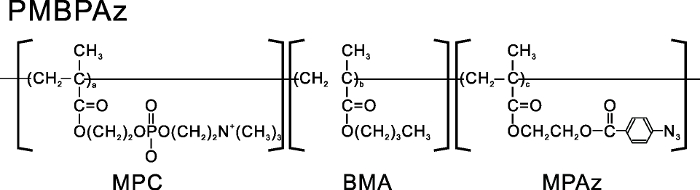
Figure 1. Chemical structural formula of the photoreactive MPC polymer PMBPAz. PMBPAz was constructed using an MPC unit, a BMA unit, and an MPAz unit. Please click here to view a larger version of this figure.
2. PMBPAz Treatment of a Complete PMMA Denture (Figure 2)
- Mechanically clean the denture for 3 min using a denture brush.
- Chemically clean the denture for 5 min in an ultrasonic bath sonicator with a denture cleaner including 2.0% sodium hypochlorite and under the following sonication conditions: frequency, 50/60 Hz; phase number, 1φ; and oscillating frequency, 28 kHz.
- Before performing the surface modification with PMBPAz, wash the denture surface by immersion in ethanol. After the ethanol wash, let the denture surface dry by itself, as ethanol is a volatile compound.
- Apply 1 ml of PMBPAz ethanol solution directly to the entire surface of the denture using a brush applicator. Subsequently, keep the denture at room temperature and atmospheric pressure for 10 min to allow the solvent to evaporate in an ethanol vapor atmosphere. Allow it to dry. Repeat these steps twice.
- Irradiate the denture surface with UV light for 2 min (at 254 nm).
- Immerse the PMBPAz-treated denture in distilled water for 5 min before use.

Figure 2. Fabrication of a surface modified using the photoreactive MPC polymer PMBPAz. The PMBPAz polymer can covalently bind to PMMA by applying UV irradiation. Please click here to view a larger version of this figure.
3. Evaluation of Denture Plaque Deposition
- Use the PMBPAz-treated denture at home for 2 weeks. As a control, repeat the same procedure, excluding the treatment with the PMBPAz.
- After a patient has used the denture for 2 weeks (used about 12 to 14 hr per day), rinse it with tap water to remove any loose food particles, and then stain it with a 0.25% methylene blue disclosing solution for 1 min.
- Clean any stains present on the denture surface in distilled water using an ultrasonic bath sonicator for 30 sec.
- Capture images at a 90° angle on a wax seat with a digital camera by using a white-light system. Capture images with the same focal object distance, exposure time, and intensity of illumination. Capture images from 3 different directions to get mucosal, right, and left polished surface images.
- Calculate the stained area and quantify it using an image analysis software for the entire denture surface16.
- Select the denture area using the "magnetic lasso" tool from the captured denture image. Subsequently, change the red-colored channel to highlight the plaque area from the denture area image. Select all plaque areas using the "magic wand" tool (tolerance level 8) and the "select similar" tool from the denture area.
- Count the total number of pixels for each image. Thereafter, calculate the percentage plaque index of the area covered on the denture from the pixel count of these images (total plaque pixels/total denture surface pixels). Evaluate the statistical differences between the stained areas on the PMBPAz-treated and untreated dentures (ANOVA, p <0.05).
Access restricted. Please log in or start a trial to view this content.
Results
PMBPAz treatment enables the MPC coating of PMMA surfaces through a simple and short method and maintains the plaque inhibition effect of the MPC polymer. This procedure does not require any specialized equipment and can be performed chair-side by clinicians within 2 min. Following protocol step 2, the PMBPAz treatment of removable complete dentures from 11 edentulous patients was successfully conducted in a clinical setting without any substantial problems. The mean percentage plaque ind...
Access restricted. Please log in or start a trial to view this content.
Discussion
Mechanism of the PMBPAz Coating
It is challenging to bind MPC polymers to a PMMA surface in a simple and stable manner. Here, we used a new photoreactive monomer bearing a phenylazide group, MPAz, which polymerizes with other monomers through a conventional free-radical polymerization procedure, resulting in a polymer with phenylazide side chains. The phenylazide groups are decomposed by UV irradiation to form nitrene groups, which are highly reactive radical groups that can covalently bind to al...
Access restricted. Please log in or start a trial to view this content.
Disclosures
We have no disclosures or financial support.
Acknowledgements
The authors wish to thank all of the participants, dentists, and assistants for their participation in this study. We sincerely thank Professor Hirotaka Kuwata and Assistant Professor Hirobumi Morisaki, Department of Oral Microbiology and Immunology, Showa University School of Dentistry, for their support.
Access restricted. Please log in or start a trial to view this content.
Materials
| Name | Company | Catalog Number | Comments |
|---|---|---|---|
| Ultrasonic Cleaner | Aiwa Medical Engineering | AU-12C | Clean in distilled water before stain the denture |
| UVP UV Crosslinker DL-1000 | Funakoshi | 95-0174-03 | UV light irradiation for 2 min before use |
| Lightbox S | Suntec | 6542 | capturing in this box after stain the denture |
| Adobe Photoshop CS6 Extended | Adobe | Calucurate and quantify |
References
- Watando, A., et al. Daily oral care and cough reflex sensitivity in elderly nursing home patients. Chest. 126, 1066-1070 (2004).
- Bassim, C. W., Gibson, G., Ward, T., Paphides, B. M., DeNucci, D. J. Modification of the risk of mortality from pneumonia with oral hygiene care. J. Am. Geriatr. Soc. 56, 1601-1607 (2008).
- Ishikawa, A., Yoneyama, T., Hirota, K., Miyake, Y., Miyatake, K. Professional oral health care reduces the number of oropharyngeal bacteria. J. Dent. Res. 87, 594-598 (2008).
- Hosokawa, R. Prosthodontic interventions for special-needs patients. J Prosthodont Res. 58, 69-70 (2014).
- Parvizi, A., Lindquist, T., Schneider, R., Williamson, D., Boyer, D., Dawson, D. V. Comparison of the dimensional accuracy of injection-molded denture base materials to that of conventional pressure-pack acrylic resin. J. Prosthodont. 13, 83-89 (2004).
- Ishihara, K., Ueda, T., Nakabayashi, N. Preparation of phospholipid polylmers and their properties as polymer hydrogel membranes. Polym. J. 22, 355-360 (1990).
- Ishihara, K., Aragaki, R., Ueda, T., Watenabe, A., Nakabayashi, N. Reduced thrombogenicity of polymers having phospholipid polar groups. J. Biomed. Mater. Res. 24 (8), 1069-1077 (1990).
- Ishihara, K., Ziats, N. P., Tierney, B. P., Nakabayashi, N., Anderson, J. M. Protein adsorption from human plasma is reduced on phospholipid polymers. J. Biomed. Mater. Res. 25 (11), 1397-1407 (1991).
- Ishihara, K., Nomura, H., Mihara, T., Kurita, K., Iwasaki, Y., Nakabayashi, N. Why do phospholipid polymers reduce protein adsorption?. J. Biomed. Mater. Res. 39 (2), 323-330 (1998).
- Ishihara, K. Bioinspired phospholipid polymer biomaterials for making high performance artificial organs. Sci. Technol. Adv. Mater. 1 (3), 131-138 (2000).
- Iwasaki, Y., Ishihara, K. Cell membrane-inspired phospholipid polymers for developing medical devices with excellent biointerfaces. Sci. Technol. Adv. Mater. 13 (6), 064101 (10pp)(2012).
- Zhang, N., Chen, C., Melo, M. A., et al. A novel protein-repellent dental composite containing 2-methacryloyloxyethyl phosphorylcholine. Int J Oral Sci. 7, 103-109 (2015).
- Hirota, K., Yumoto, H., Miyamoto, K., et al. MPC-polymer reduces adherence and biofilm formation by oral bacteria. J Dent Res. 90, 900-905 (2011).
- Fukazawa, K., Ishihara, K. Synthesis of photoreactive phospholipid polymers for use in versatile surface modification of various materials to obtain extreme wettability. ACS Appl. Mater. Interfaces. 5 (15), 6832-6836 (2013).
- Ishihara, K., Ueda, T., Nakabayashi, N. Preparation of phospholipid polymers and their properties as polymer hydrogel membranes. Polym. J. 22 (5), 355-360 (1990).
- Coulthwaite, L., Verran, J. Evaluation of in vivo denture plaque assessment methods. Br Dent J. 207 (E12), 282-283 (2009).
- He, D., Susanto, H., Ulbricht, M. Photo-irradiation for preparation, modification and stimulation of polymeric membranes. Prog Polym Sci. 34, 62-98 (2009).
- Nakayama, Y. Surface macromolecular architectural designs using photo-graft copolymerization based on photochemistry of benzyl N,N-diethyldithiocarbamate. Macromolecules. 29, 8622-8630 (1996).
- Takahashi, N., Iwasa, F., Inoue, Y., Morisaki, H., Ishihara, K., Baba, K. Evaluation of the durability and antiadhesive action of 2-methacryloyloxyethyl phosphorylcholine grafting on an acrylic resin denture base. J. Prosthet. Dent. 112 (2), 194-203 (2014).
Access restricted. Please log in or start a trial to view this content.
Reprints and Permissions
