Bacterial effector proteins are important for establishing successful infections. This protocol describes the experimental identification of proteinaceous binding partners of a bacterial effector protein in its natural plant host. Identifying these effector interactions via yeast two-hybrid screens has become an important tool in unravelling molecular pathogenicity strategies.
Method Article
Unravelling the Function of a Bacterial Effector from a Non-cultivable Plant Pathogen Using a Yeast Two-hybrid Screen
In This Article
Summary
Abstract
Unravelling the molecular mechanisms of disease manifestations is important to understand pathologies and symptom development in plant science. Bacteria have evolved different strategies to manipulate their host metabolism for their own benefit. This bacterial manipulation is often coupled with severe symptom development or the death of the affected plants. Determining the specific bacterial molecules responsible for the host manipulation has become an important field in microbiological research. After the identification of these bacterial molecules, called "effectors," it is important to elucidate their function. A straightforward approach to determine the function of an effector is to identify its proteinaceous binding partner in its natural host via a yeast two-hybrid (Y2H) screen. Normally the host harbors numerous potential binding partners that cannot be predicted sufficiently by any in silico algorithm. It is thus the best choice to perform a screen with the hypothetical effector against a whole library of expressed host proteins. It is especially challenging if the causative agent is uncultivable like phytoplasma. This protocol provides step-by-step instructions for DNA purification from a phytoplasma-infected woody host plant, the amplification of the potential effector, and the subsequent identification of the plant's molecular interaction partner with a Y2H screen. Even though Y2H screens are commonly used, there is a trend to outsource this technique to biotech companies that offer the Y2H service at a cost. This protocol provides instructions on how to perform a Y2H in any decently equipped molecular biology laboratory using standard lab techniques.
Introduction
Yeast two-hybrid screens (Y2H) were developed about 27 years ago1 and have since been widely used in various fields to determine specific protein-protein interactions2,3,4,5,6,7,8,9,10,11. The physical interaction of a bacterial effector with a host target protein is often the precondition for the functional manipulation of this target protein. Analyzing these interactions has moved to the focus of many different sectors of infection biology12,13,14,15,16,17,18. The principle of the Y2H screen is that the interaction of two proteins leads to the reconstitution of a functional transcription factor that drives the expression of reporter genes. The known effector (the "bait") is translationally fused to the DNA binding domain (DBD) of the transcription factor, and the potential interaction partners (the "prey") are fused to the activation domain (AD) of the respective transcription factor. Since the interacting partner is unknown, a library of potential interactors is cloned into the so called "prey-library." Normally, this library is made by cloning cDNAs into an appropriate prey vector expression plasmid encoding the AD that is compatible with the bait-vector encoded DBD. In case of an interaction, the reconstituted transcription factors induce the expression of reporter genes, which generally enable the growth selection of yeast. The identification of interactors is achieved by sequencing the prey plasmid with plasmid-specific primers.
Bacteria have developed various strategies to manipulate and exploit their host's metabolism or to evade defense mechanisms and secrete effector molecules via different bacterial secretion systems19,20,21. Determining the binding partners of these bacterial effectors is thus the first step in identifying the manipulated pathway in the host. This leads to an improved understanding of the specific pathogenicity mechanisms.
Y2H screens are performed to identify bacterial effector interactions during phytoplasmoses, and often, Y2H is a crucial initial experiment for the further characterization of molecular pathogenicity mechanisms in phytoplasma research22,23. However, the method description in most publications is rather scarce, and these techniques are often outsourced to biotech companies. To draw attention to the feasibility of this method, this protocol provides step-by-step information to identify interaction partners of a bacterial effector molecule in its natural host.
Despite the wide use and the fast forward approach of Y2H screens, it must not be forgotten that certain interactions might not occur in the yeast system. This is due to the fact that the yeast cell is used as a kind of "in vivo reaction vessel" with certain biological limitations. Several authors have addressed the advantages and disadvantages of Y2H and its derivatives11,24,25,26,27. General considerations are, for example, that the yeast cell might not provide the appropriate gene expression, (post-)translational, or translocational conditions for the respective proteins being studied. This can lead to false-negative results in the screen. Positive interactions can in turn be artefacts and might not occur in the natural situation (i.e., in case of effectors in the appropriate host). It is thus indispensable to confirm the interactions from the heterologous yeast expression system with an independent interaction test in a more closely related biological system.
In this study, the binding partners of the effector ATP_00189 from the non-cultivable plant pathogen Candidatus Phytoplasma mali (P. mali) were identified. The results provide important insights into the molecular mechanisms underlying the symptom development of apple proliferation28, a disease that causes high economic losses in affected apple-growing regions in Europe29.
Protocol
1. Collecting Root and Leaf Samples from Infected Apple Trees
Note: Pathogen-specific DNA can be purified from roots or leaves. The following section provides a protocol for the sampling of both.
- For DNA preparation
- Sample collection and preparation from the roots
- Identify infected trees with "apple proliferation"-specific symptoms30,31 and control trees that are symptom-free. Using clean secateurs, cut root samples that have a diameter of 0.5 - 1 cm and a length of about 5 cm. Cut samples from three different, distant sites of the root system, and put them into adequately labeled plastic bags.
- Keep the samples in a cold box with chilled thermal packs and store them in the fridge at 4 °C until further processing.
Note: Root architecture and structure can vary with respect to the physiological status of the tree. It is important to sample at three different sites and not to take too-thin rootlets. The samples can be stored for several days at 4 °C, but longer storage times increase the risk of molding. Moldy samples cannot be used for DNA preparation.
- Keep the samples in a cold box with chilled thermal packs and store them in the fridge at 4 °C until further processing.
- Rinse the root samples with water to remove the soil. Put them in a sterile petri dish and use a sterilized scalpel to remove the root epidermis and the cortex.
- Clean the scalpel with a clean, lint-free tissue wipe, dip it in 70% (v/v) ethanol water solution, and heat-sterilize it over an open flame (e.g., Bunsen burner). Scratch the phloem with the scalpel, chop it into small pieces, and aliquot 30 - 100 mg of the chopped phloem into a sterile 2.0 mL reaction tube. Store the samples at -80 °C for several months.
- Identify infected trees with "apple proliferation"-specific symptoms30,31 and control trees that are symptom-free. Using clean secateurs, cut root samples that have a diameter of 0.5 - 1 cm and a length of about 5 cm. Cut samples from three different, distant sites of the root system, and put them into adequately labeled plastic bags.
- Sample collection and preparation from leaves
- Identify an infected and an asymptomatic control tree, as described in step 1.1.1.1, and pick ten unscathed leaves per tree. One tree per condition is sufficient.
- Rinse the leaves with water and clean the surfaces by spraying 70% (v/v) ethanol solution. Put the leaves in a sterile petri dish and dissect the midrib (central vein) of each leaf with a sterile scalpel. Remove the epidermis and cortex from the midrib, cut the midrib into small pieces, and aliquot 100 mg of the midrib tissue into a sterile 2.0-mL reaction tube. Use the samples immediately for DNA preparation or store at -80 °C for several months.
Note: It is convenient to aliquot the plant material in portions of 100 mg and to eventually freeze them for storage. Each aliquot can be directly used for DNA preparation. Weighing deep-frozen plant material is cumbersome, since the frozen plant material tends to form chunks.
- Sample collection and preparation from the roots
2. Cetyltrimethylammonium Bromide (CTAB)-based DNA Preparation
Note: DNA can be purified using any column-based DNA purification method for plant material. In this section, a CTAB-based method for DNA purification is described. DNA purification is performed based on a modified protocol described elsewhere32.
- Prepare the following buffers:
- CTAB buffer: Dissolve 1% w/v cetyltrimethylammonium bromide (CTAB, Mr: 364.45 g/mol), 100 mM trishydroxymethylaminomethane (Tris, Mr: 121.14 g/mL), 1.4 M sodium chloride (NaCl, Mr: 58.44 g/mol), and 20 mM ethylenediaminetetraacetic acid disodium salt (NaEDTA, Mr: 372.24 g/mol) in water and adjust them to pH 8.0.
- N-Lauroylsarcosine buffer: Dissolve 10% w/v N-lauroylsarcosine sodium salt33 (Mr: 293,38 g/mol), 100 mM Tris, and 20 mM NaEDTA in water and adjust the pH to 8.0.
- Tris-EDTA (TE) buffer: Dissolve 10 mM Tris and 1 mM NaEDTA in water and autoclave the solution.
- Ammonium acetate solution: Prepare a 5 M ammonium acetate (Mr: 77,0825 g/mol) solution in water and autoclave it at 120 °C and 1.2 bar for 20 min.
- Mix 30 - 100 mg of fresh or frozen chopped plant material (step 1.1.2.2.) with 300 µL of CTAB buffer, 30 µL of N-Lauroylsarcosine buffer, 6 µL of proteinase K (10 µg/µL), and 12 µL of 2-mercaptoethanol34 (Mr: 78,13 g/mol). Shake for 60 min at 60 °C. Let the mix cool down to room temperature before proceeding.
- Add 360 µL of ammonium acetate solution and mix vigorously. Let the solution sit for 5 min, and then centrifuge it at 15,000 x g for 10 min at room temperature. Transfer the supernatant to a clean vial and add 720 µL of ice-cold isopropanol35. Precipitate the DNA for at least 30 min at -20 °C.
- Centrifuge the mix at 15,000 x g for 30 min at 4 °C and discard the supernatant. Wash the pellet with 500 µL of ice-cold 70% ethanol and spin it down at 15,000 x g for 5 min at 4 °C.
- Discard the ethanol supernatant and immediately dip the vial on a clean paper towel to remove residual droplets. Make sure to remove as much liquid as possible. Air-dry the pellet for 15-20 min or for 2-3 min in a vacuum concentrator centrifuge. Do not over-dry the pellet by excess heating or extended evaporation times.
- Resuspend the pellet in 700 µL of TE buffer and eventually warm it up to 37 °C to facilitate dissolving. Add 10 µL of RNAse (10 µg/µL) and incubate it for 15 min at 37 °C, shaking at 300 rpm.
- Add 700 µL of chloroform:isoamyl alcohol36 24:1 and mix well. Centrifuge the mix at 20,000 x g for 10 min at 4 °C and transfer the upper phase of the supernatant to a new, clean vial.
- Precipitate the DNA in the supernatant by adding 700 µL of 2-propanol35 (isopropanol, Mr: 60.1 g/mol) and incubating for at least 30 min at -20 °C. Centrifuge the mix at 12,000 x g for 30 min at 4 °C and discard the supernatant.
- Wash the pellet with 500 µL of 70% ethanol and centrifuge at 12,000 x g for 5 min at 4 °C. Dry the pellet as described in step 2.5. Dissolve it in 50 µL of TE.
3. Detecting Candidatus Phytoplasma mali-specific DNA by PCR
- Dilute the DNA purified from the plant material 1:10 in nuclease-free water and run a PCR with pathogen-specific primers37.
- Verify the presence of P. mali-specific DNA in the plant material by using a quantitative PCR protocol with primers and specific probes for P. mali phytoplasma37. Check the absence of the other 16SrX phytoplasma members by performing the same PCR with the respective probes for Cand. P. prunorum and for Cand. P. pyri DNA37.
NOTE: DNA from a non-infected tree should be tested as well to confirm the absence of a pathogen in this control. At this step, it is important that DNA from other closely related phytoplasma species is absent in the sample, since that would increase the risk of amplifying the effector from a phytoplasma species other than P. mali. A mixed infection with another closely related P. mali 16SrX group phytoplasma is ruled out by analyzing the sample with the respective probes. Since the expected results should be negative for other 16SrX phytoplasma, it is important to include the proper positive controls that indicate PCR efficacy.
- Verify the presence of P. mali-specific DNA in the plant material by using a quantitative PCR protocol with primers and specific probes for P. mali phytoplasma37. Check the absence of the other 16SrX phytoplasma members by performing the same PCR with the respective probes for Cand. P. prunorum and for Cand. P. pyri DNA37.
4. Amplifying the Potential Effector Gene and Subcloning into the Y2H Bait Vector
- Amplify the phytoplasmal gene atp_00189 (not comprising the signal peptide part) of P. mali using the primers 5ˈ-TCTCCTCCTAAAAAAGATTCTA-3ˈ (forward) and 5ˈ-TATTATTTATCTTTATTTTTTTCCTT-3ˈ (reverse), with restriction sites for EcoRI and SalI at the 5' and the 3' ends, respectively. Purify the PCR product with a column-based DNA purification method.
- Clone the amplicon into the Y2H bait vector pLexA-N via EcoRI and SalI ligation.
NOTE: Here, 100 ng of EcoRI and SalI linearized pLexA-N vector was combined with 15 ng of similarly digested atp_00189 PCR amplicon and 1 U T4-ligase. The ligation was performed in buffer containing 40 mM Tris-HCl (pH 7.9 at 25 °C), 10 mM MgCl2, 10 mM dithiothreitol (DTT, Mr: 154.25 g/mol), and 0.5 mM adenosine triphosphate (ATP, Mr: 507.18 g/mol) in a total volume of 10.0 µL at 16 °C overnight (14-20 h). Analyze the DNA from the uninfected tree with the same primers to rule out unspecific primer binding to Malus x domestica DNA. - Transform 1 µL of the ligation mix into E. coli electrocompetent cells and select for kanamycin-resistant clones on Luria-Bertani (LB) plates supplemented with 50 µg/mL kanamycin sulfate38.
- Purify the plasmid DNA from the selected bacterial clones with a column-based plasmid mini preparation kit following the manufacturer's instructions, and check the successful integration and orientation of the insert by sequencing39.
5. Test for Self-activation (Auto-activation) of the Potential Effector Protein
- Prepare the following buffers and growth media:
NOTE: The nomenclature for yeast-selective plates hyphenates the abbreviations of the missing amino acids in the respective medium with a "-" prior to the abbreviation. For example, SD-trp-leu-his plates contain all amino acids but trp, leu and his.- 10x dropout mix: Weigh 200 mg of L-arginine monohydrochloride (Mr: 210.66 g/mol), 300 mg of L-isoleucine (Mr: 131.17 g/mol), 269 mg of L-lysine monohydrate (Mr: 164.21 g/mol), 200 mg of L-methionine (Mr: 149.21 g/mol), 500 mg of L-phenylalanine (Mr: 165.19 g/mol), 2 g of L-threonine (Mr: 119.12 g/mol), 300 mg of L-tyrosine (Mr: 181.19 g/mol), 200 mg of L-uracil (112.09 g/mol), and 1.5 g of L-valine (Mr: 117.15 g/mol). Dissolve them in 1 L of double-distilled water and autoclave the solution. Keep the solution at 4 °C.
NOTE: The respective dropout mix can be also purchased premixed. - 10x L-adenine supplement: Weigh 100 mg of L-adenine hemisulfate salt (ade, Mr: 184.17 g/mol) and dissolve it in 50 mL of double-distilled water. Filter sterilize the solution with a 0.22-µm pore filter.
- 10x L-histidine supplement: Weigh 100 mg of L-histidine monohydrochloride monohydrate (his, Mr: 209.63 g/mol) in 50 mL of double-distilled water and filter sterilize it with a 0.22-µm pore filter.
- 10x L-leucine supplement: Weigh 500 mg of L-leucine (leu, Mr: 113.17 g/mol) in 50 mL of double-distilled water and filter sterilize it with a 0.22-µm pore filter.
- 10x L-tryptophan supplement: Weigh 100 mg of L-tryptophan (trp, Mr: 204.23 g/mol) in 50 mL of double-distilled water and filter sterilize it with a 0.22-µm pore filter.
- SD-trp-leu-his-ade-medium and plates: Dissolve 0.67% w/v yeast nitrogen base (without amino acids) and 2% w/v D-glucose monohydrate (Mr: 198.17 g/mol) in double-distilled water and autoclave. For agar plates, add 2% w/v agar (microbiological grade) prior to autoclaving.
- To prepare selective plates, add 1x of the amino acid stock solution to the autoclaved Sd-trp-leu-his-ade medium. When preparing plates, make sure that the agar is cooled to ~ 50 °C before adding the amino acids. Keep the stock solutions sterile.
- YPAD medium: Dissolve 1% w/v yeast extract, 2% w/v peptone (microbiological grade), 0.004% w/v adenine hemisulfate salt (Mr: 184.17 g/mol), and 2% w/v glucose monohydrate to double-distilled water and autoclave. For YPAD agar plates, add 2% w/v agar prior to autoclaving. To prepare 2x YPAD, use twice the concentrations of the ingredients mentioned above.
Note: (Optional) Due to the high concentration of glucose in the medium, 2x YPAD medium becomes dark-brownish after autoclaving. As an alternative, a 40% (w/v) glucose stock solution can be prepared and sterilized by passing it through a 0.22-µm filter. The filter-sterilized glucose stock solution is then added to the autoclaved 2x YPAD (lacking glucose) under sterile conditions. To avoid volume errors, the 2x YPAD must be prepared, keeping in mind that a 10x glucose solution is subsequently added. That means that, for example, instead of 1 L of medium, only 900 mL is prepared (containing all ingredients except glucose) and autoclaved, and then 100 mL of glucose stock solution is added.
- 10x dropout mix: Weigh 200 mg of L-arginine monohydrochloride (Mr: 210.66 g/mol), 300 mg of L-isoleucine (Mr: 131.17 g/mol), 269 mg of L-lysine monohydrate (Mr: 164.21 g/mol), 200 mg of L-methionine (Mr: 149.21 g/mol), 500 mg of L-phenylalanine (Mr: 165.19 g/mol), 2 g of L-threonine (Mr: 119.12 g/mol), 300 mg of L-tyrosine (Mr: 181.19 g/mol), 200 mg of L-uracil (112.09 g/mol), and 1.5 g of L-valine (Mr: 117.15 g/mol). Dissolve them in 1 L of double-distilled water and autoclave the solution. Keep the solution at 4 °C.
- Lithium acetate-mediated yeast transformation for testing self-activation
- Streak the Saccharomyces cerevisiae reporter strain NMY5140 (NMY51:MATahis3Δ200 trp1-901 leu2-3,112 ade2 LYS2::(lexAop)4-HIS3 ura3::(lexAop)8-lacZ ade2::(lexAop)8-ADE2 GAL4) from a frozen glycerol stock on a YPAD agar plate and incubate it for 48 h at 30 °C. Pick colonies from this plate and inoculate 50 mL of YPAD medium. Let the yeast grow and measure the OD600 regularly to monitor the growth.
- Let the yeast grow to a final OD600 of 0.5-0.8. Pellet the cells by centrifuging them at 700 x g for 5 min and resuspend them in 2.5 mL of double-distilled, autoclaved water.
- Prepare six aliquots with 100 µL of yeast suspension and add 240 µL of 50% w/v polyethylene glycol 4000 (PEG, Mr: 3,500-4,000 g/mol), 36 µL of 1 M lithium acetate dihydrate (LiOAc, Mr: 102.02 g/mol), and 25 µL of 2% w/v salmon sperm DNA (dissolved). Prepare all reagents with double-distilled, sterile water.
- Label the six vials containing the yeast suspension from "a" to "f" and add the following plasmid vector DNA: negative controls: (a) 1.5 µg of bait plasmid with the effector (pLexA-N-atp0018928), (b) 1.5 µg of empty prey plasmid pGAD-HA41, (c) 1.5 µg of empty bait vector pLexA-N41, and (d) 1.5 µg of empty bait vector pLexA-N and 1.5 µg of empty prey plasmid pGAD-HA; positive controls: (e) 1.5 µg of positive-control bait plasmid DNA pLexA-p5341 and 1.5 µg of positive-prey plasmid pACT-largeT41; and the self-activation test: (f) 1.5 µg of bait plasmid with the effector (pLexA-N-atp00189) and 1.5 µg of empty prey plasmid pGAD-HA.
- Mix the reactions vigorously and incubate them for 45 min at 42 °C in a water bath. Pellet the cells for 5 min at 700 x g and discard the supernatant. Resuspend the cells in 250 µL of 0.9% (w/v) sodium chloride solution (NaCl, Mr: 48.44 g/mol) and spread 50 µL on the following selective plates: SD-trp, Sd-leu, SD-trp-leu, SD-trp-leu-his, and SD-trp-leu-his-ade.
- Incubate the plates for 3 - 4 days at 30 °C. After the first day of incubation, seal the plates with plastic paraffin film to prevent the plates from drying out.
- Check the yeast growth on the plates.
6. Test the Expression of the Effector
- Test the expression of the effector by Western blot42 with an antibody against the Lex-A tag that is coupled at the N-terminus of the effector when expressed from pLexA-N.
Note: Consider that the translationally fused Lex-A tag adds about 24 kDa to the actual weight of the protein of interest. This is important when identifying the protein size in the Western blot.
7. The Y2H Screen
- Streak the pLexA-atp00189 (effector)-transformed NMY51 on a fresh SD-trp plate and let it grow for 2 - 3 days at 30 °C, until red colonies appear.
- Inoculate 3 mL of SD-trp medium in a small shaking flask with a red colony from the agar plate and incubate overnight at 30 °C with shaking at 120 - 150 rpm.
- Inoculate 20 mL of SD-trp in a shaking flask with 1 mL of the overnight culture and let it grow for 8 h.
- Adjust the culture to OD600 = 0.2 by adding SD-trp medium and inoculate 2x 100 mL in shaking flasks with 10 mL of the starter culture each. Grow overnight with shaking at 30 °C.
Note: Make sure that the yeast does not grow to OD600 > 0.5 and dilute with fresh SD-trp. - Measure the OD600 and the pellet 120 OD600 "units." For example, if an OD600 of 1.2 is measured, spin down 100 mL, discard the supernatant, and resuspend the pellet in 800 mL of pre-warmed 2x YPAD in a shaker flask with a magnetic stir bar.
- Spin down a 2-mL aliquot, remove the supernatant, and resuspend the pellet in water. Ensure that the OD600 of the yeast suspension is between 0.15 and 0.2. If not, adjust with 2x YPAD or add more yeast from the overnight culture.
Note: 2x YPAD is dark brown and can affect the results of the OD measurement. Thus, it is necessary to resuspend the yeast cells in water before determining the OD. As an alternative, 2x YPAD can be prepared by sterilizing glucose separately, as described in the step 5.1.8 note, which prevents the dark coloring of the medium.
- Spin down a 2-mL aliquot, remove the supernatant, and resuspend the pellet in water. Ensure that the OD600 of the yeast suspension is between 0.15 and 0.2. If not, adjust with 2x YPAD or add more yeast from the overnight culture.
- Incubate the remaining yeast culture in an appropriately sized shaker flask (800 mL in a 2 L shaker flask or divide 2 x 400 mL into two 1 L shaker flasks) and incubate at 30 °C, 120 - 150 rpm. Measure the OD600 about every 1.5 h until an OD600 of 0.6 is reached (takes 4 - 6 h). In the meantime, prepare the solutions described in the next step.
- Lithium acetate-mediated transformation
- Dissolve 2% w/v salmon sperm DNA in water and boil 500 µL for 5 min in a water bath at 100 °C. Place the tube on ice for 2 min and repeat the heating step. Keep the DNA on ice until further use.
- Prepare the following mixes:
- TE/LiOAC mix: Mix 3.08 mL of 1 M LiOAC, 3.08 mL of 100 mM Tris/10 mM EDTA (pH: 7.5), and 21.84 mL of sterile double-distilled water.
- PEG/LiOAc mix: Combine 4.2 mL of 1 M LiOAc, 4.2 mL of mM Tris/10 mM EDTA (pH: 7.5), and 33.6 mL of 50% (w/v) PEG 4000.
- Centrifuge the 800-mL yeast culture (OD600 = 0.6) at 700 x g for 5 min to pellet the cells. Remove the supernatant and resuspend the pellet in 200 mL of sterile double-distilled water. Pellet the cells again at 700 x g for 5 min and discard the supernatant. Note: If necessary divide the suspension into several vials for centrifugation. The liquid volumes in 7.7.3. and 7.7.4. refer to the whole pellet derived from 800 mL suspension.
- Resuspend the pellet in 16 mL of TE/LiOAc mix (see step 7.7.1.1); spin down at 700 x g for 5 min and discard the supernatant. Resuspend the pellet in 9.6 mL of TE/LiOAC mix.
- Prepare the following reaction mixes in appropriately sized reaction polypropylene vessels: 12 vials with 7 µg of pGAD-HA-cDNA library vector, 100 µL of 2% salmon sperm DNA (see step 7.7), and 2.5 mL of PEG/LiOAc mix. Add 600 µL of yeast cell suspension from step 7.10 to each of the 12 vials and mix vigorously for 1 min.
- Incubate the reaction mix for 45 min at 30 °C in a water bath and mix vigorously every 15 min. Add 160 µL of DMSO to every vial and mix vigorously. Incubate the mix for another 20 min at 42 °C.
- Pellet the cells at 700 x g for 5 min, discard the supernatant, and resuspend each pellet in 3 mL of 2x YPAD. Pool all cells (with a total of 36 mL from the 12 vials) in a 100-mL shaker flask and incubate the yeast for 90 min at 30 °C and 120 rpm.
- Pellet the cells for 5 min at 700 x g and discard the supernatant. Resuspend the pellet in 4.5 mL of sterile 0.9% (w/v) NaCl and mix well by carefully pipetting up and down with a 10-mL serological pipette. Withdraw 50 µL and prepare tenfold dilutions in 0.9% NaCl from 1:10 up to 1:1,000. Plate 100 µL of each dilution on 90-mm petri dishes containing SD-trp-leu agar.
- Spread the rest of the undiluted yeast resuspension on 16- x 150-mm diameter petri dishes with SD-trp-leu-his-ade agar. Add 3-AT to the medium to reduce self-activation. Incubate the SD-trp-leu plates for three days and the SD-trp-leu-his-ade plates for four days at 30 °C.
NOTE: Clones that appear on the selective plates are (potential) interacting pairs and carry the pGAD-HA plasmid coding for the bait interacting partner. - Determine the transfection efficiency by counting the colonies of the different serial dilutions on the SD-trp-leu selection plates. Transfer each clone by picking and streaking the colony with a sterile pipette tip on fresh SD-trp-leu-his-ade-selective plates. Incubate the plates for 24 h at 30 °C. Repeat this step every day until a total of five passages is reached.
8. Analysis of the Clones from the Selective Plates
- Prepare one sterile 2-mL reaction tube with 1 mL of SD-trp-leu-his-ade for each clone under a sterile hood. Punch a hole into each tube with a hot needle and cover the hole with a piece of gas-permeable sealer. Inoculate each vial with fresh colony material from one clone (step 7.17; use clones after the 5th passage) and incubate for 24 h at 30 °C, shaking at 150 rpm.
NOTE: It is important to take clones from a fresh plate, because yeast taken from plates stored for several days at 4 °C do not grow sufficiently within 24 h in liquid medium. - Pellet the yeast for 5 min at 4,000 x g and discard the supernatant. Resuspend the pellet in the appropriate resuspension buffer (from the respective plasmid DNA miniprep kit) and transfer it to a fresh 2.0-mL reaction tube. Add 100 µL of acid-washed glass beads (425- to 600-µm diameter) and mix vigorously for 5 min.
- Add the respective lysis buffer and proceed with the plasmid purification using a plasmid preparation mini kit following the manufacturer's instructions. Elute the plasmid DNA with 50 µL of water.
- Use the DNA from step 8.3 for a sequencing reaction with the prey plasmid-specific primer, GAL4ADseq41 5'- ACCACTACAATGGATGATG -3'.
- Verify the interaction by de novo co-transforming43,44 the bait and the prey vector. Select the transformed yeast on SD-trp-leu-his-ade selection plates.
Results
Before the actual Y2H screen can be performed the bait must be tested for self-activation. This is achieved by transforming the bait expression vector together with the empty prey library vector and checking growth on selective plates.
To analyze whether the phytoplasmal protein ATP_00189 is self-activating, the self-activation test was performed as described in section 5. The bait plasmid is complementing the trp and the prey plasmid the leu auxotrophy of S. cerevisiae NMY5140. A successful co-transformation is thus characterized by growth on selective plates lacking trp and leu. Interaction of the bait and a prey protein leads to a complementation of the his and ade auxotrophy of NMY51. If self-activation by the bait in the absence of an interaction appears, the yeast grows on selective plates lacking his and ade. Strong and weak self-activation can occur. Strong self-activation of the bait is characterized by growth of the co-transformed yeast on trp-leu-his-ade depleted selection plates. Weak self-activation leads to growth on trp-leu-his but not on trp-leu-his-ade depleted selection plates. Proper positive controls are indispensable for interpreting results of the self-activation assay. A summary of expected results of the self-activation assay and their interpretation is provided in Table 1 and visualized in Figure 1.
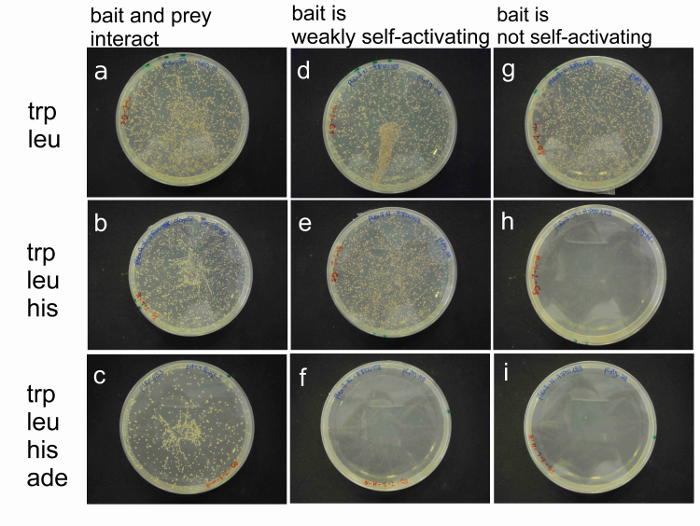
Figure 1: Example of Bait Self-activation Tests of a Bait Before Performing a Y2H Screen. S. cerevisiae NMY51 was co-transformed with interacting bait (pLEX-p53) and prey (pACT-largeT) as a positive control (left panel: a-c), a weakly self-activating plus an empty prey library vector (middle panel: d-f) and a not self-activating bait plus an empty prey library vector (right panel: g-i). The co-transformed yeast were cultured on SD plates lacking trp and leu (upper panel: a, d, g), trp, leu and his (middle panel: b, e, h) and trp, leu, his and ade (lower panel: c, f, i). Selection on medium lacking trp and leu is a positive control for successful co-transformation, as the bait vector complements the trp auxotrophy and the prey vector the leu auxotrophy of NMY51 (growth on SD-trp-leu). In case of an interaction between bait and prey or a self-activation of the bait, the reporter expression of NMY51 is turned on and complements the his and ade auxotrophy (growth on SD-trp-leu-his-ade). A weak self-activation is characterized by growth on SD-trp-leu-his plates (middle panel, d-f). Weak self-activation of a bait must be diminished prior for analyzing the bait in a Y2H screen, e.g. by adding 3-AT to the selective media. Amino acid depletions are indicated with "-" in the respective media name. Please click here to view a larger version of this figure.
| pLexA-N-atp00189 | none | colonies | no growth | no growth | no growth | no growth |
| none | pGAD-HA | no growth | colonies | no growth | no growth | no growth |
| pLexA-N | none | colonies | no growth | no growth | no growth | no growth |
| pLexA-N | pGAD-HA | colonies | colonies | colonies | no growth | no growth |
| pLexA-p53 | pACT-largeT | colonies | colonies | colonies | colonies | colonies |
| pLexA-N-atp00189 | pGAD-HA | colonies | colonies | colonies | no growth | no growth |
Table 1: Expected Results in a Bait Self-activation Assay. The transformation of S. cerevisiae NMY51 yields in differential growth on selective media based on the characteristics of co-transformed bait and prey. Growth on selective plates was evaluated upon transformation of different vector combinations (a-f) after 72 h incubation at 30 °C. Weak self-activation is characterized by yeast growth on SD-trp-leu-his and strong self-activation by growth on SD-trp-leu-his-ade selection plates in the absence of an interaction partner. The pLexA-N encoded phytoplasmal effector ATP_00189 does not exhibit self-activation, which is characterized by the inability of the bait vector transformed NMY51 to grow in the absence of his and ade.
Depending on the bait, a Y2H screen can gain numerous yeast clones growing on selective plates. All clones must be analyzed and checked for possible redundancies. Even if a normalized cDNA library has been used, it is very likely that an interactor is represented in many different clones. Depending on the library cloning technique, it is also possible that only fragments of the full gene are inserted in some prey vectors. It is thus advisable to de novo amplify (from cDNA) and subclone the full length gene of the interactor and to test the interaction in a one-to-one Y2H analysis (Figure 2).
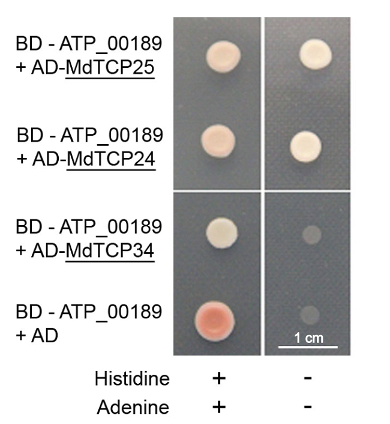
Figure 2: Example of an Interaction between Bait and Prey in a Y2H Experiment. A Yeast two-hybrid (Y2H) screen was performed and plasmids from positive interactor clones were purified. The prey vector was sequenced and the Malus x domestica host interaction partners MdTCP24 and MdTCP25 were identified. As a negative control MdTCP34 (for which no interactor was identified in the Y2H library screen) was subcloned in parallel. The full length genes were amplified from apple cDNA, subcloned into the prey vector (co-cistronically expressing the activation domain AD) and de novo co-transformed with the bait vector expressing the bacterial effector ATP_00189 coupled to the DNA binding domain (BD). This figure is taken from 28. Please click here to view a larger version of this figure.
Discussion
In the Y2H screen, the potential effector protein is co-expressed with different hypothetical interacting proteins (step 7). Each growing yeast clone contains the bait but a (potentially) different interactor. The interacting proteins are encoded in a cDNA library that is cloned into prey plasmids. The bait and the prey plasmids each co-cistronically code for a part of a yeast transcription factor. In case of a physical interaction between the bait (effector) and a prey plasmid-encoded interactor, the two transcription factor parts (the DNA binding domain and the activation domain) are united, and the reporter gene expression is induced. The yeast is able to grow on histidine- and adenine-depleted SD selection plates. The kind of prey cDNA library is dependent upon the screened effector and must be chosen accordingly. The prey and bait vector, as well as the yeast strain, must be compatible. In this screen, a LexA DNA binding domain and the Gal4 activation domain were used as the compatible yeast transcription factor units. The cDNA library can be individually constructed, custom made, or commercially obtained. The preparation of the cDNA prey library is not part of this protocol. In this protocol, a self-constructed, normalized cDNA library from the RNA of Malus x domestica leaves was used and cloned into pGAD-HA41. The effector (bait)-expressing yeast strain was transformed with the prey library, and clones were selected on histidine- and adenine-depleted SD selection plates. To extract plasmid DNA from the yeast colonies, a column-based DNA plasmid mini kit for bacteria is recommended in combination with a mechanical disruption step using glass beads to improve yeast lysis (step 8). In this plasmid purification, the bait and the prey vector will be purified simultaneously in relatively low concentrations. However, the amount of plasmid DNA is enough to identify the interaction partner through sequencing without prior plasmid propagation (step 8.4). As an alternative, the DNA purified in step 8.4 can be transformed into competent E. coli and selected with prey vector-mediated antibiotic resistance (e.g., ampicillin the in case of pGAD-HA). The selected E. coli colonies carry only the pGAD-HA library plasmid, and high-yield plasmid purification can be performed with these clones.
The successful transformation of pLexA-N and pGAD-HA constructs complements the tryptophan and leucine auxotrophy of NMY51. An interaction between the effector and a protein (encoded on pGAD-HA) leads to the activation of the reporter system in NMY51 strains. In the case of self-activation, NMY51 transformed with the effector expressing pLexA-N in combination with the empty library vector pGAD-HA grows on selective plates lacking trp-leu-his-ade, due to the unwanted activation of the NMY51 reporter system40. The self-activation can be weak and can occur in the absence of trp-leu-his, or the activation can be strong and characterized by growth on trp-leu-his-ade plates41. Self-activation can cause a massive background of false-positive clones in the actual Y2H screen. To avoid this, a self-activation test with the bait must be conducted, in which the effector-expressing vector is co-transformed with the empty library vector. In this experimental setting, reporter gene expression must not be induced. If self-activation (i.e., growth on selective plates) is visible in the test, the medium can be supplemented with different concentrations of 3-amino-1,2,4-triazole45 (3-AT). 3-AT is an inhibitor of imidazoleglycerol-phosphate dehydratase (HIS3), an enzyme important during histidine biosynthesis46. Supplementation with 3-AT can reduce the weak effects of self-activation during Y2H screens47,48. Different concentrations of 3-AT should be tested. In this protocol, 1 - 40 mM 3-AT were used. The lowest concentration that leads to the repression of self-activation should subsequently be used in the Y2H screen. The selective plates of the self-activation assay can only be evaluated if the SD-trp-leu plates of the co-transformation contain a sufficient number of clones. As an indication ≥ 500 colonies per 90-mm (diameter) petri dish are sufficient. To determine the exact transfection efficiency, it is recommended to prepare serial dilutions of the co-transformed yeast and to spread them on SD-trp-leu plates.
To reduce self-activation, the effector can be cloned into pLexA-C, a bait expression vector that fuses the LexA tag to the C-terminus of the protein. The orientation of the Lex-A tag can attenuate self-activation24. However, it is not possible in every case to reduce or abolish self-activation. The formation of red or reddish colonies indicates a weak or false-positive interaction. The ade2 reporter gene of NMY51 is only activated when it comes to a protein-protein interaction, which in turn blocks the accumulation of a red dye in this yeast strain40. In the absence of an interaction, NMY51 are reddish, while colonies carrying strong interactors are white. The observation of the colony color on the selection plates thus provides a further important hint to judge if the respective colonies are true- or false-positive interactors.
It is eventually necessary to adapt or change certain assay settings with respect to the nature of the bait and the interaction characteristics. By now, a number of improvements and derivative techniques of the common Y2H have been established to allow for the analysis of rather difficult protein interactions in different host systems. A review by Stynen et al.49 addresses and describes different aspects of Y2H, its improvements, and adaptations, and thus provides useful information about how to choose the appropriate interaction assay.
Y2H screens and derived techniques have become widely used in different research fields, wherever identification of binary protein interactions is required. Even if critical controls are performed, such as self-activation tests of the bait and one-to-one re-transformations of the identified interacting proteins, the Y2H is prone to produce false results26,50,51. The yeast as a model is not suitable for all interaction studies. Yeast does not necessarily constitute a cellular environment that supports the appropriate post-translational modification and folding for every protein24. Furthermore, in the Y2H setting, the proteins are over-expressed, and their expression is not controlled by their natural promoter. The Y2H forces the proteinaceous interaction partners to the nucleus, which is not necessarily their natural subcellular destination. The native cellular circumstances of the interaction thus may not be reflected by the yeast and may lead to false-negative or false-positive results. Most Y2H are based on yeast auxotrophy complementation as a selective principle. This nutritional selection is characterized by high sensitivity, but at the cost of decreased selectivity compared to other (e.g., chromogenic reporter) assays49. If unreducible self-activation (see above) or other limitations occur for a certain effector, the Y2H is not an appropriate assay25. In Table 1 and Figure 1, the expected results of the self-activation test are given. The absence of real interactions (i.e., false negatives) can be caused by protein toxicity, incorrect translational protein processing, steric hindrance of the interaction, underrepresented interaction partners in the prey library, membrane localization of the bait, or missing components necessary for the interaction24.
It is recommended to de novo amplify the full-length gene of the identified interacting protein from cDNA, subclone it into pGAD-HA, and perform a one-to-one interaction assay by transforming the generated pGAD-HA construct into the bait-expressing NMY51 strain. This is necessary since the observed interactor present in the prey library might only be a fragment of a bigger protein. However, the information for the respective full-length gene is only accessible if considerable genomic and transcriptomic sequence data is available. The transformation protocol for the self-activation assay described here can be applied for such a one-to-one assay, and the interaction between the bait and the interactor must be reproducible.
Interactions identified in a Y2H screen must always be confirmed by another independent technique. This independent technique must be closer to the natural setting of the actual protein-protein interaction. In the case of the phytoplasmal effector ATP_00189, the interaction with the TCP transcription factors of Malus x domestica was verified in planta with bimolecular fluorescent complementation (BiFC) in Nicotiana benthamiana protoplasts28 (not part of this protocol). The effector protein ATP_00189 was derived from the plant pathogen P. mali. In planta BiFC was thus chosen to verify ATP_00189 interactions with the Malus x domestica transcription factors previously identified in the Y2H28. BiFC is a protein-protein interaction assay that does not require the subcellular translocation of the interacting proteins to the nucleus in order to activate the reporter system52. Furthermore, the in planta expression and modification machinery mimics the environment of the natural interaction between the plant bacterial effector in its plant host. However, a global screen using BiFC is not feasible.
There are several steps in the protocol that must be carefully addressed. When amplifying the gene of interest (step 4), it is important to rule out that primers bind to plant DNA. Thus, DNA from non-infected plants must be included as a negative control. The sequence of the gene of interest must not contain the EcoRI and SalI restriction sites that are used for the directional cloning of the insert. If the sequence does contain these sites, different restriction enzymes for cloning must be chosen. Yeast transformation is a central method during this protocol. Transfection efficiency depends on the competency of the yeast cells, their viability, the growth state, and the quality of the transfection reagent53,54. For the proposed protocol, it is highly recommended to use yeast from fresh plates not older than two weeks (kept at 4 °C) when performing the transformations. Often, the growth of transformed yeast is delayed when selective liquid cultures are inoculated with colonies from old agar plates. It is also helpful to use a liquid starter culture as an inoculum for the actual experiments and not to use the yeast directly from the plate. Low efficiency when transfecting the prey into the bait-expressing yeast can lead to the underrepresentation of certain prey proteins (potential interactors) and can thus skew the whole screen. In this protocol, a yeast transfection efficiency of ~150,000 cfu/µg transfected DNA in the Y2H worked well.
Knowing the flaws and drawbacks of the Y2H technique and interpreting the results in a critical and appropriate manner is indispensable to drawing the correct conclusions. Y2H assays and the derivatives have been used for many years and have undergone many improvements and adaptations with respect to the different bait characteristics, the subcellular localization of the interaction, the expected binding partners, and other factors that might be required for the interaction (see Y3H55,56,57). Recently, array-based Y2H screens have been developed that allow for automated, high-throughput analysis of numerous baits against millions of preys58. The future most likely lies in automation and high-throughput approaches to this assay to allow for the elucidation of complex signaling pathways and interactomes in different research fields.
Disclosures
The authors declare that they have no competing financial interests.
Acknowledgements
We thank Christine Kerschbamer, Thomas Letschka, Sabine Oettl, Margot Raffeiner, and Florian Senoner from the Laimburg Research Centre and Mirelle Borges Dias Schnetzer from Dualsystems Biotech AG for technical support and Julia Strobl for proofreading the manuscript. This work was performed as part of the APPL2.0 project and was partially funded by the Autonomous Province of Bozen/Bolzano, Italy and the South Tyrolean Apple Consortium.
Materials
| Name | Company | Catalog Number | Comments |
|---|---|---|---|
| Cetyltrimethylammonium bromide (CTAB) | Applichem | A6284 | for DNA preparation |
| Trishydroxymethylaminomethane (Tris) | Applichem | A2264 | for media and buffer |
| Sodium chloride (NaCl) | Applichem | A2942 | for media and buffer |
| Ethylenediaminetetraacetic acid Disodium salt (NaEDTA) | Applichem | A2937 | for media and buffer |
| N-Lauroylsarcosin sodium salt | Applichem | A7402 | for DNA preparation |
| ammonium acetate | Sigma-Aldrich (Fluka) | 9688 | for DNA preparation |
| 2-mercaptoethanol | Applichem | A1108 | for DNA preparation |
| Isopropanol (2-Propanol) | Applichem | A3928 | for DNA preparation |
| Ethanol | Sigma-Aldrich (Fluka) | 51976 | for DNA preparation |
| RNAse | Applichem | A2760 | for DNA preparation |
| Chloroform:Isoamyl 24:1 | Applichem | A1935 | for DNA preparation |
| Proofreading Polymerase (e.g. iProof) | Bio-Rad | 203433 | for PCR |
| EcoRI | Thermo Scientific | ER0271 | for cloning |
| SalI | Thermo Scientific | ER0641 | for cloning |
| Column-based DNA Purification Kit (e.g. QIAquick) | Qiagen | 28104 | for cloning |
| Kanamycin Sulfate | Applichem | A1493 | for microbiological selection |
| 3-Amino-1,2,4-Triazole (3-AT) | Sigma-Aldrich | A8056 | for self-activation assay |
| L-Arginine Monohydrochloride | Applichem | A3680 | for yeast culture |
| L-Isoleucine | Applichem | A3642 | for yeast culture |
| L-lysine Monohydrate | Applichem | A3448 | for yeast culture |
| L-Methionine | Applichem | A3897 | for yeast culture |
| L-Phenylalanine | Applichem | A3464 | for yeast culture |
| L-Threonine | Applichem | A3946 | for yeast culture |
| L-Tyrosine | Applichem | A3401 | for yeast culture |
| L-Uracile | Applichem | A0667 | for yeast culture |
| L-Valine | Applichem | A3406 | for yeast culture |
| L-Adenine Hemisulfate Salt | Applichem | A1596 | for yeast culture |
| 0.22 µm Pore Filter | Sartorius | 16541 | for sterile filtration |
| L-Histidine Monohydrochloride | Applichem | A3719 | for yeast culture |
| L-Leucine | Applichem | A3496 | for yeast culture |
| L-Tryptophane | Applichem | A3410 | for yeast culture |
| Yeast Nitrogen Base | Sigma-Aldrich | 51483 | for yeast culture |
| D-Glucose Monohydrate | Applichem | A1349 | for yeast culture |
| Agar | Fisher Scientific | BP2641-1 | for yeast and bacteria culture |
| Peptone | Applichem | A2208 | for yeast culture |
| Polyethylene Glycol 4000 (PEG) | Applichem | A1249 | for yeast transformation |
| Lithium Acetate Dihydrate (LiOAc) | Applichem | A3478 | for yeast transformation |
| Salmon Sperm DNA | Applichem | A2159 | for yeast transformation |
| Antibody against Lex-A tag (e.g. Anti-LexA DNA binding region) | Millipore | 06-719 | for Western blot |
| Plasmid Miniprep kit (e.g. GenElute Plasmid Miniprep Kit) | Sigma-Aldrich | PLN350 | for plasmid purification from yeast and bacteria |
| Acid Washed Glass Beads | Sigma-Aldrich | G8772 | for plasmid purification from yeast |
| Ampicillin Sodium Salt | Applichem | A0839 | for microbiological selection |
| Yeast Extract | Applichem | A1552 | for yeast culture |
| Vacuum concentrator centrifuge (e.g. Concentrator 5301) | Eppendorf | Z368245 (Sigma) | for DNA preparation |
| Bait vector (e.g. pLexA-N) | Dualsystems | P01004 | for Y2H |
| Prey vector (e.g. pGAD-HA) | Dualsystems | P01004 | for Y2H |
| Control prey vector (e.g. pLexA-p53) | Dualsystems | P01004 | for Y2H |
| Control bait vector (e.g. pACT-largeT) | Dualsystems | P01004 | for Y2H |
| Electrocompetent E. coli (e.g. MegaX DH10B T1R Electrocomp Cells) | Invitrogen | C640003 | for cloning |
| Yeast reporter strain (NMY51:MATahis3Δ200 trp1-901 leu2-3,112 ade2 LYS2::(lexAop)4-HIS3 ura3::(lexAop)8-lacZ ade2::(lexAop)8-ADE2 GAL4, e.g. NMY51) | Dualsystems | P01004 | for Y2H |
| Plastic paraffin film (e.g. Parafilm M) | Sigma-Aldrich | P7793-1EA | for yeast and bacteria culture |
| Gas permeable sealer (e.g. BREATHseal) | Greiner | 676 051 | for yeast culture |
| PCR Cycler (e.g. T100 Thermal Cycler) | Bio-Rad | 1861096 | for PCR |
| quantitative PCR Cycler (e.g. CFX96 Touch Real-Time PCR Detection System) | Bio-Rad | 1855195 | for quantitative PCR |
| Microcentrifuge (e.g. Centrifuge 5417 R) | Eppendorf | 5417 R | general lab equipment |
| Centrifuge (e.g. Centrifuge 5804 R) | Eppendorf | 5804 R | general lab equipment |
| Nuclease-free water (DNAse-free, RNAse-free, Protease-free) | 5Prime | 2500010 | for PCR and DNA works |
| Scalpell | Swann-Morton | 0301 | for DNA preparation |
| Sterile filter (0.22 µm; Polyethersulfone) | VWR-International | 514-0073 (European Catalogue number) | for yeast and bacteria culture |
| Petri dishes Ø 90 mm | Greiner Bio-One | 633180 | for yeast and bacteria culture |
| Petri dishes Ø 150 mm | Greiner Bio-One | 639161 | for yeast culture |
| Photometer (e.g. BioPhotometer) | Eppendorf | 550507804 | for yeast culture |
| Photometer Cuvettes | Brand | 759015 | for yeast culture |
| Water Bath (e.g. Water Bath Memmert WB7) | Memmert | WB7 | for yeast transformation |
| Western Blot Equipment | Bio-Rad | diverse | for protein detection |
| dNTPs | 5Prime | 2201210 | for cloning |
| Shaker (Erlenmeyer) Flasks (100 mL; 1,000 mL; 2,000 mL) and breathable cotton plugs (e.g. Duran Erlenmeyer narrow-neck flasks) | Sigma Aldrich | Z232793, Z232858, Z232866 | for yeast and bacteria culture |
| Shaking Incubator (e.g. GFL 3031) | GFL | 3031 | for yeast and bacteria culture |
| Incubator | Binder | KB 53 (E3.1) | for yeast and bacteria culture |
| Ice Maker (e.g. Ice Maker IF 825) | Omniwash | IF 825 | general lab equipment |
| 0.2 mL, 1.5 mL and 2.0 mL Reaction Vials (Polypropylene) | Eppendorf | 0030.124.332 (0.2 ml); 0030.123.328 (1.5 ml); 0030.123.344 (2.0 ml) | general lab equipment |
| Pipettes and disposable pipette Tips (different volumina: 10 - 1,000 µL) | Eppendorf | diverse | general lab equipment |
| Spreader | Sigma-Aldrich | SPR-L-S01 | for yeast and bacteria culture |
| Vortex shaker (e.g. MS 3 Minishaker) | IKA | 3617000 | general lab equipment |
| T4-Ligase | Thermo Fisher | EL0011 | for cloning |
| Fridge (4 °C) (e.g. Liebherr Medline FKEX 5000) | Liebherr | 81.767.580.4 | general lab equipment |
| Freezer (-20 °C) (e.g. Liebherr Comfort Professional G5216) | Liebherr | G5216 | general lab equipment |
| Graduated Cylinder (e.g. Brand) | Sigma Aldrich | Z327352; Z327417; Z327441 | general lab equipment |
| Serological Pipettes (e.g. Fisherbrand) | Thermo Fisher | S55701 | for yeast and bacteria culture |
| Mechanical Pipettor (e.g. Pipetboy acu 2) | Integra-Biosciences | 155000 | general lab equipment |
| Cuvettes for Electroporation (1 mm) | Molecular Bio Products | 5510-11 | for bacteria transformation |
| Electroporator (e.g. Eporator) | Eppendorf | 4309000019 | for bacteria transformation |
| Gel and Blot imaging system (e.g. ChemiDoc MP System) | Bio-Rad | 1708280 | general lab equipment |
| Conical centrifuge tubes (Polypropylene) (50 mL) | VWR-International | 525-0403 (European Catalogue number) | general lab equipment |
| Conical centrifuge tubes (Polypropylene) (13 mL) | BD Falcon | 352096 | general lab equipment |
| Dithiothreitol (DTT; 1 M) | Thermo Scientific | P2325 | for ligation |
| adenosine triphosphate (ATP, e.g. ATP Solution (10 mM)) | Ambion | AM8110G (distributed by Thermo Scientific) | for ligation |
| Dropout mix without histidine, leucine, tryptophan, and adenine (DO, e.g. Yeast Synthetic Drop-out Medium Supplements) | Sigma-Aldrich | Y2021 Sigma | for yeast culture (ready-made mix) |
References
- Fields, S., Song, O. -K. A novel genetic system to detect protein-protein interactions. Nature. 340 (6230), 245-246 (1989).
- Dombrosky-Ferlan, P. -M., Corey, S. -J. Yeast two-hybrid in vivo association of the Src kinase Lyn with the proto-oncogene product Cbl but not with the p85 subunit of PI 3-kinase. Oncogene. 14, 2019-2024 (1997).
- Singh, R. Rice Mitogen-Activated Protein Kinase Interactome Analysis Using the Yeast Two-Hybrid System. Plant Physiol. 160, 477-487 (2012).
- Lee, H. -J., et al. Interaction of NADPH oxidase 1 with Toll-like receptor 2 induces migration of smooth muscle cells. Cardiovasc. Res. 99, 483-493 (2013).
- Del Bene, F., Tessmar-Raible, K., Wittbrodt, J. Direct interaction of geminin and Six3 in eye development. Nature. 427 (6976), 745-749 (2004).
- Kumar, A., Godwin, J. -W., Gates, P. -B., Garza-Garcia, A. -A., Brockes, J. -P. Molecular Basis for the Nerve Dependence of Limb Regeneration in an Adult Vertebrate. Science. 318 (5851), 772-777 (2007).
- Park, S. -Y., et al. Abscisic Acid Inhibits Type 2C Protein Phosphatases via the PYR/PYL Family of START Proteins. Science. 324 (5930), 1068-1071 (2009).
- Selyunin, A. S., et al. The assembly of a GTPase-kinase signalling complex by a bacterial catalytic scaffold. Nature. 469 (7328), 107-111 (2011).
- Uetz, P., et al. Herpesviral Protein Networks and Their Interaction with the Human Proteome. Science. 311 (5758), 239-242 (2006).
- Ushioda, R., Hoseki, J., Araki, K., Jansen, G., Thomas, D. Y., Nagata, K. ERdj5 Is Required as a Disulfide Reductase for Degradation of Misfolded Proteins in the ER. Science. 321 (5888), 569-572 (2008).
- Young, K. -H. Yeast two-hybrid: so many interactions, (in) so little time. Biol. Reprod. 58, 302-311 (1998).
- Krachler, A. M., Woolery, A. R., Orth, K. Manipulation of kinase signaling by bacterial pathogens. J. Cell Biol. 195 (7), 1083-1092 (2011).
- Hewezi, T., Baum, T. J. Manipulation of Plant Cells by Cyst and Root-Knot Nematode Effectors. Mol. Plant Microbe Interact. 26 (1), 9-16 (2012).
- McGhie, E. J., Brawn, L. C., Hume, P. J., Humphreys, D., Koronakis, V. Salmonella takes control: effector-driven manipulation of the host. Curr. Opin. Microbiol. 12 (1), 117-124 (2009).
- Kay, S., Bonas, U. How Xanthomonas type III effectors manipulate the host plant. Curr. Opin. Microbiol. 12 (1), 37-43 (2009).
- Navarro-Garcia, F., Serapio-Palacios, A., Ugalde-Silva, P., Tapia-Pastrana, G., Chavez-Dueñas, L. Actin Cytoskeleton Manipulation by Effector Proteins Secreted by Diarrheagenic Escherichia coli Pathotypes. Biomed. Res. Int. 2013, 22(2013).
- Bhat, B. S., Shanaz, E. Effectors-Role in Host-Pathogen Interaction. J. Agr. Env. Sci. 3 (2), 265-285 (2014).
- Bhavsar, A. P., Guttman, J. A., Finlay, B. B. Manipulation of host-cell pathways by bacterial pathogens. Nature. 449 (7164), 827-834 (2007).
- Natale, P., Brüser, T., Driessen, A. -J. -M. Sec- and Tat-mediated protein secretion across the bacterial cytoplasmic membrane-Distinct translocases and mechanisms. Biochimica et Biophysica Acta-Biomembranes. 1778 (9), 1735-1756 (2008).
- Costa, T. R. D., et al. Secretion systems in Gram-negative bacteria: structural and mechanistic insights. Nat Rev Micro. 13 (6), 343-359 (2015).
- Tseng, T. -T., Tyler, B. M., Setubal, J. C. Protein secretion systems in bacterial-host associations, and their description in the Gene Ontology. BMC Microbiol. 9 (1), 1-9 (2009).
- MacLean, A. M., et al. Phytoplasma effector SAP54 hijacks plant reproduction by degrading MADS-box proteins and promotes insect colonization in a RAD23-dependent manner. PLoS Biol. 12 (4), e1001835(2014).
- Sugio, A., Kingdom, H. N., MacLean, A. M., Grieve, V. M., Hogenhout, S. A. Phytoplasma protein effector SAP11 enhances insect vector reproduction by manipulating plant development and defense hormone biosynthesis. Proc Natl Acad Sci. 108 (48), 1254-1263 (2011).
- van Criekinge, W., Beyaert, R. Yeast Two-Hybrid: State of the Art. Biol Proced Online. 2 (1), 1-38 (1999).
- Bruckner, A., Polge, C., Lentze, N., Auerbach, D., Schlattner, U. Yeast two-hybrid, a powerful tool for systems biology. Int. J. Mol. Sci. 10 (6), 2763-2788 (2009).
- Serebriiskii, I., Estojak, J., Berman, M., Golemis, E. A. Approaches to Detecting False Positives in Yeast Two-Hybrid Systems. Biotech. 28 (2), 328-336 (2000).
- Golemis, E. A., Serebriiskii, I., Law, S. F. The yeast two-hybrid system: criteria for detecting physiologically significant protein-protein interactions. Curr. Issues Mol. Biol. 1 (1-2), 31-45 (1999).
- Janik, K., Mithöfer, A., Raffeiner, M., Stellmach, H., Hause, B., Schlink, K. An effector of apple proliferation phytoplasma targets TCP transcription factors - a generalized virulence strategy of phytoplasma. Mol. Plant Pathol. , (2016).
- Strauss, E. Microbiology. Phytoplasma research begins to bloom. Science. 325 (5939), 388-390 (2009).
- Kartte, S., Seemüller, E. Variable response within the genus Malus to the apple proliferation disease. J. Plant Dis. Protect. 95 (1), 25-34 (1988).
- Bovey, R. Observations and experiments on apple proliferation disease. Phytopath. Mediterr. 2 (3), 111-114 (1963).
- Schlink, K., Reski, R. Preparing High-Quality DNA From Moss (Physcomitrella patens). Plant. Mol. Biol. Rep. 20, 423(2002).
- Applichem. N-Lauroylsarcosine sodium salt. , https://www.applichem.com/fileadmin/datenblaetter/A7402_en_GB.pdf (2015).
- Applichem. 2-Mercaptoethanol. , https://www.applichem.com/fileadmin/datenblaetter/A1108_en_GB.pdf (2015).
- Applichem. 2-Propanol. , https://www.applichem.com/fileadmin/datenblaetter/A3928_en_GB.pdf (2015).
- Applichem. Chloroform:Isoamyl alcohol (24:1). , https://www.applichem.com/fileadmin/datenblaetter/A3928_en_GB.pdf (2015).
- Mehle, N., Nikolić, P., Gruden, K., Ravnikar, M., Dermastia, M. Real-time PCR for specific detection of three phytoplasmas from the apple proliferation group. Methods Mol. Biol. 938, 269-281 (2013).
- Applichem. Kanamycin sulfate. , https://www.applichem.com/fileadmin/datenblaetter/A1493_en_GB.pdf (2015).
- Smith, L. M., et al. Fluorescence detection in automated DNA sequence analysis. Nature. 321 (6071), 674-679 (1986).
- Lentze, N., Auerbach, D. Membrane-Based Yeast Two-Hybrid System to Detect Protein Interactions. Current Protocols in Protein Science. , Wiley Interscience. 1917-1952 (2008).
- Dualsystems Biotech AG. DUALhubrid Kit - Manual P01004 B06. www.dualsystems.com. , 1-44 (2012).
- Kurien, B. -T., Scofield, R. -H. Protein Blotting and Detection. , Humana Press. (2009).
- Gietz, R. D., Schiestl, R. H. High-efficiency yeast transformation using the LiAc/SS carrier DNA/PEG method. Nat. Protocols. 2 (1), 31-34 (2007).
- Yeast Transformation and Cloning. , JoVE Science Education Database. Cambridge, MA (USA). (2016).
- Sigma-Aldrich. 3-Amino-1,2,4-triazole. , http://www.sigmaaldrich.com/MSDS/MSDS/DisplayMSDSPage.do?country=IT&language=EN-generic&productNumber=A8056&brand=SIGMA&PageToGoToURL=http%3A%2F%2Fwww.sigmaaldrich.com%2Fcatalog%2Fproduct%2Fsigma%2Fa8056%3Flang%3Dit (2016).
- Ames, B. -N. The Biosynthesis of Histidine: d-erythro-Imidazole-Glycerol Phosphate Dehydrase. J. Biol. Chem. 228, 131-143 (1957).
- Joung, J. -K., Ramm, E. -I., Pabo, C. -O. A bacterial two-hybrid selection system for studying protein-DNA and protein-protein interactions. Prot Natl Acad Sci. 97, 7382-7387 (2000).
- Brennan, M. -B., Struhl, K. Mechanisms of Increasing Expression of a Yeast Gene in Escherichia coli. J. Mol. Biol. 136, 333-338 (1980).
- Stynen, B., Tournu, H., Tavernier, J., van Dijck, P. Diversity in genetic in vivo methods for protein-protein interaction studies: from the yeast two-hybrid system to the mammalian split-luciferase system. Microbiol. Mol. Biol. Rev. 76 (2), 331-382 (2012).
- Hengen, P. -H. Methods and reagents: False positives from the yeast two-hybrid system. Trends Biochem Sci. 22 (1), 33-34 (1997).
- Vidalain, P. -O., Boxem, M., Ge, H., Li, S., Vidal, M. Increasing specificity in high-throughput yeast two-hybrid experiments. Methods. 32 (4), 363-370 (2004).
- Pattanaik, S., Werkman, J. -R., Yuan, L. Bimolecular Fluorescence Complementation as a Tool to Study Interactions of Regulatory Proteins in Plant Protoplasts. Plant Transcription Factors: Methods and Protocols. Yuan, L., Perry, E. S. , Humana Press. Totowa, NJ. 185-193 (2011).
- Ito, H., Fukuda, Y., Murata, K., Kimura, A. Transformation of Intact Yeast Cells Treated with Alkali Cations. J. Bacteriol. 153 (1), (1983).
- Kawai, S., Hashimoto, W., Murata, K. Transformation of Saccharomyces cerevisiae and other fungi. Bioeng Bugs. 1 (6), 395-403 (2010).
- Bernstein, D. -S., Buetr, N., Stumpf, C., Wickens, M. Analyzing mRNA-protein complexes using a yeast three-hybrid system. Methods. 26, 123-141 (2002).
- Stumpf, C. -R., Opperman, L., Wickens, M. Analysis of RNA-Protein Interactions Using a Yeast Three-Hybrid System. Methods Enzymol. 449, 295-315 (2008).
- Cottier, S., et al. The yeast three-hybrid system as an experimental platform to identify proteins interacting with small signaling molecules in plant cells: potential and limitations. Front. Plant Sci. 2, 1-12 (2011).
- Häuser, R., Stellberger, T., Rajagopala, S. V., Uetz, P. Array-Based Yeast Two-Hybrid Screens: A Practical Guide. Two Hybrid Technologies: Methods and Protocols, Methods in Molecular Biology. , 21-38 (2012).
Reprints and Permissions
