This work describes a new protocol to assess the ecotoxicity of pollutants, including emerging contaminants such as nanomaterials, using the marine bacterium Vibrio anguillarum. This method allows for the determination of the LC50, or mortality, the concentration that causes a 50% decrease in bacteria culturability, after a 6 h exposure.
Method Article
Ecotoxicological Method with Marine Bacteria Vibrio anguillarum to Evaluate the Acute Toxicity of Environmental Contaminants
Opens in a new tab
In This Article
Summary
Loading...
$$\rightleftharpoonup{xx}$$
$$\longleftharp{xx}$$,
$$\longrightharp{xx}$$,
Abstract
Loading...
$$\rightleftharpoonup{xx}$$
$$\longleftharp{xx}$$,
$$\longrightharp{xx}$$,
Bacteria are an important component of the ecosystem, and microbial community alterations can have a significant effect on biogeochemical cycling and food webs. Toxicity testing based on microorganisms are widely used because they are relatively quick, reproducible, cheap, and are not associated with ethical issues. Here, we describe an ecotoxicological method to evaluate the biological response of the marine bacterium Vibrio anguillarum. This method assesses the acute toxicity of chemical compounds, including new contaminants such as nanoparticles, as well as environmental samples. The endpoint is the reduction of bacterial culturability (i.e., the capability to replicate and form colonies) due to exposure to a toxicant. This reduction can be generally referred to as mortality. The test allows for the determination of the LC50, the concentration that causes a 50% decrease of bacteria actively replicating and forming colonies, after a 6 h exposure. The culturable bacteria are counted in terms of colony forming units (CFU), and the "mortality" is evaluated and compared to the control. In this work, the toxicity of copper sulphate (CuSO4) was evaluated. A clear dose-response relationship was observed, with a mean LC50 of 1.13 mg/L, after three independent tests. This protocol, compared to existing methods with microorganisms, is applicable in a wider range of salinity and has no limitations for colored/turbid samples. It uses saline solution as the exposure medium, avoiding any possible interferences of growth medium with the investigated contaminants. The LC50 calculation facilitates comparisons with other bioassays commonly applied to ecotoxicological assessments of the marine environment.
Introduction
Loading...
$$\rightleftharpoonup{xx}$$
$$\longleftharp{xx}$$,
$$\longrightharp{xx}$$,
Ecotoxicological bioassays evaluate the toxicity of chemicals or environmental samples with standard biological models, integrating the effects of physical, chemical, and biological stressors on ecosystems. Due to the complexity of ecosystems, ecotoxicological risk assessments must consider a battery of bioassays that involve organisms from different trophic levels. Toxicity assays on laboratory animals may be expensive, time consuming, and ethically questionable. The drive to limit animal testing and develop alternative approaches (e.g., on bacteria and non-vertebrate animals) is now a pivotal issue, as reported in the framework of the current European legislation, including the EU Animal Protection Directive, the 7th Amendment to the EU Cosmetics Directive, and REACH.
Crustaceans, fish, and algae are largely used for toxicity measurements in the marine environment1. Bacteria are an important component of the ecosystem, and alterations to microbial communities can have significant effects on biogeochemical cycling and other critical ecosystem services. Toxicity testing based on microorganisms are gaining popularity because they are relatively quick, reproducible, and cheap and do not raise ethical issues2. The aim of this work is to describe an ecotoxicological protocol to evaluate the response of the marine bacterium Vibrio anguillarum (Listonella anguillarum, Vibrionaceae) when exposed to environmental contaminants.
V. anguillarum is a Gram-negative, short, curve-shaped rod bacterium (0.5 x 1.5 µm) with a polar flagellum. Typically found in brackish or salt water, it is halotolerant, with an optimal salinity of about 20 and an optimal temperature between 25 and 30 °C3. It has been chosen as an organism model due to its ubiquity and its important ecological roles in oceans worldwide4. Some serotypes of V. anguillarum are known to cause vibriosis in a variety of marine or brackish fish species5,6. For this, some steps of the experiment require standard microbiological practices, but no special safety equipment or precautions are needed. The proposed toxicity testing protocol uses the bacterial culturability (i.e., the capability to replicate and form colonies) as the endpoint and allows for the determination of the LC50, the concentration that causes a 50% reduction of bacteria actively replicating and forming colonies, after a 6-h exposure. In Vibrio, as in other microbes, this reduction, which we generally indicate as mortality, can partially be due to individuals in the viable but non-culturable (VBNC) phase7. In this study, we applied this method to measure the toxic effects of copper sulphate (CuSO4), a reference toxicant.
This method was developed to provide a suitable, microorganism-based test for the ecotoxic assessment of pollutants/chemical compounds, including emerging contaminants such as nanomaterials. The novelty of this protocol compared to existing methods used for microorganisms is mainly related to the exposure medium and the endpoint. In fact, the exposure is carried out in saline solution, avoiding any possible interference of the growth medium with the investigated contaminants, which may influence the biological response8. The endpoint is the reduction of bacterial culturability, which may be easily compared to other acute endpoints used for ecotoxicological screening in marine/brackish environments, based on survival/mortality. Moreover, the protocol uses the technique of liquid-to-plate micro-counts, already used on E. coli9, reducing volumes and thus the experimental effort (see steps 3.3 and 3.4 of the protocol for details).
Protocol
Loading...
$$\rightleftharpoonup{xx}$$
$$\longleftharp{xx}$$,
$$\longrightharp{xx}$$,
1. Preparation of Reagents/Materials
- Prepare (about 300) sterile 1.5 mL tubes for the serial dilution of bacterial suspensions, as well as 15 mL sterile tubes as test containers labeled with the test concentrations.
- Prepare 2% NaCl solution as the exposure medium and sterilize it. Alternatively, use sterilized synthetic or natural seawater, with salinity ranging from 5 to 40.
- Prepare tryptic soy agar (TSA) growth medium with 2% NaCl according to the label directions and considering the amount of NaCl already present in the medium.
- Pour the TSA (cool but still liquid) into the 90-mm Petri dishes previously labeled with the test concentration and exposure time, replicate number, and dilution factor; 19 mL is an appropriate volume.
- Prepare tryptic soy broth (TSB) growth medium according to the label directions. Add the appropriate amount of NaCl to obtain the same salinity as the exposure medium.
- Prepare a CuSO4 stock solution with double-distilled water and sterilize the (necessary) aliquot using a 0.22 µm syringe filter. In case of environmental samples, prepare an appropriate interval of dilutions of the sample and sterilize them using a 0.22 µm syringe filter.
- Prepare the test solutions in the 15 mL tubes labeled with the test concentrations. Fill the negative control with 5 mL of the exposure medium (2% NaCl). Fill the other tubes with the appropriate amount of exposure medium and CuSO4 stock solution to obtain the test concentrations in a 5 mL final volume.
2. Bacterial Inoculum Preparation
- 12-18 h before the test, prepare a liquid fresh culture of Vibrio anguillarum. Using a sterile loop, select a single, well-isolated colony from an overnight culture on a solid medium (TSA). Inoculate a tube filled with 10 mL of TSB and incubate the bacterial culture at 25 °C for 12-18 h.
- After 12-18 h, estimate the bacterial concentration of the inoculum spectrophotometrically. Vortex the inoculum and measure the optical density at 600-nm wavelength, using TSB as blank.
- To obtain a known bacterial concentration, dilute 2 mL of the vortexed inoculum by adding the amount of TSB calculated by this formula:
TSB mL = [(O.D. / 0.14) * 2] - 2. - Verify that the optical density of the diluted inoculum is 0.140 (±0.005), which corresponds to the 0.5 point on the McFarland nephelometric standard.
- Centrifuge the diluted inoculum for 10 min at 3,000 g. Eliminate the supernatant and re-suspend the microbial pellet in 1 mL of 2% NaCl solution (exposure medium).
3. Testing Exposure
- Add 150 µL of the re-suspended bacterial inoculum to each tube, including the control. Incubate the V. anguillarum suspensions for 6 h at 25 °C under darkness and in continuous shaking to avoid sedimentation.
- At the beginning (T0) and the end (T6) of the exposure time, carry out bacterial counting in all the exposed bacterial suspensions using colony forming unit (CFU) counting methods.
- Prepare serial dilutions of each exposed bacterial suspension in triplicate, applying a ten-fold dilution factor (up to 10-5). Add 100 µL of each bacterial suspension to the corresponding tube already filled with 900 µL of exposure medium (2% NaCl). Proceed with the serial dilution, vortexing at each step to re-suspend the bacteria.
- Plate 10 µL of the 10-4 and 10-5 dilutions on TSA Petri dishes in the corresponding segment. Quickly let the drops glide in a small circle by rotating the plate. Incubate the plates at 25 °C for 48 h.
4. CFU Counting
- After 48 h, count the colonies grown on the Petri dishes; plates harboring between 5 and 50 colonies are optimum for accurate counting.
- Calculate the number of viable bacteria per mL of each exposed bacterial suspension by applying the following formulas:
10-4 → CFU/mL = n° CFU x 100 x 10,000
10-5 → CFU/mL = n° CFU x 100 x 100,000 - Use the average of the counts obtained in parallel replicates to evaluate the mortality compared with the control. Calculate the mortality as a percentage with the following formula:
M% = 100 - [(N/C) * 100]
NOTE: Where N = number of CFU/mL grown after the exposure to the toxicant; C = number of CFU grown in the control medium. - Calculate the LC50 (i.e., the concentration of toxicant that reduces the number of actively replicating bacteria by 50% per mL; CFU/mL) with non-linear regression analysis using an appropriate statistical software (see the table of materials). Run a one-way analysis of variance (ANOVA) followed by post-hoc pairwise t-tests to evaluate significant differences between treatments.
Results
Loading...
$$\rightleftharpoonup{xx}$$
$$\longleftharp{xx}$$,
$$\longrightharp{xx}$$,
The results of three independent trials of exposing V. anguillarum to four concentrations of CuSO4 show a clear dose-response relationship and a significant decrease of bacteria actively replicating and forming colonies with an increasing concentration of the reference toxicant (Figure 1; ANOVA, F = 20.28, p <0.001). The number of CFU/mL is significantly reduced at 1.25 mg/L (post-hoc Tukey's test, p <0.05) compared with control (CNTR). Any culturable bacteria were detected at the highest concentration tested. No differences in CuSO4 toxicity were found along the wide salinity range of the exposure medium (i.e., 5, 20, or 35 g/L NaCl, data not shown). A representative output of the statistical analysis showing the non-linear regression is reported in Supplemental Figure 1. The LC50 values calculated for the three independent trials (Table 1) highlight the feasibility and reproducibility of this method.
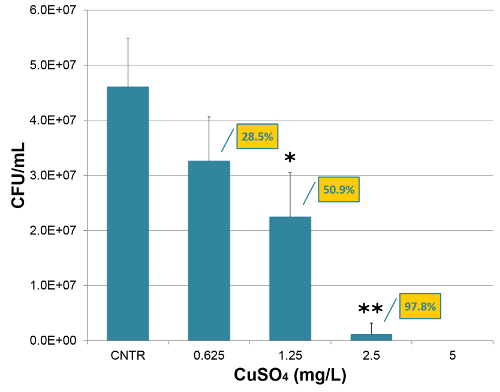
Figure 1: Vibrio anguillarum exposed to CuSO4. The mean number of CFU/mL (CFU = colony forming unit) exposed to different concentration of CuSO4 for 6 h. The values represent the mean (±SD) of three independent trials. The reductions of bacteria actively replicating and forming colonies with respect to the control (CNTR) are reported in the yellow boxes (as percentages). Significant differences with the control, based on a post-hoc Tukey's test, are indicated with asterisks (* = p <0.05; ** = p <0.01). Please click here to view a larger version of this figure.
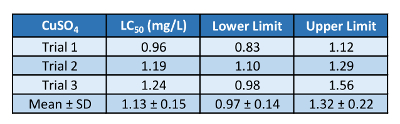
Table 1: Lethal concentration (LC50) values for Vibrio anguillarum exposed to CuSO4. Results of three independent trials and means (± SD) are reported.
Supplemental Figure 1: Non-linear regression analysis. Representative output of a non-linear regression analysis (Logit-Hill model) performed on the results of the test. Please click here to download this figure.
Discussion
Loading...
$$\rightleftharpoonup{xx}$$
$$\longleftharp{xx}$$,
$$\longrightharp{xx}$$,
This work describes a new bioassay with the marine bacterium V. anguillarum that was successfully applied to assess the toxic effects of CuSO4, a reference toxicant, demonstrating a clear dose-response relationship. The marine bacterium V. anguillarum was chosen as a model organism because it is halotolerant, ubiquitous, and representative of marine ecosystems.
The test can be performed at a wide range of salinity values (5-40) and can use saline solutions and synthetic or natural seawaters as the exposure medium, as long as microorganisms can easily survive for the duration of the entire test. This allows for the analysis of different kind of samples, including brackish and marine environments.
No growth medium is required during the exposure phase, avoiding its interference with the contaminants8 and its possible influence on the biological response. The protocol is reliable, rapid, cost effective, and relatively easy. The procedure of liquid-to-plate micro-counts9 gives the advantage of using small (sample) volumes, although this implies a high degree of accuracy and robustness. The results of the three independent trials and replicates for each treatment show the high repeatability of this method. The use of bacterium as a biological model, as well as the adaptability of the technique, favor the ecological and environmental relevance of this procedure. Other critical technical issues are accuracy in the preparation of the bacterial inoculum and the sterility required in some steps of the procedure.
The proposed test is more rapid (6 h) than other marine ecotoxicological assays (24-96 h) and does not raise the ethical problems ensuing from the use of higher organisms. Furthermore, data on the reference toxicant show LC50 values comparable with those obtained with acute tests on other marine species10,11, demonstrating a good sensitivity. Among bacterial bioassays, the V. fischeri luminescence inhibition test is the most common and well-standardized12. This bioassay is very rapid (15-30 min) and valid for testing solid-phase samples, but it can be affected by colored and turbid samples, which interfere with luminescence measurements. Salinity is a limiting factor in the use of the abovementioned test, with 2% NaCl required13. On the contrary, the test proposed here with V. anguillarum gives affordable results at a wide range of salinity values, has no limitations in regard to turbid or colored samples, and requires less expensive equipment compared to the luminescence analyzers. A comparison between the results of our study and those available in the literature for V. fisheri14,15,16 shows comparable EC50 values, further supporting the effectiveness of this bioassay.
This bioassay assesses the reduction of the bacterial culturability, generally referred to as mortality, instead of population growth rate or enzymatic activity inhibition, which are used in the tests currently available for microorganisms. The LC50 calculation allows for comparison with other bioassays commonly applied to the ecotoxicological assessment of marine environments, which often have survival/mortality as the endpoint. An intercalibration exercise is urgently necessary to evaluate/confirm the reliability and reproducibility of this test and to support its standardization and use in regulatory protocols.
The increasing use of nanomaterials and their potential release in the environment imply the need for risk assessment17. However, classical (eco)toxicological approaches for these emerging contaminants seem not to give affordable results and may require some adaptations18. The characteristics of this new bioassay allow for its easy and useful application to the toxicity assessment of nanoparticles. In fact, the possibility of carrying out the assay at different salinities will give accounts of nanoparticle behavior under different ionic strengths, an environmental parameter variable that can significantly affect toxicity19. Furthermore, no use of growth medium and nutrients is particularly recommended in the ecotoxicity assessments of nanoparticles because organic substances can facilitate their absorption by increasing the toxic effects20 or can cause aggregation, reducing the bioavailable fraction and therefore their toxicity21.
In conclusion, the bioassay on Vibrio anguillarum is a promising tool for the risk assessment of classical and emerging contaminants, as well as for the assessment of the status of marine and brackish environments.
Disclosures
Loading...
$$\rightleftharpoonup{xx}$$
$$\longleftharp{xx}$$,
$$\longrightharp{xx}$$,
The authors declare that they have no competing financial interests.
Acknowledgements
Loading...
$$\rightleftharpoonup{xx}$$
$$\longleftharp{xx}$$,
$$\longrightharp{xx}$$,
This work was financed by the research project: "NanoBioTech ambiente e salute. Progetto 2: Ambiente. Strumenti e metodi per il monitoraggio ecotossicologico delle Nanoparticelle" ("Nano-BioTechnology: environment and health. Project 2: Environment. Tools and methods for ecotoxicological monitoring of nanoparticles") granted to LM from Regione Lazio-Consorzio Hypatia. AR was funded by a postdoctoral grant from the University of Tor Vergata/Regione Lazio-Consorzio Hypatia under the framework of the previously cited project. An agreement with ISPRA-Tor Vergata University (N. 2015/52857) allowed the mutual use of facilities and the exchange of researchers.
The authors are indebted to Prof. Maria Cristina Thaller, our guardian angel for all microbial activities, for raising interest in the microbial world and for strongly helping to improve our research on the issue. The authors gratefully acknowledge Andrea Tornambè and Erika Magaletti for the precious collaboration with the ISPRA Lab of Phytoplankton ecology and ecotoxicology.
Materials
| Name | Company | Catalog Number | Comments |
|---|---|---|---|
| Vibrio anguillarum (strain AL 102, serotype O1) | Obtained from the laboratory collection of NOIFMA (Norway) | ||
| Tryptic Soy Agar | Liofilchem | 610052 | Dehydrated Culture Media |
| Tryptic Soy Broth growth medium | Liofilchem | 610053 | Dehydrated Culture Media |
| CuSO4·5H2O | Sigma-Aldrich | 209198 | |
| NaCl | Sigma-Aldrich | S-3014 | |
| Name of Equipment | Company | Catalog Number | Comments/Description |
| Biosafety Laminar Flow Hood | ESCO | ||
| Incubator | Fratelli Galli | Mod. 2100 | |
| Name of Software | Company | Catalog Number | Comments/Description |
| Benchmark Dose Software | US EPA | Benchmark Dose 2.4.0 | 2012 |
References
Loading...
$$\rightleftharpoonup{xx}$$
$$\longleftharp{xx}$$,
$$\longrightharp{xx}$$,
- http://guidance.echa.europa.au/docs/guidance document/information (2008).">Guidance on information requirements and chemical safety assessment. , ECHA (European CHemicals Agency). Available from: http://guidance.echa.europa.au/docs/guidance document/information (2008).
- A review on advantages of implementing luminescence inhibition test (Vibrio fischeri) for acute toxicity prediction of chemicals. Environm. Internat. 32 (2), 256-268 (2006).">Parvez, S., Venkataraman, C., Mukherji, S. A review on advantages of implementing luminescence inhibition test (Vibrio fischeri) for acute toxicity prediction of chemicals. Environm. Internat. 32 (2), 256-268 (2006).
- Isolation and characterization of Vibrio (Listonella) anguillarum from catfish. Turkish J. Veter. Animal. 34 (4), 413-415 (2010).">Rad, M., Shahsavani, D. Isolation and characterization of Vibrio (Listonella) anguillarum from catfish. Turkish J. Veter. Animal. 34 (4), 413-415 (2010).
- Biodiversity of Vibrios. Microbiol. Mol. Biol. Rev. 68, 403-431 (2004).">Thompson, F., Iida, T., Swings, J. Biodiversity of Vibrios. Microbiol. Mol. Biol. Rev. 68, 403-431 (2004).
- Bacterial Fish Pathogens: Disease of Farmed and Wild Fish. 29-30, Springer-Praxis. Chichester, UK. 108-115 (1999).">Austin, B., Austin, D. A. Vibrionaceae representatives: characteristics of the disease. Bacterial Fish Pathogens: Disease of Farmed and Wild Fish. 29-30, Springer-Praxis. Chichester, UK. 108-115 (1999).
- Larsen, J. L., Mellergaard, S. Microbiological and hygienic problems in marine aquaculture: furunculosis and vibriosis in rainbow trout (Salmo gairdneri). L.). Bull. Eur. Assoc. Fish Pathol. 1, 29-31 (1981).
- The viable but nonculturable state in bacteria. J. Microbiol. 43 (1), 93-100 (2005).">Oliver, J. D. The viable but nonculturable state in bacteria. J. Microbiol. 43 (1), 93-100 (2005).
- Toxicity of the 13 priority pollutant metals to Vibrio fisheri in the Microtox chronic toxicity test. Sci. Total Environ. 320, 37-50 (2004).">Hsieh, C. -Y., Tsai, M. -H., Ryan, D. K., Pancorbo, O. C. Toxicity of the 13 priority pollutant metals to Vibrio fisheri in the Microtox chronic toxicity test. Sci. Total Environ. 320, 37-50 (2004).
- Low doses of Tetracycline trigger the E. coli growth: a case of hormetic response. Dose-Response. 11, 550-557 (2013).">Migliore, L., Rotini, A., Thaller, M. C. Low doses of Tetracycline trigger the E. coli growth: a case of hormetic response. Dose-Response. 11, 550-557 (2013).
- Development of a whole-sediment toxicity test using a benthic marine microalga. Environm. Toxicol. Chem. 23 (8), 1957-1968 (2004).">Adams, M. S., Stauber, J. L. Development of a whole-sediment toxicity test using a benthic marine microalga. Environm. Toxicol. Chem. 23 (8), 1957-1968 (2004).
- Ecotoxicity of diEthylene Glycol and risk assessment for marine environment. J. Hazard. Mat. 284, 130-135 (2015).">Manfra, L., et al. Ecotoxicity of diEthylene Glycol and risk assessment for marine environment. J. Hazard. Mat. 284, 130-135 (2015).
- Microtox® Acute Toxicity Solid-Phase Test. , Azur Environmental. 20 (1995).">Microtox® Acute Toxicity Solid-Phase Test. , Azur Environmental. 20 (1995).
- Metodi analitici per le acque. Manuali e Linee Guida (Analytical methods for waters. Manual and Guidelines). Metodi Ecotossicologici (Ecotoxicological methods). 29 (3), APAT IRSA-CNR. 8030(2003).">Metodi analitici per le acque. Manuali e Linee Guida (Analytical methods for waters. Manual and Guidelines). Metodi Ecotossicologici (Ecotoxicological methods). 29 (3), APAT IRSA-CNR. 8030(2003).
- Toxicity of nanosized and bulk ZnO, CuO and TiO2 to bacteria Vibrio fischeri and crustaceans Daphnia magna and Thamnocephalus platyurus. Chemosphere. 71, 1308-1316 (2008).">Heinlaan, M., Ivask, A., Blinova, I., Dubourguier, H. -C., Kahru, A. Toxicity of nanosized and bulk ZnO, CuO and TiO2 to bacteria Vibrio fischeri and crustaceans Daphnia magna and Thamnocephalus platyurus. Chemosphere. 71, 1308-1316 (2008).
- High throughput kinetic Vibrio fischeri bioluminescence inhibition assay for study of toxic effects of nanoparticles. Toxicol. In Vitro. 22 (5), 1412-1417 (2008).">Mortimer, M., Kasemets, K., Heinlaan, M., Kurvet, I., Kahru, A. High throughput kinetic Vibrio fischeri bioluminescence inhibition assay for study of toxic effects of nanoparticles. Toxicol. In Vitro. 22 (5), 1412-1417 (2008).
- Multilaboratory evaluation of 15 bioassays for (eco) toxicity screening and hazard ranking of engineered nanomaterials: FP7 project NANOVALID. Nanotoxicology. 10 (9), 1229-1242 (2016).">Bondarenko, O. M., et al. Multilaboratory evaluation of 15 bioassays for (eco) toxicity screening and hazard ranking of engineered nanomaterials: FP7 project NANOVALID. Nanotoxicology. 10 (9), 1229-1242 (2016).
- Toxic effects of engineered nanoparticles in the marine environment: model organisms and molecular approaches. Mar. Envir. Res. 76, 32-40 (2012).">Matranga, V., Corsi, I. Toxic effects of engineered nanoparticles in the marine environment: model organisms and molecular approaches. Mar. Envir. Res. 76, 32-40 (2012).
- Common strategies and technologies for the ecosafety assessment and design of nanomaterials entering the marine environment. ACS NANO. 8 (10), 9694-9709 (2014).">Corsi, I., et al. Common strategies and technologies for the ecosafety assessment and design of nanomaterials entering the marine environment. ACS NANO. 8 (10), 9694-9709 (2014).
- The ecotoxicology and chemistry of manufactured nanoparticles. Ecotoxicology. 17, 287-314 (2008).">Handy, R. D., von der Kammer, F., Lead, J. R., Hassellöv, M., Owen, R., Crane, M. The ecotoxicology and chemistry of manufactured nanoparticles. Ecotoxicology. 17, 287-314 (2008).
- Toxicity of CuO nanoparticles to yeast Saccharomyces cerevisiae BY4741 wild-type and its nine isogenic single-gene deletion mutants. Chem. Res. Toxicol. 26, 356-367 (2013).">Kasemets, K., Suppi, S., Kunnis-Beres, K., Kahru, A. Toxicity of CuO nanoparticles to yeast Saccharomyces cerevisiae BY4741 wild-type and its nine isogenic single-gene deletion mutants. Chem. Res. Toxicol. 26, 356-367 (2013).
- Mechanisms of toxic action of Ag, ZnO and CuO nanoparticles to selected ecotoxicological test organisms and mammalian cells in vitro: A comparative review. Nanotoxicology. 8 (1), 57-71 (2013).">Ivask, A., et al. Mechanisms of toxic action of Ag, ZnO and CuO nanoparticles to selected ecotoxicological test organisms and mammalian cells in vitro: A comparative review. Nanotoxicology. 8 (1), 57-71 (2013).
Reprints and Permissions
Request permission to reuse the text or figures of this JoVE article
Request Permission