We present three new methods to study gustatory coding. Using a simple animal, the moth Manduca sexta (Manduca), we describe a dissection protocol, the use of extracellular tetrodes to record the activity of multiple gustatory receptor neurons, and a system for delivering and monitoring precisely timed pulses of tastants.
Method Article
New Methods to Study Gustatory Coding
* These authors contributed equally
In This Article
Summary
Abstract
The sense of taste allows animals to detect chemicals in the environment, giving rise to behaviors critical for survival. When Gustatory Receptor Neurons (GRNs) detect tastant molecules, they encode information about the identity and concentration of the tastant as patterns of electrical activity that then propagate to follower neurons in the brain. These patterns constitute internal representations of the tastant, which then allow the animal to select actions and form memories. The use of relatively simple animal models has been a powerful tool to study basic principles in sensory coding. Here, we propose three new methods to study gustatory coding using the moth Manduca sexta. First, we present a dissection procedure for exposing the maxillary nerves and the subesophageal zone (SEZ), allowing recording of the activity of GRNs from their axons. Second, we describe the use of extracellular electrodes to record the activity of multiple GRNs by placing tetrode wires directly into the maxillary nerve. Third, we present a new system for delivering and monitoring, with high temporal precision, pulses of different tastants. These methods allow the characterization of neuronal responses in vivo directly from GRNs before, during and after tastants are delivered. We provide examples of voltage traces recorded from multiple GRNs, and present an example of how a spike sorting technique can be applied to the data to identify the responses of individual neurons. Finally, to validate our recording approach, we compare extracellular recordings obtained from GRNs with tetrodes to intracellular recordings obtained with sharp glass electrodes.
Introduction
The gustatory and olfactory systems generate internal representations of chemicals in the environment, giving rise to perceptions of tastes and odors, respectively. These chemical senses are essential for eliciting numerous behaviors critical for the survival of the organism, ranging from finding mates and meals to avoiding predators and toxins. The process begins when environmental chemicals interact with receptors located in the plasma membranes of sensory receptor cells; these cells, directly or through interactions with neurons, transduce information about the identity and concentration of chemicals into electrical signals. These signals are then transmitted to higher order neurons and to other brain structures. As these steps progress, the original signal always undergoes changes that promote the organism's ability to detect, discriminate, classify, compare and store the sensory information, and to select an appropriate action. Understanding how the brain transforms information about environmental chemicals to best perform a variety of tasks is a basic question in neuroscience.
Gustatory coding has been thought to be relatively simple: a widely-held view posits that every chemical molecule that elicits a taste (a "tastant") naturally belongs to one of the approximately five or so basic taste qualities (i.e. sweet, bitter, sour, salty and umami) 1. In this "basic taste" view, the job of the gustatory system is to determine which of these basic tastes is present. Further, the neural mechanisms underlying basic taste representation in the nervous system are unclear, and are thought to be governed by either a "labeled line" 2,3,4,5,6 or an "across fiber pattern" 7,8 code. In a labeled line code, each sensory cell and each of its neural followers responds to a single taste quality, together forming a direct and independent channel to higher processing centers in the central nervous system dedicated to that taste. In contrast, in an across fiber pattern code, each sensory cell can respond to multiple taste qualities so that information about the tastant is represented by the overall response of the population of sensory neurons. Whether gustatory information is represented by basic tastes, through labeled lines, or through some other mechanism, is unclear and is the focus of recent investigation 3,8,9,10,11,12. Our own recent work suggests that the gustatory system uses a spatiotemporal population code to generate representations of individual tastants rather than basic taste categories 10.
Here we offer 3 new tools to assist in the study of gustatory coding. First, we suggest the use of the hawkmoth Manduca sexta as a relatively simple model organism amenable to electrophysiological study of taste and describe a dissection procedure. Second, we suggest the use of extracellular "tetrodes" to record the activity of individual GRNs. And third, we suggest a new apparatus for delivering and monitoring precisely timed pulses of tastant to the animal. These tools were adapted from techniques our lab and others have used to study the olfactory system.
Insects such as the fruit fly Drosophila melanogaster, the locust Schistocerca americana, as well as the moth Manduca sexta, have for decades provided powerful resources to understand basic principles about the nervous system, including sensory coding (e.g., olfaction 13). In mammals, taste receptors are specialized cells that communicate with neurons through complex second-messenger pathways 1,14. It is simpler in insects: their taste receptors are neurons. Further, mammalian taste pathways near the periphery are relatively complex, featuring multiple, parallel neural routes, and important components are challenging to access, contained within small bony structures 15. Insect taste pathways appear to be simpler. In insects, GRNs are contained in specialized structures known as sensilla, located in the antenna, mouthparts, wings and legs 16,17. The GRNs directly project to the subesophageal zone (SEZ), a structure whose role has been thought to be mainly gustatory 17, and which contains second-order gustatory neurons 10. From there the information travels to the body to drive reflexes, and to higher brain areas to be integrated, stored, and ultimately to drive behavioral choices 16.
It is necessary to characterize peripheral taste responses to understand how taste information is propagated and transformed from point to point throughout the nervous system. The most commonly used method to directly monitor the neural activity of GRNs in insects is the tip-recording technique 12,18,19,20,21,22,23. This involves placing an electrode directly onto a sensillum, many of which are relatively easy to access. The tastant is included within the electrode, allowing one to activate and extracellularly measure neuronal responses of GRNs in the sensillum. But, because the tastant is contained in the electrode, it is not possible to measure GRN activity before the tastant is delivered or after it is removed, or to exchange tastants without replacing the electrode 20. Another method, the "side-wall" recording technique, has also been used to record GRNs activity. Here, a recording electrode is inserted into the base of a taste sensillum 24, and tastants are delivered through a separate glass capillary on the tip of the sensillum. Both techniques restrict recording from GRNs to a particular sensillum. Here, we suggest a new technique: recording from randomly selected GRN axons from different sensilla, while separately delivering sequences of tastants to the proboscis. Axon recordings are achieved by placing either sharp glass electrodes or extracellular electrode bundles (tetrodes) into the nerve that carries axons from GRNs in the proboscis to the SEZ 10. In Manduca, these axons traverse the maxillary nerve, which is known to be purely afferent, allowing the unambiguous recording of sensory responses 25. This method of recording from axons, allows, for more than two hours, stable measurement of GRN responses before, during and after a series of tastant presentations.
Here, we describe a dissection procedure for exposing the maxillary nerves together with the SEZ, which can allow one to simultaneously record the responses of multiple GRNs and neurons in the SEZ 10. We also describe the use of extracellular recordings of GRNs using a custom-made 4-channel twisted wire tetrode which, when combined with a spike sorting method, permits the analysis of multiple (in our hands, up to six) GRNs simultaneously. We further compare recordings made with tetrodes to recordings made with sharp intracellular electrodes. Finally, we describe a new apparatus for delivering tastant stimuli. Adapted from equipment long used by many researchers to deliver odorants in olfaction studies, our new apparatus offers advantages for studying gustation: improving upon previous multichannel delivery system such as those developed by Stürckow and colleagues (see references 26,27), our apparatus achieves precise control over the timing of the tastant delivery while providing a voltage readout of this timing; and it allows the rapid, sequential delivery of multiple tastant stimuli 10. The apparatus bathes the proboscis in a constant flow of clean water into which controlled pulses of tastant can be delivered. Each tastant pulse passes over the proboscis and is then washed away. Tastants contain a small quantity of tasteless food coloring, allowing a color sensor to monitor, with precise timing, the passage of tastant over the proboscis.
Protocol
Caution: Fine, powdery scales released by Manduca can be allergenic so the use of laboratory safety gloves and a face mask is recommended.
1. Dissection of Manduca sexta to Reveal the Maxillary Nerves and the SEZ
- Choose an appropriate moth of either sex based on the following features: three days after eclosion with a general healthy appearance (wings should be fully extended, and the proboscis and antennae should be intact).
- Place the moth individually in a plastic cup for transportation.
- Insert the moth into a polypropylene tube.
Caution: We recommend performing this step in a fume hood to prevent the moth's powdery scales from spreading.- The tube should be slightly longer that the moth's body (Figure 1A). The tube can be made by cutting a 15 mL polypropylene tube.
- Push the moth until the head is exposed and insert balled-up tissue paper into the other end of the tube to help keep the moth immobile (Figure 1A).
- Remove the hair from the moth's exposed head (ventral and dorsal) by blowing pressurized air onto it.
- An air jet can be made by connecting a syringe (1 mL with a needle, I.D. around 1.4 mm, with sharp tip removed) to a pressurized air source.
Note: After removing the hair all the following steps can be performed outside the fume hood.
- An air jet can be made by connecting a syringe (1 mL with a needle, I.D. around 1.4 mm, with sharp tip removed) to a pressurized air source.
- Once most of the hair has been removed, place the tube into a holding chamber with the dorsal part of the head facing up, as shown in Figure 1B.
- On a petri dish, use modeling clay to build a triangular base about 7 cm long, 2.5 cm high (Figure 1B).
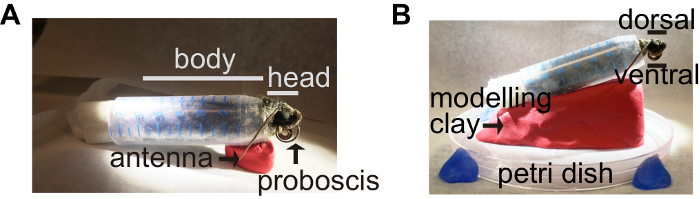
Figure 1: Preparation of the Dissection Chamber for Manduca. (A) A moth is restrained in a tube. The head is exposed on one end, while the other end is plugged with tissue paper. (B) A dissection chamber made from a petri dish and modeling clay is shown. The dorsal part of the head is facing up. Please click here to view a larger version of this figure.
- Protect the antennae and proboscis.
- Prepare 3 small tubes by cutting a pipette tip (yellow tips, 1-200 µL) with a razor blade into 3 pieces of about 0.5 cm in length. The inner diameter should be large enough so that the antenna and proboscis can fit snugly.
- Prepare a hook by bending a wire (22 AWG, of about 7 cm long). Extend the moth's proboscis and then insert it into one of the small tubes by pulling it through with the wire hook until the tube reaches the proximal part of the proboscis.
- Secure the small tube with firm batik wax (using, for example, a dental electric waxer to melt and direct the wax) to the dorsal part of the moth's head-capsule (Figure 2A left).
- Place each antenna into a tube and secure the tubes with batik wax as shown in Figure 2A (left). Be careful to avoid damaging the antennae with the hot wax.
- Stabilize the brain against movement by cutting muscles that cover the anterior surface of the brain (i.e. buccal compressor muscle).
- Under the dissection microscope, use micro-dissection scissors or a mini-axe fashioned from a razor chip glued to a toothpick to open the head capsule by making a small cut just below the proboscis (Figure 2A, left upper inset).
- Use micro-dissection scissors to cut the buccal compressor muscle (for illustrations see reference 25). As the muscle is not easily visible, the following behavioral test is recommended to confirm that it has been cut.
- Dilute sucrose in distilled water to achieve a 1 M solution.
- Use a pipette to deliver about 200 µL of sucrose solution to the distal 2/3 of the proboscis, and observe the proboscis for 5 min. If the muscle was properly cut the insect should not be able to extend or move the proboscis.
- Apply a layer of melted batik wax to seal the opening in the head-capsule.
- Flip the insect over so the ventral side of the head-capsule is now facing up.
- To perfuse saline during and after the dissection procedure build up a wax cup around the ventral side of the head using the electric waxer: Under a dissection microscope, start building the cup by applying the first row of wax along the front of the head, moving toward the back. Keep the proboscis and antennae tubes inside the cup (Figure 2A right).
- Continue building the cup outward and upward until it reaches the level of the eyes.
- Use forceps to take one of the two labial palps, then place it on the side and secure it into the wax cup by adding more melted wax. Do the same with the other maxillary palp (Figure 2A right).
- Seal any openings in the wax cup and tubes.
Note: In this step epoxy is used because it helps to easily seal gaps in the wax and the tubes, and avoids any heat-related damage to the antennae and proboscis.- Use a toothpick to mix binary epoxy in a plastic mixing dish. Retain the mixing dish.
- Use the toothpick to apply a thin layer of epoxy to the outside and the inside of the cup (Figure 2B).
- Fill the empty space in the tubes that contain the proboscis and antennae with epoxy, and fill the part of the polypropylene tube surrounding the neck with enough epoxy to hold it firmly in place (Figure 2B).
- Leave the epoxy to dry for approximately 20 min. To check this, test the epoxy remaining in the plastic mixing dish to ensure it is solid and no longer sticky.
- Fill the wax cup with Manduca physiological saline 28 and wait a couple of minutes to make sure there are no leaks. If a leak is visible, try to seal it by applying more hot wax and/or epoxy.
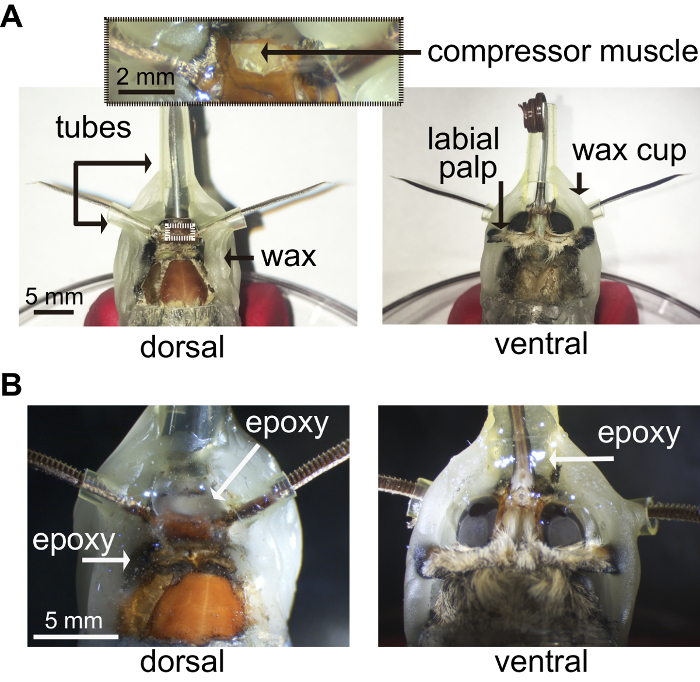
Figure 2: Preparing Manduca for Dissection. (A) Antennae and proboscis are protected inside small tubes made from pipette tips cut into three pieces of about 0.5 cm in length. (Left panel, large image) The tubes are secured with melted batik wax applied around the dorsal part of the head. (Left panel, inset) To remove the buccal compressor muscle, the dorsal side of the head capsule is opened by making a small cut as indicated by the dotted line in the large image. (Right panel) A wax cup is built surrounding the ventral side of the head as a reservoir for perfused saline during the dissection procedure and recording experiments. (B) Epoxy is used to seal gaps between the base of the wax cup and the dorsal part of the head (left panel), and between the wax and the tubes containing the antennae and proboscis, including the openings of the tubes (right panel). Please click here to view a larger version of this figure.
- Under the dissection microscope, use micro-dissection scissors to cut off the labial palps.
- Use micro-dissection scissors or a mini-axe to open the ventral side of the head capsule by making four cuts: two cuts along the cuticle that surrounds each eye from back to front, one cut on the cuticle along the back of the head, and one cut on the cuticle along the front of the head near the proboscis (Figure 3A).
- Gently pull away the cuticle using micro-dissection forceps to expose the brain.
- By using two sharp micro-dissection forceps slowly and carefully remove fat tissue and the trachea covering the SEZ. Avoid any damage to the brain or nerves (e.g., maxillary nerve, optic nerve, cervical connective). Rinse the brain by frequently replacing the saline solution, and adjust the light often for improved visibility. Note: This may be the most critical part of the dissection; it is easy to inadvertently damage the maxillary nerve by tugging on or crushing it.
Note: At this point the SEZ and the maxillary nerves should be clearly visible (Figure 3B-3C). However, the brain and the maxillary nerves are covered by a thin sheath. - To remove the sheath, replace the saline in the wax cup with 10% (w/v) collagenase/dispase dissolved in saline and leave it in place for 5 min. Then, after rinsing the brain several times with saline, gently remove the sheath with super-fine micro-dissection forceps by pulling the sheath up from the SEZ through the maxillary nerves.
- Begin to perfuse the wax cup with fresh saline. Place the tube from a saline drip line into the wax cup and secure it there with melted wax.
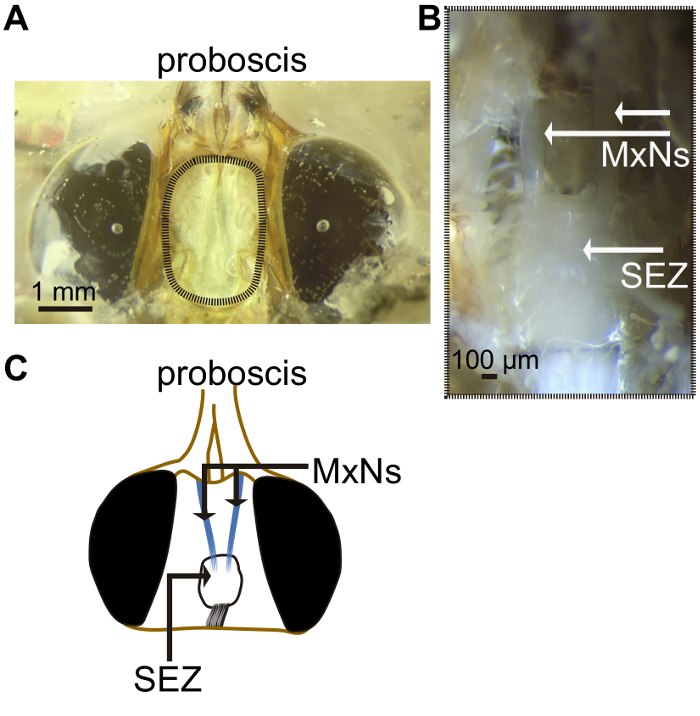
Figure 3: Manduca Dissection Procedure. (A) The labial palps removed, the head capsule is opened by making four cuts as indicated by the dotted line. (B) A magnified image of the brain after opening the head capsule and removing fat tissue and trachea, allowing visualization of the maxillary nerves (MxNs) and the sub-esophageal zone (SEZ, a term referring to the area of the brain under the esophagus). The maxillary nerves carry axons from gustatory receptor neurons (GRNs) in the proboscis to the SEZ. (C) A schematic of a Manduca brain. Please click here to view a larger version of this figure.
2. Tastant Delivery System
- The tastant delivery system is composed of four main elements: the water source, the tastant manifold, the color sensor, and the site containing the proboscis, all connected to a rigid plastic tube (Figure 4A-4B). To build this system follow the steps shown in Figure 4B. Use a rigid plastic tube about 6 cm in length (ID 0.3 cm).
- Use a soldering iron to make a small hole in the tube where the proboscis is going to be placed (Figure 4A-4B).
- To ensure that the proboscises of different animals are always placed in the same location, attach plastic screening material (mesh, hole size of about 0.1 cm) into the tube (Figure 4A-4B). With a razor blade or a rotary tool cut the rigid tube about 5 mm above the proboscis hole. Place the mesh between the two pieces of tube. Secure the mesh and reconnect the tubes by applying epoxy on the outside of the tubes. Leave the epoxy to dry for approximately 20 min.
- For tastant delivery use a pressurized perfusion system with as many tastant tubes as needed, joined to a manifold (see below). Use the soldering iron to make a small hole in the rigid tube about 1 cm above the mesh. Insert the output tube from the perfusion system (ID 0.86 mm) into the rigid tube and secure it there by applying epoxy (Figure 4A-4B).
- Use a peristaltic pump to deliver a constant flow (~40 mL/min) of distilled water. Connect it with silicone tubing to the rigid tube (Figure 4A-4C). Connect the other side of the rigid tube to another silicon tube to direct the output into a large waste container (Figure 4A-4C).
- To deliver the tastant, inject compressed air into the manifold of the perfusion system. This can be achieved, for example, by using a pneumatic pump (10 p.s.i.) controlled by a timed voltage pulse input to inject compressed air into the manifold tube containing the desired tastant. A 1s pulse ejects about 0.5 mL of tastant.
3. Tastant Preparation and Monitoring Tastant Delivery
- Dilute tastant in distilled water to the desired concentration. Be aware that the tastant will be further diluted by the water stream. We measured the final concentration reaching the proboscis as 77% of the initial concentration (see references 10,29).
- Add an artificial food dye to each tastant solution to allow determining the precise timing with which the tastant passes over the proboscis. We found that the green dye (see Material List) at 0.05% w/v does not activate Manduca GRNs.
- Use a color sensor (see Table 1) to detect the food coloring in the tastant solutions. Use a soldering iron to make a hole adjacent to the mesh and 0.5 cm below the output tube of the perfusion system (Figure 4A-4B). Connect the sensor to the rigid tube and secure it there applying epoxy on the outside.
- Record the color sensor voltage output as an analog signal together with physiological signals (see section 4). The color sensor voltage signal can be amplified using a DC amplifier connected to the sensor (Figure 4A).
- Ensure that the color sensor is working by delivering the tastant and recording the sensor's voltage output. The signal elicited by the dye should exceed the noise level.
- Adjust the constant water flow rate to make the signal as close to square as possible.
Note: When delivering multiple tastants in sequence, note the first trial with a new tastant will consist of a blend of the new and previous tastant. For this reason, we did not analyze these first trials.
- Adjust the constant water flow rate to make the signal as close to square as possible.
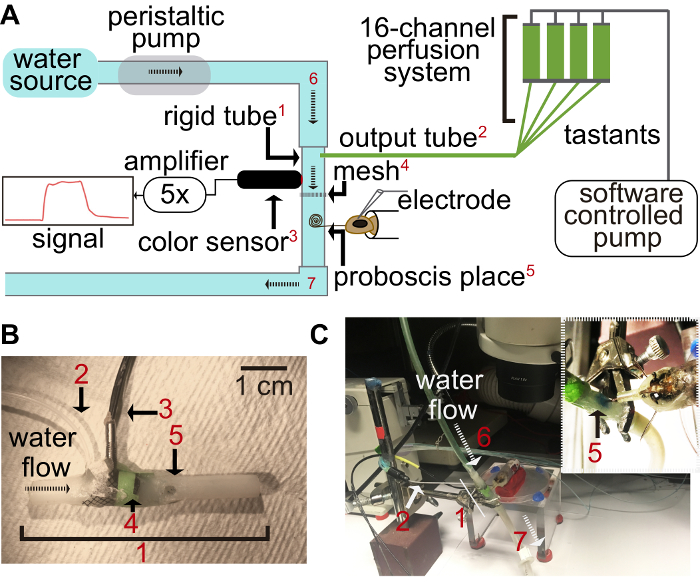
Figure 4: Tastant Delivery System. (A) A schematic of the apparatus used for delivering and monitoring timed pulses of tastants to the proboscis of the animal. The main components of the system are denoted with red numbers. A constant flow of distilled water is maintained across the proboscis by a peristaltic pump connected with silicone tubing to the rigid plastic tube (1) where the proboscis is to be placed (6). Tastants containing a small amount of taste-free dye are delivered using a pressurized 16-channel perfusion system. The reservoirs containing the tastants are connected to a manifold (2) that is attached to the rigid tube, above the hole where the proboscis is to be placed (5). Compressed air from a pneumatic pump is injected to the perfusion system to rapidly deliver a tastant, with timing controlled by custom software. A color sensor (3) is used to monitor tastant delivery. The sensor is connected to the rigid tube adjacent to the proboscis and below the outlet of the tastant perfusion system. The color sensor voltage signal is amplified by a DC amplifier. The red trace on the inset adjacent to the amplifier illustrates a color signal recorded using custom data acquisition software; the rapid increase and decrease in the signal reflect arrival and washout of the tastant, respectively. The moth's proboscis is placed into a hole (5) located just below the color sensor. A mesh (4) is placed above the hole to ensure that the proboscises of different animals are always positioned in the same location. The other side of the rigid tube is connected to another silicon tube to direct the output into a waste container (7). (B) Image showing the main elements of the tastant delivery system connected to the rigid plastic tube, which are denoted by the red numbers as shown in panel A: the water source (6), the tastant manifold output tubing (2), the color sensor (3), the mesh (4), and the hole where the proboscis is to be inserted (5) all connected into a rigid plastic tube (1). (C) The placement of the Manduca preparation into the set-up is shown. The distal t2/3 of the moth's proboscis are introduced into the hole (5) at the rigid plastic tube (1). The proboscis is secured in place with dental wax and epoxy as shown by the inset. The water input to the rigid tube and its output to a waste container are indicated by the numbers 6 and 7, respectively. The number 2 indicates the tastant manifold output tubing. Please click here to view a larger version of this figure.
4. Extracellular Tetrode Recording to Monitor Tastant-evoked Activity from GRNs
- Place moth preparation on a platform under a stereomicroscope on a vibration-isolating table (Figure 4C).
- Put the distal two-thirds of the moth's proboscis into the rigid tube of the tastant delivery system (Figure 2B). To do this, extend the moth's proboscis and then insert it into the hole of the rigid tube by gently pushing it through with the help of dressing forceps. Seal the proboscis in place with soft dental wax and then a layer of epoxy to avoid leaks (Figure 4C, inlet).
- Connect the saline perfusion line to the head capsule and set the perfusion flow to a constant rate of about 0.04 L/h.
- Immerse a ground electrode (i.e. a chlorided silver wire) in the saline bath (Figure 5A).
- Use a custom-made twisted wire tetrode built following the fabrication procedure described in 30 (4 electrode wires are suggested to achieve well isolated units and to fit into the nerve). Before the experiment, electroplate the electrode following the steps described in 30.
- Use a manual micromanipulator to position the tetrode close to the maxillary nerve. Advance the tetrode until it starts to enter the nerve (Figure 5).
- Wait for at least 10 min after placing the tetrode to allow it to stabilize within the nerve before recording.
- Amplify the signal (3000x) and use a band-pass filter set between 0.3-6 kHz. Acquire the signal at a 40 kHz sampling rate using data acquisition software.
- After finishing the experiment place the moth preparation into the freezer.
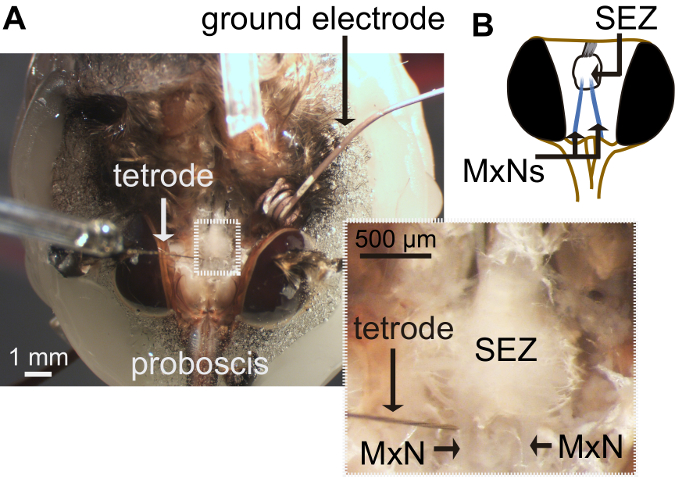
Figure 5: Tetrode Recording from GRNs. (A, large image) A micromanipulator is used to place the twisted wire tetrode into the maxillary nerve (MxN) to record the activity of GRNs. A chloride silver ground electrode is placed in the saline bath as shown. (A, inset) A magnified image of the brain showing the tetrode in the maxillary nerve. The subesophageal zone (SEZ) is also indicated. (B) A schematic of a Manduca brain oriented as in A. Please click here to view a larger version of this figure.
Results
The activity of GRNs can be recorded using an extracellular tetrode electrode before, during and after tastant delivery (Figure 6A and 6C). Figure 6A (middle and bottom panels) shows filtered (300-6,000 Hz) voltage traces recorded by each of the four wires placed in the maxillary nerve, where signals of different amplitudes reflecting action potentials (arrows) can be observed. A 1 s pulse of tastant (1 M sucrose) was delivered 2s after the beginning of the experiment; the onset and offset of the stimulus was monitored by the color sensor (Figure 6A, upper panel). The tastant induced spikes that can be observed in each of the four channels (Figure 6A, middle panel). GRNs can be identified and distinguished from mechanosensors (none shown here) when they respond to some tastants and not others 10.
To identify and isolate single neuron responses from the tetrode recordings, we performed off-line spike sorting using a set of custom functions based on Pouzat's 31 and Kleinfeld's 32,33 methods (these methods are described in these citations: 10,29). Figure 6B shows an example of spike sorting applied to the data shown in Figure 6A, in which three well isolated units were found.
Raster plots from Figure 6C depict responses of the three isolated units in Figure 6B to six different tastants (1 M sucrose, maltose and NaCl; 100 mM caffeine and 10 mM berberine and lobeline) delivered in sequence (4 trials/tastant are shown). As shown in Figure 6C, the recorded GRNs have different levels of baseline activity, ranging from silent (GRNs 1) to low or moderate (GRN 2 and 3). After tastant onset, GRNs show diverse activity patterns and exhibit different selectivity to the tastants. For example, GRN 1 responded only to sucrose, whereas GRN 2 responded to maltose and NaCl with burst of spikes and to lobeline with spiking only at the onset of the stimulus. In addition, some responses are locked to the timing of the stimulus (e.g. GRN 1 response to sucrose), whereas other responses outlast the duration of the stimulus (e.g. GRN 3 response to berberine) or contain both excitatory and inhibitory components (e.g. Figure 7 GRN 2 responses to NaCl and sucrose). For more information about the diverse sensitivities and activity patterns of GRNs see reference 10.
To validate the use of the tetrode and spike-sorting techniques to record GRNs from the maxillary nerve, we performed intracellular recordings from GRN axons in other animals by using conventional sharp glass electrodes (resistance of 80-120 MΩ). We found that the activity patterns obtained by using intracellular recordings were similar to responses observed by using the tetrode technique (Figure 7). The voltage traces in the green box in Panel A were recorded intracellularly from GRN 1 during 5 consecutive trials of sucrose presentation, and the same responses are shown as raster plots in panel B. (Note that this type of response matches that obtained with tetrodes and shown in Figure 6C.) GRN 2, recorded with sharp intracellular electrodes, shows a broader response pattern.
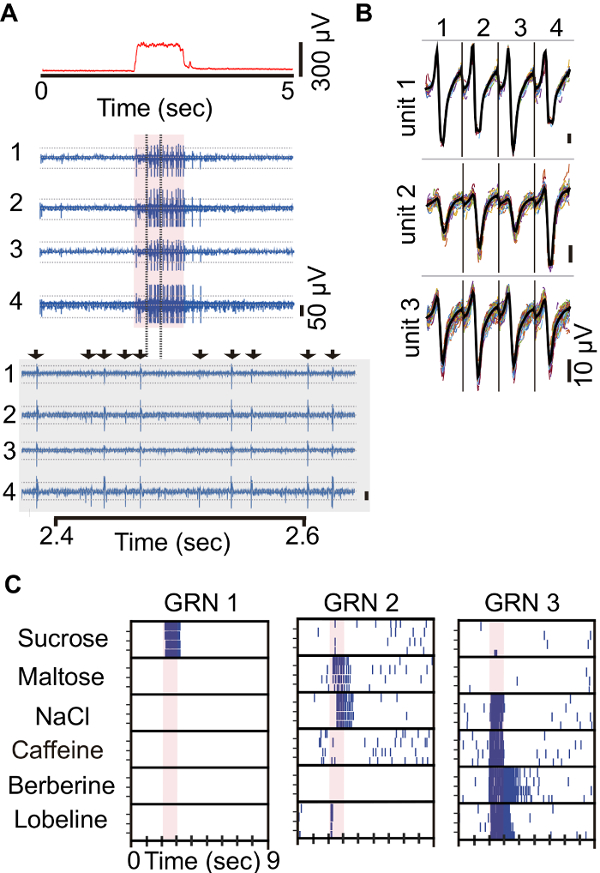
Figure 6: Representative Results from Maxillary Nerve Recordings with Extracellular Tetrodes. (A) Filtered (300-6,000 Hz) voltage traces recorded by each of the four wires at the maxillary nerve are shown (middle panel). A 1 s pulse of tastant was applied during the time period indicated by red shading in the middle panel. The onset and offset of the stimulus was monitored by the color sensor as indicated by the red voltage trace on the upper panel, and is denoted on the middle panel by the red-shaded area. The dotted horizontal lines denote +50 (top), 0 (middle) and -50 (bottom) µV. An enlargement of the raw voltage traces corresponding to the area inside the vertical dotted lines is shown (bottom panel). Examples of spikes are indicated by the arrows. (B) An example of spike sorting applied to the data shown in panel A. The waveforms recorded at each of the four extracellular wires (1-4) are identified with three different GRNs (units 1-3) contributing to the recorded signals. Individual events (colored thin lines) and the mean (thick black line) are shown for the three units. A number of statistical criteria have to be considered to reliably identify independent units using the spike-sorting method (see references 10,29). (C) Raster plots representing responses of the three isolated units to a sequence of six different tastants (4 trials/tastant are shown). The time period of tastant delivery (1 s) is indicated by the red-shaded area. The concentrations of tastants were either 1 M (sucrose, maltose, NaCl), 100 mM (caffeine) and 10 mM (berberine and lobeline). Please click here to view a larger version of this figure.
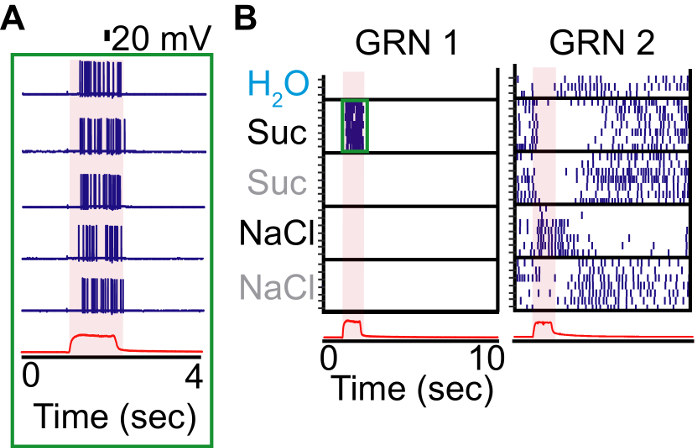
Figure 7: Intracellular Recordings from GRN Axons. (A, green box panel) Voltage traces recorded from a GRN with sharp glass intracellular electrodes (resistance of 80 - 120 MΩ) placed into the maxillary nerve, elicited by 5 consecutive stimulations with 1 M sucrose (Suc). (B) Raster plots of the responses of two GRNs, including responses shown in panel A (green box panel), to two different tastants delivered in sequence (100 mM gray font color; 1 M black font color) recorded with sharp glass intracellular electrodes placed into the maxillary nerve (7 trials/tastant and 3 trials/water are shown). Tastant delivery time is indicated by red-shaded areas in both panels. The onset and offset of the stimulus was monitored by the color sensor, as indicated by the red voltage traces at the bottom of each panel. Please click here to view a larger version of this figure.
Discussion
The methods described here permit in vivo recordings from a relatively simple animal, Manduca sexta, to characterize the activity of multiple, randomly selected GRNs over long durations (for more than 2 h), before, during and after tastant delivery. These methods also allow the rapid, sequential delivery of multiple tastant stimuli with precise temporal control, advantages that are useful for studying neural mechanisms underlying tastant representation. This protocol has been used to study how the responses of GRNs to tastants are transformed when they are transmitted to their postsynaptic target neurons (e.g., in the SEZ) by monitoring GRNs simultaneously with monosynaptically connected interneurons 10. Additionally, these methods can be adapted to the experimenter's needs, allowing the execution of complex paradigms to study fundamental aspects of gustatory coding.
When beginning our studies, one technical problem we sometimes had to troubleshoot was the inability to detect spiking signals from maxillary nerve with the tetrode wires. Possible causes for this are diverse, as the dissection protocol is challenging, and some practice is necessary to obtain a good preparation. First, during the moth dissection the maxillary nerves are easy to damage, especially during the removal of the sheath surrounding the nervous tissue. Second, if the sheath is not removed fully, the tetrode wires may not be able to access the nerve. In both cases, starting a new preparation is often the easiest way to resolve these issues. Third, there may be a problem with the tetrode wires. This can be checked by measuring the impedance of the wires which should be ~270 kΩ at 1kHz. If the impedance value is above ~300 kΩ, electroplate the wires with gold to achieve the desired impedance (see reference 30). Fourth, a piece of equipment may be misconnected or misbehaving.
Another possible problem is that spiking signals are recorded but the neuron(s) appear unresponsive to the tastants. This could be because the recorded neurons are insensitive to the set of tastants delivered. Also, is important to keep in mind that in addition to axons of GRNs, the maxillary nerve also carries mechanosensory fibers. Thus, it is possible to record from mechanosensory neurons instead of, or in addition to, GRNs. However, the tastant delivery system is designed to provide a constant mechanical input throughout the experiment making it unlikely that responses to a tastant will be confounded by responses to the mechanical component of its delivery. Neurons that respond to some but not other tastants, or in different ways to different tastants, can be classified unambiguously as GRNs. We recommend using freshly diluted tastants to avoid variations in tastant concentration or composition owing to compound degradation or evaporation of the solvent. We also recommend cleaning the system regularly to avoid tubing contamination and/or obstructions.
Another possible technical problem is a disadvantageous signal-to-noise ratio. This problem can often be solved by rechloriding or adjusting the position of the bath ground electrode. Other solutions might require shielding and minimizing the length of each electrical connection in the apparatus.
Finally, it is important to note that correct analysis of data obtained using tetrode recordings requires careful spike sorting. We found that fully-automated methods are generally inadequate. We recommend becoming familiar with the spike sorting literature before analyzing tetrode data 10,29,31,32,33.
Alternatives to our dissection protocol can be used. Here, we described a dissection through the ventral part of the moth head, providing access to the maxillary nerves and SEZ, but it is also possible to access these structures by dissecting through the dorsal side. We found the dorsal side preparation is not optimal for making recordings from these gustatory structures due to their deep location, but this preparation does offer the advantage of enabling recordings from higher order structures such as the mushroom body, an area that has been associated with multi-sensory integration, associative learning and memory processing 34. We have focused on the use of tetrode electrodes to record from the maxillary nerve, but, as we illustrated, standard intracellular sharp electrodes can also be used for this purpose. In addition, both techniques can be combined to perform simultaneous recordings from multiple brain areas 10. The neuroscience literature offers many examples of invertebrate models that have proven to be powerful tools for revealing fundamental principles of sensory processing, such as olfactory coding, that apply to both insects and vertebrates 35,36,37,38,39. We hope our methods will lead to fundamental new insights about gustatory coding.
Disclosures
The authors have nothing to disclose.
Acknowledgements
This work was supported by an intramural grant from NIH-NICHD to M.S. We thank G. Dold and T. Talbot of the NIH-NIMH Instrumentation Core Facility for assistance with designing the tastant delivery system.
Materials
| Name | Company | Catalog Number | Comments |
|---|---|---|---|
| Dissection and Specimen Preparation | |||
| Polypropylene tube, 15 mL Falcon | Fisher Scientific | 14-959-53A | |
| Needle, Short bevel, 19 G x 1 - 1/2" | MONOJET | 888200144 | For applying air to remove the hair from the moth. |
| Modeling Clay-Van Aken Plastalina | DickBlick | 33268 | |
| Petri dish -100 x 15 mm | VWR International | 89000-304 | |
| Pipette tip (1 - 200 µL) | USA Scientific | 1111-0806 | |
| Razor blade | Techni Edge | TE05-071 | |
| 22 AWG standard hookup wire | AlphaWire | 1551 | For inserting the proboscis into the pippete tip. |
| Batik wax | Jacquard | 7946000 | |
| Electric waxer | Almore International | 66000 | |
| Stereo Myscroscope | Leica | MZ75 | |
| Dumont #1 forceps (coarse) | World Precision Instruments | 500335 | For removing fat and non-nervous tissue. |
| Dumont #5 titanium forceps (fine) | World Precision Instruments | 14096 | For removing fat and non-nervous tissue. |
| Dumont #5SF forceps (super-fine) | World Precision Instruments | 500085 | For desheathing the nervous tissue. |
| Vannas scissors (fine) | World Precision Instruments | 500086 | For removing the cuticle. |
| Collagenase/Dispase | Sigma-Aldrich | 11097113001 | |
| Epoxy | Permatex | 84101 | |
| Name | Company | Catalog Number | Comments |
| Saline Perfusion System | |||
| Extension set with rate flow regulator | B Braun Medical Inc. | V5200 | |
| IV administration set with Y injection site | B Braun Medical Inc. | V1402 | |
| Name | Company | Catalog Number | Comments |
| Tastant Delivery System | |||
| White Translucent Nylon Tubing OD 1/4", ID 1/8" | Small Parts Inc. | B001JJT4SA | Rigid tube that connects the four main elements of the system. |
| Soldering iron | Circuit Specialists | ZD200BK | |
| Rotary tool-Dremel | Dremel | 4200 | |
| Polypropylene mesh, hole size (hole size 0.1 x 0.13 cm) | Industrial Netting | XN5170 | For ensuring that the probosises of different animals are placed in the same location. |
| Pressurized 16-Channel perfusion system | Bioscience Tools | PS-16H | For tastant delivery. This system includes pinch valves, tubing, manifold, solution cylinders, valve controller and fitting accessories. |
| Polypropylene tubing, ID 0.034", ID 0.050" | Becton, Dickinson & Co | 427421 | Output tube from the perfusion system. |
| Pneumatic PicoPump | World Precision Instruments | SYS-PV820 | For controlling the output channel of the perfusion system. |
| Data acquisition software system, LabVIEW PCI-MIO-16E-4 DAQ card | National Instruments | LabVIEW 2011 | To control the pico pump for tastant delivery and to record the signals from the color sensor. |
| Compulab 3 Manostat peristaltic pump | Sigma | P1366 | For pumping water. |
| Silicone tubing, ID 1/16" OD 1/8" | Cole-Parmer | WU-95802-02 | To connect the water source to the peristaltic pump tubing, and the outlet tube of the pump to the rigid tube of the delivery system. |
| Color sensor-digital fiber optic sensor | Keyence | FS-V31M | For monitoring tastant delivery. |
| Color sensor-reflective fiber unit | Keyence | FU35-FZ | To connect the color sensor device. |
| Dental periphery Wax | Henry-Schein Dental | 6652151 | To secure the proboscis into the rigid tube. |
| Two 3.7 L containers | To provide water to the system, and to recollect the water waste. | ||
| Fast green FCF | Sigma | F7258 | |
| Dressing forceps 25.5 cm | WPI | 500364 | To introduce moth proboscis into the proboscis hole in the rigid tube. |
| Name | Company | Catalog Number | Comments |
| Electrophysiology Equipment | |||
| D.C. amplifier | Brown-Lee | 440 | |
| Lamp | Schott | Schott Fostec Light Source DCR 2 | |
| Manual micromanipulator | Leica | micromanipulator | To precisely insert the tetrodes into the animal's brain. The manipulator has to allow fine and coarse movements in x, y and z axis. |
| Stereomicroscope | Leica | MZ75 | |
| Vibration-isolation table (MICRO-g lab table) | TMC | 63-541 | |
| Oscilloscope | Tektronix | TDS2014 | |
| 16-channle pre-amplifier and amplifier | 16 Channel MA-800 Amplifier System | B.E.S 2013 | |
| Computer | Dell | optiplex 780 | The following are the minimum recommended requirements. RAM: 3.32 GHz, 3GB. Processor: Intel Core 2 Duo. Graphic card: integrated Intel GMA X4500. |
| Data acquisition software system, LabVIEW PCI-MIO-16E-4 DAQ card | National Instruments | LabVIEW 2011 | To control the pico pump for tastant delivery and to record the signals from the color sensor and electrode. |
| Name | Company | Catalog Number | Comments |
| Tastants | |||
| KAc | Sigma-Aldrich | P5708 | |
| LiCl | Sigma-Aldrich | L9650 | |
| NaCl | Sigma-Aldrich | 73575 | |
| Sucrose | Sigma-Aldrich | 84097 |
References
- Chandrashekar, J., Hoon, M. A., Ryba, N. J. P., Zuker, C. S. The receptors and cells for mammalian taste. Nature. 444 (7117), 288-294 (2006).
- Chen, X., Gabitto, M., Peng, Y., Ryba, N. J. P., Zuker, C. S. A Gustotopic Map of Taste Qualities in the Mammalian Brain. Science. 333 (6047), (2011).
- Yarmolinsky, D. A., Zuker, C. S., Ryba, N. J. P. Common Sense about Taste: From Mammals to Insects. Cell. 139 (2), 234-244 (2009).
- Mueller, K. L., Hoon, M. A., Erlenbach, I., Chandrashekar, J., Zuker, C. S., Ryba, N. J. P. The receptors and coding logic for bitter taste. Nature. 434 (7030), 225-229 (2005).
- Zhao, G. Q., Zhang, Y., et al. The receptors for mammalian sweet and umami taste. Cell. 115 (3), 255-266 (2003).
- Huang, A. L., Chen, X., et al. The cells and logic for mammalian sour taste detection. Nature. 442 (7105), 934-938 (2006).
- Pfaffmann, C., Carl, The afferent code for sensory quality. Am Psychol. 14 (5), 226-232 (1959).
- Lemon, C. H., Katz, D. B. The neural processing of taste. BMC Neurosci. 8 (Suppl 3), (2007).
- Barretto, R. P. J., Gillis-Smith, S., et al. The neural representation of taste quality at the periphery. Nature. 517 (7534), 373-376 (2015).
- Reiter, S., Campillo Rodriguez, C., Sun, K., Stopfer, M. Spatiotemporal Coding of Individual Chemicals by the Gustatory System. J Neurosci. 35 (35), 12309-12321 (2015).
- Wilson, D. M., Boughter, J. D., et al. Bitter Taste Stimuli Induce Differential Neural Codes in Mouse Brain. PLoS ONE. 7 (7), e41597(2012).
- Glendinning, J. I., Davis, A., Ramaswamy, S. Contribution of different taste cells and signaling pathways to the discrimination of "bitter" taste stimuli by an insect. The Journal of neuroscience the official journal of the Society for Neuroscience. 22 (16), 7281-7287 (2002).
- Kay, L. M., Stopfer, M. Information processing in the olfactory systems of insects and vertebrates. Semin Cell Dev Biol. 17 (4), 433-442 (2006).
- Liman, E. R., Zhang, Y. V., Montell, C. Peripheral Coding of Taste. Neuron. 81 (5), 984-1000 (2014).
- Carleton, A., Accolla, R., Simon, S. A. Coding in the Mammalian Gustatory System. Trends Neurosci. 33 (7), 326-334 (2010).
- Stocker, R. F. The organization of the chemosensory system in Drosophila melanogaster: a rewiew. Cell Tissue Res. 275 (1), 3-26 (1994).
- Mitchell, B. K., Itagaki, H., Rivet, M. P. Peripheral and central structures involved in insect gustation. Microsc Res Tech. 47 (6), 401-415 (1999).
- Falk, R., Bleiser-Avivi, N., Atidia, J. Labellar taste organs of Drosophila melanogaster. J Morphol. 150 (2), 327-341 (1976).
- Hodgson, E. S., Lettvin, J. Y., Roeder, K. D. Physiology of a primary chemoreceptor unit. Science. 122 (3166), 417-418 (1955).
- Delventhal, R., Kiely, A., Carlson, J. R. Electrophysiological recording from Drosophila labellar taste sensilla. J Vis Exp. (84), e51355(2014).
- Weiss, L. A., Dahanukar, A., Kwon, J. Y., Banerjee, D., Carlson, J. R. The molecular and cellular basis of bitter taste in Drosophila). Neuron. 69 (2), 258-272 (2011).
- Descoins, C., Marion-Poll, F. Electrophysiological responses of gustatory sensilla of Mamestra brassicae (Lepidoptera, Noctuidae) larvae to three ecdysteroids: ecdysone, 20-hydroxyecdysone and ponasterone. A. J Insect Physiol. 45 (10), 871-876 (1999).
- Popescu, A., Couton, L., et al. Function and central projections of gustatory receptor neurons on the antenna of the noctuid moth Spodoptera littoralis. J Comp Physiol. 199 (5), 403-416 (2013).
- Morita, H., Yamashita, S. Generator potential of insect chemoreceptor. Science. 130 (3380), 922(1959).
- Davis, N. T., Hildebrand, J. G. Neuroanatomy of the sucking pump of the moth, Manduca sexta (Sphingidae, Lepidoptera). Arthropod Struct Dev. 35 (1), 15-33 (2006).
- Stürckow, B., Adams, J. R., Wilcox, T. A. The Neurons in the Labellar Nerve of the Blow Fly. Z Vergl Physiol. 54, 268-289 (1967).
- Stürckow, B. Electrophysiological studies of a single taste hair of the fly during stimulation by a flowing system. Proceed 16 Intern Contr Zool. 3 (8), 102-104 (1963).
- Christensen, T. A., Hildebrand, J. G. Male-specific, sex pheromone-selective projection neurons in the antennal lobes of the moth Manduca sexta. J Comp Physiol A. 160, 553-569 (1987).
- Reiter, S. Gustatory Information Processing. , https://repository.library.brown.edu/studio/item/bdr:386235/PDF/?embed=true (2014).
- Saha, D., Leong, K., Katta, N., Raman, B. Multi-unit Recording Methods to Characterize Neural Activity in the Locust (Schistocerca Americana) Olfactory Circuits. J Vis Exp. (71), (2013).
- Pouzat, C., Mazor, O., Laurent, G. Using noise signature to optimize spike-sorting and to assess neuronal classification quality. J Neurosci Methods. 122 (1), 43-57 (2002).
- Hill, D. N., Mehta, S. B., Kleinfeld, D. Quality Metrics to Accompany Spike Sorting of Extracellular Signals. J Neurosci. 31 (24), 8699-8705 (2011).
- Fee, M. S., Mitra, P. P., Kleinfeld, D. Automatic sorting of multiple unit neuronal signals in the presence of anisotropic and non-Gaussian variability. J Neurosci Methods. 69 (2), 175-188 (1996).
- Heisenberg, M. Mushroom body memoir: from maps to models. Nat Rev Neurosci. 4 (4), 266-275 (2003).
- Naraghi, M., Laurent, G. Odorant-induced oscillations in the mushroom bodies of the locust. J Neurosci. 14, 2993-3004 (1994).
- Laurent, G., Wehr, M., Davidowitz, H. Temporal representations of odors in an olfactory network. J Neurosci. 16, 3837-3847 (1996).
- Perez-Orive, J., et al. Oscillations and sparsening of odor representations in the mushroom body. Science. 297, 359-365 (2002).
- Stopfer, M., Jayaraman, V., Laurent, G. Odor identity vs. intensity coding in an olfactory system. Neuron. 39, 991-1004 (2003).
- Laurent, G. Olfactory network dynamics and the coding of multidimensional signals. Nature Re Neurosci. 3, 884-895 (2002).
Reprints and Permissions
