We present a behavior recording setup and protocol that enables automated analysis of the nematode, Caenorhabditis elegans' preference for soluble compounds in a population-based assay. This article describes the construction of a behavior chamber, the behavioral assay protocol, and video analysis software usage.
Method Article
Automated Analysis of a Nematode Population-based Chemosensory Preference Assay
In This Article
Summary
Abstract
The nematode, Caenorhabditis elegans' compact nervous system of only 302 neurons underlies a diverse repertoire of behaviors. To facilitate the dissection of the neural circuits underlying these behaviors, the development of robust and reproducible behavioral assays is necessary. Previous C. elegans behavioral studies have used variations of a "drop test", a "chemotaxis assay", and a "retention assay" to investigate the response of C. elegans to soluble compounds. The method described in this article seeks to combine the complementary strengths of the three aforementioned assays. Briefly, a small circle in the middle of each assay plate is divided into four quadrants with the control and experimental solutions alternately placed. After the addition of the worms, the assay plates are loaded into a behavior chamber where microscope cameras record the worms' encounters with the treated regions. Automated video analysis is then performed and a preference index (PI) value for each video is generated. The video acquisition and automated analysis features of this method minimizes the experimenter's involvement and any associated errors. Furthermore, minute amounts of the experimental compound are used per assay and the behavior chamber's multi-camera setup increases experimental throughput. This method is particularly useful for conducting behavioral screens of genetic mutants and novel chemical compounds. However, this method is not appropriate for studying stimulus gradient navigation due to the close proximity of the control and experimental solution regions. It should also not be used when only a small population of worms is available. While suitable for assaying responses only to soluble compounds in its current form, this method can be easily modified to accommodate multimodal sensory interaction and optogenetic studies. This method can also be adapted to assay the chemosensory responses of other nematode species.
Introduction
Foraging animals must integrate inputs from multiple sensory modalities and select appropriate behavioral strategies in order to successfully navigate their environment. Understanding how external sensory inputs are received and transduced into neural information to guide action selection is a central goal in the field of neurobiology. The genetically tractable nematode, C. elegans, is an attractive model organism in which to study the neural mechanisms underlying sensory biology and multimodal integration. Although C. elegans has only 302 neurons, it can detect and discriminate between a wide variety of environmental stimuli including soluble compounds, volatile odorants, and ambient temperature1,2,3,4,5,6,7. The nematode C. elegans relies heavily on its chemosensory apparatus to localize food sources and to alert itself to potential threats. Thus, behavioral assays designed to screen the responses of wild-type and mutant C. elegans to chemical stimuli play a crucial role in dissecting the genetic, cellular, and neural mechanisms underlying C. elegans' remarkable sensory capabilities.
To assay the response to soluble compounds, three types of assays have been described – the drop test, the chemotaxis assay, and the retention assay. In the drop test, a small drop of the compound is placed at the tail of a moving worm and the worm's decision to reverse or move forward once the liquid reaches the anterior sensory apparatus is scored4. The drop test requires little experimental preparation and is useful when the sample size of worms is small, as in the case of laser-operated worms. However, as only one worm can be assayed at a time and the experimenter must be present throughout the duration of the assay, the drop test can be time consuming. The drop test is also vulnerable to variations in drop delivery between each worm within a sample, which may influence the overall results of the assay. Another limitation of the drop test is that it can only be used to assay the worm's response to aversive compounds as it is not possible to discriminate between an attractive or neutral effect of the compound from the worm's forward movement.
The chemotaxis assay for soluble compounds generally involves dividing an agar plate into four quadrants, with the experimental solution mixed into the agar of two opposing quadrants and the control solution mixed into the other two quadrants8,9. At the start of the assay, a drop of buffer containing worms is placed at the center of the plate and the number of worms in each quadrant is scored at different time points. The chemotaxis assay provides greater statistical power compared to the drop test as large numbers of worms are tested in each assay. However, one limitation of this method is that preparation of the chemotaxis assay plates requires large quantities of the experimental compound. This will make it difficult to conduct large-scale behavior screens if a complicated purification process with limited yields is required to obtain the compound of interest, as in the case of the ascaroside signaling molecules10. In addition, the manual counting of worms throughout the assay is susceptible to errors and the perturbation of the plates during the counting process might affect the results.
Unlike the two aforementioned methods, the retention assay utilizes machine vision, which minimizes error during the scoring process and reduces experimenter's interference during the assay11. Computerized analysis of video recordings of worm behavior can also potentially reveal subtler behavioral dynamics that will be missed when scoring is only performed at a few discrete time points. In the retention assay, two solutions spots are added on opposite sides of a small circular bacterial food patch followed by the placement of a small number of worms in the middle of the food patch. The worms' behavior is then video recorded, analyzed, and a preference index value is calculated based on the total number of worm pixels in each solution region. Although the presence of an attractive food patch enables smaller populations of worms to be used in each assay, food has previously been shown to sensitize avoidance behaviors to soluble repellants12. Furthermore, worms exhibit a photophobic response to short-wavelength light and the use of microscope light sources that emit white light in the behavior recording setup might affect behavior13.
The purpose of the method discussed in this article is to record and analyze C. elegans' preference for soluble compounds using a population-based assay. To this end, the current method integrates and improves upon aspects from all three of the previously discussed methods. It enables large populations of worms to be tested and requires only small amounts of the experimental solution to be used in each assay. In addition, the assay is conducted within a custom-built enclosed behavior chamber with infrared LED backlighting to minimize the effects of short-wavelength light on behavior. Each chamber can also be outfitted with multiple microscope cameras, which increases experimental throughput without compromising bench space. Finally, video analysis software outputs the preference index value for each video as well as an accompanying worm occupancy plot to visualize population behavior dynamics over time. The chamber setup and assay protocol can be further modified to study multimodal behavior responses such as the effect of odorants or temperature on chemosensory behaviors.
This article describes the construction of the behavior chamber and the assay protocol. It also demonstrates the utility of this method in assaying the response of wild-type worms and chemosensory defective mutants to the known soluble repellant, copper ions4. Finally, the video analysis process using the provided software is detailed.
Protocol
1. Behavior Chamber Assembly
NOTE: The behavior chamber consists of an approximately cube-shaped frame made of extruded aluminum bars, covered with opaque fabric covers, with a clear acrylic bottom and camera supports. Joints between the extruded aluminum bars forming the behavior chamber are all perpendicular and are secured using "L"-shaped corner brackets (1-inch wide with 1-inch legs) that fasten one corner bracket leg to each bar with screws and slide-in T-nuts. Each joint is secured with either one or two corner brackets as described below. The fabric covers over the chamber are attached to the aluminum frame bars with the same screws and slide-in T-nuts but through grommets in the corners of the fabric. Screws are properly inserted into the countersunk side of the slide-in T-nuts, not into the side with the protruding lip. When attaching a screw/T-nut fastener assembly to an aluminum bar, slide the T-nut into the channel on the appropriate face of the bar with the head of the screw sticking out of the slot.
- Prepare fabric covers.
- Use scissors to cut five pieces of the opaque polyester fabric to cover the top and four sides of the chamber.
- Cut one square 14 x 14 inch2 sheet of fabric for the top of the chamber. Cut four rectangular 11 x 14 inch2 sheets of fabric for the sides of chamber.
- Install grommets at the corners of the fabric sheets.
- Mark a reference line 0.5 inch from each edge of all five polyester fabric sheets using a pencil and straightedge.
- For the four rectangular sheets, use grommet pliers to insert grommets centered where the pencil lines intersect at each corner (that is, 4 grommets per sheet).
- For the square sheet, insert two grommets along each edge with each grommet centered on the pencil line and positioned 1.5-inches from the end of each of the four pencil lines (that is, 8 grommets total, two near each corner).
- Insert a screw into each grommet hole and loosely attach a T-nut to each.
- Use scissors to cut five pieces of the opaque polyester fabric to cover the top and four sides of the chamber.
- Fabricate camera mount bars.
- Use a band saw or equivalent to cut one 2 inch long piece of aluminum extrusion bar for each camera, ensuring the cut end of the bar is perpendicular to the bar length to ease later assembly.
- Use a drill press with a 0.25 inch diameter drill bit to drill a hole through the center webs of each camera mount bar, 0.75 inches from one end such that the hole is perpendicular to the top and bottom faces and passes through the centerline of the bar. Optionally, drill the hole using a handheld electric drill with a 0.25 inch drill bit, but ensure that the hole is perpendicular to the top and bottom faces of the bar.
- Prepare all corner brackets.
- Insert a screw through the hole in each corner bracket leg, inserting the screw from the inside angle side. Loosely thread a T-nut onto each screw.
- Prepare the camera mount assembly (Figure 1B, layer 2).
NOTE: The camera mount assembly is an "H"-shaped assembly that supports the three camera holsters.- Attach the camera mount bars to the center bar of the camera mount assembly.
- Lay out the three camera mount bars fabricated in step 1.2 with the drilled holes oriented vertically. Slip two corner brackets onto the sides of each mount bar at the end furthest from the drilled hole.
- Position the corner brackets with the brackets' legs flush with the end of the bar and tighten the screws to secure in place. This forms a "T" shape with the drilled hole at the bottom of the "T".
- Lay a 1 foot aluminum extrusion on the work surface. Slip the T-nuts of one camera mount bar assembly (from the previous step) onto one side of the 1-foot bar. Center the mount bar along the 1 foot bar's length and tighten the screws to secure in place. Slip the other two mount bars onto the opposite side of the 1 foot bar.
- Position the two bars equidistant from the middle of the 1-foot bar, with their inner corner brackets approximately 2.5 inches apart. Slip corner brackets onto the sides of the 1-foot bar, two at each end of the bar. Position the corner brackets with the brackets' legs flush with the ends of the bar and tighten the screws to secure in place.
- Attach the end bars to the center bar.
- Slip two 1-foot aluminum extrusions onto the T-nuts at each end of the assembly from the previous step forming an "H" shape. Center each end bar on the center bar and secure by tightening the four screws.
- Slip four corner brackets onto the top of the two end bars added in the previous step, one at each end of each bar. Position the corner brackets with the brackets' legs flush with the ends of the bars and tighten the screws to secure in place.
- Attach camera stands and holsters to the camera mount assembly.
- For each of the three microscope camera stands, remove the camera holster by loosening the thumbscrew and sliding off the stand rod.
- For each camera mount bar (now secured to the center bar of the "H"), place one washer onto a round-head screw, slip the screw up through the drilled hole in the camera mount bar and place another washer down over the screw. Thread the tapped hole of the camera stand rod down onto the screw, tightening securely against the camera mount bar.
- Repeat steps 14.3.2 for the other two camera mount bars.
- Slip a camera holster onto each camera stand rod with the wider opening oriented toward the camera mount bar and screw. Temporarily secure the holster to the camera stand rod with the holster's thumbscrew.
NOTE: The final operating position will be set in section 2.
- Attach the camera mount bars to the center bar of the camera mount assembly.
- Assemble the behavior chamber frame (Figure 1A).
NOTE: For ease of construction, assemble the frame upside down, beginning with the "top" of the chamber's frame on the work surface (Figure 1B, layer 1) and working upward toward the "feet" of the frame (Figure 1B, layer 3).- To assemble the top layer of the behavior chamber, attach four 1-foot extruded aluminum bars to the square polyester sheet (Figure 1B, layer 1).
- Slide one bar onto the two T-nuts along each edge of the fabric sheet, centering the bar along the fabric width. Tighten the fasteners to secure the fabric sheet to each bar.
- Spread the square polyester sheet on the work surface with the four attached aluminum bars on top. Slip eight corner brackets onto the top surfaces of the four aluminum bars, one at each end of each bar. Position the corner brackets on the bars with the brackets' vertical legs flush with the ends of the bars. Secure by tightening the screws into the T-nuts.
- In turn at each corner, stand an additional 1-foot aluminum extrusion upright, slipping the extrusion over the T-nuts on the two corner bracket legs.
- Secure the upright bar to the horizontal bars by tightening the fasteners, thus joining the two adjacent horizontal bars.
NOTE: When completed, the eight extrusions (four horizontal and four vertical) will form a square ring on the table with four posts sticking upward (Figure 1B, layer 1). - Slip the loose T-nuts of the "H"-shaped camera mount assembly from section 1.4 down into the uprights of the frame from the previous step. Let the "H" slip all the way down to rest on top of the corner brackets at each corner of the frame. Secure the camera mount assembly in place by tightening the four corner bracket screws.
- Assemble the bottom layer of the chamber using the final four 1 foot extruded aluminum bars (Figure 1B, layer 3).
- Slip one corner bracket onto each end of each 1-foot bar, position the corner brackets with the brackets' legs flush with the ends of the bar and tighten the screws to secure in place.
- Slip the bars down between the frame uprights with the loose T-nuts in the uprights' channels. Position the bars so the top edges of their corner brackets are 1-inch below the open end of the uprights and secure in place by tightening the corner bracket screws.
- To assemble the top layer of the behavior chamber, attach four 1-foot extruded aluminum bars to the square polyester sheet (Figure 1B, layer 1).
- Slide the T-nuts of the four rectangular polyester sheets down into the channels on the upright extrusion bars to cover the sides of the chamber and tighten the fasteners to secure in place.
- Select one side to be a door for accessing the interior of the chamber and remove the two screws and T-nuts at the bottom layer of the chamber.
NOTE: When the frame is turned upright, the bottom of this cover will hang loose at the bottom and can be lifted to access the chamber's interior. - Place a plastic cap on the top end of each corner member to serve as feet for the completed frame. Turn the frame right-side-up. Insert two panel holders per side inside the frame's base layer and twist to secure them in place (Figure 1B, layer 3). Place a 12 x 12 inch2 piece of clear acrylic on top of the panel holders to provide a stage for assay plates (Figure 1B, layer 3).
2. Camera and Stage Template Positioning
- Download and install the microscope camera video acquisition software onto the computer from the manufacturer's website.
- Slip a microscope camera into each of the three camera holsters with the camera optics pointed down toward the acrylic stage and backlight. Connect the cameras to the computer's USB ports. Position the infrared LED backlight panel under the frame, centering beneath the stage. Plug in the backlight panel to turn on.
- Print the provided solution-placement and plate-alignment templates on transparency sheets (see Supplemental File).
NOTE: On the solution-placement template, the plate perimeter circle is 3.8 cm in diameter and the inner region of interest circle is 0.9 cm in diameter. - Cut along the gridlines to obtain rectangular transparency pieces enclosing the circular templates.
- Start the video acquisition software and click the numbered thumbnails at the top of the window to view the cameras' feeds.
- Adjust microscope camera alignment and magnification.
- Position a plate-alignment template under a microscope camera lens (Figure 2B).
- Change the working distance by vertically sliding the camera holster along the camera stand rod and adjust the camera's magnification by rotating the camera's magnification dial until the template's number markers are clearly visible at the edges of the camera's field of view.
- Tape the plate-alignment template to the acrylic stage.
- Place a sample plate of worms on the plate-alignment template under the microscope camera and further refine the magnification and working distance until a sharp image of the worms is achieved while still maintaining the number markers within the field of view.
- Repeat steps 2.6.1-2.6.4 for the other two microscope cameras.
3. Nematode Growth and Synchronization
- Four days before the experiments, seed twenty-four 60 mm Nematode Growth Media (NGM) agar plates with 50 µL of OP50 Escherichia coli in Luria-Bertani (LB) broth (see section 5 for recipe).
NOTE: Each 60-mm plate will provide enough worms for one assay plate. Acquiring six replicates per treatment or genotype is recommended. - Leave the seeded plates to dry upright with lids on, overnight at room temperature.
- The next day, transfer fifteen well-fed gravid hermaphrodites onto each seeded plate and allow worms to lay eggs for six hours. This will yield >360 eggs per plate.
- After 6 h, remove worms from seeded plates and let progeny grow for three days into adults at 20 °C.
4. Chemosensory Preference Assay
- The day before the experiment, prepare 35 mm NGM agar assay plates.
- Prepare 250 mL of NGM agar (see section 5 for recipe).
- Arrange twenty-eight empty 35 mm plates in stacks of five or less on a flat surface. Fill each assay plate with 5 mL of NGM agar. Leave assay plates to dry upright with lids on, overnight at room temperature.
NOTE: As a rule of thumb, prepare one additional assay plate for each treatment or genotype to be assayed in case of contingencies.
- On the day of the experiment, turn on the backlight, boot the computer, and launch the microscope camera video capture software.
- Connect a microscope camera to the computer and adjust the video recording settings.
- Click on the numbered camera thumbnail at the top of the software window to view the camera's live feed.
- Pull down the 'Video Format' menu at the top left corner of the camera feed and select 'MJPG 1280 x 1024'. Pull down the 'Folder' menu next to the 'Video Format' menu and select a folder in which to save the video files.
- Click on the 'Auto Exposure' icon at the top right corner of the camera feed and turn off the auto-exposure. Click on the 'LED' icon immediately to the right of the 'Auto Exposure' icon to turn off the inbuilt microscope camera LEDs. Click on the adjacent 'Settings' icon: Select 'Monochrome', maximize 'Contrast', and adjust 'Brightness' until worms appear distinct from the background.
- Acquire calibration videos.
- Align a solution-placement template on top of a stage plate-alignment template (Figure 2A). Click on the 'Time-Lapsed Video' recording icon on the left side of the camera feed and enter '5' s for duration and '1' s for interval to record a 5 s video at 1 frame/s. Click on 'Start' to begin video recording.
- Repeat steps in 4.3 and 4.4 for the other two microscope cameras.
- Remove the solution-placement template from the chamber.
- Wash worms three times with wash buffer to remove food.
- Use a 5 mL glass pipette to add 1.2 mL of NGM buffer to a plate of synchronized worms and gently agitate the plate to displace the worms into the buffer. Pipette up buffer from the plate and dispense worms in buffer into a clean microcentrifuge tube.
NOTE: Worms are sensitive to deviations from their culturing agar salt concentration14. To minimize changes in agar salt concentration after worm placement, using NGM buffer for the washing process is recommended (see section 5 for recipe). Do not use plastic pipettes to remove worms from plates, as worms will stick to the sides. Prepare an equivalent number of tubes as the number of assay plates to be run simultaneously. - Let the three tubes stand for 1-2 min to allow worms to settle to the bottom. Use a plastic pipette tip to remove as much wash buffer from the tubes as possible without disturbing the pellet of aggregated worms at the bottom of the tubes. Refill the tubes with 1 mL of clean NGM buffer each.
- Repeat step 4.7.2 once.
- Use a 5 mL glass pipette to add 1.2 mL of NGM buffer to a plate of synchronized worms and gently agitate the plate to displace the worms into the buffer. Pipette up buffer from the plate and dispense worms in buffer into a clean microcentrifuge tube.
- Add 10 mM CuCl2 and M13 buffer solutions to assay plates (see section 5 for recipes).
- Tape a solution-placement template on top of the stage of the dissecting microscope.
- Place a strip of double-sided tape on either side of a plate-alignment template. Ensure that the tape overlaps with the plate perimeter circle but does not occlude the recording region of interest at the center of the template.
- Align the perimeter of the assay plate with the circle on the plate-alignment template and press down until the template adheres to the bottom of the plate. Align the assay plate template number markers with the solution-placement template markers on the dissecting microscope.
- Use a P2 pipette and plastic tip to place 1 µL of the M13 buffer each in quadrants 1 and 4 (Figure 2A). Use a new tip to place 1 µL of 10 mM CuCl2 solution each in quadrants 2 and 3 (Figure 2A).
- Repeat steps 4.8.2-4.8.4 for the other two assay plates.
- Once the solution drops have been completely absorbed into the agar, use a glass Pasteur pipette to transfer washed worms from each microcentrifuge tube to the corresponding assay plate.
- Place a drop of worms each on the area above and below the circular treated region. Fold a tissue four times and use the blunt edge to absorb excess wash buffer on all assay plates.
- Immediately arrange the three assay plates under the microscope cameras in the behavior chamber by aligning the numbers at the template corners. Wait for 2-3 min to allow the worms to acclimate to the assay plates.
NOTE: Ensure that the behavior chamber door flap is closed prior to initiating video recording in the next step. - Click on the 'Time-Lapsed Video' recording icon on the left side of the camera feed and enter '10' min for duration and '1' s for interval to record a 10 min video at 1 frame per second. Click on 'Start' to start video recording. After the videos have been recorded and saved, remove the assay plates from the chamber.
- Repeat steps 4.7-4.12 for the next round of assay plates. Acquire at least six replicates or two rounds of recording for each treatment or genotype.
5. Reagent Preparation
- Prepare NGM agar and buffer.
- In a 1 L glass bottle, add 1.5 g of sodium chloride, 8.5 g of agar, and 1.25 g of peptone. Add 500 mL of distilled water and a stir bar to the bottle. Autoclave bottle with contents.
- Place the bottle on a stir plate and switch on the stir function.
- Add in order using sterile technique: 0.5 mL of 5 mg/mL cholesterol, 0.5 mL of 1 M calcium chloride, 0.5 mL of 1 M magnesium sulfate, and 12.5 mL of 1 M potassium phosphate.
- Repeat steps 5.1.1 to 5.1.2 to make NGM buffer but leave out the agar and peptone in step 5.1.1.
- Prepare LB broth.
- In a 1 L glass bottle, add 5 g of tryptone, 2.5 g of yeast extract, 2.5 g of sodium chloride, 500 mL of distilled water, and 0.5 mL of 1 N sodium hydroxide. Autoclave bottle with contents.
- Prepare M13 buffer.
- In a 1 L glass bottle, add 1.817 g of Tris, 2.922 g of sodium chloride, 0.373 g of potassium chloride, and 500 mL of distilled water. Autoclave the bottle with contents.
- Prepare copper chloride (CuCl2) solution.
- Weigh out 0.134 g of CuCl2. Add solute to 10 mL of M13 buffer in a 15-mL plastic tube to make 100 mM CuCl2 stock solution. Invert the plastic tube until all the solute has dissolved.
- Use a syringe and 0.2 µm membrane filter to filter purify the 100 mM CuCl2 solution into a clean 15 mL plastic tube.
- To make 10 mM CuCl2 solution, add 900 µL of M13 buffer and 100 µL of 100 mM CuCl2 stock solution to a microcentrifuge tube. Invert the microcentrifuge tube to mix well.
6. Video Analysis
- Download Python 3 (https://www.python.org/downloads/) and the OpenCV software library (http://opencv.org/downloads.html).
- Download the three Python scripts for analysis (https://github.com/WormLabCaltech/ResidentWorm).
NOTE: Ensure that all video files to be used are in mp4 format before proceeding. - To view the function and parameter descriptions, type 'help(enter function name)' in the console and hit enter. For example, type 'help(calibration)' and hit enter.
- Execute the calibration function with input parameters to define the video regions of interest (ROI).
- Enter the filename of the calibration video taken in section 4 for the variable 'mp4filename'. Include quotation marks when entering the filename.
- Start with the values 600 and 360 for the 'Q*x' and 'Q*y' variables. *Enter quadrant numbers 1 to 4. Start with the value 310 for the 'rad' variable. Adjust the variable values until the ROI masks align with the quadrant outlines on the template.
- Record the total number of pixels in each ROI that will be printed in the console upon execution of this function. Input this value for the 'ROI_size' parameter in the preference_index function.
- Execute the threshold_constant function to determine the appropriate thresholding constant. Adjust the 'constant' value until the worms (white) can be seen clearly and there is minimal salt-and-pepper noise in the background (black).
- Execute the preference_index function to generate a csv datasheet, the video's preference index, and the accompanying worm occupancy plot.
- Use the 'Q*x', 'Q*y', 'rad', 'ROI_size', and 'constant' values determined from steps 6.4 and 6.5 as input parameters for the preference_index function.
NOTE: For each video frame, the preference_index function counts the number of worm pixels in each ROI and calculates the percentage of worm pixels out of the total number of ROI pixels. The function then generates a preference index value for each video frame using the formula:

NOTE: Once the program has analyzed all the frames in the video, an average preference index value is generated for the video. A worm occupancy plot with the video’s preference index printed at the top as well as a csv datasheet containing worm pixel, percentage worm occupancy values, and the preference index for each video frame will be saved to the designated folder once the program has finished running.
- Use the 'Q*x', 'Q*y', 'rad', 'ROI_size', and 'constant' values determined from steps 6.4 and 6.5 as input parameters for the preference_index function.
Results
Figure 3A shows the preference index values obtained for different genotype and treatment pairings. A preference index value of 1 indicates strong attraction to the solution placed in the experimental ROI while a preference index value of -1 indicates strong repulsion. A preference index of 0.02 was obtained when the M13 buffer solution was placed in both the control and experimental ROIs, demonstrating that there is no spatial bias towards either ROI. N2 worms strongly avoided the copper ions resulting in a preference index of -0.67, which corroborates previous findings that copper ions are a strong repellant (Supplementary Movie 1)4. osm-3 mutants, which lacks proper formation of the distal segments of sensory cilia, showed a significantly decreased avoidance of copper ions (PI = -0.19)15. ocr-2 mutants, which are defective in many ASH-mediated nociceptive responses including copper avoidance, also exhibit significantly decreased avoidance and even some mild attraction to copper ions (PI = 0.19) (Supplementary Movie 2)16.
Figure 3B shows representative worm occupancy plots, which indicate the density of worms in the control versus the experimental ROIs over time in each video. The darker the color of the plotting area, the greater the number of worm pixels in the ROI. The occupancy plot for N2 worms treated with the M13 buffer control shows that the number of worms in both ROIs remains similar throughout the assay. However, the occupancy plot for N2 worms treated with copper ions indicates that the worms strongly and consistently avoid the experimental ROI throughout the assay.
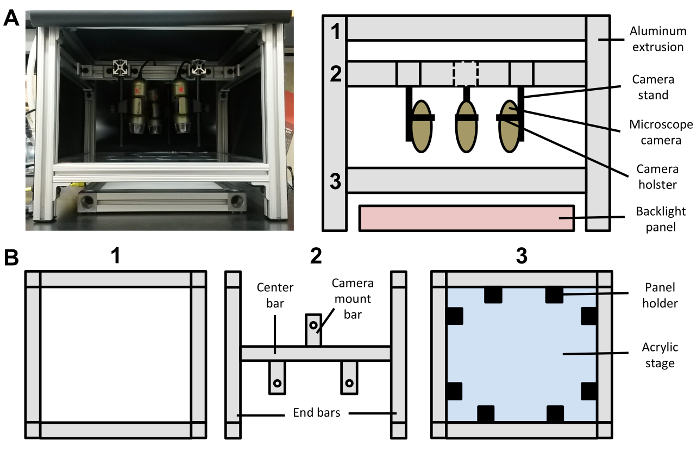
Figure 1: Photo and Schematic Representation of Behavior Chamber Design. (A) Front view of behavior chamber setup (left) and corresponding schematic representation of chamber frame (right). Opaque polyester sheets enclose the chamber on all faces except the bottom face, which allows light through from the infrared backlight panel. The numbers 1, 2, and 3 correspond to the extrusion layers in (B). (B) Schematic of top view of extrusion layers comprising the behavior chamber frame. This includes the top layer (1), the middle camera mount assembly layer (2), and the bottom stage layer (3). Please click here to view a larger version of this figure.
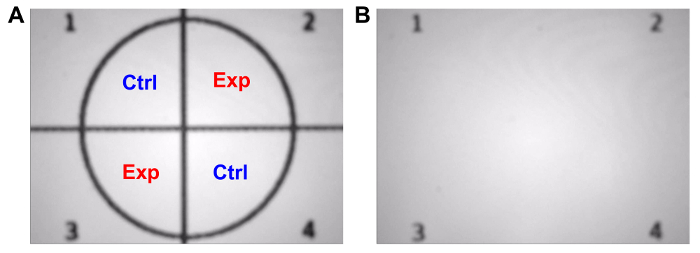
Figure 2: Solution-placement and Plate-alignment Templates. (A) The solution-placement template has four quadrants and number alignment markers. The control solution is placed in the upper left and bottom right quadrants while the experimental solution is placed in the upper right and bottom left quadrants. (B) The plate-alignment template has only number alignment markers to minimize occlusion of the worms in the field of view during video recording and analysis. Please click here to view a larger version of this figure.
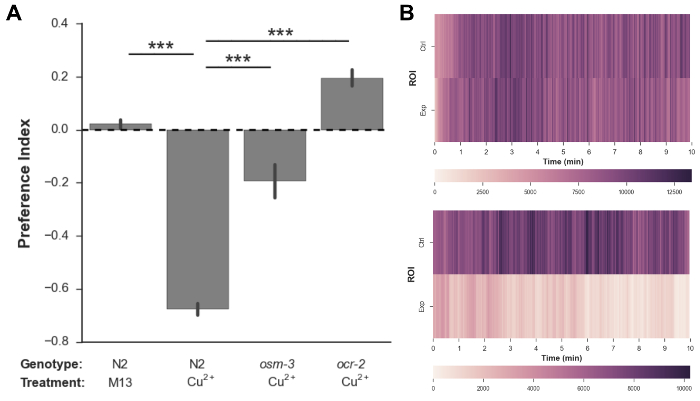
Figure 3: Example Data Collected Using this Assay. (A) Preference Index (PI) values for wild-type N2 and mutant C. elegans in response to M13 buffer and 10 mM CuCl2. N2 worms showed no preference between control and experimental ROIs when M13 control solution was placed in both ROIs but strongly avoided the experimental ROI when copper ions were placed in it (PI = 0.02 and -0.67, respectively). osm-3 (p802) mutants and ocr-2 (ak47) mutants showed significantly decreased avoidance of copper ions compared to N2 (PI = -0.1 and 0.2, respectively). N= 6 assays for each genotype-treatment pairing, >360 worms per assay, error bars indicate ± 1 S.E.M., ***p <0.001, one-way ANOVA followed by post-hoc Tukey Honestly Significant Difference (HSD) test. (B) Representative worm occupancy plots for N2 worms with M13 buffer in both ROIs (top) and N2 worms with M13 buffer in the control ROI and copper ions in the experimental ROI (bottom). The color scale below each occupancy plot represents the number of worm pixels. Please click here to view a larger version of this figure.
Supplementary Movie 1: Behavioral Response of N2 worms to 10 mM Copper Chloride. Worms are attracted to the control quadrants with M13 buffer (upper left and bottom right) but strongly avoid the quadrants containing copper ions dissolved in M13 buffer (upper right and bottom left). Video was recorded at 1 frame per second and sped up 15x. Please click here to download this file.
Supplementary Movie 2: Behavioral Response of ocr-2 (ak47) Worms to 10 mM Copper Chloride. Worms roam to a roughly equal extent in both the control quadrants with M13 buffer (upper left and bottom right) and the quadrants containing copper ions dissolved in M13 buffer (upper right and bottom left) throughout the recording duration. The mutants exhibit a slight preference for the quadrants containing copper ions at the start of the recording. Video was recorded at 1 frame per second and sped up 15x. Please click here to download this file.
Supplemental File: Solution-placement and Plate-alignment Templates. Please click here to download this file.
Discussion
A critical step in the protocol is ensuring that the assay plates have a consistent level of dryness across different experimental days. Different dryness levels will result in different diffusion rates of the solution into the agar and consequently, variations in behavioral outcome. Thus, assay plates should always be made fresh on the afternoon before experiments. The number of worms tested per assay should also be regulated for ease of comparison between treatments. For reference, a wild-type worm lays 4-10 eggs/h on average yielding >360 worms per assay if the worm synchronization protocol above is followed17. If certain mutant strains are egg-laying defective, pick more gravid adult worms for egg-laying to reach the target number of progeny. Another important step in the protocol is to handle worms gently during the washing process and worm placement. Worms are sensitive to mechanical stimuli, which elicit stress responses such as reversals and egg-laying inhibition18. Furthermore, care should be taken to define the ROI accurately and to determine the optimal thresholding constant value for specific lighting conditions before proceeding with the video analysis. It is also recommended that the calibration and thresholding processes be repeated if a lengthy period of time has elapsed since the last experiment was run.
A limitation of this method is that it is not suitable for assaying small worm populations. However, if the appropriate controls to determine the influence of the presence of food on the sensory behavior are performed, then utilizing food to restrict the worms' spatial exploratory location as in the retention assay is also possible with this setup. In addition, this method is not intended for studying stimulus gradient navigation due to the close proximity and small amounts of the control and experimental solution drops used.
In the future, programming software that enables multi-worm tracking and single-worm feature extraction can be integrated into this system19,20. Recording subtle behavior parameters of single worm behavior such as reversal speeds and amplitude of body bends will provide a more detailed picture of an individual worm's chemosensory behavior in the context of a population-based assay. The assay can also be modified to study habituation by boring holes through the ROI using syringe needles with the appropriate gauge size and filling the holes with agar infused with the experimental compound or control buffer. This will ensure a more consistent surface concentration of the compound over a longer period of recording time as is necessary during habituation studies. Another potential application of this method is to conduct comparative behavior studies across different nematode species. In addition, the behavior chamber can be modified in multiple ways to study behavioral responses to multimodal stimuli. For optogenetic applications, high-intensity LED arrays can be attached next to the camera mount to selectively activate neurons of interest during the assay. Heating elements, cooling systems, and temperature sensors can also be added to the setup to study the effects of temperature on sensory behaviors. Furthermore, odor delivery systems can be installed inside the chamber to investigate interactions between odorsensory and chemosensory modalities.
Disclosures
The authors have nothing to disclose.
Acknowledgements
Some strains were provided by the Caenorhabditis Genetics Center (CGC), which is funded by NIH Office of Research Infrastructure Programs (P40 OD010440). This work is supported by the Howard Hughes Medical Institute, with which P.W.S. is an investigator.
Materials
| Name | Company | Catalog Number | Comments |
|---|---|---|---|
| Aluminum T-slotted framing extrusions | McMaster-Carr | 47065T101 | Single profile, 1" size, solid |
| Brackets | McMaster-Carr | 47065T236 | 1" long for 1" high single profile extrusions |
| Compact end-feed fasteners | McMaster-Carr | 47065T139 | 1" (single), pack of 4 |
| Twist-in solid panel holders | McMaster-Carr | 47065T251 | For 1" high extrusion |
| Plastic end caps | McMaster-Carr | 47065T91 | For 1" high extrusion |
| Optically clear cast acrylic sheet | McMaster-Carr | 8560K211 | 3/16" thick, 12" x 12" |
| Vinyl-coated polyester fabric | McMaster-Carr | 88505K57 | 0.027" thick, 61" width, black |
| Brass grommets | McMaster-Carr | 9604K22 | Trade size 0, 0.545" outer diameter |
| Steel washers | McMaster-Carr | 90107A029 | 1/4" screw size |
| Rounded head screws | McMaster-Carr | 90272A546 | 1/4" - 20 thread size, 1 - 1/2" long |
| Standard operating backlight | Smart Vision Lights | See local vendor | 8" x 8", infrared 850 nm |
| IVP-C1 Variable Control Pot | Smart Vision Lights | See local vendor | |
| T1 Power Supply | Smart Vision Lights | See local vendor | |
| Dino lite Pro AM4113T | Dino-Lite Digital Microscope | See local vendor | |
| MS09B microscope stand | Dino-Lite Digital Microscope | See local vendor |
References
- White, J. G., Southgate, E., Thomson, J. N., Brenner, S. The structure of the nervous system of the nematode Caenorhabditis elegans. Philos Trans R Soc Lond B Biol Sci. 314, 1-340 (1986).
- Bargmann, C. I., Horvitz, H. R. Chemosensory neurons with overlapping functions direct chemotaxis to multiple chemicals in C. elegans. Neuron. 7 (5), 729-742 (1991).
- Bargmann, C. I., Hartwieg, E., Horvitz, H. R. Odorant-selective genes and neurons mediate olfaction in C. elegans. Cell. 74 (3), 515-527 (1993).
- Hilliard, M. A., Bargmann, C. I., Bazzicalupo, P. C. elegans responds to chemical repellents by integrating sensory inputs from the head and the tail. Curr Biol. 12 (9), 730-734 (2002).
- Hilliard, M. A., Bergamasco, C., Arbucci, S., Plasterk, R. H., Bazzicalupo, P. Worms taste bitter: ASH neurons, QUI-1, GPA-3 and ODR-3 mediate quinine avoidance in Caenorhabditis elegans. EMBO J. 23 (5), 1101-1111 (2004).
- Zariwala, H. A., Miller, A. C., Faumont, S., Lockery, S. R. Step response analysis of thermotaxis in Caenorhabditis elegans. J Neurosci. 23 (10), 4369-4377 (2003).
- Ward, S. Chemotaxis by the nematode Caenorhabditis elegans: identification of attractants and analysis of the response by use of mutants. Proc Natl Acad Sci U S A. 70 (3), 817-821 (1973).
- Wicks, S. R., de Vries, C. J., van Luenen, H. G., Plasterk, R. H. CHE-3, a cytosolic dynein heavy chain, is required for sensory cilia structure and function in Caenorhabditis elegans. Dev Biol. 221 (2), 295-307 (2000).
- Jansen, G., Weinkove, D., Plasterk, R. H. A. The G-protein subunit gpc-1 of the nematode C. elegans is involved in taste adaptation. EMBO J. 21 (5), 986-994 (2002).
- Srinivasan, J., et al. A blend of small molecules regulates both mating and development in Caenorhabditis elegans. Nature. 454 (7208), 1115-1118 (2008).
- Choe, A., et al. Ascaroside signaling is widely conserved among nematodes. Curr Biol. 22 (9), 772-780 (2012).
- Ezcurra, M., Tanizawa, Y., Swoboda, P., Schafer, W. R. Food sensitizes C. elegans avoidance behaviours through acute dopamine signalling. EMBO J. 30 (6), 1110-1122 (2011).
- Ward, A., Liu, J., Feng, Z., Xu, X. Z. S. Light-sensitive neurons and channels mediate phototaxis in C. elegans. Nat Neurosci. 11 (8), 916-922 (2008).
- Kunitomo, H., et al. Concentration memory-dependent synaptic plasticity of a taste circuit regulates salt concentration chemotaxis in Caenorhabditis elegans. Nat Commun. 4, 2210(2013).
- Snow, J. J., et al. Two anterograde intraflagellar transport motors cooperate to build sensory cilia on C. elegans neurons. Nat Cell Biol. 6 (11), 1109-1113 (2004).
- Tobin, D. M., et al. Combinatorial expression of TRPV channel proteins defines their sensory functions and subcellular localization in C. elegans neurons. Neuron. 35 (2), 307-318 (2002).
- Waggoner, L. E., Zhou, G. T., Schafer, R. W., Schafer, W. R. Control of alternative behavioral states by serotonin in Caenorhabditis elegans. Neuron. 21 (1), 203-214 (1998).
- Sawin, E. R. Genetic and cellular analysis of modulated behaviors in Caenorhabditis elegans. , M.I.T. Cambridge, MA. (1996).
- Ramot, D., Johnson, B. E., Berry, T. L., Carnell, L., Goodman, M. B. The parallel worm tracker: A platform for measuring average speed and drug-induced paralysis in nematodes. PLoS One. 3 (5), e2208(2008).
- Swierczek, N. A., Giles, A. C., Rankin, C. H., Kerr, R. A. High-throughput behavioral analysis in C. elegans. Nat Methods. 8 (7), 592-598 (2011).
Reprints and Permissions
