This paper introduces a procedure to investigate the adsorption of phosphonates onto iron-containing filter materials, particularly granular ferric hydroxide, with little effort and high reliability. In a buffered solution, the phosphonate is brought into contact with the adsorbent using a rotator and then analyzed via a miniaturized phosphorus determination method.
Method Article
Optimized Procedure for Determining the Adsorption of Phosphonates onto Granular Ferric Hydroxide using a Miniaturized Phosphorus Determination Method
In This Article
Summary
Abstract
This paper introduces a procedure to investigate the adsorption of phosphonates onto iron-containing filter materials, particularly granular ferric hydroxide (GFH), with little effort and high reliability. The phosphonate, e.g., nitrilotrimethylphosphonic acid (NTMP), is brought into contact with the GFH in a rotator in a solution buffered by an organic acid (e.g., acetic acid) or Good buffer (e.g., 2-(N-morpholino)ethanesulfonic acid) [MES] and N-cyclohexyl-2-hydroxyl-3-aminopropanesulfonic acid [CAPSO]) in a concentration of 10 mM for a specific time in 50 mL centrifuge tubes. Subsequently, after membrane filtration (0.45 µm pore size), the total phosphorus (total P) concentration is measured using a specifically developed determination method (ISOmini). This method is a modification and simplification of the ISO 6878 method: a 4 mL sample is mixed with H2SO4 and K2S2O8 in a screw cap vial, heated to 148-150 °C for 1 h and then mixed with NaOH, ascorbic acid and acidified molybdate with antimony(III) (final volume of 10 mL) to produce a blue complex. The color intensity, which is linearly proportional to the phosphorus concentration, is measured spectrophotometrically (880 nm). It is demonstrated that the buffer concentration used has no significant effect on the adsorption of phosphonate between pH 4 and 12. The buffers, therefore, do not compete with the phosphonate for adsorption sites. Furthermore, the relatively high concentration of the buffer requires a higher dosage concentration of oxidizing agent (K2S2O8) for digestion than that specified in ISO 6878, which, together with the NaOH dosage, is matched to each buffer. Despite the simplification, the ISOmini method does not lose any of its accuracy compared to the standardized method.
Introduction
Motivation
The efforts to reduce nutrient inputs into surface waters, which are necessary, inter alia, in the context of the implementation of the European Water Framework Directive1, require a more detailed examination of phosphorus emissions. The substance group of phosphonates (Figure 1), which are used as bleach stabilizers in textile and paper industries, as antiscalants in drinking water treatment, as hardness stabilizers of cooling water and in detergents and cleaning agents, is particularly relevant in terms of quantity and environmental relevance2. Phosphonates are suspected of contributing to long-term eutrophication of water bodies2,3,4. For example, due to UV radiation of sunlight or in the presence of MnII and dissolved oxygen, phosphonates can be degraded into microbiologically available phosphates5,6. The oversupply of phosphate is an essential characteristic of ecologically unbalanced water bodies, which makes phosphorus an important target substance for the sustainable improvement of the ecological status of water bodies.
Phosphonates can be removed from wastewater by precipitation/flocculation when using iron or aluminum salts7,8,9,10. In this process, metals are transformed into hardly soluble metal hydroxides. These polar flocks with a relatively large specific surface serve as adsorbents for the negatively charged phosphonates. However, the flocculation process can have two main disadvantages. Depending on the wastewater, sludge volumes of up to 30% of the sample volume can occur11. This sludge has to be separated, treated and disposed of in a further sedimentation or filter stage. Furthermore, phosphonates can complex the added flocculants and thus prevent the formation of flocks, especially in wastewater with low water hardness. This effect can be compensated by increased quantities of flocculant. However, this leads to increased β values (β = molar ratio of flocculant to phosphorus in wastewater)11,12. A complex wastewater matrix, therefore, can complicate the control of an optimum flocculant dosage.
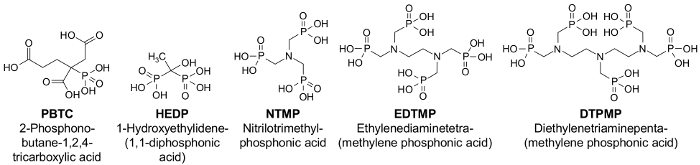
Figure 1: Structural formulae of important phosphonates11. Please click here to view a larger version of this figure.
A possible alternative that exploits the high adsorption affinity of phosphonates to metal-containing surfaces and that does not have the above-mentioned disadvantages are filter materials based on iron (hydr)oxides. For such filter materials, the literature mainly presents investigations into the elimination of phosphate13,14,15,16. This paper introduces a procedure which allows the investigation of the adsorption capacity of selective granulated filter materials, in this work in particular with granular ferric hydroxide (GFH), regarding phosphonates with little workload and significant cost saving. The study of the adsorption capacity can be divided into the following steps: preparation of the phosphonate solution, adsorption test (contact of the phosphonate solution with the granulate) and phosphonate analysis. All steps must be perfectly coordinated.
Concept for adsorption test and the use of suitable buffers
For the study of adsorption capacity, batch or column tests can be carried out. In order to determine adsorption isotherms or pH-dependencies of the adsorbent, the batch approach is preferred since many results can be obtained within a short period of time by the possibility of varying several parameters. The pH value is one of the most important factors influencing adsorption. Compliance with or adjustment of the pH value is a great challenge for the laboratory technician, as the simple adjustment of the pH value in the sample solution previously to the contact with the adsorbent is usually not sufficient. Each adsorbent material is usually striving to approximate the pH around its point of zero charge (PZC). Accordingly, it is possible that an aqueous solution, e.g., adjusted to pH 3, changes to a pH value of 8 when in immediate contact with the adsorbent. Wastewater mostly has a natural buffering capacity, which attenuates this effect. If, however, only the removal of a particular target substance is to be investigated with a particular adsorbent, synthetic wastewater must be used, i.e., pure water, which is specifically spiked with the target substance or, e.g., competitive anions. In contrast to powdered adsorbents, where the pH value can be easily maintained in the desired range by adding acids and bases in the open stirring vessel, no pH adjustment in this form can be done in a batch approach with granulates. In order to keep granules homogeneously suspended, very high stirring speeds are required, which would result in very rapid abrasion of the material. If such abrasion is unintended, the gentlest method is to rotate closed centrifuge tubes to keep the granules mixed continuously in the solution. The only way to keep the pH value constant in this case is to use buffers.
The following requirements for buffers must be met in order to be able to investigate the adsorption of phosphate and phosphonates on iron-containing filter materials: free of phosphorus; colorless; soluble; at best, no complexing agents; no competition with phosphonates regarding adsorption onto polar filter materials; similar structure of the different buffers used; and buffers or their degradation products must not have a negative effect on the spectral absorbance of the color complex after digestion for total P determination. For the biochemical research field, so-called Good buffers were developed17,18,19, which have exactly these properties. Thus, for the investigations of this work, the buffers in Table 1 were selected. The pKa value of each buffer indicates the range that can be kept constant by the buffer. For the pH range < 5, however, organic acids such as citric acid (CitOH) and acetic acid (AcOH) must be used. Citric acid is a complexing agent, but it buffers in a pH range where most iron-containing filter materials become unstable anyway. Acetic acid and MOPS were already used by Nowack and Stone7 to investigate the adsorption of NTMP on slurry goethite (α-FeOOH) at pH 4.6 and 7.2. However, their experiments on the pH-dependency of adsorption took place without buffering.
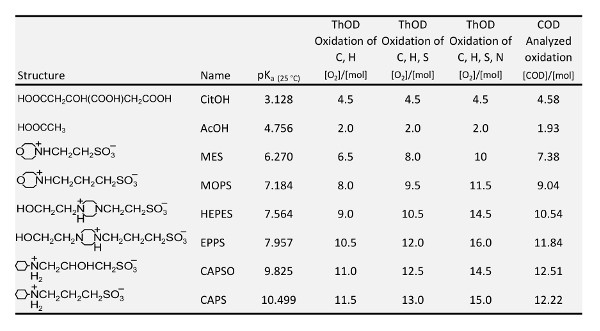
Table 1: pKa values20, theoretical oxygen demand (ThOD) and analyzed actual chemical oxygen demand (COD) of buffers used in this study.
Total P determination (ISOmini) adapted to the buffer solution
Following each adsorption test, each solution must be analyzed for the residual phosphonate concentration. Only recently, a method for the determination of phosphonates in environmental samples with limits of quantification in the range of 0.1 µg/L was introduced. It is based on the IC-ICP-MS method and the use of cation exchangers (for the conversion of phosphonates into "free" phosphonic acids) and anion exchangers (for the pre-concentration of phosphonates)21. Furthermore, already in 1997 a method from Nowack22 was introduced with higher limits of detection of 15-100 µg/L, which is based on the pre-complexation of phosphonates with FeIII, retention using HPLC and the photometric detection of these complexes. However, these methods are very time-consuming and expensive. In studies with synthetic wastewater in which the only phosphorus-containing compound is a phosphonate, it is sufficient to determine the phosphonate concentration by determining the total P concentration. The determination of inorganic phosphate presents the experimenter with far fewer problems than the determination of total P, as the latter requires previous digestion. The amount of chemicals that have to be added priorly must be matched precisely to the compounds present in the sample.
The determination of phosphate is currently carried out mainly using the method introduced by Murphy and Riley23. This method is based on the spectrophotometric detection of an intensely colored phosphomolybdenum blue complex ([PSb2Mo12O40]− with λmax at 880 nm) which is formed in the presence of phosphate and acidified molybdate using ascorbic acid and antimony(III) as reducing agents24. In other studies, the optimal ratio of [H+]:[Mo] was determined to be 60-8025,26. In order to determine total P, digestion, i.e., the breaking of P-O-P, C-O-P and C-P bonds in phosphorus-containing compounds and the oxidation of phosphorus to phosphate must be carried out prior to the phosphomolybdenum blue formation24. Eisenreich et al.27 presented a simplified method based on the use of the oxidizing agent peroxodisulfate (K2S2O8) in the acidic milieu. Many of these findings have been incorporated into the development of ISO 687828, which systematically explains the procedure for the determination of phosphate-P and total P concentrations in water samples (wastewater and seawater).
The total P determination according to ISO 6878 (Figure 2) requires the sample to be digested in an Erlenmeyer flask by K2S2O8 at an acidic pH (use of sulfuric acid) for at least 30 min. After digestion, the pH value is set to 3-10 using NaOH and the content of the Erlenmeyer flask is transferred to a 50 mL volumetric flask. In this flask, ascorbic acid and an acidic solution containing molybdate and antimony are added to the sample and then filled with water. After 10-30 minutes, the intensity of this blue coloration is measured at a wavelength of 880 nm. In the case of phosphate determination, the digestion is omitted. This means, the sample is mixed in a 50 mL volumetric flask with ascorbic acid and a solution containing molybdate as well as antimony, and the intensity of the blue coloration is measured in the photometer.
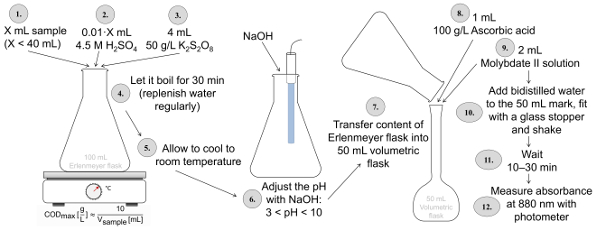
Figure 2: Procedure of total P determination according to ISO 6878 applying digestion using sulfuric acid and potassium peroxodisulfate, a subsequent pH adjustment with NaOH and coloration using ascorbic acid and molybdate-containing solutions. Please click here to view a larger version of this figure.
The procedure of total P determination is very complex since during digestion it must always be taken care of that the sample does not boil over and the adjustment of the sample to pH 3-10 takes a long time. In order to be able to analyze as many samples as possible in a very short time, a miniaturized form of the total P and ortho-phosphate determination was developed based on this ISO method. Figure 3 summarizes the individual steps of this method. In this miniaturized determination method (ISOmini), the final volume of the color solution is 10 mL (in the ISO method, this is 50 mL). Accordingly, the ISOmini method reduces the amount of the solutions to be used to one-fifth. In the ISOmini method, the digestion is carried out in a thermostat (in contrast to the ISO method, where digestion is proposed in an Erlenmeyer flask on a hotplate) at 148-150 °C to obtain the highest possible oxidation. NaOH is added after digestion together with the ascorbic acid and acidic molybdate solution.
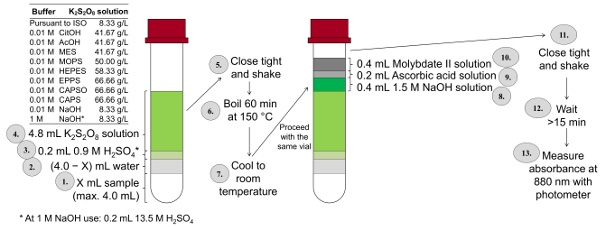
Figure 3: Procedure of total P determination according to a modified and miniaturized form of ISO 6878 (ISOmini) using 10 mL screw cap vials, buffer-dependent potassium peroxodisulfate concentrations, heating in a thermostat and addition of color reagents directly to the digested sample without transferring it previously. Please click here to view a larger version of this figure.
The organic buffers contained in the samples must be present in relatively high concentrations (10 mM) in comparison to the phosphonate (5-30 µM) in order to maintain the pH value effectively. These buffers must be digested for the analysis of the total P after the adsorption test. Accordingly, the dosed amount of oxidizing agent must be matched to each buffer, taking into account that too much oxidizing agent should not interfere with the formation of the color complex formed after digestion. In order to be able to estimate the K2S2O8 quantity required for the digestion of each buffer in the total P determination based on the analyzed chemical oxygen demand (COD), a comparison of how many electrons can be converted during the reduction of O2 and K2S2O8 is necessary:
O2 + 4 H+ + 4 e- → 2 H2O
S2O82- + 2 e- → 2 SO42-
Thus, the oxidation of a particular molecule requires twice as many peroxodisulfate molecules as O2 molecules. Accordingly, in the case of a sample volume of 20 mL, the COD of the sample must not exceed 500 mg/L when using the ISO method. However, even in the case of MES, the Good buffer with the smallest molar mass from Table 1, already a COD of 2.4 g/L is present at a concentration of 10 mM. In addition to the step-by-step protocol of the adsorption test and ISOmini method, this paper, therefore, investigates the required buffer concentration, the influence of the buffers on phosphonate adsorption and the K2S2O8 quantity and NaOH dosage required for their digestion in the ISOmini method.
Freundlich model of adsorption
Adsorption isotherms, i.e., loading q (e.g., in mg P/g adsorbent) applied over the dissolved concentration c (in mg/L P) of adsorptive after a specific contact time, can be modeled using the equation proposed by Freundlich29:

If the experimentally obtained values q and c are plotted in the form of a function ln(q) over ln(c), the slope of this function determined by linear regression corresponds to 1/n and the y-axis intercept to the KF value30.
Overview of the procedure
The entire process for determining the adsorption capacity of granular ferric hydroxide with regard to phosphonates is divided into several steps and is described in the protocol section. For the analysis, it is necessary to prepare a sufficient amount of reagent solutions (Section 1 in the protocol). These are durable for several weeks. The phosphonate-containing solution is then prepared (Section 2), followed by the adsorption test (contact of the phosphonate solution with the granular material) (Section 3) and the analysis of the total P according to the miniaturized ISO method (Section 4).
Protocol
1. Preparation of All Required Solutions for the Total P Determination
NOTE: The preparation of some of the solutions described below is explained in ISO 687828. These preparation methods have been slightly adapted to the method of this work. The required degree of purity of chemicals can be found in the attached material list.
- Preparation of H2SO4 solutions (13.5, 9 and 0.9 M H2SO4)
Caution: Work under fume hood.- Preparation of 13.5 M H2SO4
- Fill a 100 mL graduated cylinder with 25 mL of water and transfer it into a 100 mL glass bottle surrounded by ice cubes placed in a beaker.
- Fill the same graduated cylinder with 75 mL of concentrated sulfuric acid and transfer it under stirring to the water in the bottle. Caution: Heat development.
- Take the bottle carefully out of the beaker as soon as it is sufficiently cooled down (max. 40 °C).
- Preparation of 9 M H2SO4 (required for the preparation of molybdate solution)
- Fill a 1 L graduated cylinder with 700 mL of water and transfer it into a 3 L glass beaker surrounded by ice cubes placed in a bucket.
- Fill the same 1 L graduated cylinder with 700 mL of concentrated sulfuric acid and transfer it under stirring to the water in the 3 L beaker. Caution: Heat development.
- Take the 3 L beaker carefully out of the bucket as soon as it is sufficiently cooled down (max. 40 °C) and transfer its content into a 2 L glass bottle.
- Preparation of 0.9 M H2SO4
- Fill a 250 mL volumetric flask with about 100 mL of water.
- Transfer 25 mL of 9 M H2SO4 (see 1.1.2) into the 250 mL volumetric flask using a 25 mL volumetric pipette. Caution: Heat development.
- Fill the 250 mL volumetric flask with water up to the 250 mL ring mark.
- Close the volumetric flask with a stopper, shake it several times for homogenization and transfer the content of the volumetric flask into a 250 mL glass bottle.
- Preparation of 13.5 M H2SO4
- Preparation of HCl rinsing solution (approx. 2 M)
Caution: Work under fume hood.- Fill a 2 L graduated cylinder with 1 L of water.
- Fill this graduated cylinder with 400 mL of 32% HCl (w/w) solution.
- Now add 600 mL of water to gain a total volume of 2 L in the graduated cylinder.
- Stir the content of the graduated cylinder with a rod (e.g., graduated pipette) and transfer the content of the graduated cylinder into a 2.5 L glass bottle.
- Close the bottle and shake it upside down several times for homogenization.
- Reuse this solution only until a color change becomes apparent. Then discard the rinsing solution and prepare a new one.
- Preparation of HCl solutions (10.2 and 2 M)
Caution: Work under fume hood.- Use 32% HCl (w/w) as 10.2 M HCl.
- Preparation of 2 M HCl
- Fill a 100 mL volumetric flask with 15 mL of 32% HCl (10.2 M) using a 15 mL volumetric pipette.
- Add another 4.67 mL of 32% HCl (10.2 M) to the volumetric flask using a micropipette.
- Fill the volumetric flask with water up to the 100 mL ring mark.
- Close the volumetric flask with a stopper and shake it upside down several times for homogenization and transfer the content of the volumetric flask into a 100 mL glass bottle.
- Preparation of NaOH solutions (10, 2, 1.5 M NaOH)
Caution: Work under fume hood.- Weigh 100.0 g (for 10 M), 20 g (for 2 M) or 15 g (for 1.5 M) of NaOH into a small beaker and transfer the content of the beaker into a 250 mL volumetric flask.
- Fill the volumetric flask with water up to the 250 mL ring mark. Close the volumetric flask with a stopper and shake it upside down several times for homogenization (Caution: solution can become hot). If the height of the water level no longer corresponds to the ring mark, add more water (the total volume changes as a result of the dissolving process).
- Transfer the content of the volumetric flask into a 250 mL plastic bottle (Caution: Do not use glass bottles for NaOH solutions).
- Preparation of K2S2O8 solution/suspension (8.33, 41.67, 50.00, 58.33, 66.66 g/L)
NOTE: Differently concentrated peroxodisulfate mixtures are required for phosphorus determination. Since some of them are above the saturation limit of K2S2O8 of approx. 50 g/L at 20 °C, it is advisable to weigh the K2S2O8 directly into a brown glass bottle and pour a corresponding volume of water over it (do not use volumetric flasks for the preparation).- Weigh 2.08 g (for 8.33 g/L), 10.42 g (41.67 g/L), 12.50 (50.00 g/L), 14.58 g (58.33 g/L) or 16.67 g (66.66 g/L) of solid K2S2O8 directly into a brown 250 mL glass bottle.
- Fill a graduated cylinder with 250 mL of water and pour this water over the K2S2O8 in the bottle.
- Stir the content of the bottle until all ingredients are dissolved or until there is only a slight turbidity.
- Carry out the extraction of K2S2O8 under high turbulence on the magnetic stirrer to ensure that the undissolved K2S2O8 can also be extracted as homogeneously as possible.
- Preparation of 100 g/L ascorbic acid solution
- Weigh 50 g of ascorbic acid into a 500 mL volumetric flask.
- Fill the volumetric flask with water up to the 500 mL ring mark.
- Stir the content of the volumetric flask on the magnetic stirrer until the ascorbic acid is completely dissolved. It may be necessary to correct the level of the water surface to make it congruent with the ring mark by adding a little more water (be careful of the stirring bar giving volume as well). Then transfer the content of the volumetric flask into a brown 500 mL glass bottle.
- Preparation of Molybdate I solution (required for phosphate determination)
- Weigh 13.0 g of solid (NH4)6Mo7O24∙4H2O directly into a 100 mL glass bottle. Fill a graduated cylinder with 100 mL of water and pour it into the bottle. Stir the content of the bottle on a magnetic stirrer until it is completely dissolved.
- Weigh 0.35 g of solid K(SbO)C4H4O6∙½H2O directly into a fresh 100 mL glass bottle. Fill a graduated cylinder with 100 mL of water and pour it into the bottle with K(SbO)C4H4O6∙½H2O. Stir the content of the bottle until it is completely dissolved.
- Fill a graduated cylinder with 300 mL of 9 M H2SO4 (see 1.1.2) and pour it into a brown 500 mL glass bottle.
- Add the (NH4)6Mo7O24∙4H2O solution to the 300 mL of 9 M H2SO4. Then add the K(SbO)C4H4O6∙½H2O solution to this mixture. Close the bottle and shake it several times upside down for homogenization.
- Preparation of Molybdate II solution (required for total P determination)
- Weigh 13.0 g of solid (NH4)6Mo7O24∙4H2O directly into a 100 mL glass bottle. Fill a graduated cylinder with 100 mL of water and pour it into the bottle. Stir the content of the bottle on a magnetic stirrer until it is completely dissolved.
- Weigh 0.35 g of solid K(SbO)C4H4O6∙½H2O directly into a fresh 100 mL glass bottle. Fill a graduated cylinder with 100 mL of water and pour it into the bottle with K(SbO)C4H4O6∙½H2O. Stir the content of the bottle until it is completely dissolved.
- Fill a graduated cylinder with 70 mL of water. Add 230 mL of 9 M H2SO4 (see 1.1.2) to the water in the graduated cylinder (i.e., fill up to 300 mL). Carefully homogenize the content of the graduated cylinder with a rod (e.g., graduated pipette). Transfer the content of the graduated cylinder into a brown 500 mL glass bottle (current content: 6.9 M H2SO4).
- Add the (NH4)6Mo7O24∙4H2O solution to the 300 mL of 6.9 M H2SO4. Then add the K(SbO)C4H4O6∙½H2O solution to this mixture. Close the bottle and shake it several times upside down for homogenization.
- Preparation of internal quality standard (IQS: 1 mg/L KH2PO4-P in 0.9 mM H2SO4)
- Dry a few grams of KH2PO4 in a small glass dish at 105 °C in the drying oven until mass constancy is achieved and then cool the KH2PO4 down to room temperature in a desiccator.
- Weigh 0.2197 g ± 0.0002 g of KH2PO4 directly from the desiccator into a 1 L volumetric flask and add approx. 800 mL of water into the volumetric flask.
- Now add 5 mL of 9 M H2SO4 (see 1.1.2) to the flask using a 5 mL volumetric pipette and fill the flask with water up to the 1 L ring mark.
- Stir the content of the volumetric flask on the magnetic stirrer and transfer the content of the volumetric flask into a 1 L glass bottle (current content: 50 mg/L KH2PO4-P in 45 mM H2SO4). This solution can henceforth be used as a stock solution for the preparation of IQS.
- Transfer 10 mL of this solution into a 500 mL volumetric flask using a 10 mL volumetric pipette, fill the volumetric flask with water up to the 500 mL ring mark and stir the content of the volumetric flask on the magnetic stirrer.
- Transfer the content of the volumetric flask into a 500 mL glass bottle (current content: 1 mg/L KH2PO4-P in 0.9 mM H2SO4). This solution is the IQS.
2. Preparation of Phosphonate-Containing Buffered Solutions
- Weigh or pipette the desired buffer into a volumetric flask (at a target concentration of 0.01 M buffer in 1 L, e.g.: 572 µL of 100% AcOH, 2.1014 g of CitOH·H2O, 1.9520 g of MES, 2.0926 g of MOPS, 2.3831 g of HEPES, 2.5233 g of EPPS, 2.3732 g of CAPSO, 2.2132 g of CAPS, 5 mL of 2 M NaOH).
- Fill the volumetric flask to about three quarters with water and add a previously prepared 1 g/L phosphonate-P stock solution (for a target concentration of 1 mg/L P in 1 L, e.g., 1 mL of 1 g/L phosphonate-P).
- Fill the flask with water up to the ring mark, stir the content of the flask on the magnetic stirrer until all ingredients are dissolved and transfer it into a glass bottle.
- While stirring, adjust the desired pH value in the buffer solution (e.g., pH 6 at MES) with HCl (e.g., 2 and 10.2 M) or NaOH (e.g., 2 and 10 M) (the addition of both acidic and basic solution should be avoided to prevent an unnecessary increase of ionic strength).
- To determine the phosphonate-P concentration, proceed according to step 4.
3. Procedure of the Adsorption Test
- Wash the filter material thoroughly with distilled water (e.g., over a sieve with a mesh size of 0.5 mm) and then dry it at 80 °C.
Note: The protocol can be paused here. - Weigh the filter material (e.g., granular ferric hydroxide) into a 50 mL centrifuge tube.
Note: The protocol can be paused here. - Quickly fill the 50 mL centrifuge tube with the phosphonate-containing solution from step 2 up to the 50 mL mark.
- Quickly close the tube and clamp it into the running rotator (the contact time starts from now on).
- Rotate the tube at 20 revolutions per minute for a specific amount of time (e.g., 1 h).
- Filter approx. 10-20 mL of the supernatant with a syringe filter (0.45 µm pore size) into an empty glass bottle.
Note: The protocol can be paused here. - Determine the pH value of the filtrate and to determine the phosphonate-P concentration proceed with step 4. In the case of investigating phosphate adsorption, proceed with step 5.
4. Determination of Total P (Phosphonate-P) According to ISOmini
NOTE: The following procedure is also shown in Figure 3.
- Transfer an aliquot of the sample to be analyzed (Vsample, max. 4 mL) using a micropipette into a 10 mL screw cap vial (the vial including the cap should be pre-rinsed with HCl (see 1.2) and H2O and dried at 80-100 °C).
Note: The protocol can be paused here. - Add water with a micropipette to obtain a total volume of 4 mL together with the sample previously added (Vwater = 4 mL-Vsample).
Note: The protocol can be paused here. - Add 0.2 mL of 0.9 M H2SO4 solution (see 1.1.3) using a micropipette. If there is a concentration of 1 M NaOH in the sample, as is often the case with regeneration solutions, add 0.2 mL of 13.5 M H2SO4 solution (see 1.1.1) (Caution: This solution of sulfuric acid is highly concentrated).
Note: The protocol can be paused here. - Add 4.8 mL of a K2S2O8 solution/suspension (see 1.5) the concentration of which depends on the buffer contained in the sample (corresponding to ISO at 0.01-1 M NaOH: 8.33 g/L K2S2O8; 0.01 M CitOH, AcOH, MES: 41.67 g/L; 0.01 M MOPS: 50.00 g/L; 0.01 M HEPES: 58.33 g/L; 0.01 M EPPS, CAPSO, CAPS: 66.66 g/L).
- Close the vial with the cap very tightly and shake it.
- Heat the vial in a thermostat at 148-150 °C for 1 h.
- Take the vial out of the thermostat and let it cool down to room temperature.
Note: The protocol can be paused here. - Open the vial and add 0.4 mL of 1.5 M NaOH solution (see 1.4).
Note: The protocol can be paused here. - Add 0.2 mL of 100 g/L ascorbic acid solution (see 1.6).
- Subsequently, add 0.4 mL molybdate II solution (see 1.8).
- Close the vial and turn it upside down for homogenization.
- Wait minimum 15 minutes to a maximum of 4 h for color formation.
- Measure spectral absorbance (A) at a wavelength of 880 nm using a photometer.
- Carry out the steps 4.1-4.13 regularly for 4 mL of water (for the determination of Ablind) as well as for 4 mL of an IQS (see 1.9).
- Calculate the total P or phosphonate-P concentration of the analysis sample on the basis of the specific absorbance of the analysis sample (A), the absorbance of the blind sample (Ablind) and the sample volume (Vsample) using the following equation (0.287 corresponds to the slope of the calibration line with 1 cm cuvettes and can deviate depending on the photometer):
![Phosphorus concentration formula, diagram; P[mg/L]=(A-A_blind)/0.287×4mL/V_sample[mL]](/files/ftp_upload/57618/57618eq2v2.jpg "figure-protocol-1")
5. Determination of o-PO43--P According to ISOmini
NOTE: This determination method can be used when the adsorption of inorganic ortho-phosphate on granulated filter materials is to be investigated. In this case, the sample to be tested does not have to be digested.
- Transfer an aliquot of the sample to be analyzed (Vsample, max. 9.4 mL) by means of a micropipette into a 10 mL screw cap vial (the vial including the cap should be pre-rinsed with HCl (see 1.2) and H2O and dried at 80-100 °C).
Note: The protocol can be paused here. - Add water with a micropipette to obtain a total volume of 9.4 mL together with the sample previously added (Vwater = 9.4 mL-Vsample).
Note: The protocol can be paused here. - Add 0.2 mL of 100 g/L ascorbic acid solution (see 1.6).
- Subsequently, add 0.4 mL of molybdate I solution (see 1.7).
- Close the vial and turn it upside down for homogenization.
- Wait minimum 15 minutes to a maximum of 4 h for color formation.
- Measure spectral absorbance (A) at a wavelength of 880 nm using a photometer.
- Carry out the steps 5.1-5.7 regularly for 9.4 mL of water (for the determination of Ablind) as well as for 4 mL of an IQS (see 1.9).
- On the basis of the specific absorbance of the analysis sample (A), of the blind sample (Ablind) and the sample volume (Vsample), the ortho-phosphate-P concentration of the analysis sample can be calculated using the equation in 4.15.
Results
Example of isotherms gained with the proposed procedure
Figure 4 shows an example of the results gained when applying the protocol in the case of the investigation of the adsorption of NTMP by GFH at different pH values. NTMP was selected because, with three phosphonate groups, it is the most representative phosphonate for the broad spectrum of possible phosphonates of which the number of phosphonate groups vary between one (PBTC) and five (DTPMP). Furthermore, the molar mass of NTMP (299.05 g/mol) is also located in the middle range of phosphonates (HEDP: 206.03 g/mol, DTPMP: 573.20 g/mol). In Figure 4, the adsorption isotherms, i.e., the loading of the phosphonate above the residual phosphonate concentration, are depicted at different buffers and pH values after a contact time of 1 h. Longer contact times could lead to undesirable abrasion of the material due to too long contact between the particles. For each isotherm, a solution with 1 mg/L NTMP-P and, depending on the desired pH range, buffer in the concentration of 0.01 M was prepared and adjusted to an initial pH value by means of HCl or NaOH. This was 4.0 (AcOH), 6.0 (MES), 8.0 (EPPS), 10.0 (CAPS) and 12.0 (NaOH). Depending on the GFH concentration, as a result of the 1 h contact time, the pH value in the solution changed by a maximum of 2.0: 4.0-6.0 (AcOH), 6.0-7.3 (MES), 8.0-8.2 (EPPS), 9.4-10.0 (CAPS), 10.9-12.0 (NaOH). The PZC of GFH is approx. 8.6, so it is consequential that the pH value in the case of a set pH value > 8.6 decreased due to contact with GFH and increased at a pH value < 8.6. The further away this adjusted pH value was from 8.6, the stronger the pH change was.
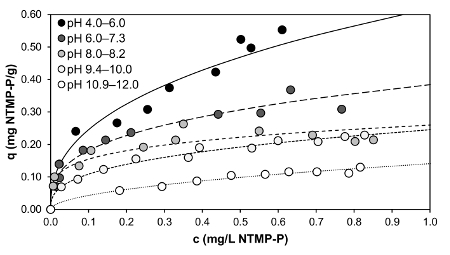
Figure 4: Loading of NTMP (initial concentration of 1 mg/L NTMP-P) onto granular ferric hydroxide dosed at concentrations of 0.7-14 g/L after 1 h contact time at room temperature. The following buffers at concentrations of 0.01 mol/L were used at the mentioned pH values in the graph: AcOH (pH 4.0-6.0), MES (pH 6.0-7.3), EPPS (pH 8.0-8.2), CAPS (pH 9.4-10.0) and NaOH (pH 10.9-12.0). The curves plotted are Freundlich isotherms. Please click here to view a larger version of this figure.
All isotherms in Figure 4 were modeled using the Freundlich equation (R² values from left to right with increasing pH: 0.875, 0.905, 0.890, 0.986, 0.952; corresponding n values: 2.488, 3.067, 4.440, 2.824, 1.942; corresponding KF values: 0.619, 0.384, 0.260, 0.245, 0.141). At pH values of 4-6, a loading of up to 0.55 mg NTMP-P/g was achieved, which corresponds to 1.8 mg NTMP/g. The higher the pH value, the lower the level of adsorption. Iron hydroxides have a large number of Fe-OH groups on their surface, which may be protonated or deprotonated depending on the pH value. With the depth of the pH value, the surface is predominantly protonated, i.e., positively charged, which means that the multidentate phosphonates, which are negatively charged over the almost entire pH range, are attracted. A higher pH value shifts the charge of the iron hydroxide surface in the negative direction, which in turn leads to increased electrostatic repulsion7. Interestingly, even at pH 12, which corresponds to an OH- concentration of 0.01 M, adsorption occurred. Therefore, for successful desorption, NaOH solutions with a much higher concentration must be used.
In comparison to the results of other researchers, the maximum loading of up to 0.55 mg NTMP-P/g of GFH in this work seems to be rather low. Boels et al.14 found a maximum loading of 71 mg NTMP/g of GFH, which corresponds to 21.7 mg of NTMP-P/g GFH in their experiments with a synthetic reverse osmosis concentrate with 30 mg/L NTMP (9.3 mg/L NTMP-P) at pH 7.85. They used powdered GFH and stirred the synthetic solution, which contained HCO3- that also acts as a buffer, for 24 h. Therefore, their results cannot be directly compared to the findings of this work, as they used a much higher initial concentration and powdered GFH, which is likely to lead to a higher surface area and, therefore, results in a better adsorption performance. Additionally, the contact time was significantly longer as in this work. Nowack and Stone7 conducted experiments with a 40 µM NTMP solution (3.72 mg of NTMP-P/L) in a 0.42 g/L goethite slurry at a pH of 7.2. The solution was stirred for 2 h leading to a maximum loading of approx. 30 µM NTMP/g goethite (2.79 mg of NTMP-P/g). 1 mM MOPS was used as a buffer. Again, the results cannot be compared directly to the results of this work due to the higher initial phosphonate concentration. In addition, the slurry, which consisted of goethite flocks, had a high surface area. However, the shapes of the isotherms from Boels et al.14 and Nowack and Stone7 agree with the ones of this work, and all of them could be fitted well by the Freundlich model.
Influence of buffer on phosphonate adsorption and required buffer concentration
Previous experiments to determine the adsorption kinetics had shown that also with the use of buffers, an equilibrium pH value is reached within a very short period of time. That pH can deviate significantly from the pH value that was previously set in the phosphonate-containing solution (adjusted pH). This equilibrium pH tends to the PZC of the filter material, which was 8.6 for the granular ferric hydroxide discussed here (according to own investigations). Therefore, it can be assumed that the pH value after the contact time (final pH) is decisive for the extent to which the adsorption of the phosphonate occurs.
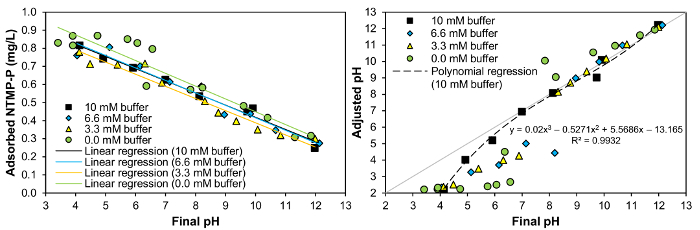
Figure 5: Left: loading of NTMP (initial concentration of 1 mg/L NTMP-P) onto 2.5 g/L granular ferric hydroxide as a function of the pH value at different buffer concentrations after a contact time of 1 h. Right: Comparison of the pH value after 1 h contact time with the pH value set in the stock solution before contact with the granular ferric hydroxide at different concentrations of the buffers AcOH, MES, MOPS, EPPS, CAPSO and CAPS. Please click here to view a larger version of this figure.
In the right-hand diagram in Figure 5, the pH values that were set in the NTMP-containing solution at different buffer concentrations are compared with the final pH values after the 1 h contact between 1 mg/L NTMP-P and 2.5 g/L GFH. It becomes evident that a specific correlation between the pH value previously set in the solution and the final pH value was only attainable and thus a relatively reliable pH adjustment was possible only when buffers in concentrations of 10 mM were used. This is reflected in the correlation function determined by means of polynomial regression and reproduced in the diagram on the right. The fact that in the case of buffer concentrations below 10 mM pH values of 2-4 had to be preset in order to obtain final pH values of 6-7 shows that the prediction of the final pH value, which is decisive for adsorption, and thus the safe execution of the adsorption tests for such buffer concentrations were challenging.
In the left-hand diagram in Figure 5, the extent of adsorption of 1 mg/L NTMP-P at 2.5 g/L GFH is depicted as a function of the final pH value for different buffer concentrations. Assuming a linear dependence of the loading on the pH value in the pH range 4-12 according to equation y = ax + b, the values calculated by linear regression for all buffer concentrations investigated were very similar (10 mM: a=−0.0673, b=1.0914, R²=0.9837; 6.6 mM: a=−0.0689, b=1.1047, R²=0.9512; 3.3 mM: a=−0.0672, b=-0.0672, R²=0.9570; 0 mM: a=−0.0708, b=1.157, R²=0.8933). The coefficient of determination, which was the highest for 10 mM buffer, showed very clearly that with this buffer concentration not only the final pH value was easier to adjust, but also the most reliable results with regard to adsorption were achieved. Only the course without buffer indicates possible deviations of the adsorption extent between pH 5 and 7. However, in order to achieve these final pH values without buffering, very low pH values had to be set in the stock solution, some of which were only slightly above 2. Due to the very strong difference between adjusted pH and final pH, it is, therefore, possible that the final pH value was not decisive for the extent of the adsorption in the case of no buffer. It can thus be assumed that the use of Good buffers mentioned in Table 1 has no significant influence on the adsorption of phosphonates onto GFH, i.e., there is no competition for adsorption sites between the phosphonate and the buffer. Such selectivity is only prevalent because the adsorption of NTMP onto GFH is mainly due to the formation of mono- and bidentate complexes15. Good buffers, on the other hand, have little tendency to form metal complexes17,19, which is why NTMP is preferably bound by GFH. In the case of adsorbents with a less polar surface, such as activated carbon, it can be assumed that Good buffers also occupy free adsorption sites and thus influence the adsorption of the phosphonate. The use of these buffers to study the adsorption of phosphonates on activated carbon is therefore not recommended.
Calibration of ISOmini method and compliance with ISO
Figure 6 shows the calibration lines using the internal quality standard (IQS: 1 mg/L KH2PO4-P in 0.9 mM H2SO4) according to ISO 6878 as well as the modified ISOmini method for total P and o-PO43--P determination. Based on a linear regression, the calibration function equivalent to ISO 6878 was y = 0.0033 + 0.2833x (R²=0.99978). The linear regression applied to the miniaturized variant for phosphate determination resulted in the calibration function y = 0.0058 + 0.2864x (R²=0.99999). With y = 0.0020 + 0.2890x (R²=0.99985) the calibration function for total P determination according to the ISOmini method was very similar and very precise as well. All variants had a very high coefficient of determination, which means that the ISOmini method does not compromise accuracy by the reduction of the sample volume to one-fifth. The conversion equation determined by means of the calibration functions for determining the P concentration in the analysis sample from the measured spectral absorbances is given in the protocol in step 4.15. Experience has shown that the absorbance of the blind sample can usually be neglected since at 880 nm the signal emitted by the photometer can jump very strongly in the very small measuring range. Thus, a measured value of 0.287 at 4 mL sample volume (ISOmini) corresponded to a phosphorus concentration of 1 mg/L P.
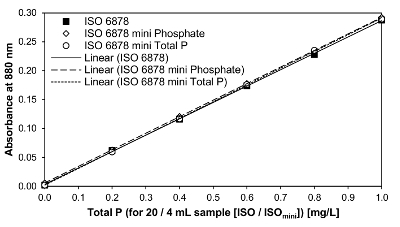
Figure 6: Calibration lines for the determination of total P and ortho-phosphate-P according to ISO 6878 and ISOmini. An IQS (1 mg/L KH2PO4-P in 0.9 mM H2SO4) was used in accordance with point 1.9 of the protocol. For the ISO method, the IQS was used in aliquots of 4, 8, 12, 16 and 20 mL and for the modified ISOmini method in aliquots of 0.8, 1.6, 2.4, 3.2 and 4.0 mL. Please click here to view a larger version of this figure.
Plausibility and buffer-dependent dosage quantities of ISOmini method
As already mentioned, a reliable pH adjustment in the adsorption test is only possible with a buffer concentration of 0.01 M. However, such a buffer concentration requires a higher K2S2O8 dosage than specified in ISO 6878 for most buffers. In addition, the ISO stipulates that the pH value must be set to 3-10 using a pH probe after digestion. Since such a pH adjustment cannot be carried out in a small screw cap vial, the matching NaOH dosage quantity for different buffer solutions had to be determined. Figure 7 shows the absorbance of different buffer-containing solutions with 1 mg/L NTMP-P when these were digested with different K2S2O8 quantities according to ISOmini and treated with varying amounts of NaOH after digestion. Accordingly, each matrix was based on the following procedure: 4 mL of a solution was mixed with 0.2 mL 0.9 M H2SO4, provided with different K2S2O8 quantities and filled up with H2O to the same total volume of 9 mL. This was now digested in accordance with the protocol (1 h at 148-150 °C). After cooling, different NaOH quantities were added and filled up to a total volume of 9.4 mL with H2O. Subsequently, 0.2 mL of ascorbic acid solution and 0.4 mL of molybdate II solution were added. The determination of the absorbance (880 nm) was carried out 4 h after the addition of these color reagents. This time was chosen to ensure that the specific absorbance was stable. A solution with 1 mg/L NTMP-P and 1 M NaOH was also investigated. However, instead of the K2S2O8 and NaOH amounts, the H2SO4 amounts were varied to ensure that the pH was low enough for digestion. The targeted absorbance value was 0.287 (see calibration line in Figure 6). Thus, in Figure 7 those values are shown in light green that deviated from this target value by a maximum of 5%. One value in each matrix is highlighted with a dark green color. This marks the K2S2O8 and NaOH dosage quantities recommended for the regular ISOmini method for this type of buffer solution.
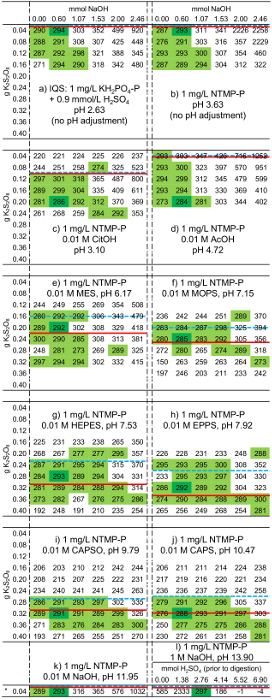
Figure 7: Spectral absorbance (×1000) of different phosphonate- and buffer-containing solutions with different K2S2O8 and NaOH dosage quantities at a wavelength of 880 nm in 1 cm cuvettes. Procedure: 4 mL solution (as shown in the figure and adjusted to the pKa value of the buffer adapted from the thermodynamic pKa values of Goldberg et al.20 to a concentration of 0.01 M and 25 °C31) was placed in a 10 mL screw cap vial, mixed with 0.2 mL of 0.9 M H2SO4 and with different amounts of K2S2O8 (as shown in the figure). Water was then added to obtain a total volume of 9 mL for all samples before digestion. Now the vials were heated in the thermostat at 148-150 °C for 1 h (digestion). After cooling to room temperature, different amounts of NaOH (as shown in the figure) were added and with the addition of water, it was ensured that a total volume of 9.4 mL was present in all vials. 4 h after addition of 0.2 mL of ascorbic acid solution and 0.4 mL of molybdate II solution, the absorbance at 880 nm was determined. In the case of solution l (1 mg/L NTMP-P in 1 M NaOH), the amount of H2SO4 was varied instead of K2S2O8. Here, the dosed amount of NaOH in all samples corresponded to 0.4 mL of 1.5 M NaOH, i.e., 0.60 mmol of NaOH. Light green: maximum 5% deviation from target value: 287. Dark green: the recommended setting for this buffer- and phosphonate-containing solution. Dashed line: COD, straight line: ThOD. Please click here to view a larger version of this figure.
Although reductive conditions must prevail in the color formation process and excessive K2S2O8 may interfere with this, the results for solutions a and b (Figure 7), for which no (IQS) or only a very small quantity of K2S2O8 (only NTMP without buffer) is required, show that higher quantities of K2S2O8 than required do not automatically lead to an abrupt reduction of the absorbance. It should also be mentioned here that other phosphonates in solutions analogous to solution b with 1 mg/L PBTC-P (absorbance: 0.3005), 1 mg/L HEDP-P (0.3035), 1 mg/L EDTMP-P (0.2952) or 1 mg/L DTPMP-P (0.2936) were digested entirely using the ISOmini method according to the protocol with 0.04 g K2S2O8 and 0.6 mmol NaOH. Thus, this method can also be used for phosphonates other than NTMP.
Table 1 shows the theoretical oxygen demand (ThOD) for the oxidation of each buffer and the chemical oxygen demand (COD) measured in a 0.01 M buffer solution by Hach LCK 514 cuvette rapid tests. It is known that potassium dichromate, the oxidant used for the COD determination, does not oxidize organically bound nitrogen32. For Good buffers, the measured COD was always between the theoretical amount for the oxidation of C and H and the oxidation of C, H and S. Only for buffers with a C-OH group (HEPES, EPPS, CAPSO) the measured value did correspond to the theoretical value for oxidation of C, H and S. In buffers that do not contain a C-OH group (MES, MOPS, CAPS), the sulfo group is obviously not degraded completely to sulfate.
For the solutions 7c to 7j, it can be seen very clearly that K2S2O8 quantities significantly below the amount of oxidizing agent required according to the COD of the buffer, independently of the NaOH amount, did not contribute to the achievement of the target value. At 10 mM, the buffer in these solutions had a concentration of approx. 1000 times higher than that of NTMP. If the buffer is not digested, it cannot be guaranteed that the phosphonate can be completely oxidized. Only K2S2O8 quantities beyond the COD contributed to the reliable attainment of the target value. Thus, it was not necessary for all buffers to apply the theoretical oxidant requirement for the complete oxidation of the buffer (ThOD) because the nitrogen and obviously also for some buffers, the sulfo groups were not completely decomposed. Any oxidizing agent beyond the COD did not react with the buffer, and, therefore, there was sufficient excess of K2S2O8 to oxidize the phosphonate. NTMP also contains nitrogen. Although this may not be completely oxidized to nitrate, all phosphonate groups are obviously oxidized to phosphate. Otherwise, one would not find the absorbance that is present for 1 mg/L P. Abundant excess of K2S2O8 did certainly also contribute to the complete oxidation of the phosphonate, but after the digestion some K2S2O8 was still present and could react with ascorbic acid, which is necessary for the reduction of the blue molybdate-phosphate complex. The result was an absorbance lower than the target value.
In each row, the absorbance increased with the amount of NaOH starting from a certain amount of NaOH. Thus, it also occurred that below the amount of oxidizing agent required according to the COD of the buffer, the measured absorbance value could be in accordance with the target value, although NTMP was obviously not completely digested (see solutions 7c, 7f, and 7h). In this case, the increase in absorbance was due to self-reduction of the molybdate ion due to a too low [H+]:[Mo] ratio26, and any correspondence is therefore only random. Accordingly, with higher K2S2O8 quantities, more NaOH could be used after digestion, as K2S2O8 reduces the pH value.
In most solutions, the absorbance was also in accordance with the target value even if no NaOH dosing was applied. Occasionally, however, deviations from this value occurred, which may be because the absence of NaOH resulted in the fact that the optimum [H+]:[Mo] ratio was not maintained and thus the color complex became unstable. Therefore, irrespective of the analysis solution, a dosage of 0.6 mmol NaOH is recommended, as, thereby, the color complexes proved to be the most stable. Regeneration solutions often have a concentration of 1 M NaOH. One such case is covered by matrix l. Here, it was shown that only a very narrow spectrum of H2SO4 dosage is permissible, proving that the use of a pH probe to adjust the pH after digestion may be a safer procedure here.
All dark green absorbance values in Figure 7 (n=12), converted into the total P concentration according to the calibration line in Figure 6, give an average value of 1.013 mg/L. The standard deviation is 0.014 mg/L. The typical deviation from the target value (1.000 mg/L) is therefore only 0.11-2.67% ((1.013-0.014-1.000) / 1.000 × 100% = 0.11%; (1.013 + 0.014-1.000) / 1.000 × 100% = 2.67%). This shows a high accuracy of the ISOmini method.
Discussion
The increasing significance of phosphonates requires research for reliable methods of removing these compounds from wastewater to protect wastewater treatment plants or receiving water bodies. At present, very few studies have been carried out on the removal of phosphonates from industrial wastewater5,11,12,13,14,16. The procedure presented here shows that investigations regarding the elimination of phosphonates by adsorption on polar iron oxide containing materials, in particular granular ferric hydroxide, can be carried out quickly and reliably when in accordance with the given protocol.
The decisive point in conducting adsorption studies is the maintenance of the pH value. This cannot be done in rotating centrifuge tubes without using a buffer. In this article, it was shown that Good buffers allow an acceptable pH adjustment only at a concentration of 0.01 M and even at this concentration have no significant influence on the adsorption of phosphonates onto GFH. The application of Good buffers is also the reason why the procedure presented here cannot be used for studies on adsorption of phosphonates onto rather non-polar materials such as activated carbon. Good buffers would compete with phosphonates for free adsorption sites.
Since the direct analysis of phosphonates by means of HPLC22 or IC-ICP-MS21 is very complex and expensive, the presented method suggests that the phosphonate after contact with the adsorbent should be measured indirectly via the determination of the total P. A standardized method (ISO 687828) is generally used for the total P determination, in which a digestion is carried out by means of H2SO4 and K2S2O8 on a hotplate, the pH value is then set to 3-10 by means of NaOH and a blue color complex (the color intensity of which is linearly proportional to the phosphate concentration) is formed with the aid of ascorbic acid and molybdate solution. This standardized method is very labor and time consuming, which is why a faster variant of the ISO method (ISOmini) was developed. The ISOmini method reduces the total volume to one-fifth. The digestion takes place comfortably in a thermostat and the NaOH dosage after digestion is fixed. This method enables a large number of phosphorus determinations to be carried out within a very short time and does not compromise accuracy in comparison to the ISO method.
Each buffer has a different COD. In addition, the relatively high necessary buffer concentration of 0.01 M means that, in order to ensure sufficient digestion of the sample constituents, considerably higher amounts of oxidizing agent have to be dosed than it is stipulated in the ISO method. If the K2S2O8 dosage is too low or too high, incorrect measurement results do occur. In the ISOmini method, this K2S2O8 dosage is thus matched to each buffer individually. Another critical point is the dosage of NaOH. As a rule, regeneration solutions have NaOH concentrations of > 0.1 M. In order to avoid that the [H+]:[Mo] ratio required for the formation of the color complex25,26 is not adhered to, a proper adjustment of the H2SO4 quantity prior to digestion is therefore necessary. The problem arises when the regeneration solution is reused several times, thereby changing its pH value and COD. Since a reliable and simple pH measurement is not possible in screw cap vials and an appropriate pH adjustment is not provided, the ISOmini method presented here, thus, reaches its limits for samples with very high pH values. For regeneration solutions it is therefore recommended to use the ISO method.
Disclosures
No conflicts of interest declared.
Acknowledgements
The authors are grateful for the financial support by the Willy-Hager-Stiftung, Stuttgart. We would also like to thank the employees of Zschimmer & Schwarz Mohsdorf GmbH & Co. KG for providing phosphonate samples.
Materials
| Name | Company | Catalog Number | Comments |
|---|---|---|---|
| Sulfuric acid (H2SO4) | Merck (Darmstadt, Germany) | 1120802510 | 98% (p.a.) |
| Hydrochloric acid (HCl) | VWR Chemicals (Fontenay-sous-Bois, France) | 20254.401 | 32% (AnalaR NORMAPUR, p.a.) |
| Sodium hydroxide (NaOH) | Merck (Darmstadt, Germany) | 1064981000 | ≥99% (p.a.) |
| Acetic acid (AcOH) | VWR Chemicals (Fontenay-sous-Bois, France) | 20104.334 | 100% (p.a.) |
| 2-(N-morpholino)ethanesulfonic acid (MES) | SigmaAldrich (St. Louis, MO, USA) | M3671-250G | ≥99% |
| 3-(N-morpholino)propanesulfonic acid (MOPS) | SigmaAldrich (St. Louis, MO, USA) | M1254-250G | ≥99.5% |
| 4-(2-Hydroxyethyl)-1-piperazineethanesulfonic acid (HEPES) | SigmaAldrich (St. Louis, MO, USA) | H3375-250G | ≥99.5% |
| 4-(2-Hydroxyethyl)-1-piperazinepropanesulfonic acid (EPPS) | SigmaAldrich (St. Louis, MO, USA) | E9502-250G | ≥99.5% |
| N-cyclohexyl-2-hydroxyl-3-aminopropanesulfonic acid (CAPSO) | SigmaAldrich (St. Louis, MO, USA) | C2278-100G | ≥99% |
| N-cyclohexyl-3-aminopropanesulfonic acid (CAPS) | SigmaAldrich (St. Louis, MO, USA) | C2632-250G | ≥98% |
| 2-Phosphonobutane-1,2,4-tricarboxylic acid (PBTC) | Zschimmer & Schwarz (Mohsdorf, Germany) | CUBLEN P 50 | 50% technical |
| 1-Hydroxyethane 1,1-diphosphonic acid monohydrate (HEDP·H2O) | SigmaAldrich (St. Louis, MO, USA) | 54342-50G | ≥95.0% |
| Nitrilotris(methylene phosphonic acid) (NTMP) | SigmaAldrich (St. Louis, MO, USA) | 72568-50G | ≥97.0% |
| Ethylenediamine tetra(methylene phosphonic acid) (EDTMP·1.4H2O) | Zschimmer & Schwarz (Mohsdorf, Germany) | - | |
| Diethylenetriamine penta(methylene phosphonic acid) (DTPMP·6H2O) | Zschimmer & Schwarz (Mohsdorf, Germany) | - | |
| Potassium dihydrogen phosphate (KH2PO4) | Merck (Darmstadt, Germany) | 1048731000 | ≥99.5% (p.a.) |
| Potassium peroxodisulfate (K2S2O8) | Merck (Darmstadt, Germany) | 1050920250 | ≥99.0% (p.a.) |
| L(+)-Ascorbic acid (C6H8O6) | Merck (Darmstadt, Germany) | 1004680500 | ≥99.7% (p.a.) |
| Ammonium heptamolybdate tetrahydrate ((NH4)6Mo7O24·4H2O) | Merck (Darmstadt, Germany) | 1011800250 | ≥99.0% (p.a.) |
| Granular ferric hydroxide (GFH) | Hego BioTec (Berlin, Germany) | - | FerroSorp RW |
| Syringe membrane filters | Sartorius Stedim Biotech GmbH (Göttingen, Germany) | 17765----------Q | Minisart RC Hydrophilic 25 mm 0.45 μm pore size |
| Single-use syringes for membrane filtration | Henke Sass Wolf (Tuttlingen, Germany) | 5200.X00V0 | 3-part Soft-Ject Luer 20 mL |
| Rotator | LLG Labware (Meckenheim, Germany) | 6.263 660 | uniROTATOR2 |
| Clamp for rotator | LLG Labware (Meckenheim, Germany) | 6.263 664 | Clamp for uniROTATOR2 |
| Screw cap vial | Glasgerätebau Ochs (Bovenden, Germany) | 135215 | Präparatenglas Duran, 16x100 mm, thread GL18, cap with PTFE seal |
| Micropipette | Eppendorf (Hamburg, Germany) | 3123000047 | eppendorf Research plus 10–100 µL |
| Micropipette | Eppendorf (Hamburg, Germany) | 3123000063 | eppendorf Research plus 100–1000 µL |
| Micropipette | Eppendorf (Hamburg, Germany) | 3123000071 | eppendorf Research plus 0.5–5 mL |
| Precision balance | Precisa Gravimetrics (Dietikon, Switzerland) | - | Precisa LX 220 A SCS |
| Thermostat | Hach (Berlin, Germany) | LTV077 | HT200S High Temperature Thermostat |
| Thermostat | Merck (Darmstadt, Germany) | 1712000001 | Spectroquant TR 320 |
| Spectrophotometer | Jasco Labor- u. Datentechnik (Groß-Umstadt, Germany) | - | UV/VIS Spectrophotometer Jasco V-550 |
| Centrifuge tube | Sarstedt (Nümbrecht, Germany) | 62.559.001 | Tube 50 mL, 115x28 mm, flat/conical base PP, assembled cap |
| pH probe | WTW (Weilheim, Germany) | 103635 | WTW pH-Electrode SenTix 41 |
| pH device | WTW (Weilheim, Germany) | - | WTW Multi 350i |
| COD determination | Hach (Berlin, Germany) | LCK514 | 100–2000 mg/L O2 |
| Sieve | Retsch (Haan, Germany) | 60.131.000500 | Test sieve 0.5 mm mesh (ISO 3310/1) stainless steel |
| Drying cabinet | Memmert (Schwabach, Germany) | - | Modell 600 |
References
- Directive 2000/60/EC of the European Parliament and of the Council of 23 October 2000 establishing a framework for Community action in the field of water policy. Official Journal of the European Communities. , 327(2000).
- Rott, E., Steinmetz, H., Metzger, J. W. Organophosphonates: A review on environmental relevance, biodegradability and removal in wastewater treatment plants. Science of the Total Environment. 615, 1176-1191 (2018).
- Grohmann, A., Der Horstmann, B. Der Einsatz von Phosphonaten unter umwelttechnischen Gesichtspunkten (The use of phosphonates under environmental aspects). , Umweltbundesamt Berlin, Germany. Research report 102 063 22 UFA-FB 89-018 (1989).
- Studnik, H., Liebsch, S., Forlani, G., Wieczorek, D., Kafarski, P., Lipok, J. Amino polyphosphonates-chemical features and practical uses, environmental durability and biodegradation. New Biotechnology. 32 (1), 1-6 (2015).
- Matthijs, E., de Oude, N. T., Bolte, M., Lemaire, J. Photodegradation of ferric ethylenediaminetetra(methylenephosphonic acid) (EDTMP) in aqueous solution. Water Research. 23 (7), 845-851 (1989).
- Nowack, B., Stone, A. T. Degradation of nitrilotris(methylenephosphonic acid) and related (amino)phosphonate chelating agents in the presence of manganese and molecular oxygen. Environmental Science & Technology. 34 (22), 4759-4765 (2000).
- Nowack, B., Stone, A. T. Adsorption of phosphonates onto goethite-water interface. J. Colloid Interface Science. 214 (1), 20-30 (1999).
- Nowack, B., Stone, A. T. The influence of metal ions on the adsorption of phosphonates onto goethite. Environmental Science & Technology. 33 (22), 3627-3633 (1999).
- Nowack, B., Stone, A. T. Competitive adsorption of phosphate and phosphonates onto goethite. Water Research. 40 (11), 2201-2209 (2006).
- Zenobi, M. C., Hein, L., Rueda, E. The effects of 1-hydroxyethane-(1,1-diphosphonic acid) on the adsorptive partitioning of metal ions onto γ-AlOOH. Journal of Colloid and Interface Science. 284 (2), 447-454 (2005).
- Rott, E., Minke, R., Steinmetz, H. Removal of phosphorus from phosphonate-loaded industrial wastewaters via precipitation/flocculation. Journal of Water Process Engineering. 17, 188-196 (2017).
- Klinger, J., Sacher, F., Brauch, H. J., Maier, D., Worch, E. Behaviour of phosphonic acids during drinking water treatment. Vom Wasser. 91, 15-27 (1998).
- Boels, L., Tervahauta, T., Witkamp, G. J. Adsorptive removal of nitrilotris(methylenephosphonic acid) antiscalant from membrane concentrates by iron-coated waste filtration sand. Journal of Hazardous Materials. 182 (1-3), 855-862 (2010).
- Boels, L., Keesman, K. J., Witkamp, G. J. Adsorption of phosphonate antiscalant from reverse osmosis membrane concentrate onto granular ferric hydroxide. Environmental Science & Technology. 46 (17), 9638-9645 (2012).
- Martínez, R. J., Farrell, J. Understanding Nitrilotris(methylenephosphonic acid) reactions with ferric hydroxide. Chemosphere. 175, 490-496 (2017).
- Chen, Y., Baygents, J. C., Farrell, J. Removing phosphonate antiscalants from membrane concentrate solutions using granular ferric hydroxide. Journal of Water Process Engineering. 19, 18-25 (2017).
- Good, N. E., Winget, G. D., Winter, W., Connolly, T. N., Izawa, S., Singh, R. M. M. Hydrogen ion buffers for biological research. Biochemistry. 5 (2), 467-477 (1966).
- Good, N. E., Izawa, S. Hydrogen ion buffers. Methods in Enzymology. 24, 53-68 (1972).
- Ferguson, W. J., et al. Hydrogen ion buffers for biological research. Analytical Biochemistry. 104 (2), 300-310 (1980).
- Goldberg, R. N., Kishore, N., Lennen, R. N. Thermodynamic quantities for the ionization reactions of buffers. Journal of Physical and Chemical Reference Data. 31 (2), 231-370 (2002).
- Schmidt, C. K., Raue, B., Brauch, H. J., Sacher, F. Trace-level analysis of phosphonates in environmental waters by ion chromatography and inductively coupled plasma mass spectrometry. International Journal of Environmental Analytical Chemistry. 94 (4), 385-398 (2014).
- Nowack, B. Determination of phosphonates in natural waters by ion-pair high-performance liquid chromatography. Journal of Chromatography A. 773 (1-2), 139-146 (1997).
- Murphy, J., Riley, J. P. A modified single solution method for the determination of phosphate in natural waters. Analytica Chimica Acta. 27, 31-36 (1961).
- Worsfold, P., McKelvie, I., Monbet, P. Determination of phosphorus in natural waters: A historical review. Analytica Chimica Acta. 918, 8-20 (2016).
- Going, J. E., Eisenreich, S. J. Spectrophotometric studies of reduced molybdoantimonylphosphoric acid. Analytica Chimica Acta. 70, 95-106 (1974).
- Pai, S. C., Yang, C. C., Riley, J. P. Effects of acidity and molybdate concentration on the kinetics of the formation of the phosphoantimonylmolybdenum blue complex. Analytica Chimica Acta. 229, 115-120 (1990).
- Eisenreich, S. J., Bannerman, R. T., Armstrong, D. E. A simplified phosphorus analysis technique. Environmental Letters. 9 (1), 43-53 (1975).
- ISO 6878:2004. Water quality-Determination of phosphorus-Ammonium molybdate spectrometric method. , Beuth Verlag GmbH, Germany. (2004).
- Freundlich, H. Über die Adsorption in Lösungen (About the adsorption in solutions). Z. Physical Chemistry. 57, 385-470 (1907).
- Ho, Y. S., Porter, J. F., McKay, G. Equilibrium isotherm studies for the sorption of divalent metal ions onto peat: Copper, nickel and lead single component systems. Water Air & Soil Pollution. 141 (1-4), 1-33 (2002).
- Reach Devices. , Available from: http://www.reachdevices.com/Protein/BiologicalBuffers.html (2017).
- Li, L., Zhang, S., Li, G., Zhao, H. Determination of chemical oxygen demand of nitrogenous organic compounds in wastewater using synergetic photoelectrocatalytic oxidation effect at TiO2 nanostructured electrode. Analytica Chimica Acta. 754, 47-53 (2012).
Reprints and Permissions
