We use an isothermal adsorption apparatus, the gravimetric sorption analyzer, to test the adsorption capacity of different particle sizes of shale, in order to find out the relationship between particle size and the adsorption capacity of shale.
A subscription to JoVE is required to view this content. Sign in or start your free trial.
Method Article
Experimental Study of the Relationship Between Particle Size and Methane Sorption Capacity in Shale
In This Article
Summary
Abstract
The amount of adsorbed shale gas is a key parameter used in shale gas resource evaluation and target area selection, and it is also an important standard for evaluating the mining value of shale gas. Currently, studies on the correlation between particle size and methane adsorption are controversial. In this study, an isothermal adsorption apparatus, the gravimetric sorption analyzer, is used to test the adsorption capacity of different particle sizes in shale to determine the relationship between the particle size and the adsorption capacity of shale. Thegravimetric method requires fewer parameters and produces better results in terms of accuracy and consistency than methods like the volumetric method. Gravimetric measurements are performed in four steps: a blank measurement, preprocessing, a buoyancy measurement, and adsorption and desorption measurements. Gravimetric measurement is presently considered to be a more scientific and accurate method of measuring the amount of adsorption; however, it is time-consuming and requires a strict measuring technique. A Magnetic Suspension Balance (MSB) is the key to verify the accuracy and consistency of this method. Our results show that adsorption capacity and particle size are correlated, but not a linear correlation, and the adsorptions in particles sieved into 40 - 60 and 60 - 80 meshes tend to be larger. We propose that the maximum adsorption corresponding to the particle size is approximately 250 µm (60 mesh) in the shale gas fracturing.
Introduction
Shale is a clay rock with a thin sheet of bedding structure, which serves as both a shale gas source rock and a reservoir. Shale has a strong anisotropy consisting of nano- and micron-scale pores, and graptolite fossils are commonly recognized1,2,3.
Shale gas is commercially exploited in the Yangtze Plate, Southern China. As an unconventional gas system that serves as both a source rock and a reservoir for methane, shale gas is derived from the organic matter within the shale through biogenic and/or thermogenic processes4
Access restricted. Please log in or start a trial to view this content.
Protocol
1. Sample Preparation
- Sample characterization
- Measure the total organic carbon (TOC) using a TOC apparatus (see Table of Materials) at a temperature of 20 °C and a relative humidity of 65% (per standard GB/T 19145-2003).
- Perform a vitrinite reflectance measurement on polished sections of the shale using a photometer microscope (see Table of Materials).
- Sample cleaning and crushing
NOTE: To avoid the influence of various internal and external factors as well as the inhomogeneity of shale as much as possible, select a large shale roc....
Access restricted. Please log in or start a trial to view this content.
Results
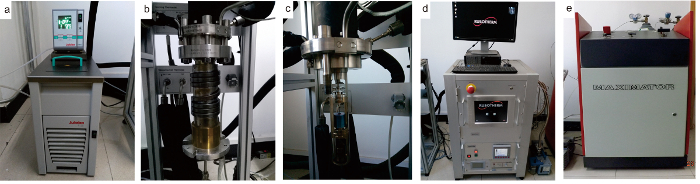
Figure 1: Experimental set-up for gravimetric gas adsorption at high temperatures and pressures. This figure shows the set-up for the isothermal adsorption experiment: (a) the oil bath heating device for the.......
Access restricted. Please log in or start a trial to view this content.
Discussion
The materials used in this experiment are shown in the Table of Materials. Before the sample pool is removed, it must be confirmed that the temperature and pressure in the sample pool are at normal pressure and normal temperature; otherwise, there is a danger of injury. If the temperature is too high, wait for the temperature to drop and then removethe sample pool. If the pressure is too high or too low, manually set the air pressure on the software and use an inert gas13,
Access restricted. Please log in or start a trial to view this content.
Disclosures
The authors have nothing to disclose.
Acknowledgements
A lot of assistance was provided by Engineer Gang Chen and Tao Zhang. This work was financially supported by the Major State Research Development Program of China (Grant No.2016YFC0600202) and the China Geological Survey (CGS, Grant No. DD20160183). We thank anonymous reviewers for their constructive comments that greatly improved this paper.
....Access restricted. Please log in or start a trial to view this content.
Materials
| Name | Company | Catalog Number | Comments |
|---|---|---|---|
| XRF D8 DISCOVER X-Ray diffractometer | Brook,Germany | 204458 | For mineralogy X-ray diffraction |
| EBSD three element integration system with spectrum | EDAX,USA | Trident XM4 | For nanoscale imaging (SEM) |
| Mercury injection capillary pressure (MICP) | USA micromeritics Instrument company | AutoPore IV 9520 | For the immersion method to measure macropores(Porosity) |
| Nitrogen gas adsorption at low temperature | USA micromeritics Instrument company | ASAP2460/2020 | For the low pressure nitrogen gas adsorption to measure mesopores and micropores(BET) |
| Finnigan MAT-252 mass spectrometer | ThermoFinnigan,USA | TRQ/Y2008-004 | For C isotope |
| LECO CS-230 analyzer | Research Institute of Petroleum Exploration and Development | 617-100-800 | TOC apparatus |
| 3Y-Leica MPV-SP photometer microphotometric system | Leica,Germany | M090063016 | Ro apparatus |
| Magnetic Suspension Balance Isothermal adsorption analyzer | Rubotherm,Germany | 2015-1974CHN | For methane adsorption tests |
| Sieve(20/40/60/80/100/120mesh) | Sinopharm Chemical Reagent Beijing Co.Ltd | 200*50GB6003.102012 | Used to screen samples |
| Absorbent cotton, hammer, tweezers and acetaldehyde | Sinopharm Chemical Reagent Beijing Co.Ltd | standard | Used to clean materials |
| Residual gas tight grinder | Nantong Huaxing Petroleum Instrument Co., Ltd | TY2013000237 | Sample smasher |
References
- Strapoc, D., Mastalerz, M., Schimmelmann, A., Drobniak, A. Geochemical constraints on the origin and volume of gas in the New Albany Shale (Devonian-Mississippian), eastern Illinois Basin. AAPG Bulletin. 94, 1713-1740 (2010).
- Loucks, R. G., Ruppel, S. C. Mississippian Barnett Shale: Lithofacies and depositional setting of a deep-water shale-gas succession in the Fort Wo....
Access restricted. Please log in or start a trial to view this content.
Reprints and Permissions
