This protocol describes an eyeblink conditioning paradigm appropriate for experiments with one-year-old infants. Commercial or custom-made equipment can be used to deliver the stimuli, and data collection and analysis should be performed on the video recordings.
Method Article
Classical Short-Delay Eyeblink Conditioning in One-Year-Old Children
In This Article
Summary
Abstract
Classical eyeblink conditioning (EBC) refers to the learned association between a conditioned stimulus (an auditory tone) and an unconditioned stimulus (a puff of air to the cornea). Eyeblink conditioning is often used experimentally to detect abnormalities in cerebellar-dependent learning and memory that underlies this type of associative learning. While experiments in adults and older children are relatively simple to administer using commercial equipment, eyeblink conditioning in infants is more challenging due to their poor compliance, which makes correct positioning of the equipment difficult. To achieve conditioning in one-year-old infants, a custom-made or an adapted commercial system can be used to deliver the air puff to the infant's cornea. The main challenge lies in successfully detecting and classifying the behavioral responses. We report that automated blink detection methods are unreliable in this population, and that conditioning experiments should be analyzed using frame-by-frame analysis of supplementary video camera recordings. This method can be applied to study developmental changes in eyeblink conditioning and to examine whether this paradigm can detect children with neurological disorders.
Introduction
EBC is a form of classical conditioning that is commonly used to assess learning and memory in humans and other animals. The conventional EBC paradigm refers to a learned association between an innocuous 'conditioned' stimulus (an auditory tone) with the 'unconditioned' stimulus (a corneal air puff that induces a reflexive eyeblink, the unconditioned response). Associative learning is assessed by presenting the conditioned stimulus and classifying eyeblinks as conditioned and unconditioned responses-an increase in the number of conditioned responses over time, or over more than one session, may indicate associative learning is occurring.
The eyeblink conditioning paradigm can be used to identify individuals with associative learning impairments. Delay conditioning-where the conditioned stimulus (CS) begins before but overlaps the unconditioned stimulus (US)-is controlled by cerebellar circuitry1,2, and is disrupted in adults and children with neurological disorders, including schizophrenia3, autism4,5, and fetal alcohol spectrum disorder6,7. From a clinical perspective, examining eyeblink conditioning in infants may support earlier detection and treatment of these neurological disorders. However, while older children may tolerate a corneal air puff6,7,8 and can maintain a stable head/eye position for the duration of the experiment, infants are less compliant, and conventional eyeblink detection equipment and software is not sufficient.
Here we describe a simple protocol to examine short-delay eyeblink conditioning in one-year-old children, that has been adapted from protocols previously described elsewhere9,10,11. This protocol can be administered using any commercial or custom-made system capable of delivering a controlled puff of air to the cornea. However, in place of commercial eyeblink detection software (e.g., San Diego Instrument's EyeBlink Detection System, which processes signals from an infrared camera), we, and others9,10,11, recommend using frame-by-frame analysis of video camera recordings to detect and classify eyeblink responses in one-year-old infants.
Protocol
All methods described here have been approved by The Northern B Health and Disability Ethics Committee, reference number: 13/NTB/181.
1. Technical Requirements
- Use an air puff unit capable of administering a puff of air directly to the cornea. This can be achieved using a flexible tube attached to an air tank via an air compressor. To ensure the infant's safety, fit this with an adjustable pressure regulator that restricts air pressure and limits air puff duration.
NOTE: Commercially available systems incorporate the compressor within the system, and do not require an air tank. - Use an adjustable headband or hat that can be worn by the infant and allows appropriate positioning of the air puff tubing beside the eye.
- Set up two portable audio speakers with adjustable volume settings.
- Design and set up computational control of the equipment so that the tone and air puff can be administered automatically with precise timing and at varying intervals.
- Set up a portable video camera with at least a 60-Hz frame rate to manually record eyeblink responses. To measure response times, use a video camera that can capture the trial onset, either by recording the audible tone or by filming a trial onset indicator programmed into the software package.
- Install and run any video editing software that allows frame-by-frame stepping of both audio and video components (e.g., Adobe Premiere Pro) to allow the researcher to measure the time interval between the stimulus and the blink response.
2. Experimental Paradigm
- Administer trials in blocks of 10. Each block should contain the following trial types.
- Include eight paired trials, where each learning trial consists of a 750-ms tone (80 dB, 1 kHz) that overlaps and terminates with a 100-ms air puff (~1/20 psi)9,10,11.
- Include an unpaired trial, that consists of a single 750-ms tone presented alone in the absence of the air puff to test for a conditioned eyeblink response indicating associative learning.
- Include a somatosensory trial consisting of a single 100-ms air puff trial presented alone in the absence of the tone to test for corneal sensitivity to the air puff and the correct positioning of the headband.
- Randomize the interval between consecutive trials (e.g., 8 - 16 s, with an average trial time interval of approximately 12 s)9,10,11.
- Measure five consecutive blocks (i.e., a total of 50 trials) in a single session, for a total session time of approximately 12 min.
- To test whether conditioning persists, administer two EBC sessions of 50 trials at least 1 h apart.
3. Testing Procedure
- Perform EBC in a moderately lit room (~300 lux) with consistent lighting levels between experiments.
- Position the two portable speakers on either side of the infant, approximately 40 cm from either side of the head.
- Place the custom-made headband on the infant's head and adjust for head size.
- Position the flexible tube holding the air puff nozzle and adjacent infrared sensor so that these are approximately 1 - 3 cm from the child's right eye at a ~45° angle from the axial plane of the head (Figure 1).
- Before beginning the experiment, check that the experimental set-up is optimized to deliver the corneal air puff. Deliver a single test air puff to the infant's eye and observe whether an eyeblink occurs and is visible on the video camera. If no eyeblink is observed, adjust the headband positioning so that the air puff unit is closer to the eye.
- Record the infant's eyeblink responses throughout the duration of the experiment. Position the video camera so that the field of view is directed toward the infant's eyes. The camera should be close enough to discern small eye movements, but not so close such that the infant can move outside the frame if he/she becomes fussy.
- Ensure the experimenters are masked to the stimulus timing. If the EBC user interface indicates when the next trial will occur, ask the researcher to orient themselves away from the computer interface so that they are not aware when the next stimulus will be delivered. This will prevent the researcher from responding to the stimulus themselves and potentially contributing to the infant's learned responses.
4. Optimizing the Experimental Set-up for One-year-old Infants
- Ensure that two researchers are available to conduct the experiment.
- When placing the headband on the infant, ask the caregiver to position the infant on their lap facing sideways. This allows the researcher to approach from the side and behind the infant's head, while a second researcher engages the infant.
- Placing the headband and positioning the nozzle should be performed as quickly and calmly as possible to ensure the infant's compliance. Placing a hand over the tip of the nozzle prevents the infant from turning their head into the nozzle during positioning.
- Keep the infant on the caregiver's lap throughout the experiment.
NOTE: While a high-chair may provide a more consistent environment between experiments, this may increase anxiety and reduce compliance in many infants. - For infants inclined to interfere with the headband during the experiment, use gentle distraction.
- The headband commonly moves during the experiment. If the infant is no longer responding to the air puff or the headband has moved significantly away from the eye, pause the experiment and adjust the headband position before continuing.
- Encourage the child to look up during the experiment in order to increase the magnitude of the eyeblink movements; this way, eyeblink detection may be improved.
NOTE: This can be achieved by placing the infant in front of a monitor playing an infant friendly video (e.g., an age-appropriate cartoon with the audio turned off) slightly above their line of sight.
5. Eyeblink Detection Using Video Camera Recordings
- Let two researchers independently define the eyeblink responses for each experiment.
- Use video editing software to analyze each trial for a 2,000-ms latency following trial onset.
- Use the audio waveform to detect the first frame of the trial onset.
- For the paired (CS + US) and unpaired (CS only) trials, define trial onset from the beginning of the audible tone.
- For the somatosensory trials where only the US (air puff) is presented, perform pretesting to ensure that the camera's microphone can detect the subtle 100-ms noise created by the air puff. Otherwise, video recording of the trial onset indicator programmed into the software package will aid in detecting the air puff onset.
- Use the video track to detect the blink response. Record blink latency as both the following: Blink onset-the first frame where the eyelids begin to close; Blink peak-the first frame where the eyelids are maximally closed.
- As needed, develop strategies to handle ambiguous responses. See the following examples.
- Reasonably exclude partial blinks, which may occur when the eyelids fail to completely close by more than ~50%.
- Exclude trials where the tone/air puff onset is concealed by extraneous noise, or where the blink response is obscured from view, from further analyses.
- In trials where multiple blinks are observed, analyze the first blink response following trial onset.
- Record the number of video frames between the stimulus onset and the blink peak. Convert the latency into real-time based on the sampling rate of the video camera.
6. EBC Response Classification
- After detecting those trials in which an eyeblink response occurred, define the type of blink, based on its latency relative to the stimulus onset (Figure 2).
- Define a blink as a startle response if it occurs within the first 200-ms interval after the tone; these represent a reflex response to the auditory tone, or blinks that are timed coincidentally with tone onset that would have occurred independently of the air puff.
NOTE: Startle responses may be observed for the paired (CS + US) or unpaired (CS only) trials, where the auditory tone is delivered. - Define a blink as a somatosensory response if it occurs in response to the air puff; it indicates whether the cornea is sensitive to the air puff with the current headpiece configuration. This is a type of unconditioned response (see below).
- Define unconditioned responses as somatosensory responses to the air puff during paired (CS + US) trials that occur more than 650 ms after the tone onset.
- Define conditioned responses as blinks that are optimally timed to coincide with the air puff. They are initiated between 350 to 650 ms after the tone onset for the paired or unpaired trials and indicate that associative learning between the CS and US may have occurred.
- Define a trial as failed responses if no blink was detected in response to the air puff; these can be observed for the paired (CS + US) trials or the somatosensory trials. These responses indicate that the air puff is not reaching the eye.
- Define a blink as a startle response if it occurs within the first 200-ms interval after the tone; these represent a reflex response to the auditory tone, or blinks that are timed coincidentally with tone onset that would have occurred independently of the air puff.
7. Analysis of Associative Learning
Note: A number of methods have been previously described to assess associative learning9,10,11 (described briefly here). Researchers should modify these methods or develop their own to define whether associative learning has occurred, depending on their experimental design.
- First, exclude trials in which no usable data was collected, such as those with technical errors.
- Calculate the sensitivity to the air puff by calculating the percentage of eyeblink responses from all possible somatosensory trials.
- Assess whether associative learning has occurred during the experiment by comparing the percentage of conditioned responses in sequential blocks of 10 trials. An increase in the percentage of conditioned responses over the course of the experiment may indicate conditioning has occurred.
NOTE: Alternatively, modeling the change in eyeblink latencies over time could be used to assess whether the infant has adapted their response times during the course of the experiment. - Assess whether associative learning is occurring across experimental sessions or between two experimental groups. Use an arbitrary criterion to define whether conditioning has occurred (e.g., > 40% conditioned responses within an experimental session)6,9.
Results
Testability of Eyeblink Conditioning in One-year-old Infants:
The experimental set-up required to examine eyeblink conditioning is challenging for one-year-old infants. In the experiments we conducted, 35% (11 infants) failed to participate in the experiment because they would not tolerate wearing a headband or receiving the air puff to the cornea (n = 31 infants attempted). Approximately half (52%, n = 16 infants) completed or partially completed the first set of 50 trials (median [IQR] = 22.5 [0 - 50] trials completed). The remainder participated in two experimental sessions.
Achieving reliable experimental results requires correct positioning of the headband and air puff unit throughout the experiment. For those infants who do participate in the experiment, air puff delivery to the cornea can be achieved for the majority of the trials (77 ± 6% of air puffs induced a blink response; n = 13 infants/557 air puff trials attempted). The remaining trials represent 'failed trials' in which the infant was not sensitive to the air puff.
Figure 3 illustrates air puff delivery success during two conditioning experiments of 50 trials. The number of observed eyeblinks is described as a percentage of air puff trials (i.e., either somatosensory or paired trials). Blink responses from the first infant decrease in each successive block of 10 trials, indicating that the headband may have been sub-optimally positioned toward the end of the experiment. In contrast, the second infant illustrates relatively good sensitivity to the air puff, with at least 90% of air puff trials successfully eliciting a blink response in each subsequent block of 10 trials.
Eyeblink Detection Success Rates Using Video Camera Analysis:
A hand-held video camera provides a reliable method of capturing eyeblink responses by allowing the researcher to manually track the infant's eyes. Manual frame-by-frame analysis was used to identify responses from 90 ± 3% of trials (n = 13 infants/608 trials attempted). The remaining trials represent those in which the infant's eyes were obscured during filming.
Although video analysis requires subjective interpretations, this method can be used to reliably measure eyeblink latency from the stimulus onset. Our analysis of blink response times measured by two independent observers illustrates good inter-rater reliability whereby the mean difference between measurements was 28.4 ms and 95% limits of agreement of ± 263.9 ms (Figure 4: n = 4 experiments analyzed by two observers/94 blink responses). Considering that conditioned eyeblinks are defined as those that fall within a 300-ms window, this allows sufficient precision to distinguish conditioned from unconditioned responses. Note that those trials with significant disagreement can be easily reassessed following consultation between the observers.
Eyeblink Conditioning in One-year-old Infants:
The two conditioning experiments shown in Figure 5A and 5B illustrate the eyeblink response latencies over the course of the experiment for both the paired and unpaired trials. The eyeblink responses from the first infant during the first EBC session peak after the onset of the air puff and outside the latency window that defines a conditioned response. Moreover, this infant fails to respond to any of the unpaired (tone only) trials. Together, this indicates that this infant has not learned to associate the tone and the air puff during their initial exposure to the EBC paradigm. In comparison, the second infant, who is participating in their second EBC session, routinely blinks prior to the air puff onset, and responds to all the unpaired trials, indicating the infant has achieved eyeblink conditioning following the initial session of 50 trials. Figure 5C illustrates a typical method of assessing associative learning over multiple trials of sessions6,9,10,11. The number of conditioned responses from both infants is described in successive blocks of 10 trials and as a percentage of all paired and unpaired trials in each block. In this instance, both infants show minimal changes in associative learning during the experiment, illustrating a lack of conditioning (infant 1, session 1) or that conditioning has already occurred (infant 2, session 2).
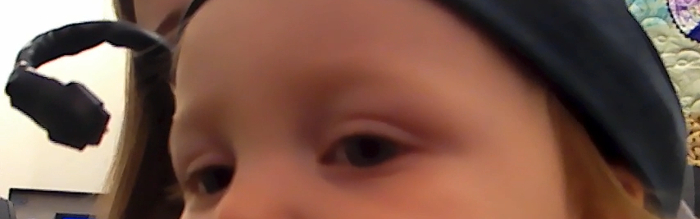
Figure 1: Eyeblink conditioning set-up with a one-year-old infant participant. The custom-made headband supporting the air puff unit is shown. Please click here to view a larger version of this figure.
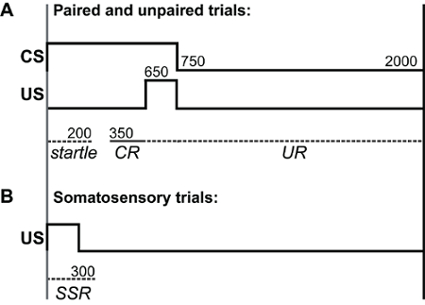
Figure 2: Stimuli and response definitions for an eyeblink conditioning paradigm appropriate for experiments with one-year-old children. (A) During paired trials, a 750-ms audible tone (conditioned stimulus [CS]) overlaps and terminates with a 100-ms air puff (unconditioned stimulus [US]). Blink responses vary according to their timing relative to the stimulus onset (startle response: 0 - 200 ms; conditioned response [CR]: 350 - 650 ms; unconditioned response [UR]: 650 - 2,000 ms). Response definitions are identical for unpaired (CS only) trials. (B) Somatosensory trials deliver a single 100-ms air puff (US) only, and blinks that occur within a 300-ms window are classified as somatosensory responses (SSR). Please click here to view a larger version of this figure.
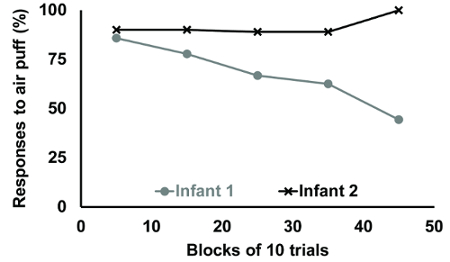
Figure 3: Example of eyeblink conditioning experiments in one-year-old infants illustrating variation in air puff sensitivity. The sensitivity to the air puff is described as the number of observed responses to the air puff (delivered either as a somatosensory trial or as a paired trial) as a percentage of all air puff trials, in each subsequent block of 10 trials. Please click here to view a larger version of this figure.
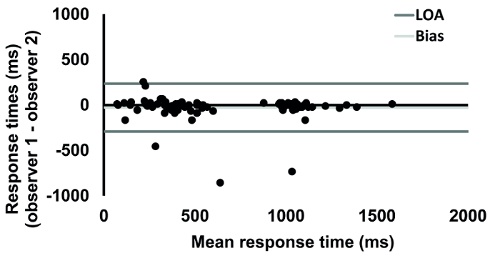
Figure 4: Bland-Altman plot illustrating the agreement in blink response times measured from video camera recordings by two independent observers. Grey lines indicate the bias between measurements (defined as the mean difference between measurements), and the upper and lower limits of agreement (LOA, defined as the mean difference ± 1.96 standard deviations). Please click here to view a larger version of this figure.
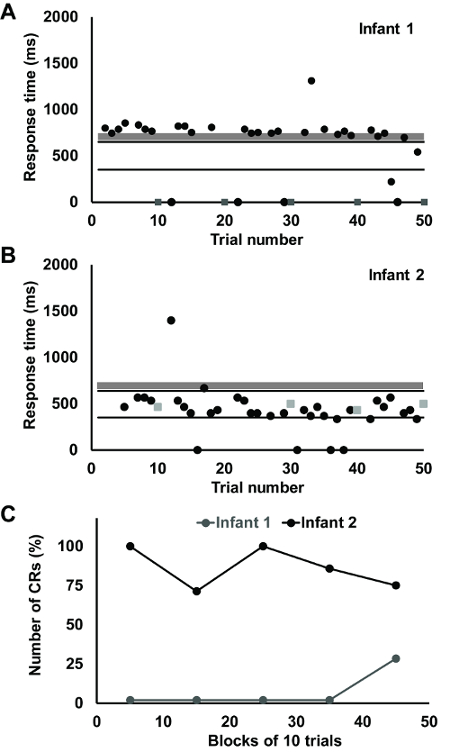
Figure 5: Example of eyeblink conditioning experiments in one-year-old infants illustrating variation in conditioned responses. Blink response times are shown for the paired (CS + US) trials (black circles), and unpaired (CS only) trials (grey squares). The grey bar indicates the timing of the air puff and the black lines indicate the latency between 350 - 650 ms used to define a conditioned response. Trials that failed to elicit a response are shown on the x-axis. (A) Blink responses generally fall outside the conditioning window, and unpaired trials failed to elicit an eyeblink response. (B) Responses are adequately timed to coincide with the occurrence of the air puff, and unpaired responses and paired trials initiate a conditioned response. (C) Conditioning over the course of the experiment is illustrated as the number of conditioned responses (described as a percentage of all paired and unpaired trials), in each successive block of 10 trials. Please click here to view a larger version of this figure.
Discussion
Modifications and Troubleshooting:
Commercial or custom-made eyeblink conditioning systems should present the stimuli to the subject in an experimentally controlled manner and be able to detect the behavioral responses. Although this is a non-invasive procedure, the technical requirements for conducting these experiments in less compliant populations (e.g., infants) is challenging. Physically attaching the head-mount to the eye is possible for animal experiments, such as conditioning experiments in sheep12,13. Older children may tolerate wearing a headband with an attached air-puff delivery unit6,7,8 and can be encouraged to maintain a constant eye position using television as a distraction. Although compliance in very young infants can be achieved by conditioning during sleep14, older infants approaching one year of age are generally easily distracted, making them a uniquely challenging population. Despite the challenges, eyeblink conditioning experiments are possible for some awake, one-year-old infants. Our success rates are similar to those reported previously in the literature (~40% - 50% compliance)9, with the likelihood of success probably reflected by the infant's temperament on the day of the experiment.
Critical Steps Within the Protocol:
We recommend adapting a commercially-available EBC set-up, or using a custom-built air pressure generator as previously described, for younger infants9,10,11. The initial challenge is maintaining the air-puff delivery unit in the correct position throughout the experiment, which requires a smaller, modified headpiece. Eye safety is a particular concern for non-compliant infants who attempt to remove the headpiece themselves. Therefore, infants must be closely monitored at all times. A proportion of children will not tolerate wearing the headband or receiving the air puff to the eye (here, ~35%), although this may be improved by gently distracting the infant if the experimental protocol allows this and if this does not overtly interfere with infant behavior. For the children who do complete the experiment, air-puff-only trials are essential to confirm that the headpiece was positioned correctly, as lack or reversal of conditioning responses may be caused by poor delivery of the air puff throughout the experiment.
While manual video analysis is time-consuming, automated measures of infant eyeblink responses are currently difficult to achieve. Infrared sensors supplied with commercial EBC set-ups (positioned on the headband adjacent to the air puff unit) record the moment-to-moment reflectance from the cornea at a 1-kHz sampling rate, and blinks can be detected by measuring the change in reflectance following the stimulus onset. Significant changes from baseline reflectance indicate that an eyeblink has occurred, and automated analysis can be used to detect and classify blink responses. However, we and others9,10,11 suggest that researchers should not rely on infrared corneal reflectance measurements provided with commercial EBC set-ups to detect blinks in one-year-old children. While this method may be suitable for adult participants or older children6,7, we were unable to reliably detect blinks in one-year-olds using this method. Here, negligible change in the baseline reflectance is observed over the length of the trial epoch, indicating that the eyeblink is not detected by the infrared sensor. In addition, false positive peaks are commonly observed, which are caused by the infant's head movements that change the positioning of the sensor. Pilot testing in adults suggests that the participant must focus on or slightly above their horizontal line of sight, with the air puff unit positioned within 1 - 2 cm of the cornea, to successfully detect the eyeblinks-conditions that cannot be maintained consistently with an infant. In addition, the small interpalpebral fissure size in infants may reduce corneal reflectance, making blink detection more difficult than in adults or older children.
Significance with Respect to Existing Methods:
Despite the need for manual video camera analysis and the lower temporal resolution of a 60-Hz video in comparison to 1-kHz reflectance measurements, the improved success rates of video recordings make this a superior method to the infrared sensor. Although the corneal air puff is also delivered by the same headpiece attachment as a commercial infrared sensor, stimulus delivery appears to be more resilient to positioning than the infrared sensor, as the air puff strength can be adjusted as required. This avoids excessive adjustment of the headband, which tends to reduce infant compliance. Researchers who can achieve higher success rates using the infrared sensor may still require supporting video camera analysis. For the trials where there is no detectable eyeblink response recorded by the infrared sensor, video recordings can distinguish between true responses or invalid trials (i.e., whether the child was wearing the air puff unit in the correct position, whether they did not blink, or whether the infrared sensor failed to detect the blink). Equally, video recordings are necessary to confirm false positive results, as movements during the trial can also produce artefacts masquerading as blinks. Eye-tracking apparatus15,16 and electromyography9,10,14 of the orbicularis oculi muscle are other automated methods of blink detection that are beyond the scope of this paper, although without visual confirmation of the air puff unit positioning for each trial, these methods are likely to suffer the same drawbacks as the infrared eyeblink detection software described here.
Previously published work on eye-blink conditioning has focused on younger infants, typically 4 - 5 months of age; this work adds to this body of literature by describing techniques for use with older infants (12 ± 1 month of age) and the unique challenges this age group presents. Other authors have also used video analysis (either alone or in combination with electromyography) with infants9,10,11,14. The results presented here are consistent with these previous findings which suggest frame-by-frame video analysis is the best method of detecting eyeblinks in infants, as both electromyography and infrared monitoring can be problematic due to facial and head movements in very young children. This work also supports the finding that infants can develop conditioned responses even at very young ages, at least for a 650-ms delay interval9.
Future Applications:
As a limited number of studies have attempted eyeblink conditioning experiments in human infants, the stimulus parameters should be carefully considered in future experiments. Conditioning has been observed as early as 10 days of age17 and at least within the first month of life14, although a long inter-stimulus interval (e.g., 1,500 ms) appears to be more successful in these very early stages of infancy18. In comparison, children approaching six months of age can be more reliably conditioned with a shorter interval10, although less successfully than in adults19. The 650-ms interval between the tone and the air puff suggested for one-year-old children in this protocol can successfully induce conditioning in 4- or 5-month-old infants9,10,11, as well as in older children6,7. This suggests that eyeblink conditioning is developmentally regulated, with the optimal delay between the tone and the air puff decreasing with infant age10, although additional experiments adapting this protocol are required to investigate these parameters further.
Limitations of This Technique:
EBC can be challenging to set up and may require troubleshooting in each individual situation. Determining when conditioning has occurred is difficult to define and is best observed over multiple trials or sessions. For example, other studies have used an arbitrary conditioning rate of 40% within each block of 10 trials to define conditioning and compared any changes between successive experimental sessions6,9,10,11. Successfully completing the required number of trials to observe conditioning can, therefore, be difficult to achieve in young children.
In regards to the data analysis, one of the particular challenges is separating stimulus-evoked blinks from spontaneous (endogenous) blinks9. The rate of spontaneous eyeblinks is different between individuals but can be influenced by environmental factors such as room humidity, as well as behavioral states. Double blinks occur when there are two complete eyelid closures in a very short space of time (e.g., 400 ms)20, and it is possible that these reflect spontaneous blinks occurring at the same time as a reflexive (conditioned or unconditioned) eyeblink. We occasionally observed double blinks in our data set and, using this protocol, we recorded the latency to the first blink only. However, discarding these trials may increase certainty that the analysis is capturing stimulus-evoked blinks only.
Researchers will also need to make decisions on the latency window in which to define a conditioned or unconditioned response, as well as whether to define latency to the blink onset or the blink peak (eyelid closure). Here we have conservatively defined a conditioned response as a blink that peaks prior to 650 ms in either paired or unpaired trials, to provide certainty that the blink is initiated before the air puff onset rather than in response to the air puff. However, this latency window could be extended for unpaired trials where no air puff is presented, particularly if using blink peak to define the latency of the response. The important principle here is that all instances are dealt with in the same manner, by all examiners, and that this criterion is determined prior to any data analysis commencing.
In summary, frame-by-frame video analysis can provide a reliable and reproducible method of assessing classical EBC responses in young infants. These measures provide one measure of learning behavior, although a comprehensive developmental assessment is required to fully characterize neurodevelopment in infancy.
Disclosures
The authors have nothing to disclose.
Acknowledgements
This study was supported by the New Zealand Optometric Vision Research Foundation, the Health Promotion Agency, The University of Auckland Faculty Research Development Fund, and The University of Auckland School of Medicine PBRF fund.
We are grateful to the two Optometry students from The University of Auckland (Shannon Boy and Harpreet Singh) who completed the manual video analysis to examine agreement in blink response measurements.
Materials
| Name | Company | Catalog Number | Comments |
|---|---|---|---|
| Eyeblink conditioning system | San Diego Instruments | Model #2325-0145-W | includes portable airpuff unit and infrared emitter/receiver mounted to adjustable headband; eyeblink stimulus and response detection software; PC interface |
| 4K Ultra HD action camera | RV77 | Model SJ9000 | micro SD/TF card recording 90fps at 720p |
References
- Freeman, J. H., Steinmetz, A. B. Neural circuitry and plasticity mechanisms underlying delay eyeblink conditioning. Learning & Memory. 18 (10), 666-677 (2011).
- Mccormick, D. A., et al. The engram found? Role of the cerebellum in classical conditioning of nictitating membrane and eyelid responses. Bulletin of the Psychonomic Society. 18 (3), 103-105 (1981).
- Bolbecker, A. R., et al. Eye-blink conditioning deficits indicate temporal processing abnormalities in schizophrenia. Schizophrenia Research. 111 (1-3), 182-191 (2009).
- Sears, L. L., Finn, P. R., Steinmetz, J. E. Abnormal classical eye-blink conditioning in autism. Journal of Autism and Development Disorders. 24 (6), 737-751 (1994).
- Oristaglio, J., et al. Children with autism spectrum disorders show abnormal conditioned response timing on delay, but not trace, eyeblink conditioning. Neuroscience. 248, 708-718 (2013).
- Jacobson, S. W., et al. Impaired eyeblink conditioning in children with fetal alcohol syndrome. Alcoholism: Clinical and Experimental Research. 32 (2), 365-372 (2008).
- Jacobson, S. W., et al. Impaired delay and trace eyeblink conditioning in school-age children with fetal alcohol syndrome. Alcoholism: Clinical and Experimental Research. 35 (2), 250-264 (2011).
- Ohlrich, E. S., Ross, L. E. Acquisition and differential conditioning of the eyelid response in normal and retarded children. Journal of Experimental Child Psychology. 6 (2), 181-193 (1968).
- Ivkovich, D., Eckermann, C. O., Krasnegor, N. A., Stanton, M. E. Using eyeblink conditioning to assess neurocognitive development. Eyeblink Classical Conditioning: Volume I. Woodruff-Pak, D., Steinmetz, J. E. , Springer. Boston, MA. 119-142 (2002).
- Klaflin, D. I., Stanton, M. E., Herbert, J., Greer, J., Eckerman, C. O. Effect of delay interval on classical eyeblink conditioning in 5 month old human infants. Developmental Psychobiology. 41 (4), 329-340 (2002).
- Ivkovich, D., Collins, K. L., Eckerman, C. O., Krasnegor, N. A., Stanton, M. E. Classical Delay Eyeblink Conditioning in 4- and 5-Month-Old Human Infants. Psychological Science. 10 (1), 4-8 (1999).
- Nation, K., et al. Video-based data acquisition system for use in eye blink classical conditioning procedures in sheep. Behavior Research Methods. , 1-14 (2016).
- Johnson, T. B., Stanton, M. E., Goodlett, C. R., Cudd, T. A. Eyeblink classical conditioning in the preweanling lamb. Behavioral Neuroscience. 122 (3), 722-729 (2008).
- Reeb-Sutherland, B. C., et al. One-month-old Human Infants Learn About the Social World While They Sleep. Developmental Science. 14 (5), 1134-1141 (2011).
- Kulke, L., Atkinson, J., Braddick, O. Automatic Detection of Attention Shifts in Infancy: Eye Tracking in the Fixation Shift Paradigm. PLoS One. 10 (12), e0142505(2015).
- Meng, X., Uto, Y., Hashiya, K. Observing Third-Party Attentional Relationships Affects Infants' Gaze Following: An Eye-Tracking Study. Frontiers in Psychology. 7, 2065(2016).
- Naito, T., Lipsitt, L. P. Two attempts to condition eyelid responses in human infants. Journal of Experimental Child Psychology. 8 (2), 263-270 (1969).
- Little, A. H., Lipsitt, L. P., Rovee-Collier, C. Classical conditioning and retention of the infant's eyelid response: effects of age and interstimulus interval. Journal of Experimental Child Psychology. 37 (3), 512-524 (1984).
- Hoffman, H. S., Cohen, M. E., Devido, C. J. A comparison of classical eyelid conditioning in adults and infants. Infant Behavior and Development. 8 (3), 247-254 (1985).
- Nakanishi, M., Mitsukura, Y., Wang, Y., Wang, Y. T., Jung, T. P. Online Voluntary Eye Blink Detection using Electrooculogram. IEICE Proceeding Series. , (2012).
Reprints and Permissions
