Herpesvirus of turkeys (HVT) is widely used as a vector platform for the generation of recombinant vaccines against a number of avian diseases. This article describes a simple and rapid approach for the generation of recombinant HVT-vectored vaccines using an integrated NHEJ-CRISPR/Cas9 and Cre-Lox system.
Method Article
Generating Recombinant Avian Herpesvirus Vectors with CRISPR/Cas9 Gene Editing
In This Article
Summary
Abstract
Herpesvirus of turkeys (HVT) is an ideal viral vector for the generation of recombinant vaccines against a number of avian diseases, such as avian influenza (AI), Newcastle disease (ND), and infectious bursal disease (IBD), using bacterial artificial chromosome (BAC) mutagenesis or conventional recombination methods. The clustered regularly interspaced palindromic repeats (CRISPR)/Cas9 system has been successfully used in many settings for gene editing, including the manipulation of several large DNA virus genomes. We have developed a rapid and efficient CRISPR/Cas9-mediated genome editing pipeline to generate recombinant HVT. To maximize the potential use of this method, we present here detailed information about the methodology of generating recombinant HVT expressing the VP2 protein of IBDV. The VP2 expression cassette is inserted into the HVT genome via an NHEJ (nonhomologous end-joining)-dependent repair pathway. A green fluorescence protein (GFP) expression cassette is first attached to the insert for easy visualization and then removed via the Cre-LoxP system. This approach offers an efficient way to introduce other viral antigens into the HVT genome for the rapid development of recombinant vaccines.
Introduction
Marek's disease (MD) is a lymphoproliferative disease of chickens induced by serotype 1 (Gallid Herpesvirus 2 [GAHV-2]) of the genus Mardivirus in the subfamily of Alphaherpesvirinae. Mardivirus also includes two nonpathogenic serotypes: serotype 2 (GaHV-3) and serotype 3 (MeHV-1, historically known as HVT) which are used as vaccines against MD. Live HVT vaccine (FC-126 strain) is the first generation of MD vaccine used in the early 1970s and is still being used widely in bivalent and polyvalent vaccine formulations to provide an enhanced protection against MD. HVT is also widely used as a vaccine vector to induce the protection against a number of avian diseases due to its versatility and safety for both in ovo and subcutaneous hatchery administration and capability to provide a lifelong immunity. The strategy to generate recombinant HVT vaccines is based on either conventional homologous recombination in virus-infected cells, overlapping cosmid DNAs, or BAC mutagenesis2. However, these methods are generally time-consuming and labor-intensive, requiring the construction of transfer vectors, the maintenance of the viral genome in Escherichia coli, plaque purifications, and the removal of the BAC sequence and selection marker from the edited viruses3,4.
CRISPR/associated (Cas9) is the most popular gene editing tool in recent years due to its versatility and specificity. The CRISPR/Cas9 system has been successfully used in the efficient generation of genetically modified cells and animal models5,6,7,8,9,10, as well as in the manipulation of several large DNA virus genomes11,12,13,14,15,16,17,18,19,20. After reporting a simple and efficient method using the CRISPR/Cas9 system to edit the HVT genome21, we developed a pipeline for the rapid and efficient generation of recombinant HVT22.
In order to extend the potential application of this method, we describe the detailed methodology for the generation of recombinant HVT vaccine expressing the VP2 gene of IBDV at the UL45/46 locus in this report. The approach combines NHEJ-CRISPR/Cas9 to insert the VP2 gene tagged with GFP reporter gene and a Cre-LoxP system to remove the GFP expression cassette later. Compared to traditional recombination and BAC recombineering techniques, we demonstrate that NHEJ-CRISPR/Cas9 together with a Cre-Lox system is a rapid and efficient approach to generate recombinant HVT vaccine.
Protocol
1. Preparation of Cas9/gRNA Expression and Donor Constructs
- Construction of Cas9/gRNA expression plasmids
- Design a gRNA sequence targeting intergenic region between UL45 and UL46 genes of HVT as described previously22. Align the guide-RNA target sequence against the HVT genome to rule out any potential off-target sequences in the HVT genome. Synthesize and clone the gRNA sequence targeting UL45/46 region and sg-A sequence from published data23 into pX459-V2 as described previously22. Verify the cloned gRNA sequence by Sanger sequencing using the U6-Fwd primer24.
- Construction of donor plasmid
- To generate a donor plasmid containing the VP2 expression cassette tagged with a removable GFP reporter cassette, design oligos Donor-F and Donor-R containing the following elements (Figure 1A and Figure 3A): an sg-A target sequence at both ends, a PacI site flanked with two LoxP sequences for the GFP reporter cassette cloning and excision, and two SfiI sites for the cloning of the VP2 expression cassette.
- Clone the sequence into a pGEM-T-easy vector and, then, clone the GFP and VP2 gene cassettes into the resulting vector to generate the donor plasmid designated as pGEM-sgA-GFP-VP222.
NOTE: Any cloning vector can be used to construct donor plasmid.
- Plasmid DNA preparation
- Prepare both donor plasmid and Cas9/gRNA expression plasmid DNAs using a commercial DNA extraction kit according to the manufacturer's instructions.
2. CRISPR/Cas9-mediated Knock-in: Transfection and Infection
- The day before transfection, prepare chick embryo fibroblasts (CEFs) for the transfection/infection, using 10-day old embryos in M199 medium supplemented with 5% fetal bovine serum (FBS), 10% tryptose phosphate broth, 100 U/mL penicillin-streptomycin, and 0.25 µg/mL fungizone. Seed 1.3 x 10⁶ cells per well into each well of a 6-well plate in 2.5 mL of medium.
NOTE: CEF cells can be kept for 3 d at 4 °C. - Transfect CEF cells (prepared in step 2.1) with 0.5 µg of UL45/46-gRNA, 0.5 µg of sg-A, and 1 µg of pGEM-sgA-GFP-VP2 using an appropriate transfection reagent according to the manufacturer's instructions. Incubate the cells for 12 h in an incubator (at 38.5 °C with 5% CO2).
- 12 h posttransfection of Cas9/gRNA and donor plasmids, dilute the HVT virus stock with M199 culture medium to 1 x 10⁵ pfu/mL. Add 130 µL of the diluted virus into each well of the transfected cells and set one well of untransfected cells as a negative control with the same quantity of virus. Incubate the transfected/infected cells for 3 d at 38.5 °C with 5% CO2. Carry out all procedures using the Joint Code of Practice (JCoPR) approved by the funders.
3. Harvesting and Purification of the HVT Recombinant Virus
- Fluorescence-activated cell sorting
- Prepare two 96-well plates preseeded with 2 x 10⁴ CEF cells per well the day before sorting.
- Trypsinize transfected/infected CEFs 3 d postinfection. Aspirate the medium from each well and rinse the cell sheet with phosphate-buffered saline (PBS). Add 1 mL of 0.05% trypsin-EDTA (0.48 mM) to trypsinize the cells in the 38.5 °C incubator for approximately 5 min.
- Resuspend and transfer the cells into a 1.5 mL microcentrifuge tube with 50 µL of FBS. Centrifuge at 200 x g for 5 min.
- Resuspend the cells in 1 mL of PBS with 1% FBS. Count the cell numbers using a hemocytometer and adjust the number of cells to 1 x 10⁶ cells/mL.
NOTE: Cells can be kept on ice for 1 - 2 h. - Transfer the cells to a polystyrene sorting tube through its strainer cap. Sort the single cells expressing GFP into 96-well plates seeded with CEFs using the cell sorter according to the manufacturer's instruction. Incubate the sorted cells for 5 d at 38.5 °C with 5% CO2.
NOTE: One passage of the recombinant virus may be needed before sorting if there are too many single GFP-expression cells and few GFP-positive plaques in the original well.
- Passaging of recombinant viruses
- Prepare 6-well plates seeded with 1.3 x 10⁶ CEF cells per well the day before the passage. 5 d postsorting, check the 96-well plates under a fluorescence microscope. Mark the wells containing a single GFP-positive plaque.
NOTE: See Figure 2A for a representative GFP-positive plaque. - Trypsinize each GFP-positive well with 50 µL of trypsin-EDTA for 3 min, add 50 µL of culture medium, resuspend and transfer the cells into one well of a 6-well plate with CEFs. This will be the first generation of recombinant HVT.
- Harvest the first generation of recombinant viruses 3 d later, freeze down one vial of each in 1 mL of freezing medium containing 10% fetal calf serum (FCS), 10% dimethyl sulfoxide (DMSO), and 80% culture medium, and store the viruses in liquid nitrogen.
NOTE: The harvest time varies from 2 - 4 d depending on the amount and proliferation capacity of the virus. - Collect 1 x 10⁵ cells of each first generation of viruses, centrifuge them, and discard the supernatant. Store the cells at -20 °C for DNA extraction.
- Prepare 6-well plates seeded with 1.3 x 10⁶ CEF cells per well the day before the passage. 5 d postsorting, check the 96-well plates under a fluorescence microscope. Mark the wells containing a single GFP-positive plaque.
- Detection of genomic insertion by polymerase chain reaction
- For the DNA extraction, defrost and resuspend the cell pellet from step 3.2.4 with 50 µL of squishing buffer (10 mM Tris-HCl [pH 8], 1mM EDTA, 25 mM NaCl, and 200 µg/mL Proteinase K) and lyse the samples at 65 °C for 30 min and, then, at 95 °C for 2 min to inactivate the Proteinase K.
- Perform a polymerase chain reaction (PCR) with 3' junction primers (Table 1) using 1 µL of DNA sample.For each sample, prepare the following 20 µL reaction mix on ice: 2x PCR Master Mix (10 µL), 10 µM upstream primer (0.5 µL), 10 µM downstream primer (0.5 µL), DNA template (1 µL), and nuclease-free water (8 µL). The amplification program is: 95 °C for 2 min; 95 °C for 30 s, 55 °C for 30 s, and 72 °C for 40 s for 35 cycles; 72 °C for 7 min. Load 2 µL of the amplification products to one well of 1% agarose gel for gel electrophoresis.
NOTE: See Figure 2A for a representative result of the 3' junction PCR.
4. Excision of the Fluorescent Reporter Gene via the Cre-lox System
- To remove the GFP gene from the recombinant virus, transfect 2 µg of Cre recombinase expression plasmid into the 6-well plate preseeded with CEF cells, using a transfection reagent following the manufacturer's instruction.
- 12 h posttransfection, defrost one vial of recombinant virus from liquid nitrogen, resuspend gently, seed 50 µL into each well of transfected cells, and set one well as the negative control with the same amount of virus. Incubate for 3 d at at 38.5 °C with 5% CO2.
5. Plaque Purification
- Fluorescence-activated cell sorting
- Seed two 96-well plates with 2 x 10⁴ CEF cells per well the day before sorting.
- Follow the procedures described in step 3.1 72 h postinfection (from step 4) to prepare the infected cells for sorting. Sort the single nonfluorescence cells into 96-well plates seeded with CEFs.
- Passaging of the recombinant viruses and PCR confirmation
- Choose 5 - 10 single nonfluorescence plaques 5 d postsorting, trypsinize them with 50 µL of trypsin-EDTA at 38.5 °C for 3 min, and add 50 µL of culture medium to resuspend the cells.
NOTE: See Figure 2B for a representative GFP-negative plaque. - Pass half of the cells into each well of a 6-well plate preseeded with CEFs as the second generation.
- Centrifuge the remaining cells of each clone at 200 x g for 5 min, discard the supernatant, and resuspend the cells with 50 µL of squishing buffer for DNA extraction.
- Perform PCR with 5' junction primers (Table 1) using 1 µL of DNA template with the same PCR reaction condition as described in step 3.3.2.
NOTE: See Figure 2B for a representative result of 5' junction PCR. - Based on the PCR results, choose three to five positive clones of recombinant HVT for further passages and verification.
- Choose 5 - 10 single nonfluorescence plaques 5 d postsorting, trypsinize them with 50 µL of trypsin-EDTA at 38.5 °C for 3 min, and add 50 µL of culture medium to resuspend the cells.
6. Verification of the Recombinant HVT
- Indirect immunofluorescence assay
- Infect CEFs with the second generation of recombinant HVT obtained from step 5.2 in the 24-well plate seeded with 2.5 x 10⁵ CEFs the day before infection. Remove the cell culture medium 48 h postinfection and add 500 µL of 4% paraformaldehyde in PBS to fix the cells. Incubate the plate at room temperature for 30 min and, then, remove the fixative and wash the cell layer 3x with PBS.
NOTE: The cells may be stored at 4 °C at this step for several weeks. - Remove the PBS and add 500 µL of 0.1% Triton X-100 to permeabilize the cells for 15 min. Wash the cell layer 3x with PBS.
- Block nonspecific binding by adding blocking buffer (5% bovine serum in PBS) for 1 h.
- Dilute the primary antibody anti-VP2 monoclonal antibody HH7- or HVT-infected chicken serum at 1:200 in blocking buffer, add 200 µL per well, and incubate at room temperature for 1 h. Wash the cell layer 3x with PBS.
- Dilute the secondary antibody goat anti-mouse IgG Alexa 568 or goat anti-chicken IgG Alexa 488 at 1:200 in blocking buffer, add 200 µL per well, incubate at room temperature for 1 h, and wash the cells 3x with PBS. Check the protein expression under the fluorescence microscope.
NOTE: See Figure 4 for a representative VP2 staining result.
- Infect CEFs with the second generation of recombinant HVT obtained from step 5.2 in the 24-well plate seeded with 2.5 x 10⁵ CEFs the day before infection. Remove the cell culture medium 48 h postinfection and add 500 µL of 4% paraformaldehyde in PBS to fix the cells. Incubate the plate at room temperature for 30 min and, then, remove the fixative and wash the cell layer 3x with PBS.
- Sequencing of the VP2 gene
- Amplify the DNA sequence spanning the UL45 and UL46 intergenic region with high-fidelity DNA polymerase and primers UL45-F1 and UL46-R1 (Table 1) to detect the whole insertion.
- Prepare the following 50 µL reaction mix: 5 µL of 10x Pfx Reaction Mix, 1.5 µL of 10 µM upstream and downstream primer mix, 1 µL of 10 mM dNTP mix, 1 µL of 50 mM MgSO4, 1 µL of DNA template, and 0.5 µL of Pfx DNA polymerase, and add nuclease-free water to 50 µL. The amplification program is: 95 °C for 2 min; 95 °C for 15 s, 55 °C for 30 s, and 68 °C for 3 min for 35 cycles. Load all of the PCR product to 1% agarose gel for gel electrophoresis.
- Purify the PCR product following the instruction of a DNA gel purification kit. Send 10 µL of the PCR product (30 ng/µL) to a sequencing company to confirm the knock-in of the VP2 gene.
7. Stability of the Recombinant Virus
- Seed 2.6 x 10⁶ CEF cells into each T25 flask the day before the virus expansion.
- Thaw at least three positive clones from step 5.2; add one vial of cells/viruses into each T25 flask. Incubate at 38.5 °C with 5% CO2 until a 50% cytopathic effect is observed.
- Harvest the cells in 2 mL of culture medium; infect 50 µL to a new T25 flask preseeded with CEF cells for the next generation. Keep passaging the recombinant virus for at least 15 generations. Analyze each generation of viruses by PCR for the presence of the VP2 sequence and by indirect immunofluorescence assay (IFA) for VP2 expression to assess the stability of the recombinant viruses.
Results
The strategy used for the generation of the recombinant HVT vaccine is outlined in Figure 1, which includes how the donor plasmid is constructed (Figure 1A) and procedures to generate the recombinant HVT (Figure 1B). Five to thirty GFP-positive plaques surrounded by wild-type plaques can be observed in gene knocking-in wells under the fluorescence microscope 3 d posttransfection and -infection. The purified virus obtained after single-cell sorting (Figure 2A) was analyzed by 3' junction PCR, which shows a PCR product of the expected size (Figure 2A, bottom panel). After the excision of the GFP reporter by Cre recombinase, over 50% of the plaques lost their GFP expression. The purified plaque after the GFP excision (Figure 2B) by single-cell sorting was further confirmed by 5' junction PCR, which shows the right-sized PCR product (Figure 2B, bottom panel). Figure 3 shows the sequencing results of both junction PCR products with different colored elements. In Figure 4, the protein expression was confirmed by IFA with VP2-specific monoclonal antibody and anti-HVT chicken serum. As expected, cells infected with the parental HVT can only be stained by anti-HVT serum (green), while recombinant HVT-infected cells clearly showed the expression of VP2 gene (red).
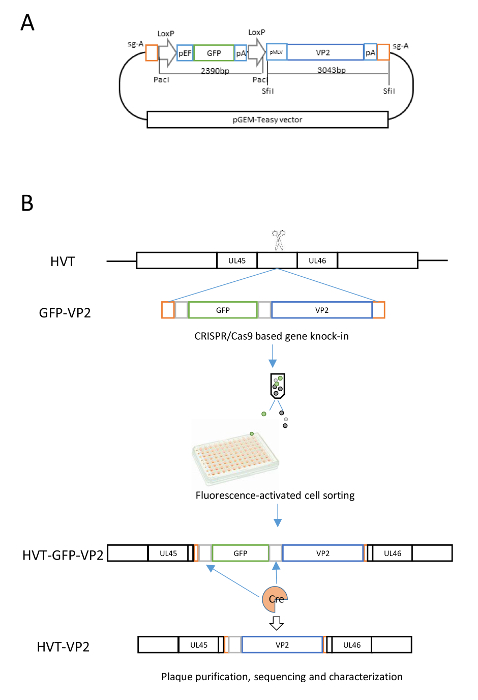
Figure 1: Strategy for the generation of a recombinant HVT-vectored vaccine. (A) This panel shows a schematic representation of the cloning strategy for donor plasmid construction. The key elements include two Cas9 target sites (sgA) for releasing insert, a reporter GFP cassette flanked with LoxP sequences for the excision of GFP, and the VP2 expression cassette. (B) This panel shows an overview of a two-step gene knock-in strategy. The insert fragment of the GFP and the VP2 expression cassettes is released by Cas9/sgA cleavage and inserted into the HVT genome at UL45/46 loci via NHEJ-CRISPR/Cas9. The GFP-positive recombinant virus is then sorted and purified by single-cell fluorescence-activated cell sorting (FACS). Subsequently, the GFP reporter gene is excised by Cre recombinase and the recombinant virus is purified and characterized. Please click here to view a larger version of this figure.

Figure 2: Verification of the recombinant HVT. (A) This panel shows a GFP-positive plaque (HVT-GFP-VP2) visualized under the fluorescence microscope (top panel) and the PCR verification of HVT-GFP-VP2 with primers VP2-F & UL46-R1 for the 3' junction.(B) This panel shows a plaque (HVT-VP2) visualized after the GFP excision of HVT-GFP-VP2, using Cre recombinase and PCR verification of HVT-VP2 with primers UL45-F1 and VP2-R1 for the 5' junction. Please click here to view a larger version of this figure.
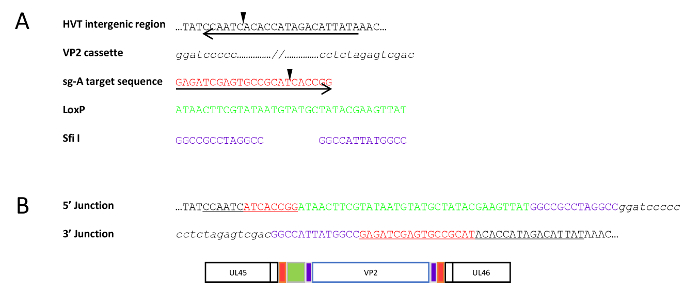
Figure 3: Sequence analysis of the recombinant HVT virus. (A) The sequences of the key elements in different colors in this panel are the HVT intergenic region between UL45/46 with the gRNA target sequence underlined and an arrow showing the Cas9 cleavage site, the VP2 expression cassette with the end sequences in italic lowercase, the sg-A target sequence in red with the arrow showing the Cas9 cleavage site, the LoxP site sequence in green, and two SfiI sites sequences in blue. (B) This panel shows the sequencing results of the 5' and 3' junctions and a schematic presentation of HVT-VP2 with key elements with corresponding colors presented in sequences. Please click here to view a larger version of this figure.
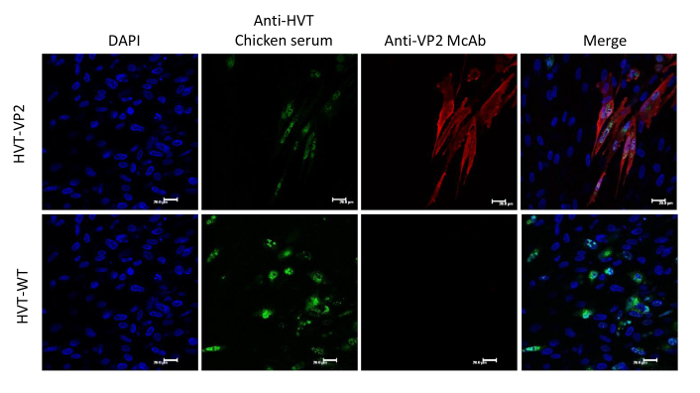
Figure 4: Characterization of the recombinant HVT-VP2. This panel shows the confirmation of the successful expression of VP2 in infected CEFs by indirect immunofluorescence assay (IFA) with anti-VP2 monoclonal antibody HH7 (red). HVT infection is confirmed by IFA with HVT-infected chicken serum (green). The scale bar = 20 µm. Please click here to view a larger version of this figure.
Discussion
The CRISPR/Cas9 system has become a valuable tool in gene editing. The traditional technologies for recombinant HVT vector development, such as homologous recombination13 and BAC mutagenesis technology25, usually involve several rounds of vector cloning and selection, as well as large-scale screening, which may take several months. The protocol described here using an NHEJ-CRISPR/Cas9-based strategy combined with the Cre-Lox system and single-cell sorting is more a convenient, efficient, and faster approach in recombinant vaccine generation. Using this pipeline, the recombinant virus can be obtained within only 1 - 2 weeks24, and plaque purification steps can also be reduced to a single-round separation using fluorescence-activated cell sorting17. The whole process, from gRNA design and donor construction to obtaining the purified recombinant HVT virus, can be achieved within 1 month. The critical steps for successful recombinant HVT generation include the high-efficiency gRNA selection for targeting the viral genome to ensure efficient cleavage for the foreign gene insertion, the high transfection efficiency to maximize the chance for Cas9/gRNAs and the virus to meet in the same cell for editing, and the 12 hour interval between the transfection of the donor and gRNA plasmids and the viral infection to allow Cas9 and gRNA to be expressed at a reasonable level before the virus gets into the cells.
The limitation for the HVT recombinant generation is the complexity of the identification of GFP-positive clones by junction PCR. The GFP-VP2 cassettes could be inserted in either orientation. The junction PCR described here is only for the identification of the insert in the sense orientation. In case of the insert in antisense orientation, PCR using the primer pairs described would not work, and the internal primers could be swapped for this purpose. Another potential problem is that the donor construct can only be used for one gene insertion in the same virus due to the existence of the remaining LoxP sequence after the GFP removal by Cre treatment. A new donor construct with a variant LoxP sequence could be used instead for a multiple insertion purpose.
NHEJ and HDR (homology-directed repair) are the two pathways to repair the double-stranded breaks (DSBs) created by Cas926,27. NHEJ is more efficient as it occurs throughout the cell cycle28, whereas HDR is less efficient and only occurs during S and G2 phases6,29,30. We exploited the more efficient NHEJ repair pathway here to introduce the foreign genes into the targeted locations. Although the NHEJ repair may introduce indels by joining noncompatible or damaged DNA ends through a homology-independent mechanistically flexible process31,32 between the cleaved donor sequence and genomic DNA, the indels can only occur at the cleavage sites of sgA, and the foreign gene-expression cassette is not affected. Another advantage of this approach is that NHEJ is free from the restriction of homology arm construction, making the cloning step very straightforward. This prompts a great potential for the application of NHEJ for foreign gene insertion. The introduction of a universal gRNA target site at both ends of the foreign gene cassette makes the process more rapid as the donor template could be constructed straightaway with no need for the specific gRNA selection. The backbone of the donor plasmid containing sgA target sites, LoxP sites, and PacI and SfiI sites can also be shared widely between different reporter genes, foreign gene-expression cassettes, and different virus vectors, giving this new approach the advantage of customization.
The HVT-harboring VP2 insert was used to describe the protocol in this manuscript; however, the same approach can be used to insert more viral genes at different genomic locations of the HVT genome using the gRNA targeting the desired corresponding sequence for the development of multivalent recombinant HVT vectored vaccines. Other MDV vaccine strains, such as SB-1 and CVI988, other avian herpesviruses, including infectious laryngotracheitis virus and duck enteritis virus, and also other avian DNA viruses, such as pox viruses and adenoviruses, can also be engineered using the same approach for multivalent recombinant vaccine development. The development of new multivalent vectored vaccines using the CRISPR/Cas9 system platform described here will be highly beneficial for the poultry industry to protect against multiple poultry diseases.
Disclosures
The authors have nothing to disclose.
Acknowledgements
The authors thank Pippa Hawes for helping with the confocal imaging. This project was supported by the Biotechnology and Biological Sciences Research Council (BBSRC) grants BBS/E/I/00007034 and BB/L014262/1.
Materials
| Name | Company | Catalog Number | Comments |
|---|---|---|---|
| M199 medium, Earle's Salts | Life technology | 11150059 | cell culture medium |
| Fetal Bovine Serum | Sigma | F0926 | cell culture medium |
| Penicillin and Streptomycin | Life technology | 15140148 | antibiotics |
| Fungizone | Sigma | 1397-89-3 | antifunigal |
| Tryptose Phosphate Broth | Sigma | T8782 | cell culture medium |
| HVT Fc126 strain | Avian Disease and Oncology Laboratory | wildtype HVT virus | |
| pX459-v2 | Addgene | Plasmid #62988 | Cas9 and gRNA expression vector |
| pGEM-T Easy Vector Systems | promega | A1360 | donor vector cloning |
| Subcloning Efficiency DH5α Competent Cells | Invitrogen | 18265-017 | transformation |
| PacI | NEB | rR0547S | donor vector cloning |
| SfiI | NEB | R0123S | donor vector cloning |
| T4 DNA Ligase | NEB | M0202S | cloning |
| QIAprep Spin Miniprep Kit | QIAGEN | 27106 | plasmid extraction |
| TransIT-X2 | Mirus | MIR 6004 | transfection |
| Cell Culture 6-well Plate | Thermofisher | 140675 | cell culture |
| GoTaq Master Mixes | Promega | M7123 | junction PCR amplification |
| Platinum Pfx DNA Polymerase | Thermofisher | 11708021 | PCR amplification of full insert |
| Goat anti-Chicken IgY (H+L) Antibody, Alexa Fluor 488 | Invitrogen | A-11039 | immunoflourescence staining |
| Goat anti-Mouse IgG Antibody, Alexa Fluor 568 | Invitrogen | A-11004 | immunoflourescence staining |
| Confocal laser scanning microscope | Leica Microsystems | Leica TCS SP5 LASAF | immunoflourescence |
| FACS cell sorter | BD biosciences | BD FACSAria | single cell sorting |
| Paraformaldehyde (4% in PBS) | Santa cruz biotechnology | SC-281692 | cell fixation |
| Triton X-100 | GeneTex | GTX30960 | permeabilization |
References
- Witter, R. L., Solomon, J. J. Experimental infection of turkeys and chickens with a herpesvirus of turkeys (HVT). Avian Diseases. 16 (1), 34-44 (1972).
- Baigent, S. J., et al. Herpesvirus of turkey reconstituted from bacterial artificial chromosome clones induces protection against Marek's disease. Journal of General Virology. 87, Pt 4 769-776 (2006).
- Messerle, M., Crnkovic, I., Hammerschmidt, W., Ziegler, H., Koszinowski, U. H. Cloning and mutagenesis of a herpesvirus genome as an infectious bacterial artificial chromosome. Proceedings of the National Academy of Sciences of the United States of America. 94 (26), 14759-14763 (1997).
- Zhao, Y., Nair, V. Mutagenesis of the repeat regions of herpesviruses cloned as bacterial artificial chromosomes. Methods in Molecular Biology. 634, 53-74 (2010).
- Ma, Y., et al. Generating rats with conditional alleles using CRISPR/Cas9. Cell Research. 24 (1), 122-125 (2014).
- Mali, P., et al. RNA-guided human genome engineering via Cas9. Science. 339 (6121), 823-826 (2013).
- Niu, Y., et al. Generation of gene-modified cynomolgus monkey via. Cas9/RNA-mediated gene targeting in one-cell embryos. Cell. 156 (4), 836-843 (2014).
- Ran, F. A., et al. Double nicking by RNA-guided CRISPR Cas9 for enhanced genome editing specificity. Cell. 154 (6), 1380-1389 (2013).
- Yin, H., et al. Genome editing with Cas9 in adult mice corrects a disease mutation and phenotype. Nature Biotechnology. 32 (6), 551-553 (2014).
- Zhang, Y., et al. CRISPR/Cas9 mediated chicken Stra8 gene knockout and inhibition of male germ cell differentiation. PLoS One. 12 (2), 0172207(2017).
- Bi, Y., et al. High-efficiency targeted editing of large viral genomes by RNA-guided nucleases. PLoS Pathogens. 10 (5), 1004090(2014).
- Bierle, C. J., Anderholm, K. M., Wang, J. B., McVoy, M. A., Schleiss, M. R. Targeted mutagenesis of guinea pig cytomegalovirus using CRISPR/Cas9-mediated gene editing. Journal of Virology. 90 (15), 6989-6998 (2016).
- Suenaga, T., Kohyama, M., Hirayasu, K., Arase, H. Engineering large viral DNA genomes using the CRISPR-Cas9 system. Microbiology and Immunology. 58 (9), 513-522 (2014).
- Xu, A., et al. A simple and rapid approach to manipulate pseudorabies virus genome by CRISPR/Cas9 system. Biotechnology Letters. 37 (6), 1265-1272 (2015).
- Yuan, M., et al. Efficiently editing the vaccinia virus genome by using the CRISPR-Cas9 system. Journal of Virology. 89 (9), 5176-5179 (2015).
- Yuen, K. S., et al. CRISPR/Cas9-mediated genome editing of Epstein-Barr virus in human cells. Journal of General Virology. 96, Pt 3 626-636 (2015).
- Liang, X., et al. A CRISPR/Cas9 and Cre/Lox system-based express vaccine development strategy against re-emerging Pseudorabies virus. Scientific Reports. 6, 19176(2016).
- Zou, Z., et al. Construction of a highly efficient CRISPR/Cas9-mediated duck enteritis virus-based vaccine against H5N1 avian influenza virus and duck Tembusu virus infection. Scientific Reports. 7 (1), 1478(2017).
- Peng, Z., et al. Pseudorabies virus can escape from CRISPR-Cas9-mediated inhibition. Virus Research. 223, 197-205 (2016).
- Tang, Y. D., et al. Live attenuated pseudorabies virus developed using the CRISPR/Cas9 system. Virus Research. 225, 33-39 (2016).
- Yao, Y., Bassett, A., Nair, V. Targeted editing of avian herpesvirus vaccine vector using CRISPR/Cas9 nucleases. Journal of Vaccine and Technologies. 1, (2016).
- Tang, N., et al. A simple and rapid approach to develop recombinant avian herpesvirus vectored vaccines using CRISPR/Cas9 system. Vaccine. 36 (5), 716-722 (2018).
- He, X., et al. Knock-in of large reporter genes in human cells via. CRISPR/Cas9-induced homology-dependent and independent DNA repair. Nucleic Acids Research. 44 (9), 85(2016).
- Ran, F. A., et al. Genome engineering using the CRISPR-Cas9 system. Nature Protocols. 8 (11), 2281-2308 (2013).
- Petherbridge, L., et al. Cloning of Gallid herpesvirus 3 (Marek's disease virus serotype-2) genome as infectious bacterial artificial chromosomes for analysis of viral gene functions. Journal of Virological Methods. 158 (1-2), 11-17 (2009).
- Hsu, P. D., Lander, E. S., Zhang, F. Development and applications of CRISPR-Cas9 for genome engineering. Cell. 157 (6), 1262-1278 (2014).
- Sander, J. D., Joung, J. K. CRISPR-Cas systems for editing, regulating and targeting genomes. Nature Biotechnology. 32 (4), 347-355 (2014).
- Panier, S., Boulton, S. J. Double-strand break repair: 53BP1 comes into focus. Nature Reviews Molecular Cell Biology. 15 (1), 7-18 (2014).
- Wang, H., et al. One-step generation of mice carrying mutations in multiple genes by CRISPR/Cas-mediated genome engineering. Cell. 153 (4), 910-918 (2013).
- Yang, H., et al. One-step generation of mice carrying reporter and conditional alleles by CRISPR/Cas-mediated genome engineering. Cell. 154 (6), 1370-1379 (2013).
- Jinek, M., et al. A programmable dual-RNA-guided DNA endonuclease in adaptive bacterial immunity. Science. 337 (6096), 816-821 (2012).
- Lieber, M. R. The mechanism of double-strand DNA break repair by the nonhomologous DNA end-joining pathway. Annual Review of Biochemistry. 79, 181-211 (2010).
Reprints and Permissions
