Here we describe a protocol for efficient chromatin immunoprecipitation (ChIP) followed by high-throughput DNA sequencing (ChIP-seq) of brown adipose tissue (BAT) isolated from a mouse. This protocol is suitable for both mapping histone modifications and investigating genome-wide localization of non-histone proteins of interest in vivo.
A subscription to JoVE is required to view this content. Sign in or start your free trial.
Method Article
Chromatin Immunoprecipitation of Murine Brown Adipose Tissue
In This Article
Summary
Abstract
Most cellular processes are regulated by transcriptional modulation of specific gene programs. Such modulation is achieved through the combined actions of a wide range of transcription factors (TFs) and cofactors mediating transcriptional activation or repression via changes in chromatin structure. Chromatin immunoprecipitation (ChIP) is a useful molecular biology approach for mapping histone modifications and profiling transcription factors/cofactors binding to DNA, thus providing a snapshot of the dynamic nuclear changes occurring during different biological processes.
To study transcriptional regulation in adipose tissue, samples derived from in vitro cell cultures of immortalized or primary cell lines are often favored in ChIP assays because of the abundance of starting material and reduced biological variability. However, these models represent a limited snapshot of the actual chromatin state in living organisms. Thus, there is a critical need for optimized protocols to perform ChIP on adipose tissue samples derived from animal models.
Here we describe a protocol for efficient ChIP-seq of both histone modifications and non-histone proteins in brown adipose tissue (BAT) isolated from a mouse. The protocol is optimized for investigating genome-wide localization of proteins of interest and epigenetic markers in the BAT, which is a morphologically and physiologically distinct tissue amongst fat depots.
Introduction
While white adipose tissue (WAT) is specialized for energy storage, brown adipose tissue (BAT) dissipates energy in the form of heat due to its ability to convert carbohydrates and lipids into thermal energy via mitochondrial uncoupling1. Because of this specialized function, the BAT depot is required for maintenance of body temperature in physiological conditions and in response to cold exposure. While gene expression changes during BAT differentiation and upon thermogenic stress have been extensively studied in vivo and in vitro, the molecular mechanisms underlying these changes have been mostly dissected in immortalized cell lines and primary pre-adipocytes, with the exception of several in vivo studies2,3,4,5.
Regulation of specific gene expression programs through transcriptional regulation is achieved by coordinated changes in chromatin structure via various transcription factors and co-factors actions. Chromatin immunoprecipitation (ChIP) is a valuable molecular biology approach for investigating the recruitment of these factors to DNA and for profiling the associated changes in the chromatin landscape. Key factors for the success of ChIP experiments include optimizations of crosslinking conditions and chromatin shearing consistency throughout different samples, availability of adequate starting material, and, most notably, quality of the antibodies. When performing ChIP from whole tissues, it is also important to consider heterogeneity of the samples and optimize the protocol to improve efficiency of nuclei isolation, with the latter being a particularly sensitive step when working with adipose tissue due to the elevated lipid content. In fact, molecular isolation techniques from whole adipose depots are complicated by the presence of high levels of triglycerides, and protocols must be optimized to increase the amount of chromatin isolation. Finally, when high-throughput sequencing is performed after ChIP-DNA isolation, the sequencing depth is critical for determining the number of peaks that are confidently detected.
Here, we refer to the working standards and general guidelines for ChIP-seq experiments recommended by the ENCODE and modENCODE consortia6 for best practices, and we focus on a step-by-step description of a protocol optimized for ChIP-seq from BAT. The described protocol allows for efficient isolation of chromatin from adipose tissue to perform genome-wide sequencing for DNA-binding factors with well-defined peaks as well as histone marks with more diffuse signals.
Access restricted. Please log in or start a trial to view this content.
Protocol
The animal handling steps of the protocol have been approved by Boston University’s Institutional Animal Care and Use Committee (IACUC).
1. Day 1: Dissection and Preparation of BAT for Chromatin Immunoprecipitation (ChIP)
- Euthanize mice using a carbon dioxide (CO2) chamber, and perform the dissection immediately afterwards. Spray mouse fur with 70% ethanol before incision. Place the mouse with its back facing up, then cut open the skin along the neck. Locate the BAT directly under the skin between the shoulders (interscapular; it appears as two lobes, butterfly-shaped, with a thin layer of white fat that needs to be carefully removed7).
NOTE: For a 3 month-old C57BL/6J mouse that is fed a regular chow diet (mouse weight at this age ranges between 27 and 30 g), each BAT lobe is approximately 1 cm long. The total weight of the BAT depot is approximately 0.15 g in both male and female mice. - Use 1 BAT pad for 3 ChIPs. Multiple BAT pads can be simultaneously processed until sonication.
- Crosslink each BAT pad in 10 mL of phosphate-buffered saline (PBS) containing 1% formaldehyde for 15 min rotating at 150 rpm at room temperature (RT).
- Quench crosslinking by adding 2.5 M glycine to a final concentration of 125 mM for 5 min, rotating at 150 rpm at RT.
- Transfer the BAT pad to 500 µL of hypotonic lysis buffer (10 mM HEPES, 1.5 mM MgCl2, 10 mM KCl, 0.5 mM DTT, 0.2 mM PMSF) and add 2 stainless steel beads (size: 3.2 mm diameter, see Table of Materials) for each BAT pad. Use a bead-based tissue homogenizer (see Table of Materials) to shred the tissue.
- Start with 5 min at max power. If needed, extend the time until the tissue is homogenized and single cells are separated. Transfer the samples into a new tube and centrifuge at 4 °C at 16,000 x g for 10 min.
- After centrifugation, transfer the supernatant into a new tube and keep the cell pellet on ice. Centrifuge the supernatant at 4 °C at 16,000 x g for 10 min to prevent loss of floating cells. Discard the final supernatant and resuspend both cell pellets together in 300 µL of SDS lysis buffer (SDS 1%; EDTA 10 mM; Tris-HCl pH 8, 50 mM) with 1x protease inhibitor (see Table of Materials). Incubate on ice for 10 min.
- Sonicate the lysates to generate DNA fragments 200–500 base pairs long. After sonication, remove debris by centrifugation for 10 min at 16,000 x g at 4 °C and check the success of sonication via DNA electrophoresis on a 1% agarose gel. For a medium-size gel, run at 120 V; a good separation is achieved after 45 min.
NOTE: Sonication optimization may be required to achieve proper size of fragments. With the chosen sonicator (see Table of Materials), this requires 2 times at 320 W output power and 20 KHz frequency for 10 min, using cycles of 30 s on/30 s off. - Dilute the supernatant fraction 10-fold (final volume is 3 mL for each BAT pad) in ChIP dilution buffer (SDS 0.01%; Triton 1.1%; EDTA 1.2 mM; Tris-HCl pH 8, 16.7 mM; NaCl 167 mM) with 1x protease inhibitor. Keep aside 1% of this chromatin solution (equal to 30 µL for 3 mL) as the ChIP input. Keep the inputs overnight at 4 °C (until step 2.4).
Note: The above fraction will provide the input reference for relative quantification of immunoprecipitated material compared to the amount of DNA present in each sample prior to immunoprecipitation. - Add the ChIP antibody (see Table of Materials for the antibodies used here as an example) to 1 mL of chromatin solution and incubate overnight at 4 °C with rotation. Perform parallel immunoprecipitation with corresponding pre-immune IgG, if available, or normal IgG of the same species (e.g., regular rabbit IgG if the antibody is produced in a rabbit). Alternatively, save 1 mL of chromatin solution for a no-antibody control.
NOTE: The optimal amount of antibody should be determined experimentally for each new antibody, if the antibody concentration is not known. Otherwise, 2–5 µg of antibody is a reasonable starting amount to use. Use ChIP-grade antibodies whenever possible, or antibodies that have been validated for immunoprecipitation.
2. Day 2: Collection of the Immune Complexes
- Add 50 µL of Protein A Agarose 50% slurry to the immune complexes and incubate for 1 h at 4 °C with rotation at 150 rpm.
- Pellet the beads by centrifugation for 1 min at 100 x g at 4 °C. Perform sequential washes of the beads with buffers of increasing stringency.
- First, wash with low-salt wash buffer (150 mM NaCl; Tris-HCl pH 8, 20 mM; EDTA 2 mM; Triton-X 1%; SDS 0.1%), then with high-salt wash buffer (500 mM NaCl; Tris-HCl pH 8, 20 mM; EDTA 2 mM, Triton-X1%; SDS 0.1%), then with LiCl wash (0.25 M LiCl; Tris-HCl pH 8, 10 mM; EDTA 1 mM; Igepal 1%; deoxicholate 1%), and finally with 1x TE (Tris-HCl pH 8, 10 mM; EDTA).
- Perform all washes on 0.45 µm PVDF centrifugal filter columns (Table of Materials) by first transferring the beads in the columns using 500 µL of low-salt wash buffer. Pellet the beads in the columns for 3 min at 2,500 x g. Discard the flow-through and repeat 1 time for all the wash buffers listed in step 2.2.1.
- After the washes are completed, elute the immune complexes by adding 300 µL of elution buffer 1% SDS, 0.1 M NaHCO3) to the pelleted beads in the columns. Incubate at RT for 30 min on a shaker at 400 rpm. Collect the eluate by spinning down columns for 3 min at 2,500 x g in a fresh tube.
- Reverse the crosslinks by incubating the eluate and inputs collected in step 1.9 at 65 °C overnight.
3. Day 3: Recovery of DNA with Phenol/Chloroform Extraction
- Add 300 µL of phenol:chloroform:IAA, 1:1 to the eluate and inputs. Vortex for 10 s.
- Spin at 4 °C for 15 min at 21,000 x g. Transfer the supernatant to a fresh tube. Add 3 µL of glycogen, 30 µL of 3 M sodium acetate, and 750 µL of cold 100% ethanol. Vortex for 10 s. Store at -80 °C for 2 h.
- Spin down at 21,000 x g at 4 °C for 20 min, keep the pellet, and discard the supernatant. Wash pellet with 1 mL of cold 70% EtOH, then spin down at 21,000 x g at 4 °C for 5 min. Discard the supernatant and air-dry the pellet.
- Resuspend the pellet in 70 µL of DNAse-free water.
- Proceed to step 4 for testing chromatin occupancy on specific genomic regions by quantitative polymerase chain reaction (qPCR) or to step 5 to prepare samples for sequencing.
4. Analysis of ChIP using qPCR (Single/Multiple Genes Readout)
- Dilute the input DNA from step 3.4 to generate a standard reference curve. Serial dilutions of 1/10, 1/100, and 1/1000 are usually sufficient to capture the linear range, but further dilutions may be required for more concentrated samples.
- For each primer pair (here, we have used primers targeting NDUFV1 and TOMM20 promoters), prepare two sets of qPCR reactions: one using the diluted input samples from step 4.1, and a second with the DNA samples isolated by immunoprecipitation from step 3.4. Perform each reaction in triplicate.
NOTE: Reactions can be set up in parallel for multiple genes using 96- or 384-well plates. - Set up a reaction volume of 10 μL per well with 5 μL of 2x PCR mix (Table of Materials), 1 μL of primer mix (1 μM forward primer and 1 μM reverse primer), and 4 μL of DNA from ChIP (or the input control).
- Briefly spin down the plate.
- Run the qPCR reactions on a real-time PCR system using the protocol recommended by the manufacturer for reagent detection (Table of Materials). Here we have used the following conditions: 1) 1s at 95°C for 1 cycle; 2) 1 s at 95 °C followed by 20 s at 60 °C for 45 cycles; 3) 15 s at 95 °C followed by 60 s at 60 °C followed by 15 s at 95 °C for 1 cycle.
NOTE: Check the dissociation curve: the presence of one peak in the thermal dissociation plot suggests a single amplicon is generated from the PCR reaction. If more than one peak is visualized, this is potentially indicative of multiple, non-specific amplicons; in which case, we recommend the design of alternative primer pairs. - Determine the linear phase of exponential amplification of the PCR reaction for each primer set by calculating the standard curve using the series of diluted genomic DNA in step 4.1. according to the Ct (cycle threshold) value.
- If the Ct value of DNA from ChIP and input control are within the linear range of Ct value, calculate the enrichment of DNA from ChIP relative to the input, according to the dilution factor of DNA from ChIP and input control in step 4.1.
5. Amplification of DNA from ChIP for High-throughput Sequencing (Genome-wide Readout)
NOTE: This step can be outsourced to an academic core facility or commercial sequencing company when sequencing capabilities are not available in-house.
- Prepare a DNA library from the extracted DNA with an appropriate ChIP library preparation kit (see Table of Materials) following the manufacturer’s instructions.
- Sequence the library on a high-throughput sequencing system, using 50 bp single-end as readout (see Table of Materials).
NOTE: According to ChIP-seq guidelines suggested by ENCODE6, a minimum of 10 million reads is recommended for mammalian genomes.
6. Raw Data Analysis
- Perform quality control on raw sequencing reads using FastQC8.
NOTE: Common sequencing quality metrics include per base sequence quality, per base sequence content, per sequence GC content, sequence length, and sequence duplication levels. Generally, a read quality score of Q > 30 across each base position is indicative of high-quality sequencing results. The distribution of GC content across all reads should roughly resemble a normal distribution, with a peak centered around the species’ actual genomic GC content percentage. - Remove any sequencing adapter contamination and low-quality reads through the read trimming utility Trimmomatic9.
NOTE: The implemented default parameters specify the removal of platform dependent adapters, removal of leading and trailing low-quality bases, and use of a 4-base wide sliding window to trim reads when the average quality per base drops below a specified threshold. - Align processed reads to the mouse MM10 reference genome10 with the Bowtie2 aligner11 using default parameters.
- Filter aligned reads by removing those with a Bowtie2 mapping quality score (MAPQ) of less than 10 using Samtools12.
- Determine various post-alignment quality metrics such as percent reads mapped, strand cross-correlation, cumulative read coverage, and sample replicate reproducibility.
Note: Various packages including SPP13, ChIPqc14, and Deeptools15 are available to calculate these quality metrics. - Perform peak calling analysis with an input control or appropriate KO sample using the MACS algorithm (MACS2)16 with default parameters.
- Remove any called peaks that overlap with known blacklisted regions17 from the mm10 annotation using Bedtools18.
NOTE: Blacklisted regions are areas in the genome that have been shown to have high signal or read counts independent of cell line or sequencing technique. These regions display artificially high artifact signals in certain regions of the genome that can be filtered out of functional genomic sequencing experiments. All replicates should be processed independently through the pipeline and may then be used for irreproducibility discovery rate (IDR). IDR is employed to measure the reproducibility of findings between replicates through the method as described by Li, Brown, Huang, and Bickel19,20. The IDR method quantitatively assesses consistency between replicates and is recommended by ENCODE and modENCODE as part of their ChIP-seq guidelines. - Use statistically significant peaks for various downstream analyses such as gene ontology21,22, enrichment, or motif analysis23.
Access restricted. Please log in or start a trial to view this content.
Results
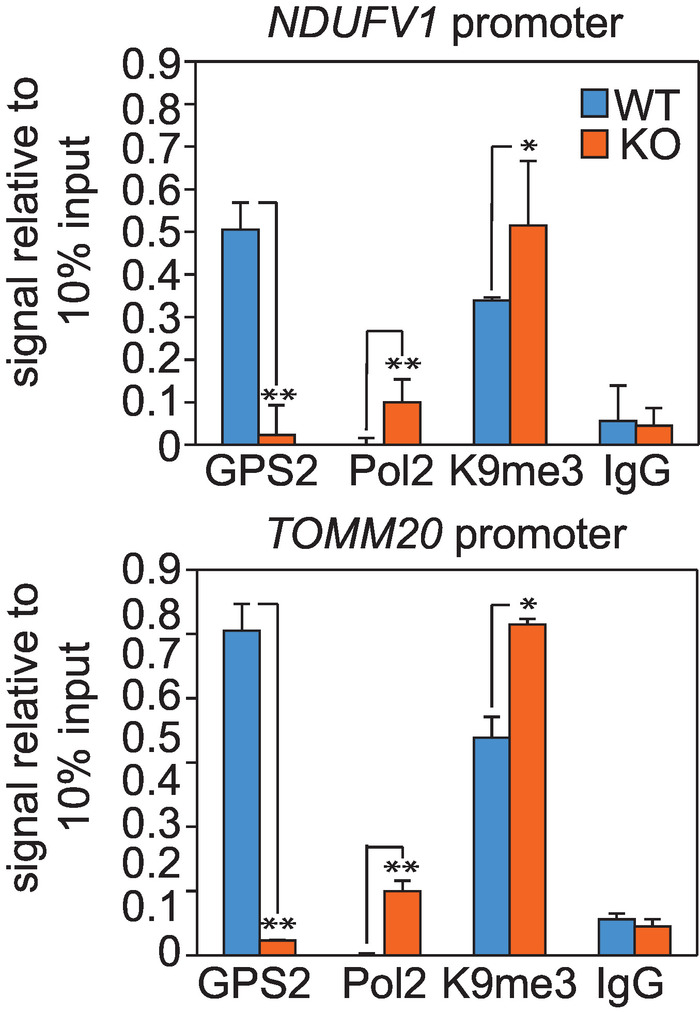
Figure 1: ChIP validation by qPCR. ChIP-qPCR analysis of representative GPS2 target genes NDUFV1 (left) and TOMM20 (right) in the BAT of WT and GPS2-AKO mice, showing relative changes in the level of H3K9 methylation and GPS2 ...
Access restricted. Please log in or start a trial to view this content.
Discussion
The protocol described here represents a valuable tool for performing ChIP from murine tissues, specifically optimized for brown adipose tissue. One of the greater challenges in performing ChIP from tissue is recovering a sufficient number of cells during sample preparation. Shearing the BAT using a tissue homogenizer blender coupled with stainless steel beads instead of a canonical glass pestle significantly reduces the number of cells lost due to unbroken tissue. Moreover, homogenizing the tissue directly in a hypotoni...
Access restricted. Please log in or start a trial to view this content.
Materials
| Name | Company | Catalog Number | Comments |
|---|---|---|---|
| Bullet Blender Tissue Homogenizer | Next Advence | BBX24 | |
| Stainless Steel Beads 3.2 mm Diameter | Next Advence | SSB32 | |
| Bioruptor Sonicator | Diagenode | ||
| 1.5 mL Micro Tube TPX Plastic | Diagenode | C30010010-5 | |
| Complete-Protease inhibitor | Roche | 11836145001 | |
| Protein A Agarose Slurry | Invitrogen | 101041 | |
| GPS2 antibody | In house | Rabbit polyclonal, Ct antibody (Cardamone et al., Mol Cell 2018) | |
| Pol2 antibody | Diagenode | C15100055 | |
| h3K9me3 antibody | Millipore | 05-1242 | |
| Fast Syber Green Master Mix | Aplied Biosytem | 4385612 | |
| ViiA7 | Aplied Biosytem | ||
| TruSeq ChIP Library Preparation Kit | Illumina | IP-202-1012 | |
| HiSeq 2000 | Illumina |
References
- Cannon, B., Nedergaard, J. Brown adipose tissue: function and physiological significance. Physiological Reviews. , (2004).
- Cardamone, M. D., et al. Mitochondrial Retrograde Signaling in Mammals Is Mediated by the Transcriptional Cofactor GPS2 via Direct Mitochondria-to-Nucleus Translocation. Molecular Cell. 69, (2018).
- Emmett, M. J., et al. Histone deacetylase 3 prepares brown adipose tissue for acute thermogenic challenge. Nature. , (2017).
- Harms, M. J., et al. PRDM16 binds MED1 and controls chromatin architecture to determine a brown fat transcriptional program. Genes & Development. , (2015).
- Shapira, S. N., et al. EBF2 transcriptionally regulates brown adipogenesis via the histone reader DPF3 and the BAF chromatin remodeling complex. Genes & Development. , (2017).
- Landt, S. G., et al. ChIP-seq guidelines and practices of the ENCODE and modENCODE consortia. Genome Research. 22, 1813-1831 (2012).
- Liisberg Aune, U., Ruiz, L., Kajimura, S. Isolation and Differentiation of Stromal Vascular Cells to Beige/Brite Cells. Journal of Visualized Experiments. , e50191(2013).
- Andrews, S. FastQC: a quality control tool for high throughput sequence data. , Available from: http://www.bioinformatics.babraham.ac.uk/projects/fastqc (2010).
- Bolger, A. M., Lohse, M., Usadel, B. Trimmomatic: a flexible trimmer for Illumina sequence data. Bioinformatics. 30, 2114-2120 (2014).
- Genome Browser Gateway. , Available from: https://genome.ucsc.edu/cgi-bin/hgGateway?db=mm10 (2018).
- Langmead, B., Salzberg, S. L. Fast gapped-read alignment with Bowtie 2. Nature Methods. , 357-359 (2012).
- Li, H., et al. The Sequence alignment/map (SAM) format and SAMtools. Bioinformatics. 25 (16), 2078-2079 (2009).
- Kharchenko, P. V., Tolstorukov, M. Y., Park, P. J. Design and analysis of ChIP-seq experiments for DNA-binding proteins. Nature Biotechnology. 26, 1351-1359 (2008).
- Carroll, T. S., Liang, Z., Salama, R., Stark, R., de Santiago, I. Impact of artifact removal on ChIP quality metrics in ChIP-seq and ChIP-exo data. Frontiers in Genetics. 5, 75(2014).
- Ramírez, F., et al. deepTools2: A next Generation Web Server for Deep-Sequencing Data Analysis. Nucleic Acids Research. , (2016).
- Zhang, Y., et al. Model-based Analysis of ChIP-Seq (MACS). Genome Biology. 9, R137(2008).
- ENCODE Project Consortium. An integrated encyclopedia of DNA elements in the human genome. Nature. 489 (7414), 57-74 (2012).
- Quinlan, A. R., Hall, I. M. BEDTools: a flexible suite of utilities for comparing genomic features. Bioinformatics. 26, 841-842 (2010).
- Li, Q., Brown, J. B., Huang, H., Bickel, P. J. Measuring reproducibility of high-throughput experiments. Annals of Applied Statistics. 5 (3), 1752-1779 (2011).
- Irreproducible Discovery Rate (IDR). , Available from: https://github.com/nboley/idr (2018).
- The Gene Ontology Consortium. Expansion of the Gene Ontology Knowledgebase and Resources. Nucleic Acids Research. 45, D331-D338 (2017).
- Ashburner, M., et al. Gene Ontology: tool for the unification of biology. Nature Genetics. 25, 25-29 (2000).
- Boeva, V. Analysis of Genomic Sequence Motifs for Deciphering Transcription Factor Binding and Transcriptional Regulation in Eukaryotic Cells. Frontiers in Genetics. 7, 24(2016).
Access restricted. Please log in or start a trial to view this content.
Reprints and Permissions
