In vitro fertilization is a commonly used technique with a variety of model organisms to maintain lab populations and produce synchronized embryos for downstream applications. Here, we present a protocol that implements this technique for different populations of the Mexican tetra fish, Astyanax mexicanus.
Method Article
Gamete Collection and In Vitro Fertilization of Astyanax mexicanus
* These authors contributed equally
In This Article
Summary
Abstract
Astyanax mexicanus is emerging as a model organism for a variety of research fields in biological science. Part of the recent success of this teleost fish species is that it possesses interfertile cave and river-dwelling populations. This enables the genetic mapping of heritable traits that were fixed during adaptation to the different environments of these populations. While this species can be maintained and bred in the lab, it is challenging to both obtain embryos during the daytime and create hybrid embryos between strains. In vitro fertilization (IVF) has been used with a variety of different model organisms to successfully and repeatedly breed animals in the lab. In this protocol, we show how, by acclimatizing A. mexicanus to different light cycles coupled with changes in water temperature, we can shift breeding cycles to a chosen time of the day. Subsequently, we show how to identify suitable parental fish, collect healthy gametes from males and females, and produce viable offspring using IVF. This enables related procedures such as the injection of genetic constructs or developmental analysis to occur during normal working hours. Furthermore, this technique can be used to create hybrids between the cave and surface-dwelling populations, and thereby enable the study of the genetic basis of phenotypic adaptations to different environments.
Introduction
In recent years, Astyanax mexicanus has become a model organism in different fields such as developmental biology, evolutionary biology, behavioral biology, and physiology1,2,3,4. The uniqueness of this system comes from this species having several morphotypes that have adapted to very different environments. The surface dwelling morphotype lives in rivers where there is high biodiversity and plenty of food sources for the fish. In contrast, the cave morphotypes of A. mexicanus, the cavefish, live in caves where biodiversity, food sources, and oxygen are drastically diminished1. Cavefish differ from the surface fish in a variety of phenotypes such as the absence of eyes and pigmentation, insulin resistance, and the ability to store fat2,3,4. However, surface fish and cavefish still belong to the same species and are, therefore, interfertile.
For both morphotypes, a set of conditions has been defined to allow routine maintenance and breeding under laboratory conditions5,6. However, genetic modifications, proper embryonic developmental studies, and creation of hybrids are still challenging for several reasons. A. mexicanus primarily spawn during night hours which is inconvenient for subsequent experiments on early embryonic stages such as injection of genetic constructs or monitoring of early embryonic developmental processes. In addition, generation of surface and cave hybrids is challenging using natural spawning, since the cave morphotypes have an altered circadian rhythm7 that ultimately affects the production of viable ova. Successful, yet invasive, IVF procedures have been described for other Astyanax species, where gamete production and spawning behavior was primed using hormonal injections8,9. Less invasive IVF procedures (i.e., obtaining gametes from manual spawning without the injection of hormonal preparations) have been described but do not consider the differences in the spawning cycle between cave and surface morphotypes of A. mexicanus6.
Other fish model organisms, such as the zebrafish, can easily be genetically modified and studied at an embryonic level because the obstacles stated above have been successfully resolved. Implementation of standardized breeding techniques, in vitro fertilization, and sperm cryopreservation have all pushed zebrafish forward and solidified the model's use in the biological sciences10. Therefore, extending these techniques to A. mexicanus will further strengthen it as a model system.
Here, we present a detailed protocol for IVF that will help to make A. mexicanus more accessible. We will present a breeding setup that enables shifting the light-cycles of the fish from daytime to nighttime so that viable ova can be obtained during day hours without injection of hormonal preparations. We then provide a detailed description of how to obtain the ova and milt used for IVF. This method will enable the production of embryos during normal working hours and make further downstream applications more feasible compared to using embryos from natural spawning.
Protocol
All methods described here have been approved by the Institutional Animal Care and Use Committee (IACUC) of Stowers Institute for Medical Research.
1. Light cycle manipulation
- Set up fish tanks within an opaque, fully enclosed (light protection), flow-through aquaculture system containing multiple rows of tanks (Figure 1).
NOTE: The flow-through system as shown in Figure 1 uses system water to flush waste through the back stand pipe of each tank and flows into a sump that empties into a sanitary drain. In this experiment, a water exchange rate of one gallon (US) per hour through a drip emitter was used. - Maintain the temperature of each tank with an independent heating element that is used to manually alter the temperature during the priming process.
- Set up individual rows in a way to enable separate photoperiods in each. Install doors on each row that can be closed to prevent light from entering or escaping.
NOTE: The automated controller can enable manipulation of all photoperiods with the least disturbance to the fish. - Equip the rack with a red work light and blackout curtains for access during dark hours.
2. Adjusting photoperiod and priming fish for gamete collection
- Remove the desired fish (Figure 2a) from general system racks and place in breeding racks to allow for adjustment of the photoperiod 14 days prior to priming.
NOTE: This allows the fish to acclimatize to a new environment. - Keep the fish at 22.8 °C (73 °F) during this period using the installed aquatic heating system. The normal photoperiod is from 6 a.m. to 8 p.m. light and 8 p.m. to 6 a.m. dark. For the light cycle rack, shift the photoperiod to 10 p.m. to 12 p.m. light and 12 p.m. to 10 p.m. dark by adjusting the timer that powers the light within the rack.
NOTE: Males and females are housed in the same tank to allow for natural priming behaviors to take place. While spawning may take place in the tank, fish can still be used for in vitro fertilization since gametes are released in stages11. - Once the fish are acclimatized, start priming the animals for spawning5 as described in steps 2.3.1 to 2.3.5.
NOTE: This procedure takes six days in total. Over this time, change the temperature to prime the ova production using an installed aquatic heating system. Using the 50W Aquatic Heaters (see Table of Materials), set the heater directly to the temperature (scale on the heater is in Fahrenheit) given in the protocol at each step. Depending on the size of the tank and flow-through rate of the water, time of temperature adjustment may differ. In this experiment, the temperature was adjusted at noon and temperature equilibration took over the next 18 h.- On day 1, raise the temperature from 22.8 °C (73 °F) to 24.4 °C (76 °F).
- On day 2, raise the temperature from 24.4 °C (76 °F) to 26.1 °C (79 °F).
- On day 3 and 4, keep the temperature at 26.1 °C (79 °F). Fish will be ready to spawn during the day and IVF can be performed.
NOTE: Depending on the individual fish, females can spawn on day 3 and/or day 4. We recommend trying to obtain ova on day 3 and/or day 4 depending on the success of the ova collection. - On day 5, lower the temperature from 26.1 °C (79 °F) to 24.4 °C (76 °F).
- On day 6, lower the temperature from 24.4 °C (76 °F) to 22.8 °C (73 °F).
NOTE: Provide a 7-day gap before repeating this temperature cycle. It is recommended to continue keeping the fish in this photoperiod since this will reduce the overall time needed by the fish to adjust to this shifted light cycle.
3. Female gamete collection
- Begin by inserting a moistened tissue wipe into a Petri dish lid and closing the dish to create a humidified chamber and prevent the ova from drying out during the collection process.
- Next choose a female for collection. Gravid fish with large, protruding abdomens will likely be the best choice for this procedure (Figure 2a).
NOTE: To differentiate between males and females of adult A. mexicanus, the cotton ball method was used12. - Immobilize a female using chilled water and place her in the supine position in a moistened sponge animal holder. Do so by placing the fish in 4 °C system water for at least 30 s or until the fish is immobilized (i.e., loss of gill movement, see Ross and Ross13 for details).
NOTE: Work quickly and try to avoid warming the fish until the procedure is completed. This may include periodically dipping the gloved tips of the fingers into cold water or offering supplemental anesthesia. Other anesthesia methods (e.g., MS-22213) may be used as well. Under the IACUC guidelines of the Stowers Institute for Medical Research, manual collection of ova is considered a non-invasive procedure, which does not require complete anesthesia (e.g., through MS-222). - Once positioned, blot the ventral side of the fish with a delicate tissue wipe as contact with water will cause the ova to activate.
- Hold the female between the thumb and index finger. Gently squeeze against the lateral sides of the coelomic cavity in the direction of the urogenital opening while rolling the fingers slightly. Collect the expressed ova using a disposable spatula.
- Transfer these ova to the humidified Petri dish.
NOTE: Several clutches of ova may be combined in the same dish if specific parentage data is not needed. The ova can be stored at 24 °C and are best when used for IVF within 30-60 min after collection. - After collection, gently return the fish to a recovery tank filled with system water.
NOTE: Place the fish back into dark cabinet tank for future ova collection when necessary.
4. Male gamete collection
- Choose a male for collection.
NOTE: There are no outwardly visible signs of male gamete quality. However, fish should appear healthy in appearance before use in this procedure. To differentiate between males and females of adult A. mexicanus, the cotton ball method was used12. - Immobilize a male using chilled water and place him in the supine position in a moistened sponge animal holder. Immobilize by placing the fish in 4 °C system water for at least 30 seconds or until the fish is immobilized (i.e., loss of gill movement, see Ross and Ross13 for details).
NOTE: Work quickly and try to avoid warming the fish until the procedure is completed. This may include periodically dipping the gloved tips of the fingers into cold water or offering supplemental anesthesia. Other anesthesia methods (e.g., MS-22213) may be used here as well. Under the IACUC guidelines of the Stowers Institute for Medical Research, manual collection of sperm is considered a non-invasive procedure, which does not require complete anesthesia (e.g., through MS-222). - Blot the ventral side of the fish with a delicate tissue wipe as contact with water will activate the milt.
- Gently place the end of a capillary tube at the urogenital opening.
- Expel milt by applying gentle pressure on the sides of the fish with the thumb and forefinger. Start distal to the gills, moving towards the urogenital opening.
- Collect the milt in the end of a capillary tube. Gentle suction may be necessary by use of an aspirator tube. Avoid any feces that may be expelled with the milt.
- Dispense the milt into an empty 1.5 mL centrifuge tube and dilute with twice the volume of Sperm Extender E400 (see Table of Materials). Keep on ice.
NOTE: Milt from multiple males may be pooled together if specific parentage data is not needed. This step can be used to extend the working time of the milt for several hours, but it is not required for immediate fertilization. - After collection, gently return the fish to a recovery tank filled with system water.
NOTE: Place fish back into dark cabinet tank for future sperm collection when necessary.
5. In vitro fertilization
- Using a new pipette for each stock, mix the sperm by pipetting and/or agitating the side of the tube before fertilizing as sperm in milt can settle in the E400 solution over time.
- Dispense the milt or extended milt solution into the freshly collected ova.
- Quickly add 1 mL of system water to the clutch to activate the sperm and eggs for fertilization. Avoid mixing or agitating the dish contents and allow 2 min for fertilization to occur.
NOTE: Mixing and agitating greatly reduces the fertilization rates and should, therefore, be avoided14. - Add E2 Embryo Media to fill the dish 2/3rd full.
NOTE: Depending on the subsequent procedure, embryos can be either used right away (e.g., for injection of genetic constructs as described before15) or embryos can be incubated in E2 Embryo Media at 23 °C until they reach 5 dpf. At this point transfer embryos to the main recirculating housing system using system water.
Results
The protocol presented here is mainly based on a previously published protocol6. However, since A. mexicanus spawns during night hours, we designed a housing rack for fish breeding that can change the photoperiod independent of working hours (Figure 1). The fish light cycle is altered within a fully enclosed, flow-through aquaculture system containing three rows of tanks (Figure 1). Each tank contains an independent heating element that is used to manually increase the temperature during the priming process. Individual shelves can be put on separate photoperiods and can be closed to prevent light from entering or escaping. All photoperiods can be manipulated by way of an automated controller positioned on the side of the light cycle rack. For access during dark hours, the rack is equipped with a red work light and blackout curtains. A. mexicanus spawns after an increase in temperature from 23 - 26 °C with an increment of 1.5 °C per day16. To achieve this in our dark cabinets, we used submersible aquarium heaters in each tank (Figure 1).
The key factor for a successful IVF procedure in A. mexicanus is the quality of the collected ova. Gravid, female fish with large, protruding abdomens are most likely to release viable ova, which appear clear and even in appearance (Figure 2a-d). Adding the collected milt to such ova results in the development of fertilized embryos usually within 20-30 min (Figure 2e). Viable fertilized embryos will become slightly more translucent before entering the one cell stage of the developmental cycle while unfertilized ova will appear more uneven and opaque (Figure 2e). Resulting embryos are held in Petri dishes in ZIRC E2 Embryo Media and incubated at 23 °C in a 14/10 light/dark cycle. Embryos are then transferred to the main recirculating housing system at 5 days post fertilization for rearing.
To demonstrate the importance of the technique, we show how the phenotyping of hybrids for specific traits such as eye size and body pigmentation can help in deciphering their genetic basis. Cavefish clearly differ from surface fish in their eye size and body pigmentation. To understand the genetic basis of these traits, we crossed surface and cavefish (F0) and generated hybrid F1 and F2 populations using IVF to observe the phenotypic variation obtained (Figure 3). The size of the eyes is smaller in the F1 generation indicating that the presence of eyes is a partially dominant trait (Figure 3). In surface-cave F2 hybrids, we obtain a broad range of eye sizes, indicating that there are multiple loci that control eye size in A. mexicanus, making it a quantitative trait (Figure 3). Another example is pigmentation. Observing the F1 hybrid of surface and cavefish, it can be concluded that body pigmentation is a dominant trait as the fish are fully pigmented (Figure 3). In the F2 generation, the variation in body pigmentation again points towards a quantitative trait. Combination of this phenotypic data with sequencing data can reveal underlying genetic loci responsible for these phenotypes. These F2 populations are a good resource for understanding the genetic basis of various traits and such populations have been used previously for studying these traits17,18,19. A standardized IVF technique can greatly streamline the generation of hybrids, enabling genetic mapping of the loci controlling such traits and helping us understand how certain phenotypes are disadvantageous in some habitats and adaptive in others.
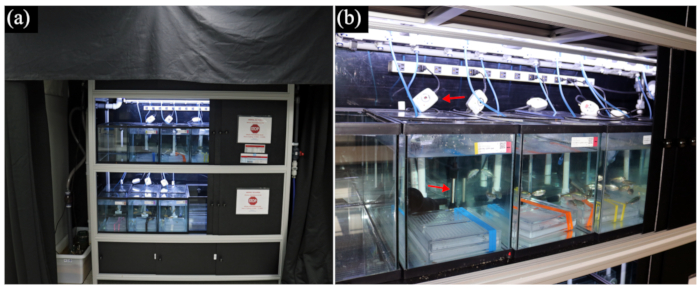
Figure 1: Design of racks to shift day/ night cycles of A. mexicanus. (a) The general setup of this rack system allows photoperiod manipulation, giving a simulation of night time during the day hours when doors are closed, and the shelf lights are turned off. (b) Priming the fish to stimulate ova maturation is achieved by using submersible heaters (see Table of Materials) installed in individual tanks that can be adjusted separately (red arrows). Please click here to view a larger version of this figure.
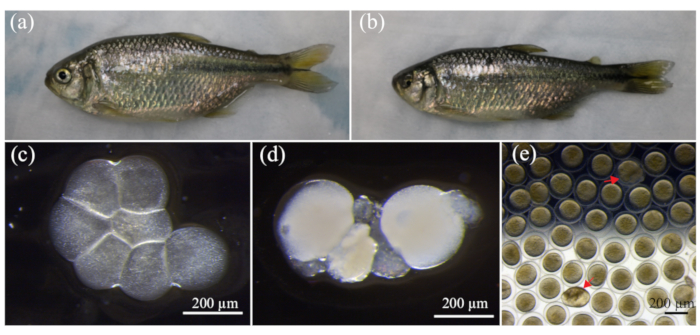
Figure 2: Examples of suitable females for ova collection and representative illustration of viable and unviable ova. (a) Gravid, female fish with large, protruding abdomens are more suitable for manual ova collection than (b) females with a streamlined shaped abdomen. (c) Viable ova (i.e., ova producing viable embryos when fertilized) can be identified by their clear, even appearance, while unviable ova (i.e., ova not producing viable embryos when fertilized), as shown in (d), have a cloudy, uneven appearance. (e) After successful fertilization, viable embryos become more translucent and enter the one cell stage while unfertilized ova (red arrows) will slowly decay. Please click here to view a larger version of this figure.
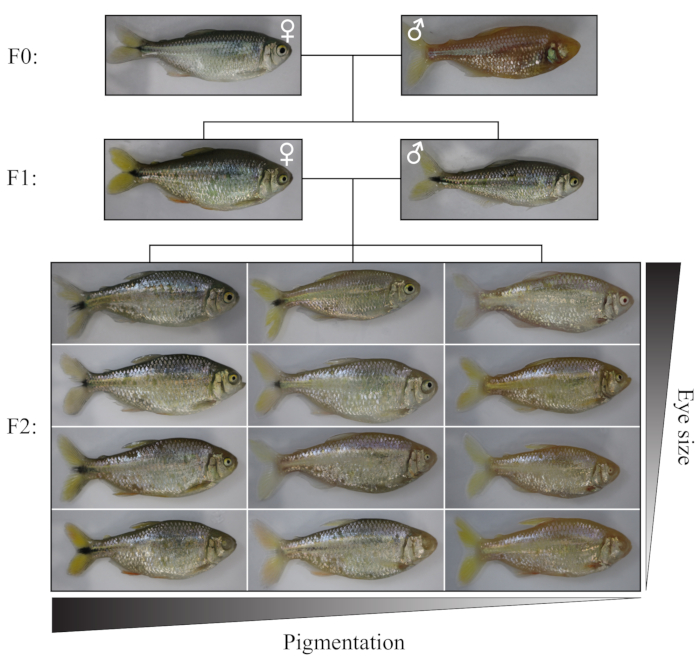
Figure 3: Genetic analysis of eye size and body pigmentation traits. Pedigree showing pictures of parental (F0) surface fish (top left) and cavefish (top right), F1 hybrids (second row) and the F2 hybrids. The F1 fish have intermediate eye size and are fully pigmented while F2 fish show a broad variation in the two morphological traits: eye size and pigmentation. All original data underlying this figure can be accessed from the Stowers Original Data Repository at http://www.stowers.org/research/publications/libpb-1365. Please click here to view a larger version of this figure.
Discussion
While IVF is a standardized method for many different model organisms such as zebrafish, existing protocols for A. mexicanus do not take into account that this species naturally spawns during night hours6. Given that cavefish and surface fish differ quite drastically in their circadian rhythms, the maturation cycle of the ova also differs between the cave and surface morphotypes. While the staging temperatures and times for surface A. mexicanus are well studied12, cavefish can differ in their spawning behavior and maturation cycle. Conventional methods of hybrid production are therefore very challenging and uncertain due to the loss of circadian rhythm in the cave morphotype of A. mexicanus7, which results in altered spawning times of these fish. By shifting the photoperiod, we can provide time specific hybrid embryos without having to rely on rare natural spawning events between the two morphotypes. Keeping the cave and surface fish separate also prevents aggressive surface morphs from having an adverse effect on breeding.
Some limitations do exist with this method such as variations in ova quality. Identification of a female (surface or cavefish) with mature ova is not trivial and requires careful observations of the fish behavior. Generally, gravid females ready for spawning have larger abdomens and will repeatedly brush against the bottom tank surface or embryo collection trap20.
We observed that the quality of sperm is consistent throughout the entire day/night cycle. The critical step of successful IVF (successful in terms of generating fertilized embryos) is obtaining good quality, viable ova. Therefore, it is extremely important to collect the ova from fish that are about to spawn naturally (Figure 2a). Once the ova are collected, they can be observed under a dissection microscope to examine the quality. The collection of viable ova during the night, however, is inconvenient and challenging for the researcher. The setup that we present here allows for shifting of the maturation cycle of the ova, so IVF can be used to generate synchronized embryos for downstream application during normal working hours.
With the advancement of cryopreservation of milt (e.g., as it is described in zebrafish21), IVF will become a powerful tool towards establishing and maintaining genetic lines for the emerging model system A. mexicanus. In combination with methods for genetic modification15 and morpholino-based knockdown17, these procedures will provide the methodological platform to study the genetic and developmental underpinnings of adaptations to different habitats in A. mexicanus.
In summary, the protocol presented here will enable the production of synchronized embryos of A. mexicanus for other downstream applications, such as injection of genetic constructs or studying early embryological phenotypes. The major strength of the protocol is that it allows for efficient production of surface-cave hybrids that can be used to genetically map phenotypic differences between surface fish and cavefish through QTL (quantitative trait loci) analysis. Taken together, obtaining viable ova during daytime for IVF is a powerful technique that will be beneficial for a variety of future studies in different fields of biological sciences.
Disclosures
The authors have nothing to disclose.
Acknowledgements
The authors would like to thank Philippe Noguera and Kimberly Bland for their support on the video production. The authors would also like to acknowledge the entire Aquatics Team of the Stowers Institute for animal husbandry. This work was supported by institutional funding to DPB and NR. NR was supported by the Edward Mallinckrodt Foundation and JDRF. RP was supported by a grant from the Deutsche Forschungsgemeinschaft (PE 2807/1-1).
Materials
| Name | Company | Catalog Number | Comments |
|---|---|---|---|
| 1.5 mL Centrifuge Tube | Eppendorf | #22364111 | |
| 100 mm Petri Dishes | VWR International | #25384-302 | |
| Aspirator Tube | Drummond | #2-000-000 | |
| Calibrated 1-5 µL Capillary Tubes | Drummond | #2-000-001 | |
| Dispolable Spatulas | VWR International | #80081-188 | |
| HMA-50S 50W Aquatic Heaters | Finnex | HMA-50S | |
| P1000 Pipette | Eppendorf | #3123000063 | |
| P1000 Pipette Tips | Thermo Scientific | #2079E | |
| Sanyo MIR-554 incubator | Panasonic Health Care | MIR-554-PA | |
| Sperm Extender E400 | 130 mM KCl, 50 mM NaCl, 2 mM CaCl2 (2H2O), 1 mM MgSO4 (7H2O), 10 mM D (+)-Glucose, 30 mM HEPES Adjust to pH 7.9 with 5M KOH and filter sterilize. Solution can be stored at 4 ?C for up to 6 months. | ||
| Sponge Animal Holder | Made from scrap foam | ||
| System Water | Deionized water supplemented with Instant Ocean Sea Salt [Blacksburg, VA] to reach a specific conductance of 800 µS/cm. Water quality parameters are maintained within safe limits (Upper limit of total ammonia nitrogen range, 1 mg/L; upper limit of nitrite range, 0.5 mg/L; upper limit of nitrate range, 60 mg/L; temperature, 22 °C; pH, 7.65; dissolved oxygen 100 %) | ||
| Tissue Wipes | Kimberly-Clark Professional | #21905-026 | |
| ZIRC E2 Embryo Media | 15 mM NaCl, 0.5 mM KCl, 1.0 mM MgSO4, 150 µM KH2PO4, 50 µM Na2HPO4, 1.0 mM CaCl2, 0.7 mM NaHCO3. Adjust pH to 7.2 to 7.4 using 2 N hydrochloric acid. Filter sterilize. Stored at room temperature for a maximum of two weeks. |
References
- Jeffery, W. R. Regressive evolution in Astyanax cavefish. Annual Review Genetics. 43, 25-47 (2009).
- Gross, J. B., Borowsky, R., Tabin, C. J. A novel role for Mc1r in the parallel evolution of depigmentation in independent populations of the cavefish Astyanax mexicanus. PLoS Genetics. 5, e1000326(2009).
- Riddle, M. R., et al. Insulin resistance in cavefish as an adaptation to a nutrient-limited environment. Nature. 555, 647-651 (2018).
- Xiong, S., Krishnan, J., Peuß, R., Rohner, N. Early adipogenesis contributes to excess fat accumulation in cave populations of Astyanax mexicanus. Developmental Biology. 441 (2), 297-304 (2018).
- Borowsky, R. Breeding Astyanax mexicanus through Natural Spawning. COLD SPRING HARBOR Protocols. , (2008).
- Borowsky, R. In Vitro Fertilization of Astyanax mexicanus. COLD SPRING HARBOR Protocols. , (2008).
- Beale, A., et al. Circadian rhythms in Mexican blind cavefish Astyanax mexicanus in the lab and in the field. Nature Communications. 4, 2769(2013).
- Sato, Y., Sampaio, E. V., Fenerich-Verani, N., Verani, J. R. Reproductive biology and induced breeding of two Characidae species (Osteichthyes, Characiformes) from the São Francisco River basin, Minas Gerais, Brazil. Revista Brasileira Zoology. 23 (1), 267-273 (2006).
- Yasui, G. S., et al. Improvement of gamete quality and its short-term storage: an approach for biotechnology in laboratory fish. Animal. 9 (3), 464-470 (2015).
- Westerfield, M. The zebrafish book : a guide for the laboratory use of zebrafish (Danio rerio). , University of Oregon Press. (2000).
- Simon, V., Hyacinthe, C., Retaux, S. Breeding behavior in the blind Mexican cavefish and its river-dwelling conspecific. PLoS One. 14 (2), e0212591(2019).
- Borowsky, R. Determining the Sex of Adult Astyanax mexicanus. COLD SPRING HARBOR Protocols. , (2008).
- Ross, L. G., Ross, B. Anaesthetic and Sedative Techniques for Aquatic Animals. , 3rd edn, Wiley-Blackwell. (2008).
- Matthews, J. L., et al. Changes to Extender, Cryoprotective Medium, and In Vitro Fertilization Improve Zebrafish Sperm Cryopreservation. Zebrafish. 15 (3), 279-290 (2018).
- Stahl, B. A., et al. Stable transgenesis in Astyanax mexicanus using the Tol2 transposase system. Developmental Dynamics. , 1-9 (2019).
- Elipot, Y., Legendre, L., Pere, S., Sohm, F., Retaux, S. Astyanax transgenesis and husbandry: how cavefish enters the laboratory. Zebrafish. 11, 291-299 (2014).
- Gross, J. B., Borowsky, R., Tabin, C. J. A novel role for Mc1r in the parallel evolution of depigmentation in independent populations of the cavefish Astyanax mexicanus. PLoS Genetics. 5 (1), e1000326(2009).
- Jeffery, W. R. Chapter 8. Evolution and development in the cavefish Astyanax. Current Topics in Developmental Biology. 86, 191-221 (2009).
- Protas, M., Conrad, M., Gross, J. B., Tabin, C., Borowsky, R. Regressive evolution in the Mexican cave tetra, Astyanax mexicanus. Current Biology. 17 (5), 452-454 (2007).
- Hinaux, H., et al. A developmental staging table for Astyanax mexicanus surface fish and Pachon cavefish. Zebrafish. 8, 155-165 (2011).
- Draper, B. W., Moens, C. B. A high-throughput method for zebrafish sperm cryopreservation and in vitro fertilization. Journal of Visualized Experiment. (29), (2009).
Reprints and Permissions
