This iron redox speciation method is based on capillary electrophoresis-inductively coupled plasma mass spectrometry with sample stacking combined with short analysis in one run. The method quickly analyzes and provides low limits of quantification for iron redox species across a diverse range of tissues and biofluid samples.
Method Article
Setup of Capillary Electrophoresis-Inductively Coupled Plasma Mass Spectrometry (CE-ICP-MS) for Quantification of Iron Redox Species (Fe(II), Fe(III))
1Research Unit Analytical BioGeoChemistry, Helmholz Zentrum München-German Research Center for Environmental Health, 2Department of Hematology and Medical Oncology, University Medical Center Göttingen (UMG), 3Institute of Pathology, University Medical Center Göttingen (UMG), 4RECIPE Chemicals + Instruments GmbH
Opens in a new tab
In This Article
Summary
Loading...
$$\rightleftharpoonup{xx}$$
$$\longleftharp{xx}$$,
$$\longrightharp{xx}$$,
Abstract
Loading...
$$\rightleftharpoonup{xx}$$
$$\longleftharp{xx}$$,
$$\longrightharp{xx}$$,
Dyshomeostasis of iron metabolism is accounted in the pathophysiological framework of numerous diseases, including cancer and several neurodegenerative conditions. Excessive iron results in free redox-active Fe(II) and can cause devastating effects within the cell like oxidative stress (OS) and death by lipid peroxidation known as ferroptosis (FPT). Therefore, quantitative measurements of ferrous (Fe(II)) and ferric (Fe(III)) iron rather than total Fe-determination is the key for closer insight into these detrimental processes. Since Fe(II)/(III) determinations can be hampered by fast redox-state shifts and low concentrations in relevant samples, like cerebrospinal fluid (CSF), methods should be available that analyze quickly and provide low limits of quantification (LOQ). Capillary electrophoresis (CE) offers the advantage of fast Fe(II)/Fe(III) separation and works without a stationary phase, which could interfere with the redox balance or cause analyte sticking. CE combined with inductively coupled plasma mass spectrometry (ICP-MS) as a detector offers further improvement of detection sensitivity and selectivity. The presented method uses 20 mM HCl as a background electrolyte and a voltage of +25 kV. Peak shapes and concentration detection limits are improved by conductivity-pH-stacking. For reduction of 56[ArO]+, ICP-MS was operated in the dynamic reaction cell (DRC) mode with NH3 as a reaction gas. The method achieves a limit of detection (LOD) of 3 µg/L. Due to stacking, higher injection volumes were possible without hampering separation but improving LOD. Calibrations related to peak area were linear up to 150 µg/L. Measurement precision was 2.2% (Fe(III)) to 3.5% (Fe(II)). Migration time precision was <3% for both species, determined in 1:2 diluted lysates of human neuroblastoma (SH-SY5Y) cells. Recovery experiments with standard addition revealed accuracy of 97% Fe(III) and 105 % Fe(II). In real-life bio-samples like CSF, migration time can vary according to varying conductivity (i.e., salinity). Thus, peak identification is confirmed by standard addition.
Introduction
Loading...
$$\rightleftharpoonup{xx}$$
$$\longleftharp{xx}$$,
$$\longrightharp{xx}$$,
Today, it is most evident that iron-mediated oxidative stress (OS) plays a crucial role in multiple disorders specifically in neurodegenerative brain disorders, like Alzheimer’s and Parkinson’s disease as well as in cancer1,2,3,4. OS is closely related to the state and balance of the redox-couple Fe(II)/Fe(III). While Fe(III) is redox-inactive, Fe(II) potently generates reactive oxygen species (ROS) by catalyzing H2O2 decomposition followed from hydroxyl radical production and membrane lipid peroxidation5,6. On a molecular level, Fe(II)-generated ROS and peroxidized phospholipids are a strong attack to the integrity of proteins, lipids and DNA7,8. Such detrimental cellular dysfunction was demonstrated to induce mitochondrial dysfunction with decreased ATP-content9 and can even trigger a programmed necrotic cell death, known as ferroptosis (FPT)10,11. Therefore, quantitative Fe(II)/(III) redox speciation is of eminent importance in a broad spectrum of redox-related disorders.
Chemical speciation is a well-established tool for the study of trace elements biological role and metabolism in general7,8 as well as in neurodegenerative conditions12,13,14,15,16,17. Methods for Fe-redox speciation found in literature are typically based on liquid chromatography (LC) separation. Some of the literature use inductively coupled plasma mass spectrometry (ICP-MS) as an element selective detector. However, in routine LC work, excessive purge times were needed between runs. Even more problematic, batch-to-batch variation of LC columns forced re-optimization of the elution conditions after each column change. These problems are hampering high-throughput. Additional time is required to gain acceptable reliability and thoroughly evaluate the method again.
To circumvent these drawbacks, a method is presented here for Fe(II)/Fe(III) redox speciation based on capillary electrophoresis inductively coupled plasma mass spectrometry (CE-ICP-MS). CE offers various advantages compared to LC18. Capillaries have no stationary phase and thus depend (nearly) not on batch identity. When aged or blocked, they are replaced quickly, showing usually unchanged performance. The purge and cleaning steps between samples are effective and short, and the analysis time per sample is short, too.
The presented method is reliable with good figures of merit. As a proof-of-principle, the method is applied to human dopaminergic neuroblastoma (SH-SY5Y) cell lysate, a sample type important in neurodegeneration as well as cancer research19.
Protocol
Loading...
$$\rightleftharpoonup{xx}$$
$$\longleftharp{xx}$$,
$$\longrightharp{xx}$$,
CAUTION: The method uses hydrochloric acid (HCl, starting dilutions from ultrapure, concentration 1 M) and tetramethylammoniumhydroxide (TMAH, starting dilutions from ultrapure, concentration 25%). Both substances are strongly corrosive. Use skin and eye protection.
1. Preparing electrolytes
- Preparing HCl-electrolytes: background electrolyte (20 mM HCl), outlet electrolyte (5 mM HCl) and terminating electrolyte (0.05 mM HCl)
- Prepare 20 mM HCl in a 100 mL flask: Pipette 2 mL of 1 M HCl into the flask, fill up to the mark with ultrapure water and shake gently.
- Prepare 5 mM HCl in a 100 mL flask: Pipette 500 µL of 1 M HCl into the flask, fill up to the mark with ultrapure water and shake gently.
- Prepare 0.05 mM HCl in two steps: Pipette 1 mL of 20 mM HCl into a 100 mL flask, and then fill up to the mark with ultrapure water and shake gently. Subsequently, pipette 2.5 mL of the latter solution into a 15 mL conical tube (Table of Materials) and add 7.5 mL of ultrapure water, then shake gently.
- Preparing leading electrolyte 12% TMAH in a 15 mL conical tube: Pipette 4.8 mL of 25% TMAH into the tube, add 5.2 mL of ultrapure water and shake gently.
NOTE: The 12% TMAH is used to purge and clean the capillary before each run and as a leading electrolyte in front of the injected sample).
2. Preparation and storage of standards and samples
- Standards
- For Fe(II), weigh 35.61 mg of Fe(II)Cl2·4H2O into a 100 mL flask and fill up to the 100 mL mark with ultrapure water for a 100 mg Fe(II)/L stock concentration. Shake gently until complete dissolution.
- For Fe(III), weigh 29.04 mg of Fe(III)Cl3 into a 100 mL flask and fill up to the 100 mL mark with ultrapure water for a 100 mg Fe(III)/L stock concentration. Shake gently until complete dissolution.
- Dilute each standard solution according to Table 1 to prepare the working standard solutions.
NOTE: After preparing the daily stock solutions from the 100 mg/L stock solution, the latter must be stored frozen. After preparing the daily standards according to Table 1, the 1 mg/L stock solution must be aliquoted into 1.5 mL volumes and stored frozen (best with no air left on top) in 1.5 mL tubes. For each new day, one daily stock cap is thawed for preparation of daily standards and withdrawn after use.
| Starting concentration | Pipetting volume | Fill up with Milli-Q water | Resulting concentration | Final volume | Use of solution |
| 100 mg/L | 50 µL | 4950 µL | 1 mg/L | 50 mL | Daily stock solution |
| 1 mg/L | 200 µL | 1800 µL | 100 µg/L | 2 mL | Standard |
| 100 µg/L | |||||
| 1 mg/L | 100 µL | 1900 µL | 50 µg/L | 2 mL | Standard |
| 50 µg/L | |||||
| 1 mg/L | 50 µL | 1950 µL | 25 µg/L | 2 mL | Standard |
| 25 µg/L | |||||
| 1 mg/L | 25 µL | 1975µL | 12.5µg/L | 2 mL | Standard |
| 12.5 µg/l | |||||
| 1 mg/L | 20 µL | 1980µL | 10 µg/L | 2 mL | Standard |
| 10 µg/L | |||||
| 0 | 2000 µL | 0 µg/L | 2 mL | Blank |
Table 1: Pipetting scheme for preparing the standards.
- SH-SY5Y cell lysate
NOTE: The cell lysate (SH-SY5Y) served as Fe(II)/(III)-relevant bio-matrix to show the performance and reliability of the method.- Use lysate from previously running experiments16. Follow this cell lysate preparation avoiding pH changes or chemicals that might affect redox balance. Use a modified radioimmunoprecipitation assay (RIPA) lysis buffer (PBS pH 7.4, 0.5% sodium deoxycholate, 1% NP-40), avoiding metal chelators (such as EDTA), reducing agents (such as DTT, 2-Mercaptoethanol) and anionic surfactant detergents and metal complexing agents (such as SDS) for minimizing post-collection alterations of the Fe(II)/Fe(III) ratio.
- Work under a N2-atmosphere inhibited oxidation by O2 from ambient air and work on ice to minimize any autoxidation until the lysate was stored as soon as possible at -80 °C under the nitrogen atmosphere.
3. Setting up instruments for hyphenation of CE to ICP-MS
- Set up the capillary electrophoresis instrument.
NOTE: For this section, the reader is mainly referred to the manual of the respective instrument available in the laboratory.- Install a capillary with a suitable length to reach from the inlet vial of the CE instrument to the nebulizer of ICP-MS. Install the capillary only at the inlet side and lead it outside the instrument toward CE-ICP-MS interface.
NOTE: For hyphenating CE to ICP-MS, in this protocol a 90 cm fused silica capillary (ID 50 µm) was installed according to the general instrumental setup description. Typically, capillary sizes of 70−100 cm will be needed, depending on the position of the instruments in the laboratory. - De-activate the outlet lift of the CE-instrument in the software for smooth operation as it is not in use when the capillary is directed outside to the CE-ICP-MS interface.
- Install a trigger cable from CE-instrument trigger-OUT to trigger-IN of the ICP-MS instrument.
- Select positions for all necessary solutions (20 mM HCl, 0.05 mM HCl, 12% TMAH), standards and samples in the sample & solutions rotor of the instrument and define their positions in the instrument software as usual (refer to the manual of the instrument).
- Select rotor and capillary temperature to be identical at 20 °C, as being identical to the controlled laboratory temperature.
NOTE: No temperature gradient to the capillary parts inside and outside the CE instrument occurs.
- Install a capillary with a suitable length to reach from the inlet vial of the CE instrument to the nebulizer of ICP-MS. Install the capillary only at the inlet side and lead it outside the instrument toward CE-ICP-MS interface.
- Set up the ICP-MS instrument
- Optimize the ICP-MS instrument according to the daily instrumental standard setup and operation procedures. Use the manufacturer’s protocol.
- Use dynamic reaction cell (DRC) technology with NH3 as the DRC gas, with 0.6 mL/min NH3–flowrate and RPq value = 0.45.
NOTE: For iron speciation, a method is programmed with 56Fe, being the most abundant Fe isotope (91.754% relative abundance), however, being severely interfered from the [40Ar16O]+ cluster. A quadrupole based ICP-MS in standard mode is practically blind and the detector in overflow at this isotope. With the settings above (see step 3.2.2), low baselines and high sensitivity are achieved (for regular total iron determination LOD in the low ng/L range is achieved). - Choose a dwell time setting per isotope at 50 ms for monitoring even sharp and short appearing peaks during CE-separation.
- Program the ICP-MS method to be trigger-started by the CE-instrument.
- Set up the CE-ICP-MS interface
NOTE: There are mainly two options for connecting the CE-capillary to the ICP-MS. Follow the provided descriptions about setup if a commercial interface is used. This protocol uses a simple, homemade interface based on a previous publication after modifications20. Key issues are an efficient nebulization with possibly less dilution of the capillary efflux aside from adoption of the overall flowrate to nebulizer for best nebulization. Also, the minimization of a suction flow through separating capillary caused by the self-aspiration from nebulizer, and the electrical connection of the grounded outlet electrode to capillary end are mandatory.- Nebulizer selection
- Use a concentric nebulizer with low self-aspirating volume (e.g., 100 µL/min) that fits into a low-volume spray chamber.
NOTE: The low uptake will cause only moderate dilution of capillary efflux paralleled from the still optimized nebulization. Electrical connection of the outlet electrode is accomplished by an electrolyte flow around the outlet electrode and around the capillary end. - Use the self-aspiration of the nebulizer to minimize the suction through the separating capillary and for adoption of the flow rate to the optimal value needed by the nebulizer.
- Prepare the following parts from Table 2 to mount this home-made interface.
- Use a concentric nebulizer with low self-aspirating volume (e.g., 100 µL/min) that fits into a low-volume spray chamber.
- Setup of the simple interface
NOTE: Use Figure 1 to follow the description of part mounting for the simple interface. The numbers in Figure 1 and in the following text refer to the numbers in Table 2.- Start mounting the interface by connecting the two 3-way female Luer connectors (No. 3) with a male cone Luer connector (No. 4). Connect the left end of the lower 3-way Luer bar to the male connector and that to the middle connection of the upper 3-way Luer.
- Put a 1 cm tube (No. 1) over the Pt-wire (No. 7) and a 1 cm silicone tube (No. 5) over the latter one and the nozzle of a male Luer connector (No. 2). Fix the assembly to the middle connection of the lower 3-way Luer connector (No. 3) by Luer-typical screw rotation.
- Push a 1 cm tube (No.1) over the outlet end of the CE capillary and position it about 8-9 cm from the end.
- Put a 1 cm silicone tube (No. 5) over the latter one and the nozzle of a male Luer connector (No. 2).
- Put the whole assembly from the left through the bar of the upper 3-way-T connector and fix the male Luer connector and left end of the female 3-way Luer connector (No. 3) by Luer-typical screw rotation.
- Fix the 25 cm silicone tube (No. 5) at the nozzle of a male Luer connector (No. 2) and fix the whole assembly at the lower (right) end of the bar from the lower 3-way Luer connector (No.3) by Luer-typical screw rotation.
- Take the 1 cm silicone tube (No.6) and push it 5 mm over the end of the nebulizer tightly while the second male Luer cone connector (No. 4) is plugged tightly into the protruding part of the silicone tube.
- Move the above mounted interface part subsequently with the protruding CE capillary to the male cone at the nebulizer. Insert the CE capillary carefully through the male cone and further through the wider part of the nebulizer capillary until the latter gets narrow. Given that the protruding length of the capillary was chosen suitably, the upper female 3-way Luer connector now also fits tightly to the male cone.
- Correct the length of the protruding capillary length if necessary, by moving the capillary (forward/backward) at the tube (No. 1) where entering the self-made interface.
NOTE: The optimal position of the CE capillary at the beginning of the nebulizer capillary is not too critical. However, do not push the CE capillary too close to the narrow part of nebulizer capillary. This could hinder or block the outlet electrolyte flow. Also, this would interrupt the electrical connection to the outlet electrode and would increase the suction through CE capillary, resulting in disturbed separation. In turn, do not keep the CE capillary end too far away from nebulizer capillary since then sharp separated peaks would be broadened and resolution will be lost. - Use a lens to identify the best position.
NOTE: Figure 1 (bottom right) shows the optimal position of CE-capillary inside the nebulizer.
- Nebulizer selection

Figure 1: Schematic and mounting of the CE-ICP-MS interface. The schematic identifies the single parts for stepwise mounting of the simple and cheap CE-ICP-MS interface. The window shows a photo of optimal positioning of the CE-capillary in the nebulizer. Please click here to view a larger version of this figure.
| No. | Part | used for |
| 1 | Tubing (green-orange color code), 2 x ca. 1 cm | fixing CE capillary and outlet electrode at Luer-parts and keeping tight |
| 2 | Luer, male, 3 x, suitable for 1.6 mm ID silicone tubing | connection of silicone tube to outlet electrolyte and as aid for fixing CE capillary and Pt-wire electrode |
| 3 | 3-way-Luer, female, 2 x | T-pieces to connect electrode, capillary and aspirated outlet flow |
| 4 | Luer cone, male, 2 x | connecting female Luers to each other and to nebulizer |
| 5 | Silicone tube, 1.6 mm ID, 0.8 mm wall, 2 x 1 cm, 1x ca. 25 cm | a) 1cm; tighting CE capillary to interface, b) 1cm; tighting Pt-wire to interface c) 25 cm; connection from outlet electrolyte flask to interface |
| 6 | Silicone tube, 3 mm ID, 1.2 mm wall, ca.1 cm | tighting Luer cone to nebulizer |
| 7 | Platinum wire | Outlet electrode |
Table 2: Parts for building the simple, self-made CE-ICP-MS interface. The numbers refer also to Figure 1 and description in the text.
4. Preparation for measurement
NOTE: Before measurement, the capillary should be flushed with strong alkaline solution (here: 12% TMAH) for cleaning and then filled with background electrolyte. For improved separation a stacking buffer sandwich is built around the sample based on conductivity and pH gradients. Table 3 summarizes the consecutive preparation steps of the capillary, which are processed automatically by the instrument according to programmed method:
| Step-No | Step | chemical | condition |
| Preparation of CE column | |||
| Prep 1 | Capillary cleaning | 12 % TMAH | 4 bar, 1 min. |
| Prep 2 | Capillary purging with background electrolyte | 20 mM HCl | 4 bar, 1 min. |
| Prep 3 | Stacking: leading electrolyte | 12 % TMAH | 150 mbar, 3 s |
| Prep 4 | Injection | Sample | 150 mbar, 3 s |
| Prep 5 | Stacking: terminating electrolyte | 0.05 mM HCl | 150 mbar, 3 s |
Table 3: Capillary preparation steps before measurement. These steps are programmed with the CE-system software in the CE-method and include pressurized sample injection and the build-up of a "stacking sandwich" around the sample.
- Program a CE method, which is executing consecutively the steps given in Table 3.
- Define a sample table and sequence in CE software and copy this sequence also into ICP-MS software.
5. Measurement and data evaluation
- Start the method at CE instrument. After the programmed preparation and filling of the capillary, measurement starts automatically as soon as the inlet vial, containing 20 mM HCl, is in position at capillary inlet. The “Start-trigger” is sent to the ICP-MS, which starts the on-line monitoring of Fe-isotopes.
NOTE: The separation uses a voltage of +25 kV. The extended length of the capillary, necessary to connect the CE-instrument to ICP-MS, causes separation time to be unnecessarily increased. Therefore, the separation is supported by a low pressure of 250 mbar at inlet. The self-aspirated electrolyte at outlet is 5 mM HCl. The total analysis lasts 3 minutes for samples with moderate conductivity. In the signal window of the ICP-MS software the electropherogram can be observed during the run. At the end of each sample, two data files are automatically generated, one only accessible from instrument software from internal data bank, a second one in the export folder as “.xl” or “.txt” format, accessible by import function from regular chromatography software. - Refer to the software manual of the ICP-MS instrument for exporting the files into chromatography software.
Results
Loading...
$$\rightleftharpoonup{xx}$$
$$\longleftharp{xx}$$,
$$\longrightharp{xx}$$,
Measurements of standards and calibration
Migration times were elucidated by single standard injections: the Fe(III) standard was monitored at 118 s of migration time and the Fe(II) standard at 136 s of migration time. Limits of detection were calculated using 3σ criterion referring to baseline noise and a standard concentration of 50 µg/L. LOD(Fe(II) was 3.1 µg/L and LOD(Fe(III) was 3.2 µg/L. Peak area based calibration for both iron species was linear from the LOD to 150 µg/L. While linearity of Fe(III) was proven also for higher concentration, the slope of calibration curve for Fe(II) decreased. An upper concentration limit of 150 µg/L was considered to be sufficient since bio-samples relevant for Fe(II)/(III) determination typically have lower Fe concentration. In case of higher concentration, samples may be diluted accordingly. Peak-height calibration was checked up to 600 µg/L and showed linearity over the whole tested range. This is shown in Figure 2.
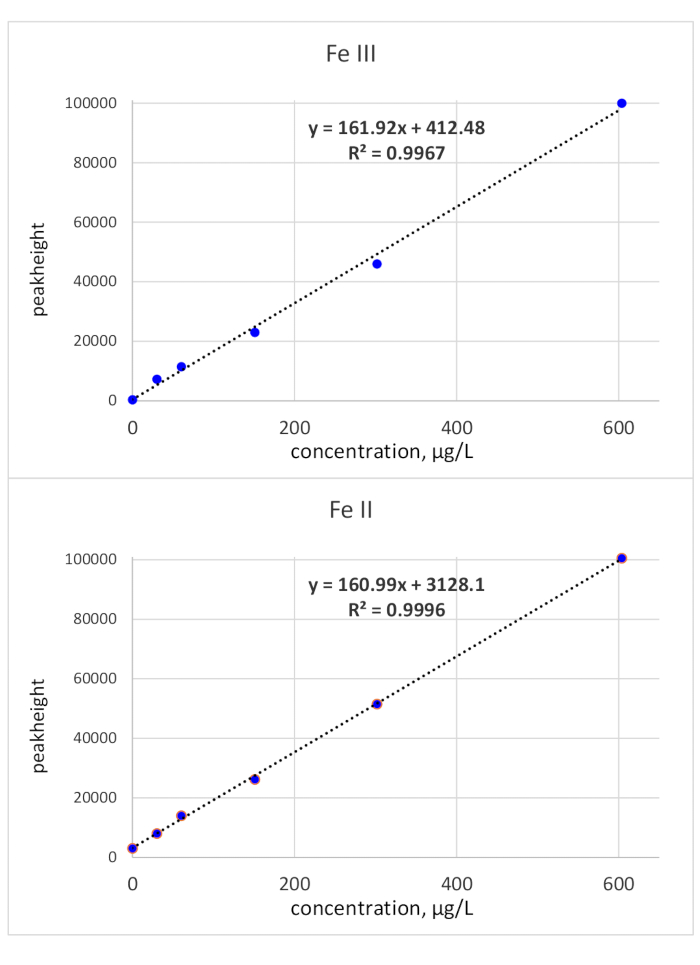
Figure 2: Calibration curves (peak height) of Fe(III) and Fe(II). Peak height-related calibrations of both Fe redox species are linear with a slope of ca. 161 *X Please click here to view a larger version of this figure.
Analysis of SH-SY5Y cell lysate
The analysis of the SH-SY5Y cell lysate showed a slightly slower migration for iron redox species due to the somewhat higher conductivity. Fe(III) was monitored at 124 s of migration time, Fe(II) at 158 s of migration time. Migration time precision in SH-SY5Y cell lysate was 2% for Fe(III) and 3% for Fe(II). Quantitative Fe(II) and Fe(III) measurements using this method revealed Fe(III) concentration of 330 µg/L and Fe(II) concentration 84 µg/L, both resulting in a Fe(II)/Fe(III) ratio of 0.25. The respective 56Fe-selective electropherogram is demonstrated in Figure 3.
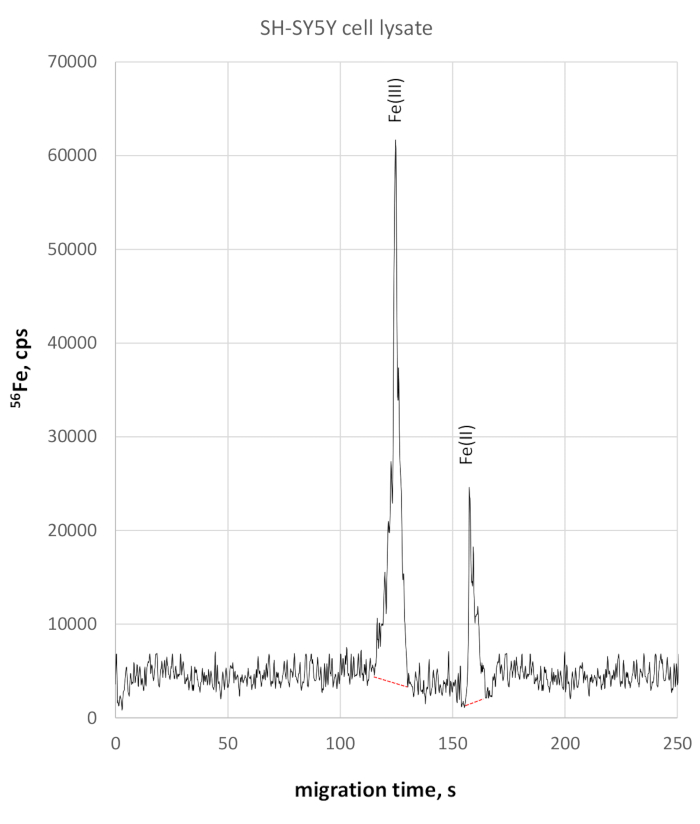
Figure 3: 56Fe-specific electropherogram of SH-SY5Y cell lysate. Fe(III) is monitored at 123 s reaching 58025 cps peak height, being clearly separated from Fe(II) at 158 s, reaching 22800 cps Please click here to view a larger version of this figure.
Discussion
Loading...
$$\rightleftharpoonup{xx}$$
$$\longleftharp{xx}$$,
$$\longrightharp{xx}$$,
Since iron plays a prominent role in OS progression, thus facilitating mitochondrial dysfunction or FTP, a versatile CE-ICP-MS based quantitative method for simultaneous Fe(II)/Fe(III) speciation is presented in this article and its application is exemplarily demonstrated in cell lysates. The method provided short analysis time and the figures of merit (LOQ, precision, recovery) are suitable for samples being relevant for iron redox speciation specifically in neurodegenerative and cancer research. Compared to previous methods based on LC, this CE-based method is practically independent of column batches and previously observed reproducibility problems after LC-column change. Capillary preparation before each run is <4 minutes and analysis time per sample with moderate salinity up to 3 min. Apart from molecule charge and size, migration time in CZE depends on conductivity at the sample plug, which causes migration time variation or shifts when samples themselves influence conductivity considerably. Such shifts in migration time are well known in capillary electrophoresis. This is a CZE-immanent problem, known from literature21,22. Standards and SH-SY5Y cell lysates had moderate and homogenous conductivity. Consequently, migration times showed only little changes with good precision. For samples with high conductivity, however, prolonged migration times may be observed up to 5 min. Therefore, standard additions are recommended for clear species identification.
A critical issue in iron redox speciation is species stability (i.e., maintenance of Fe(II)/(III) equilibria) during sample preparation8,13. Inappropriate pH or chelating chemicals as well as inappropriate storage conditions such as oxygen (air) in contact with sample or a break in deep-frozen storage can easily change the Fe(II)/(III) balance. Therefore, for preparation of SH-SY5Y cell lysates, a lysis buffer was chosen without any chelating chemicals, physiological pH, but inert gas overlay during sample preparation, in sample containers and immediate deep freezing was applied for these samples.
In the literature, one can find semi-quantitative approaches to monitor Fe(II). For improved understanding of iron´s role in oxidative stress, several research groups developed Fe(II)-specific probes to semi-quantitatively monitor and visualize aberrant elevation of ferrous iron in vitro. However, important to note, such probes do not consider Fe(III) and do not quantify but report just “more” or “less” Fe(II)). To date, only a few biomarkers are available to determine OS and FPT, being due to the lack of reliable methods to simultaneously quantify the Fe(II)/Fe(III) redox species23,24. Having this in mind, the presented method - facilitating fast quantification of both, Fe(III) and Fe(II) in one run - may become a promising tool to deepen the insight into iron-dependent molecular processes.
Disclosures
Loading...
$$\rightleftharpoonup{xx}$$
$$\longleftharp{xx}$$,
$$\longrightharp{xx}$$,
The authors have nothing to disclose.
Acknowledgements
Loading...
$$\rightleftharpoonup{xx}$$
$$\longleftharp{xx}$$,
$$\longrightharp{xx}$$,
VV was supported by the intramural research grant (Forschungsförderung) of the University Medical Center Göttingen and the Else Kröner research program of the Else Kröner-Fresenius-Stiftung.
Materials
| Name | Company | Catalog Number | Comments |
|---|---|---|---|
| CE capillary | CS-Chromatographie Service, Langerwehe, Germany | 105180-25 | |
| CE system | PrinCe technolgies | 0005.263 | model PrinCe 760 |
| Conical Superclear Tubes 15 ml | Analytics-shop.com by Altmann Analytik | PEN0777704 | |
| Conical Superclear Tubes 50 ml | Analytics-shop.com by Altmann Analytik | PEN0777694 | |
| FeCl2 * 4H2O | Merck | 103861 | |
| FeCl3 | Merck | 803945 | |
| Fluidflex Silikon HG-Schlauch | ProLiquid | 4001106HG | |
| Fused silica capillary OD 360 µm, ID 50 µm | Chromatographie Service GmbH | 105180-25 | |
| hydrochloric acid, 1 M | Merck | 1101652500 | corrosive |
| ICP-MS | Perkin Elmer | N814003 | |
| Luer, 3-way female | BioRad | 7318229 | |
| Luer, cone male | neoLab Migge | 2-1895 | |
| Luer, male | neoLab Migge | 2-1880 | |
| Peakfit peak evaluation software | Systat | PeakFit 4.12 | |
| Pt-wire | Carl Roth | 0737.1 | |
| PVC tube | ProLiquid | 6000002 | |
| RIPA buffer | Abcam | ab156034 | |
| Tetramethylammoniumhydroxide, 25 % | Merck | 814748 | corrosive |
| TYGON-tube R-3607 | ProLiquid | 3700203A |
References
Loading...
$$\rightleftharpoonup{xx}$$
$$\longleftharp{xx}$$,
$$\longrightharp{xx}$$,
- Hare, D. J., et al. Is early-life iron exposure critical in neurodegeneration. Nature Reviews Neurology. 11 (9), 536-544 (2015).
- Ashraf, A., Clark, M., So, P. W. The Aging of Iron Man. Frontiers in Aging Neuroscience. 10, (2018).
- Hare, D. J., Cardoso, B. R., Szymlek-Gay, E. A., Biggs, B. A. Neurological effects of iron supplementation in infancy: finding the balance between health and harm in iron-replete infants. Lancet Child Adolesc Health. 2 (2), 144-156 (2018).
- Torti, S. V., Torti, F. M. Iron and cancer: more ore to be mined. Nature Reviews Cancer. 13 (5), 342-355 (2013).
- Kehrer, J. P. The Haber-Weiss reaction and mechanisms of toxicity. Toxicology. 149 (1), 43-50 (2000).
- Gaschler, M. M., Stockwell, B. R. Lipid peroxidation in cell death. Biochemical and Biophysical Research Communications. 482 (3), 419-425 (2017).
- Michalke, B., Halbach, S., Nischwitz, V. JEM Spotlight: Metal speciation related to neurotoxicity in humans. Journal of Environmental Monitoring. 11 (5), 939-954 (2009).
- Solovyev, N., Vinceti, M., Grill, P., Mandrioli, J., Michalke, B. Redox speciation of iron, manganese, and copper in cerebrospinal fluid by strong cation exchange chromatography - sector field inductively coupled plasma mass spectrometry. Analytica Chimica Acta. 973, 25-33 (2017).
- Lee, H. J., et al. Effect of excess iron on oxidative stress and gluconeogenesis through hepcidin during mitochondrial dysfunction. Journal of Nutritional Biochemistry. 26 (12), 1414-1423 (2015).
- Dixon, S. J., Lemberg, K. M., Lamprecht, M. R., Skouta, R., Zaitsev, E. M., Gleason, C. E., et al. Ferroptosis: an iron-dependent form of nonapoptotic cell death. Cell. 149 (5), 1060-1072 (2012).
- Stockwell, B. R., et al. Ferroptosis: A Regulated Cell Death Nexus Linking Metabolism, Redox Biology, and Disease. Cell. 171 (2), 273-285 (2017).
- Michalke, B., Berthele, A., Mistriotis, P., Ochsenkuhn-Petropoulou, M., Halbach, S. Manganese speciation in human cerebrospinal fluid using CZE coupled to inductively coupled plasma MS. Electrophoresis. 28 (9), 1380-1386 (2007).
- Fernsebner, K., Zorn, J., Kanawati, B., Walker, A., Michalke, B. Manganese leads to an increase in markers of oxidative stress as well as to a shift in the ratio of Fe(II)/(III) in rat brain tissue. Metallomics. 6 (4), 921-931 (2014).
- Neth, K. Manganese: Species Pattern and Mechanisms of Brain Injury. , Technical University of Munich, Analytical Food Chemistry. Doctoral Dissertation (2015).
- Neth, K., et al. Changes in Brain Metallome/Metabolome Pattern due to a Single i.v. Injection of Manganese in Rats. Plos One. 10 (9), (2015).
- Venkataramani, V., et al. Manganese causes neurotoxic iron accumulation via translational repression of Amyloid Precursor Protein (APP) and H-Ferritin. Journal of Neurochemistry. 147 (6), 831-848 (2018).
- Willkommen, D., Lucio, M., Schmitt-Kopplin, P., Gazzaz, M., Schroeter, M., Sigaroudi, A., Michalke, B. Species fractionation in a case-control study concerning Parkinson's disease: Cu-amino acids discriminate CSF of PD from controls. Journal of Trace Elements in Medicine and Biology. 49, 164-170 (2018).
- Thibault, P., Dovichi, N. J. General instrumentation and detection systems including mass spectrometry. Capillary Electrophoresis - Theory and Practice. Camilleri, P. , CRC Press. Boca Raton, Boston, New York, Washington D.C., London. 23-89 (1998).
- Iliff, J. J., et al. A Paravascular Pathway Facilitates CSF Flow Through the Brain Parenchyma and the Clearance of Interstitial Solutes, Including Amyloid beta. Science Translational Medicine. 4 (147), (2012).
- Michalke, B. Manganese speciation using capillary electrophoresis-ICP-mass spectrometry. Journal of Chromatography A. 1050 (1), 69-76 (2004).
- Kuhn, R., Hofstetter-Kuhn, S. Capillary electrophoresis: Principles and practice. , Springer. Berlin, Heidelberg. (1993).
- Michalke, B. Capillary electrophoretic methods for a clear identification of selenoamino acids in complex matrices such as human milk. Journal of Chromatography A. 716 (1-2), 323-329 (1995).
- Yang, W. S., et al. Regulation of ferroptotic cancer cell death by GPX4. Cell. 156 (1-2), 317-331 (2014).
- Shimada, K., Hayano, M., Pagano, N. C., Stockwell, B. R. Cell-Line Selectivity Improves the Predictive Power of Pharmacogenomic Analyses and Helps Identify NADPH as Biomarker for Ferroptosis Sensitivity. Cell Chemical Biology. 23 (2), 225-235 (2016).
Reprints and Permissions
Request permission to reuse the text or figures of this JoVE article
Request Permission