A protocol to culture the microsporidian parasite Edhazardia aedis. The parasite is passaged from one generation of Aedes aegypti mosquitoes to the next via horizontal transfer at the larval stage followed by vertical transmission at the adult stage. Live sporoplasms survive long-term in infected eggs.
Method Article
Propagation of the Microsporidian Parasite Edhazardia aedis in Aedes aegypti Mosquitoes
* These authors contributed equally
In This Article
Summary
Abstract
Edhazardia aedis is a microsporidian parasite of Aedes aegypti mosquitoes, a disease vector that transmits multiple arboviruses which cause millions of disease cases each year. E. aedis causes mortality and reduced reproductive fitness in the mosquito vector and has been explored for its potential as a biocontrol agent. The protocol we present for culturing E. aedis is based on its natural infection cycle, which involves both horizontal and vertical transmission at different life stages of the mosquito host. Ae. aegypti mosquitoes are exposed to spores in the larval stage. These infected larvae then mature into adults and transmit the parasite vertically to their offspring. Infected offspring are then used as a source of spores for future horizontal transmission. Culturing E. aedis can be challenging to the uninitiated given the complexities of the parasite’s life cycle, and this protocol provides detailed guidance and visual aids for clarification.
Introduction
Aedes aegypti is the mosquito vector of multiple arboviruses (e.g., dengue, Zika, yellow fever) that together are estimated to account for hundreds of millions of disease cases each year and more than 30,000 deaths1,2. Treatment for diseases caused by these pathogens is limited to supportive care and it is likely that additional arboviruses will emerge in the future3. Control of the mosquito vector is therefore of primary importance, as it effectively prevents transmission of current and emerging pathogens4. Traditionally, vector control strategies primarily utilize chemical insecticides, but resistance to many commonly used insecticides has driven the demand for novel methods of vector control. One potential agent that has been explored for its biocontrol properties against Ae. aegypti is the parasite Edhazardia aedis5,6.
E. aedis, first identified as Nosema aedis by Kudo in 1930, is a microsporidian parasite of Ae. aegypti mosquitoes7. The development and reproduction of E. aedis is relatively complex and its life cycle can proceed in multiple ways7,8,9. One common developmental cycle is described in depth in Becnel et al., 19897 and is utilized for laboratory propagation (Figure 1)8. Briefly, the cycle begins when Ae. aegypti eggs vertically infected with E. aedis hatch into infected larvae which develop uninucleate spores in the fat body, and usually die as larvae or pupae. Uninucleate spores released from dead larvae contaminate the habitat and are ingested by healthy Ae. aegypti larvae. These spores germinate primarily in the digestive tract, infecting digestive tissue of the exposed larvae, resulting in horizontal transmission. Horizontally infected larvae develop into adults (parental generation) where binucleate spores are formed. In the female, these binucleate spores invade the reproductive tract and their associated sporoplasm infects developing egg cells. These eggs then hatch into infected larvae (filial generation), resulting in vertical transmission of the parasite and continuation of the cycle as described above.
Multiple studies have investigated the potential of E. aedis for biocontrol. Infection with E. aedis has been demonstrated to result in diminished reproductive capacity of Ae. aegypti females10. Further, in a semi-field experiment, inundative release of E. aedis resulted in the total eradication of a test Ae. aegypti population kept within a screened enclosure6. While able to undergo some stages of development in a diverse set of mosquito species, E. aedis is only vertically transmitted in Ae. aegypti, indicating a high degree of host specificity11,12. Likewise, in a laboratory assessment of the potential environmental risk associated with E. aedis, the microsporidian parasite failed to infect non-target aquatic fauna, including predators that ingested Ae. aegypti larvae infected with E. aedis13. These results highlight the potential for E. aedis to be used in biological control strategies targeting natural Ae. aegypti populations.
Despite the fact that E. aedis shows promise for use in vector control, there are challenges to culturing and deploying it on a broad scale. E. aedis spores lose infectivity in less than one day at cold temperatures (i.e., 5 °C). Even at warmer temperatures (i.e., 25 °C), spores rapidly lose infectivity over the course of three weeks14. Additionally, E. aedis must be cultured in live Ae. aegypti mosquitoes and controlled dosing of healthy larval mosquitoes is necessary to ensure completion of the life cycle and to prevent collapse of the population used for culture8. The requirement of in vivo culturing presents a challenge; however, recent advances in mosquito mass rearing and robotics (e.g., Massaro et al.15) could allow for large-scale generation of E. aedis spores. We anticipate that visualization of this methodology will increase accessibility to the E. aedis rearing protocol and allow more researchers to investigate the basic biology and applied potential of this system. We also anticipate that it will facilitate increased collaborations with engineers, roboticists, and the broader technology sector, which may serve to improve mass rearing of E. aedis.
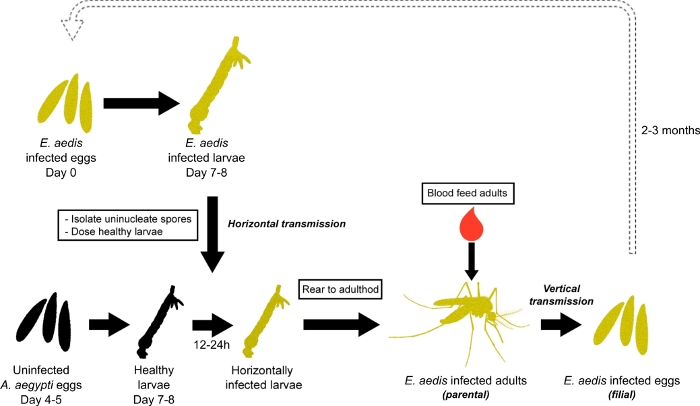
Figure 1: E. aedis propagation in Ae. aegypti. Propagation of E. aedis begins with hatching E. aedis infected eggs. Infected larvae are reared to 4th instar, E. aedis spores are isolated from those larvae, and the spores are used to orally infect healthy 2nd/3rd instar larvae reared from an uninfected clutch of eggs (horizontal transmission). These orally infected larvae are then reared to adulthood (parental generation) and lay eggs infected with E. aedis (vertical transmission). Infected eggs (filial generation) are then hatched to continue the infection cycle and parasite culture. Please click here to view a larger version of this figure.
Protocol
1. Day 0
- Hatch Ae. aegypti eggs infected with E. aedis by placing in larval rearing tray with 1 L deionized (DI) water. Add 50 mg of fish food.
NOTE: At the time of publication, a laboratory strain of E. aedis is only available from laboratories actively researching the parasite, as E. aedis is not amenable to long-term storage and infected eggs are not currently stored in repositories. Researchers interested in working with E. aedis can contact the corresponding author to request infected eggs.
NOTE: Hatching large numbers of infected eggs is generally not necessary; ten E. aedis infected Ae. aegypti larvae are sufficient to dose ≥ 1000 healthy larvae.
NOTE: For all parts of this protocol, we housed mosquitoes at the following conditions: 14 h/10 h light/ dark cycle, 27 °C temperature and 80% relative humidity.
2. Day 1
- After hatching, reduce density of larvae to ~100 larvae per tray, making new trays as necessary (also with 1 L DI water).
- Add a piece of dry cat food to each tray. Replenish food when depleted, but do not provide an excess of food. One piece of cat food (~200 mg) every three days is sufficient.
NOTE: Adjust food amount depending on the specific rearing conditions (i.e., reduce food if water becomes turbid or larvae are dying, increase food if larvae are severely delayed in development). Other feeding regimens and/or rearing conditions than those suggested here can be used but adjustments to timing of this standard protocol may be needed.
3. Days 4‒5
- When infected larvae are 3rd – 4th instars, hatch healthy/uninfected Ae. aegypti eggs in a new tray.
- Rear at densities such that healthy Ae. aegypti reach 2nd – 3rd instar in 48–72 h. In our hands, this can be achieved using densities of 200‒300 larvae per 1 L of water with ad libitum access to food. Hatching batches of healthy eggs over multiple days can guarantee that larvae are at the correct stage when needed.
4. Days 7‒8: Horizontal transmission
NOTE: Dosing of healthy larvae with E. aedis cannot be performed until uninucleate spores are at high numbers in infected larvae (1 x 10⁴ – 1 x 10⁶ per larva). This occurs late in the 4th instar stage (Figure 2).
- Harvest and quantify uninucleate spores.
- Use a transfer pipette (one may have to cut the tip to a wider diameter) to move 10 infected larvae to a 1.5 mL microcentrifuge tube.
- Remove breeding water with a transfer pipet and wash once by adding ~1 mL of clean DI water. Remove the wash water with a pipet, add 500 µL of clean DI water to the 10 larvae, and homogenize using a pestle and mechanical homogenizer.
- Quantify spores using a hemocytometer at 400x magnification.
NOTE: Uninucleate spores can be identified by their distinct pyriform shape (i.e., pear shape; Figure 2A).
- Dose healthy Ae. aegypti larvae with E. aedis.
- Make fresh larval food slurry by mixing 1.2 g of liver powder, 0.8 g of brewer’s yeast and 100 mL of water.
NOTE: Food does not need to be fresh if it is autoclaved and stored at 4 °C until use. - Transfer 100 2nd – 3rd instar healthy Ae. aegypti larvae into 150 mL beakers or specimen cups.
- Dose each beaker of 100 larvae with 5 x 10⁴ – 1 x 10⁵ spores.
- Add 2 mL of larval food slurry and DI water to a final volume of 100 mL.
- Make fresh larval food slurry by mixing 1.2 g of liver powder, 0.8 g of brewer’s yeast and 100 mL of water.
- After 12–24 h of exposure, transfer exposed larvae into rearing trays and rear to adulthood following a standard rearing protocol16.
5. Monitoring and vertical transmission
- Monitor dosed larvae for pupation and transfer pupae as they develop to an emergence cup in a cage. Sugar feed adults ad libitum (as per16,17). Eclosing adults will be infected by E. aedis.
- Blood feed adults (as per16,17) and collect eggs. Vertical transmission of E. aedis occurs at this step.
NOTE: If additional blood meals are provided as soon as oviposition is complete, females can lay at least one additional clutch of eggs before adults suffer (often sudden) high levels of mortality. - Use these Ae. aegypti eggs infected with E. aedis to continue propagation starting with step 1 of this protocol.
NOTE: Eggs can be stored for 2 – 3 months under appropriate conditions16. - Clean all materials that came in contact with E. aedis with 10% bleach and autoclaving (if possible) to prevent contamination.
Results
E. aedis infected Ae. aegypti Liverpool (LVP1b12) eggs were hatched as described in the protocol above. In the 4th instar stage, visual signs of infection could be observed, including white spore cysts throughout the fat bodies of infected larvae (an example of this phenotype is shown in Figure 2B). Uninucleate spores were harvested from 4th instar larvae by homogenizing 10 larvae in 500 µL DI water. These spores were pyriform (pear shaped) and readily visible at 400x (Figure 2A). Using a hemocytometer, a spore count of 4.05 x 10³ spores/µL was calculated. One hundred healthy Ae. aegypti larvae were then horizontally infected with ~50,000 spores in 100 mL water for a final dose of ~500 spores/larva. Larvae were reared to adulthood (parental generation) and blood fed using defibrinated rabbit blood plus 1% (v/v) 100 mM adenosine triphosphate. Vertically infected eggs were collected (filial generation) and hatched to continue E. aedis propagation and to quantify infection success.
At seven days post-hatching, 25 filial generation larvae were transferred into individual 1.5 mL microcentrifuge tubes and washed once with DI water. Individual larvae were homogenized in 250 µL of DI water and infection status and E. aedis loads were assessed using a hemocytometer. Vertical infection rate of E. aedis in the filial generation was found to be 96% and the mean spore load of infected individuals at seven days post hatching was 3.31 x 10⁵ (Range: 3.25 x 10⁴ – 1.47 x 10⁶; Figure 3).
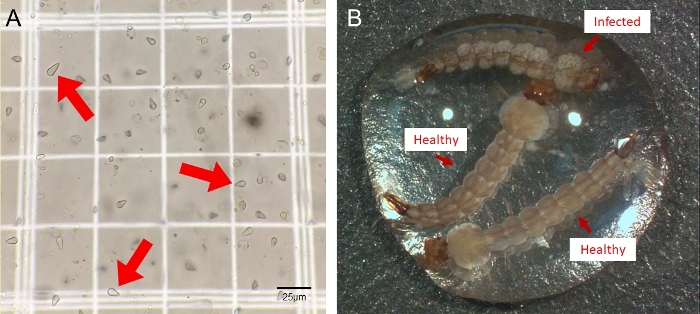
Figure 2: Visualization of E. aedis infection in Ae. aegypti mosquitoes. (A) E. aedis uninucleate pyriform spores. Ten E. aedis infected 4th instar larvae were homogenized in 500 µL of DI water approximately seven days post hatching. 10 µL of the homogenate was loaded onto a hemocytometer and viewed at 400X. Red arrows indicate representative uninucleate E. aedis spores. (B) E. aedis infected 4th instar larvae develop distinctive white spore cysts throughout their fat body18. They also commonly have malformed and distended abdominal segments. Please click here to view a larger version of this figure.
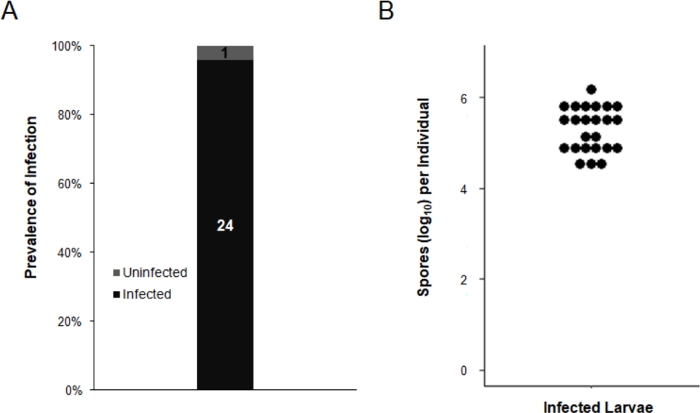
Figure 3: Culture protocol leads to effective E. aedis infection in filial generation. Ae. aegypti larvae (n = 25) from the filial generation were homogenized individually in 250 µL DI water and 10 µL of the homogenate was loaded onto a hemocytometer. Presence of uninucleate spores indicated a positive infection and spores were quantified for all positive samples. (A) Prevalence of infection among filial larvae. Grey corresponds to uninfected larvae, and black to infected. Numbers displayed on each segment give the absolute count of individuals in each group. (B) Spore load for each infected individual. Black dots represent the log10 transformed uninucleate spore count for each larva. Please click here to view a larger version of this figure.
Discussion
We present here the method originally described in Hembree and Ryan, 19828 for rearing E. aedis microsporidia in Ae. aegypti mosquitoes. The strain of E. aedis used in this study was derived from the original field collection by Stephen Hembree in Thailand in 197919. The method capitalizes on horizontal transmission, which naturally occurs in the transmission cycle of E. aedis7, to propagate the parasite in a controlled manner. This method can be challenging to newcomers who are not familiar with spore appearance, symptoms of infection in larvae, or the coordination required to successfully complete the multi-stage rearing/dosing protocol. Our hope is that the visual aids that accompany this protocol will reduce barriers to entry for researchers who wish to culture E. aedis.
We propagated E. aedis in Ae. aegypti as described above and quantified the success of parasitism in the filial generation. Briefly, we hatched E. aedis infected Ae. aegypti eggs, reared them to 4th instar, and collected uninucleate E. aedis spores from the infected larvae. We then horizontally infected healthy larvae with these spores via oral ingestion, and reared the horizontally infected larvae to adulthood. We blood fed the infected adults (parental generation) and collected eggs (filial generation), which we hypothesized would be vertically infected with the E. aedis parasite. We hatched eggs from the filial generation and collected and homogenized a subset of the larvae when they were 4th instars. We quantified the percent of larvae that were infected with E. aedis and the total spore count in all infected individuals. We found that the vast majority (96%) of individuals were infected and the mean spore load of infected larvae was ~105. We conclude that our rearing protocol resulted in highly successful propagation of E. aedis in Ae. aegypti mosquitoes.
There are multiple aspects of this protocol that may be particularly challenging for the uninitiated user. We offer below some additional information that may be of assistance. For questions regarding general mosquito rearing, a complete guide to Ae. aegypti colony maintenance is beyond the scope of this protocol. However, many common questions can be addressed by resources from the Biodefense and Emerging Infections Research Resources Repository16,17 including egg hatching, general dietary needs, housing and environmental conditions, and blood feeding. Regarding the timeline of infection, larvae hatched from infected eggs do not show signs of infection until late in the 4th instar stage. Uninucleate spores appear rapidly, over the course of 1–2 days. Larvae may appear virtually uninfected at 6 days post-hatching but highly infected by day 7 or 8 post-hatching. Additionally, it can be challenging to visualize spores in homogenized samples because there are many other microbes present in whole mosquito homogenates, including other eukaryotic single-celled organisms (e.g., yeast) of a similar size as the E. aedis uninucleate spores. The distinctive shape of E. aedis spores (Figure 2A) is a highly reliable method for identification and will help differentiate E. aedis from other microbes in the homogenate. Though it is not necessary for identification or quantification, if spore purification is desired, it can be achieved via colloidal silica density gradient centrifugation which will allow for separation of E. aedis spores from other contaminating elements in the homogenate. This process is described in detail in Solter et al.20.
Temperature and diet used in rearing practices commonly differ between laboratories, but variations will likely still yield successful parasite propagation. Minor differences in larval food type do not interfere with successful infection, though we did not explicitly test different food types in this protocol. The effect of temperature on infection has been tested and E. aedis infection was found to be robust at a wide range of temperatures21. Maximum spore production occurred at 30.8 °C but was still robust at rearing temperatures as low as 20 °C. Spore count was reduced dramatically at higher rearing temperatures (36 °C), therefore these temperatures should be avoided for this protocol.
Contamination is always a concern when working with parasites. E. aedis is a successful parasite of Ae. aegypti and must therefore be kept separate from uninfected laboratory colonies to prevent contamination. We recommend storage of infected mosquitoes in a separate incubator if possible. We also recommended that materials used for microsporidia work (e.g., larval trays, transfer pipets, cages, egg collection cups) are designated for microsporidia work and not used more broadly throughout the insectary. All rearing materials should be sterilized with 10% bleach after use and autoclaving can be used to supplement bleach sterilization.
Disclosures
The authors have nothing to disclose.
Acknowledgements
We wish to thank Spencer Blankenship for help with mosquito rearing. We also thank James N. Radl and M. Dominique Magistrado for helpful feedback on the manuscript.
Materials
| Name | Company | Catalog Number | Comments |
|---|---|---|---|
| 120 mL Specimen cup | McKesson | 911759 | Inexpensive alternative to beaker |
| 150 mL beakers | VWR | 10754-950 | For larval dosing |
| 2 oz round glass bottle | VWR | 10862-502 | Bottle for 10% sucrose in adult cages |
| 3 oz. emergence cup | Henry-Schein | 1201502 | For transfer of pupae to cage |
| Adult mosquito cages | Bioquip | 1462 or 1450ASV | For adult housing |
| Autoclave | For sterilization | ||
| Bleach | For sterilization | ||
| Brewer’s yeast | Solgar | For feeding larvae during dosing | |
| Controlled rearing chamber | Tritech | DT2-MP-47L | Inexpensive small rearing chamber |
| Cotton roll | VWR | 470161-446 | Wick for sugar bottles |
| Defibrinated rabbit blood | Fisher | 50863762 | For blood feeding adults |
| Disodium ATP, crystalline | Sigma-Aldrich | A26209-5G | For blood feeding adults |
| Dry cat food | 9Lives | Indoor Complete | For general larval rearing |
| Fish food flakes | TetraMin | For general larval rearing | |
| Hemocytometer | Fisher | 267110 | For counting spores |
| Homogenizer/mixer motor | VWR | 47747-370 | For homogenizing infected larvae |
| Larval rearing trays | Sterillite | 1961 | Overall dimensions are 11" x 6 5/8" x 2 3/4" |
| Liver powder | NOW foods | 2450 | For feeding larvae during dosing |
| Pipette 1 - 10µL | VWR | 89079-962 | For larval dosing |
| Pipette 100 - 1000µL | VWR | 89079-974 | For food during larval dosing |
| Pipette tips 1 - 10µL | VWR | 10017-042 | For larval dosing |
| Pipette tips 100 - 1000µL | VWR | 10017-048 | For food during larval dosing |
| Plastic pestles | VWR | 89093-446 | For homogenizing infected larvae |
| Sucrose, crystalline | Life Technologies | 15503022 | For adult feeding |
| Transfer pipet | VWR | 414004-033 | For larval transfer, must trim ends |
References
- WHO. Yellow fever. World Health Organization. , Available from: https://www.who.int/en/news-room/fact-sheets/detail/yellow-fever (2019).
- WHO. Dengue and severe dengue. World Health Organization. , Available from: https://www.who.int/en/news-room/fact-sheets/detail/dengue-and-severe-dengue (2020).
- Weaver, S. C. Prediction and prevention of urban arbovirus epidemics : A challenge for the global virology community. Antiviral Research. 156, 80-84 (2018).
- Rather, I. A., Parray, H. A., Lone, J. B., Paek, W. K., Lim, J., Bajpai, V. K., Park, Y. H. Prevention and Control Strategies to Counter Dengue Virus Infection. Frontiers In Cellular and Infection Microbiology. 7, 336(2017).
- Becnel, J. J. Edhazardia aedis (Microsporidia: Amblysporidae) as a biocontrol agent of Aedes aegypti (Diptera: Culicidae). Proceedings and abstracts, Vth International Colloquium on Invertebrate Pathology and Microbial Control. , Adelaide, Australia. 20-24 (1990).
- Becnel, J. J., Johnson, M. A. Impact of Edhazardia aedis (Microsporidia: Culicosporidae) on a seminatural population of Aedes aegypti (Diptera: Culicidae). Biological Control. 18 (1), 39-48 (2000).
- Becnel, J. J., Sprague, V., Fukuda, T., Hazard, E. I. Development of Edhazardia aedis (Kudo, 1930) N. G., N. Comb. (Microsporida: Amblyosporidae) in the mosquito Aedes aegypti (L.) (Diptera: Culicidae). Journal of Protozoology. 36, 119-130 (1989).
- Hembree, S. C., Ryan, J. R. Observations on the vertical transmission of a new microsporidian pathogen of Aedes aegypti from Thailand. Mosquito News. 42, 49-54 (1982).
- Johnson, M. A., Becnel, J. J., Undeen, A. H. A new sporulation sequence in Edhazardia aedis (Microsporidia: Culicosporidae), a parasite of the mosquito Aedes aegypti (Diptera: Culicidae). Journal of Invertebrate Pathology. 70 (1), 69-75 (1997).
- Becnel, J. J., Garcia, J. J., Johnson, M. A. Edhazardia aedis (Microspora: Culicosporidae) effects on the reproductive capacity of Aedes aegypti (Diptera: Culicidae). Journal of Medical Entomology. 32 (4), 549-553 (1995).
- Becnel, J. J., Johnson, M. A. Mosquito host range and specificity of Edhazardia aedis (Microspora: Culicosporidae). Journal of the American Mosquito Control Association. 9 (3), 269-274 (1993).
- Andreadis, T. G. Host range tests with Edhazardia aedis (Microsporida: Culicosporidae) against northern Nearctic mosquitoes. Journal of Invertebrate Pathology. 64 (1), 46-51 (1994).
- Becnel, J. J. Safety of Edhazardia aedis (Microspora: Amblyosporidae) for nontarget aquatic organisms. Journal of the American Mosquito Control Association. 8 (3), 256-260 (1992).
- Undeen, A. H., Becnel, J. J. Longevity and germination of Edhazardia aedis (Microspora: Amblyosporidae) spores. Biocontrol Science and Technology. 2, 247-256 (1992).
- Massaro, P., Sobecki, R., Behling, C., Criswell, V., Zha, T., Devenzengo, R. T. Automated mass rearing system for insect larvae. , Pub. No. US 2018/0092339 A1. USA (2018).
- Methods in Aedes Research. BEI Resources. , Available from: https://www.beiresources.org/Portals/2/VectorResources/Methods_20in_20Aedes_20Research_202016.pdf (2016).
- Methods in Anopheles Research. BEI Resources. , Available from: https://www.beiresources.org/portals/2/MR4/MR4_Publications/Methods_20in_20Anopheles_20Research_202014/2014MethodsinAnophelesResearchManualFullVersionv2tso.pdf (2014).
- Desjardins, C. A., et al. Contrasting host-pathogen interactions and genome evolution in two generalist and specialist microsporidian pathogens of mosquitoes. Nature Communications. 6 (1), 1-12 (2015).
- Hembree, S. C. Preliminary Report of some mosquito pathogens from Thailand. Mosquito News. 39 (3), 575-582 (1979).
- Solter, L. F., Becnel, J. J., Vávra, J. Research methods for entomopathogenic microsporidia and other protists. Manual of Techniques in Invertebrate Pathology. , Elsevier Ltd. 329-371 (2012).
- Becnel, J. J., Undeen, A. H. Influence of temperature on developmental parameters of the parasite/host System Edhazardia aedis (Microsporidia: Amblyosporidae) and Aedes aegypti (Diptera: Culicidae). Journal of Invertebrate Pathology. 60, 299-303 (1992).
Reprints and Permissions
