Here, we present a protocol to assess the neuroprotective activities of test compounds in Caenorhabditis elegans, including polyglutamine aggregation, neuronal death, and chemoavoidance behavior, as well as an exemplary integration of multiple phenotypes.
Method Article
Caenorhabditis elegans as a Model System for Discovering Bioactive Compounds Against Polyglutamine-Mediated Neurotoxicity
* These authors contributed equally
In This Article
Summary
Abstract
Age-related misfolding and aggregation of pathogenic proteins are responsible for several neurodegenerative diseases. For example, Huntington's disease (HD) is principally driven by a CAG nucleotide repeat that encodes an expanded glutamine tract in huntingtin protein. Thus, the inhibition of polyglutamine (polyQ) aggregation and, in particular, aggregation-associated neurotoxicity is a useful strategy for the prevention of HD and other polyQ-associated conditions. This paper introduces generalized experimental protocols to assess the neuroprotective capacity of test compounds against HD using established polyQ transgenic Caenorhabditis elegans models. The AM141 strain is chosen for the polyQ aggregation assay as an age-associated phenotype of discrete fluorescent aggregates can be easily observed in its body wall at the adult stage due to muscle-specific expression of polyQ::YFP fusion proteins. In contrast, the HA759 model with strong expression of polyQ-expanded tracts in ASH neurons is used to examine neuronal death and chemoavoidance behavior. To comprehensively evaluate the neuroprotective capacity of target compounds, the above test results are ultimately presented as a radar chart with profiling of multiple phenotypes in a manner of direct comparison and direct viewing.
Introduction
Progressive neurodegeneration in HD involves pathogenic mutant huntingtin with an abnormal stretch of polyQ encoded by CAG trinucleotide repeats1,2,3. Mutant huntingtin proteins with more than 37 glutamine repeats are prone to aggregate and accumulate in the brains of HD patients and animal models4,5, which ultimately leads to neurodegeneration6. Despite the lack of clarity on the roles of polyQ aggregates in disease pathology5, the inhibition of polyQ aggregation and its associated toxicity is a useful therapeutic strategy for HD and other polyQ diseases4,7,8.
Due to the conservation in neuronal signaling pathways and easy-to-construct transgenic disease models, Caenorhabditis elegans has been widely used as a major model organism for the investigation of neurological disorders9,10,11,12. For example, transgenic C. elegans models expressing aggregation-prone polyQ expansions can objectively mimic HD-like features such as selective neuronal cell loss, cytoplasmic aggregate formation, and behavioral defects13. Investigation of the potential effects of test samples to reverse these phenotypes in established polyQ nematode models has led to the identification of a variety of promising therapeutic candidates, e.g., polysaccharides7,14,15, oligosaccharides16, natural small molecules17,18, and herbal extracts and formulas19,20.
Described here are two main polyQ C. elegans models and relevant protocols for potential applications as exemplified by the study on astragalan, a polysaccharide isolated from Astragalus membranaceus7. For the polyQ aggregation assay in C. elegans, the model used is the transgenic strain AM141, which shows fluorescent puncta dispersed in its body wall muscle when reaching adulthood due to the expression of the Q40::YFP fusion protein, a polyQ tract of 40 residues (polyQ40) fused to yellow fluorescent protein (YFP)21,22. The strain HA759 was used to examine neuronal survival and chemoavoidance behavior as it expresses both green fluorescent protein (GFP) and Htn-Q150 (a human huntingtin-derived polyQ tract of 150 residues) strongly in ASH neurons but weakly in other neurons, resulting in progressive neurodegeneration and ASH cell death7,13. A comprehensive summary of the neuroprotective potential of therapeutic candidates is provided by integrating results from different assays.
Protocol
NOTE: See Table 1 for the recipes of solutions used in this protocol.
1. Preparation of materials for the Caenorhabditis elegans assay
- Maintenance of C. elegans strains
- Obtain C. elegans (AM141 and HA759) and Escherichia coli (OP50 and NA22) strains (see the Table of Materials).
- Maintain the nematodes on the nematode growth media (NGM) plate seeded with E. coli OP50 at 20 °C for AM14121 or 15 °C for HA75923.
- Preparation of E. coli OP50 bacterial culture
- Pick a single colony of E. coli OP50 from a Luria-Bertani (LB) streak plate and inoculate it into 50 mL of liquid LB culture.
- Incubate the OP50 bacteria in a shaker at 37 °C and 200 rpm until an optical density of ~0.5 at 570 nm (OD570).
- Store the OP50 bacterial culture at 4 °C and use it within two weeks.
- Preparation of NGM plates with OP50 bacteria
- Add 20 g of agar, 2.5 g of peptone, 3.0 g of NaCl, and 975 mL of deionized water to a 1 L autoclavable bottle. Autoclave at 121 °C for 30 min.
- Place the liquid NGM agar bottle on the bench to cool to ~60 °C, and then add the following sterile stock solutions: 1 mL of 1 M CaCl2, 1 mL of 1 M MgSO4, 1 mL of 5 mg/mL cholesterol, and 25 mL of 1 M potassium phosphate (pH 6.0).
- Pour 20 mL of NGM into a sterile 90 mm Petri dish, and leave the plates on the bench to cool and solidify. Keep the plates upside down and allow them to dry on the bench at room temperature for 2 days.
- Dispense 200 µL of the OP50 bacterial culture onto each NGM plate and spread evenly with a sterile glass coating rod. Close the lids and incubate the plates overnight at 37 °C.
- Store the NGM plates seeded with OP50 in a plastic box with a cover at room temperature and use within two weeks.
- Preparation of age-synchronized C. elegans population
- Collect gravid adult nematodes into a sterile 1.5 mL microcentrifuge tube and centrifuge at 1000 × g for 1 min. Wash three times and resuspend the nematodes in M9 buffer.
- Add an equal volume of bleach solution and agitate gently for 3-5 min. Monitor the bleaching every 15 s under a dissecting microscope.
NOTE: The bleach solution must be prepared freshly before use by mixing equal volumes of 10% NaOCl and 1 M NaOH (Table 1)20. - Once most of the nematodes are broken, stop the digestion by diluting with M9 buffer. Quickly centrifuge to remove the supernatant and resuspend the pellet in M9 buffer to repeat the washing three times.
- Resuspend the pellet in S medium. Let the nematode residues settle down by gravity for 2-3 min while the eggs remain in the supernatant.
- Aspirate the supernatant into a new sterile microcentrifuge tube. Collect the eggs by centrifugation at 1000 × g for 1 min.
- Discard ~80% of the supernatant and transfer the eggs into a sterile flask containing 20 mL of S medium. Place the flask in a shaker and incubate the eggs overnight without food at 120 rpm to obtain synchronized L1 nematodes.
2. PolyQ aggregation assay
- Preparation of nematodes for the polyQ aggregation assay
- Transfer 300-500 synchronized L1 larvae of AM141 to each well of a 48-well plate with 500 µL of S medium containing OP50 (OD570 of 0.7-0.8) and 5 mg/mL of astragalan, typically one well per treatment for one time point.
- Seal the plate with parafilm and incubate at 20 °C and 120 rpm for 24, 48, 72, and 96 h.
- Harvest the nematodes in a sterile 1.5 mL microcentrifuge tube and wash with M9 buffer >3 times by centrifugation (1000 × g for 1 min) to remove the remaining OP50. Resuspend the AM141 nematodes in M9 buffer, and keep them ready for image acquisition.
- Acquisition of fluorescent images and data analysis
NOTE: Data are automatically analyzed with this high-content imaging system. If an automated imaging device is not available, a conventional method to prepare an agarose pad for image acquisition can be used to achieve similar performance by using a common fluorescent microscope7,15,17 (see steps 3.2 and 3.3).- Transfer 10-15 nematodes into each well in a 384-well plate (final volume 80 µL per well). Set 10 replicate wells for each treatment.
- Add 10 µL of 200 mM sodium azide to each well to paralyze the nematodes and allow them to settle down to the bottom (5-10 min).
- Place the plate in a high-content imaging system to acquire fluorescent images (see the Table of Materials for device and software information).
- Open the image acquisition software and set up the following parameters.
- Open the Plate Acquisition Setup window and create a new experiment set and name.
- Select Magnification as 2x, Camera binning as 1, and Plate type as 384-well plate.
- Set the wells and sites (single site) to be visited.
- Select the fluorescein isothiocyanate (FITC) filter and enable image-based focusing options.
- Set the Exposure as 300 ms.
NOTE: The above settings can be tested and adjusted to optimize the imaging parameters. - Save Image acquisition settings and click on the Acquire Plate button to run.
- Analyze the image data by using the image analysis software.
- Open the Review Plate Data window and select the Test plate for image analysis.
- Double-click on a test well to display its image.
- Select the Count Nuclei as the analysis method and click on the Configure Settings button to bring out a window for the following settings.
- Define the source image from the FITC channel and select the Standard Algorithm.
- Set the image analysis parameters as follows: approximate minimum width = 10 µm (= 2 pixels); approximate maximum width = 50 µm (= 12 pixels); intensity above local background = 1,000-2,000 graylevels.
- Test the current settings to optimize the method of analysis.
- Save the settings and run the analysis on all the wells.
NOTE: It takes ~20 min to finish analysis for one 384-well plate. - Export the Total Nuclei as the total number of Q40::YFP aggregates in each well.
- Count the number of nematodes in each well.
- Calculate the average number of Q40::YFP aggregates per nematode in each group, and apply a nonlinear curve fit to the data from each time point.
- Calculate the inhibition index using eq (1) below:
Inhibition index = (1)
(1)
Where Ncontrol and Nsample are the average number of Q40::YFP aggregates in the control and the treatment groups, respectively.
3. PolyQ-mediated neurotoxicity assays
- Treatment of C. elegans with test samples
- To prepare nematodes for the polyQ neurotoxicity assay, transfer 300-500 synchronized L1 larvae of HA759 to each well of a 48-well plate with 500 µL of S medium containing OP50 (OD570 of 0.7-0.8) and 5 mg/mL of astragalan, typically three replicate wells for each treatment.
- Seal the plate with parafilm and incubate at 15 °C and 120 rpm for 3 days23.
- Collect the nematodes by centrifugation and wash 3-5 times with M9 buffer. Resuspend the nematodes in M9 buffer for use in neuronal survival and avoidance assays.
- Preparation of agarose pad
- Add 2 g of agarose to 100 mL of M9 buffer (2%, w/v) and heat the agarose solution in a microwave to near-boiling.
- Dispense 0.5 mL of melted agarose onto the center of a 1 mm thick microscopy glass slide placed between two pieces of 2 mm thick glass plates. Cover with another slide vertically. Once the agarose cools down and is solidified, gently remove the top slide.
- ASH neuronal survival assay
- Add a drop of 20 mM sodium azide onto the agarose pad. Transfer 15-20 HA759 nematodes into the drop to immobilize them.
- Place a coverslip gently over the nematodes. Keep the slide under a fluorescence microscope fitted with a digital camera. Select a 40x objective lens and FITC filter to detect GFP-positive ASH neurons in the head region of the nematodes.
- Select more than 50 nematodes in each group randomly to count the number of nematodes with GFP-labeled bilateral ASH neurons in their head region7. Calculate the survival rate of ASH neurons using eq (2) below.
Neuronal survival (%) = (2)
(2)
Where Nsurvival and Ntotal are the number of nematodes with GFP-positive ASH neurons and the total number of tested nematodes in each group, respectively.
- Osmotic avoidance assay
- Divide a food-free NGM plate (9 cm) into normal (N) and trap (T) zones by an 8 M glycerol (~30 µL) line in the middle. Spread a 200 mM sodium azide (~20 µL) line at ~1 cm away from the glycerol line to paralyze the nematodes crossing through the glycerol barrier into Zone T.
- Transfer ~200 nematodes each onto Zone N of three replicate plates for each group. Add a drop of 1% butanedione (~2 µL) onto Zone T (1 cm from the plate edge) to attract the nematodes. Cover the lid of the Petri dish immediately, and incubate at 23 °C for 90 min.
- Score the number of nematodes on the N and T zones under a microscope. Calculate the avoidance index using eq (3)20.
Avoidance index =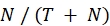 (3)
(3)
Where N and T are the number of nematodes in N and T zones, respectively. Data are presented as means ± standard deviation (SD) of three replicates, representative of >3 independent experiments. - Perform an unpaired, two-tailed t-test to compare the data from the astragalan and control groups.
4. Creating a radar chart
- Open the graphing software and import data from different assays into a new sheet. Input the A(X) column as the titles of the radial axes, A(Y) column as the data from the control group, and B(Y) column as the data from the treatment group.
- Select the required data and click on Plot | Specialized: Radar button in the toolbar menu to generate a radar chart.
- Double-click on the radial axis and adjust the Scale, Tick, and Tick labels of each axis as needed.
- Click on File in the menu and select Export Graphs to save the image as *.tiff.
NOTE: The software websites in the Table of Materials provide detailed help documents and video tutorials on creating radar charts.
Results
The transgenic polyQ strain AM141 strongly expresses Q40::YFP fusion proteins in its body wall muscle cells7,21. As shown in Figure 1A, the discrete aggregate phenotype of this strain can be identified by the automated imaging and analysis protocol described in this article. The amount of Q40::YFP aggregates in AM141 nematodes increased significantly after 48 h from the L1 stage. However, this tendency to increase was inhibited by astragalan treatment (Figure 1B), demonstrating the protective potential of astragalan against polyQ aggregation. Typically either 72 h or 96 h can be conveniently used as the time points to count Q40::YFP aggregates to evaluate the anti-aggregation effect of test samples. In this protocol, the fluorescent aggregates of AM141 nematode were captured by an automated imaging system, although fluorescence microscopes can also be used for this purpose7.
The C. elegans strain HA759 expresses both the GFP marker and Htn-Q150 in its sensory ASH neurons, leading to progressive loss and dysfunction of these neurons11,13. The nematodes were mounted on 2% agarose pads to determine the ASH neuronal viability (Figure 2A) and visualized microscopically to detect the ASH neurons. A loss of GFP fluorescence in bilateral ASH neurons in the head regions of nematodes indicates the ASH neuronal death (Figure 2B). The survival rate of ASH neurons in HA759 nematodes is <40% in the control group after incubation at 15 °C for 3 days7,20, indicating polyQ-mediated neurotoxicity. Hence, this ASH neuronal survival assay can be used to visually evaluate the effects of test compounds on C. elegans neurons, e.g., the neuroprotective effect of astragalan but not Poria glycan (Figure 2C).
As behavior dysfunction is a major clinical symptom in polyQ diseases, the chemosensory avoidance assay (Figure 3A) using large numbers of HA759 nematodes is designed as a simplified test to examine the effect of test samples on the functional loss of ASH neurons mediated by polyQ aggregation. As shown in Figure 3B, the avoidance index of HA759 nematodes in the untreated control group was ~0.5, similar to what was reported previously14. Interestingly, the avoidance index increased to >0.6 in the nematodes treated with astragalan at 15 °C for 3 days (Figure 3B), demonstrating a neuroprotective effect of the polysaccharide against behavioral impairments.
To evaluate the overall neuroprotective capacity of test compounds, the data from the above individual assays can be integrated and presented as a radar chart for multiple phenotypes, making it a unifying feature of polyQ phenotypes suitable for direct comparison and direct viewing. As shown in Figure 4, the area of the triangle in the astragalan treatment group is greater than that of the control group, indicating the anti-polyQ effects of the polysaccharide.
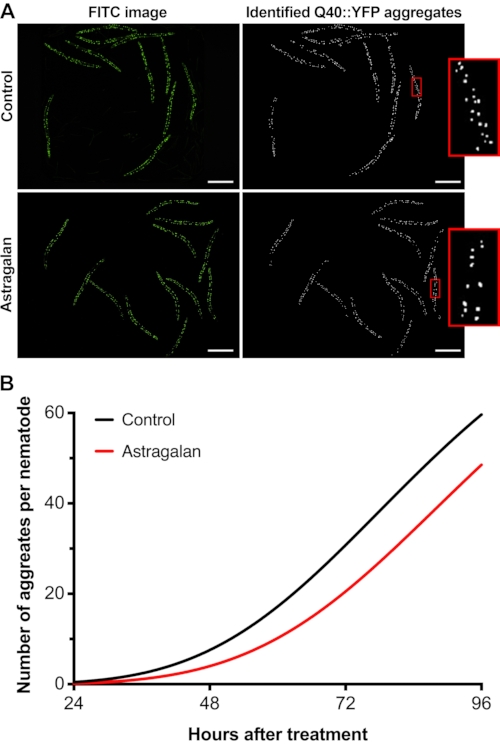
Figure 1: Effect of astragalan on polyQ40 aggregation. (A) Representative images of AM141 nematodes after treatment with or without astragalan for 96 h at 20 °C. The fluorescent images (left panels) were acquired from 384-well plates using a high-content imaging and analysis system, and the Q40::YFP aggregates (right panels) were automatically identified by the system. Insets are the magnified views of nematode images showing the polyQ aggregates. Scale bars = 500 µm. (B) Quantification of Q40::YFP aggregates. The number of Q40::YFP aggregates in AM141 nematodes was monitored using the high-content imaging system every 24 h for 4 days after treatment with or without astragalan at 20 °C. Approximately 100-150 nematodes in each group were scored for aggregates at each time point. The results are shown as fitted curves based on the average number of aggregates per nematode. Abbreviations: polyQ = polyglutamine; YFP = yellow fluorescent protein; FITC = fluorescein isothiocyanate. Please click here to view a larger version of this figure.
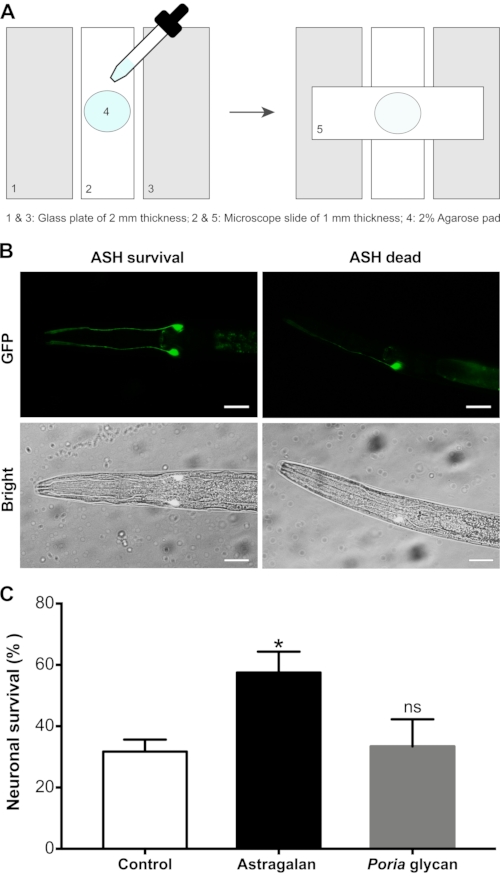
Figure 2: Effect of astragalan on Htn-Q150-mediated ASH neuronal death. (A) Schematic diagram of agarose slide preparation. (B) Representative micrographs of HA759 nematodes with ASH neuronal survival and death using 400x magnification. Scale bars = 20 µm. The HA759 nematodes were photographed using a fluorescence microscope after treatment with or without astragalan at 15 °C for 3 days from L1. (C) Protective effect of astragalan against polyQ-mediated ASH neuronal death. Poria glycan, a polysaccharide from Poria cocos, was used as a control. Data are presented as means ± SD of three replicates, representative of more than three independent experiments. Statistical analysis was performed using an unpaired, two-tailed t-test to compare data of the control group with those of the astragalan and Poria glycan groups. *p < 0.05; ns = no significant. Abbreviation: GFP = green fluorescent protein. Please click here to view a larger version of this figure.
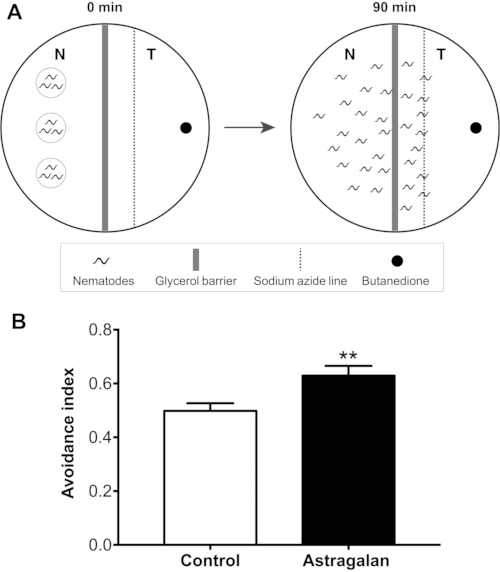
Figure 3: Effect of astragalan on Htn-Q150-mediated behavioral dysfunction. (A) Schematic diagram of the avoidance assay plate. (B) Representative results of avoidance assay. Avoidance index was defined as the ratio of nematodes in the N zone to the total number of nematodes on the plate. The results are presented as means ± SD of three replicates, representative of three independent experiments. Statistical analysis of avoidance index was performed using an unpaired, two-tailed t-test. **p < 0.01. Please click here to view a larger version of this figure.
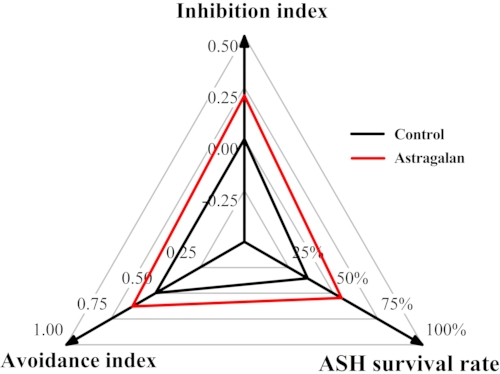
Figure 4: Overall neuroprotective capacity of astragalan. Data from three different assays are imported into OriginPro software to a create radar chart, which is presented to profile the general effect of astragalan on multiple phenotypes mediated by polyQ. Please click here to view a larger version of this figure.
Discussion
As polyQ aggregation and proteotoxicity are important features of polyQ disorders, such as Huntington's disease13, we recommend the use of multiple models and methods to comprehensively evaluate the neuroprotective capacity of test compounds, including the polyQ aggregation assay in the AM141 strain, the ASH neuronal survival assay in the HA759 strain, and the chemosensory avoidance assay in the HA759 strain. The protocols presented here have been used to evaluate the neuroprotective capacities of test samples against polyQ toxicity, including inhibitory effects on both polyQ aggregation and associated neurotoxicity7,14,15,16,17,19,20, demonstrating their potential in drug discovery for HD and other polyQ diseases.
An automated imaging and analysis system is introduced for the detection and counting of polyQ aggregates in the polyQ aggregation assay. This method has the advantages of being high-throughput and time-efficient and results in significantly reduced subjective errors in the laborious counting process. For an entire 384-well plate, it only takes <1 h to finish image acquisition and analysis. However, the conventional microscopic imaging method has also shown similar performance in this laboratory without using the automated imaging device7.
A total of 100-150 nematodes per treatment are recommended in a typical Q40::YFP aggregation assay for each time point, which can be performed in replicate wells containing 10-15 nematodes each. However, it should be noted that L1 larvae may be more sensitive to some treatments or higher concentrations. Therefore, higher doses of test compounds might inhibit their growth, leading to false-positive results due to slow growth and, thus, delayed polyQ aggregation. Usually, a food clearance assay can be performed to address this concern and ensure the appropriate concentration range of test compounds23.
The HA759 transgenic nematodes used in polyQ neurotoxicity assays coexpress OSM-10::GFP and Htn-Q150, making it possible to unambiguously identify bilateral ASH sensory neurons. Hence, ASH neuron survival is evaluated by the presence or absence of GFP expression; usually, ~40-75% of ASH neurons in the control nematodes are dead23,24. Interestingly, the pqe-1 (polyglutamine enhancer-1) genetic mutant background in the HA759 strain (pqe-1;Htn-Q150) accelerates polyQ-mediated toxicity, leading to the death of most ASH neurons within three days, even at 15 °C, and therefore this strain is grown at 15 °C for the neuronal survival assay, as previously reported23,24.
Functional loss of ASH neurons in HA759 nematodes may occur before the detection of cell death and protein aggregates13; therefore, the osmotic avoidance behavior assay is essential for the assessment of polyQ-mediated toxicity. To minimize the potential impact of less active HA759 nematodes at low temperature on behavioral experiments, the avoidance assay plates are incubated in a humidified 23 °C incubator rather than at 15 °C as in the neuronal survival assay using this strain. In addition, it has been reported that Htn-Q150/OSM-10::GFP transgenic nematodes are highly sensitive to nose touch; hence, an alternative detection of ASH neuron function is the nose touch assay13.
Disclosures
The authors declare that they have no competing financial interests.
Acknowledgements
We thank former members of the Huang Lab who have helped develop and improve the protocols used in this paper, particularly, Hanrui Zhang, Lingyun Xiao, and Yanxia Xiang. This work was supported by the 111 Project (grant number B17018) and the Natural Science Foundation of Hebei Province (grant number H2020207002).
Materials
| Name | Company | Catalog Number | Comments |
|---|---|---|---|
| C. elegans strains | |||
| AM141 rmIs133 [unc-54p::Q40::YFP] | Caenorhabditis Genetics Center (CGC) | https://cgc.umn.edu/strain/AM141 | |
| HA759 rtIs11 [osm-10p::GFP + osm-10p::HtnQ150 + dpy-20(+)] | Caenorhabditis Genetics Center (CGC) | https://cgc.umn.edu/strain/HA759 | |
| E. coli strains | |||
| NA22 | Caenorhabditis Genetics Center (CGC) | https://cgc.umn.edu/strain/NA22 | |
| OP50 | Caenorhabditis Genetics Center (CGC) | https://cgc.umn.edu/strain/OP50 | |
| Reagent | |||
| Agar | Shanghai EKEAR Bio-Technology Co., Ltd. | EQ1001-500G | https://www.ekear.com |
| Agarose | Biowest | 111860 | |
| Butanedione | Sinopharm Chemical Reagent Co., Ltd. | 80042427 | https://www.reagent.com.cn/goodsDetail/d027c00e64c9404d9aa41391fbb59 5d0 |
| Cholesterol | Sigma-Aldrich | C8667 | https://www.sigmaaldrich.cn/CN/zh/product/sigma/c8667?context=product |
| Glycerol | Aladdin Co., Ltd. | G116203 | https://www.aladdin-e.com/zh_cn/g116203.html |
| Peptone | Guangdong HuanKai Microbial Science and Technology Co., Ltd. | 050170B | https://www.huankai.com/show/21074.html |
| Sodium azide | Sinopharm Chemical Reagent Co., Ltd. | 80115560 | https://www.reagent.com.cn/goodsDetail/5e981aa807664e26af 551e96ff5f07cd |
| Sodium hydroxide | Sinopharm Chemical Reagent Co., Ltd. | 10019718 | https://www.reagent.com.cn/goodsDetail/450dfdb1132a4d8a817 d3d8c68ec25e6 |
| Sodium hypochlorite solution | Guangzhou Chemical Reagent Factory | 7681-52-9 | http://www.chemicalreagent.com/product/DetailProduct.aspx?id=125 |
| Tryptone | Oxoid Ltd. | LP0042B | https://www.thermofisher.cn/order/catalog/product/LP0042B#/LP0042B |
| Yeast extract | Oxoid Ltd. | LP0021B | https://www.thermofisher.cn/order/catalog/product/LP0021B#/LP0021B |
| Equipment | |||
| 384-well cell culture plate | Nest Biotechnology Co., Ltd. | 761001 | https://www.cell-nest.com/page94?_l=en&product_id=85 |
| 48-well cell culture plate | Nest Biotechnology Co., Ltd. | 748001 | https://www.cell-nest.com/page94?_l=en&product_id=85 |
| 90 mm Petri dish | Sangon Biotech (Shanghai) Co., Ltd. | F611003 | https://www.sangon.com/productDetail?productInfo.code=F611003 |
| Autoclave | Panasonic | MLS-3781L-PC | |
| Dissecting microscope | ChongQing Optical Co., Ltd. | ZSA0745 | http://www.coicuop.com/plus/view.php?aid=64 |
| Fluorescence microscope | Guangzhou Micro-shot Optical Technology Co., Ltd. | Mshot MF31-LED | https://www.mshot.com/article/442.html |
| High-content imaging system | Molecular Devices | ImageXpress | https://www.moleculardevices.com/products/cellular-imaging-systems#High-Content-Imaging |
| Microcentrifuge | GeneCompany | GENESPEED X1 | https://www.genecompany.com/index.php/Home/Goods/goodsdetails/gid/189.html |
| Microscope digital camera | Guangzhou Micro-shot Optical Technology Co., Ltd. | MS60 | https://www.mshot.com/article/677.html |
| Microwave | Midea Corp. | M1-211A | https://www.midea.cn/10000/10000000001 00511264425.html |
| Parafilm M | Sigma-Aldrich | P7793-1EA | https://www.sigmaaldrich.cn/CN/en/product/sigma/p7793?context=product |
| Shaker | Zhicheng Inc. | ZWY-2102C | http://www.zhicheng.net/Product/0865291356.html |
| Software | |||
| Image acquisition and analysis software | Molecular Devices | MetaXpress | https://www.moleculardevices.com/products/cellular-imaging-systems/acquisition-and-analysis-software/metaxpress |
| OriginPro | OriginLab Corp. | Version 9.8.5.204 | 1. Software introduction: https://www.originlab.com/index.aspx?go=Products/Origin 2. Instruction for creating a radar chart: https://www.originlab.com/doc/Origin-Help/RadarChart-Graph 3. Video tutorial for creating a radar chart: https://www.originlab.com/videos/details.aspx?pid=1813 |
References
- The Huntington's Disease Collaborative Research Group. A novel gene containing a trinucleotide repeat that is expanded and unstable on Huntington's disease chromosomes. Cell. 72 (6), 971-983 (1993).
- Bauer, P. O., et al. Harnessing chaperone-mediated autophagy for the selective degradation of mutant huntingtin protein. Nature Biotechnology. 28 (3), 256-263 (2010).
- Lieberman, A. P., Shakkottai, V. G., Albin, R. L. Polyglutamine repeats in neurodegenerative diseases. Annual Review of Pathology. 14, 1-27 (2019).
- Sakahira, H., Breuer, P., Hayer-Hartl, M. K., Hartl, F. U. Molecular chaperones as modulators of polyglutamine protein aggregation and toxicity. Proceedings of the National Academy of Sciences of the United States of America. 99, Suppl 4 16412-16418 (2002).
- Bäuerlein, F., Fernández-Busnadiego, R., Baumeister, W. Investigating the structure of neurotoxic protein aggregates inside cells. Trends in Cell Biology. 30 (12), 951-966 (2020).
- Tu, Z., Yang, W., Yan, S., Guo, X., Li, X. J. CRISPR/Cas9: a powerful genetic engineering tool for establishing large animal models of neurodegenerative diseases. Molecular Neurodegeneration. 10, 35(2015).
- Zhang, H., et al. Inhibition of polyglutamine-mediated proteotoxicity by Astragalus membranaceus polysaccharide through the DAF-16/FOXO transcription factor in Caenorhabditis elegans. Biochemical Journal. 441 (1), 417-424 (2012).
- Koyuncu, S., et al. The ubiquitin ligase UBR5 suppresses proteostasis collapse in pluripotent stem cells from Huntington's disease patients. Nature Communications. 9 (1), 2886(2018).
- Dimitriadi, M., Hart, A. C. Neurodegenerative disorders: insights from the nematode Caenorhabditis elegans. Neurobiology of Disease. 40 (1), 4-11 (2010).
- Li, J., Le, W. Modeling neurodegenerative diseases in Caenorhabditis elegans. Experimental Neurology. 250, 94-103 (2013).
- Wang, Q., et al. Caenorhabditis elegans in Chinese medicinal studies: making the case for aging and neurodegeneration. Rejuvenation Research. 17 (2), 205-208 (2014).
- Hassan, W. M., Dostal, V., Huemann, B. N., Yerg, J. E., Link, C. D. Identifying Aβ-specific pathogenic mechanisms using a nematode model of Alzheimer's disease. Neurobiology of Aging. 36 (2), 857-866 (2015).
- Faber, P. W., Alter, J. R., MacDonald, M. E., Hart, A. C. Polyglutamine-mediated dysfunction and apoptotic death of a Caenorhabditis elegans sensory neuron. Proceedings of the National Academy of Sciences of the United States of America. 96 (1), 179-184 (1999).
- Zhang, J., et al. Antioxidant and neuroprotective effects of Dictyophora indusiata polysaccharide in Caenorhabditis elegans. Journal of Ethnopharmacology. 192, 413-422 (2016).
- Xiang, Y., et al. Epimedium polysaccharide alleviates polyglutamine-induced neurotoxicity in Caenorhabditis elegans by reducing oxidative stress. Rejuvenation Research. 20 (1), 32-41 (2017).
- Zhong, G., et al. Physicochemical and geroprotective comparison of Nostoc sphaeroides polysaccharides across colony growth stages and with derived oligosaccharides. Journal of Applied Phycology. 33 (2), 939-952 (2021).
- Xiao, L., et al. Salidroside protects Caenorhabditis elegans neurons from polyglutamine-mediated toxicity by reducing oxidative stress. Molecules. 19 (6), 7757-7769 (2014).
- Cordeiro, L. M., et al. Rutin protects Huntington's disease through the insulin/IGF1 (IIS) signaling pathway and autophagy activity: Study in Caenorhabditis elegans model. Food and Chemical Toxicology. 141, 111323(2020).
- Yang, X., et al. The neuroprotective and lifespan-extension activities of Damnacanthus officinarum extracts in Caenorhabditis elegans. Journal of Ethnopharmacology. 141 (1), 41-47 (2012).
- Xiao, L., et al. The traditional formula Kai-Xin-San alleviates polyglutamine-mediated neurotoxicity by modulating proteostasis network in Caenorhabditis elegans. Rejuvenation Research. 23 (3), 207-216 (2020).
- Morley, J. F., Brignull, H. R., Weyers, J. J., Morimoto, R. I. The threshold for polyglutamine-expansion protein aggregation and cellular toxicity is dynamic and influenced by aging in Caenorhabditis elegans. Proceedings of the National Academy of Sciences of the United States of America. 99 (16), 10417-10422 (2002).
- Gidalevitz, T., Ben-Zvi, A., Ho, K. H., Brignull, H. R., Morimoto, R. I. Progressive disruption of cellular protein folding in models of polyglutamine diseases. Science. 311 (5766), 1471-1474 (2006).
- Voisine, C., et al. Identification of potential therapeutic drugs for huntington's disease using Caenorhabditis elegans. PLoS One. 2 (6), 504(2007).
- Faber, P. W., Voisine, C., King, D. C., Bates, E. A., Hart, A. C. Glutamine/proline-rich PQE-1 proteins protect Caenorhabditis elegans neurons from huntingtin polyglutamine neurotoxicity. Proceedings of the National Academy of Sciences of the United States of America. 99 (26), 17131-17136 (2002).
Reprints and Permissions
