This article provides a detailed description of a novel mouse judgment bias protocol. Evidence of this olfactory digging task's sensitivity to affective state is also demonstrated and its utility across diverse research fields is discussed.
A subscription to JoVE is required to view this content. Sign in or start your free trial.
Method Article
Assessment of Mouse Judgment Bias through an Olfactory Digging Task
* These authors contributed equally
In This Article
Summary
Abstract
Judgment biases (JB) are differences in the way that individuals in positive and negative affective/emotional states interpret ambiguous information. This phenomenon has long been observed in humans, with individuals in positive states responding to ambiguity 'optimistically' and those in negative states instead showing 'pessimism'. Researchers aiming to assess animal affect have taken advantage of these differential responses, developing tasks to assess judgment bias as an indicator of affective state. These tasks are becoming increasingly popular across diverse species and fields of research. However, for laboratory mice, the most widely used vertebrates in research and a species heavily relied upon to model affective disorders, only one JB task has been successfully validated as sensitive to changes in affective state. Here, we provide a detailed description of this novel murine JB task, and evidence of its sensitivity to mouse affect. Though refinements are still necessary, assessment of mouse JB opens the door for answering both practical questions regarding mouse welfare, and fundamental questions about the impact of affective state in translational research.
Introduction
Measuring affectively modulated judgment bias (henceforth JB) has proven to be a useful tool for studying the emotional states of animals. This innovative approach borrows from human psychology since humans experiencing positive or negative affective states (emotions and longer-term moods) reliably demonstrate differences in the way they process information1,2,3. For example, humans experiencing anxiety or depression might interpret neutral facial expressions as negative, or neutral sentences as threatening4,5. It is likely that these biases have an adaptive value and are therefore conserved across species6,7. Researchers aiming to assess animal affect have cleverly taken advantage of this phenomenon, operationalizing optimism as the increased expectation of reward in response to neutral or ambiguous cues, and pessimism as the increased expectation of punishment or reward absence8,9. Thus, in an experimental setting, optimistic and pessimistic responses to ambiguous stimuli can be interpreted as indicators of positive and negative affect, respectively10,11.
Compared to other indicators of animal affect, JB tasks have the potential to be particularly valuable tools since they are capable of detecting both the valence and intensity of affective states10,11. The ability of JB tasks to detect positive states (e.g., Rygula et al.12) is especially useful since most indicators of animal affect are limited to the detection of negative states13. During JB tasks, animals are typically trained to respond to a positive discriminative cue predicting reward (e.g., high-frequency tone) and a negative discriminative cue predicting punishment (e.g., low-frequency tone), before being presented with an ambiguous cue (e.g., intermediate tone)8. If in response to ambiguous cues an animal 'optimistically' performs the trained response for the positive cue (as if expecting reward), this indicates a positive judgment bias. Alternatively, if animals demonstrate the negative trained response to avoid punishment, this is indicative of 'pessimism' or negative judgment bias.
Since the development of the first successful JB task for animals by Harding and colleagues8, several JB tasks have been developed for a wide range of species across diverse research fields7. But despite their increasing popularity, animal JB tasks are often labor-intensive. Moreover, perhaps because they are methodologically different from the human tasks that inspired them, they sometimes produce null or counterintuitive results14 and commonly yield only small treatment effect sizes15. As a result, JB tasks can be challenging to develop and implement. In fact, for laboratory mice, the most widely used vertebrates in research16,17 and a species heavily relied upon to model affective disorders18, only one JB task has been successfully validated as sensitive to changes in affective state19 despite many attempts over the past decade (see supplementary material of Resasco et al.19 for a summary). This article describes the recently validated murine JB task, detailing its biologically relevant design, and highlighting the ways that this humane task can be applied to test important hypotheses relevant to mouse affect. Overall, the protocol can be implemented to investigate the affective effects of any variable of interest on JB in mice. This would include categorical treatment variables as described here (drug or disease effects, environmental conditions, genetic background, etc.), or relationships with continuous variables (physiological changes, home cage behaviors, etc.).
Access restricted. Please log in or start a trial to view this content.
Protocol
Experiments were approved by the University of Guelph's Animal Care Committee (AUP #3700), conducted in compliance with Canadian Council on Animal Care guidelines, and reported in accordance with ARRIVE (Animal Research: Reporting of In Vivo Experiments)20 requirements.
1. Experiment preparation
- Experimental design (see Table 1).
NOTE: This behavioral test is a scent-based Go/Go digging task, in which mice have to dig for high- or low-value rewards. It uses a rectangular arena (Figure 1) with two arms, in which one arm is scented while the other one is unscented. As outlined below, mice are trained to discriminate between positive and negative odor cues before being presented with an ambiguous odor mixture.- Pseudorandomly assign cages to mint or vanilla positive discriminative stimulus (DS+) groups as follows.
NOTE: This protocol has only been validated for mice assigned to vanilla DS+ odor mixture (see Representative Results and Resasco et al.19 for details). However, pilot tests are strongly recommended to confirm that the DS+, DS-, and ambiguous mixtures meet requirements for valid JB assessment (steps 4.7.3 and 5.3). Thus, the methods outlined here include the testing of both a vanilla and a mint DS+, to provide an example of a group that successfully meets requirements for assessment of JB (the vanilla DS+ mice) and a group that fails to do so (the mint DS+ mice). Prior pilot tests would identify this type of problem in advance. - Mint DS+ mice: for these mice, during arena setup for training (see step 1.4 below), mark scent dispensers and pots containing a high-value reward with the mint odor cue, and those containing no reward with the vanilla odor cue.
- Vanilla DS+ mice: for these mice, during arena setup for training (see step 1.4 below), mark scent dispensers and pots containing a high-value reward with the vanilla odor cue, and those containing no reward with the mint odor cue.
NOTE: This task consists of reinforced training trials and unreinforced test trials. During unreinforced test trials, no rewards are accessible to the mice (see step 1.4.3 below) and the ambiguous odor cue for both mint and vanilla DS+ mice is the same 1:1 mint/vanilla mixture. - Pseudorandomly assign cages to left or right scented arm groups (counterbalancing across DS+ odor groups) as follows.
- Left: for these mice, during arena setup for training and testing (see step 1.4 below), mark the left arm with the appropriate DS+ or DS- odor cue and ensure the right arm is always unscented (marked only with distilled water).
- Right: for these mice, during arena setup for training and testing (see step 1.4 below), mark the right arm with the appropriate DS+ or DS- odor cue and ensure the left arm is always unscented (marked only with distilled water).
- Randomly assign each animal a "blind code" as follows.
NOTE: Blinding allows the researcher handling the mice and scoring their behavior to remain unaware of the animal ID or treatment, avoiding undesirable subjective bias. This is a mandatory step to comply with the ARRIVE (Animal Research: Reporting of In Vivo Experiments) guidelines and other reference documents20. - Add a column for blind code in a spreadsheet containing each animal ID and the corresponding treatment they have been assigned to.
- Randomly assign each animal a unique code (e.g., a letter and number combination "A2") that is unrelated to cage number or treatment.
NOTE: All randomization should be conducted using a random number generator (e.g., Random.org). During this randomization step, counter-balance across treatment, strain, etc., where applicable. Have this done by a research assistant who will remain "unblind" to treatment throughout experiments. This individual must not collect data during testing, to avoid biased assessments. - During all data collection, provide the "blind" researcher who is live- and video-scoring latency to dig and digging duration with only the animal's blind code to keep the researcher blind to treatment.
NOTE: Spreadsheets used during data collection will only include the animal's blind code and the corresponding latency to dig and digging duration for each trial. At the end of the experiments, the corresponding animal ID and treatment information can be added to the spreadsheet, thus "unblinding" researchers for data analyses.
- Pseudorandomly assign cages to mint or vanilla positive discriminative stimulus (DS+) groups as follows.
- Material preparation.
- High-value food rewards: break dried sweetened banana chips into approximately 0.5 cm x 0.5 cm pieces by hand.
- Low-value food rewards: using a cutting board and knife, cut rodent chow (from animals' regular diet) into approximately 0.125 cm3 pieces.
NOTE: Pilot tests to identify high- and low-value rewards should be conducted prior to starting the task. - Mint and vanilla essences: Using a 1 mL syringe or micropipette, add mint and vanilla extract into labeled centrifuge tubes. Dilute extracts 1:4 with distilled water and mix by inverting several times. Make these daily and invert repeatedly before use to ensure that the mixtures are fresh and consistent.
- Ambiguous odor mixture: after mint and vanilla essences have been diluted, add equal volumes to a centrifuge tube (creating a 1:1 mixture of the diluted essences). Make these on the day of testing responses to ambiguous odor mixture, and invert repeatedly before use to ensure that the mixture is fresh and consistent.
NOTE: Pilot tests to identify appropriate dilutions and intermediate odor mixtures are strongly encouraged to ensure the utility of ambiguous probes, since intensity may vary between manufacturers, batches, etc. If multiple ambiguous cues are offered, randomly assign mice to the near positive, midpoint, near negative test cues. See Discussion for further details. - Cotton pads: cut each circular cotton pad into six equal pieces (allowing them to fit within the tissue cassettes used as scent dispensers).
NOTE: The number of high- and low-value food rewards, cotton pads, and volumes of odor mixtures will be dependent on the number of subjects being tested. Please refer to Table 1 for the number of trials per subject in each phase and Table 2 for the materials required in each trial type. - Identify the experimental area: Conduct training and testing on a bench in the colony room or elsewhere. Conduct all trials under red light during the dark phase when mice are active.
- Pre-training (1 week prior to experiments) for digging in the home cage.
- For each cage being tested, pour a small amount of corncob bedding into two digging pots (just enough to cover the bottom of the pot) to help treats remain in the center of the pot when being buried.
- In one pot, place pieces of high-value reward on top of the corncob layer so that each mouse in the cage can have one piece (e.g., three pieces of banana chips for a cage of three mice). In the other pot, place pieces of low-value reward on top of the corncob layer so that each mouse in the cage can have one piece (e.g., three pieces of chow for a cage of three mice).
- Slowly pour corncob bedding over the treats in each pot, covering them and filling the pots to a height of 3 cm.
- Simultaneously place one high-value and one low-value pot in each cage for 10 min. After 10 min, remove the pots from all cages.
- Discard any corncob and treats remaining in the pot. Wipe all pots thoroughly with 70% ethanol to prevent animal and cage odors from influencing future trials.
- Repeat steps 1.3.1-1.3.5 once per day for 5 consecutive days.
NOTE: The goal of this phase is to allow all cage mates the opportunity to dig and eat a treat prior to the onset of formal training. This also facilitates habituation to food rewards.
- Arena set up for training and testing.
- Place the arena on a workbench under red light. Wipe all components of the arena, the digging pots, and scent dispensers thoroughly with 70% ethanol to remove dust and any odors from previous trials.
- Prepare the digging pots as follows.
- Place the appropriate food rewards into the "inaccessible compartment" (see Figure 1).
NOTE: Rewards included in this compartment are dependent on which treats (if any) are buried in a given trial (see Table 2). Thus, each pot will always contain one piece of banana chip and one piece of chow across the two compartments.- DS+ odor pots: during reinforced trials, place one piece of chow in the inaccessible compartment and bury one piece of banana chip in the accessible area of the pot.
- DS- odor pots: during reinforced trials, place one piece of chow and one piece of banana chip in the inaccessible compartment. No food rewards will be available in the accessible area of the pot.
- Unscented pots: during reinforced trials, place one piece of banana chip in the inaccessible compartment and bury one piece of chow in the accessible area of the pot.
- During all unreinforced test trials (positive, negative, and ambiguous), place one piece of chow and one piece of banana chip in the inaccessible compartment. No food rewards will be available in the accessible area of the pot.
NOTE: This step is to prevent the scent of the buried treats from revealing which pot is rewarded. As such, the barrier between the two compartments is perforated to facilitate odor transmission.
- Pour a small amount of corncob bedding into each pot to keep food rewards centered when being buried. Place one piece of the appropriate food reward (see Table 2) on top of the corncob layer and slowly pour corncob bedding over the treats, covering them and filling the pots up to a height of 3 cm.
- Using a 1 mL syringe or micropipette, draw up 0.1 mL of the appropriate odor mixture (i.e., mint, vanilla, or ambiguous mixtures) or distilled water (see Table 2) and inject it directly on top of the corncob in a circular motion.
- Prepare scent dispensers.
- Place one cotton pad piece in the base of the tissue cassette. Using a 1 mL syringe or micropipette, draw up 0.1 mL of the appropriate odor mixture (i.e., mint, vanilla, or ambiguous mixtures) or distilled water (see Table 2) and inject it onto the cotton piece. Cover the tissue cassette with its lid to enclose the scented cotton creating a scent dispenser.
- Place the digging pots at the ends of the arms and scent dispensers at the beginning of each arm. Insert the removable "door" immediately before the cassette slots to block entry to the arena arms and to create the start compartment (see Figure 1).
NOTE: Digging pots, scent dispensers, and syringes must be clearly labeled and only used for one scent throughout experiments to avoid unintentional mixing of odor cues (i.e., use a different set of materials for mint, vanilla, unscented, and ambiguous mixtures throughout).
2. Digging training: 5 days, two positive trials per day (Table 2)
- Fast mice for 1 h prior to training in their home cage by removing food from the hopper.
- Set up the arena for a reinforced positive trial by following the arena setup instructions above (step 1.4).
- On Day 1 of digging training, place the food rewards on top of the 3 cm corncob bedding instead of burying them.
- Progressively bury the rewards deeper under the corncob over the following 4 days, until they are located at the bottom of the 3 cm bedding by Day 5 (i.e., Day 1: on top of corn-cob, Day 2: buried by a very thin layer of corn-cob, Day 3: buried half-way to the bottom of the pot, Day 4: buried three-quarters of the way to the bottom of the pot, and Day 5: buried at the bottom of the pot).
- Move mice from their home cage to an empty transport cage. Place a cue card with the animal's blind code on top of the transport cage so that the researcher conducting experiments remains blind to animal ID and treatment. Carry mice to the experimental area.
NOTE: Steps 2.1 and 2.5 should be completed by a research assistant familiar with the mice. Subsequent steps during trials will be conducted by a researcher blind to animal ID (and treatment, if applicable). Always handle mice using cup handling (open hand) or tunnel handling (with a paper cup or plastic tunnel) to avoid the aversive effects of traditional tail handling21. - Move mice from the transport cage to the start compartment of the arena. Remove the start "door", immediately lower the plexiglass lid over the arena, and start the 5-min trial timer.
NOTE: If multiple mice from the same cage are being tested, this should be done simultaneously. However, the number of animals being tested at the same time will depend on the number of blind observers available; ideally, a researcher will observe and handle one animal at a time, but one individual can observe and handle two animals simultaneously, if necessary. - Live-score latency to dig and latency to eat the reward in both arms.
- Record latency to dig as the time at which the first occurrence of digging is observed. Digging is described as a mouse actively pushing or manipulating corncob bedding with the forepaws and/or muzzle.
- Record latency to eat as the time at which the first occurrence of eating is observed. Eating is described as a mouse consuming a reward while holding it in the forepaws and sitting on haunches.
- When the trial ends, lift the plexiglass lid, and move the mouse back to its transport cage.
- Discard all corncob bedding and treats left in the pots. Open tissue cassettes and discard cotton pieces. Wipe all components of the arena and the digging pots and scent the dispensers thoroughly with 70% ethanol.
- Set up the arena for a second positive trial (step 1.4). Repeat steps 2.6-2.9 for a reinforced positive trial.
- Return the transport cage to the research assistant so mice can be placed back into their home cage.
- Repeat steps 2.1-2.11 for 5 consecutive days.
3. Discrimination training : 10 days, four trials per day
- Set up the arena for a positive or negative trial (see Table 2) following instructions in step 1.4.
- Conduct two positive and two negative trials per day following the order outlined in Table 2 (i.e., alternating positive and negative trials on days 1-5 and pseudorandom order on days 6-10).
- Follow instructions in step 2.1 at the beginning of each training day, and then follow steps 2.5-2.10. Repeat until mice have undergone four trials in total.
- Return the transport cage to the research assistant so mice can be placed back into their home cage.
- Repeat steps 3.1-3.4 once per day for 10 days in total (i.e., two consecutive 5-day work weeks, separated by a 2-day weekend).
4. Testing
NOTE: Testing duration is 3-5 days (depending on the time taken for each mouse to meet learning criteria), five trials per day for the sessions in which positive and negative test trials are conducted, and three trials per day when the ambiguous test is conducted.
- Fast mice for 1 h prior to training/testing in their home cage by removing food from the hopper.
- Perform one positive trial and one negative trial in a randomized order (see Table 1) by following arena setup instructions in step 1.4 and reinforced trial instructions in steps 2.5-2.10.
- Perform one video-recorded unreinforced test trial.
NOTE: The unreinforced trials are identical to reinforced trials, except for the location in which the rewards are placed. Therefore, in the unreinforced trial, one piece of each high- and low-value reward are placed in the inaccessible compartment both for the scented and unscented pots.- Conduct one positive or negative test trial for each mouse daily until learning criteria are met (maximum 4 days; learning criteria is described in step 4.7.3). Ensure positive and negative test trials are conducted in alternating order across days (e.g., Day 1: positive test, Day 2: negative test, Day 3: positive test, etc.).
- Follow arena setup instructions in step 1.4.
- Move mice from the transport cage to the start compartment of the arena. Set up a video camera on a tripod so that both pots at the ends of arms are in view, and start recording. Ensure the cue card with the animal's blind code and the trial type (Positive Test or Negative Test) is recorded in the video (for reference during video scoring).
- Remove the start "door", immediately lower the plexiglass lid over the arena, and start the 2 min trial timer.
- When the trial ends, stop recording, move the camera to the side, lift the plexiglass lid, move the mouse back to their transport cage.
- Discard all corncob bedding and treats left in the pots. Open tissue cassettes and discard cotton pieces. Wipe all components of the arena, the digging pots, and scent dispensers thoroughly with 70% ethanol.
- Perform one positive trial and one negative trial in a randomized order (see Table 1) by following arena setup instructions in step 1.4 and reinforced trial instructions in steps 2.5-2.10.
- Return the transport cage to the research assistant so mice can be placed back into their home cage.
- Once all mice have completed their five daily trials, transfer videos from camera memory card to a computer for video scoring.
- Score positive and negative test trial videos on the day of testing to assess whether mice have met learning criteria. Ensure same-day video scoring since animals who meet learning criteria will undergo ambiguous tests the following day.
- Using event recording software or a stopwatch, have the researcher who is blind to treatment record each mouse's latency to dig and digging duration in each pot during the first minute of positive and negative test trials.
- Record latency to dig as the time at which the first occurrence of digging is observed. Digging is described as a mouse actively pushing or manipulating corncob bedding with the forepaws and/or muzzle. Record digging duration as the total time a mouse spends digging.
- Compare digging duration in the scented arm between positive (DS+) and negative (DS-) trials for each mouse to determine whether animals can discriminate the task. Consider the learning criterion to be met if digging duration in the DS+ scented arm is at least double that for the DS- scented arm during the first minute of testing (with a minimum DS+ digging duration of 3 s).
- Repeat steps 4.1-4.7 daily until mice have met the learning criterion.
- Exclude individuals that have not met criterion by day 4 from ambiguous trials (and thus, judgment bias assessment).
- For mice that have met learning criteria, test responses to the ambiguous odor mixture.
- Fast mice for 1 h prior to training/testing in their home cage by removing food from the hopper.
- Perform one positive and one negative reinforced trial in a randomized order by following arena setup instructions in steps 1.4 and reinforced trial instructions in steps 2.5-2.10.
- Perform one video-recorded unreinforced test trial as described in step 4.3 using the ambiguous odor mixture (see Table 2).
- Score Ambiguous trial videos to assess judgment bias.
- Using event recording software or a stopwatch, have a researcher who is blind to animal ID and treatment record each mouse's latency to dig (see step 4.7.2) in each pot during the first 1 min and 2 min of test trials.
5. Data analysis
NOTE: Exact analyses required will depend on the details of the experimental design. A general overview is outlined here, but researchers are strongly encouraged to refer to Gygax22 when planning analyses for animal JB experiments, and to Gaskill and Garner23 when selecting sample size (since required analyses are often too complex for a priori power analyses).
- "Unblind" the researcher by adding the corresponding animal ID and treatment information (e.g., enriched or conventional housing; drug or placebo etc.) for each blind code to the spreadsheet. Ensure that the resulting spreadsheet includes three rows for each animal that met the learning criteria (i.e., for the positive, negative, and ambiguous test trials) indicating latencies to dig in the scented arm.
- Run a repeated measures generalized linear mixed model, using preferred statistical software. Here, the outcome variable will be latency to dig. Ensure that the model includes Treatment (or continuous variable of interest), Trial Type, and the Treatment x Trial Type interaction as fixed effects. Include Mouse ID (nested within treatment) as a random effect. Additional terms included in the model will depend on the experimental design applied.
NOTE: If mice are group-housed (as is appropriate for this social species24) and cage mates are tested, then cage nested within treatment (if present) must be included in the model as a random effect (and Mouse ID must subsequently be nested within the cage). - Plot the least-square means of latency in each trial type to confirm that the ambiguous cue presented was interpreted as intermediate (i.e., the latency least-square means estimate for the ambiguous trial should fall at a midpoint between the positive and negative latencies). Assess mouse JB only if this requirement is met.
- Assess the simple effect of treatment (or continuous variable of interest) on latency to dig in the ambiguous trial by investigating the Treatment x Trial Type interaction to determine whether mice display affect-modulated JB.
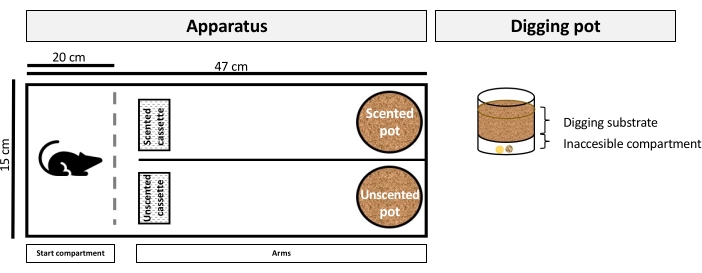
Figure 1: Diagram of experimental apparatus. The JB apparatus includes a rectangular arena with two arms. Each arm contains a scent dispenser located at the start and a digging pot placed at the end. Reprinted from Resasco et al.19 with permission from Elsevier. Please click here to view a larger version of this figure.
| Phase: | Experimental Design | |
| All | High Value Reward | Banana chip |
| Low Value Reward | Rodent chow | |
| DS+ | Mint or Vanilla (counterbalanced) | |
| DS- | Mint or Vanilla (counterbalanced) | |
| Digging Training | Digging Training Schedule | 5 days: 2 Pos trials/day |
| Digging Trial Duration | 5 min | |
| Discrimination Training | Discrimination Training Schedule | 10 days: 4 trials/day |
| Digging Trial Order | Days 1-5: 4 trials/day | |
| Trial 1: Pos | ||
| Trial 2: Neg | ||
| Trial 3: Pos | ||
| Trial 4: Neg | ||
| Days 6-10: 4 trials/day* | ||
| Discrimination Trial Duration | 5 min | |
| Testing | Testing Schedule | 3-5 days (dependent on time to meet learning criteria) |
| 5 trials/day | ||
| Testing Phase Order | Trials 1 and 2: Pos or Neg** | |
| Trial 3: test trial | ||
| Trials 4 and 5: Pos or Neg** | ||
| Test Trial Duration | 2 min | |
| * Trials were pseudorandomized so mice always had two Pos and two Neg trials per day | ||
| ** Trials were pseudorandomized so mice always had one Pos and one Neg trial before and after the test trial | ||
Table 1: Summary of experimental design and schedule for training and testing. Number and order of trials per day for Digging Training, Discrimination Training, and Testing phases in addition to experimental design details. Reprinted from Resasco et al.19 with permission from Elsevier.
| Trial Details | |||||||
| Phase | Trial Type | Scented Arm | Unscented Arm | ||||
| Odor Cue | Buried Reward | Inaccessible Reward | Odor Cue | Buried reward | Inaccessible Reward | ||
| Digging and Discrimination Training | Pos Training | DS+ | Banana | Chow | Water | Chow | Banana |
| Neg Training | DS- | No reward | Banana + chow | Water | Chow | Banana | |
| Testing | Pos Test | DS+ | No reward | Banana + chow | Water | No reward | Banana + chow |
| Neg Test | DS- | No reward | Banana + chow | Water | No reward | Banana + chow | |
| Ambiguous Test | Mint/ vanilla mixture | No reward | Banana + chow | Water | No reward | Banana + chow | |
| Learning Criterion | Mice must dig twice as long in the DS+ pot (Pos test) than the DS- pot (Neg test), and dig for a minimum of 3 s | ||||||
Table 2. Summary of trial details. Odor cues and rewards presented in each trial type during Digging Training, Discrimination Training, and Testing phases. DS(+): positive discriminative stimulus, DS(-): negative discriminative stimulus, Pos: positive, Neg: negative. Reprinted from Resasco et al.19 with permission from Elsevier. See Supplementary Table S2 in the original article for the expanded table.
Access restricted. Please log in or start a trial to view this content.
Results
Results presented here reflect relevant findings from Experiment 1 of Resasco et al.19. Subjects in this experiment were 18 female C57BL/6NCrl ('C57') and 18 Balb/cAnNCrl ('Balb') mice. Animals arrived at the facility at 3-4 weeks of age and were randomly assigned to environmentally enriched or conventional housing treatments (EH or CH, respectively) in mixed strain quartets25. Each cage contained one C57 and one Balb, in addition to two DBA/2NCrl mice being used in another...
Access restricted. Please log in or start a trial to view this content.
Discussion
The scent-based digging protocol and results outlined here demonstrate the ability of this novel JB task to detect changes in mouse affective state. The task thus presents a valuable tool for diverse fields of research. Similar to any JB task, to assess animal affect it is critical that animals first learn to discriminate between cues (step 4.7.3) and that the ambiguous stimulus is interpreted as intermediate (step 5.3). Though simple, meeting these requirements can be challenging, particularly in laboratory mice for whi...
Access restricted. Please log in or start a trial to view this content.
Disclosures
The authors have no conflicts of interest to disclose.
Acknowledgements
The authors are grateful to Miguel Ayala, Lindsey Kitchenham, Dr. Michelle Edwards, Sylvia Lam and Stephanie Dejardin for their contributions to the Reseasco et al.19 validation work which this protocol is based on. We would also like to thank the mice and our wonderful animal care technicians, Michaela Randall and Michelle Cieplak.
Access restricted. Please log in or start a trial to view this content.
Materials
| Name | Company | Catalog Number | Comments |
|---|---|---|---|
| Absolute ethanol | Commercial alcohol | P016EAAN | Dilute to 70% with distilled water, for cleaning |
| Centrifuge tubes | Fischer | 55395 | 15 mL tubes used to dilute essences here. However, size may be selected based on total volume required for sample size |
| Cheerios (original) | Cheerios | N/A | Commercially available. Used as reward to train animals to enter annex cage for handling |
| Corncob bedding | Envigo | 7092 | Teklad 1/8 corncob bedding used in digging pots and animal cages |
| Cotton pads | Equate | N/A | Commercially available. Modified in lab to fit within tissue cassettes for scent dispensing |
| Digging pots | Rubbermaid | N/A | Commercially available. Containers were modified to fit the apparatus in the lab |
| Dried, sweetened banana chips | Stock and Barrel | N/A | Commercially available. High value reward in JB task |
| JB apparatus | N/A | The apparatus was made in the lab | |
| JWatcher event recording software | Animal Behavior Laboratory, Macquarie University | Version 1.0 | Freely available for download online. Used to score digging behavior during JB task |
| Mint extract | Fleibor | N/A | Commercially "Menta (Solución)". Discriminative stimulus odor |
| Rodent Diet | Envigo | 2914 | Teklad global 14% protein rodent maintenance diets. Low value reward in JB task and regular diet in home cage |
| SAS statistical software | SAS | Version 9.4 | Other comparable software programs (e.g. R) are also appropriate |
| Vanilla extract | Fleibor | Commercially available "Vainilla (Solución)". Discriminative stimulus odor | |
| Video camera | Sony | DCR-SX22 | Sony handycam. |
References
- Mathews, A., MacLeod, C. Cognitive vulnerability to emotional disorders. Annual Review of Clinical Psychology. 1, 167-195 (2005).
- Mathews, A., MacLeod, C. Cognitive approaches to emotions. Anual Review of Psychology. 45 (1), 25-50 (1994).
- Blanchette, I., Richards, A. The influence of affect on higher level cognition: A review of research on interpretation, judgement, decision making and reasoning. Cognition and Emotion. 24 (4), 561-595 (2010).
- MacLeod, C., Cohen, I. L. Anxiety and the interpretation of ambiguity: A text comprehension study. Journal of Abnormal Psychology. 102 (2), 238-247 (1993).
- Everaert, J., Podina, I. R., Koster, E. H. W. A comprehensive meta-analysis of interpretation biases in depression. Clinical Psychology Review. 58, 33-48 (2017).
- Haselton, M. G., Nettle, D. The paranoid optimist: An integrative evolutionary model of cognitive biases. Personality and Social Psychology Review. 10 (1), 47-66 (2006).
- Mendl, M., Paul, E. Getting to the heart of animal welfare. The study of animal emotion. Stichting Animales. , Netherlands. (2017).
- Harding, E. J., Paul, E. S., Mendl, M. Cognitive bias and affective state. Nature. 427 (6972), 312(2004).
- Douglas, C., Bateson, M., Walsh, C., Bédué, A., Edwards, S. A. Environmental enrichment induces optimistic cognitive biases in pigs. Applied Animal Behaviour Science. 139 (1-2), 65-73 (2012).
- Paul, E. S., Harding, E. J., Mendl, M. Measuring emotional processes in animals: The utility of a cognitive approach. Neuroscience and Biobehavioral Reviews. 29 (3), 469-491 (2005).
- Mendl, M., Burman, O. H. P., Parker, R. M. A., Paul, E. S. Cognitive bias as an indicator of animal emotion and welfare: Emerging evidence and underlying mechanisms. Applied Animal Behaviour Science. 118 (3-4), 161-181 (2009).
- Rygula, R., Pluta, H., Popik, P. Laughing rats are optimistic. PLoS ONE. 7 (12), 51959(2012).
- Boissy, A., et al. Assessment of positive emotions in animals to improve their welfare. Physiology and Behavior. 92 (3), 375-397 (2007).
- Ross, M., Garland, A., Harlander-Matauschek, A., Kitchenham, L., Mason, G. Welfare-improving enrichments greatly reduce hens' startle responses, despite little change in judgment bias. Scientific Reports. 9 (1), 1-14 (2019).
- Lagisz, M., et al. Optimism, pessimism and judgement bias in animals: A systematic review and meta-analysis. Neuroscience and Biobehavioral Reviews. 118, 3-17 (2020).
- Canadian Council on Animal Care CCAC Animal Data Report 2019. , Available from: https://ccac.ca/Documents/AUD/2019-Animal-Data-Report.pdf (2019).
- Report From the Commission to the European Parlaiment and the Council. European Commission. , Available from: https://eur-lex.europa.eu/legal-content/EN/TXT/HTML/?uri=CELEX:52020DC0016&from=EN (2020).
- Cryan, J. F., Holmes, A. Model organisms: The ascent of mouse: Advances in modelling human depression and anxiety. Nature Reviews Drug Discovery. 4 (9), 775-790 (2005).
- Resasco, A., et al. Cancer blues? A promising judgment bias task indicates pessimism in nude mice with tumors. Physiology and Behavior. 238, 113465(2021).
- Percie du Sert, N., et al. The ARRIVE guidelines 2.0: Updated guidelines for reporting animal research. Journal of Cerebral Blood Flow and Metabolism. 40 (9), 1769-1777 (2020).
- Gouveia, K., Hurst, J. L. Optimising reliability of mouse performance in behavioural testing: The major role of non-aversive handling. Scientific Reports. 7, 44999(2017).
- Gygax, L. The A to Z of statistics for testing cognitive judgement bias. Animal Behaviour. 95, 59-69 (2014).
- Gaskill, B. N., Garner, J. P. Power to the people: Power, negative results and sample size. Journal of the American Association for Laboratory Animal Science: JAALAS. 59 (1), 9-16 (2020).
- MacLellan, A., Adcock, A., Mason, G. Behavioral biology of mice. Behavioral Biology of Lab Animals. , 89-111 (2021).
- Walker, M., et al. Mixed-strain housing for female C57BL/6, DBA/2, and BALB/c mice: Validating a split-plot design that promotes refinement and reduction. BMC Medical Research Methodology. 16 (11), (2016).
- Weber, E. M., Dallaire, J. A., Gaskill, B. N., Pritchett-Corning, K. R., Garner, J. P. Aggression in group-housed laboratory mice: Why can't we solve the problem. Lab Animal. 46 (4), 157-161 (2017).
- Nip, E., et al. Why are enriched mice nice Investigating how environmental enrichment reduces agonism in female C57BL / 6, DBA / 2, and BALB / c mice. Applied Animal Behaviour Science. 217, 73-82 (2019).
- Tilly, S. C., Dallaire, J., Mason, G. J. Middle-aged mice with enrichment-resistant stereotypic behaviour show reduced motivation for enrichment. Animal Behaviour. 80 (3), 363-373 (2010).
- Fureix, C., et al. Stereotypic behaviour in standard non-enriched cages is an alternative to depression-like responses in C57BL/6 mice. Behavioural Brain Research. 305, 186-190 (2016).
- Nip, E. The long-term effects of environmental enrichment on agonism in female C57BL/6, BALB/c, and DBA/2 mice. Thesis Dissertation. , University of Guelph. (2018).
- Wei, J., Carroll, R. J., Harden, K. K., Wu, G. Comparisons of treatment means when factors do not interact in two-factorial studies. Amino Acids. 42 (5), 2031-2035 (2012).
- Ruxton, G. D., Neuhäuser, M. When should we use one-tailed hypothesis testing. Methods in Ecology and Evolution. 1 (2), 114-117 (2010).
- Young, J. W., et al. The odour span task: A novel paradigm for assessing working memory in mice. Neuropharmacology. 52 (2), 634-645 (2007).
- Latham, N., Mason, G. From house mouse to mouse house: The behavioural biology of free-living Mus musculus and its implications in the laboratory. Applied Animal Behaviour Science. 86 (3-4), 261-289 (2004).
- Jones, S., et al. Assessing animal affect: an automated and self-initiated judgement bias task based on natural investigative behaviour. Scientific Reports. 8 (1), 12400(2018).
- Novak, J., et al. Effects of stereotypic behaviour and chronic mild stress on judgement bias in laboratory mice. Applied Animal Behaviour Science. 174, 162-172 (2016).
- Krakenberg, V., von Kortzfleisch, V. T., Kaiser, S., Sachser, N., Richter, S. H. Differential effects of serotonin transporter genotype on anxiety-like behavior and cognitive judgment bias in mice. Frontiers in Behavioral Neuroscience. 13, 263(2019).
- Krakenberg, V., et al. Technology or ecology? New tools to assess cognitive judgement bias in mice. Behavioural Brain Research. 362, 279-287 (2019).
- Krakenberg, V., et al. Effects of different social experiences on emotional state in mice. Scientific Reports. 10, 15255(2020).
- Bračić, M., Bohn, L., Krakenberg, V., Schielzeth, H., Kaiser, S. Once an optimist, always an optimist? Studying cognitive judgment bias in mice. EcoEvoRxiv. , (2021).
- Jones, S., Paul, E. S., Dayan, P., Robinson, E. S. J., Mendl, M. Pavlovian influences on learning differ between rats and mice in a counter-balanced Go/NoGo judgement bias task. Behavioural Brain Research. 331, 214-224 (2017).
- Roelofs, S., Boleij, H., Nordquist, R. E., vander Staay, F. J. Making decisions under ambiguity: Judgment bias tasks for assessing emotional state in animals. Frontiers in Behavioral Neuroscience. 10 (119), 1-16 (2016).
- Sherwin, C. M., Haug, E., Terkelsen, N., Vadgama, M. Studies on the motivation for burrowing by laboratory mice. Applied Animal Behaviour Science. 88 (3-4), 343-358 (2004).
- Deacon, R. M. J. Burrowing: A sensitive behavioural assay, tested in five species of laboratory rodents. Behavioural Brain Research. 200 (1), 128-133 (2009).
- MacDougall-Shackleton, S. A., Bonier, F., Romero, L. M., Moore, I. T. Glucocorticoids and "stress" are not synonymous. Integrative Organismal Biology. 1 (1), 1-8 (2019).
Access restricted. Please log in or start a trial to view this content.
Reprints and Permissions
