Training protocols involving positive reinforcement for routine husbandry procedures in rabbits were developed and proved to be successful, as the rabbits reliably showed the trained behaviors at the weekly general examination. Picking the rabbits up with the transport box was less aversive than the conventional handling technique.
Method Article
Training Laboratory Rabbits to Refine Routine Husbandry Procedures
In This Article
Summary
Abstract
Non-aversive handling and training techniques for laboratory animals are required to facilitate experimental and routine husbandry procedures, improving both animal welfare and scientific quality. Clicker training was utilized to develop training protocols for rabbits to refine stressful routine husbandry procedures usually associated with lifting (i.e., being picked up from the floor)/restraining (i.e., being held in the arms of a human) them. Thirteen female New Zealand White rabbits were trained over three weeks. All rabbits learned the predefined goal behaviors: they followed the target stick, jumped onto the weighing scale, entered a transport box, and reared while placing their front paws onto the trainer's hand. In addition, ten animals jumped from the floor onto the sitting trainer's lap and allowed the trainer to lift their paws off the surface while sitting on the trainer's lap. For some individuals, the protocols had to be adapted by additional interim steps. At the end of the training, the rabbits reliably showed the expected goal behaviors, even after short and long training breaks. With few exceptions, a familiar person other than the trainer could elicit the goal behaviors from the rabbits (generalization), though further sessions were required for generalization. In the voluntary approach test, the rabbits preferred interacting with the trainer in the 1st trial but spent as much time with an unfamiliar person as with the trainer in the 2nd trial. The behavioral observations suggested that picking the rabbits up with the transport box, as described in the protocol, instead of restraining them with the scruff of their neck and lifting them on the arm, was less aversive. All in all, the training protocols were feasible and can serve as a refinement strategy in laboratory animal facilities. In the interest of animal welfare, the training protocols should be applied wherever possible.
Introduction
Between 2015 and 2019, more than 49 million animals were used for scientific purposes in the European Union (and Norway); 1,745,037 (3.5 %) of them were rabbits1. Rabbits are mostly used for regulatory research (e.g., quality control, toxicity, and other safety testing, including pharmacology) and routine production of biological substances (e.g., blood-based products)2. Although efforts are made to replace animal experiments with animal-free methods, the use of animals is still necessary for some of these purposes. Whenever an animal experiment cannot be replaced, it is crucial to reduce the number of animals and refine experimental as well as housing and husbandry conditions to minimize suffering. Russel and Burch described this strategy as the 3R principle (replace, reduce, refine) in 19593 and, in 2010, it was implemented into the Directive 2010/63/EU on the protection of laboratory animals used for scientific purposes4. The role of refinement sometimes referred to as 'Cinderella' of the 3Rs5, has gained growing importance. While replacement and reduction are long-term strategies towards the ultimate goal of the Directive to fully replace animal experiments, refinement enables the immediate improvement of animal welfare5, which in turn has the potential to improve scientific quality6. Essential parts of refinement are animal handling and training, as pointed out in Annex III of the Directive 2010/63/EU. The Directive stipulates that animal facilities should design habituation and training programs for the laboratory animals adapted to species, procedure, and project4. Appendix A of the ETS No. 123 suggests that the laboratory animal personnel spends time "talking to, handling, training and grooming animals"7.
Some handling procedures cause stress, especially for terrestrial prey animals such as rabbits. Examples are being cornered, restrained (i.e., grabbed by a human, held in the arms of a human, or immobilized by a device), and lifted (i.e., picked up from the floor) for a health inspection or experimental procedures8. A survey focusing on pet rabbits revealed that 57-61% of them struggled when being lifted9,10 and some even showed fear related aggression (i.e., biting)11. This emphasizes the need for gentle handling and training techniques. It has already been demonstrated for other small mammals such as mice that gentle handling techniques decreases anxiety12. Moreover, gentle handling in combination with training reduces stress, anxiety, and depression-like behavior in mice13. In rhesus macaques and chimpanzees, physiological measures related to stress were less affected when they were previously trained on a procedure14,15. It may be assumed that if an animal can choose to participate in the training voluntarily, it can actively engage in and control the situation, which improves the animal's welfare and may also contribute to more robust and reliable scientific data16.
Many animal training procedures are reliant on operant conditioning principles, particularly the use of positive reinforcement and shaping17,18,19. Operant conditioning requires an animal to elicit behaviors that can then be increased or decreased20. There are four common contingencies that are used to describe operant conditioning: positive and negative reinforcement as well as positive and negative punishment21,22. In rabbits, positive punishment is used when a person approaches (undesired stimulus) an animal to move it away from or towards a particular location23. In the context of handling a rabbit on the examination table, an example for negative reinforcement is the removal of pressure (undesired stimulus) on the rabbit's body when the rabbit keeps still; an example for negative punishment is withdrawing a food reward (desired stimulus) when the rabbit starts struggling. Neither positive/negative punishment nor negative reinforcement are recommended in animal training. Punishment causes negative emotional affects24, such as distress as shown in dogs25. Instead, positive reinforcement should be the method of choice when training animals25,26. Positive reinforcement training (PRT) means that a desirable stimulus (e.g., a food reward) is provided after the animal showed a desired behavior, which increases the likelihood that the animal will display the desired behavior again in the future27. PRT often involves the application of a conditioned reinforcer. A conditioned reinforcer (secondary reinforcer) usually is a neutral stimulus such as a sound, which the animal learns to associate with an unconditioned reinforcer (primary reinforcer, e.g., food reward)28. After the animal displays the desired behavior, the conditioned reinforcer is immediately presented, followed by the presentation of the food reward26. A well-known example of PRT is clicker training, where a clicker is used for producing a click as a secondary reinforcer26.
The training should follow predictable patterns, which is achieved by designing a training protocol. The training protocol describes how a goal behavior can be reached step by step (i.e., behavioral shaping) while each step is defined by objective criteria and should be easily accomplished26. If the training follows a particular protocol, it is possible that the laboratory animal staff alternates with training the animals. Important to note is that the personnel needs to know the principles of learning and training techniques in order to correctly apply them26. Animal training often incorporates behavioral shaping. Behavioral shaping by hand was deliberately used for the first time by Skinner and colleagues in the early 1940s29. In contrast, in previous work, Skinner rather focused on "making small changes in the physical environment in order to implement a program of successive approximation"29. In an article published in Scientific American, he explained that reinforcing a behavior increases the likelihood that the behavior will be repeated which "makes it possible to shape an animal's behavior almost as a sculptor shapes a lump of clay"30. Since then, shaping has experienced growing importance for captive animals29,30,31,32. For reproducing and improving shaping protocols, it is crucial to assess the protocols in a systematic and objective manner33,34,35,36.
A recently published systematic review and meta-analysis by Pfaller-Sadovsky et al. found that conditioned reinforcement was most frequently studied in horses and dogs, though cats, cattle, fish, goats, and non-human primates were also investigated37. In laboratory animal science, PRT is widely used for non-human primates38,39,40 and dogs41,42. In addition, pigs43, goats44, and even small mammals, such as mice13 and rats45,46,47, were successfully trained using a clicker in the laboratory setting. To the authors' knowledge, the introduction of PRT for laboratory rabbits has only been rarely reported yet48; existing peer-reviewed literature published several decades ago is outdated and does not meet the criteria of modern ethical research. Although few non-peer-reviewed pieces of information suggest that rabbits can be successfully trained using PRT49, there seems to be a lack of knowledge on suitable training protocols for rabbits that are housed in laboratory animal facilities. The underlying reasons may be varying. For instance, training techniques used may not be described in detail in research articles or data are generated for regulatory research and therefore not being published. Moreover, rabbits may not be the main focus of refinement research since other species such as mice and rats are more frequently used in research. Since rabbits can mask stress and discomfort extremely well, their negative emotional state when being handled may often remain unrecognized. The size of a rabbit allows humans to restrain these animals for procedures while other species such as non-human primates may not be held with the hands for similar interventions without being seriously injured50. However, these facts should not prevent the development or sharing of PRT protocols for laboratory rabbits.
Regarding the potential benefits of PRT, first attempts were made to fill the knowledge gap on suitable training protocols for laboratory rabbits. To facilitate routine procedures such as handling, health inspections, and weighing, training protocols were developed and their feasibility for female New Zealand White rabbits was evaluated. Comparisons were carried out to assess whether the alternative handling technique described in the training protocols was less aversive than the conventional handling technique and whether the training protocols can serve as refinement measures. Figure 1 demonstrates the time schedule of the present study.
Animal maintenance
Thirteen female New Zealand White rabbits were obtained from commercial sources (arrival at animal facility at the age of approximately seven weeks of age). The animals were free of all viral, bacterial, and parasitic pathogens listed in the FELASA recommendations51. Protective clothing and equipment (gloves, masks, hair nets) were worn when conducting the steps of the present protocol. A group of six and a group of seven animals were housed together in a floor pen of 2.8 m × 2.8 m (floor housing), respectively. The floor was covered with fine and flaky wooden bedding material (autoclaved). Moreover, nesting material and paper wool were scattered on top of the bedding. Three plastic houses with two openings each (37 cm × 60 cm; height 30 cm) and a plastic tunnel (length: 58 cm; diameter: 16 cm) served as shelters. Additionally, enrichment items such as wooden gnawing blocks, hay and willow balls, and snack balls filled with food pellets, that fall out when moving the ball, were provided. The rabbits had free access to tap water, pelleted food, and autoclaved hay as well as straw. Further information on food and enrichment items are listed in the Table of Materials. The animal room was cleaned on Thursdays.
The rabbits were maintained under standard conditions (room temperature and relative humidity given as mean ± standard deviation: 20.3 ± 0.4 °C and 50 ± 5 %) on a light:dark cycle of 12:12 h (artificial light with additional daylight incidence). A radio was turned on 30 min before the beginning of the light phase for approximately 8 h to habituate the rabbits to ambient noises.
Protocol
Maintenance of the animals was approved by the Berlin State Authority ("Landesamt für Gesundheit und Soziales", permit number: ZH3 - German Federal Institute for Risk Assessment, Berlin). The training protocols were developed within the framework of the routine animal husbandry to refine procedures such as handling, health inspection, and weighing. Since the training protocols did not cause any pain, suffering, or harm and all observations were made in the context of routine animal husbandry, this study was not considered as an animal experiment as per the European legislation.
1. General requirements for training
NOTE: The following points are generally required for animal training, independent of the present protocol.
- Clearly mark the animals for identification.
- Make sure to have a reward of high quality, e.g., very palatable food.
- Define the training plan including all steps towards the goal behavior, i.e., the desired behavior the animal should display.
NOTE: The goal behavior is shaped step-by-step while each step is defined by objective criteria and should be easily accomplished. - Define whether the animals should succeed in performing 80% or 100% of the training steps before proceeding with the next step.
- Prepare the documentation (e.g., Supplementary Table 1).
- Do not train the animals when in a rush and care for mannerisms, tone of voice, and speed of movement, i.e., talk softly and calmly, move slowly and predicably.
- Test the steps that were trained in the previous training.
- Do not train an animal when the animal's general health status is impaired and/or the animal is not interested in interacting with the trainer.
2. Training routines for the present protocol
NOTE: The following training routines were defined for the present protocol.
- Set up the training arena in the animal room/pen (Figure 2) and, depending on the goal behavior to be trained, place the scale or the transport box (floor 30 cm × 50 cm; door 27 cm × 25.5; with an opening in the lid 16 cm × 39 cm) in the arena.
- Place the scale and transport box outside the arena to familiarize the rabbits with these novel objects before the goal behaviors "weighing" and "transport box" are trained.
- For goal behaviors (see steps 6-9), lead the rabbit into the training arena, as described in step 5.7.
- Sit on the floor or use a low stool/step to sit on in the training arena.
- Train the goal behaviors one after the other, in the order as described in the protocol and not simultaneously. Make an exception if an animal fails to learn a step of a goal behavior on two consecutive days - in this case, train the next goal behavior simultaneously. Change the order of goal behaviors if this facilitates the training process for an individual.
- After habituation and clicker introduction, start training all animals on the 1st step of the goal behavior "following the target" (i.e., the ball at the end of the target stick is defined as target). Note that, depending on their individual performance, they may reach different training steps on this day. Continue the training according to the animals' individual progress in the following days.
- Schedule a training session (e. g., approximately 30 min for a group with six to seven animals) for each workday during the week.
NOTE: The training session starts when the trainer is in the animal room/pen and is prepared to start the training. A session ends when either none of the rabbits participates in the training (anymore) or all rabbits reached the final training step of the goal behavior to be trained in this session. Begin each training session with the last successful step of the protocol. A session consists of at least one or more trials per animal. - Start a trial by asking the animal to perform a particular training step (i.e., step 3.1 after the rabbit learned to touch the target with the nose/mouth) and end the trial when the animal does not participate in the training (anymore) or the animal reached the final training step of the goal behavior to be trained. At the end of the training, open the training arena and guide the rabbit out of the arena; then hold the target stick (with the target facing towards the ceiling) as well as the reward bowl in front of the chest.
- Schedule the training before feeding, cleaning, treatments, or experimental procedures.
- Use a reward bowl with an integrated clicker (Figure 3, Supplementary Coding File 1) and, for some goal behaviors, an additional target stick.
- Fill the reward bowl with palatable food, e.g., sunflower seeds and grain-based foraging treats.
NOTE: Rabbits are folivores and these reward examples are not optimal; however, due to the hygiene restrictions in the laboratory animal facility, they were the best available alternatives for these animals. If possible, fresh herbs should be preferred as a food reward. Note that a reward is only a reward if the rabbit really favors it. - Make sure to always hold the reward bowl in the same position, e.g., in front of the chest, and begin moving the reward bowl towards the rabbits only after the click. Except for the goal behavior "rearing" and "jumping on the lap", hold the target stick in one and the reward bowl in the other hand.
- Present the reward at the spot where the nose/mouth of the rabbit was when the desired behavior was correctly shown.
- Take care that the rabbit only eats a little amount of food when presenting the reward.
- If a rabbit shows the desired behavior at least four times in a block of five attempts (80% success rate), proceed with the next step. If an animal is not able to perform the next step (i.e., fails to perform the step more than once), return to the previous step of the protocol. If it was necessary to return to a previous step or a rabbit does not participate in the training, revise the training protocols (e.g., define smaller training steps), choose another (more palatable) food reward or check the training skills of the trainer.
- If a rabbit correctly performs the final training step of a goal behavior, finish the training sessions for this rabbit on the same day.
- Print the documentation sheet (Supplementary File 1), the detailed training protocols, as well as the simplified training protocols (Supplementary File 2) and attach them to a clipboard or open them on a tablet. Use the documentation sheet to note the training steps reached by the individual animals in each session.
3. Contextual conditioning/habituation
NOTE: The contextual conditioning/habituation sessions are performed daily by the trainer and animal caretakers for approximately 15 min per rabbit group over a period of five consecutive days (Monday to Friday).
- Softly talk to the rabbits.
- Offer palatable food rewards.
NOTE: Be aware that sudden changes in the diet may cause digestive problems in rabbits. Therefore, slowly introduce the novel food reward. - Move the reward bowl filled with palatable food towards the rabbits and let them eat from it.
- Gently touch the rabbits around the neck, shoulders, back, and rump without restraining them.
4. Introducing the clicker
NOTE: Goal behavior: Approach the trainer and eat the reward from the bowl after the click. The goal is that the rabbit associates the food reward with the click, i.e., the rabbit eats the food reward after the click.
- Let the rabbit approach.
- Click once and move the reward bowl towards the rabbit (referred to as click and treat or C and T).
- Repeat step 4.2 ten times. When clicking for the tenth time, wait a second before the reward is presented and observe the rabbit's behavior.
NOTE: If the animal seeks the reward immediately after the click, it can be assumed that the conditioning of the secondary reinforcer was successful. - Repeat steps 4.1.-4.3. on the following day if a rabbit did not eat the food reward after the click for at least eight times.
5. Following the target
NOTE: Goal behavior: Follow and touch the target with nose/mouth. The goal behaviors in sections 6-9 are modifications of the goal behavior presented in section 5.
- Place the target close to the rabbit's nose/mouth.
NOTE: The ball at the end of the target stick is defined as target.- C and T when the rabbit touches the target with the nose/mouth.
NOTE: Make sure the rabbit's nose/mouth does not touch the stick at any undefined location but the ball. - Remove the target from the rabbit's field of view while rewarding.
- Repeat all the above steps for five times until the rabbit successfully performed this step for at least four out of five times (success rate of 80%).
- C and T when the rabbit touches the target with the nose/mouth.
- Place the target at a different spot where it can be touched with the nose/mouth by head movements without moving the whole body.
- C and T when the rabbit touches the target with the nose/mouth and follow steps 5.1.2 and 5.1.3.
- Place the target at a wider distance from the rabbit and let the rabbit stretch towards it.
- C and T when the rabbit touches the target with the nose/mouth and follow steps 5.1.2 and 5.1.3.
- Further increase the distance between the target and rabbit requiring the animal to make one hop to reach the target.
- C and T when the rabbit touches the target with the nose/mouth and follow steps 5.1.2 and 5.1.3.
- Place the target just in front of the rabbit's nose/mouth so that the rabbit can touch the target and then slowly move the target away from the rabbit. Ensure that the rabbit must make variable number of hops to follow the target.
NOTE: In a block of five attempts, the 1st, 2nd, 3rd, 4th, and 5th time the rabbit is rewarded after 2, 1, 2, 3, and 2 hops, respectively (on an average: after 2 hops).- C and T when the rabbits made the required number of hops and follows steps 5.1.2 and 5.1.3.
- Repeat step 5.5 and move the target through the corridor between the two objects.
NOTE: For this step, two objects such as tunnels are placed parallel to each other and form a corridor.- C and T when the rabbits made the required number of hops and follow steps 5.1.2 and 5.1.3.
- Repeat step 5.5 and move the target towards the training arena so that the rabbit enters it.
- C and T when the rabbits made the required number of hops and follow steps 5.1.2 and 5.1.3.
6. Weighing
NOTE: Goal behavior: Stay on the weighing scale for at least one second. If the surface of the scale is too slippery, a non-slip pad can be put on the top. However, some rabbits tend to gnaw the pad.
- Lead the rabbit with the target stick towards the scale as described in step 5.5.
- C and T when the rabbit touches the target with the nose/mouth.
- Remove the target from the rabbit's field of view while rewarding.
- Repeat all the above-described steps five times until the rabbit successfully performed this step for at least four out of five times (success rate of 80%).
- Move the target slightly above the scale so that the rabbit steps on it with the front paws to touch the target with the nose/mouth.
- C and T and follow steps 6.1.2 and 6.1.3.
- Move the target slightly beyond the center of the scale so that the rabbit steps on it with the front paws and stretches over the scale to touch the target with the nose/mouth.
- C and T and follow steps 6.1.2 and 6.1.3.
- Move the target further beyond the center of the scale so that the rabbit steps on the scale with the front and hind paws to touch the target with the nose/mouth.
- C and T and follow steps 6.1.2 and 6.1.3.
- Lead the rabbit onto the scale as described in 4.4. and wait for a few seconds before C and T.
NOTE: In this step, reward the rabbit after sitting for a variable amount of time on the scale. In a block of five attempts, the 1st, 2nd, 3rd, 4th, and 5th time, the rabbit is rewarded after 0.5, 1.0, 2.0, 0.5, and 1.0 seconds, respectively (on average: 1.2 s). While the rabbit stays still during this time, the weight can be read from the scale. If the scale takes more time to stabilize and measure the weight, increase the animal sitting time on the scale.- C and T and follow steps 6.1.2 and 6.1.3.
7. Entering transport box
NOTE: Goal behavior: Entering and leaving the transport box. For the training session, use a transport box (floor 30 cm × 50 cm; door 27 cm × 25.5 cm) with an opening in the lid (16 cm × 39 cm) whose bottom is covered with soiled bedding material.
- Lead the rabbit with the target stick towards the box as described in step 5.5.
- C and T when the rabbit is in front of the box entrance.
- Remove the target from the rabbit's field of view while rewarding.
- Repeat all the above-described steps five times until the rabbit successfully perform the task for at least four out of five times (success rate of 80%).
- Hold the target stick through the lid opening and move it into the box thereby motivating the rabbit to enter the box with the front paws.
- C and T and follow steps 7.1.2 and 7.1.3.
- Follow step 7.2 and lead the rabbit into the box (i.e., all front and hind paws entered the box).
- C and T and follow steps 7.1.2 and 7.1.3.
- Follow step 7.3 and close the door of the box for a few seconds. Then open the door again.
- C and T and follow steps 7.1.2 and 7.1.3.
- Follow step 7.3 and close the door of the box. Carefully lift the box a little (i.e., a few centimeters above the floor). Place the box back on the floor and open the door.
- C and T and follow steps 7.1.2 and 7.1.3.
- Follow step 7.5. Then lead the rabbit with the target stick out of the box.
- C and T and follow steps 7.1.2 and 7.1.3.
8. Rearing
NOTE: Goal behavior: Place the front paws on the palm of the hand while rearing. For the training session, hold both target stick and reward bowl in same hand.
- Place the target above the rabbit's head so that the rabbit stretches the nose upwards to touch the target with the nose/mouth while all paws stay on the ground.
- C and T.
- Remove the target from the rabbit's field of view while rewarding.
- Repeat all the above-described steps five times until the rabbit successfully performed this step for at least four out of five times (success rate of 80%).
- Place the target above the rabbit's head, as described in step 8.1. After the rabbit stretched the nose upwards, move the target further upwards so that the rabbit lifts the front paws off the ground and touches the target with the nose/mouth.
- C and T and follow steps 8.1.2 and 8.1.3.
NOTE: If the rabbit fails to perform 8.2, an interim step can be added after 8.2. For this, follow 8.2 and then approach and touch the rabbit's front paws (palmar surface) with the palm of the free hand. C and T and follow steps 8.1.2 and 8.1.3.
- C and T and follow steps 8.1.2 and 8.1.3.
- Place the palm of the free hand in front of the rabbit and move the target above the rabbit's head so that the rabbit puts the front paws onto the hand to touch the target with the nose/mouth.
- C and T after one second and follow steps 8.1.2 and 8.1.3.
NOTE: While the front paws rest on the trainer's hand, the abdomen of the rabbit can be visually inspected.
- C and T after one second and follow steps 8.1.2 and 8.1.3.
9. Jumping on lap
NOTE: Goal behavior: Jump onto the trainer's lap and remain seated while being touched. For steps 9.5-9.9, hold both target stick and reward bowl in the same hand since one hand needs to touch the rabbit.
- Lead the rabbit with the target stick near the trainer as described in protocol step 5.5.
- C and T when the rabbit touches the target with the nose/mouth.
- Remove the target from the rabbit's field of view while rewarding.
- Repeat all the above-described steps five times until the rabbit successfully performed this step for at least four out of five times (success rate of 80%).
- Move the target above the legs of the trainer so that the rabbit puts the front paws onto the legs to touch the target with the nose/mouth.
- C and T and follow steps 9.1.2 and 9.1.3.
- Move the target above the legs and slightly further away from the rabbit so that the rabbit puts the front paws onto the legs and stretches forward to touch the target with the nose/mouth.
- C and T and follow steps 9.1.2 and 9.1.3.
NOTE: If the rabbit fails to perform 9.4, an interim step can be added after 9.3. For this, follow step 9.3 and then lure the rabbit with the reward bowl onto the lap. When the rabbit placed all four paws onto the lap, C and T and follow steps 9.1.2 and 9.1.3.
- C and T and follow steps 9.1.2 and 9.1.3.
- Move the target above the legs and even further away from the rabbit so that the rabbit jumps onto the lap to touch the target with the nose/mouth.
- C and T and follow steps 9.1.2 and 9.1.3.
- Follow step 9.4. and carefully stroke the rabbit with the free hand from cranial to caudal (starting at the shoulder) while the rabbit sits on the lap.
- C and T and follow steps 9.1.2 and 9.1.3.
- Follow step 9.4 and carefully stroke the rabbit's ears with the free hand from cranial to caudal while the rabbit sits on the lap.
- C and T and follow steps 9.1.2 and 9.1.3.
- Follow step 9.4. and gently grasp one of the rabbit's ears to visually inspect the ears.
- C and T and follow steps 9.1.2 and 9.1.3.
- Follow step 9.4. and stroke a front or hind paw with the free hand while the rabbit sits on the lap.
NOTE: If the right body side of the rabbit faces towards and the left body side away from the trainer, the left paws can be gently touched (and vice versa). Make sure to train both sides alternately.- C and T and follow steps 9.1.2 and 9.1.3.
- Follow step 9.4. and carefully lift a front paw or hind paw with the free hand while the rabbit sits on the lap.
NOTE: The claws can be inspected when the paws are lifted. Make sure to train both sides alternately.- C and T and follow steps 9.1.2 and 9.1.3.
Results
In the following sections, information on material and methods that go beyond the protocol are provided along with the representative results.
Statistics
Data obtained from the protocol mentioned above were stored in spread sheets and analyzed using software for advanced statistical analysis (Table of Materials). Tests for normality (visual inspection of histograms and qq-plots, comparison of mean, standard deviation and median) were carried out for the continuous parameters. Differences between parameters investigated in the voluntary approach test (time duration interacting with trainer and unfamiliar person, front paws-legs touches) were analyzed using the Wilcoxon signed-rank test. Differences between the handling techniques were either analyzed using the Wilcoxon signed-rank test or McNemar test (if binary). Differences were considered significant at p < 0.05. When using the Wilcoxon signed-rank test, the distribution of differences had to be symmetrical according to visual inspection of the histogram.
The study was explorative. Power analysis based on the time duration the rabbits interacted with the "handling devices" was performed after the study (Wilcoxon signed-rank test; power ≥ 0.999) using G*Power (version 3.1.9.7)52.
Habituation
All rabbits except from #4 and #10 ingested food from the reward bowl and let the trainer touch them in all habituation sessions. Rabbit #4 did not accept the food reward in the 1st session but ate four times from the reward bowl in the 2nd session. The amount of reward intake however increased in later sessions and the rabbit could be touched as well. Rabbit #10 also required more time to habituate to the trainer and the food reward. In the first session the rabbit accepted the food reward from the trainer after 5 min but could not be touched. In the 2nd session, interest in the food was not observed. In the subsequent sessions, however, rabbit #10 accepted both food rewards and touches.
Introducing the clicker
Twelve out of thirteen rabbits successfully completed protocol section 4 in a day and associated the food reward (primary reinforcer) with the click (secondary reinforcer) within this training session. The association was tested by observing the rabbits' behavior after the click was presented for the tenth time. When an animal was seeking for the reward immediately after the click, it was assumed that the rabbit associated the primary with the secondary reinforcer. Rabbit #4 did not eat the food reward after the click on day 1. It took rabbit #4 one day longer (i.e., two days) to successfully associate the click and the food reward.
Following the target
Table 1 provides the number of training sessions (given as median, 25th percentile and 75th percentile) required to teach the rabbits the goal behaviors of the protocols. It took the rabbits 2 training sessions (median) to follow the target stick into the training arena (Table 1). All rabbits reached the final step (5.7) of this goal behavior.
Rabbit #4 and rabbit #7 needed 7 and 8 training sessions respectively, before they followed the target stick into the training arena. Since rabbit #7 failed to complete step 5.4 and did not make a hop to follow the target stick, an additional training step (5.3+) was implemented into the protocol after step 5.3. In step 5.3+, the target stick was placed at a wider distance from the rabbit than in 5.3 and the rabbit had to stretch towards it in different directions, but the target stick was still reachable without making a hop. Rabbit #4 had issues with step 5.5 and was not able to follow the target stick, that was placed just in front of the nose/mouth, for a variable number of hops. Therefore, an additional step 5.4+ was added to the protocol. In this case, the target stick was placed just in front of the rabbit's nose/mouth and was then moved into different directions requiring the rabbit to make one hop. The same additional step was also successfully used for rabbit #7. After completing the additional training steps with a success rate of at least 80%, they were able to continue with the following steps.
Weighing
The rabbits needed 1 training session (median) until performing step 6.5 (i.e., staying on the scale for a variable amount of time) (Table 1). All rabbits reached the final step (6.5) of this goal behavior.
Entering transport box
The rabbits successfully performed all steps from 7.1 to 7.6 (i.e., entering and leaving the transport box after lifting) within 2 training sessions (median) (Table 1). All rabbits reached the final step (7.6) of this goal behavior.
When rabbits #2 and #3 successfully performed step 7.6 for the first time(s), they did not want to re-enter the transport box to repeat this step. Therefore, step 7.5+ was created: after the animal followed the target stick towards the box, the reward bowl was held through the lid opening and the animal was lured inside the box. Once the rabbit entered the box, the door was closed, and the box carefully lifted. After placing the box back onto the floor, the door was opened, and rabbit was led with the target stick out of the box. Both animals succeeded in performing step 7.5+ for at least 4 times, followed by step 7.6 on the next day.
Rearing
1 training session (median) was required until the rabbits successfully completed step 8.3 (i.e., placing the front paws onto the trainer's hand) (Table 1). Since 11 out of 13 rabbits (i.e., all except from #3 and #7), failed to perform step 8.3, an additional training step 8.2+ after 8.2 was defined for these animals. In step 8.2+, the target stick was moved above the rabbit's head so that the rabbit lifted the front paws off the ground and touched the target with the nose/mouth. While the rabbit was touching the target, the trainer approached and touched the front paws (palmar surface) with the palm of her free hand. After step 8.2+ was successfully carried out in at least four out of five attempts, step 8.3 was trained again and completed.
Jumping on lap
2.5 training sessions (median) were necessary to train the rabbits in steps 9.1. to 9.9. (Table 1). Ten rabbits were able to reach the final step 9.9 (i.e., accepting their paws to be touched while sitting on the trainer's lap). Rabbit #4 reached only step 9.2 (i.e., placing her front paws onto the trainer's legs) and rabbit #10 reached step 9.3 (i.e., jumping on the trainer's lap). Rabbit #7 reached step 9.3+, which was an additional interim step after step 9.3. In this case, the rabbit placed the front paws onto the trainer's legs, as described in step 9.2, and was then lured with the reward bowl on the trainer's lap. Once all the four paws were placed onto the trainer's lap, the click and reward were presented. This step was successfully added to the protocol for eight rabbits to facilitate performing the following steps.
Generalization
To evaluate whether the rabbits generalized the trained clues to perform the goal behaviors with other persons than the trainer, a female animal caretaker, who was familiar to the rabbits but had only little previous experiences in clicker training, asked the rabbits to perform the trained goal behaviors "weighing", "entering transport box", "rearing", and "jumping on lap". If a rabbit did not previously learn the final step of "jumping on lap", the last successful training step should be demonstrated.
The sessions took place on five consecutive days after the 3-week training was completed (Figure 1). The animal caretaker read the training protocols before the 1st session. At the beginning of the 1st session, the trainer gave a brief demonstration of all goal behaviors. Then she stayed in the pen, gave instructions during sessions, and documented which step of the goal behaviors the rabbits displayed. If a rabbit failed to show a particular step, the animal caretaker was instructed to return to the previous step in the protocol.
All rabbits except from rabbit #4 performed the goal behaviors "weighing", "entering transport box", and "rearing" (data given as median) after 1 session, 2 sessions, and 2 sessions, respectively (Table 2). Rabbit #4 was not willing to show any steps of these goal behaviors.
Eight out of ten animals that were able to show the final step of "jumping on lap" (9.9) demonstrated this behavior after 3 sessions (median). Although rabbit #3 and #11 had previously learned the final step of "jumping on lap" (9.9), they only showed step 9.3 with the animal caretaker. Rabbit #4, #7, and #10 showed the same step as with the trainer (9.2, 9.3+, and 9.3).
Performance of goal behaviors after 1-week training breaks
To test whether the animals could retain the final steps of "weighing", "entering transport box", "rearing", and "jumping on lap", the trainer retrieved the goal behaviors one week and two weeks after the generalization sessions (Figure 1). During these breaks, the animals were not trained and did not receive any rewards.
At both time points, all rabbits were able to perform the final steps of "weighing" (6.5), "entering transport box" (7.6), and "rearing" (8.3) they learned in the previous 3-week training. Animals (n = 10) that learned the final step of "jumping on lap" (9.9) showed this behavior at both time points; those that did not learn the final step of this goal behavior (n = 3) were able to demonstrate the last step they previously reached (rabbit #4: step 9.2; rabbit #7: step 9.3+, rabbit #10: step 9.3) after the first 1-week break. After the second 1-week break, these three rabbits showed the same steps as the week before but were also asked to perform the next steps and reached step 9.9.
Performance of goal behaviors after a training break of approximately 8.5 weeks
After the animals had a training break of approximately 7.5 weeks (#1-5, #13) or 9.5 weeks (#6-12), the goal behaviors were recalled again. All animals were able to show the final step of "weighing" (6.5), "entering transport box" (7.6), and "rearing" (8.3). Twelve rabbits displayed the final step of "jumping on lap" (9.9) while rabbit #7 only placed her front paws onto the trainer's legs and stretched forward to touch the target with her nose/mouth (9.3).
Voluntary approach towards the familiar trainer and an unfamiliar person
Three weeks after the training, voluntary approach behavior of the rabbits was tested to investigate their interaction with the familiar trainer and an unfamiliar person (both female). Before the test, both persons showered using the same shower gel and shampoo, put on the same kind of clothes and protective equipment (gloves, masks, hair nets). Two 5-min trials were performed with a 2-min break between the trials in the animal pen. As shown in Figure 4A, the familiar trainer and an unfamiliar person sat (in the same position) opposite to each other on the floor of the pen, with the back facing the wall of the pen. Two houses were removed from the pen; the remaining house and the tunnel were placed near the other two walls at the same distance from both persons. In the 2nd trial, they swapped their seat locations to consider potential place preferences of the rabbits. They neither moved nor talked during the 5-min trials. If a rabbit chewed on their trousers and pinched their leg, a hand was gently moved towards the rabbit to make her stop. It should be noted that the observations of the individual animals were made within the group, i.e., the rabbits could interact with each other during both trials.
The videos were analyzed retrospectively using BORIS53. According to the ethogram defined for this investigation, a rabbit interacted with a person when all four paws were in the square of 70 cm × 70 cm around a person or on the border line of this square. Moreover, it was monitored whether a rabbit placed both front paws onto the legs or jumped onto the lap (with all four paws being placed on the lap).
Figure 4B shows the time duration the rabbits interacted with the two persons. Wilcoxon signed-rank test revealed that the interaction time with the trainer and unfamiliar person significantly differed in the 1st trial (z = -2.040, p = 0.041, Pearson correlation coefficient r = 0.57) but not in the 2nd trial (z = 0.245, p = 0.807, r = 0.07). In the 1st trial, the rabbits spent more time interacting with the trainer.
Three (#1, #5, #6) and five (#1, #6, #7, #8, #12) rabbits placed their front paws onto the trainer's legs in trial 1 and 2, respectively. Five animals jumped with all four paws onto the trainer's lap (trial 1: #1, #3, #5, #6; trial 2: #9). While four animals (#1, #2, #8, #9) in the 1st trial and three (#1, #4, #8) animals in the 2nd trial climbed with their front paws onto the unfamiliar person's legs, none of them jumped with all four paws onto her lap. The mean of the differences between the number of "front paws-legs touches" neither significantly differed between the trainer and the unfamiliar person in trial 1 (z = -0.264, p = 0.792, r = 0.07) nor in trial 2 (z = -0.707, p = 480, r = 0.20).
Effect of handling techniques on the rabbits' behavior towards the "handling device"
To investigate whether the techniques used for lifting the rabbits from the floor affected their behavior, a 2-min behavioral observation was performed after this procedure within the context of the general examination on two consecutive days (Figure 1). This observation was carried out for seven animals.
On day 1, the rabbits were picked up with the transport box. For this, they followed the target stick into the box, the box was closed and brought to the examination table, as described in training step 7.5. Here they were gently lifted from the box to the table, with both hands/arms placed below/around the animal's body. A health inspection (including palpation of the body, visual inspection of ears, eyes, nostrils, incisors, anogenital region) was carried out and a food reward was offered to them subsequently. After the health inspection, they were gently guided with the hands into the transport box. The target stick was not used on the examination table to ensure that the trainer's hands were free to secure the animals. When the rabbits entered the transport box again and the door was closed, the box was transferred to the pen and the door was opened. The rabbit was made to follow the target stick and leave the box, followed by the presentation of the food reward, as described in training step 7.6.
On day 2, the rabbits were picked up by the conventional technique, routinely used by the animal caretakers (i.e., they were restrained by the scruff of their neck with one hand and briefly lifted onto the other arm with the head facing the crook of the arm). Then they were transferred to the examination table and a health inspection was performed, as described above. After the health inspection, a food reward from the reward bowl was offered to them. Finally, they were again restrained by the scruff of their neck and briefly lifted onto the arm to bring them back to the pen. After they were released, a food reward was offered to them again.
After the food reward was offered to the rabbits in the pen, the trainer sat on the floor of the pen without interacting with the rabbits and a 2-min video was recorded, which was analyzed retrospectively using BORIS53. It should be noted that the observations of individual animals were made within the group because they should be monitored in their familiar environment. This means the rabbits could interact with each other. The following parameters were investigated and defined: Time duration spent interacting with trainer or transport box (i.e., a rabbit was in the interaction zone of the trainer or the transport box when the nose was less than a body-length away from the trainer or the box); time duration spent in transport box (i.e., this event occurred when the animal was in the interaction zone of the box; it started when the rabbits entered the box with all four paws and stopped when one or more paws were placed outside the box); time duration spent eating (i.e., the rabbit ingested straw, hay, pellets, or feces; chewing the trainer's clothes or shoes was not considered as eating); time duration spent hiding (this event started when the rabbit entered a house or tunnel with all four paws; it stopped when the rabbit left the shelter with one or more paws); jumping on lap (i.e., the rabbit jumped onto the trainer's lap and placed all four paws onto it; this event occurred when the animal was in the interaction zone of the trainer); placing front paws on legs (i.e., the rabbit placed both front paws onto the trainer's legs; this event occurred when the animal was in the interaction zone of the trainer).
The behavioral analysis was performed by the trainer and a person fully blinded to the procedure carried out. According to Landis and Koch54, the interrater reliability between the trainer and the blinded person calculated using BORIS53 (Cohens Kappa) was substantial to almost perfect. For further analysis, data extracted by the blinded observer was used.
Wilcoxon signed-rank test revealed that the conventional handling technique significantly reduced the duration spent interacting with the "handling device", i.e., sum of time duration spent interacting with the trainer and box after being picked up (z = 2.366, p = 0.018, r = 0.89; Figure 5A). The handling technique did not significantly affect the time duration of interaction with the trainer (z = 1.014, p = 0.310, r = 0.28; Figure 5B). In contrast, picking the rabbits up by the box increased the time duration they interacted with the box (z = 2.366, p = 0.018, r = 0,66; Figure 5C) and spent in the box (z = 2.201, p = 0.028, r = 0.61; Figure 5D) when compared to the conventional handling technique. Moreover, the animals spent more time hiding in the shelters after they were picked up by the conventional handling technique (z = -1.992, p = 0.046, r = 0.046; Figure 5F).
The handling technique had no significant effect on the time duration the animals spent eating (z = 0.944, p = 0.345, r = 0.26; Figure 5E), the number of rabbits placing their front paws onto the trainer's legs (McNemar: p = 1.000) or jumped onto the trainer's lap (McNemar: p = 0.500). Independent of the handling technique, rabbit #9 jumped onto the trainer's lap and rabbit #12 placed her front paws onto the trainer's legs. Additionally, rabbits #8 and #11 put their front paws on their legs after being picked up by the transport box.
While the food reward offered on the examination table was ingested by all rabbits after the brief transport in the box, only one rabbit (#8) accepted it after the conventional handling technique. This difference was significant (McNemar: p = 0.031). In the pen, the food reward was accepted by six rabbits (i.e., all except from #7) after leaving the transport box and four rabbits (#7, #9, #10, and #12) after being released from the arm (conventional handling technique; McNemar: p = 0.625).
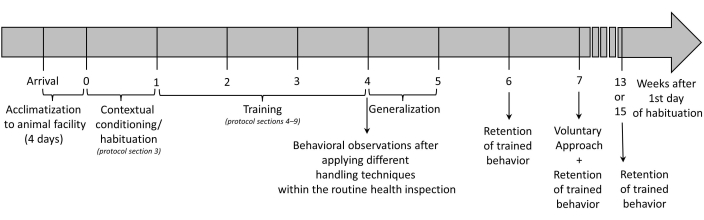
Figure 1: Time schedule. All habituation, training, and generalization sessions as well as behavioral observations were carried out in the morning before feeding and cleaning. In week 1 (i.e., four days after arrival), five contextual conditioning/habituation sessions (Monday to Friday; protocol section 3) were carried out by the animal caretakers and the corresponding author (all female), followed by a 3-week training period in weeks 2-4 (Mondays to Fridays; protocol section 4-9). Training sessions were conducted by the corresponding author who is a veterinarian specialized in laboratory animal science and experienced in training rabbits, mice, chickens, and horses. After that, behavioral observations were made on two consecutive days to investigate whether the technique used for lifting the rabbits from the floor affected their behavior. In week 5, five generalization sessions (Monday to Friday) were conducted to evaluate whether the rabbits would perform the goal behaviors learned with another person than the trainer. In week 6 and week 7 (on Thursdays) as well as in week 14 (Monday/Tuesday), the trainer tested within the context of the weekly general health inspection whether the rabbits could retain and show the goal behaviors. A voluntary approach test with the trainer and an unfamiliar person was carried out in week 7 to investigate the rabbits' behavioral responses towards familiar versus unfamiliar humans. Please click here to view a larger version of this figure.

Figure 2: Training arena. The training arena (see Table of Materials) was set up a few minutes before the training began. (A) To facilitate transport and installation, the arena consisted of two pieces, which were connected to each other in the pen. (B) Two rows of transparent plastic panels created an arena of approximately 136 cm × 90 cm × 70 cm. The door was attached to the other panels using cable ties allowing to open and close it. The door can be locked using a clip. As the walls of the training arena were transparent, a rabbit had visual, olfactory, and acoustical contact with the group members when it entered the training arena. A low stool/step as a seat for the trainer and, depending on the goal behavior to be trained, a scale or a transport box can be placed in the arena. Please click here to view a larger version of this figure.
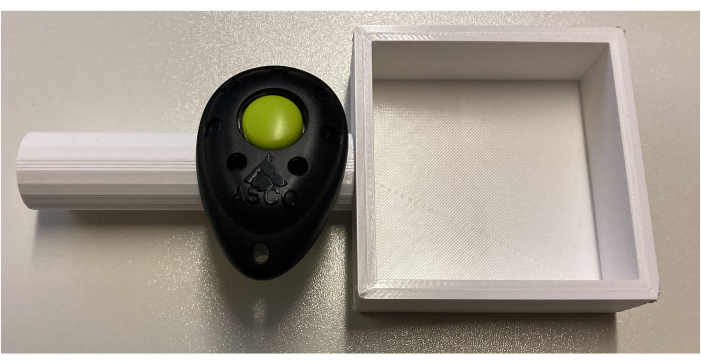
Figure 3: Reward bowl with integrated clicker. The reward bowl was 3D printed using white polylactic acid (PLA). Size of square bowl: 8 cm × 8 cm × 3 cm; size of cylindrical handle: 9.5 cm × 2.3 cm. A finger clicker (see Table of Materials) was attached to the handle. A 3D print file for the reward bowl can be found in Supplementary Coding File 1. Please click here to view a larger version of this figure.

Figure 4: Voluntary approach test. (A) In the two 5-min trials, the familiar trainer and an unfamiliar female person sat opposite each other in the pen, with the back facing the wall of the pen. A house and a tunnel were placed near the other two walls at the same distance from both persons. (B) The duration time spent interacting with a person was analyzed for each rabbit. A rabbit interacted with a person when all four paws were in the square of 70 cm × 70 cm around a person or on the border line of this square. The symbols indicate the data of each individual animal. Please click here to view a larger version of this figure.

Figure 5: Effects of handling techniques on the rabbits' behavior. (A-F) Illustrations of behavioral data collected from seven rabbits after they were handled either by the transport box or by the conventional technique (i.e., they were restrained by the scruff of their neck and lifted on the arm). Since trainer and transport box were considered as "handling devices", (A) This panel shows the sum of panel B and C. The symbols indicate the data of each individual animal. Please click here to view a larger version of this figure.
| Rabbit | Number of training sessions needed to train the goal behavior | ||||
| Following the target | Weighing | Entering transport box | Rearing | Jumping on lap | |
| #1 | 1 | 1 | 2 | 2 | 2 |
| #2 | 1 | 1 | 4 | 1 | 5 |
| #3 | 2 | 1 | 3 | 1 | 4 |
| #4 | 7 | 2 | 1 | 3 | 2 (step 9.2) |
| #5 | 2 | 1 | 3 | 1 | 3 |
| #6 | 2 | 1 | 2 | 1 | 1 |
| #7 | 8 | 1 | 2 | 2 | 3 (step 9.3+) |
| #8 | 2 | 1 | 2 | 1 | 1 |
| #9 | 2 | 1 | 2 | 1 | 2 |
| #10 | 2 | 2 | 3 | 3 | 5 (step 9.3) |
| #11 | 2 | 1 | 2 | 2 | 4 |
| #12 | 2 | 1 | 1 | 1 | 1 |
| #13 | 2 | 3 | 1 | 2 | 4 |
| Median (25th–75th percentile) | 2 | 1 | 2 | 1 | 2.5 |
| (2–2) | (1–1.5) | (1.5–3) | (1–2) | (1–4)* | |
Table 1: Number of sessions needed to train the goal behaviors. If a rabbit did not learn the final step of a goal behavior, the last training step reached is indicated in brackets.
Definition of a training session: approximately 30 mins per group (6-7 animals); Mondays to Fridays over three weeks; starts when the trainer sits in the pen and is prepared to begin the training; ends when either none of the rabbits participates in the training anymore or all rabbits reached a final step of a goal behavior; an animal can perform more than one trial per session.
* Rabbits #4, #7, #10 were excluded from this calculation since they did not reach the final step of "jumping on lap".
| Rabbit | Number of training sessions until final step of goal behavior was reached | |||
| Weighing (5 training steps) | Entering transport box (6 training steps) | Rearing (3 training steps) | Jumping on lap (9 training steps) | |
| #1 | 1 | 3 | 1 | 1 |
| #2 | 1 | 3 | 1 | 1 |
| #3 | 1 | 3 | 1 | F (9.3) |
| #4 | F | F | F | 3 (9.2) |
| #5 | 2 | 3 | 2 | 2 |
| #6 | 1 | 1 | 3 | 3 |
| #7 | 1 | 1 | 3 | 3 (9.3+) |
| #8 | 1 | 1 | 1 | 3 |
| #9 | 1 | 1 | 1 | 3 |
| #10 | 1 | 3 | 3 | 3 (9.3) |
| #11 | 1 | 1 | 3 | F (9.3) |
| #12 | 1 | 1 | 3 | 3 |
| #13 | 1 | 3 | 2 | 5 |
| Median (25th–75th percentile) | 1 | 2 | 2 | 3 |
| (1–1) | (1–3) | (1–3) | (1.25–3) | |
| (excluding #4) | (excluding #4) | (excluding #4) | (excluding #3, #4, #7, #10, #11) | |
Table 2: Generalization. In five sessions (Monday to Friday), an animal caretaker familiar to the rabbits asked the rabbits to perform the final steps (or the last step reached) of the trained goal behaviors. If the final step of a goal behavior was not reached, the last training step reached is indicated in brackets. F (failure) was indicated when an animal did not show the last step of a goal behavior previously reached in the training. Definition of a session: Monday to Friday over one week; starts when the animal caretaker and trainer sit in the pen; ends when either none of the rabbits participates (anymore) or all rabbits showed the final step (or the last step reached) of a desired goal behavior; an animal can perform more than one trial per session.
Supplementary Coding File 1: 3D print file "reward bowl". Polylactic acid (PLA) can be used for the print. Please click here to download this File.
Supplementary File 1: Documentation sheet for six rabbits. The sheet should be printed or opened on a tablet to document the training progress of each rabbit. In each training session, it must be noted which training steps the individual animals reached or whether adaptations to the protocol were required. Any special occurrences (e.g., external factors, impaired health status) should also be documented. Please click here to download this File.
Supplementary File 2: Simplified training protocols. The tables describe the steps of the protocol sections 3-9 in a simplified manner. For further detail, the protocol steps of the main manuscript should be read. Please click here to download this File.
Discussion
The training protocols were developed to refine routine procedures such as handling, health inspections, and weighing in laboratory rabbits. Their feasibility was evaluated in this explorative study using thirteen female New Zealand White rabbits. The training protocols could be reliably applied to successfully train the rabbits. Most rabbits were able to learn the goal behaviors defined in the training protocols within less than the 3-week training period, remembered them after 1-week training breaks, and generalized them to another person than the trainer. Few adaptations to the protocol had to be made to meet the need of individual animals. The main finding of the present study was that the refined handling technique for picking up rabbits, as described in the training protocols, was less aversive than the conventional handling technique. Interestingly, the trained rabbits showed their exploratory behavior not only towards the familiar trainer but also an unfamiliar person in a voluntary approach test.
Meaning of the target
The target served as a basis for the present training protocol. When introducing the target, the animals learned that their behavior affected the environment and generated consequences. Introducing the target builds trust between the human and the animal, as demonstrated by rabbit #4, it took 7 training sessions before following the target stick into the training arena but learned the following goal behaviors quickly (i.e., within 1-3 trainings sessions). This rabbit #4 seemed to gained trust in the trainer during the target introduction, which facilitated the training of the other goal behaviors. However, this rabbit still lacked trust in other persons and was not willing to show most of the goal behaviors in the generalization sessions.
It must be noted that the target was not defined as endpoint in some protocol sections. Instead, for example, the animals had to follow the target for a variable number of hops or stay on the scale for a variable number of seconds. Variable rewarding pattern was chosen to increase and maintain the rabbits' attention and motivation in the training.
Signals
After the rabbits had successfully performed step 5.1, in all following training sessions, the trainer placed the target in close distance to the rabbit's nose to signal the rabbit that the training trial started. If the rabbit touched the target with the nose/mouth, willingness to participate in the training was considered and the training began.
The present protocols did not include any further signals, e.g., the scale, the transport box, or the hand were not considered signals. Instead, the target was used to lead the animal into the training arena, onto the scale, into the transport box, into the air (rearing) or onto the trainer's lap. This means that the goal behaviors "weighing", "entering transport box", "rearing", and "jumping on lap" were modifications of "following the target". The reason for this was the requirements for the training protocol: it should be feasible to be carried out by the staff of animal facilities, that may not be experts in animal training, and easily integrated into the daily work routine. Therefore, the protocols must be efficient and achieve the goal behaviors quickly.
However, the hand that is placed in front of the rabbit (step 8.3), the scale or the transport box also have the potential to become both a signal and a target for the paws. Therefore, it may be possible to define further steps that go beyond the present protocols and do not require the use of the target stick. For example, as soon as the rabbit sees the scale, the scale signals the rabbits to jump onto it with all four paws.
Adaptations of the protocols
Although it may be expected that the phenotype of almost genetically identical laboratory animals is very similar, there are behavioral "differences between individuals that are consistent over time and across situations [and] are referred to as personality"55, e.g., some animals are rather shy and others bold56. It may take shy, less explorative animals longer to learn the defined goal behaviors of the protocol (e.g., rabbit #4). Even if standard training protocols may be suitable for the majority, training has to consider the needs of an individual animal and adapt to it, when necessary26. Thus, additional smaller interim steps should be defined for those rabbits that fail to learn a training step of the protocol. The additional interim training steps should help them to successfully proceed towards the following step. Especially because training plans are developed in theory and then tested in practice, it may become apparent that additional training steps are required to train a particular goal behavior.
With respect to the present training protocols, some interim training steps had to be added for the goal behaviors "following the target", "entering transport box", "rearing", and "jumping on lap", as described in detail in the section on the representative results since individual animals failed to continue with the following training step. Interestingly, the interim steps 8.2+ and 9.3+ were required by most rabbits, emphasizing their importance. Therefore, these steps were added as a note to the training protocols.
Alternatively, to the defined step 8.2+, the trainer could place a hand on the floor with the palm facing upwards and let the rabbit step on the hand with one and eventually both front paws. Moreover, it is conceivable that a rabbit requires additional interim steps before step 9.3+, e. g., first the rabbit places one hind paw and after that both hind paws onto the trainer's lap. If a rabbit does not accept to be touched in steps 9.5-9.9, the duration of touching the different body parts could be gradually increased. Moreover, initially only the index and middle fingers could be used to stroke the animals with feather-light pressure. Then the number of fingers used for touching and the pressure may be increased in several steps.
Refinement of handling techniques
It can be assumed that handling is highly aversive, especially in rabbits with a shy personality trait. Rabbits are terrestrial prey animals and being lifted (i.e., picked up from the floor) or restrained (i.e., held in the arms of a human) for a health inspection and experimental procedure is likely to cause anxiety and distress. One option to refine handling methods was introduced in the training protocols: instead of restraining the rabbit by the scruff of the neck and lifting the rabbit onto the other arm, the rabbit can be led with the target stick into the box and carried in the box to the examination table, as previously suggested50,57, where the rabbit is gently transferred from the box to the table. Alternatively, the top of the box can be removed, or the rabbit can be guided with the target stick out of the box.
The behavioral observations performed after the rabbits were picked up using either the conventional handling technique or the transport box revealed that the conventional handling technique was associated with more stress- and anxiety-related behavior than the alternative technique. This conclusion was drawn from the high number of animals refusing the food reward on the examination table and the increased time duration spent hiding in the shelters when the conventional handling technique was applied. Interestingly, the handling technique did not affect the time of interaction with the trainer, indicating that the handling process may have not impaired the human-animal-relationship. However, besides the trainer, the transport box also served as "handling device" (i.e., the handling device of the conventional technique was the trainer, the handling devices of the alternative technique were both the trainer and the transport box). Therefore, the time of interaction with the transport box was also analyzed. Although the rabbits had just been picked up with the transport box, they spent more time interacting with the box or in the box than when being picked up by the conventional technique. This suggested that the transport box could be associated with a positive affect. When comparing the duration spent interacting with both "handling devices" (i.e., sum of time duration spent interacting with the box and the trainer), the box handling technique increased the time duration interacting with the "handling devices", i.e., this technique had a clear positive effect on the behavioral response of the rabbits towards the "handling devices" in anticipation of being handled. Similar findings were made in laboratory mice, demonstrating that gentle handling techniques and training reduced stress and anxiety: animals that were picked up using a tunnel or the cupped hands spent more time voluntarily interacting with the "handling device" and showed less anxiety-related behavior than tail-handled mice12. Training appeared to strengthen this effect. Leidinger et al. demonstrated that gentle-handled (tunnel/cup) mice showed less urination, defecation, and vocalization when being restrained by the scruff of their neck and less floating behavior in the Morris Water Maze Test when they were trained using PRT in comparison to untrained mice13.
Feasibility of the protocols for daily work - training duration, retention, and generalization
The number of training sessions required to learn a goal behavior depended on the individual animal and the goal behaviors, which comprised a different number of steps ranging from section 3 to section 9 of the protocol presented above.
According to the number of animals that succeeded in learning a goal behavior and the number of adaptations that had to be made to the protocols for the individual animals, the training steps had different difficulty levels. The behavior "following the target" was the first training experience of the rabbits and, therefore, it took longer for some animals to train on this behavior than the other goal behavior, as discussed above. While all animals could be trained on "weighing" according to the present protocol, additional interim steps were required for "entering transport box" by two animals and for "rearing" as well as "jumping on lap" by almost all rabbits. This may be explained by the degree of physical contact between animal and trainer which was necessary for performing the different goal behaviors. "Weighing" and "entering transport box" did not involve any physical contact between animal and human. The final step of "rearing" (8.3) and the steps 9.2-9.4 of "jumping on lap" required the rabbits to make physical contact with the trainer. Additionally, the trainer touched the rabbit's shoulder, back, rump, ears, or paws in steps 9.5-9.9 of "jumping on lap", increasing the degree of physical contact between animal and trainer. Accepting being touched was more challenging for some rabbits than for others. As discussed above, it was beneficial to adapt the training protocols of these goal behaviors and add interim steps.
However, three rabbits required additional training sessions to complete the goal behavior "jumping on lap" (#4, #7, #10). Physical impairments that prevented these animals from jumping onto the trainer's lap could be excluded. Moreover, the rabbits were able to jump onto their houses, the heights of these were higher than the trainer's lap.
It was noticeable that two of these three rabbits (#4 and #10) needed longer to get used to the trainer as well as the food reward in the habituation sessions and partially needed more training sessions to reach the final step of other goal behaviors. This was also true for rabbit #7, which had an injury at the tail due to fights within the group since the fourth habituation session. Therefore, rabbit #7 was picked up, transferred to the examination table, treated, and inspected daily for 15 days, which may have resulted in increased caution towards humans. On the one hand, it is crucial to note that the training performance can be affected by, for instance, an impaired health status, increased stress levels, or a disturbed human-animal relationship due to other interventions. On the other hand, these observations demonstrated the importance of habituation to the trainer and the food reward. Some animals may require longer to get familiar with the presence of the trainer and accept the food reward from the trainer. If additional habituation sessions had been conducted, rabbit #4 and #10 may have performed better in the training sessions. The relevance of habituating rabbits to humans has already been reported in the literature. The commercial breeder, from which the rabbits used in this study were purchased, recently introduced regular petting sessions, which reduced the stress-related behavior and eliminated aggressions58. In an earlier study, petting and handling of young rabbits were demonstrated to decrease anxiety-related behavior, increase their weight gain, and reduce the mortality rate59.
Once the rabbits had learned the different goal behaviors, they were still able to display them after two short (one week) and a long (approximately 7.5-9.5 weeks) training breaks, except from individual exceptions. These observations may indicate that it is sufficient to ask the rabbits to perform the trained goal behaviors once a week when the general examination is performed, and the room/pen is cleaned.
For the feasibility of the protocol for daily work life, it is also crucial that the rabbits generalize the trained goal behaviors to other persons than the trainer. In case of vacation or illness, another person has to continue the training and care for the animals. The majority of rabbits (twelve out of thirteen) generalized the goal behaviors "weighing", "entering transport box", and "rearing" to the animal caretaker, although, in some cases, it took the rabbits more than one training sessions to show the desired behavior. "Weighing" seemed to generalize best; followed by "entering transport box" and "rearing". However, "jumping on lap" appeared to be more difficult to generalize to another person. It took the animals longer to demonstrate the desired behavior (9.9.) and two rabbits, that previously learned the final step 9.9, failed to show this goal behavior, possibly due to the higher physical contact needed (see above). One rabbit (#4) did not show any steps of the goal behaviors "weighing", "entering transport box", and "rearing" and was not interested in interacting with the animal caretaker. Rabbit #4 was one of the animals that needed longer to get used to the trainer and the food reward in the habituation sessions. This may indicate that, for some individuals, additional sessions in which the animal caretakers spend time with the rabbits, habituate them to accept the food reward from them and build up a positive bond are beneficial23. Rabbits may be able to distinguish between different persons, as demonstrated for rats60. Further factors, that have the potential to affect the rabbits' performance in the sessions with the trainer and the animal caretaker may be unconscious signals the trainer gave the animals during the training sessions, e.g., the position of the target stick or reward bowl, the body position or movement. If the trainer is not aware of these signals, they will not be documented and the other persons will not mimic these signals.
Furthermore, the training skills of the persons working with the animals, including the routine of handling the target stick and reward presentation, can influence the behavior of the animals. Besides knowledge of learning principles and animal communication, practical experiences are needed to successfully train an animal61 and retrieve a goal behavior. Since generalization sessions involving a skilled and an unskilled person were not compared, the relevance of the factor "training skills" cannot be determined. However, to the authors' knowledge, a large proportion of the laboratory animal staff is not trained in animal training and thus the conditions under which the generalization sessions were performed (i.e., involving an animal caretaker with only little previous experiences in clicker training) represented a realistic setting in laboratory animal facilities.
The representative data of the protocols provide animal facilities an idea of the workload associated with training the different goal behaviors. The data may help animal facilities to create their own work schedules when implementing (parts of) the protocol. Depending on the individual animal and goal behaviors, some additional time should be reserved for the generalization process. However, the time duration may vary when working with male rabbits or another rabbit breed. In the animal facilities, discussion should be held on whether appropriate time exists and what needs to be changed to allow time for animal training.
Besides the time required for training the animals, it must be considered that training needs skilled trainers and teaching the staff how to train animals can also be time-consuming. If training was a mandatory part of the education of the laboratory animal personnel, i.e., animal caretakers, veterinarians, and researchers, the implementation of animal training in facilities would be facilitated and would take less time. According to Annex III of the Directive 2010/63/EU, "establishments shall set up habituation and training programs suitable for the animals, the procedures and length of the project", i.e., animal training is required by law. In Germany, such programs must be submitted when applying for an animal testing license. This requires that persons planning animal experiments and working with laboratory animals are skilled in animal training. However, at least in Germany, animal training is not part of the training schedule of animal caretakers in the field of research and clinic62,63,64. Moreover, it is not explicitly mentioned in the EU recommendations for education and training framework65. Therefore, as long as training has not been implemented in these regulations, continued professional development focusing on positive reinforcement training needs more attention. The laboratory animal personnel need to learn the principles of learning and training techniques, the needed criteria, the transfer of procedure between trainers, record keeping, and how to respond to animals that are not participating in a desired manner to ensure consistency and predictability.
Human-animal-interaction
The intensive human-animal-interaction-time during the training sessions provides an optimal setting for strengthening the relationship between the individual rabbits and the trainer26,66. A positive human-animal-relationship is beneficial for the animals' well-being since it can reduce their stress levels in husbandry and experimental settings67. In the present training protocols, the trainer considers the agency of the rabbits and they can decide to participate (or not participate) in the training on a voluntary basis. Providing the animals with agency is beneficial for their well-being 16 and should therefore be pursued in experiments as well as housing and husbandry. There are different behavioral agency levels68; participating in PRT may be attributed to the level of action driven agency, i.e., "actively behaving to achieve current outcomes [e.g., procure food]"68.
When analyzing the voluntary approach of the rabbits towards the trainer and an unfamiliar person, an intensive human-animal-interaction could be observed. The results revealed that all rabbits, except from one animal in the 1st trial (#12), interacted with both the trainer and the unfamiliar person. They appeared to recognize the trainer since they showed a clear preference for interacting with the trainer in the 1st trial and some of them jumped with all four paws onto the trainer's lap; a behavior that was not displayed towards the unfamiliar person. Although the rabbits spent more time interacting with the trainer than the unfamiliar person in the 1st trial, the interaction time did not differ anymore in the 2nd trial. A reason for this observation may be that the rabbits expected to receive a food reward from the trainer in the 1st trial and, due to lack of food rewards in the voluntary approach test, they did not spend more time with the trainer in the 2nd trial anymore. These data nevertheless emphasized that the trained rabbits quickly habituated to the presence of an unfamiliar person and none of them was too shy to interact. In contrast, they were very explorative and interested in the unfamiliar person. However, since an untrained control group was not investigated, the effect of training on the voluntary approach behavior of the rabbits is unclear.
A hypothesis explaining the behavior of rabbit #12 in the 1st trial is that this individual still had to habituate to the presence of the unfamiliar person in the 1st trial and was more interested in interacting with both the trainer (70 seconds) and the unfamiliar person (9 seconds) in the 2nd trial. Rabbits have different personality traits which may affect the level of comfort around unfamiliar persons and in turn the latency to approach or the interaction time duration with a person69,70.
Limitations
We are aware that all rabbits in the pen/room, not only the one participating in the training can hear the click (i.e., the conditioned reinforcer) during a training session and its reinforcing effect may be weakened since the food reward (i.e., natural/unconditioned reinforcer) is not presented. If a rabbit outside the training arena shows a trained behavior and hears the click, but no food is presented (and this scenario occurs several times), the trained behavior may be extinguished. This phenomenon is referred to as extinction64,71. However, since all goal behaviors of the present protocols depend on the target presented by the trainer, extinction is unlikely to occur in our training setting.
Since the walls of the training arena were transparent and the training arena was located in the pen, the rabbits could see, hear, and smell each other during the training, which is a clear welfare-related advantage. Moreover, the rabbits may have observed their group members during the training sessions and learned from each other. In rats, it was previously shown, that individuals learned to perform a goal behavior by observing their cage mate being trained by PRT45. This fact may be considered as both an advantage and disadvantage. The learning progress of the animals may be faster when they can observe each other. However, the data of the individual animals may be influenced by the performance of the group members and may not be attributed solely to the training of the individual animal. Thus, training animals without any contact with their group members or single-housed rabbits could take longer.
Behavioral observations of the individuals (in the voluntary approach test and after applying the different handling techniques) were carried out in their familiar social environment and group to avoid stress and distraction caused by a novel environment and separation from their group, which in turn would have affected the behavioral observations. The disadvantage is, however, that the rabbits may have influenced each other's behavior during the observation sessions.
The effects of the handling techniques were only investigated in seven animals involving the trainer as person handling the animals. The authors are planning a follow-up study including an a priori sample size calculation to reproduce the findings with other handlers and to further examine the differences between the handling techniques.
All humans involved in training, handling, and the voluntary approach test were female. It was not investigated whether the training performance of the rabbits or their behavior would vary if male persons were involved.
The present training protocols should give the reader an idea of what can be trained in rabbits but do not comprise all potential goal behaviors that would be beneficial to train in a laboratory rabbit. For instance, marking a rabbit as suggested in the protocol section on general requirements would also be worth training using PRT.
As pointed out further above, the choice of the right reward is not trivial. Due to hygiene restrictions, the use of fresh herbs as food rewards is not allowed in some laboratory animal facilities and, therefore, less appropriate food rewards such as sunflower seeds or grain-based foraging treats must be used. With respect to the decision on the food reward, some rules and regulations of current laboratory practices are detrimental to animal well-being and effective training and, therefore, may need to be reconsidered on a case-by-case basis. It may also be possible to use alternatives to food rewards, e.g., gentle touches or interactions with the trainer or enrichment items. However, the trainer must make sure for each individual animal that the alternative is to reward the animal because a reward is only a reward if the rabbit really favors it. Especially touches may not be received as rewarding by all rabbits.
Conclusions
In summary, the present study was a first step for filling the knowledge gap on suitable training protocols for laboratory rabbits. Female New Zealand White rabbits could be trained for routine husbandry procedures using PRT and generalized the goal behaviors learned to other persons, though additional time should be reserved for the generalization process. Goal behaviors without physical contact seemed to be easier to learn than behaviors that required physical contact to humans. After the animals successfully completed the training of a goal behavior, it was sufficient to retrieve them once a week in the context of the general examination and pen cleaning. Training protocols considered to be generally applied to all rabbits are convenient, but the trainer must be aware that, in some cases, it must be adapted to the needs of the animal. The results on handling techniques suggested that picking the rabbits up with the transport box instead of restraining them by the scruff of their neck and lifting them on the arm was less aversive. All in all, the present protocols provide feasible instructions for the habituation and training process of rabbits and can serve as refinement in laboratory animal facilities.
Animals must not suffer due to saving labor, time or money (at least according to the German Animal Welfare Act72). It is important to care for and handle all animals in the gentlest way possible. Since untrained animals suffer to a higher degree from anxiety and distress caused by experimental and routine husbandry procedures than their trained counterparts13, training is a simple refinement measure to effectively prevent them from experiencing negative affective states.
Disclosures
The authors declare no conflicts of interest related to this publication.
Acknowledgements
The authors thank the animal caretakers for taking care of the rabbits and their compassionate and dedicated work. Thanks to Kai Diederich for proofreading the manuscript.
Materials
| Name | Company | Catalog Number | Comments |
|---|---|---|---|
| Bed-r’Nest | The Andersons, Inc., Maumee, USA | The successful implementation of the protocol does not depend on this particular product. You could use comparable products by other companies. | |
| Finger Clicker | ASCO | https://ascoshop.de/products/fingerclicker | |
| G*Power | version 3.1.9.7 | ||
| Heu-Proppen | Ssniff Spezialdiäten GmbH, Soest, Germany | The successful implementation of the protocol does not depend on this particular product. You could use comparable products by other companies. | |
| IBM Corp. Released 2020. IBM SPSS Statistics for Windows, Armonk, NY: IBM Corp | IBM Corp | Version 27.0. | in the manuscript referred to as "software for advanced statistical analysis" |
| Kaninchen Haltung + 25 mg/kg Salinomycin-Natrium-Sondermischung | Ssniff Spezialdiäten GmbH, Soest, Germany | The successful implementation of the protocol does not depend on this particular product. You could use comparable products by other companies. | |
| Lignocel block | Lignocel J. Rettenmaier &Söhne GmbH + Co KG, Rosenberg, Germany | The successful implementation of the protocol does not depend on this particular product. You could use comparable products by other companies. | |
| Lillebro geschälte Sonnenblumenkerne”, Martina GmbH, München, Germany) and Rainbow Foraging Bits (Bio-Serv, Flemington, USA) | Martina GmbH, München, Germany | The successful implementation of the protocol does not depend on this particular product. You could use comparable products by other companies. | |
| Microsoft Excel for Microsoft 365 MSO | Microsoft Corporation | Version 2305 | in the manuscript referred to as "spread sheet" |
| New Zealand White rabbits | Charles River Laboratories France | ||
| Plattformwaage DE 35K5DL | KERN & SOHN GmbH, Balingen-Frommern, Germany | The successful implementation of the protocol does not depend on this particular product. You could use comparable products by other companies. | |
| Premium scientific bedding (fine & flake) | SAFE, Augy, France | The successful implementation of the protocol does not depend on this particular product. You could use comparable products by other companies. | |
| Rainbow Foraging Bits | Bio-Serv, Flemington, USA | The successful implementation of the protocol does not depend on this particular product. You could use comparable products by other companies. | |
| Snackball für Kaninchen – 7 cm | TRIXIE Heimtierbedarf GmbH & Co. KG, Tarp, Germany | The successful implementation of the protocol does not depend on this particular product. You could use comparable products by other companies. | |
| Target stick with integrated clicker | TRIXIE Heimtierbedarf GmbH & Co. KG, Tarp, Germany | The successful implementation of the protocol does not depend on this particular product. You could use comparable products by other companies. | |
| Trixi Transportbox Capri Open Top | TRIXIE Heimtierbedarf GmbH & Co. KG, Tarp, Germany | The successful implementation of the protocol does not depend on this particular product. You could use comparable products by other companies. | |
| Weiden-Heuball | JR FARM GmbH, Holzheim-Pessenburgheim, Germany | The successful implementation of the protocol does not depend on this particular product. You could use comparable products by other companies. |
References
- European Commission: Alures-animal use reporting-EU system. EU statistics on the use of animals for scientific purposes under directive 2010/63/eu-section 1: Number of animals used for research, testing, routine production and education and training purposes in the EU. European Commission. , Available from: https://webgate.Ec.Europa.Eu/envdataportal/content/alures/section1_number-of-animals.html (2023).
- European Commission: Alures-animal use reporting-EU system. EU statistics database on the use of animals for scientific purposes under directive 2010/63/eu-section 2: Details of all uses of animals for research, testing, routine production and education and training purposes in the EU. European Commission. , Available from: https://webgate.Ec.Europa.Eu/envdataportal/content/alures/section2_number-of-uses.html (2023).
- Russell, W. M. S., Burch, R. L. The principles of humane experimental technique. , Methuen. (1959).
- Directive 2010/63/EU of the European Parliament and of the Council of 22 September 2010 on the protection of animals used for scientific purposes. Official journal of the European Union. , Available from: https://eur-lex.europa.eu/legal-content/EN/TXT/?uri=celex%3A32010L0063 (2023).
- Hau, J., Carver, J. Refinement in laboratory animal science; is it a cinderella subject, and is there conflict and imbalance within the 3Rs. Scandinavian Journal of Laboratory Animal Science. 21 (4), 161-167 (1994).
- Prescott, M. J., Lidster, K. Improving quality of science through better animal welfare: the NC3Rs strategy. Lab Anim (NY). 46 (4), 152-156 (2017).
- European convention for the protection of vertebrate animals. Appendix a of the european convention for the protection of vertebrate animals used for experimental and other scientific purposes (ETS No. 123). Guidelines for accommodation and care of animals (article 5 of the convention). European convention for the protection of vertebrate animals. , (2006).
- Morimoto, A., Watanabe, T., Myogin, T., Murakami, N. Restraint induced stress elicits acute-phase response in rabbits. Pflügers Archiv - European Journal of Physiology. 410 (4), 554-556 (1987).
- Rooney, N. J., et al. The current state of welfare, housing and husbandry of the English pet rabbit population. BMC Research Notes. 7, 942(2014).
- Schepers, F., Koene, P., Beerda, B. Welfare assessment in pet rabbits. Animal welfare. 18 (4), 477-485 (2009).
- Normando, S., Gelli, D. Behavioral complaints and owners' satisfaction in rabbits, mustelids, and rodents kept as pets. Journal of Veterinary Behavior. 6 (6), 337-342 (2011).
- Hurst, J. L., West, R. S. Taming anxiety in laboratory mice. Nature methods. 7 (10), 825-826 (2010).
- Leidinger, C., Herrmann, F., Thoene-Reineke, C., Baumgart, N., Baumgart, J. Introducing clicker training as a cognitive enrichment for laboratory mice. Journal of Visualized Experiments. (121), e55415(2017).
- Lambeth, S. P., Hau, J., Perlman, J. E., Martino, M., Schapiro, S. J. Positive reinforcement training affects hematologic and serum chemistry values in captive chimpanzees (pan troglodytes). American Journal of Primatology. 68 (3), 245-256 (2006).
- Reinhardt, V. Working with rather than against macaques during blood collection. Journal of Applied Animal Welfare Science. 6 (3), 189-197 (2003).
- Sueur, C., Zanaz, S., Pelé, M. Incorporating animal agency into research design could improve behavioral and neuroscience research. Journal of Comparative Psychology. 137 (2), 129-143 (2023).
- National Research Council (Us) Committee for the Update of the Guide for the Care and Use of Laboratory Animals. Guide for the care and use of laboratory animals. 8th edition. , National Academies Press (US); 2011. 3, Environment, Housing, and Management. Washington (dc). Available from: Https://www.Ncbi.Nlm.Nih.Gov/books/nbk54046/ (2023).
- Skinner, B. F. Two types of conditioned reflex: a reply to Konorski and M. The Journal of General Psychology. 16 (1), 272-279 (1937).
- Skinner, B. F. The behavior of organisms: An experimental analysis. , Appleton-Century. (1938).
- Pierce, W. D., Cheney, C. D. Behavior analysis and learning: a biobehavioral approach. , Routledge. (2017).
- Cooper, J. O., Heron, T. E., Heward, W. L. Applied behavior analysis. , Pearson UK. (2020).
- Pryor, K. Don't shoot the dog: The art of teaching and training. , Simon & Schuster. (2019).
- Brando, S., Norman, M. Handling and training of wild animals: Evidence and ethics-based approaches and best practices in the modern zoo. Animals (Basel). 13 (14), (2023).
- Heidenreich, B. An introduction to positive reinforcement training and its benefits). Journal of Exotic Pet Medicine. 16 (1), 19-23 (2007).
- Vieira De Castro, A. C., et al. Does training method matter? Evidence for the negative impact of aversive-based methods on companion dog welfare. PLoS One. 15 (12), 0225023(2020).
- Laule, G. The UFAW Handbook on the care and management of laboratory and other research animals. Hubrecht, R. C., Kirkwook, J. , John Wiley & Sons. 206-218 (2010).
- Zimbardo, P. G., Gerrig, R. J. Psychologie. 18th edition. , Pearson Studium. German edition by Ralf Graf (2004).
- Powell, R. A., Honey, P. L., Symbaluk, D. G. Introduction to learning and behavior. 5th edition. , Cengage Learning. (2017).
- Peterson, G. B. A day of great illumination: B. F. Skinner's discovery of shaping. J Exp Anal Behav. 82 (3), 317-328 (2004).
- Skinner, B. F. How to teach animals. Scientific American. 185 (6), 26-29 (1951).
- Breland, K., Breland, M. A field of applied animal psychology. American Psychologist. 6 (6), 202-204 (1951).
- Fernandez, E. J., Martin, A. L. Animal training, environmental enrichment, and animal welfare: a history of behavior analysis in zoos. Journal of Zoological and Botanical Gardens. 2 (4), 531-543 (2021).
- Ferguson, D. L., Rosales-Ruiz, J. Loading the problem loader: The effects of target training and shaping on trailer-loading behavior of horses. J Appl Behav Anal. 34 (4), 409-423 (2001).
- Fernandez, E. J., Dorey, N. R. An examination of shaping with an african crested porcupine (hystrix cristata). J Appl Anim Welf Sci. 24 (4), 372-378 (2021).
- Fernandez, E. J., Rosales-Ruiz, J. A comparison of fixed-time food schedules and shaping involving a clicker for halter behavior in a petting zoo goat. The Psychological Record. 71 (3), 487-491 (2021).
- Slater, C., Dymond, S. Using differential reinforcement to improve equine welfare: shaping appropriate truck loading and feet handling. Behav Processes. 86 (3), 329-339 (2011).
- Pfaller-Sadovsky, N., Hurtado-Parrado, C., Cardillo, D., Medina, L. G., Friedman, S. G. What's in a click? The efficacy of conditioned reinforcement in applied animal training: A systematic review and meta-analysis. Animals (Basel). 10 (10), (2020).
- Prescott, M., Bowell, V., Buchanan-Smith, H. Training laboratory-housed non-human primates, part 2: Resources for developing and implementing training programmes. Animal Technology and Welfare. 4 (3), 133-148 (2005).
- Prescott, M., Buchanan-Smith, H. Training laboratory-housed non-human primates, part i: A UK survey. Animal welfare. 16 (1), 21-36 (2007).
- Schapiro, S. J., Bloomsmith, M. A., Laule, G. E. Positive reinforcement training as a technique to alter nonhuman primate behavior: Quantitative assessments of effectiveness. Journal of Applied Animal Welfare Science. 6 (3), 175-187 (2003).
- Joint Working Group on Refinement. Refining dog husbandry and care. Eighth report of the BVAAWF/FRAME/RSPCA/UFAW joint working group on refinement. Laboratory Animals. 38, 1-94 (2004).
- Meunier, L. D. Selection, acclimation, training, and preparation of dogs for the research setting. ILAR Journal. 47 (4), 326-347 (2006).
- Thomsen, A. F., Kousholt, B. S. Transition of farm pigs to research pigs using a designated checklist followed by initiation of clicker training - a refinement initiative. Journal of Visualized Experiments. (174), e62099(2021).
- Langbein, J., Siebert, K., Nuernberg, G., Manteuffel, G. The impact of acoustical secondary reinforcement during shape discrimination learning of dwarf goats (capra hircus). Applied Animal Behaviour Science. 103 (1), 35-44 (2007).
- Leidinger, C. S., Kaiser, N., Baumgart, N., Baumgart, J. Using clicker training and social observation to teach rats to voluntarily change cages. Journal of Visualized Experiments. (140), e58511(2018).
- Poling, A., et al. Tuberculosis detection by giant african pouched rats. The Behavior Analyst. 34 (1), 47-54 (2011).
- Poling, A., et al. Using trained pouched rats to detect land mines: Another victory for operant conditioning. Journal of Applied Behavior Analysis. 44 (2), 351-355 (2011).
- Rubin, H. B., Brown, H. J. The rabbit as a subject in behavioral research. J Exp Anal Behav. 12 (4), 663-667 (1969).
- Müller, I. Clickertraining: Für Kaninchen. , Meerschweinchen & Co. (2015).
- Bradbury, A. G., Dickens, G. J. Appropriate handling of pet rabbits: a literature review. J Small Anim Pract. 57 (10), 503-509 (2016).
- Mähler, M., et al. Felasa recommendations for the health monitoring of mouse, rat, hamster, guinea pig and rabbit colonies in breeding and experimental units. Laboratory Animals. 48 (3), 178-192 (2014).
- Faul, F., Erdfelder, E., Lang, A. G., Buchner, A. G*power 3: a flexible statistical power analysis program for the social, behavioral, and biomedical sciences. Behavior Research Methods. 39 (2), 175-191 (2007).
- Friard, O., Gamba, M. Boris: A free, versatile open-source event-logging software for video/audio coding and live observations. Methods in Ecology and Evolution. 7 (11), 1325-1330 (2016).
- Landis, J. R., Koch, G. G. The measurement of observer agreement for categorical data. Biometrics. 33 (1), 159-174 (1977).
- Réale, D., Dingemanse, N. J., Kazem, A. J., Wright, J. Evolutionary and ecological approaches to the study of personality. Philosophical transactions of the Royal Society of London. Series B, Biological sciences. 365 (1560), 3937-3946 (2010).
- Mullan, S. M., Main, D. C. Behaviour and personality of pet rabbits and their interactions with their owners. Veterinary Record. 160 (15), 516-520 (2007).
- Mackie, J., Patel, C. Bsava manual of practical veterinary welfare. Rendle, M., Hinde-Megarity, J. , British Small Animal Veterinary Association. 146-165 (2022).
- Dhondt, K. P., Rabany, B., Méon, B., Leal, A., Paillet, G. Rabbit human habituation program during breeding reduced significantly stress related signs during acclimatization period. In Abstracts of 15th FELASA congress 2022. Laboratory Animals. 56, 23(2022).
- Jezierski, T. A., Konecka, A. M. Handling and rearing results in young rabbits. Applied Animal Behaviour Science. 46 (3), 243-250 (1996).
- Davis, H., Taylor, A. A., Norris, C. Preference for familiar humans by rats. Psychonomic Bulletin & Review. 4 (1), 118-120 (1997).
- Meier, J., Hillmann, E., Theby, V., Fischer-Tenhagen, C. Train the trainer: what is needed to train goats for experiments. In Abstracts of 15th FELASA congress 2022. Laboratory Animals. 56, 24(2022).
- BGBL. I S. Verordnung über die Berufsausbildung zum Tierpfleger/zur Tierpflegerin vom 3. , BGBL. I S. 1093(2003).
- Pavlov, P. I. Conditioned reflexes: An investigation of the physiological activity of the cerebral cortex. Annals of Neurosciences. 17 (3), 136-141 (2010).
- Skinner, B. On the rate of extinction of a conditioned reflex. The Journal of General Psychology. 8 (1), 114-129 (1933).
- Directorate-General for Environment (European Commission). Caring for animals aiming for better science - directive 2010/63/eu on protection of animals used for scientific purposes - education and training framework. Directorate-General for Environment (European Commission). , (2018).
- Rault, J. L., Waiblinger, S., Boivin, X., Hemsworth, P. The power of a positive human-animal relationship for animal welfare). Frontiers in Veterinary Science. 7, 590867(2020).
- Bayne, K. Development of the human-research animal bond and its impact on animal well-being. ILAR J. 43 (1), 4-9 (2002).
- Špinka, M. Animal agency, animal awareness and animal welfare. Animal Welfare. 28 (1), 11-20 (2019).
- Ellis, C. F. Exploring domestic rabbit (oryctolagus cuniculus) personality utilising behaviour coding, behaviour testing and a novel behaviour rating tool. , University of Northampton. (2020).
- Gomezdelatorre Clavel, M. G., Youngblood, M., Lahti, D. Relationship between personality and cognitive traits in domestic rabbits (Oryctolagus cuniculus). bioRxiv. , (2020).
- Pavlov, P. I. Conditioned reflexes: An investigation of the physiological activity of the cerebral cortex. Annals of Neurosciences. 17 (3), 136(2010).
- Tierschutzgesetz in der Fassung der Bekanntmachung vom 18. Mai 2006 (BGBL. I S. 1206, 1313), das zuletzt durch Artikel 105 des Gesetzes vom 10. August 2021 (BGBL. I S. 3436) geändert worden ist. , Available from: www.gesetze-im-internet.de/tierschg/BJNR012770972.html (2023).
Reprints and Permissions
