Here, we present a protocol to obtain the pVAX1-PRRSV expression vector by introducing suitable restriction sites at the 3' end of the inserts. We can linearize the vector and join DNA fragments to the vector one by one through homologous recombination technology.
Method Article
A Seamless Cloning Approach for Porcine Reproductive and Respiratory Syndrome Virus Expression Vector Construction
* These authors contributed equally
Opens in a new tab
In This Article
Summary
Loading...
$$\rightleftharpoonup{xx}$$
$$\longleftharp{xx}$$,
$$\longrightharp{xx}$$,
Abstract
Loading...
$$\rightleftharpoonup{xx}$$
$$\longleftharp{xx}$$,
$$\longrightharp{xx}$$,
The construction of gene expression vectors is an important component of laboratory work in experimental biology. With technical advancements like Gibson Assembly, vector construction becomes relatively simple and efficient. However, when the full-length genome of Porcine Reproductive and Respiratory Syndrome Virus (PRRSV) cannot be easily amplified by a single polymerase chain reaction (PCR) from cDNA, or it is difficult to acquire a full-length gene expression vector by homologous recombination of multiple inserts in vitro, the current Gibson Assembly technique fails to achieve this goal.
Consequently, we aimed to divide the PRRSV genome into several fragments and introduce appropriate restriction sites into the reverse primer for obtaining PCR-amplified fragments. After joining the previous DNA fragment into the vector by homologous recombination technology, the new vector acquired the restriction enzyme cleavage site. Thus, we can linearize the vector by using the newly added enzyme cleavage site and introduce the next DNA fragment downstream of the upstream DNA fragment.
The introduced restriction enzyme cleavage site at the 3' end of the upstream DNA fragment will be eliminated, and a new cleavage site will be introduced into the 3' end of the downstream DNA fragment. In this way, we can join DNA fragments to the vector one by one. This method is applicable to successfully construct the PRRSV expression vector and is an effective method for assembling a large number of fragments into the expression vector.
Introduction
Loading...
$$\rightleftharpoonup{xx}$$
$$\longleftharp{xx}$$,
$$\longrightharp{xx}$$,
As an essential technique to construct DNA-based experimental tools for expression in prokaryotic and eukaryotic cells, molecular cloning is a very important component of experimental biology. Molecular cloning involves four processes: the acquisition of insert DNA, ligation of the insert into the appropriate vector, transformation of the recombinant vector into Escherichia coli (E. coli), and identification of the positive clones1. So far, multiple methods have been adopted for joining DNA molecules by using restriction enzymes2,3 and PCR-mediated recombination4,5,6. Homologous recombination, known as seamless cloning technology, is the group of cloning methods, which allows sequence-independent and scarless insertion of one or more fragments of DNA into a vector. This technology includes sequence- and ligation-independent cloning (SLIC), Seamless Ligation Cloning Extract (SLiCE), In-Fusion, and Gibson Assembly. It employs an exonuclease to degrade one strand of the insert and a vector to generate cohesive ends, and either in vivo repair or in vitro recombination to covalently join the insert to the vector by forming phosphodiester bonds. The ability to join a single insert to a vector at any sequence without any scars is very appealing. Furthermore, the technology has the ability to join 5-10 fragments in a predetermined order without sequence restrictions.
As one of many recombinant DNA techniques, the Gibson Assembly technique, currently the most effective cloning method7,8, is a robust and elegant exonuclease-based method to assemble one or multiple linearized DNA fragments seamlessly. The Gibson Assembly reaction is performed under isothermal conditions using a mixture of three enzymes,namely, 5' exonuclease, high-fidelity polymerase, and a thermostable DNA ligase. Single-strand 3´ overhangs created by the 5'-3' exonuclease contribute to the annealing of fragments that share complementarity at one end. The high-fidelity polymerase effectively fills the gaps in the annealed single-strand regions by adding dNTPs, and the thermostable DNA ligase seals the nicks to form joint DNA molecules8. Hence, this technical method has been widely used for the construction of gene expression vectors.
Porcine reproductive and respiratory syndrome (PRRS) is a viral disease that leads to reproductive impairment and respiratory failure in pigs caused by PRRSV at any age9. The syndrome is manifested as fever, anorexia, pneumonia, lethargy, depression, and respiratory distress. Moreover, clinical signs, including red/blue discoloration of the ears, have been observed in some epidemics. As a member of the family arterivirus, PRRSV is widely transmitted to pork-producing countries by direct contact and exchange of fluids, including urine, colostrum, and saliva. Due to the spread of PRRSV in the United States, the total economic losses of the pork industry have been estimated to be approximately $664 million per year, based on the breeding scale of 5.8 million sows and 110 million pigs10,11. The Animal and Plant Health Inspection Service report shows that 49.8% of unvaccinated pigs show the presence of PRRSV in serum12 and low levels of PRRSV in infected pigs are excreted through saliva, nasal secretions, urine, and feces13. Multiple strategies have been implemented to control PRRSV propagation14,15,16. In addition to elimination procedures to create completely virus-negative populations or improving biosafety and management, administering vaccines is an effective means of controlling PRRS.
PRRSV is an enveloped, single-stranded, positive-sense RNA virus with a length of approximately 15 kilobases (kb). The PRRSV genome consists of at least 10 open reading frames (ORFs), a short 5' untranslated region (5' UTR), and a poly(A) tail at the 3' terminus (Figure 1A)17. The genome of a negative-stranded RNA virus is non-infectious whereas the genome from positive-stranded RNA viruses is infectious. There are two main strategies for RNA and DNA transfection for generating virus progeny18. However, cloning the full-length fragment corresponding to the RNA genome is crucial for the construction of infectious clones. Due to the long and complex nature of the PRRSV genome, the full-length genome cannot be easily obtained through PCR at once. Additionally, although the artificial synthesis of PRRSV genes is an effective solution, the synthesis of long fragments is often expensive. Hence, to obtain the PRRSV full-length expression vector, we attempted to create it by the multiple inserts homologous recombination method19,20. Unfortunately, we were not able to obtain the full-length gene expression vector. Therefore, in this study, we added appropriate restriction sites to the reverse primer and successfully obtained the pVAX1-PRRSV expression vector by several rounds of homologous recombination reactions. Furthermore, this method can also achieve deletion or mutation of target genes and efficiently join a large number of DNA fragments to the expression vector.
Protocol
Loading...
$$\rightleftharpoonup{xx}$$
$$\longleftharp{xx}$$,
$$\longrightharp{xx}$$,
1. Preparation of the template of the PRRSV gene
- Thaw the virus stock in 1 mL of RNA extraction reagent (see Table of Materials).
- Add 0.2 mL of chloroform and mix thoroughly. Incubate for 3 min.
- Centrifuge the mixture for 15 min at 12,000 × g at 4 °C.
NOTE: The mixture is divided into three phases, namely, a colorless aqueous phase, an interphase, and a red phenol-chloroform phase. - Pipet the colorless aqueous phase out and transfer it to a new tube.
- Mix the aqueous phase thoroughly with 0.5 mL of isopropanol and incubate for 10 min at 4 °C.
- Centrifuge for 10 min at 12,000 × g at 4 °C.
NOTE: The bottom of the tube has a white RNA precipitate. - Use a micropipette to discard the supernatant of the tube.
- Add 1 mL of 75% ethanol to resuspend the pellet and vortex briefly.
- Centrifuge for 5 min at 7,500 × g at 4 °C. Use a micropipette to discard the supernatant of the tube.
- Dry the RNA for 5 min, add 20-50 µL of RNase-free water to resuspend the RNA, and mix thoroughly.
- Proceed to perform reverse transcription; set up the reactions to perform reverse transcription as shown in Table 1.
NOTE: To ensure successful reverse transcription, use high-quality RNA templates. - Use the resulting cDNA for PCR or store it at -20 °C.
2. PCR primer design
- Designing the forward primer
- Open the software and choose New DNA File.
- Paste the PRRSV gene sequence (GenBank: FJ548852.1) from NCBI into the software. Click OK to generate the sequence files.
- Analyze the sequence and mark the fragment junctions. Design the forward specific sequence primer of the fragments. For most cases, the preferable melting temperature (Tm) is between 55 °C and 62 °C, and the GC content is 40-60%.
- Click on Primers and choose Add Primer.
- Paste the specific sequence and add overlap sequences of the vector to the first 5' nucleotide of the specific sequence primer. Near each junction, choose 20-40 bp to serve as the overlap region between the two adjacent fragments.
- Name the forward primer containing the overhangs and the specific sequence (see Supplemental Figure S1).
- Click on Add Primer to Template.
- Designing the reverse primer
- Analyze the sequence and mark the fragment junctions in the software. Design the reverse specific sequence primer of the fragments.
- Click on Primers and choose Add Primer.
- Paste the specific sequence and add the restriction site to the first 5' nucleotide of the specific sequence primer.
NOTE: The restriction sites added must be absent from the insert fragment and the vector except for the multiple cloning sites. - Add 20-40 bp overhang sequences of vectors to the first 5' nucleotide of the restriction site.
- Name the reverse primer containing the overhangs and the specific sequence (see Supplemental Figure S1).
- Click on Add Primer to Template.
3. PCR to amplify fragments
- Set up six individual PCR reactions (Table 2): for fragment 1, use primers P1 and P2 (see Supplemental Figure S2); for fragment 2, use primers P3 and P4 (see Supplemental Figure S2); for fragment 3, use primers P5 and P6 (see Supplemental Figure S2); for fragment 4, use primers P7 and P8 (see Supplemental Figure S2); for fragment 5, use primers P9 and P10; and use primers P11 and P12 to amplify fragment 6 (see Supplemental Figure S2).
NOTE: Thaw, mix, and briefly centrifuge each component before use. - Run the PCR using the three-step protocol in Table 2.
- Add 1 µL of 6x DNA loading buffer to 5 µL of PCR product, mix, and briefly centrifuge the contents.
- Analyze the samples using 1% agarose gel electrophoresis.
4. Purification of the PCR fragments
NOTE: Purifying the PCR products from a gel using a gel extraction kit (see Table of Materials) is important for vector construction.
- Add 9 µL of 6x DNA loading buffer to 45 µL of PCR products, mix, and briefly centrifuge the contents.
- Perform 1% agarose gel/goldview electrophoresis to separate the DNA fragments.
NOTE: Do not reuse TAE running buffer as its pH value will affect DNA fragment recovery. - Upon adequate separation of bands, use a sharp scalpel to carefully excise the DNA bands.
NOTE: Minimize the size of the gel slice by trimming off excess agarose. - Weigh the gel slice in a clean 1.5 mL microcentrifuge tube, add an equal volume of binding buffer to the gel slice (e.g., 0.3 mL to a 0.3 g slice), and incubate at 60 °C for 7 min.
- Insert a mini column in a 2 mL collection tube. Add 700 µL of DNA/agarose solution from step 4.4 to the mini column.
- Centrifuge at 10,000 × g for 1 min at room temperature. Discard the filtrate and reuse the collection tube.
- Add 300 µL of binding buffer and centrifuge at 13,000 × g for 1 min at room temperature. Discard the filtrate and reuse the collection tube.
- Add 700 µL of wash buffer and centrifuge at 13,000 × g for 1 min at room temperature. Discard the filtrate and reuse the collection tube.
- Spin the empty mini column for 2 min at maximum speed to dry the column matrix. Place the mini column in a clean 1.5 mL microcentrifuge tube.
- Add 20 µL of deionized water directly to the center of the column membrane and let sit at room temperature for 2 min. Centrifuge at 13,000 × g speed for 1 min.
- Store the DNA at -20 °C.
5. Preparation of a linearized vector
NOTE: After preparing the plasmid, the selected enzymes can be used to cut it. Long digestion or dual enzyme digestion is crucial for ensuring the digestion of all DNA. This will reduce the number of false-positive clones in subsequent experiments.
- pVAX1 linearization
- Prepare the reaction mixture at room temperature in the order indicated (Table 3).
NOTE: The volume of water should be added to keep the indicated total reaction volume. Here, 1 µg of the plasmid was digested with enzymes in the reaction mixture. Depending on the plasmid concentration, the volume of the plasmid can be adjusted in the reaction mixture. - Mix gently; then spin down. Incubate at 37 °C in a heat block or water thermostat for 60 min.
- Perform gel purification similar to the purification of the PCR fragments in section 4 using the gel extraction kit (see Table of Materials).
- Prepare the reaction mixture at room temperature in the order indicated (Table 3).
- pVAX1-F1 linearization
NOTE: pVAX1-F1 is the vector obtained from the first round of pVAX1 (NdeI and HindIII) and fragment 1 recombination. pVAX1-F2 is the vector obtained from the round of pVAX1-F1 (NdeI) and fragment 2 recombination. pVAX1-F3 is the vector obtained from the round of pVAX1-F2 (NdeI) and fragment 3 recombination. pVAX1-F4 is the vector obtained from the round of pVAX1-F3 (NdeI) and fragment 4 recombination. pVAX1-F5 is the vector obtained from the round of pVAX1-F4 (EcoRV and NtoI) and fragment 5 recombination.- For each vector, prepare the reaction mixture separately at room temperature in the order indicated (Table 3).
- Mix gently; then spin down. Incubate at 37 °C in a heat block or water thermostat for 60 min.
- Perform gel purification similar to the purification of the PCR fragments in section 4 using the gel extraction kit (see Table of Materials).
6. Subcloning to a new vector
NOTE: Good cloning efficiency can be achieved when using 50-200 ng of vector and inserts.
- Set up the ExonArt seamless cloning and assembly reaction (Table 4). Adjust the total reaction volume to 10 µL using sterilized deionized H2O and mix.
- Incubate the reaction in a thermocycler for 15-60 min at 50 °C. Store the samples on ice.
NOTE: Extending the incubation up to 60 min may enhance assembly efficiency. - Thaw DH5α chemically competent cells on ice.
- Add 10 µL of the assembly product to the competent cells; then, mix gently by pipetting up and down.
- Place the mixture on ice for 30 min.
- Heat shock at 45 °C for 45 s and transfer the tubes onto ice for 3 min.
- Add 900 µL of SOC medium to the tube.
- Shake the tube at 225 rpm for 1 h in a 37 °C shaking incubator.
- Centrifuge the transformation reaction at 6,000 × g for 2 min. Discard the supernatant and resuspend the cells in 100 µL of fresh SOC medium.
- Spread the transformed cell suspension on a separate LB plate with 50 µg/mL kanamycin.
- Incubate all plates overnight at 37 °C. Pick individual isolated colonies from each experimental plate.
7. Analyzing the transformants
- Pick eight colonies into 20 µL of LB medium containing 50 µg/mL kanamycin.
- Set up the colony PCR reaction and run the PCR (Table 5).
NOTE: For the colony PCR reaction for fragment 1, use primers P1 and P2 (see Supplemental File 1); for fragment 2, use primers P3 and P4 (see Supplemental File 1); for fragment 3, use primers P5 and P6 (see Supplemental File 1); for fragment 4, use primers P7 and P8 (see Supplemental Figure S2); for fragment 5, use primers P9 and P10; and use primers P11 and P12 to detect fragment 6 (see Supplemental Figure S2). - Add 1 µL of 6x DNA loading buffer to 5 µL of the PCR product, mix, and briefly centrifuge the contents.
- Analyze the results using 1% agarose gel electrophoresis.
- Select one positive colony into 5 mL of LB medium containing 50 µg/mL kanamycin and grow overnight at 37 °C.
- Obtain the plasmid using a plasmid DNA mini kit (see Table of Materials) according to the manufacturer's instructions.
- Visualize the results using 1% agarose gel electrophoresis.
Results
Loading...
$$\rightleftharpoonup{xx}$$
$$\longleftharp{xx}$$,
$$\longrightharp{xx}$$,
In this paper, we present an in vitro recombination system to assemble and repair overlapping DNA molecules using the reverse primer via continually introduced restriction sites (Figure 1B). This system is a simple and efficient procedure comprising the preparation of the linear vector and the insert fragments containing overhangs introduced by PCR with primers having appropriate 5' extension sequences and restriction sites; an in vitro single isothermal reaction and the standard chemical transformation of recombination products into suitable host bacteria; and the selection of a positive colony and obtaining the recombinant vector for the next round of cloning. For obtaining the pVAX1-PRRSV vector step by step, restriction sites must be absent from the inserts and multiple cloning sites of the recombinant vector.
As it is difficult to obtain full-length and complex gene sequences with a single PCR, insert fragments of PRRSV could only be amplified with six PCR reactions (Figure 1C). During the first round of recombination, Fragment 1 of PRRSV was successfully inserted into the pVAX1 vector, and the new recombinant plasmid with the introduced restriction sites (NheI, a single enzyme cleavage site) was named pVAX1-F1 (Figure 1D). At the second round of recombination, the pVAX1-F1 vector was linearized with the restriction enzyme NheI. Fragment 2 was successfully inserted into the pVAX1-F1 vector, yielding the recombinant plasmid pVAX1-F2 with restriction sites (NheI, a single enzyme cleavage site) (Figure 1D). For the third round of recombination, as shown in Figure 1D, fragment 3 was successfully inserted into the pVAX1-F2 vector to obtain pVAX1-F3 with restriction sites (NheI, a single enzyme cleavage site). In the fourth round of recombination, we obtained the pVAX1-F4 vector by introducing fragment 4 with restriction sites EcoRV (a single enzyme cleavage site). Then, the pVAX1-F4 vector was linearized by the restriction enzyme EcoRV and NotI. Fragment 5 was cloned into the pVAX1-F4 vector to obtain pVAX1-F5 with restriction sites (NotI, a single enzyme cleavage site). After the last round of recombination, the PRRSV full-length overexpression vector (pVAX1-PRRSV) was successfully obtained (Supplemental File 1). As illustrated in Figure 1D, the new recombinant plasmid becomes larger and larger with the continuous introduction of fragments. Thus, these results indicated that the combination of adding appropriate restriction sites and utilizing the Gibson Assembly technique can achieve the efficient introduction of DNA fragments into the vector.
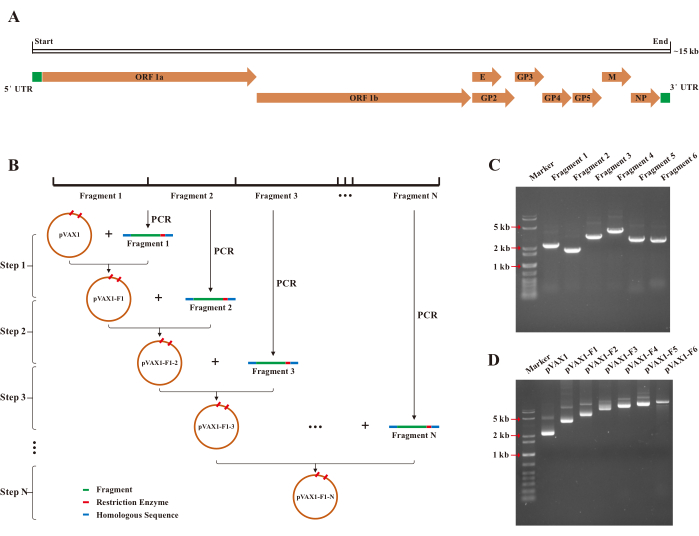
Figure 1: Organization and construction of pVAX1-F6 (pVAX1-PRRSV) vectors by homologous recombination. (A) Organization of the PRRSV genome. ORF1b encodes RNA-dependent RNA polymerase, RNA helicase, and multinuclear zinc-binding domains. Other ORFs encode membrane-associated glycoproteins (GP2, GP3, GP4, and GP5), E protein, membrane envelope protein, and the nucleocapsid protein. (B) Schematic diagram of the process of generation of the pVAX1-PRRSV vector.(C) DNA agarose gel shows PCR amplification of target fragments. (D) With the insertion of fragments, the size of the recombinant vector increases gradually. Abbreviations: PRRSV = Porcine Reproductive and Respiratory Syndrome Virus; ORF = open reading frame; GP = glycoprotein; E = E protein; M = membrane envelope protein; N = nucleocapsid protein. Please click here to view a larger version of this figure.
| Component | Volume | |
| PRRSV RNA | 2 μL (25 ng) | |
| RNase-free water | 11 μL | |
| 5x Reaction Mix | 4 μL | |
| Supreme Enzyme Mix | 3 μL | |
| Temperature | Duration | Cycles |
| 25 °C | 10 min | Remove genomic DNA, random primers pair with RNA templates |
| 55 °C | 15 min | Rapid inactivation of dsDNase and reverse transcription |
| 85 °C | 5 min | Reverse transcriptase inactivation |
Table 1: Reverse transcription setup and conditions.
| Component | Volume | ||
| 5x SuperFi II Buffer | 10 μL | ||
| 10 μM Forward Primer | 2.5 μL | ||
| 10 μM Reverse Primer | 2.5 μL | ||
| 10 mM dNTPs | 1 μL | ||
| cDNA (PRRSV) | 1 μL | ||
| Platinum SuperFi II DNA Polymerase | 1 μL | ||
| ddH2O | 32 μL | ||
| Cycle step | Temperature | Duration | Cycles |
| Initial denaturation | 98 °C | 30 s | 1 |
| Denaturation | 98 °C | 10 s | 35 |
| Annealing | 60 °C | 10 s | |
| Extension | 72 °C | 3 min | |
| Final extension | 72 °C | 5 min | 1 |
| Hold | 4 °C | - | - |
Table 2: PCR reaction setup and conditions.
| pVAX1 linearization | pVAX1-F1 linearization | pVAX1-F2 linearization | pVAX1-F3 linearization | pVAX1-F4 linearization | pVAX1-F5 linearization | |
| Component | Volume | Volume | Volume | Volume | Volume | |
| Vector | 10 μL (1 μg) of pVAX1 | 6 μL (1 μg) of pVAX1-F1 | 3.5 μL (1 μg) of pVAX1-F2 | 7.5 μL (1 μg) of of pVAX1-F3 | 10 μL (1 μg) of pVAX1-F4 | 15 μL (1 μg) of pVAX1-F5 |
| Restriction enzyme 1 | 1 μL of NdeI | 1 μL of NdeI | 1 μL of NdeI | 1 μL of NdeI | 1 μL of EcoRV | 1 μL of NotI |
| Restriction enzyme 2 | 1 μL of HindIII | 1 μL of HindIII | 0.5 μL of CIAP | 0.5 μL of CIAP | 1 μL of NotI | - |
| 10x FastDigest buffer | 2 μL | 2 μL | 2 μL | 2 μL | 2 μL | 2 μL |
| ddH2O | 6 μL | 10 μL | 13 μL | 9 μL | 6 μL | 2 μL |
| Total | 20 μL | 20 μL | 20 μL | 20 μL | 20 μL | 20 μL |
Table 3: Linearization mixture of pVAX1, pVAX1-F1, pVAX1-F2, pVAX1-F3, pVAX1-F4, and pVAX1-F5.
| Component | Volume |
| ExonArt Seamless Cloning and Assembly kit | 5 μL |
| Linearized Vector | 200 ng |
| Fragment | 200 ng |
| ddH2O | to 10 μL |
Table 4: ExonArt seamless cloning and assembly reaction setup.
| Component | Volume | |
| 2x Universal Green PCR Master Mix | 10 μL | |
| 10 μM Forward Primer | 0.4 μL | |
| 10 μM Reverse Primer | 0.4 μL | |
| Template | 1 μL | |
| ddH2O | 8.2 μL | |
| Total | 20 μL | |
| Temperature | Duration | Cycles |
| 95 °C | 30 s | 1 |
| 98 °C | 10 s | 28 |
| 56 °C | 10 s | |
| 72 °C | 3 min | |
| 72 °C | 5 min | 1 |
| 4 °C | - | - |
Table 5: Colony PCR setup and conditions.
Supplemental Figure S1: Schematic of the process of primer design. Other primer designs such as P5 and P6 are also shown. Please click here to download this File.
Supplemental Figure S2: Primer sequences. Please click here to download this File.
Supplemental File 1: DNA sequencing data. Please click here to download this File.
Discussion
Loading...
$$\rightleftharpoonup{xx}$$
$$\longleftharp{xx}$$,
$$\longrightharp{xx}$$,
The Gibson assembly technique is an in vitro recombination-based molecular cloning method for the assembly of DNA fragments8. This method enables the assembly of multiple DNA fragments into a circular plasmid in a single-tube isothermal reaction. However, one of the obstacles to the Gibson Assembly technique is the acquisition of long fragments from cDNA. The long fragments are difficult to accurately amplify for many reasons. For example, primers are easier to mismatch during long extending times, cDNA may not be of good quality, or GC-rich regions will stop DNA polymerizing. When the full-length fragment cannot be easily obtained from cDNA using PCR, the full-length fragment needs to be divided into multiple fragments for amplification. However, as the number and length of the inserted DNA fragments increase, the efficiency and positive clones from the homologous recombination assay will also significantly decrease. Hence, we tried an alternative solution by introducing suitable restriction sites at the 3' end of the inserts. Then, we could linearize the vector and join the DNA fragments into the vector one by one through homologous recombination technology and eliminate the unwanted restriction sites via the homologous recombination reaction.
As one of the most economically significant pathogens in the global markets, PRRSV has always attracted the attention of researchers during the past 30 years10,21,22. It is a positive-stranded RNA virus, approximately 15 kb in length, and the long DNA fragment cannot be easily amplified from cDNA. Hence, to investigate whether this method can be used for the cloning of long fragments, we employed the PRRSV as a template for full-length genome cloning. In this study, we divided the full-length sequence into six fragments and added appropriate restriction sites to the reverse primer, obtaining six fragments by PCR. We then successfully obtained the full-length pVAX1-PRRSV expression vector by several rounds of recombination reactions. In addition, the constructed PRRSV expression vector can serve as a template for in vitro transcription to obtain capped RNAs for transfection or mRNA vaccine research. Meanwhile, the constructed mRNA virus plasmid can be used for batch screening of antiviral natural compounds in vitro through molecular interaction techniques, such as surface plasmon resonance23,24. The pVAX1 plasmid meets the requirements because an in vitro transcription assay requires a high-copy plasmid with a T7 promoter. Besides, the pVAX1-PRRSV plasmid containing the CMV promoter can be transfected into BHK-21cells for viral genome expression25,26.
In summary, with this protocol, we demonstrate that long full-length genes can be divided into several fragments obtained by PCR amplification. It is important that the reverse primers are introduced into the appropriate restriction sites so that the full-length gene expression vector can be obtained by several rounds of recombination reactions. This method can be used for full-length genes that cannot be directly obtained by a single PCR or for full-length genes that cannot be obtained by homologous recombination of multiple inserts. Hence, this approach is an important supplement to the Gibson Assembly technique, we anticipate that it can be widely used for the cloning of long DNA fragments and fusion gene construction.
Disclosures
Loading...
$$\rightleftharpoonup{xx}$$
$$\longleftharp{xx}$$,
$$\longrightharp{xx}$$,
The authors declare no conflicts of interest.
Acknowledgements
Loading...
$$\rightleftharpoonup{xx}$$
$$\longleftharp{xx}$$,
$$\longrightharp{xx}$$,
This work was supported by the financial support of the doctoral research initiation funds provided by the China West Normal University (No. 20E059).
Materials
| Name | Company | Catalog Number | Comments |
|---|---|---|---|
| 1 kb plus DNA Ladder | Tiangen Biochemical Technology (Beijing) Co., Ltd | MD113-02 | |
| 2x Universal Green PCR Master Mix | Rong Wei Gene Biotechnology Co., Ltd | A303-1 | |
| Agarose | Sangon Biotech (Shanghai) Co., Ltd. | 9012-36-6 | |
| Benchtop Microcentrifuge | Thermo Fisher Scientific Co., Ltd | FRESCO17 | |
| Clean Bench | Sujing Antai Air Technology Co., Ltd | VD-650-U | |
| DNA Electrophoresis Equipment | Cleaver Scientific Co., Ltd | 170905117 | |
| DNA Loading Buffer (6x) | Biosharp Biotechnology Co., Ltd | BL532A | |
| E. Z. N. A. Gel Extraction kit | Omega Bio-Tek Co., Ltd | D2500-01 | |
| E.Z.N.A. Plasmid DNA Mini Kit I | Omega Bio-Tek Co., Ltd | D6943-01 | |
| Electro-heating Standing-temperature Cultivator | Shanghai Hengyi Scientific Instrument Co., Ltd | DHP-9082 | |
| ExonArt Seamless Cloning and Assembly kit | Rong Wei Gene Biotechnology Co., Ltd | A101-02 | |
| ExonScript RT SuperMix with dsDNase | Rong Wei Gene Biotechnology Co., Ltd | A502-1 | |
| FastDigest Eco321 (EcoRV) | Thermo Fisher Scientific Co., Ltd | FD0303 | |
| FastDigest HindIII | Thermo Fisher Scientific Co., Ltd | FD0504 | |
| FastDigest NheI | Thermo Fisher Scientific Co., Ltd | FD0974 | |
| FastDigest NotI | Thermo Fisher Scientific Co., Ltd | FD0596 | |
| Gel Doc XR | Bio-Rad Laboratories Co., Ltd | 721BR07925 | |
| Goldview Nucleic Acid Gel Stain | Shanghai Yubo Biotechnology Co., Ltd | YB10201ES03 | |
| Ice Maker Machine | Shanghai Bilang Instrument Manufacturing Co., Ltd | FMB100 | |
| Invitrogen Platinum SuperFi II DNA Polymerase | Thermo Fisher Scientific Co., Ltd | 12361010 | |
| LB Agar Plate (Kanamycin) | Sangon Biotech (Shanghai) Co., Ltd. | B530113-0010 | |
| LB sterile liquid medium (Kanamycin) | Sangon Biotech (Shanghai) Co., Ltd. | B540113-0001 | |
| Micropipettors | Thermo Fisher Scientific Co., Ltd | — | |
| Microwave Oven | Panasonic Electric (China) Co., Ltd | NN-GM333W | |
| Orbital Shakers | Shanghai Zhicheng Analytical Instrument Manufacturing Co., Ltd | ZHWY-2102C | |
| PRRSV virus | Sichuan Agricultural University | — | |
| SnapGene | GSL Biotech, LLC | v5.1 | To design primers |
| T100 PCR Gradient Thermal Cycler | Bio-Rad Laboratories Co., Ltd | T100 Thermal Cycler | |
| TAE buffer | Sangon Biotech (Shanghai) Co., Ltd. | B040123-0010 | |
| TRIzol Reagent | Thermo Fisher Scientific Co., Ltd | 15596026 | RNA extraction reagent |
References
Loading...
$$\rightleftharpoonup{xx}$$
$$\longleftharp{xx}$$,
$$\longrightharp{xx}$$,
- Lessard, J. C. Molecular cloning. Methods Enzymol. 529, 85-98 (2013).
- Shetty, R. P., Endy, D., Knight, T. F. Jr Engineering BioBrick vectors from BioBrick parts. J. Biol. Eng. 2, 5(2008).
- Horton, R. M., Cai, Z. L., Ho, S. N., Pease, L. R. Gene splicing by overlap extension: tailor-made genes using the polymerase chain reaction. Biotechniques. 54 (3), 129-133 (2013).
- Horton, R. M. PCR-mediated recombination and mutagenesis. SOEing together tailor-made genes. Mol Biotechnol. 3 (2), 93-99 (1995).
- Bang, D., Church, G. M. Gene synthesis by circular assembly amplification. Nat. Methods. 5 (1), 37-39 (2008).
- Geu-Flores, F., Nour-Eldin, H. H., Nielsen, M. T., Halkier, B. A. USER fusion: a rapid and efficient method for simultaneous fusion and cloning of multiple PCR products. Nucleic Acids Res. 35 (7), e55(2007).
- Gibson, D. G. Enzymatic assembly of overlapping DNA fragments. Methods Enzymol. 498, 349-361 (2011).
- Gibson, D. G., et al. Enzymatic assembly of DNA molecules up to several hundred kilobases. Nat Methods. 6 (5), 343-345 (2009).
- Cho, J. G., Dee, S. A. Porcine reproductive and respiratory syndrome virus. Theriogenology. 66 (3), 655-662 (2006).
- Holtkamp, D. J., et al. Assessment of the economic impact of porcine reproductive and respiratory syndrome virus on United States pork producers. J. Swine Health Prod. 21, 72-84 (2013).
- Thomann, B., Rushton, J., Schuepbach-Regula, G., Nathues, H. Modeling economic effects of vaccination against porcine reproductive and respiratory syndrome: Impact of vaccination effectiveness, vaccine price, and vaccination coverage. Front Vet Sci. 7, 500(2020).
- Dwivedi, V., et al. Evaluation of immune responses to porcine reproductive and respiratory syndrome virus in pigs during early stage of infection under farm conditions. Virol J. 9, 45(2012).
- Mengeling, W. L., Lager, K. M., Vorwald, A. C. Clinical consequences of exposing pregnant gilts to strains of porcine reproductive and respiratory syndrome (PRRS) virus isolated from field cases of "atypical" PRRS. Am. J. Vet. Res. 59 (12), 1540-1544 (1998).
- Dee, S. A., Joo, H. S. Prevention of the spread of porcine reproductive and respiratory syndrome virus in endemically infected pig herds by nursery depopulation. Vet Rec. 135 (1), 6-9 (1994).
- Dee, S. A., Joo, H. Strategies to control PRRS: a summary of field and research experiences. Vet Microbiol. 55 (1-4), 347-343 (1997).
- Renukaradhya, G. J., Meng, X. J., Calvert, J. G., Roof, M., Lager, K. M. Live porcine reproductive and respiratory syndrome virus vaccines: Current status and future direction. Vaccine. 33 (33), 4069-4080 (2015).
- Conzelmann, K. K., Visser, N., Woensel, P. V., Thiel, H. J. Molecular characterization of porcine reproductive and respiratory syndrome virus, a member of the arterivirus group. Virology. 193 (1), 329-339 (1993).
- Han, M. Y., Yoo, D. W. Engineering the PRRS virus genome: Updates and perspectives. Vet Microbiol. 174 (3), 279-295 (2014).
- Bryksin, A. V., Matsumura, I. Overlap extension PCR cloning: a simple and reliable way to create recombinant plasmids. Biotechniques. 48 (6), 463-465 (2010).
- Wang, S., et al. Restriction-based multiple-fragment assembly strategy to avoid random mutation during long cDNA cloning. J Cancer. 6 (7), 632-635 (2015).
- Zhang, Z. D., et al. The economic impact of porcine reproductive and respiratory syndrome outbreak in four Chinese farms: Based on cost and revenue analysis. Front Vet Sci. 9, 1024720(2022).
- Chen, N. H., et al. High genetic diversity of Chinese porcine reproductive and respiratory syndrome viruses from 2016 to 2019. Res Vet Sci. 131, 38-42 (2020).
- Wang, X. B., et al. Salidroside, a phenyl ethanol glycoside from Rhodiola crenulata, orchestrates hypoxic mitochondrial dynamics homeostasis by stimulating Sirt1/p53/Drp1 signaling. J Ethnopharmacol. 293, 115278(2022).
- Hou, Y., et al. Salidroside intensifies mitochondrial function of CoCl2-damaged HT22 cells by stimulating PI3K-AKT-MAPK signaling pathway. Phytomedicine. 109, 154568(2023).
- Zhang, S. R., et al. Generation of an infectious clone of HuN4-F112, an attenuated live vaccine strain of porcine reproductive and respiratory syndrome virus high copy plasmid. Virol J. 8, 410(2011).
- Ni, Y. Y., Huang, Y. W., Cao, D. J., Opriessnig, T., Meng, X. J. Establishment of a DNA-launched infectious clone for a highly pneumovirulent strain of type 2 porcine reproductive and respiratory syndrome virus: identification and in vitro and in vivo characterization of a large spontaneous deletion in the nsp2 region. Virus Res. 160 (1-2), 264-273 (2011).
Reprints and Permissions
Request permission to reuse the text or figures of this JoVE article
Request Permission