An erratum was issued for: A Modified Trier Social Stress Test for Vulnerable Mexican American Adolescents. The Abstract, Protocol, Representative Results and Discussion sections were updated.
Erratum: A Modified Trier Social Stress Test for Vulnerable Mexican American Adolescents
72 views
⸱
September 8th, 2025
In This Article
Summary
Abstract
This corrects the article 10.3791/55393
Protocol
An erratum was issued for: A Modified Trier Social Stress Test for Vulnerable Mexican American Adolescents. The Abstract, Protocol, Representative Results, and Discussion sections were updated.
The eigth sentence in the Abstract has been updated from:
Saliva samples were collected at baseline (after a resting phase), and then again at 15, 30, and 45 min post-TSST onset to assess cortisol concentration.
to:
Saliva samples were collected at baseline (after a resting phase), and then again at 15, 30, and 60 min post-TSST onset to assess cortisol concentration.
Step 12 of the Protocol has been updated from:
12. Saliva Sample #4 (45 min Post-stressor Onset)
to:
12. Saliva Sample #4 (60 min Post-stressor Onset)
The third paragraph in the Representative Results has been updated from:
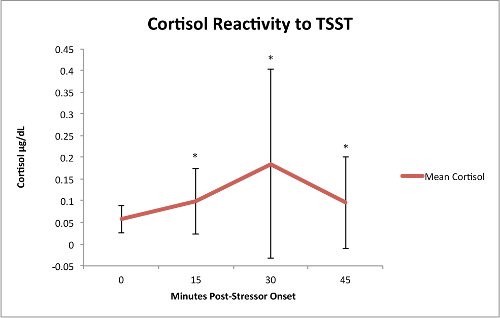
Descriptive statistics for the cortisol measurements along with standard deviations across each sample are provided in Table 2 and depicted in Figure 1. A 2 x 4 repeated measures ANOVA was run to test the effects of sex on the four saliva samples. There was a main effect for cortisol response to the TSST (F = 9.09, p <0.001), but sex was not a significant predictor of cortisol response to stress (F = 1.03, p = .39). Average body mass index was 23.53, and was also not a significant predictor of the repeated measures cortisol ANOVA (F = 1.03, p = 0.38). As would be expected, paired samples t-tests (provided in Table 3) revealed significant changes in cortisol from pre-stress to 15 min post-stressor onset, from 15 min post-stressor onset to 30 min post-stressor onset, and from 30 min post-stressor to 45 min post-stressor. The greatest change in cortisol occurred when comparing the pre-stress cortisol concentration to the 30 min post-stressor concentration, consistent with prior research (Cohen's d = .80)1,3. Individuals who were marked as having a difficult time with the TSST tended to report heightened stress reactivity to the stressor but reported coming back to a normal state prior to the end of the study. While the 30 min post-stressor concentration was the highest concentration from these samples, the 45 min post-stressor cortisol concentration suggests that individuals began to recover from the stressor, as the 45 min post-stressor concentration was significantly lower than the 30 min concentration (see Table 3).
to:
Descriptive statistics for the cortisol measurements along with standard deviations across each sample are provided in Table 2 and depicted in Figure 1. A 2 x 4 repeated measures ANOVA was run to test the effects of sex on the four saliva samples. There was a main effect for cortisol response to the TSST (F = 9.09, p <0.001), but sex was not a significant predictor of cortisol response to stress (F = 1.03, p = .39). Average body mass index was 23.53, and was also not a significant predictor of the repeated measures cortisol ANOVA (F = 1.03, p = 0.38). As would be expected, paired samples t-tests (provided in Table 3) revealed significant changes in cortisol from pre-stress to 15 min post-stressor onset, from 15 min post-stressor onset to 30 min post-stressor onset, and from 30 min post-stressor to 60 min post-stressor. The greatest change in cortisol occurred when comparing the pre-stress cortisol concentration to the 30 min post-stressor concentration, consistent with prior research (Cohen's d = .80)1,3. Individuals who were marked as having a difficult time with the TSST tended to report heightened stress reactivity to the stressor but reported coming back to a normal state prior to the end of the study. While the 30 min post-stressor concentration was the highest concentration from these samples, the 60 min post-stressor cortisol concentration suggests that individuals began to recover from the stressor, as the 45 min post-stressor concentration was significantly lower than the 30 min concentration (see Table 3).
Figure 1 has been updated from:
to:
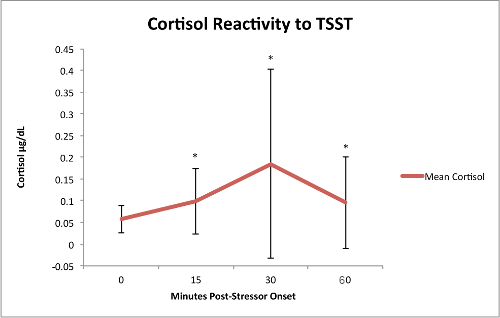
Table 1 and 2 have been updated from:
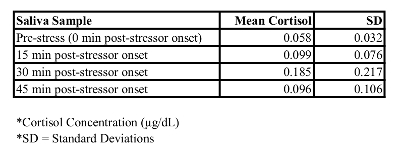
Table 2: Mean Cortisol Concentrations and Standard Deviations. Cortisol increased from samples 1-3, and then declined by sample 4.
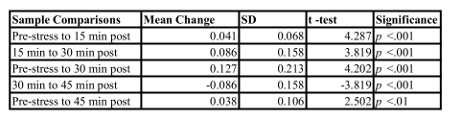
Table 3: Paired Samples t-tests. Compares samples to one another in cortisol concentration (µg/dL) and standard deviations (SD) for cortisol change. Significant increases in cortisol were observed from the baseline sample to post-stress samples.
to:
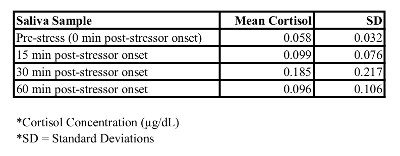
Table 2: Mean Cortisol Concentrations and Standard Deviations. Cortisol increased from samples 1-3, and then declined by sample 4.
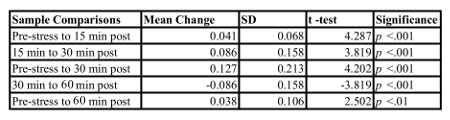
Table 3: Paired Samples t-tests. Compares samples to one another in cortisol concentration (µg/dL) and standard deviations (SD) for cortisol change. Significant increases in cortisol were observed from the baseline sample to post-stress samples.
The fifth paragraph in the Discussion has been updated from:
First, it is important not to alienate participants. Administration of a stress task was important to this study, yet it was imperative that participants were not lost to attrition, as the youth had been followed longitudinally since their mothers became pregnant with them. In this study, participants were debriefed immediately after the TSST in order to ensure that the stress ceased for participants after the conclusion of the TSST. For this sample, the staff administering the debriefing needed to be someone as unfamiliar as possible but still empathic, without an emotional connection to the youth. While that may seem counterintuitive, when staff who were familiar and emotionally connected to the youth debriefed them on the TSST, the youth tended to have more proclivity towards rumination over the TSST and talking more about it, which sometimes ended with crying or feelings of resentment towards being "tricked." Unfamiliar staff administering the debriefing helped ensure that we did not sever the longitudinal connections that the cohort had made with the familiar staff by implementing the TSST. This is noted as important within the Latino community but is something that many longitudinal studies that develop a strong rapport with participants should consider. Using unfamiliar staff also reduced the likelihood that the debrief served to further stress the youth, given the more optimal behavioral responses we observed using unfamiliar staff. While debriefing before the collection of two more saliva samples may concern researchers using this modification, it should be noted that this study observed the prototypical cortisol response pattern after the conclusion of the TSST (with the highest concentration coming 15 min after the conclusion of the stressor, and recovery 30 min after the conclusion of the stressor). This modification was made to be more culturally sensitive to the youth whom may have continued to have a stress response after the TSST due to their vulnerable state.
to:
First, it is important not to alienate participants. Administration of a stress task was important to this study, yet it was imperative that participants were not lost to attrition, as the youth had been followed longitudinally since their mothers became pregnant with them. In this study, participants were debriefed immediately after the TSST in order to ensure that the stress ceased for participants after the conclusion of the TSST. For this sample, the staff administering the debriefing needed to be someone as unfamiliar as possible but still empathic, without an emotional connection to the youth. While that may seem counterintuitive, when staff who were familiar and emotionally connected to the youth debriefed them on the TSST, the youth tended to have more proclivity towards rumination over the TSST and talking more about it, which sometimes ended with crying or feelings of resentment towards being "tricked." Unfamiliar staff administering the debriefing helped ensure that we did not sever the longitudinal connections that the cohort had made with the familiar staff by implementing the TSST. This is noted as important within the Latino community but is something that many longitudinal studies that develop a strong rapport with participants should consider. Using unfamiliar staff also reduced the likelihood that the debrief served to further stress the youth, given the more optimal behavioral responses we observed using unfamiliar staff. While debriefing before the collection of two more saliva samples may concern researchers using this modification, it should be noted that this study observed the prototypical cortisol response pattern after the conclusion of the TSST (with the highest concentration coming 15 min after the conclusion of the stressor, and recovery 45 min after the conclusion of the stressor). This modification was made to be more culturally sensitive to the youth whom may have continued to have a stress response after the TSST due to their vulnerable state.
Disclosures
No conflicts of interest declared.