This protocol describes a custom overpressure air system designed to induce closed-system central nervous system (CNS) injuries in mice, including ocular, brain, and spinal cord traumas. The goal of this protocol is to provide a framework for researchers to easily adapt and expand the system for their unique CNS trauma studies.
Method Article
System for Focal, Closed-System Central Nervous System Injury
In This Article
Summary
Abstract
The prevalence of closed-system central nervous system (CNS) injuries underscores the need for an enhanced understanding of these traumas to improve protective and therapeutic interventions. Crucial to this research are animal models that replicate closed-system CNS injuries. In this context, a custom overpressure air system was engineered to reproduce a range of closed-system CNS injuries in murine models, including ocular, brain, and spinal cord trauma. To date, the system has been used to administer eye-, head-, or spine-directed overpressure air to model anteroposterior pole injury in the eye, indirect traumatic optic neuropathy (ITON), focal traumatic brain injury, and spinal cord injury. This paper provides a detailed protocol outlining the system's design and operation and shares representative results demonstrating its effectiveness. The robust framework presented here provides a strong foundation for ongoing research in CNS trauma. By leveraging the system’s flexible attributes, investigators can modify and carefully control the location, severity, and timing of injuries. This allows for comprehensive comparisons of molecular mechanisms and therapeutic efficacy across multiple closed-system CNS injuries.
Introduction
Closed-system central nervous system (CNS) injuries are injuries that are caused by damage to the brain or spinal cord without causing a break in the skull or spinal column. These injuries include traumatic brain injury (TBI) and spinal cord injury (SCI) and can occur from a variety of incidents, including blunt force injuries (e.g., falls, sports injuries, motor vehicle accidents) and explosive blasts. Closed-system CNS injuries are generally considered less severe compared to penetrating CNS injuries, yet they occur more often. However, similar to penetrating injuries, closed-system CNS injuries can result in long-term and progressive health issues, especially after repeated occurrences1,2,3,4,5,6. Concerningly, emerging evidence suggests that even subclinical closed-system CNS injuries, which fall below the diagnostic criteria for a TBI or SCI after a single occurrence7,8,9,10,11,12,13, may evolve into chronic neurodegenerative diseases after repeated injury6,14,15,16. This underscores the urgent need for a better understanding of the mechanisms and consequences of single and repeated closed-system CNS injuries. Such knowledge is imperative for improved protective and therapeutic approaches. Crucial to this endeavor are animal models that replicate closed-system CNS injuries.
Current animal models of closed-system CNS injuries have been instrumental in advancing our understanding of the pathophysiology and potential protective and therapeutic interventions for these traumas. Rodents are particularly popular due to their low cost, availability, genetic manipulability, ease of handling, well-established behavioral and physiological assays, and more favorable ethical considerations17. Common methods for inducing closed-system TBI in rodents include weight-drop devices18,19, controlled cortical impact (CCI) devices20, and compression-air-driven shock tubes21. For SCI, blunt trauma models typically require laminectomy22,23 or other surgical techniques24 to access the spinal cord or epidural space directly. However, closed-body SCI blast injury models have been developed using compression-air-driven shock tubes 25. Despite providing valuable insights, each of these models has unique limitations. Weight-drop models can have high variability and limited control of injury location and severity, producing experimental and ethical concerns for causing severe, uncontrolled injury26. CCI devices offer precision but require training to operate, may involve a craniotomy, and can suffer from mechanical variability impacting reproducibility27. Shock tubes are generally less invasive but can be difficult to acquire, complex to set up and operate, and can create unrealistic and highly variable injury conditions due to environmental factors, wave reflections, and complex pressure interactions28.
To better study the mechanisms and effects of single and repeat closed-system CNS injuries and their treatments, this paper presents a modular, user-friendly, cost-effective, and non-invasive method. The primary objective of this approach is to enable precise control and flexible modification of injury parameters, including location, severity, and timing. To support this objective, this manuscript provides a detailed protocol for constructing, calibrating, and troubleshooting an overpressure air system, which addresses some of the limitations of existing closed-system CNS injury devices. This system not only offers cost-effectiveness and minimal setup time, but it highly versatile, providing consistent and reproducible results while minimizing ethical concerns and maximizing clinical relevance. Additionally, the system’s ability to produce a range of closed-system CNS injuries in murine models is described, along with its potential applications in future studies. Notably, the goal of this manuscript is to provide a framework that enables investigators to easily acquire, adapt, and expand this system for their specific needs, thereby furthering ongoing research in CNS trauma. Representative results demonstrating the system’s efficacy in inducing axonal trauma are also presented.
Protocol
All procedures were performed under protocols approved by Vanderbilt University's29,30,31,32 Institutional Animal Care and Use Committee (IACUC) and under the guidelines of the Association for Assessment and Accreditation of Laboratory Animal Care (AAALAC) and the Association for Research in Vision and Ophthalmology's (ARVO). All mice were group-housed and maintained on a 12 h light/dark cycle and provided food and water ad libitum. Three-month-old30,31,33 C57 Bl/6 mice were used in this protocol.
1. System construction
- Obtain a commercially available paintball gun (see Table of Materials) that has an integrated air pressure regulator.
- Modify the barrel (Figure 1A) if necessary.
- If the original barrel is fenestrated with openings or perforations along its length, the compressed air can leak and dissipate into the air, reducing the maximum output pressure level. Replace it by purchasing a solid, non-fenestrated barrel to increase the output pressure range (Figure 1, I).
- If the original barrel is long and cumbersome, shorten it by purchasing a shorter barrel of custom length or using a pipe cutter or saw.
- If the original barrel does not produce the desired output pressure level, modify the inner diameter (bore size) of the barrel by purchasing a barrel with a custom bore diameter. Decreasing the diameter of the original bore size will increase the range of output pressure, and vice versa.
- Modify the regulator (Figure 1B) if necessary.
- Remove the guide cap to provide direct access to the adjustment screw (Figure 1, II) if the original regulator comes with a guide cap.
- Exchange the Allen-head socket screw for a flat-head socket screw if the original adjustment screw comes with an Allen-head socket.
- Remove the standard gravity feed loader (i.e., the reservoir for holding and feeding paintballs into the gun) and seal the vertical feed tube (Figure 1, III) to avoid pressure leakage.
- Ensure the paintball gun is unloaded and the air source (CO2 or compressed air tank) is disconnected before removing the gravity feed loader.
- Locate the feed neck (Figure 1C) where the gravity feed loader is attached. Loosen the feed neck clamp using the appropriate tool.
- Remove the standard gravity feed loader by pulling it upward.
- Insert a feed neck cover or plug to seal the opening. These are typically available at paintball stores or online and are designed to fit snugly into the feed neck, sealing it off.
- Assemble a platform (Figure 1D) for the paintball gun and an x-y animal positioning table.
- Construct the platform base by cutting two pieces of medium-density fiberboard.
NOTE: Depending on material availability and preference, alternative materials (e.g., plywood) can also be employed. - Cut a smaller, square piece to measure 1.5 x 1.5 ft.
- Cut a larger rectangular piece to measure 2.5 x 1.5 ft.
- Elevate and secure the smaller platform 3.5 inches above the larger platform using two parallel 2 x 4 s.
- Construct the platform base by cutting two pieces of medium-density fiberboard.
- Secure the modified paintball gun to the platform.
- Lay the paintball gun on its side on the smaller platform so the end of the barrel extends half an inch over the edge.
- Secure the paintball gun using mounting brackets or clamps that fit the barrel and stock of the paintball gun.
- Attach a pressurized air tank (Figure 1E; see Table of Materials) to the regulator of the paintball gun. Alternatively, connect a direct pressure line from a compressed nitrogen tank to increase the range of reliable output pressure levels.
- If using a pressurized air tank, secure it to the fiberboard with a durable fabric strap. Attach the strap with screws or bolts and include an adjustment mechanism for easy tightening and loosening.
- Secure an x-y positioning table to the larger piece of rectangular fiberboard opposite the barrel of the paintball gun using screws or bolts (Figure 1F).
NOTE: An x-y positioning table (see Table of Materials), also known as an x-y stage, can be purchased from various suppliers, including online retailers, industrial suppliers, and scientific equipment suppliers. When purchasing an x-y positioning table, consider the travel range, load capacity, precision, and the choice between manual adjustment or motorized control. This x-y positioning table will allow for precise movement and positioning of the animal along two axes: the x-axis (horizontally toward or away from the barrel) and the y-axis (vertically up or down from the barrel). - Modify the x-y positioning table by installing three PVC clamps.
- Secure two 1 cm-thick PVC clamps on either side of the front of the barrel using screws or bolts. Ensure the clamps are wide enough to accommodate the animal holder from Steps 1.9 and 1.10 (e.g., 1.5 in).
- Secure a thicker (4 cm) PVC clamp perpendicular and opposite to the two 1-cm-thick clamps using screws or bolts. Ensure the clamp is wide enough to accommodate the pressure transducer from Step 2.4 (e.g., 1.5 in).
- Drill two holes at the top of the third clamp and insert two plastic screws for additional stabilization of the pressure transducer during system calibration in Step 2.
- Customize the inside of the animal holder (Figure 2A).
- Purchase and cut a piece of PVC tube (35 mm outer diameter, 26mm inner diameter, 6.75 inches long) for the inner containment chamber for the mouse.
- Create a rectangular-shaped hole (3 x 5 cm) at 1 inch from the end of the tube to expose the mouse's head and upper hind shoulders while the rest of the body remains shielded.
NOTE: If the CNS injury site is lower on the mouse's back (e.g., the thoracic or lumbar spine), make the rectangular hole larger.
- Customize the outside of the animal holder (Figure 2B).
- Purchase and cut a piece of PVC tube (44 mm outer diameter, 35 mm inner diameter, 6 inches long) for the outer containment chamber for the mouse.
- Construct an exposure aperture (Figure 2C) within the outer containment chamber for precise control of the CNS injury site.
- Create a reciprocal aperture on the opposing side to insert the barrel of the pressure transducer during system calibration in Step 2 (e.g., a 9 mm hole).
- Modify the outside of the animal holder to accommodate gas anesthesia delivery. If an injectable anesthetic will be used instead, skip this step.
- Seal one end of the outside of the animal holder using tape. Ensure a tight fit to prevent gas leakage.
- Create a small hole in the seal to insert the anesthesia line.
- Position the anesthesia line to introduce isoflurane into the tube's environment without direct contact with the animal.
2. System calibration
- Connect a pressure transducer (Figure 2D; see Table of Materials for options) to a data acquisition (DAQ) system and computer to translate physical pressure readings into digital data.
- Connect the pressure transducer to the DAQ module (see Table of Materials), ensuring proper polarity and secure connections.
- Insert the DAQ module into a DAQ chassis (see Table of Materials) to allow it to receive power and communicate with the computer.
- Use a USB cable to connect the DAQ chassis to the computer.
- Ensure the computer has the necessary software and drivers installed for interfacing with the DAQ hardware and acquiring data (see Table of Materials for options).
- Configure DAQ system settings.
- Open installed DAQ software.
- Ensure the DAQ system is recognized by the computer.
- Consult the specification and calibration datasheets for your specific DAQ module/chassis and pressure transducer and configure DAQ system settings:
NOTE: The DAQ settings for the DAQ hardware used in this manuscript are publicly available on GitHub. Interested readers can access the repository at https://github.com/amystahl19/RexLab-ITON.- Analog input: Select the physical input channel on the DAQ module where the pressure transducer is connected.
- Excitation source (Vex source): Specify the excitation source of the DAQ module (e.g., internal or external).
- Excitation voltage (Vex value): Set the vex value to the value specified by the pressure transducer manufacturer (e.g., 5 or 10 V).
- Bridge type: Choose the appropriate bridge type of your DAQ module (e.g., full bridge, half bridge, or quarter bridge).
- Bridge resistance: Set the bridge resistance to the value specified by the pressure transducer manufacturer (e.g., 350 ).
- Calibration factor/Custom scaling: Configure the scaling based on calibration datasheet provided by the manufacturer of the pressure transducer. The manufacturer calibrates the pressure transducer by applying a known physical unit (psi) and measuring the resulting electrical units (mV/V). Create a calibration curve by plotting the known physical units against the obtained electrical units.
- Sampling rate (Hz): Set the sampling rate high enough to capture the dynamics of the pressure changes without aliasing (e.g., 1 or 10 kHz depending on the speed of pressure changes in your experiment).
NOTE: The narrower your overpressure air waveform (i.e., the more rapidly it changes pressure), the broader the frequency range it excites and thus the higher the sampling rate needs to be. This is especially important in experiments involving CNS injury models where pressure changes can occur quickly.
- Create a digital tool in the DAQ software for data acquisition.
NOTE: This digital tool will be used to accurately measure, record, display, and analyze the output pressures of the system. The digital tool used in thhis manuscript is publicly available on GitHub. Interested readers can access the repository at https://github.com/amystahl19/RexLab-ITON.x- Implement signal processing algorithms to filter, amplify, or otherwise process the raw data from the transducer.
- Add analysis tools to calculate metrics such as peak pressure, average pressure, and duration of pressure events.
- Incorporate visual elements (e.g., graphs) to show real-time pressure data and control elements to start, stop, and reset data acquisition.
- Save the digital tool.
- Measure output pressure of the system
- Insert the pressure transducer into the thick clamp on the x-y table and its barrel through the hole of the animal holder (created in step 1.10.3).
- Adjust the barrel of the pressure transducer until the tip is precisely at the location of the CNS injury site.
- Secure the pressure transducer with two plastic screws (installed in step 1.8.3).
- Run the digital tool in the data acquisition software while releasing the trigger of the paintball gun to capture, analyze, and visualize the output pressure of the system.
- Adjust the adjustment screw until the system's output pressure reaches the desired level.
NOTE: After modifying the barrel of the paintball gun to be non-fenestrated, 1.5 inches in length, and 6.5mm in diameter, the system is capable of reliably delivering overpressure air levels in the range of 15-50 psi at 5 mm from the front of the barrel34. Overpressure air levels below 15 psi and above 50 psi exhibit large variability in intensity. For a comprehensive display of the system's output pressure (psi) as a function of input pressure (psi), distance from the barrel (cm), and time (ms), see Figure 2 of Hines-Beard et al.34. Use compressed nitrogen instead of compressed air to reliably obtain overpressure air levels above 50 psi using this system.
3. Animal preparation and overpressure air exposure
- Anesthetize the mouse with isoflurane in an induction chamber with 1.5-3%30,31,32,33 isoflurane in oxygen until fully sedated.
- Confirm anesthetization by assessing for the absence of a response to a toe pinch.
- Secure the mouse into the inner animal holder with its head and upper hind shoulders exposed through the rectangular opening, while the dorsum and lower hind limbs remain shielded.
- Support the head of the mouse with a cushion affixed to the intact lower segment of the inner animal holder.
- Secure the mouse by applying surgical tape across the upper hind shoulders.
- Insert the inner animal holder into the outer animal holder.
- Open secondary anesthesia line to isoflurane delivery inside the animal holder.
- Place an additional cushion at the end of the animal holder to prevent anesthetic from leaking out of the tube and to prevent the mouse from moving during exposure to overpressure air.
- Overpressure air delivery
- Align the outer animal holder's 4 mm circular aperture directly over the mouse's left eye.
- Position the animal holder using the control knobs on the x-y table so that its aperture aligns with the barrel of the paintball gun and the external surface is 5 mm from the end of the barrel.
NOTE: Adjust the animal's distance from the end of the barrel to change the overpressure air level (psi) and shape. Move the animal further from the barrel to lower the overpressure air level and create a more diffuse overpressure airwave. - Initiate the overpressure air sequence to induce ITON:
- Deliver two bursts of 15 psi overpressure air at an interval of 0.5 s repeated daily for 3 days29,30,31,32.
NOTE: Similar ITON can be induced via the delivery of three consecutive bursts of 15 psi overpressure air separated by 0.5 s intervals23.The degree of ITON that results after delivery of six consecutive bursts of 15 psi overpressure air separated by 0.5 s intervals is shown here in Representative Results. - Expose sham mice to the noise of the overpressure air, but not the overpressure air itself by turning the animal holder so that the aperture is no longer facing the barrel and block the air with a cardboard shield.
- Deliver two bursts of 15 psi overpressure air at an interval of 0.5 s repeated daily for 3 days29,30,31,32.
- Mouse recovery
- Let the mice recover from anesthesia.
- Administer lubricant eye drops (see Table of Materials) to prevent the eyes from drying out from anesthesia.
- Provide warmth using a controlled heating support (see Table of Materials).
- Visually monitor the mice until they maintain an upright posture and walk normally. Allow them to be in the company of their cage mates.
- Provide all mice exposed to overpressure air with gel recovery food (see Table of Materials) for the first 3 days post-injury to prevent weight loss.
- Let the mice recover from anesthesia.
4. Tissue collection and processing
- Euthanize the mice via intraperitoneal injection of Avertin Working Solution.
- Make Avertin Stock by mixing 10 gm of 2,2,2,-tribromoethanol (see Table of Materials) with 10 mL of 1-Pentanol (see Table of Materials). Store in the dark at 4 °C.
- Make Avertin Working Solution by combining 1.25 mL of Avertin Stock, 45 mL of double distilled water, and 5 mL of 10x PBS (see Table of Materials) in a 50 mL tube. Filter sterilize the mixture and store in the dark at 4 °C.
- Transcardially perfuse the mice with 4% paraformaldehyde (see Table of Materials) in 1x PBS (see Table of Materials).
- Enucleate the eye exposed to overpressure air using fine forceps (see Table of Materials) and scissors (see Table of Materials), ensuring to preserve the optic nerve (ON).
- Collect the ON along with the enucleated eye tissue for further analysis.
- Osmicate ON tissue.
- Postfix ON tissue overnight in 4% paraformaldehyde and 2% glutaraldehyde (see Table of Materials) in 1x PBS. If working with tissue that was not perfused (as in step 4.2), postfix for 5 days instead of overnight.
- Transfer ON tissue to a 12- or 24-well plate (see Table of Materials) with 1x PBS using a paintbrush (see Table of Materials) or a sharp wooden stick.
- In a fume hood, replace 1xPBS with 2% osmium tetroxide (see Table of Materials) in 0.2 M cacodylate buffer (recipe is publicly available on GitHub. Interested readers can access the repository at https://github.com/amystahl19/RexLab-ITON) using a transfer pipette. Incubate on ice for 2 h.
- Perform three washes with 1x PBS
- Discard osmium waste appropriately.
- Leave the plate in the fume hood for two nights after the third PBS wash.
- Dehydrate ON tissue in a graded ethanol series.
- Transfer nerves to a new plate with 50% ethanol and incubate for 30 min.
- Replace with 70% ethanol for 30 min.
- Replace with 95% ethanol for 30 min.
- Replace with 100% ethanol for 30 min.
- Embed ON tissue in epon.
NOTE: Epon recipe is publicly available on GitHub. Interested readers can access the repository at https://github.com/amystahl19/RexLab-ITON; see Table of Materials for materials listed in the recipe.- Day 1: Transfer tissue to a 2 mL vial with propylene oxide (see Table of Materials)/100% ethanol (1:1) and shake for 30 min at room temperature. Replace with pure propylene oxide and shake for 15 min, repeating once. Replace with propylene oxide/epon (1:1) and shake overnight in the cold room.
- Day 2: Transfer tissue to a 12- or 24-well plate with 100% epon and shake for 4 h at room temperature. Replace with fresh 100% epon and incubate overnight at room temperature in a vacuum.
- Day 3: Repeat the epon incubation as on Day 2.
- Day 4: Transfer tissue to a flat mold with 100% epon, reorient the tissue, and place in a 60 °C oven for 48 h.
- Section ON tissue.
- Trim molds under a dissecting scope into a double pyramid with the nerve in the center.
- Collect 700 nm thick cross-sections using an ultramicrotome and a diamond knife (see Table of Materials).
- Collect sections on charged white glass microscope slides using distilled water.
- Dry slides in a 60 °C oven until water evaporates. Cool at room temperature.
- Stain ON tissue.
- Immerse slides in 1% paraphenylenediamine (PPD) (see Table of Materials) in a 1:1 mixture of methanol and 2-propanol for 28 min.
- Rinse slides in two consecutive mixtures of 1:1 methanol (see Table of Materials) and 2-propanol (see Table of Materials) for 1 min each.
- Rinse slides in 100% ethanol for 1 min and allow to air dry.
- Place slides in a humid box and cover sections with 1% toluidine blue (see Table of Materials) using a transfer pipette.
- Incubate in a 60 °C oven for 20 min.
- Rinse slides with double distilled water and allow to air dry.
- Mount and image ON tissue.
- Coverslip slides using mounting media (see Table of Methods), removing excess media.
- Allow slides to dry overnight.
- Image cross-sections using bright field microscopy with a 100x oil immersion objective.
- Embed, section, and immunohistochemically stain retina tissue.
- Postfix whole eye tissue in 4% paraformaldehyde for 2-4 h.
- Cryoprotect the whole eye tissue in 30% sucrose (see Table of Materials in 1x PBS overnight at 4 °C.
- Embed eye tissue in a freezing medium (see Table of Materials).
- Collect 10-μm-thick retina cross-sections on a cryostat and mount the sections on charged white glass microscope slides (see Table of Materials).
- Wash slides in 1x PBS and incubate in a blocking buffer (5% Triton X-100 and 2% bovine serum albumin (BSA) (see Table of Materials) in 1x PBS) with 5% normal donkey serum (NDS) (see Table of Materials) at room temperature for 30 min.
- Incubate slides overnight at 4 °C (or at room temperature for 4 h) in primary antibody (see Table of Materials) in 0.5% Triton X-100 (see Table of Materials) in 1xPBS (PBT).
- Wash slides in PBT and incubate in secondary antibody (See Table of Materials) in blocking buffer with 5% NDS.
- Wash slides in PBT, apply mounting medium with DAPI (see Table of Materials), coverslip, and seal with nail polish.
- Image slides on an epifluorescence microscope.
- If quantifying the fluorescence intensity, ensure images are taken from the same retinal region with identical magnification, gain, and exposure settings.
- Count ON axons.
- Manually count the number of axons using image analysis software (see Table of Materials) by sampling 20% of the total nerve cross-sectional area using a fixed grid overlay to estimate axon density (axons/mm2).
- Measure the area of the ON cross-section.
- Use the Set Scale function to set pixels/microns for the objective used to image.
- Use the Polygon selection tool to trace along the myelin sheath of the optic nerve, excluding the vasculature.
- Measure the area of the ON by using the Measure function.
- Determine 20% of the total area by multiplying the measured area by 0.2.
- Overlay the fixed grid onto the ON cross-section.
- Download the Counting Array plug-in.
NOTE: This plug-in is publicly available on GitHub. Interested readers can access the repository at https://github.com/amystahl19/RexLab-ITON. - Open the Counting Array plug-in to overlay a fixed grid atop the cross-section, consisting of 9 evenly spaced square-shaped in the formation of a plus sign.
- Edit the area per each of the 9 regions by dividing 20% of the total area of the ON cross-section (calculated in step 4.6.2.4) by 9.
- Center the fixed grid so that the center of the plus sign is centered in the middle of the ON cross-section.
- Download the Counting Array plug-in.
- Count living and degenerating axons separately.
- Download and open the Cell Counter plug-in.
NOTE: This plug-in is publicly available on GitHub. Interested readers can access the repository at https://github.com/amystahl19/RexLab-ITON. - For each of the 9 regions, count the number of living and degenerating axon profiles separately by visualizing the condition of the myelin sheath. Ensure axon quantification is performed while blinded to the animal's experimental group to avoid bias.
- For live axons, look for those in which the myelin sheath appears intact, uniformly stained, and smoothly and evenly encircled around the axon.
- For degenerating axons, look for those with a thickening, onion-ing, or collapsing of the myelin sheath.
- If the axon is partially cut off by the overlayed grid, only include it in the axon count if the lumen is seen.
- Ensure oblong axons are not accidentally counted more than once, and do not mistake debris or dust for a degenerating axon profile.
- Download and open the Cell Counter plug-in.
- Perform statistical analyses to test for significant differences in average axon counts between groups. Ensure a minimum of four ONs are included in each group to account for normal variability observed in previous analyses.
- Perform an Independent Samples t-test (also known as the Student's t-test for independent samples) to assess for significant differences between the means of two independent groups.
- Perform the non-parametric alternative, the Mann-Whitney U Test, If the conditions for an Independent Samples t-test cannot be met (i.e., if the data are not normally distributed or the sample sizes are too small).
Results
Using the overpressure air-producing system described here, indirect traumatic optic neuropathy (ITON) was elicited by exposing the left eye of adult (3-month-old) male C57Bl/6 mice (n = 4) to six consecutive bursts of 15 psi overpressure air separated by 0.5 s intervals. Sham animals (n = 8; data taken from Vest et al.33) were anesthetized, placed into the animal holder, and exposed to the sound but not the overpressure air.
The proximal optic nerves of sham animals (Figure 3A) appeared healthy with densely packed and uniformly sized axons surrounded by glial cells with normal morphology and distribution. In comparison, the proximal optic nerves of mice exposed to ITON (i.e., 6 consecutive bursts of 15 psi overpressure air separated by 0.5 s intervals) (Figure 3B) appeared to be degenerating with signs of axon loss, such as increased spacing between remaining axons, signs of axon degeneration, including swelling, irregularities in axon shape, and breakdown of the axons' myelin sheath, and signs of gliosis, including the hypertrophy and hyperplasia of glial cells. Mann-Whitney U tests confirmed a significant difference in total axons (p = 0.0040) (Figure 3C) and degenerative profiles (p = 0.0028) (Figure 3D) between ITON and sham mice. These results suggest that ITON significantly decreases total axons and significantly increases degenerative profiles. Mann-Whitney U tests were performed because the data for the ITON group did not have a sample size large enough for an Independent Samples t-test.
Immunohistochemical staining of retina cross-sections with anti-Iba1 (see Table of Materials), a marker for microglia (the primary immune cells of the central nervous system), was performed on both sham (Figure 4A) and ITON (Figure 4B) mice. The staining revealed that microglia were in their resting state for all mice, characterized by small cell bodies with long, thin, and highly ramified processes. Notably, an increased number of microglia was noted in ITON mice (Figure 4B), suggesting microglial proliferation in response to injury. Additionally, in ITON mice, microglia were observed to be abnormally extending into the outer nuclear layer (ONL), where photoreceptor cell bodies reside (Figure 4B). This contrasts with the sham animals (Figure 4A), where microglia were localized to the ganglion cell layer (GCL), inner plexiform layer (IPL), inner nuclear layer (INL), and outer plexiform layer (OPL) - the layers where microglia typically reside in a healthy, uninjured retina.
Subsequent immunohistochemical staining with anti-PKC-α (see Table of Materials) and anti-synaptophysin (see Table of Materials), markers for rod bipolar cells and photoreceptor ribbon synapses, respectively, revealed intact synaptic connections in both sham (Figure 5A) and ITON mice (Figure 5B). Specifically, the dendrites of rod bipolar cells were observed extending and overlapping with the synaptic terminals of rod photoreceptors. This finding contrasts with an early study35, which showed a retraction of rod bipolar cell dendrites towards their cell bodies four weeks after ITON from two consecutive 15 psi bursts of overpressure air (0.5s apart) once daily for 3 days. This discrepancy may be attributed to the different tissue collection time points between the two studies. The current samples were collected 2 weeks post-ITON compared to 4 weeks post ITON in the earlier study. Although no synaptopathy was detected in the current analysis, we did note the extension of microglia processes into the ONL (Figure 4B), where photoreceptor cell bodies are located. This observation suggests that the disruption of synaptic connections between bipolar cells and photoreceptors may emerge as a secondary effect of the injury, while axon loss, axon degeneration, and gliosis constitute primary effects of damage.

Figure 1: System for focal, closed-system central nervous system injury. Dashed rectangles in the top image are enlarged and shown as B, C, and A in the two images below (as denoted with white arrows). (A) Custom 1.5-inch, non-fenestrated barrel (I) at the end of the paintball gun. (B) Pressure regulator with guide cap removed to expose adjustment screw (II). (C) Feed neck with the gravity feed loader removed and a feed neck cover installed (III). (D) Base platform consisting of a 1.5 ft x 1.5 ft piece of fiberboard elevated above a larger 2.5 ft x 1.5 ft piece of fiberboard. (E) Compressed air tank connected to the pressure regulator of the paintball gun and secured to the fiberboard platform using a durable strap. (F)x-y animal positioning table. Please click here to view a larger version of this figure.
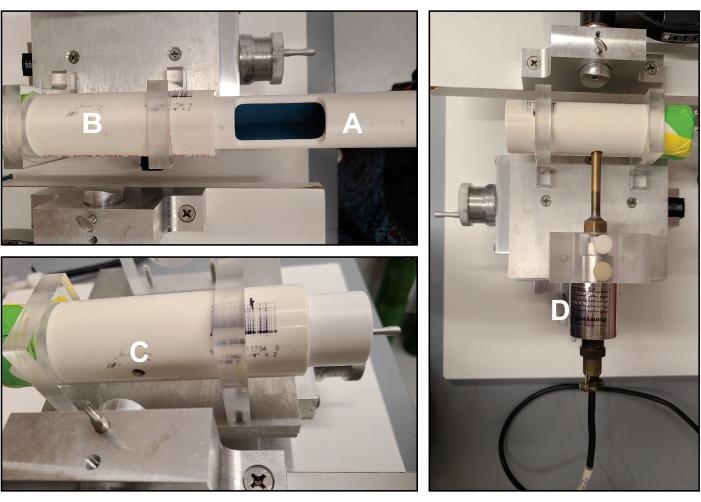
Figure 2: Custom animal holder for focal delivery of overpressure air. (A) Inside of the animal holder consisting of a narrow PVC tube with a rectangular-shaped hole (3 x 5 cm) to expose the animal's head and upper hind shoulders. (B) Outside of the animal holder consisting of a wider PVC tube that the narrower PVC tube slides into, shielding the entirety of the animal's body apart from the exposed tissue within the exposure aperture. (C) Exposure aperture for focal delivery of overpressure air to the CNS injury site of interest. (D) Pressure transducer to calibrate the system's output pressure. Please click here to view a larger version of this figure.
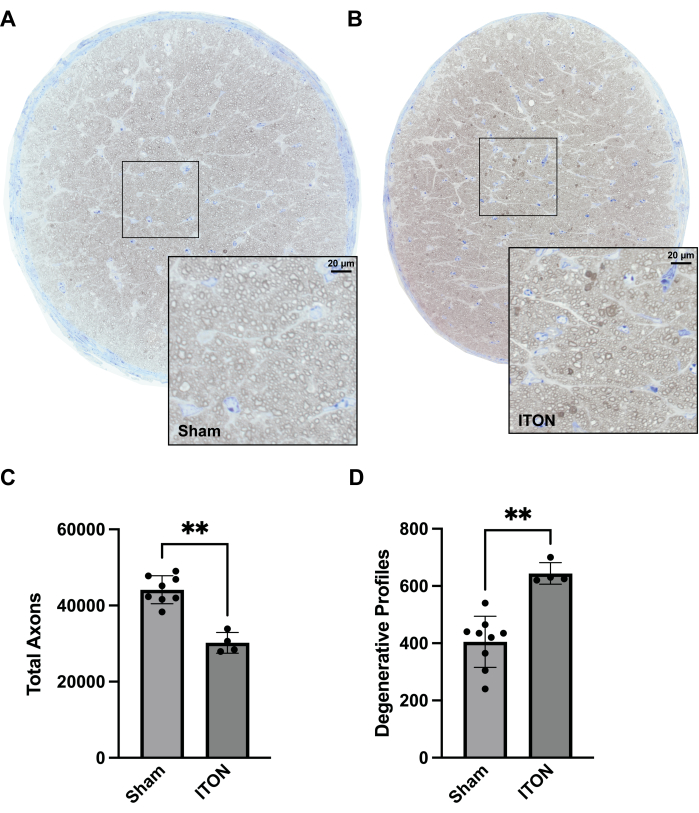
Figure 3: ITON due to focal delivery of overpressure air. (A,B) Representative brightfield micrographs of proximal optic nerve cross-sections from (A) sham and (B) ITON. (C) Quantification of total axon counts.(D) Quantification of degenerative axon profiles. n = 4 for ITON. n = 9 for sham. Axon count data for the sham group was taken from Vest et al.33. **p < 0.005. Error bars represent standard deviation. Scale bars = 20 μm. Abbreviation: ITON = indirect traumatic optic neuropathy. Please click here to view a larger version of this figure.

Figure 4: Abnormal microglia proliferation and migration into the ONL due to system-induced ITON. (A,B) Representative fluorescence micrographs of retina cross-sections with anti-Iba1 labeling of microglia (red) from (A) sham and (B) ITON animals. Scale bars = 100 μm. Abbreviations: ITON = indirect traumatic optic neuropathy; GCL = ganglion cell layer, INL = inner nuclear layer, ONL = outer nuclear layer. Please click here to view a larger version of this figure.
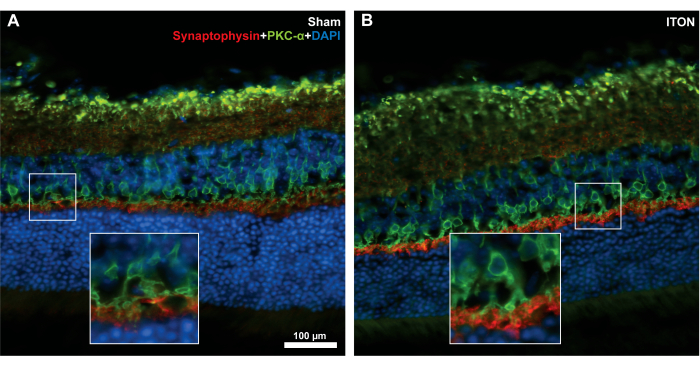
Figure 5: Early perseveration of synaptic connections between rod bipolar cells and photoreceptors due to system-induced ITON, despite the potential for delayed synaptopathy. (A,B) Representative fluorescence micrographs of retina cross-sections with anti-synaptophysin labeling of photoreceptor ribbon synapses (red) and anti-PKC-α labeling of rod bipolar cells (green) from (A) sham and (B) ITON animals. Scale bars = 100 μm. Abbreviations: ITON = indirect traumatic optic neuropathy; PKC = protein kinase C. Please click here to view a larger version of this figure.
Discussion
This custom overpressure air system is a useful tool for studying closed-system CNS injuries in murine models. The representative results from the example experiment demonstrate that the focal delivery of overpressure air using this system can effectively induce ITON, resulting in significant axon loss and degeneration. This highlights the system's ability to produce precise and reproducible CNS injury.
One of the major strengths of this system is its customizability to induce a range of CNS injuries. The severity of the injury can be adjusted by modifying the overall output pressure of the system, the distance of the animal from the end of the barrel using the x-y positioning stage, the size and shape of the exposure aperture, the number of exposures to overpressure air, and the interval between exposures. Additionally, the location of the CNS injury can be adjusted by modifying the location of the exposure aperture within the animal holder. This versatility has enabled the system to produce a spectrum of closed-system CNS injuries in murine models. Initially, the system was used to model closed-globe injuries, focusing on anterior and posterior pole damage and related deficits34,36, including the impacts of immune system response37, strain-specific outcomes38, and the efficacy of neuroprotective agents39. Eventually, this application expanded to assess the sequelae of repeated eye-directed exposures to model indirect traumatic optic neuropathy (ITON)30 and explore the effect of the number and interval between repeated exposures33. Since then, the application of the system has expanded to model closed-head mild traumatic brain injury (mTBI) through head-directed exposures40,41 and closed-body spinal cord injury (SCI) through dorsum-directed exposures42, emphasizing the device's adaptability and versatility in studying varied CNS injury domains.
When using this system, it is critical to take measures to minimize variability in injury outcomes to ensure the reproducibility and reliability of experimental results. Key measures include calibrating the system's output pressure levels before and after each series of three exposures to ensure consistent pressure delivery. Although variability is low when the system is operated between 15 psi and 50 psi when using compressed air34, consistent calibration helps detect unexpected errors, such as low battery or low air. Additionally, position each animal at the same distance from the end of the barrel to ensure consistent overpressure magnitude, as the intensity of the pressure wave decreases with distance. Uniform positioning also ensures each animal is impacted by the same part of the airwave. Furthermore, securing animals uniformly within the holder ensures the tissue of interest is consistently targeted, especially in repeated exposure models when there is risk of movement. Finally, uniformity in the age, sex, and genetic background of the animals is crucial as these factors influence the response to injury. For example, previous studies using this system compared the effects of eye-directed overpressure air on different mouse strains, highlighting significant differences in injury response between C57Bl/6J36, DBA/2J37, and Balb/c38 mice. The DBA/2J and Balb/c mice exhibited more severe anterior pole pathologies, greater retinal damage, higher oxidative stress, and more pronounced neuroinflammatory responses compared to the C57Bl/6J mice with Balb/c mice showing particularly robust and lasting injury profiles38.
System troubleshooting
If the pressure values are uncharacteristically low for a given pressure gauge setting, pull the trigger 5-10x, allowing air to pass through the system and the regulator to adjust to a new setting. There must be no leaks in the air tank. The O-ring on the air tank must not be damaged or worn, the air tank should have enough air, and the battery of the gun should not be depleted. The x-y table should not have shifted away from its usual position from the end of the barrel and the overpressure air exposure aperture should be lined up with the barrel of the gun and not occluding it. The regulator should be tightly secured to the grip of the gun. If the pressure values are too low despite using the highest setting on the pressure gauge, the pressure gauge must not be increased beyond 200 psi, and the velocity setting on the gun should be adjusted to the maximum setting. If the pressure settings are inconsistent (e.g., high then low), ensure the air tank has enough air, the regulator is tightly secured to the grip of the gun, there are no leaks in the air tank and that it is screwed on tight, and the O-ring on the air tank is not damaged or worn.
To comprehensively understand this system's full capabilities, it is important to recognize its limitations. Mimicking real-world scenarios in a laboratory setting remains challenging. Although this system generates overpressure air, it does not replicate the complex dynamics of an explosive event, such as the varying pressure and temperature gradients, the presence of debris and reflected waves, and a multiphasic nature. Additionally, it does not mimic a Friedlander waveform ("primary blast wave"), which is characterized by a sharp, near-instantaneous peak in pressure followed by a rapid exponential decay that drops below ambient pressure before returning to baseline43. Rather, the waveform produced by this system represents a simpler, more symmetrical profile in which there is a more gradual rise and fall in pressure with no distinct negative phase (see Figure 2C in Hines-Beard et al.34). Somewhat advantageously, this waveform combines elements of both blast and blunt injuries. The bell-shaped "pressure pulse" delivers a consistent overpressure impact, akin to a "wall of air" hitting the subject. Yet, the overpressure air delivered by the wave is also a key characteristic aspect of blast injuries. Some may argue that while this waveform includes aspects of both injury types, it does not fully capture the complexity of either one. However, this consistent and reproducible "pressure pulse" is ideal for controlled experiments in a laboratory setting to study focal closed-system CNS injury. We have demonstrated the focal nature of the injury previously. For example, exposure to one eye does not cause damage to the primary nasal epithelium or brain44. Also, when directed to the side of the mouse head, a small area of the brain is affected45. Finally, the energy from the overpressure air from this system at the pressure level used for ITON did not affect the mouse unless repeated with a short time interval33. Thus, the pressure is non-injurious and therefore does not replicate a jet-end force. Further, even with repeated overpressure air exposure to the eye, there was no effect on anterior eye structures33. Significant optic nerve degeneration and vision loss only occurred with repeated exposure with an inter-exposure interval of less than 1 min33.
Compared to other laboratory devices for creating closed-system CNS injuries, this system offers unique benefits. It can deliver sequential bursts of overpressure air in rapid succession (0.5 s intervals)33, mimicking conditions in high-risk occupational environments where rapid blast exposures are a common hazard. For example, military personnel, both in training and combat scenarios, use a host of automatic firearms capable of rapid repeated firing, including automatic rifles (e.g., M16, AK-47), machine guns (e.g., M2 .50 caliber), Gatling guns, and miniguns. Other slower, yet repetitive weaponry used by military personnel include artillery, mortars, grenades, and improvised explosive devices (IEDs). Demolition workers involved in controlled demolition and miners involved in blasting operations to break up rock and extract minerals also experience sequential blasts in rapid succession. Finally, construction workers using pneumatic tools, pile drivers, or other heavy equipment that generative powerful percussive forces can experience rapid repeat impacts that mimic blast exposures. Notably, rapid delivery of overpressure air is not possible with devices like shock tubes that require extensive reconfiguration or re-pressurization between each event. Shock tubes use diaphragms that burst to generate shock waves, and after each burst, the diaphragm must be replaced. This process takes time, as the shock tube must be opened, the spent diaphragm removed, a new diaphragm installed, and the system allowed time to reset and repressurize. Thus, especially for studies investigating CNS injury after rapid repeat blast exposure, a system that does not require extensive reconfiguration or re-pressurization between each event is ideal.
Future applications of this modulatory, user-friendly, cost-effective system are promising. Leveraging its adaptable and unique attributes, this system opens several promising avenues for future pre-clinical therapeutic studies. Its ability to deliver rapid, sequential bursts of overpressure air can be leveraged to study the cumulative effects of repeated blast exposures, which is relevant for understanding chronic traumatic encephalopathy and other long-term neurodegenerative conditions. Additionally, this system can be used to explore the effectiveness of various pharmacological interventions aimed at mitigating closed-system CNS injuries, including the timing and dosing of neuroprotective drugs to determine optimal treatment windows. Furthermore, the system's precision in mimicking aspects of both blunt and blast injury mechanisms allows for the development of comprehensive injury models that reflect the complex trauma experienced by individuals in real-world scenarios. This can facilitate the testing of multi-modal therapies that address common global aspects of injury, such as inflammation, oxidative stress, and neuronal death. Overall, this device offers a versatile and powerful platform for advancing our understanding of closed-system CNS injuries and developing effective therapeutic interventions.
Disclosures
The authors have no conflicts of interest to disclose.
Acknowledgements
This work was supported by funding from NIH NEI P30 EY008126, the Potocsnak Discovery Grant in Regenerative Medicine, the Ret. Maj. General Stephen L. Jones, MD Fund, and Research Prevent Blindness, Inc Unrestricted Funds (VEI).
Materials
| Name | Company | Catalog Number | Comments |
|---|---|---|---|
| 1-Pentanol | Fisher Scientific | AC160600250 | Used to make Avertin solution |
| 2,2,2-tribomoethanol | Sigma Aldrich | T48402 | Used to make Avertin solution |
| 24-well plates with lid | VWR | 76520-634 | 24-well plate |
| 2-Propanol | Fisher Scientific | A451-1 | |
| 50 kS/s/channel Bridge Analog Input Module | National Instruments | NI-9237 | DAQ module |
| Albumin Bovine Fraction V (BSA) | Research Products International | A30075 | BSA |
| Anti-Iba1 Primary Antibody (Goat polyclonal) | Abcam | ab5076 | Marker for microglia, Used at 1:500 concentration |
| Anti-Synaptophysin Primary Antibody (Mouse monoclonal) | Abcam | ab8049 | Marker for photoreceptor ribbon synapses, Used at 1:20 concentration |
| Araldite GY 502 | Electron Microscopy Sciences | 10900 | |
| Cacodylate buffer | Electron Microscopy Sciences | 11652 | |
| Charcoal Filter Canister | E-Z Systems | EZ-258 | Collection of anesthetic waste |
| Clear H20 DietGel 76A | Clear H2O | 72-07-5022 | Used post blast to aid animal recovery |
| CompactDAQ Chassis | National Instruments | USB-9162 | DAQ chassis |
| Compressed Air | A-L Gas | GSMCA300 | Used to refill pressurized air tank |
| DAPI Fluoromount-G | Southern Biotech | Mounting media with DAPI | |
| Diamond knife | Micro Star Technologies, Group of Bruker Nano, Inc. | For sectioning optic nerves, 3 mm/45 degrees/Style H | |
| Donkey Anti-Goat IgG (H+L) High Cross Adsorbed Secondary Antibody, Alex Fluor 594 | Invitrogen (Supplier: Fisher Scientific) | A-11058 | Secondary antibody for microglia, Used at 1:200 concentration |
| Donkey Anti-Mouse IgG (H+L) High Cross Adsorbed Secondary Antibody, Alex Fluor 594 | Invitrogen (Supplier: Fisher Scientific) | A-21203 | Secondary antibody for photoreceptor ribbon synapses, Used at 1:200 concentration |
| Donkey Anti-Rabbit IgG (H+L) High Cross Adsorbed Secondary Antibody, Alex Fluor 488 | Invitrogen (Supplier: Fisher Scientific) | A-21206 | Secondary antibody for rod bipolar cells, Used at 1:200 concentration |
| Donkey Serum | Sigma Aldrich | D9662 | NDS |
| Dumont #3 Forceps | Fine Science Tools | 11231-30 | Fine forceps for whole eye enucleation |
| Ethanol (200 proof) | KOPTEC (Supplier: VWR) | 89125-188 | Ethanol |
| Fluoromount-G | Invitrogen (Supplier: Fisher Scientific) | 00-4958-02 | Mounting media |
| Genteal Tears Ophthalmic Gel | Covetrus | 72359 | Eye lubricant to prevent eyes from drying out during/after anesthesia |
| Glutaraldehyde | Electron Microscopy Sciences | 16200 | |
| Graduated Cylinder 1000 mL | Fisher Scientific | 08-572G | |
| Graduated Cylinder 250 mL | Fisher Scientific | 08-572E | |
| Graduated Cylinder 500 mL | Fisher Scientific | 08-572F | |
| Heating pad | Braintree Scientific | AP-R 26E | Controlled heating support |
| High Pressure Fill Station | Ninja Paintball | HPFSV2 | Used to refill pressurized air tank |
| ImageJ | National Institutes of Health | Image analysis software | |
| Invert Mini | Empire Paintball | Paintball gun | |
| Isoflurane | Covetrus | 29405 | Inhalation anesthetic |
| Isoflurane Vaporizer | VetEquip | 901806 | Animal anesthesia |
| Masterflex Pump | Cole-Parmer | Used for animal perfusion | |
| Methanol | Sigma Aldrich | 322415-2L | |
| Microscope Slides | Globe Scientific | 1358W | White glass microscope slides |
| NI Measurement and Automation Explorer (NI MAX) | National Instruments | Software to configure DAQ system settings | |
| NI-DAQmx drivers | National Instruments | Driver for interacing with DAQ system | |
| Nikon Eclipse Ni-E microscope | Nikon Instruments | ||
| Osmium tetroxide 2% | Electron Microscopy Sciences | 19152 | |
| Paraformaldehyde 32% | Electron Microscopy Sciences | 15714-S | PFA diluted down to 4% |
| Paraphenylenediamine | Sigma Aldrich | P6001 | |
| PBS (10x), pH 7.4 | Thermo Fisher Scientific | 70011044 | PBS diluted down to 1x |
| Propylene oxide | Electron Microscopy Sciences | 20401 | |
| PROV3 48 L, 48 in3 Aluminum 3000 psi Rated Tank | Ninja Paintball | Pressurized air tank | |
| Pyrex Reusable Media Storage Bottle 1000 mL | Fisher Scientific | 06-414-1D | |
| Pyrex Reusable Media Storage Bottle 500 mL | Fisher Scientific | 06-414-1C | |
| Pyrex Reusable Media Storage Bottles 250 mL | Fisher Scientific | 06-414-1B | |
| Recombinant Anti-PKC-a Primary Antibody (Rabbit monoclonal) | Abcam | ab32376 | Marker for rod bipolar cells, Used at 1:500 concentration |
| Resin 812 | Electron Microscopy Sciences | 14900 | |
| Series TJE Pressure Transducer, 100 psi | Honeywell | 060-0708-10TJG | Consider the range when selecting pressure transducer to optimize resolution of measurements |
| Sucrose | Sigma Aldrich | S5016 | |
| Super TJE Pressure Transducer, 7500 psi | Honeywell | Consider the range when selecting pressure transducer to optimize resolution of measurements | |
| Syringe/Needle Combo | Covetrus | 60728 | Syringe/Needle to perform IP injections |
| Tissue-Plus OCT Compound | Fisher Scientific | 23-730-571 | Freezing medium |
| Toluidine blue | Fisher Scientific | BP107-10 | |
| Triton X-100 | Sigma Aldrich | T8787 | |
| UniSlide XY Table | Velmex | AXY40 Series | XY positioning table |
| University Brush - Series 233- Round, Size 000 | Winsor and Newton | Paintbrush | |
| Vannas Spring Scissors - 2.5mm Cutting Edge | Fine Science Tools | 15000-08 | Scissors for whole eye enucleation |
| Virtual Instrument | National Instruments | Digital tool for data acquisition software |
References
- Schneiderman, A. I., Braver, E. R., Kang, H. K. Understanding sequelae of injury mechanisms and mild traumatic brain injury incurred during the conflicts in Iraq and Afghanistan: Persistent postconcussive symptoms and posttraumatic stress disorder. Am J Epidemiol. 167 (12), 1446-1452 (2008).
- Terrio, H., et al. Traumatic brain injury screening: Preliminary findings in a us army brigade combat team. J Head Trauma Rehabil. 24 (1), 14-23 (2009).
- Morissette, S. B., et al. Deployment-related tbi, persistent postconcussive symptoms, ptsd, and depression in oef/oif veterans. Rehabil Pyschol. 56 (4), 340(2011).
- Cooper, D. B., et al. Treatment of persistent post-concussive symptoms after mild traumatic brain injury: A systematic review of cognitive rehabilitation and behavioral health interventions in military service members and veterans. Brain Imaging Behav. 9, 403-420 (2015).
- Elder, G. A. Update on tbi and cognitive impairment in military veterans. Curr Neurol Neurosci Rep. 15 (10), 68(2015).
- Vincent, A. S., Roebuck-Spencer, T. M., Cernich, A. Cognitive changes and dementia risk after traumatic brain injury: Implications for aging military personnel. Alzheimers Dement. 10, S174-S187 (2014).
- St Onge, P., Mcilwain, D. S., Hill, M. E., Walilko, T. J., Bardolf, L. B. Marine corps breacher training study: Auditory and vestibular findings. US Army Med Dep J. , 97-107 (2011).
- Capó-Aponte, J. E., et al. Effects of repetitive low-level blast exposure on visual system and ocular structures. J Rehabil Res Dev. 52 (3), 273-290 (2015).
- Tate, C. M., et al. Serum brain biomarker level, neurocognitive performance, and self-reported symptom changes in soldiers repeatedly exposed to low-level blast: A breacher pilot study. J Neurotrauma. 30 (19), 1620-1630 (2013).
- Carr, W., et al. Repeated low-level blast exposure: A descriptive human subjects study. Mil Med. 181 (suppl_5), 28-39 (2016).
- Caplan, B., et al. Relation of repeated low-level blast exposure with symptomology similar to concussion. J Head Trauma Rehabil. 30 (1), 47-55 (2015).
- Woodall, J. L., et al. Repetitive low-level blast exposure and neurocognitive effects in army ranger mortarmen. Mil Med. 188 (3-4), e771-e779 (2023).
- Stone, J. R., et al. Functional and structural neuroimaging correlates of repetitive low-level blast exposure in career breachers. J Neurotrauma. 37 (23), 2468-2481 (2020).
- Gavett, B. E., Stern, R. A., Cantu, R. C., Nowinski, C. J., Mckee, A. C. Mild traumatic brain injury: A risk factor for neurodegeneration. Alzheimers Res Ther. 2, 1-3 (2010).
- Smith, D. H., Johnson, V. E., Stewart, W. Chronic neuropathologies of single and repetitive tbi: Substrates of dementia. Nat Rev Neurol. 9 (4), 211-221 (2013).
- Juan, S. M., Daglas, M., Adlard, P. A. Tau pathology, metal dyshomeostasis and repetitive mild traumatic brain injury: An unexplored link paving the way for neurodegeneration. J Neurotrauma. 39 (13-14), 902-922 (2022).
- Kundi, S., Bicknell, R., Ahmed, Z. Spinal cord injury: Current mammalian models. Am J Neurosci. 4 (1), 1-12 (2013).
- Flierl, M. A., et al. Mouse closed head injury model induced by a weight-drop device. Nat Protoc. 4 (9), 1328-1337 (2009).
- Khalin, I., et al. A mouse model of weight-drop closed head injury: Emphasis on cognitive and neurological deficiency. Neural Regen Res. 11 (4), 630-635 (2016).
- Jamnia, N., et al. A clinically relevant closed-head model of single and repeat concussive injury in the adult rat using a controlled cortical impact device. J Neurotrauma. 34 (7), 1351-1363 (2017).
- Mishra, V., et al. Primary blast causes mild, moderate, severe and lethal tbi with increasing blast overpressures: Experimental rat injury model. Sci Rep. 6 (1), 1-14 (2016).
- Hu, C. -K., Chen, M. -H., Wang, Y. -H., Sun, J. -S., Wu, C. -Y. Integration of multiple prognostic predictors in a porcine spinal cord injury model: A further step closer to reality. Front Neurol. 14, 1136267(2023).
- Lim, J. -H., et al. Establishment of a canine spinal cord injury model induced by epidural balloon compression. J Vet Sci. 8 (1), 89(2007).
- Fukuda, S., et al. New canine spinal cord injury model free from laminectomy. Brain Res Protoc. 14 (3), 171-180 (2005).
- Norris, C., et al. A closed-body preclinical model to investigate blast-induced spinal cord injury. Front Mol Neurosci. 16, 1199732(2023).
- Zhao, Q., Zhang, J., Li, H., Li, H., Xie, F. Models of traumatic brain injury-highlights and drawbacks. Front Neurol. 14, 1151660(2023).
- Osier, N. D., Dixon, C. E. The controlled cortical impact model: Applications, considerations for researchers, and future directions. Front Neurol. 7, 214364(2016).
- Chen, Y., Constantini, S. Caveats for using shock tube in blast-induced traumatic brain injury research. Front Neurol. 4, 117(2013).
- Bernardo-Colón, A., et al. Antioxidants prevent inflammation and preserve the optic projection and visual function in experimental neurotrauma. Cell Death Dis. 9 (11), 1097(2018).
- Bernardo-Colón, A., et al. Progression and pathology of traumatic optic neuropathy from repeated primary blast exposure. Front Neurosci. 13, 719(2019).
- Thomas, C. N., et al. Assessment of necroptosis in the retina in a repeated primary ocular blast injury mouse model. Exp Eye Res. 197, 108102(2020).
- Naguib, S., Bernardo-Colón, A., Rex, T. S. Intravitreal injection worsens outcomes in a mouse model of indirect traumatic optic neuropathy from closed globe injury. Exp Eye Res. 202, 108369(2021).
- Vest, V., Bernardo-Colón, A., Watkins, D., Kim, B., Rex, T. S. Rapid repeat exposure to subthreshold trauma causes synergistic axonal damage and functional deficits in the visual pathway in a mouse model. J Neurotrauma. 36 (10), 1646-1654 (2019).
- Hines-Beard, J., et al. A mouse model of ocular blast injury that induces closed globe anterior and posterior pole damage. Exp Eye Res. 99, 63-70 (2012).
- Naguib, S., Bernardo-Colon, A., Cencer, C., Rex, T. S. Galantamine confers neuroprotection in a model of indirect traumatic optic neuropathy. Invest Ophthalmol Vis Sci. 60 (9), 4407-4407 (2019).
- Bricker-Anthony, C., Hines-Beard, J., Rex, T. S. Molecular changes and vision loss in a mouse model of closed-globe blast trauma. Invest Ophthalmol Vis Sci. 55 (8), 4853-4862 (2014).
- Bricker-Anthony, C., Hines-Beard, J., D'surney, L., Rex, T. S. Exacerbation of blast-induced ocular trauma by an immune response. J Neuroinflammation. 11 (1), 1-15 (2014).
- Bricker-Anthony, C., Hines-Beard, J., Rex, T. S. Eye-directed overpressure airwave-induced trauma causes lasting damage to the anterior and posterior globe: A model for testing cell-based therapies. J Ocul Pharmacol Ther. 32 (5), 286-295 (2016).
- Bricker-Anthony, C., et al. Erythropoietin either prevents or exacerbates retinal damage from eye trauma depending on treatment timing. Optom Vis Sci. 94 (1), 20-32 (2017).
- Heldt, S. A., et al. A novel closed-head model of mild traumatic brain injury caused by primary overpressure blast to the cranium produces sustained emotional deficits in mice. Front Neurol. 5, 2(2014).
- Guley, N. H., et al. A novel closed-head model of mild traumatic brain injury using focal primary overpressure blast to the cranium in mice. J Neurotrauma. 33 (4), 403-422 (2016).
- Del Mar, N., et al. A novel closed-body model of spinal cord injury caused by high-pressure air blasts produces extensive axonal injury and motor impairments. Exp Neurol. 271, 53-71 (2015).
- Wolf, S. J., Bebarta, V. S., Bonnett, C. J., Pons, P. T., Cantrill, S. V. Blast injuries. Lancet. 374 (9687), 405-415 (2009).
- Bricker-Anthony, C., Rex, T. S. Neurodegeneration and vision loss after mild blunt trauma in the c57bl/6 and dba/2j mouse. PLoS One. 10 (7), e0131921(2015).
- Heldt, S. A., et al. A novel closed-head model of mild traumatic brain injury caused by primary overpressure blast to the cranium produces sustained emotional deficits in mice. Front Neurol. 5, 2(2014).
Reprints and Permissions
