The protocol describes the in vivo and in vitro pinewood nematode infection of Pinus pinaster and their volatilome analysis through Gas Chromatography (GC) and GC coupled to Mass Spectrometry (GC-MS).
Method Article
Infection of In Vivo and In Vitro Pines with the Pinewood Nematode Bursaphelenchus xylophilus and Isolation of Induced Volatiles
In This Article
Summary
Abstract
The pinewood nematode (PWN) is a phytoparasite that causes pine wilt disease (PWD) in conifer species. This plant parasitic nematode has heavily contributed to pine deforestation in Asian countries, e.g., Japan, China, and Korea. Over the last two decades, in Europe, Portugal and Spain have been greatly affected. Research on the mechanisms of PWN infection and/or PWD progression in susceptible host species relies on the controlled infection of pine seedlings under greenhouse conditions. This technique is laborious and mobilizes substantial economic and human resources. Additionally, it can be prone to variability that results from the genetic diversity associated with some pine species but also from the interference of external factors. As an alternative, in vitro co-cultures of pine with PWNs offer a more advantageous system for studying biochemical changes since they a) allow controlling single environmental or nutritional variables, b) occupy less space, c) require less time to obtain, and d) are free from contamination or from host genetic variation. The following protocol details the standard in vivo PWN infection of Pinus pinaster, the maritime pine, and the establishment of the novel in vitro co-cultures of pine shoots with the PWN as an improved methodology to study this phytoparasite influence on pine volatiles. PWN-induced volatiles are extracted from in vivo and in vitro infected pines by hydrodistillation and distillation-extraction, and the emitted volatiles are captured by solid phase microextraction (SPME), using fiber or packed column techniques.
Introduction
The pinewood nematode (PWN), Bursaphelenchus xylophilus (Steiner & Bührer 1934) Nickle 1970, is a plant parasitic nematode that mainly parasitizes Pinus species. This phytoparasite is vectored by insects of the genus Monochamus into trees of susceptible pine species during the insect's maturation feeding. The PWN kills the tree by attacking its resin canals and reducing resin flow, and by damaging its vascular tissue, causing interruptions in the water column. Lack of water at the tree canopy induces the first visible symptoms of pine wilt disease (PWD), i.e., the pine needles become chlorotic after the cessation of photosynthesis and drooping due to desiccation. Pine generally responds to biotic and abiotic stress through the production of resin and volatile compounds1. Thus, understanding the mechanisms of pine defense is important to determine the specific effects of PWN attacks and to find alternative methods for pest control2.
Currently, experimentation under field conditions is dependent on the availability of infected pines, the confirmation of PWN infection, and variable environmental conditions. Under greenhouse conditions, these parameters can be more easily controlled; however, the genetic diversity of the host becomes a strong source of variability3. For example, in a study on the resistance response of Pinus pinaster, the production of the terpene limonene and resin acids was associated with PWN infection4. However, due to the small number of samples and the variability of natural conditions, detectable changes were only registered for half the samples. In another study using greenhouse-grown pine seedlings, even though environmental conditions were more easily controlled, natural pine genetic diversity induced a great variability in the volatiles extracted5. Since disease-induced pine volatiles can be greatly influenced by environmental and genetic variation, resorting to in vitro shoot cultures is a good alternative for studies on the chemical and biochemical response of pine tissue to PWN infection5,6. By propagating a plant genotype in vitro, its genetic makeup can be maintained and cloned indefinitely, leading to the establishment of a higher amount of genetically identical individuals in less space and under less time than in in vivo conditions. These cultures are a simple working system under easily manipulated nutritional and environmental conditions, so they offer additional advantages to conventional systems in the evaluation of the production and emission of volatiles7,8. These systems are particularly advantageous for research in woody species, which most of the time require substantial resources, i.e., target trees are sometimes located in hard-to-reach sites, require expensive equipment, a dedicated workforce, and longer time periods of analysis8. In vitro, co-cultures of pines with the PWN enable the assessment of metabolic interactions between the nematode and the plant at different stages9. For the analysis of volatiles, this is very important since profiling techniques have become highly accurate, and minute variations in sampling can result in substantial changes in volatile profiles. Gas chromatography coupled with mass spectrometry (GC-MS) is a powerful technique for the analysis of volatiles and allows a quick and streamlined profiling of volatiles10. The protocol presented here describes techniques for infecting in vivo pine seedlings under greenhouse conditions and in vitro shoot cultures of genetically identical pines optimized for the extraction and profiling of induced volatiles.
Protocol
1. Growing in vitro pinewood nematode
NOTE: Pinewood nematodes are grown by feeding on the fungal mycelium of a non-sporulating strain of Botrytis cinerea (de Bary) Whetzel11.
- For routine sub-culture, transfer a culture plug (0.5 cm diameter) from the outermost border of the fungal colony onto a plate of sterile potato dextrose agar (PDA) and keep at 25 ± 1 °C for 7 to 10 days, or until the fungal colony reaches the edge of the plate.
NOTE: Other types of general fungal growth medium can be used for fungal growth. - To obtain larger amounts of PWNs, use B. cinerea grown in vitro on steam-sterilized hydrated certified organic barley grains (Hordeum vulgare L.). Add 15 g cereal to 15 mL of ultrapure water, in covered wide-neck 250 mL Erlenmeyer flasks and sterilize. Following, inoculate with a B. cinerea culture plug and keep at 25 ± 1 °C for 7 to 10 days or until the surface of the cereal is fully colonized12.
NOTE: Nematodes for research purposes can be requested from national reference laboratories for plant parasitic nematodes. - Initiate PWN cultures by inoculating B. cinerea in vitro cultures with a PWN aqueous suspension (containing a minimum of 20 males and 30 females) and maintain in darkness in the conditions previously described, for 7 to 10 days or until the fungal colony is completely consumed and the PWN population begins climbing the walls of the plate or flask (Figure 1). Seal the plates or flasks with plastic film to avoid desiccation.
NOTE: Females can be distinguished by the vulval flap, long post-uterine sac, and a generally round tail terminus; males have a ventrally curved pointed tail terminus with characteristic spicules13. When pipetting PWN suspensions, streak the fungi colony so that the pipetted suspension does not form droplets on the fungal surface, trapping the PWNs through surface tension. - Isolate PWNs by rinsing down the walls of the flask with tap water, pouring the contents onto a paper towel in a Baermann funnel or tray, and immersing with water14. After 24 to 48 h, the living nematodes would have transferred from the infected material into the water. Recover them by sieving using a 38 µm mesh sieve15. Wash the accumulated PWNs into a container with tap water.
NOTE: Any material that comes into contact with the PWN must be properly decontaminated as it is a quarantine organism; immersion in ethanol for 10 to 20 min is usually sufficient. Rejected aqueous suspensions must be sterilized or heated to 60 °C for at least 35 min. - Use the aqueous suspension containing the PWNs immediately or keep it at 11 °C for a longer storage period (up to 2 months).
2. Sterilizing mixed life-stage pinewood nematodes
- In a flow hood, pipette a volume of PWN suspension containing around 5000 PWNs into a sterile 38 µm mesh sieve and wash with sterile water.
NOTE: Count nematodes under a binocular microscope (40x). - Immerse the bottom half of the sieve containing the PWNs in a 20% hydrogen peroxide (H2O2) solution, and mix manually for 15 min.
- Wash the sterile PWNs by dispensing sterile water through the sieve. Repeat this step 3x. In the last wash tilt the sieve so that PWNs collect at the sieve border. Recover the sterile nematode suspension by pipetting 1 mL of sterile water in the sieve border, and store at 11 °C or use immediately.
NOTE: The success of the sterilization can be assessed by plating a 100 µL aliquot of the PWN suspension in a PDA medium and regularly monitoring for contaminations for about 1 week.
3. Infection of in vivo Pinus pinaster seedlings
NOTE: Inoculation trials are performed in ≥ 2-year-old P. pinaster seedlings. Trees can be acquired from certified commercial retailers but can also be grown in a greenhouse from certified seeds.
- Obtain PWN inoculum as described in step 1 and set suspensions of mixed life-stage PWNs to 1000 PWNs/mL by adding water to the suspension or waiting for nematodes to settle (ca. 60 min) and lowering the volume by decanting the surface water. Carry out counting at room temperature in a concave slide under the binocular microscope at 40x.
- To begin inoculation, manually remove needles from a section below the upper 5 cm of the pine stem and make a superficial longitudinal incision (0.5 to 1 cm length) with a sterilized scalpel16.
NOTE: The incision is performed to give the nematode access to the inner pine tissues. - At the wounding zone, place a piece of sterilized cotton to hold 0.5 mL of the pipetted PWN suspension and fix it with a transparent strip to maintain humidity.
NOTE: Mix the PWN suspension vigorously between each inoculation because nematodes will quickly settle. If the suspension dries at the inoculation site, nematode infection can be unsuccessful, so cover the humid cotton adequately. - For control pines replace the PWN suspension with sterile water.
- Follow PWD progression regularly and score symptomatology by quantifying the percentage of discolored and wilted needles. Score 0 for no external symptoms, 1 for up to 25% needle discoloration, 2 for between 25% and 50% of needle discoloration, 3 for 50% to 75% of needle discoloration, and 4 for pines with completely brown needles (Figure 2).
- Maintain the greenhouse in humid conditions (60%-80%) and water frequently (keep at 70% of soil maximum water holding capacity), avoiding temperature extremes since nematodes become metabolically inactive below 10 °C and development can be affected above 30 °C.
- At 20 days after inoculation, harvest plant material for volatiles extraction by cutting the seedlings at the base of the stem and freezing (-20 °C) in brown paper bags. For emitted volatiles (SMPE fibers or packed tubes), sample pine seedlings immediately, at room temperature5,17.
4. Establishment and infection of in vitro pine shoot cultures
- Before surface sterilization, wash certified P. pinaster seeds in running tap water to remove the largest debris, and then with a common detergent solution (1 drop per 40 mL of water), with vigorous agitation, to wash the finer debris.
- In a flow hood, begin seed surface sterilization by adding a commercial bleach solution (1:4, commercial bleach in tap water) until the washed seeds are covered, and mix vigorously for 15 min. Dispose of the bleach solution and rinse seeds 3x with sterilized tap water.
- Immerse the seeds in an ethanol solution (80%, v/v) for 15 min with vigorous agitation, dispose of the ethanol, and wash 3x with sterilized ultrapure water.
- For pine germination, break the sterilized seed coats with a sterile mechanical lathe in a flow hood, isolate the pine nuts, and set them in a closed container with sterilized wet filter paper to hydrate the pine nuts overnight6.
- Stratify hydrated pine nuts at 4 °C for 7 days, to break dormancy and synchronize germination, and then maintain in dark at 25 °C until germination.
NOTE: The stratification step is optional. - Transfer the aseptic germinated pines, in the closed container, to a 16 h light photoperiod, at 24 °C/ 18 °C thermoperiod and maintain for 2 weeks or until the main stem begins developing.
- In the flow hood, cut the aerial portion of the seedling above the root with a scalpel and transfer to sterilized Schenk and Hildebrandt (SH)18 culture medium (pH = 5.8) supplemented with 30 g/L of sucrose, 8 g/L of agar, 0.5 mg/L of 6-benzylaminopurine (BAP, a cytokinin), and 0.1 mg/L of indole-3-butyric acid (IBA, an auxin)6, to induce microshoot multiplication. Keep the cultures in the conditions described above in an in vitro culture growth chamber.
- In the flow hood, subculture periodically (around 4 weeks) by cutting the callus tissue at the base of the shoot (portion in contact with the culture medium) with a sterile scalpel and transferring the shoot cluster with sterile tweezers to a fresh multiplication culture medium.
- For microstem elongation, transfer the microshoots to the SH culture medium described above but containing 3 g/L of activated charcoal instead of phytohormones.
NOTE: Activated charcoal adsorbs toxicants and prevents excessive induced phytohormone accumulation on the sectioned tissue19. - For PWN infection, transfer elongated shoots to SH culture medium without phytohormones or activated charcoal and add 100-150 mixed life-stage sterilized PWNs at the bottom of the microshoot. Maintain in the conditions described above until the symptoms of PWD begin to be noticeable (Figure 3)6.
- To harvest plant material for volatiles extraction, use in vitro explants immediately or freeze (-20 °C) until analysis. For emitted volatiles (SMPE fibers or packed tubes), analyze microshoot boxes immediately.
5. Isolation of volatile compounds
NOTE: Isolation of volatiles can be performed through several techniques. Here, volatile extraction is done by hydrodistillation, using a Clevenger apparatus20, distillation-extraction, using a Likens-Nickerson apparatus21, and trapping of headspace volatiles through solid phase microextraction (SPME) using coated fibers or packed tubes (porous polymer sorbent)22.
- Hydrodistillation
- Use a Clevenger apparatus for the isolation of essential oils. The distillation system is composed of a) the Clevenger apparatus, b) a round-bottomed flask or an Erlenmeyer to hold water and the pine material, c) suitable heating equipment, and d) a support frame to hold the system in place (Figure 4A).
- Thoroughly clean the glassware before use. Use laboratory frame clamps to secure the Clevenger apparatus to the lattice frame. Refrigerate the system condenser by circulating water or use a refrigerated circulator if available.
- Register the pine shoot weight and place it into the round-bottomed flask or Erlenmeyer. Adjust the amount of water to make sure the container is no more than half full.
- Position the heating equipment beneath the flask, check for the absence of leaks, and ensure that all parts of the system are in the correct position and secured to the support frame.
NOTE: The ground-glass connecting parts of the Clevenger and flask should be thoroughly cleaned, degreased, and dried before connection. For this purpose, use a piece of filter paper slightly moistened with acetone. Grease should not be used in these parts. - Introduce water through the filling funnel, located in the return diagonal tube in the middle part of the Clevenger apparatus. Adjust the position of the three-way tap so that water flows equally in the two tubes (the diagonal and graduated) until filling the flask, just before flowing down from the return diagonal tube into it (see Figure 4).
- Turn on the heat source and adjust it to bring the water to boil at a distillation rate of 2 - 3 mL/min.
- Start the distillation time when the first drop of distilled water falls in the graduated tube on the right side of the Clevenger apparatus. The average distillation time is 3 h23, but shorter or longer distillation periods can be used according to the specific requirements. Essential oils are typically in the supernatant liquid since they are usually lighter than the distilled aromatic water below (hydrolate).
CAUTION: When the distillation is running, the Clevenger apparatus will be hot to the touch. - Once the distillation time is over, stop the heating and let it stand for about 10 min to allow distillation and boiling to stop. After 10 min, open the tap clockwise to let the hydrolate flow out until the essential oil reaches the graduated part. Read the volume of essential oil isolated. Calculate the yield as mL/g (fresh or dry weight), expressed as a percentage (%, v/w).
- In the case of essential oils with volume below 0.05 mL, the lowest graduation in the graduated tube, yield cannot be determined. To recover the essential oil, use distilled n-pentane to rinse the Clevenger apparatus.
- To recover the essential oil using distilled n-pentane, once the distillation is over, wait about 10 to 15 min and open the three-way tap anti-clockwise so that the hydrolate flows out of the return diagonal tube until just below the filling funnel. With a clean dropper, introduce distilled n-pentane in the filling funnel until the top left side of the return diagonal tube. Avoid touching the filling funnel to prevent cross-contamination.
- With a distilled water wash bottle, introduce water in the filling funnel. n-Pentane will flow down to the distillation flask and evaporate with the residual heat of the decoction water. In this way, it will go through the system, dissolve, and drag the volatiles to the surface of the hydrolate, in the graduated tube. Open the three-way tap clockwise to its regular position.
- Proceed as in 5.1.8. to collect the essential oil dissolved in n-pentane.
- Concentrate the mixture of essential oil and n-pentane to a minimum volume of about 100 µL at room temperature under nitrogen flux using a blow-down evaporator system. Keep it at -20 °C until analysis.
NOTE: Do not concentrate to dryness to avoid loss of volatile compounds.
- Distillation-extraction
- Use the Likens-Nickerson apparatus to extract volatiles from plants. The distillation-extraction system is composed of a) the Likens-Nickerson apparatus, b) a round-bottomed flask for holding water and the pine material (right side arm of the distillation unit), and another to hold an immiscible organic solvent, such as distilled n-pentane (left side arm of the distillation unit), c) two suitable heating devices, d) a condenser, and e) a support frame to hold the system (Figure 4B).
NOTE: Use in-lab distilled n-pentane to avoid contamination of the sample with solvent-added stabilizers. - Start by circulating water in the secured condenser or use a refrigerated circulator if available.
- Use laboratory frame clamps to secure the distillation-extraction unit to the lattice frame. Load the round-bottomed flask with the pine material to be extracted and add water to half-full capacity. The smaller 100 mL round-bottomed flask should be half-full of distilled n-pentane.
NOTE: Prior to connecting, the ground-glass connecting parts of the glass components need to be well-cleaned, degreased, and dried. A piece of filter paper that has been briefly wet with acetone can be used for cleaning. - Position the heating mantles beneath each flask. Verify that there are no leaks and that every component of the system is correctly positioned and fastened to the lab lattice frame. Turn on the heat sources and adjust them to their respective boiling points. Water should boil at a distillation rate of 2-3 mL/min.
CAUTION: During the process of distillation-extraction, the Likens-Nickerson apparatus will be hot to the touch. - Once the distillation time is over, stop the heating from the flask with pine material and allow n-pentane to distill alone for 10 min. After n-pentane changes to a transparent liquid, stop the heating and let it stand for about 10 min. The color change indicates that distillate is now in the flask with n-pentane.
- Concentrate the n-pentane extract under reduced pressure (70 - 73 mmHg) on a rotary evaporator at room temperature. Transfer the partially concentrated extract to a vial and concentrate it to ≈100 µL under a stream of nitrogen in a blow-down evaporator at room temperature. After extraction keep samples stored at -20 °C until analysis.
NOTE: The extract should not be concentrated to dryness as this will induce loss of volatile compounds.
- Use the Likens-Nickerson apparatus to extract volatiles from plants. The distillation-extraction system is composed of a) the Likens-Nickerson apparatus, b) a round-bottomed flask for holding water and the pine material (right side arm of the distillation unit), and another to hold an immiscible organic solvent, such as distilled n-pentane (left side arm of the distillation unit), c) two suitable heating devices, d) a condenser, and e) a support frame to hold the system (Figure 4B).
- Headspace sampling with a coated fiber
- The solid phase microextraction (SPME) setup involves a) a manually operated SPME holder, b) coated fiber, and c) an appropriate stand to support the SPME holder (Figure 4C). For the present protocol, use a manual in-vial SPME-headspace system with 100 µM polydimethylsiloxane (PDMS) coated fiber for trapping volatiles.
NOTE: Other commercially available fibers have coatings with different chemical characteristics and should be chosen according to the desired effect. - Condition each SPME fiber thermally for up to 20 min at 250 °C before use, according to the manufacturer's recommendations.
- Insert the pine material, or pine part, into a clear glass vial and seal it with a hole screw cap with a polytetrafluoroethylene (PTFE) liner (septum). The material should be at least 2 to 3 cm from the vial top, so that the fiber does not touch the sample.
- Perform control experiments simultaneously using SPME fibers by sampling empty vials to identify system contaminants, or to confirm the absence of carry-over from repeated use of the SPME fibers.
- Keep the pine material inside the vial for 1 h before volatiles collection for atmosphere equilibrium.
NOTE: Assays with SPME can be run at room temperature or at an adjustable temperature by accommodating the vials in a support rack and inserting them into a Bain Marie bath. - Adjust the depth of the septum piercing needle from the SPME holder to pierce the septum but not to come into contact with the material when the fiber is exposed.
- With the fiber withdrawn, insert the holder needle through the PTFE liner. Push down the plunger to expose the fiber. Rotate the plunger clockwise and hold the retaining screw on the horizontal left side of Z-slot24. Expose the fiber for 1 h.
- Retract the fiber by turning the plunger counterclockwise until the plunger reaches the top of the Z-slot. The collected volatiles are now ready for GC and/or GC-MS direct analysis.
NOTE: If needed, fibers can be stored at room temperature before analysis, but no longer than a week.
- The solid phase microextraction (SPME) setup involves a) a manually operated SPME holder, b) coated fiber, and c) an appropriate stand to support the SPME holder (Figure 4C). For the present protocol, use a manual in-vial SPME-headspace system with 100 µM polydimethylsiloxane (PDMS) coated fiber for trapping volatiles.
- Headspace trapping with packed tubes
- Prepare a setup for trapping of headspace volatiles with packed stainless-steel traps consisting of a) a mass flow pumping system, b) PTFE tubing, c) activated charcoal air filters, d) porous resin polymer packed tubes, and e) glassware or polyethylene terephthalate (PET) bags (cooking bags) (Figure 4D)25.
- Keep pine material set in covered glassware or inside PET bags to accumulate headspace volatiles.
NOTE: Be aware that volatiles from common plastic are abundant and can be detected in large amounts through GC-MS. - For a closed loop system, connect the circuit as follows: a) the pump outlet to the PTFE tubing, b) the PTFE tubing to activated charcoal air filters, c) from the air filters to additional tubing connecting to the glassware or PET bags with the pine material, d) the packed tube to the glassware or PET bag outlet, e) additional PTFE tubing from the stainless steel tube outlet to the mass flow pump inlet22.
NOTE: Porous polymer packed stainless-steel tubes should be thermally conditioned in the Thermal Desorption unit according to the manufacturer's recommendations, e.g., up to 15 min at 100 °C, before use. Beware that tubes have a flow direction that should be respected. - Collect volatiles by pumping 100 L of filtered air through the pine system at 0.6 L per min, using the mass flow pump to control the amount and rate of filtered air.
NOTE: The amount and/or flow of headspace air that flows through the column can influence the quantity of trapped volatiles and, subsequently, the chromatogram obtained. - After volatiles collection, close the packed tubes at both ends with air-tight storage caps. Store at room temperature (for a maximum of 1 week) and analyze as soon as possible, as volatiles can degrade or escape.
- For washing, rinse all PTFE tubing and glassware with 70% ethanol and heat up in an oven at 230 °C for at least 2 h25.
6. Analysis of volatile profiles
- Perform analysis of volatile profiles through gas chromatography-mass spectrometry (GC-MS), or routinely through gas chromatography with flame ionization detection (GC-FID) for quantification of previously identified volatiles.
NOTE: The description of methods of analysis by GC-FID and GC-MS is extensive and beyond the goal of the present work. The reader is advised to use in-lab procedures or standards, such as ISO 760926, that provide relevant operating conditions on the quantification of individual constituents and literature data on the comparison of two analytical methods27. - Use analytes that are pure or carried in a solvent, e.g., n-pentane or n-hexane, and directly injected or adsorbed into a fiber, e.g., SPME and desorbed directly into the chromatograph injector or by using a Thermal Desorption (TD) unit linked to the GC unit.
NOTE: Despite their greater sensitivity, higher resolution, and shorter analysis time, capillary columns have low sample capacity. Thus, although almost all operating conditions can be similar, the type of analyte (pure, in solvent, SPME, etc.) may require different split / split less injection procedures. - Carry out the identification of volatile components by comparing their retention indices, evaluated in accordance with ISO 7609, with GC-MS spectra from a library created in the laboratory using reference samples whose component's identity was established by RI, GC-MS, and 13C-NMR, laboratory-synthesized and isolated compounds, and commercially available standards, or, in the lack thereof, commercially available mass spectra libraries.
- Express the results using a graphical representation (chromatogram) and a chromatographic profile that lists the relative amounts of all the identified compounds in the sample, with their elution order indicated by their retention indices in the suitable column used.
- For a large number of samples, perform a suitable statistical analysis evaluation based on the chemical composition for interpretation of sample arrangement (groupings and/or separations).
Results
The PWN reproduces quickly under optimal conditions, and generation times can be as low as 4 days, with each female lying about 80 eggs during her life28. Using the methodology described above, large amounts of PWNs can be obtained depending on fungal growth. Within an 8-day growth period, PWNs can have a 100-fold increase in population numbers (Figure 1). To increase the consistency in the amounts of PWNs, use sterilized PWNs since contamination with unknown bacteria or fungi will negatively impact the PWN population.
The successful infection of pine seedlings with the PWN will result in symptoms of PWD at around 20 days after infection (Figure 2). However, P. pinaster is known to possess a high genetic variability on susceptibility to PWD, and variations on the time of symptoms onset are very common3.
In vitro pine shoots do not have this genetic variability, and environmental and nutritional conditions are controlled and set according to the user's needs. In vitro maritime pine shoot cultures grow well in SH elongation medium, showing a growth rate of about 0.9 mm per week6. Ideally, sterile PWNs can be added to shoots with at least 5 cm (from the base to the highest needle). Because in vitro pine shoots are smaller and the PWN infection area is reduced, nematode population growth is less expressive, so doubling times can be between 6 and 7 days6. Nevertheless, chlorotic needles can be observed within a month of co-culture (Figure 3). In comparison to greenhouse-grown pines, in vitro pine shoot cultures allow synchronization of PWD symptoms, control of temperature and photoperiod, control of nutritional status, and avoidance of contamination.
Two-year-old P. pinaster seedlings have an essential oil yield of around 0.2% ± 0.1% (v/fresh weight) and a volatiles profile rich in α-pinene, β-pinene or δ-3-carene, with regular chemical variability. Currently, two main chemotypes have been identified, one where α-pinene and β-pinene are dominant and another where α-pinene and β-pinene share dominance with δ-3-carene5. Maritime pine in vitro shoots can be cultured according to the desired chemotype, whose volatiles are fully profiled through GC-MS. While volatile profiles from volatiles obtained by distillation-extraction can be different from those of essential oils, in P. pinaster, they are similar (Figure 5A). Volatile extraction techniques are adequate for assessing induced changes in pine volatile metabolite profiles. Volatile trapping techniques give information on the volatiles emitted by pines. Chemical profiles from SPME techniques can be different, but differences are usually dependent on the amount of plant material and the volatiles trapped (Figure 5B,C).
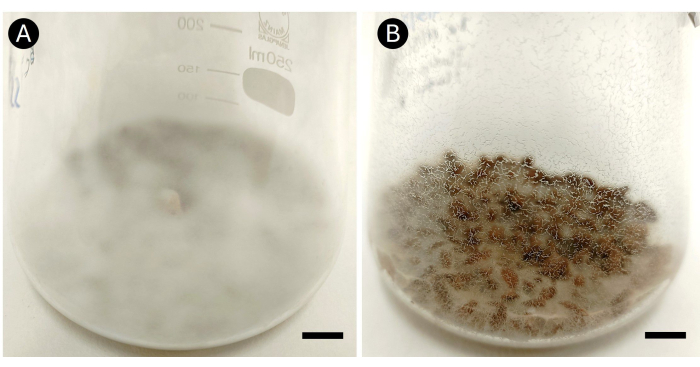
Figure 1: In vitro growth of pinewood nematode. (A) Non-sporulating Botrytis cinerea strain grown in sterilized hydrated barley seeds and (B) in vitro pinewood nematode culture after feeding on fungal mycelium. Scale bar = 1 cm. Please click here to view a larger version of this figure.
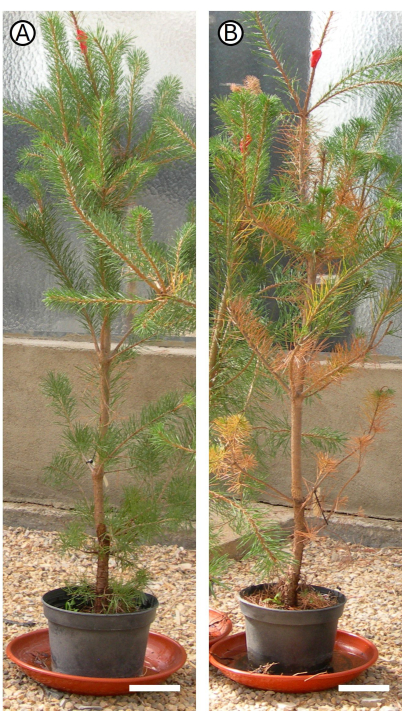
Figure 2: Greenhouse trials with pine seedlings. (A) A 2-year-old Pinus pinaster seedlings without and (B) with symptoms of Pine Wilt Disease. Scale bar = 10 cm. Please click here to view a larger version of this figure.
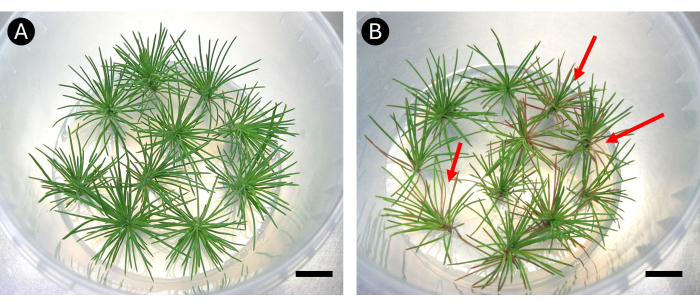
Figure 3: In vitro experiments with pine microshoots. Pinus pinaster in vitro shoot cultures (A) before and (B) after pinewood nematode infection. Chlorosis as a result of nematode infection can be seen in microshoot needles (arrows). Scale bar = 1.5 cm. Please click here to view a larger version of this figure.
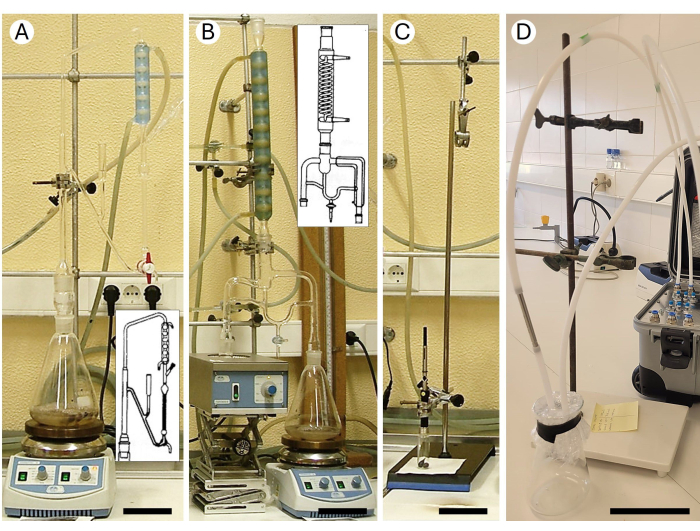
Figure 4: Setup for the different volatiles isolation systems. Isolation of (A) essential oils by hydrodistillation (Clevenger apparatus), (B) volatiles by distillation-extraction (Likens-Nickerson apparatus), and headspace volatiles by solid phase microextraction (SPME) with (C) fibers or (D) packed tubes. Scale bar = 10 cm. Please click here to view a larger version of this figure.
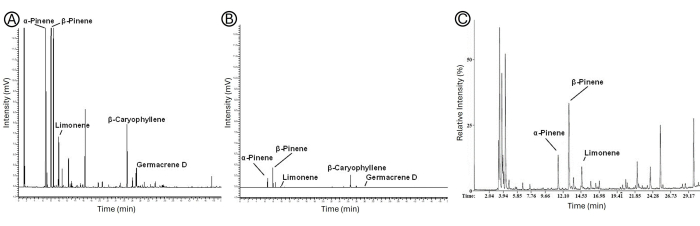
Figure 5: Representative chromatograms of Pinus pinaster shoot volatiles. (A) essential oil, (B) volatiles collected by solid-phase microextraction fiber, and (C) emitted volatiles using packed tubes. Identified using a laboratory-built reference library. Please click here to view a larger version of this figure.
Discussion
The protocol presented here outlines an enhanced methodology to analyze volatile compounds in maritime pine infected by the PWN, where environmental and genetic variability is reduced and does not influence the outcomes. Using pure lines of in vitro maritime pine genotypes, extracted and emitted volatiles can be analyzed as a host response to one of the most damaging biotic threats to pine forests.
Maintenance of reference cultures or the growth of large amounts of PWNs is easily performed in the lab by growing in vitro B. cinerea (non-sporulating strain) and using it as a food source for the nematode. This procedure is commonly very accessible, given the right conditions; however, when pipetting the PWN suspension, be sure to break the fungal colony surface. Otherwise, the PWNs will be retained in the water droplets. When successful, the fungal mycelium will be consumed, and PWNs will greatly multiply. Nematode sterilization is a critical step, but once sterile PWNs are obtained, the culture can be either maintained in B. cinerea, being then a monoxenic culture only contaminated with this fungus, or on the in vitro pine shoots6,29.
The use of greenhouse-grown 2-year-old P. pinaster seedlings has the advantage of simulating a closer condition to natural PWD infections; however, variability is harder to control3,5. In vitro co-cultures of P. pinaster shoots with the PWN are a refined working system that is more adequate for studies that require a finer control of environmental and biological variation6,9. However, their use is limited to studies on the tissue level, e.g., ultrastructural morphology or on biochemical regulation mechanisms under biotic or abiotic stress. In other fields, these systems offer a great potential for following minute changes in host metabolome, proteome, or transcriptome induced by the PWN in the first stages of infection.
In the establishment of in vitro pine shoots, the surface sterilization of pine seeds resorts to a strong biocide; however, optimizations can be performed with a variation on exposure time or biocidal agent. Pine seed coats are generally strong and can withstand pure ethanol for a longer period than weaker seeds. However, liquid diffuses inside the shell, so care must be taken that ethanol does not reach the embryo. In vitro, pine shoots can also be used for the maintenance or micropropagation of specific pine genotypes. Although harder to establish in an uncontaminated environment, non-seminal material can also be used to establish the in vitro shoot cultures. However, multiplication and growth may be slower.
Hydrodistillation and distillation-extraction procedures are volatile extraction techniques. The first will yield a pure extract of pine volatiles, called an essential oil; the second has the advantage of simultaneously using a solvent, so lighter molecules that are prone to escape due to high temperatures of boiling water can potentially be retained. These are extracts and do not always represent the volatile mixtures that plants emit into the environment. These headspace volatiles are more accurately sampled through solid-phase microextraction procedures, e.g., using coated fibers or packed tubes. Despite using boiling water as an extractive agent, which can induce the formation of artifacts, the hydrodistillation procedure has several advantages, e.g., a) the non-use of organic solvents, thus providing a pure extract, b) allowing yield determination, c) affording a chlorophyll-free extract, and d) providing, in addition to the essential oil, two other extracts, an hydrolate and decoction water, each of which with its own composition and characteristic bioactivity. The Likens-Nickerson apparatus is a special distillation-extraction unit that allows the simultaneous condensation of the hydrodistillate coming from the flask with plant material and of the organic solvent coming from the second flask. As the organic solvent is immiscible with, and lighter than, water, it is visible as the supernatant floating over the distilled water in the U-shaped central separatory trap above the apparatus stopcock. The fact that the distillate return-arms in the separatory trap are at different levels allows the distilled water to return to the flask with plant material and the extracting organic solvent to return to the second flask. n-Pentane changes from being transparent to translucent, indicating the distillate's presence. Solid phase microextraction is one of the several ways to collect headspace volatiles and can be adjusted to different types of applications and volumes of plant material in nature, in vials, in glass desiccators, and in PTFE bags, among others17. All these extraction procedures provide complementary information on the volatile profile. However, individual in vitro pine shoots are small and have a lower weight, and consequently lower amounts of volatiles when compared to pine seedlings. For in vitro pine shoots, distillation-extraction is more suitable to obtain extracted volatiles, while resin packed tubes are more suitable to trap emitted volatiles.
Disclosures
We have nothing to disclose.
Acknowledgements
This research was partly funded by the EU under the PurPest project through grant agreement 101060634, and by Fundação para a Ciência e a Tecnologia (FCT), through projects NemACT, DOI 10.54499/2022.00359.CEECIND/CP1737/CT0002; NemaWAARS, DOI 10.54499/PTDC/ASP-PLA/1108/2021; CESAM UIDP/50017/2020+UIDB/50017/2020+ LA/P/0094/2020; CE3C, DOI 10.54499/UIDB/00329/2020; GREEN-IT, DOI 10.54499/UIDB/04551/2020 and 10.54499/UIDP/04551/2020.
Materials
| Name | Company | Catalog Number | Comments |
|---|---|---|---|
| 38 mesh test sieve | Retsch | 60.131.000038 | |
| 6-Benzylaminopurine (6-BAP) | Duchefa Biochemie | B0904 | |
| Charcoal activated | Duchefa Biochemie | C1302 | |
| Clevenger apparatus | WINZER Laborglastechnik | 25-000-02 | |
| Hydrogen peroxide solution | Sigma-Aldrich | H1009-500ML | |
| Indole-3-butyric acid (IBA) | Duchefa Biochemie | I0902 | |
| Likens-Nickerson apparatus | VitriLab LDA. | c/IN29/32 | |
| Microbox round containers | Sac O2 | O118/80+OD118 | |
| n-Pentane | Sigma-Aldrich | 1.00882 | |
| PARAFILM M sealing film | BRAND | HS234526B-1EA | |
| Phyto agar | Duchefa Biochemie | P1003 | |
| Potato Dextrose Agar | BD DIFCO | 213400 | |
| Scalpel blade no. 24 | Romed Holland | BLADE24 | |
| Schenk & Hildebrandt Basal salt medium | Duchefa Biochemie | S0225 | |
| Schenk & Hildebrandt vitamin mixture | Duchefa Biochemie | S0411 | |
| SPME fiber assembly Polydimethylsiloxane (PDMS) | Supelco | 57300-U | |
| SPME Fiber Holder | Supelco | 57330-U | |
| Sucrose | Duchefa Biochemie | S0809 | |
| Tenax TA- stainless steel tubes- conditioned + capped | Markes International | C1-AAXX-5003 |
References
- Back, M. A., Bonifácio, L., Inácio, M. L., Mota, M., Boa, E. Pine wilt disease: A global threat to forestry. Plant Pathol. 73 (5), 1026-1041 (2024).
- Mumm, R., Hilker, M. Direct and indirect chemical defence of pine against folivorous insects. Trend Plant Sci. 11 (7), 351-358 (2006).
- Carrasquinho, I., Lisboa, A., Inácio, M. L., Gonçalves, E. Genetic variation in susceptibility to pine wilt disease of maritime pine (Pinus pinaster Aiton) half-sib families. Annals Forest Sci. 75 (3), 85(2018).
- Gaspar, M. C., et al. Impact of the pinewood nematode on naturally-emitted volatiles and scCO2 extracts from Pinus pinaster branches: a comparison with P. pinea. J Supercritical Fluids. 159, 104784(2020).
- Rodrigues, A. M., et al. Pinus halepensis, Pinus pinaster, Pinus pinea and Pinus sylvestris essential oils chemotypes and monoterpene hydrocarbon enantiomers, before and after inoculation with the pinewood nematode Bursaphelenchus xylophilus. Chem Biodiver. 14 (1), e1600153(2017).
- Faria, J. M. S., et al. In vitro co-cultures of Pinus pinaster with Bursaphelenchus xylophilus: a biotechnological approach to study pine wilt disease. Planta. 241 (6), 1325-1336 (2015).
- Espinosa-Leal, C. A., Puente-Garza, C. A., García-Lara, S. In vitro plant tissue culture: means for production of biological active compounds. Planta. 248 (1), 1-18 (2018).
- Bonga, J. M., von Aderkas, P. In Vitro Culture of Trees. , Springer. Netherlands, Dordrecht. (1992).
- Faria, J. M. S., et al. Nematotoxic and phytotoxic activity of Satureja montana and Ruta graveolens essential oils on Pinus pinaster shoot cultures and P. pinaster with Bursaphelenchus xylophilus in vitro co-cultures. Indus Crops Prod. 77, 59-65 (2015).
- Vallarino, J. G., et al. Acquisition of volatile compounds by gas chromatography-mass spectrometry (GC-MS). Plant Metabol. Meth Mol Biol. , 225-239 (2018).
- Kikuchi, T., Aikawa, T., Oeda, Y., Karim, N., Kanzaki, N. A rapid and precise diagnostic method for detecting the pinewood nematode Bursaphelenchus xylophilus by loop-mediated isothermal amplification. Phytopathology. 99 (12), 1365-1369 (2009).
- Faria, J. M. S., Barbosa, P., Bennett, R. N., Mota, M., Figueiredo, A. C. Bioactivity against Bursaphelenchus xylophilus: Nematotoxics from essential oils, essential oils fractions and decoction waters. Phytochemistry. 94, 220-228 (2013).
- Nickle, W. R., Golden, A. M., Mamiya, Y., Wergin, W. P. On the taxonomy and morphology of the pine wood nematode, Bursaphelenchus xylophilus (Steiner &Buhrer 1934) Nickle 1970. J Nematol. 13 (3), 385-392 (1981).
- Viglierchio, D. R., Schmitt, R. V. On the methodology of nematode extraction from field samples: baermann funnel modifications. J Nematol. 15 (3), 438-444 (1983).
- IPPC. IPPC DP 10: Bursaphelenchus xylophilus. Diagnostic protocols, International standard for phytosanitary measures. 27, 1-40 (2016).
- Rodrigues, A. M., Carrasquinho, I., António, C. Primary metabolite adjustments associated with pinewood nematode Resistance in Pinus pinaster. Front Plant Sci. 12, 10(2021).
- Gonçalves, E., et al. Effect of Monochamus galloprovincialis feeding on Pinus pinaster and Pinus pinea, oleoresin and insect volatiles. Phytochemistry. 169, September 2019 112159(2020).
- Schenk, R. U., Hildebrandt, A. C. Medium and techniques for induction and growth of monocotyledonous and dicotyledonous plant cell cultures. Canadian J Botany. 50 (1), 199-204 (1972).
- Tereso, S., et al. Improved axillary and adventitious bud regeneration from Portuguese genotypes of Pinus pinaster AIT. Propag Ornam Plants. 6 (1), 24-33 (2006).
- Council of Europe European Directorate for the Quality of Medicines. European Pharmacopoeia. , 241(2010).
- Likens, S. T., Nickerson, G. B. Detection of certain hop oil constituents in brewing products. Proc Ann Meet - Am Soc Brewing Chem. 22 (1), 5-13 (1964).
- Karimi, A., Gross, J. Development and validation of an innovative headspace collection technique: volatile organic compound patterns emitted by different developmental stages of Halyomorpha halys. Front Horti. 3, (2024).
- Koedam, A., Scheffer, J. J. C., Baerheim Svendsen, A. Comparison of isolation procedures for essential oils - II. Ajowan, Caraway, Coriander and Cumin. Zeitschrift für Lebensmittel-Untersuchung und -Forschung. 168 (2), 106-111 (1979).
- Abdulra'uf, L. B., Hammed, W. A., Tan, G. H. SPME fibers for the analysis of pesticide residues in fruits and vegetables: A review. Crit Rev Anal Chem. 42 (2), 152-161 (2012).
- Gross, J., Gallinger, J., Rid, M. Collection, identification, and statistical analysis of volatile organic compound patterns emitted by phytoplasma infected plants. Methods Mol Biol. 1875, 333-343 (2019).
- ISO. ISO 7609:1985 Essential Oils-Analysis by Gas Chromatography on Capillary Columns-General Method. ISO: Geneva, Switzerland. , (1985).
- Rubiolo, P., Sgorbini, B., Liberto, E., Cordero, C., Bicchi, C. Essential oils and volatiles: Sample preparation and analysis. A review. Flav Fragr J. 25 (5), 282-290 (2010).
- Fielding, N. J., Evans, H. F. The pine wood nematode Bursaphelenchus xylophilus (Steiner and Buhrer) nickle (= B. lignicolus Mamiya and Kiyohara): An assessment of the current position. Forestry. 69 (1), 34-46 (1996).
- Faria, J. M. S., et al. First report on the synergistic interaction between essential oils against the pinewood nematode Bursaphelenchus xylophilus. Plants. 12 (13), 2438(2023).
Reprints and Permissions
