Here we present a study established in the iDiv Ecotron, terrestrial mesocosm chambers with controlled environmental conditions above- and below-ground, to study the independent and interactive effects of plant history and soil history on ecosystem functioning of grassland communities along a plant diversity gradient.
Method Article
JenaTron - An Experimental Approach to Study the Effects of Plant History and Soil History on Grassland Ecosystem Functioning
In This Article
Summary
Abstract
The global loss of biodiversity has motivated many studies that experimentally vary plant species richness and examine the consequences for ecosystem functioning. Such experiments generally show a positive relationship between above- and below-ground biodiversity and the functioning of terrestrial ecosystems. Moreover, this relationship tends to strengthen over time, seen as enhanced functioning of diverse plant communities and reduced functioning of low-diversity plant communities. Differences in multitrophic community assembly and biotic interactions in high- versus low-diversity plant communities are hypothesized to affect plant performance by altering consumer community structure and function and driving plastic or micro-evolutionary responses of plant species in the plant communities. To resolve this complex interplay of community history, we separated these effects into plant and soil history. Plant history refers to all plant-level responses to past abiotic and biotic selection pressures experienced in their communities, while soil history relates to all abiotic and biotic soil properties developed as a legacy of plant-soil interactions under variable plant diversity. We set up a biodiversity experiment in an Ecotron, a terrestrial mesocosm facility that allows controlling environmental conditions above- and below-ground, to test whether the strengthening biodiversity-ecosystem functioning relationship is due to soil history, plant history, or a combination of both. We established a plant diversity gradient consisting of 1, 2, 3, and 6 grassland plant species and factorially nested with soil history and plant history treatments for each level of plant species richness. Representative results demonstrate the successful establishment of target treatments in the Ecotron experiment, observing the effects of plant and soil history on initial plant development and final plant growth. Additionally, we provide a case study for data analysis of individual response variables. We outline research objectives and methods to comprehensively assess the multifunctional responses to the experimental treatments necessary to ultimately address the overarching hypothesis.
Introduction
Over the past three decades, growing concerns about biodiversity loss have driven extensive research focused on experimentally manipulating plant species richness to investigate its impact on ecosystem functioning1,2. Experimental studies have demonstrated a positive relationship between plant diversity and ecosystem functioning1, which tends to increase over time3,4,5,6,7,8,9. This is a significant finding, as it suggests that experimental results obtained from young, recently established communities likely underestimate the consequences of biodiversity loss while emphasizing the importance of conserving older, species-rich ecosystems10.
Changes in biotic and abiotic processes over time, which can only be observed in long-term experiments, are one possible explanation for the amplifying effects of biodiversity on ecosystem functioning. High plant diversity has been associated with increases in soil carbon and nutrient concentrations3,9,11,12,13, optimized resource complementarity3,8,14, enhanced niche differentiation among plants15, accumulation of mutualists at all trophic levels10,16, and diminished threats from pathogens and herbivores via stronger top-down regulatory mechanisms17,18,19. Conversely, low plant diversity has been associated with selective pressure toward increased investment in plant defenses and less efficient resource use10,20,21,22. Taken together, differences in multitrophic community assembly and biotic interactions in high- versus low-diversity plant communities are hypothesized to influence plant performance by altering consumer community structure and function, as well as driving plastic or micro-evolutionary changes of plant species at the level of plant communities23,24,25,26. To resolve the complex interplay of community history, these effects were separated into two important components: plant history and soil history. Plant history refers to all plant responses to past abiotic and biotic selection pressures experienced in their respective communities, whereas soil history relates to all abiotic and biotic soil properties developed as a result of plant-soil interactions23,24,27,28. Both components are increasingly recognized as key drivers in long-term biodiversity effects29,30,31.
Experimental field studies provide valuable insights into the long-term effects of soil and plant history under realistic environmental conditions and on a large spatial scale32,33. However, field experiments are subject to various uncontrolled external factors, such as weather fluctuations, natural disturbances, and interactions with other organisms. In contrast, small-scale microcosm experiments, while limited in capturing the complexity and dynamics of natural ecosystems, offer precise control over abiotic factors like temperature, light, and water34. To combine the advantages of both approaches, novel experimental facilities called 'Ecotrons' emerged in the 1990s (e.g., Ecotron in Silkwood, UK34; Ecotron in Montpellier, France35; Ecotron in Hasselt, Belgium36). Roy et al. (2021)37 define an Ecotron as an experimental facility consisting of replicated enclosures designed to accomodate ecosystem samples, allowing realistic simulation of above- and below-ground environmental conditions while facilitating the simultaneous and automated measurement of ecosystem processes. Thus, Ecotrons enable the integrated study of complex ecosystem processes, multitrophic interactions, and ecosystem functions. They can harbor a variety of above- and below-ground organisms from multiple trophic levels in a large series of independent mesocosm chambers, enabling precise controlling and monitoring of environmental conditions in both above- and below-ground systems37,38.
In this study, we set up an experiment in the iDiv Ecotron38,39, referred to as the "JenaTron Experiment" (Figure 1 and Figure 2), to test whether biodiversity-ecosystem functioning (BEF) relationships in communities with different levels of plant species richness are modulated by soil history, shared plant history, or a combined effect of both. The iDiv Ecotron is specifically designed for multitrophic biodiversity experiments, focusing on the joint investigation of above- and below-ground interactions in terrestrial ecosystems38,39,40. It comprises 24 identical experimental units, termed 'EcoUnits' (Figure 2F,G), each capable of accommodating up to four individual ecosystems in isolated compartments (Figure 2K), allowing the construction of complex, near-natural ecosystems while minimizing the impact of environmental variability. One key advantage is the capacity to establish multiple replicates of intact soil monoliths (Figure 2A-C) under controlled environmental conditions, which enables the measurement of intricate ecosystem processes, including plant-plant and plant-soil feedback effects, that are often difficult to capture in small-scale microcosm experiments38,39.
In Europe, semi-natural grasslands are among the most biodiverse and complex terrestrial ecosystems, providing vital ecosystem services. However, since the early 20th century, these extensively managed grasslands have faced increasing threats from land-use change, making them a key focus for biodiversity conservation and research. One of the world's longest-running biodiversity experiments on extensively managed grasslands is the Jena Experiment32,33, located in Jena, Germany (50.951°N, 11.621°E, 139 m a.s.l.; website: https://the-jena-experiment.de). Established in 2002, the experiment investigates the relationships between grassland plant diversity and ecosystem functioning, particularly focusing on nutrient cycling and trophic interactions32,33. For the installation of the JenaTron Experiment within the iDiv Ecotron, we utilized the Trait-Based Experiment41 (TBE), a component of the Jena Experiment initiated in 2010 and completed in 2021. In 2022, 23 plots of the TBE were selected to establish a plant diversity gradient ranging from one to six species, spanning over 24 plant communities within the iDiv Ecotron. These communities comprised six grassland plant species, which overlapped with the Main Experiment of the Jena Experiment and represented three grass species (Anthoxanthum odoratum L., Dactylis glomerata L., Holcus lanatus L.) and three forb species (Leucanthemum vulgare agg., Plantago lanceolata L., and Ranunculus acris L.; see Table 1 for details on plant species composition and replicates for each plant diversity level). These species, widespread and frequently coexisting in semi-natural European grasslands, additionally differ in their temporal resource acquisition traits, making them ideal for comprehensive studies of temporal resource use, such as plant phenology41. The 24 plant compositions were randomly assigned to all EcoUnits (Figure 1C), with each EcoUnit further subdivided into four compartments to accommodate the factorial combinations of soil history and plant history treatments.
Soil history (Figure 1A) was established by excavating a total of 96 soil monoliths from the Jena Experiment. The soil of the site is a nutrient-rich floodplain soil classified as Eutric Fluvisol, developed from loamy river sediments32,33. Detailed information regarding soil pH, changes in soil texture, and organic matter within the Jena Experiment soil profile can be found in Lange et al. (2023)9. Of the 96 monoliths, 48 were sourced by excavating two monoliths from each of 22 TBE plots, encompassing monocultures, two- and three-species mixtures. Additionally, four monoliths were taken from an eight-species plot, which will serve as a six-species mixture in the JenaTron Experiment. Each of these 48 soil monoliths (depth: 0.8 m; diameter: 0.5 m) harbored a plot-specific residence community since 2010, thus representing a plant community-specific soil history (+SH). The remaining 48 monoliths were excavated from four bare ground plots that were kept free of vegetation since the initiation of the Jena Experiment in 2002, thus lacking any plant community-specific soil history (-SH). From each of the four bare-ground plots, 12 monoliths were excavated. The two soil history treatments (+SH; -SH) were factorially combined with two plant history treatments by planting pre-grown plants that reflected the plant community-specific composition of the TBE at an equal density, with individual plants spaced 6 cm apart.
Plant history (Figure 1B) was established using two distinct seed sources for each of the selected plant species from the Jena Experiment species pool: The first source consisted of seeds collected from plants that had experienced a community-specific history since 2010, corresponding to the exact Trait-Based Experiment (TBE) plots from which the soil monoliths were excavated (+PH). These seeds were collected from May to September 2019 dependent on species flowering phenology, ensuring a minimum of five individuals per species and plot were sampled. After collection, seeds were cleaned and stored at -20°C until the initiation of the JenaTron Experiment. The second seed source comprised seeds obtained from a commercial seed supplier producing seeds of regional provenances. These seeds were used to establish the TBE plots in 2010, thus representing plants without a community-specific selection history within the Jena Experiment (-PH) and were stored at -20°C from 2010 until the start of the JenaTron Experiment. Both histories of the six perennial plant species were pre-cultivated from February to May 2022 in four chambers of the iDiv research greenhouse located in Leipzig, Germany (51.330°N, 12.393°E, 120 m a.s.l.).
The factorial combination of soil history (SH) and plant history (PH) at each level of plant species richness resulted in four treatments within each of the 24 EcoUnits: (1) with soil history, with plant history (+SH/+PH), (2) with soil history, without plant history (+SH/-PH), (3) without soil history, with plant history (-SH/+PH), and (4) without soil history, without plant history (-SH/-PH; Figure 1C). The primary objective of the JenaTron Experiment is to investigate whether the strengthening relationship between biodiversity and ecosystem functioning is due to soil history, plant history, or a combination of both. We hypothesize that plant communities with shared plant and soil community-specific history will show the strongest BEF relationship, whereas an experimental exclusion of soil history, plant history, or both may have detrimental effects on the positive relationships of plant diversity and ecosystem functioning. Ultimately, if soil or plant history were to alter the relationship between plant species richness and ecosystem functioning, this would serve as an important consideration for the conservation and monitoring of locally preserved and novel restored communities.
Protocol
NOTE: Ensure that appropriate personal protective equipment (e.g., helmets, gloves, waistcoats, safety shoes, etc.) is provided at all protocol steps.
1. Soils: Preparation, excavation, installation
- Soil sources, plot selection, and preparation (February 2022)
- Select two soil sources from the Jena Experiment field site:
- Select 23 TBE plots that harbored a plot-specific community for 12 years in order to cover a plant diversity gradient of 1, 2, 3, and 6 species. Designate these plots as JenaTron Experiment treatment "with plant community-specific soil history" (+SH).
- Select 4 bare ground plots with the same soil properties as the TBE plots (pH, sand content, etc.), but kept without vegetation cover since 2002. Designate these plots as JenaTron Experiment treatments "without a plant community-specific history" (-SH).
- Gently remove the upper 5 cm of soil from all selected plots using a mini-excavator to equalize conditions across soil history treatments.
- Select two soil sources from the Jena Experiment field site:
- Soil monolith excavation (March 2022)
- Set up the monolith extraction device at each plot, mount a cutting system on an empty steel cylinder, and insert it into the extraction device (Figure 2A).
- Switch on the device, and the cutting system will rotate around the outer cylinder wall. The system cuts a notch in the soil into which the extraction device simultaneously presses the steel cylinder. In parallel, use a mini-digger to excavate a pit at the side of the steel cylinder (Figure 2B).
- Once the steel cylinder is completely embedded in the soil, climb into the side pit and clip the monolith at the bottom edge of the steel cylinder by mounting a temporary bottom plate and use the monolith extraction device to lift it out of the excavation pit (Figure 2C).
- Dismantle the cutting system from the steel cylinder, mount a temporary top plate to the steel cylinder, lift the monolith using a suspension attached to the mini-digger, and turn it upside down.
- Installation of the water suction system (March 2022)
- Dismount the bottom plate, remove approximately 5 cm of soil layer with a trowel, and store it for later use.
- Embed a ring of water suction probes (8 candles connected with Polyvinyl chloride [PVC] hoses) in quartz powder, moist it with demineralized water (VE), and refill the steel cylinder bottom with the previously removed soil.
- Connect the PVC end piece of the water suction probe ring to the bottom plate and bolt it subsequently.
- Turn the steel cylinder with the suspension on the mini-excavator upright again, label it individually, seal the openings in the cylinder walls with adhesive tape, and wrap the cylinder in plastic foil for protection during transportation.
- Transport the soil monoliths with a truck to the iDiv Ecotron, located at the experimental field station of the Helmholtz Center for Environmental Research (UFZ) in Bad Lauchstädt, Germany (51.392°N, 11.876°E, 116 m a.s.l.).
- Installation of soil sensors (April 2022)
- After unpacking, cut precisely fitting holes for the sensors horizontally in the soil monolith with a customized steel blade using the openings in the cylinder wall at three different depths (9.5 cm, 21.5 cm, and 43.5 cm).
- Place the soil sensors into the holes, use a wooden log to bring them in the right position, and bolt the openings with custom-made seal plugs.
- Installation of the soil monoliths into the EcoUnits (April 2022)
- Carefully lift the technical and upper part of each EcoUnit from the lower part (Figure 2G). Transport the lower part to the steel cylinders harboring the intact soil monoliths equipped with soil sensors.
- Attach each steel cylinder to a suspension, lift it with a forklift, and mount a connector to the suction candle ring connected to the bottom plate.
- Lift four soil monoliths into the lower container of each of the 24 EcoUnits (Figure 2F), with two having the same plant community-specific soil history (+SH) and two without plant community-specific soil history (-SH). Lead the cables of the soil sensors through the openings of the ground container.
- Fix the steel cylinders to the lower part with screws and subsequently connect the water suction candle rings of each cylinder to the water suction system of the EcoUnit through the previously installed connector.
- Use the forklift to transport the container equipped with the soil monoliths into a hall (24 m x 24 m).
- Carefully place the technical and upper parts (with internal walls between subunits [Figure 2K]) of each EcoUnit back on top of the lower part.
- Arrange all 24 EcoUnits in three rows, each consisting of two groups of four EcoUnits, forming a total of six blocks. Ensure a center-to-center distance of 6 m between blocks within each row and 8.2 m between rows. In each block, randomly assign the four plant diversity levels (1, 2, 3, and 6) to the four EcoUnits, ensuring an even distribution of species across all EcoUnits wherever possible.
2. Plants: Preparation and cultivation installation
- Selection of species and seed material
- Select the following six plant species from the Jena Experiment species pool: Anthoxanthum odoratum L. (Poaceae), Dactylis glomerata L. (Poaceae), Holcus lanatus L. (Poaceae), Leucanthemum vulgare agg. (Asteraceae), Plantago lanceolata L. (Plantaginaceae), and Ranunculus acris L. (Ranunculaceae).
- For each species, select seed material originating from two different seed sources:
- Use seeds from plants that had been growing on the TBE plots of the Jena Experiment since 2010 (with plant history, +PH).
- Use the original seed material that was used to initiate the TBE in 2010 sourced from a regional seed producer (without plant history, -PH).
- Substrate preparation (February 2022)
- Collect plot-specific soil from each of the selected plots at the Jena Experiment field site. Fill the soil into 20 L plastic boxes and store it at 4 °C until used for plant cultivation.
- Sieve each plot-specific soil through a 4 mm mesh. Mix the soil from the four bare ground plots before sieving.
- To remove unwanted biota, transfer quartz sand into stainless steel containers and heat in a drying oven for 4 h at 200 °C.
- Mix plot-specific soil and quartz sand by volume in a 3:1 ratio and fill the soil-sand mixture into multipot plates using a plastic shovel (total n = 152).
- Label each multipot plate individually and place them in a greenhouse with a day-night cycle of 16 h/18 °C and 8 h/12 °C, maintaining moderate humidity of 60%-70% relative humidity (RH).
- Water the plates on demand and keep them bare for two weeks to allow soil seed banks to germinate. Weed all plates twice to remove unwanted seedlings.
- Sowing campaign (March-April 2022)
- Determine the sowing order based on species-specific germination time as follows:
- Sow R. acris 2 weeks prior to other herbs
- Sow P. lanceolata and L. vulgare 1 week ahead of grasses A. odoratum, D. glomerata, and H. lanatus.
- Sow all species, except R. acris, directly into the plot-specific soil-sand substrate (3:1) in multipot plates with two or three seeds per pot. After successful germination, thin out all species to single seedlings using spring steel tweezers.
- Pretreat R. acris seeds in Petri dishes on filter paper moistened with a gibberellic acid solution (1000 mg.L−1) to break dormancy (Figure 2D). Incubate the seeds for 24 h.
- Transfer R. acris seeds to filter paper moistened with demineralized water (VE) until germination. Once seeds reach the radicle stage, prick seedlings into the plot-specific soil-sand substrate (3:1) in the prepared multipot plates using spring steel tweezers.
- Water all plant individuals with deionized water on demand and keep them in the greenhouse until transport to the iDiv Ecotron (Figure 2E-H)
- Determine the sowing order based on species-specific germination time as follows:
- Planting campaign (May 2022)
- Design individual planting schemes for all soil monoliths with the following characteristics:
- Ensure a balanced number of individuals per species within the plant communities.
- Maintain a 6 cm distance between each plant individual and its neighbor.
- Randomize the planting pattern across EcoUnits, but keep it constant within subunits.
- Use a custom-made planting stencil to mark the exact position of each plant individual on the soil monoliths. Use different colored plastic toothpicks for marking, assigning a specific color to each species. After marking, remove the stencil (Figure 2I).
- Plant the pre-grown plants on all soil monoliths within one week using bulb planters with a 4 cm diameter (5280 total plant individuals; Figure 2J).
- Design individual planting schemes for all soil monoliths with the following characteristics:
3. Course of the experiment
- Three-week establishment phase (May 2022):
- Replace all individuals that did not survive the planting campaign within 2 weeks of initial planting (n = 124 [2.35%]).
- Turn on the lights and set the lighting regime to a 16/8 h day-night cycle. To replicate the regional day length in late spring and summer at the start of the experiment, simulate dusk by dimming the lights from 100% to 75% intensity over one hour, then to 0% over the next hour (100% intensity: ~370 μmol/(m²·s)). Simulate dawn by reversing this dimming pattern.
- Equalize the upper soil moisture to 20% (± 3%) by volume using a soil moisture measurement kit.
- Set the initial irrigation to 450 mL every 12 h for each subunit.
- Connect air and soil sensors to monitor temperature and humidity throughout the experiment.
- Experimental phase (June-October 2022)
- Following the natural seasonality, shorten the day length by a full hour every 2 weeks from August to October to account for the regional day lengths from late summer to autumn.
- Increase the initial irrigation to 650 mL every 12 h in July and 750 mL every 12 h in August, adjusting to plant water demands.
- Constantly weed out unwanted seedlings at the cotyledon stage using tweezers to maintain plant density while minimizing disturbance to the soil structure.
- In accordance with the standard management for extensively managed meadows, perform two harvests of above-ground biomass, cutting the plants 3 cm above the soil surface with scissors.
Results
To provide initial insights into the effectiveness of this approach in testing the independent and interactive effects of plant and soil history on biodiversity-ecosystem functioning relationships, we first evaluated photographs of two representative EcoUnits after the 3-week establishment phase of the JenaTron Experiment, where treatment effects quickly became visible (Figure 3). Besides treatment-specific differences in plant community height and color (Figure 3A), we additionally recognized treatment-specific differences in the flowering time of R. acris. Specifically, plants grown from seeds with no plant history appeared to have an earlier flower onset than plants grown from seeds with the community-specific plant history of the Jena Experiment (Figure 3B).
To evaluate whether the newly established communities in the iDiv Ecotron accurately reflect the original field communities, a comparative analysis of species-specific vegetative plant height was performed as an indicator of final plant development between the JenaTron Experiment and TBE plots. In the JenaTron Experiment, plant height was determined as the mean value of the highest vegetative leaf of three individuals per plant species in each of the 24 communities and treatment combinations just prior to the first harvest campaign end of July 2022. In the TBE, vegetative plant height was determined as the mean value of the highest vegetative leaf of three individuals per plant species and plot in July 2012. Plant height measurements from the iDiv Ecotron exhibit a strong correlation with those from the Jena Experiment field plots (Supplementary Figure 1).
To further provide a case study for data analysis, the vegetative plant height in the iDiv Ecotron was investigated in more detail. We focused on species- and community-level analyses and tested whether plant history, soil history, and plant diversity influence vegetative plant growth. For this, we used linear mixed-effects models (LMM) and summarized results via ANOVA (type-I sum of squares; for detailed ANOVA results, see Supplementary Table 1). At plot level, response variables were mean plant vegetative height and the coefficient of variation of plant height (CV = sd/mean 100). Fixed effects included plant diversity (numerical), plant and soil history treatments, and their interactions. Random effects included EcoUnit nested within the Ecotron hall block. At the species level, we additionally included species and their interaction with plant diversity and history treatments in fixed terms. Data transformations (log for plant height and square root for height (CV) ensured model assumptions were met. Analyses were conducted using R (Version4.3.1)42 and the nlme package for LMMs43. Results showed significant species differences in plant height, with grasses taller than forbs (Figure 4, Supplementary Figure 2). Across all species, soil history had a positive effect on plant height (F(1,66) = 11.11, P = 0.001), while plant history and diversity had no significant impact (F(1,66) = 0.22, P = 0.64 and F(1,17) = 1.52, P = 0.23, respectively; Figure 4). At the community level, plant diversity had no effect on height (F(1,17) = 0.01, P = 0.91; Figure 5A) but significantly increased plant height CV within communities (F(1,17) = 14.29, P = 0.002; Figure 5B). No significant effects of plant or soil history were found on plant height CV (F(1,68) = 0.55; P = 0.46; F(1,68) = 0.09, P = 0.76; Figure 5). We have uploaded the data and R script to the Jena Experiment database (https://doi.org/10.25829/QN9R-J839).

Figure 1: Setup of the JenaTron experiment. (A) Soil History (SH) was established by excavating 96 intact soil monoliths from the Jena Experiment (JE), of which half (n = 48) were obtained from 23 plots that harbored a plot-specific community for 12 years (+SH), while the other half (n = 48) was obtained from four bare ground plots held vegetation-free since the beginning of the Jena Experiment in 2002 (-SH). (B) Plant history (PH) was established using two seed sources for each of six plant species: seeds collected from plants grown since 2010 on the same plots, where the monoliths were excavated in the Jena Experiment (+ PH), and the original seeds as used to sow these communities in the field in 2010 (-PH). (C) Plant history and soil history were independently crossed for each composition at different plant diversity levels (1, 2, 3, and 6), resulting in four treatments in each EcoUnit of the iDiv Ecotron: (1) +SH/+PH, (2) +SH/-PH, (3) -SH/+PH, and (4) -SH/-PH. Please click here to view a larger version of this figure.

Figure 2: The iDiv Ecotron at the Research Station of the Helmholtz-Centre for Environmental Research (UFZ) in Bad Lauchstädt, Germany. (A) Soil monolith excavation equipment in the field, (B) Soil monolith excavation in the field, (C) Excavation pit in the field, (D) Preparation of Ranunculus acris seed material in petri-dishes on filter paper moistened with gibberellic acid solution in the greenhouse, (E) Pre-cultivation of plants with plot-specific soil substrate in multipot plates in the greenhouse, (F) EcoUnits in the iDiv Ecotron hall, (G) Schematic depiction of one experimental unit ("EcoUnit") with technical equipment (adapted from Eisenhauer et al. (2019)23 and Schmidt et al. (2021)38), (H) Plates with all individuals to be planted in the JenaTron Experiment) after transport to the iDiv Ecotron, (I) Species-specific marking of the planting positions for all plant individuals on a soil monolith made with a planting stencil, (J) Planting of plant individuals on a soil monolith using bulb planters, (K) Four lysimeters in an EcoUnit with internal walls. Please click here to view a larger version of this figure.

Figure 3: Two representatives of the 24 EcoUnits, each harboring one community in all treatment combinations of plant and soil history. (A) EcoUnit with a 3-species mixture (A. odoratum, H. lanatus, and P. lanceolata) with treatment specific differences in community vegetation height and color. (B) EcoUnit with a monoculture of R. acris, indicating plant history dependent differences in flowering time. Please click here to view a larger version of this figure.
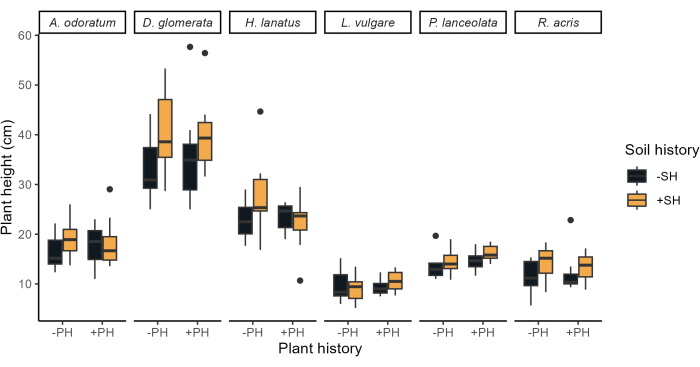
Figure 4: Effects of plant and soil history on vegetative plant height (cm) of the six grassland plant species before the first harvest in July 2022. Species are listed alphabetically within functional groups (grasses followed by forbs). Plant history treatments (+PH/-PH) are on the x-axis, and soil history (+SH/-SH) is color-coded (yellow/black) in the box plots. Please click here to view a larger version of this figure.
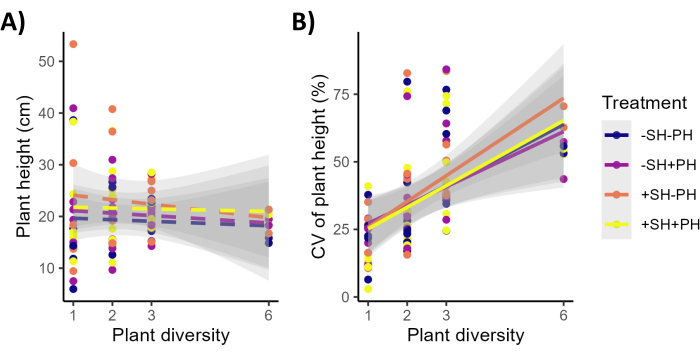
Figure 5: Effects of species richness on community mean and variation in vegetative plant height. (A) Community mean. (B) Variation in vegetative plant height. (+PH/-PH) for plant history, (+SH/-SH) for soil history. Plant height variation (CV) is shown per subunit. Dashed lines represent non-significant, solid lines represent significant effects on plant diversity. Please click here to view a larger version of this figure.
Table 1 Plant communities in the JenaTron Experiment. Monocultures of all selected plant species (n = 6); 2-species mixtures (n = 9); 3-species mixtures (n = 7) all with different compositions; and two identical replicates of the 6-species mixture (n = 2). Please click here to download this Table.
Supplementary Figure 1: Species' average plant height. Species' average plant height in the (A) JenaTron Experiment plots (July 2022) and in the field (B) TBE plots (July 2012). Only data from the treatment with plant history and soil history were included in panel A. There is a significant correlation between plant height in the JenaTron Experiment and the field plots (Pearson correlation r(49) = 0.45, p = 0.0008). Please click here to download this File.
Supplementary Figure 2: Effects of plant and soil history treatments on vegetative plant height (cm) of the six plant species at different levels of plant diversity (SR). Legend symbols +PH and -PH represent treatments with and without plant history, while +SH and -SH signify treatments with and without soil history, respectively. Please click here to download this File.
Supplementary Table 1: ANOVA results from linear mixed-effects models assessing the effects of plant diversity (species richness, SR), soil history (SH), and plant history (PH) on plant height at both species level and plot level. F-values and p-values are reported for each term. Note: numDF and denDF represent the numerator and the denominator degrees of freedom for each model term. P-values < 0.05 suggest a statistically significant effect on plant height. Please click here to download this File.
Supplementary Table 2: Above- and below-ground measurements, response variables, and methods. A spectrum of above- and below-ground measurements, response variables, and methods conducted in the JenaTron Experiment to study the independent and interactive effects of plant history and soil history on BEF relationships for ecosystems as a whole. Please click here to download this File.
Discussion
With the JenaTron Experiment, we provide a complementary experimental approach to the Jena Experiment field site32,33 to enhance our mechanistic understanding of BEF relationships. The Field Experiment allows us to study the long-term effects of soil history and plant history on ecosystem functioning under realistic environmental conditions, with large, undisturbed plots allowing repeated measurements over many years. The randomly selected combinations of plant species from a large species pool along a well-established plant diversity gradient from monocultures up to 60 species help to identify diversity effects by excluding species-specific effects as much as possible32,33. However, the Field Experiment, referring here explicitly to the 'ΔBEF Experiment' as part of the Jena Experiment (for further details, see Vogel et al. (2019)29), is limited in investigating soil history and plant history completely independent from each other and from potential influences of various external factors, such as weather fluctuations, natural disturbances, and interactions with other organisms29. At this point, the complementary approach of using Ecotron experiments comes into the focus of BEF research. Ecotron experiments represent an important link between small-scale, short-term microcosm experiments, which study only a few or even just a single species and thus reduce the high complexity of field experiments or even the real world34,38. Hence, the main aim of Ecotron experiments is not to imitate the full complexity of nature but rather to create simplified but biologically meaningful ecosystems. This allows to better understand many, but of course not all, biological processes and interactions that occur in the real world34,37. Moreover, the closed systems of an Ecotron allow for studying fluxes and processes, which often cannot be easily studied in the field35.
Various modifications of the experimental technique have been utilized in previous studies, underscoring the significant adaptability of the iDiv Ecotron facility. For example, the "Insect Armageddon" experiment44, conducted in 2018, involved a reconfiguration of the EcoUnits by removing the above-ground interior walls and below-ground dissection with steel cylinders. Instead, the below-ground containers were entirely filled with a soil-sand mixture, facilitating the establishment of grassland communities comprising 12 European plant species across a soil surface area of 1.5 m2 per EcoUnit. This experimental design allowed for the introduction of two distinct abundance levels of above-ground invertebrates, enabling researchers to investigate the impacts of invertebrate biomass decline on ecosystem functions and services within Central European grassland ecosystems. Another illustrative example is the "EcoLux" experiment, conducted in 2020, which demonstrated a modification in the light regime to investigate the effects of light pollution at night on plant diversity and performance45 as well as its influence on soil communities and functions46. Looking ahead, the potential for further modifications remains substantial. The upcoming "ResCUE" experiment, scheduled for 2026, aims to examine the relationships between plant diversity and ecosystem stability under climatic extremes26. This experiment will implement a standardized hot drought, an environmental condition difficult to replicate in natural settings, by simulating reduced precipitation alongside increased temperatures across a gradient of grassland plant diversity established in the iDiv Ecotron. The study will focus on assessing the resistance and recovery of multiple ecosystem functions in response to the controlled climatic extreme event26.
However, using Ecotron facilities to bridge field experiments and small-scale microcosm experiments also entails limitations, such as mostly a still relatively small spatial scale, a low number of replicates, lower biological complexity and the lack of representation of natural climatic variability37. Furthermore, the iDiv Ecotron facility cannot simulate all kinds of climatic scenarios, such as winters, limiting its ability to study individual plants in a realistic annual cycle across several generations. Hence, as mentioned before, it is very important to consider Ecotron studies as complementary research approaches that must ultimately be considered in combination with results from other experimental approaches37. Nevertheless, the iDiv Ecotron facility offers us the unique opportunity to study intact soil monoliths under controlled environmental conditions, to orthogonally cross plants with different plant community-specific histories with soils with different plant community-specific histories and to study their effects on ecosystem functioning along a plant diversity gradient, which is difficult to achieve under field conditions23,35. Additionally, the technique allows for studying plants as a whole, both above- and below-ground, under controlled environmental conditions, which is not easily achievable in the field. Lastly, in the JenaTron Experiment, the planted (rather than sown) plant communities were established to ensure equal total plant densities, with each species represented in equal proportions. In contrast, in sown communities, species often establish at different rates, and some target species may fail completely to establish or could remain at very low abundance.
To ensure the reproducibility of the presented protocol, several critical steps must be meticulously considered during execution: (1) Soil monolith excavation: One key advantage of the iDiv Ecotron facility is its capability to establish a substantial number of replicates of intact soil monoliths under controlled environmental conditions. To ensure the integrity of the soil monoliths, it is essential to maintain optimum field conditions for soil monolith extraction. Specifically, excessive soil moisture can lead to compaction of the soil column, while soils that are either too dry or frozen may result in the formation of cracks. In instances where the monolith is compromised due to these factors, it must be discarded, necessitating a repetition of the excavation process. (2) Species selection: The protocol described uses six grassland plant species of the TBE, which were selected based on overlap with the main experiment, a balanced representation of grasses and forbs, and the possibility of studying different resource use strategies (e.g., plant phenology)41. For a biodiversity experiment, six species are a low species number, and the selection of other species possessing other trait combinations could lead to different experimental results and must be carefully considered. (3) Plant density and equal proportions of all species: A notable advantage of the JenaTron Experiment setup is that plant communities are established with equal total plant densities and that each species is represented with the same number of individuals. Ensuring consistent plant density and equal planting proportions is crucial for experimental reproducibility, as it prevents confounding effects associated with a differential establishment of individual species. Hence, precise control of plant density is essential to preserve the experimental design and ensure reliable outcomes.
After initiating the JenaTron Experiment following the protocol with special emphasis of considering the mentioned most critical steps, discernible treatment effects on plant community height, color, and flowering time swiftly emerged. Subsequent comparative analyses of species-specific vegetative plant heights between JenaTron and TBE clearly confirmed that communities established in the iDiv Ecotron indeed resemble the original communities in the field. To further provide a case study for data analysis, we analyzed the vegetative plant height in the JenaTron experiment in more detail. Analyses of species-specific vegetative plant heights in the JenaTron confirmed the successful establishment of all target species and revealed significant differences among species and functional groups. This result is expected, as grasses are known to grow taller than other functional groups in the Jena Experiment47. A significant positive effect of soil history was detected across species, indicating that prior soil conditions shape plant growth in the Ecotron, potentially driven by positive feedback effects from soils that previously harbored a plant community (independent of the diversity level) and negative feedback from soils held vegetation-free. The biotic and abiotic properties of soil histories appear to differ, giving plants in soils with plant community-specific history an advantage over plants in soils without this respective history, as plant height plays an important role in their ability to compete for light and is thus a vital trait for carbon gain48. In contrast, no significant effect of plant community-specific plant history on mean vegetative height was found, implying that soil properties may have a stronger influence than the seed sources under the Ecotron's environmental conditions. However, this hypothesis needs to be tested in a holistic way by investigating the multitude of ecosystem functions that were measured in the JenaTron Experiment.
Neither species- nor community-specific analyses provided evidence that species richness affects mean vegetative plant height, contrasting with previous findings from the Field Experiment, where plant height increased with higher species49 likely due to stronger light competition47,50. Greater complementarity among species in more diverse communities may lead to higher plant densities51, potentially additionally enhancing plant height growth52. The lack of plant diversity effects on plant height in the JenaTron Experiment could thus be due to the absence of biodiversity-dependent variation in plant density, indicating the potential importance of this mechanism for diversity-dependent individual plant performance in the real world52. Nevertheless, species richness had a significant effect on plant height CV, suggesting that plant diversity increases vegetation structural complexity, consistent with studies linking diversity to more complex above-ground canopies49,50,52,53,54.
Taken together, results confirm the successful establishment of the JenaTron Experiment's target treatments, providing first insights into the effectiveness of our approach through the rapid manifestation of significant treatment effects (Figure 3, Figure 4, and Figure 5). Additionally, comparative analysis of species-specific vegetative plant height indicates that the newly established communities in the iDiv Ecotron indeed resemble the original field observations. The detailed analysis of vegetative plant height serves as a case study for data analysis and visualization of single response variables. However, this case study highlights the limitations of focusing on a single response variable in holistically addressing the overarching hypothesis, whether the strengthening relationship between biodiversity and ecosystem functioning over time is due to soil history, plant history, or a combination of both. This underscores the importance of our highly collaborative approach to investigating the independent and interactive effects of plant history and soil history on BEF relationships23. Eleven sub-projects of the Jena Experimental Research Unit (FOR 5000) worked closely together in the JenaTron Experiment, measuring a wide range of response variables across various research areas, such as microbiology, chemical ecology, phenology, proximal sensing, genetics, epigenetics, soil ecology, and food web modeling. This integrative effort aims to (1) separate plant history effects from soil history effects on multiple trophic levels and ecosystem functions, (2) investigate plant species-specific and interaction-specific effects at all levels of plant species richness, and (3) explore the underlying mechanisms of BEF relationships23(Supplementary Table 249, 50,55,56,57,58,59,60,61,62,63,64,65,66,67,68,69,70,71,72,
73,74,75,76,77,78,79,80,81,82,83,84).
Disclosures
The authors have nothing to disclose.
Acknowledgements
Exceptional thanks go to L. Boockmann, T. Meier, N. Naderi, and L.-M. Walter for their support as research assistants during the entire duration of the JenaTron Experiment. Many thanks to all employees of the Umwelt-Geräte-Technik GmbH (UGT) for their professional and warm cooperation during the soil monolith excavation in the Jena Experiment. We would also like to thank C. Lauterwasser, H.-C. Schulz, and R. Widuwils for supporting UGT in soil monolith excavation. Many thanks go to the technical staff of the Jena Experiment S. Eismann, F. Freter, G. Kratzsch, U. Köber, K. Kunze, and H. Scheffler for their support in the field and their diligent help during the planting campaign at the iDiv Ecotron. We are grateful to I. Merbach and the technical staff of the Research Station of the Helmholtz Centre for Environmental Research (UFZ) in Bad Lauchstädt, especially to O. Bednorz and K. Kirsch, for their vital support. We want to thank A.Q. Barth and R. Altmann for their excellent collaboration in the iDiv greenhouse. Many thanks to S. Haenzel, A. Lochner, and A. Zeuner for their indispensable help with administration, organization, and laboratory work. We thank the Mercator Fellows J. Cavender-Bares, F. Isbell, L. Mommer, and K. Mueller, as well as the close collaborator B. Schmid and the Principal investigators U. Brose, H. Schielzeth, N. van Dam, W.W. Weisser, C. Wirth and J. Wolf for their important contribution to the conception, design and realization of the JenaTron Experiment. Finally, we thank the German Research Foundation (DFG) for financial support (FOR 5000) as well as the German Centre for Integrative Biodiversity Research (iDiv, funded by the German Research Foundation [DFG-FZT 118, 202548816]), the University of Leipzig, the Friedrich Schiller University Jena and the Max Planck Institute for Biogeochemistry Jena for financial and logistic support.
Materials
| Name | Company | Catalog Number | Comments |
|---|---|---|---|
| Bulb planter (4 cm diameter) | Kent & Stowe | hardware store | https://www.bauhaus.info/gartenhandgeraete/kent-stowe-hand-blumenzwiebelpflanzer/p/27516825?cid=SSAGoo 8995092923_90652787883&gad_ source=1&gclid=CjwKCAiAqNSs BhAvEiwAn_tmxcMcdbxDo72K6g O6FX7hNePwWoc_8JIcgwA4qrY sbv-diJjHf_osDhoCXxEQAvD_BwE |
| Connector suction candle | Umwelt Geräte Technik (UGT) | 1871000 | https://ugt-online.de/en/solutions/ugt-lysimeter-sampling-technology-for-mineral-soils/ |
| Cultivation tray (without drainage) | Bonsai-shopping | 59000/5-m.D._1 | https://www.bonsai-shopping.eu/Anzuchtschale-59000-5er.html |
| Demineralized water (VE) | Alfiltra | VEWA1000B | https://www.alfiltra.de/zubehoer/1000-liter-ve-wasser-im-ibc-behaelter |
| Duct tape | T-Rex | hardware store | https://www.bauhaus.info/panzertape/t-rex-gewebeband/p/25421491?cid=SSAGoo8843016955_1500 14388930&gad_source=1&gclid= CjwKCAiAqNSsBhAvEiwAn_tmxX 5KDl2CRPyAgi7nx2ILVTSy7dUfNY 2DvvCi0ZvtnU8opjA-stwmvRoCflwQAvD_BwE |
| iDiv Ecotron | iDiv | n.a. | https://www.idiv.de/en/research/platforms-and-networks/idiv-ecotron.html |
| Plastic boxes (20 L) | Auer Packaging | EG 43/22 HG | https://www.auer-packaging.com/de/de/Eurobeh%C3%A4lter-geschlossen/EG-4322-HG.html?customer_type=private&gad_source =1&gclid=Cj0KCQjw4Oe4BhCc ARIsADQ0csk38dwQfgiSU63e KE-xapuDT3f2f6EpzwKCJdjknbGP NbEwv4iOg0YaApUKEALw_wcB |
| Filter paper (150 mm diameter) | Labsolute | 7697996 | https://www.thgeyer.com/lab/shop/qualitativ-rundfilter-sorte-2005/labsolute-/7697990_de?variant=7697996 |
| Forklift | hirsch | NEW-10084 | https://www.hirsch.expert/elektro-gabelstapler-2-tonnen_1794_13098/?gad_source=1&gclid=Cj0KCQjw4O e4BhCcARIsADQ0csmqfjWn 46WlTGVGnZDoDv4WkqUh WT0eYrsGnvIWcjemrOYCp 3c3QC4aAn3WEALw_wcB |
| Gibberellic acid (90%) | Rotichrom | 7697996 | https://www.carlroth.com/de/de/weitere-vergleichssubstanzen/gibberellinsaeure/p/7464.2 |
| Measuring jugs (3000 mL) | Hünersdorff | hardware store | https://www.hornbach.de/p/messkanne-3000-ml-huenersdorff/6481831/ |
| Measuring jugs (5000 mL) | Hünersdorff | hardware store | https://www.hornbach.de/p/messkanne-5000-ml-huenersdorff/6481832/ |
| Metal sieves (4 mm mesh size) | Blau-Metall | 711082 | https://analysensiebe.de/shop/produkt/analysensieb-400-maschenweite-2000/ |
| Mini-digger | Zeppelin Cat | ZCS196577 | https://www.zeppelin-cat.de/shop/produkte/minibagger-kaufen/cat-301-8-minibagger-inkl-loeffel-und-schnellwechsler/?srsltid=AfmBOoqOG9_VONO0EmP K0GAYEr1onMxM-v3YyM 14hZFK0i9YHXJ_0ddggcs |
| Mortar tubs (90 L) | Gripline | hardware store | https://www.hornbach.de/p/moertelkuebel-pe-eckig-78-5-x-46-3-x-31-0-cm-90-l/274293/ |
| Multipot plates (QuickPotPlates - QP 96T) | Herkuplast | 741238 | https://www.meyer-shop.com/product/view/37052?variantProductId=29253 |
| Petri dishes (150 mm diameter) | Labsolute | 7696412 | https://www.thgeyer.com/lab/shop/petrischalen-ps-mit-nocken--aseptis/labsolute-/7696390_de?variant=7696412 |
| Planting stencil (custom-made) | UFZ | n.a. | Planting stencil manufactured by the workshop of the Helmholtz Centre for Environmental Research (UFZ), Leipzig, Germany, specifically for planting the iDiv Ecotron metal cylinders. |
| Plastic foil | Cargo Point | hardware store | https://www.hornbach.de/p/cargo-point-stretchfolie-0-50-x-300-m-20/7152950/ |
| Plastic shovels | Hünersdorff | hardware store | https://www.hornbach.de/p/abfuellschaufel-huenersdorff-1390-ml/6481824/ |
| Pressure sprayer (1500 mL) | Bürkle | 9223162 | https://shop.thgeyer-lab.com/erp/catalog/search/search.action?model.query=9223162 |
| Quartz powder | Quarzsande | n.a. | https://quarzsand-shop.de/p/quarzmehl-25-kg-papier-sack-feinpulverig?srsltid=AfmBOoptmSFCMO-9KTIKo StSkd6aV2OobmBa2__ UUcpYHXJisHGdq0JG |
| Quartz sand HQS (0.3 - 0.8 mm size) | Quanzsande | WMQ-10040 | https://quarzsand-shop.de/p/quarzsand-hqs?variant=1185 |
| Seal plugs | Umwelt Geräte Technik (UGT) | 1871000 | https://ugt-online.de/en/solutions/ugt-lysimeter-sampling-technology-for-mineral-soils/ |
| Seed material | Rieger-Hofmann GmbH | n.a. | https://www.rieger-hofmann.de/startseite-rieger-hofmann.html |
| Soil moisture measuring kit (ML3 ThetaKit) | Delta-T Devices | ML3 ThetaKit | https://delta-t.co.uk/product/ml3/ |
| Soil monolith extraction device | Umwelt Geräte Technik (UGT) | 1871000 | https://ugt-online.de/en/solutions/ugt-lysimeter-sampling-technology-for-mineral-soils/ |
| Soil sensors (SMT-100) | Truebner GmbH | SMT-100 | https://www.truebner.de/en/smt100.php#scroll-target |
| Spring steel tweezers (105 mm) | Roth | AL99.1 | https://www.carlroth.com/de/de/spezialpinzetten-wafer-hakenpinzetten/federstahlpinzette/p/al99.1 |
| Stainless steel blade (custom-made) | UFZ | n.a. | Stainless steel blade manufactured by the workshop of the Helmholtz Centre for Environmental Research (UFZ), Bad Lauchstädt, Germany, specifically for inserting soil sensors into the iDiv Ecotron metal cylinders. |
| Stainless steel cylinder | Umwelt Geräte Technik (UGT) | 1871000 | https://ugt-online.de/en/solutions/ugt-lysimeter-sampling-technology-for-mineral-soils/ |
| Stick labels (12 cm x 2 cm) | Meyer | 160140 | https://www.meyer-shop.com/product/view/36273?variantProductId=31841 |
| Suspension | Umwelt Geräte Technik (UGT) | 1871000 | https://ugt-online.de/en/solutions/ugt-lysimeter-sampling-technology-for-mineral-soils/ |
| Temporary top/bottom plate | Umwelt Geräte Technik (UGT) | 1871000 | https://ugt-online.de/en/solutions/ugt-lysimeter-sampling-technology-for-mineral-soils/ |
| Toothpicks | Büroshop24 | 269946 | https://www.bueroshop24.de/500-papstar-party-picker-drop-kunststoff-269946?srpId=c8e0fcec04cb5e7e68a9bfe94 096a8aa&storeType=B2C&lkz= 1131602&obt=20&kwdid=54 40413105-16705681638-135 559674952-pla-32800987645 8&gad_source=1&gclid=CjwK CAiAqNSsBhAvEiwAn_tmxfR EZBIPohPHqFs2n6v_elmZTx L6QgkYdjBjMgZ2eYONmM05 Iwo-CRoCfWsQAvD_BwE |
| Trowel | Kaufmann | hardware store | https://www.hornbach.de/p/berner-edelstahl-putzkelle-kaufmann-mit-softgriff/7940328/?marketNo=566&wt_mc=de.paid.sea. google.alwayson_assortment.bod. pla.868482949.79838688391.&wt _cc1=868482949&wt_cc2=798386 88391&wt_cc3=377419910580&wt _cc4=&wt_cc6=7940328&wt_cc7= 566&gad_source=1&gclid=Cj0KCQ jw4Oe4BhCcARIsADQ0cslOTaWzp RLoaIVADaAOi5ZcHJEtFbKXvXJU ocTnzbhZTWgEUTlXr0waAp1q EALw_wcB |
| Truck | Europcar | n.a. | https://www.europcar.de/de-de/reservation/vehicles?utm_source=google&utm_medium= cpc&utm_campaign&utm_term& gad_source=1&gclid=Cj0KCQjw4 Oe4BhCcARIsADQ0csn2Ph3mak wxbwrSHzKvJNJq9jaD-aiUvo8-4l RdCaUy8Gw_hgNW6KsaAiR2 EALw_wcB&gclsrc=aw.ds&vehicle Type=TR&pickupLocation=ZJSC04 &dropoffLocation=ZJSC04&pickupYe ar=2024&pickupMonth=12&pickup Day=11&dropoffYear=2024&dropoff Month=12&dropoffDay=18&pickup Hour=10&pickupMinute=00&dropoff Hour=18&dropoffMinute=00&driver Age=26&countryOfResidence=DE |
| Tweezers | Bochem Instrumente | 9171013 | https://www.thgeyer.com/lab/shop/pinzette-105-mm-18/10-stahl/bochem-instrumente-1000/9171010_de?variant=9171013 |
| Water suction probes | Umwelt Geräte Technik (UGT) | 1211000 | https://ugt-online.de/en/solutions/ugt-suction-probe-with-ceramic-cup/ |
| Wood for the sensor log | Konsta | hardware store | https://www.hornbach.de/p/konsta-konstruktionsvollholz-40x60x3000-mm-fichte-nsi-nicht-sichtbarer-einbau/8465807/ |
References
- Cardinale, B. J., et al. Biodiversity loss and its impact on humanity. Nature. 486 (7401), 59-67 (2012).
- Eisenhauer, N., et al. Chapter One - A multitrophic perspective on biodiversity-ecosystem functioning research. Adv Ecol Res. 61, 1-54 (2019).
- Reich, P. B., et al. Impacts of biodiversity loss escalate through time as redundancy fades. Science. 336 (6081), 589-592 (2012).
- Meyer, S. T., et al. Effects of biodiversity strengthen over time as ecosystem functioning declines at low and increases at high biodiversity. Ecosphere. 7 (12), e01619(2016).
- Guerrero-Ramírez, N. R., et al. Diversity-dependent temporal divergence of ecosystem functioning in experimental ecosystems. Nat Ecol Evol. 1 (11), 1639-1642 (2017).
- Huang, Y., et al. Impacts of species richness on productivity in a large-scale subtropical forest experiment. Science. 362 (6410), 80-83 (2018).
- Bongers, F. J., et al. Functional diversity effects on productivity increase with age in a forest biodiversity experiment. Nat Ecol Evol. 5 (12), 1594-1603 (2021).
- Wagg, C., et al. Biodiversity-stability relationships strengthen over time in a long-term grassland experiment. Nat Commun. 13 (1), 7752(2022).
- Lange, M., Eisenhauer, N., Chen, H., Gleixner, G. Increased soil carbon storage through plant diversity strengthens with time and extends into the subsoil. Glob Change Biol. 29 (9), 2627-2639 (2023).
- Eisenhauer, N., Reich, P. B., Scheu, S. Increasing plant diversity effects on productivity with time due to delayed soil biota effects on plants. Basic Appl Ecol. 13 (7), 571-578 (2012).
- Fornara, D. A., Tilman, D. Plant functional composition influences rates of soil carbon and nitrogen accumulation. J Ecol. 96 (2), 314-322 (2008).
- Leimer, S., et al. Mechanisms behind plant diversity effects on inorganic and organic N leaching from temperate grassland. Biogeochemistry. 131 (3), 339-353 (2016).
- Dietrich, P., Eisenhauer, N., Roscher, C. Linking plant diversity-productivity relationships to plant functional traits of dominant species and changes in soil properties in 15-year-old experimental grasslands. Ecol Evol. 13 (3), e9883(2023).
- Roscher, C., et al. A functional trait-based approach to understand community assembly and diversity-productivity relationships over 7 years in experimental grasslands. Perspect Pl Ecol Evol Syst. 15 (3), 139-149 (2013).
- Zuppinger-Dingley, D., Schmid, B., Petermann, J. S., Yadav, V., De Deyn, G. B., Flynn, D. F. B. Selection for niche differentiation in plant communities increases biodiversity effects. Nature. 515 (7525), 108-111 (2014).
- Latz, E., et al. Plant diversity improves protection against soil-borne pathogens by fostering antagonistic bacterial communities. J Ecol. 100 (3), 597-604 (2012).
- Barnes, A. D., et al. Biodiversity enhances the multitrophic control of arthropod herbivory. Sci. Adv. 6 (45), eabb6603(2020).
- Huang, Y., et al. Effects of enemy exclusion on biodiversity-productivity relationships in a subtropical forest experiment. J Ecol. 110 (9), 2167-2178 (2022).
- Wan, N. -F., et al. Species richness promotes plant productivity by suppressing plant antagonists. Research Square. , (2023).
- Schnitzer, S. A., et al. Soil microbes drive the classic plant diversity-productivity pattern. Ecology. 92 (2), 296-303 (2011).
- Kulmatiski, A., Beard, K. H., Heavilin, J. Plant-soil feedbacks provide an additional explanation for diversity-productivity relationships. Proc Biol Sci. 279 (1740), 3020-3026 (2012).
- Mommer, L., et al. Lost in diversity: the interactions between soil-borne fungi, biodiversity and plant productivity. New Phytol. 218 (2), 542-553 (2018).
- Eisenhauer, N., et al. Biotic interactions, community assembly, and eco-evolutionary dynamics as drivers of long-term biodiversity-ecosystem functioning relationships. Res Ideas Outcomes. 5, e47042(2019).
- Thakur, M. P., et al. Plant-soil feedbacks and temporal dynamics of plant diversity-productivity relationships. Trends Ecol Evol. 36 (7), 651-661 (2021).
- Eisenhauer, N. Aboveground-below-ground interactions as a source of complementarity effects in biodiversity experiments. Plant Soil. 351 (1), 1-22 (2012).
- Eisenhauer, N., et al. The multiple-mechanisms hypothesis of biodiversity-stability relationships. Basic Appl Ecol. 79, 153-166 (2024).
- Bever, J. D. Soil community feedback and the coexistence of competitors: conceptual frameworks and empirical tests. New Phytol. 157 (3), 465-473 (2003).
- Schmid, M. W., Hahl, T., van Moorsel, S. J., Wagg, C., De Deyn, G. B., Schmid, B. Feedbacks of plant identity and diversity on the diversity and community composition of rhizosphere microbiomes from a long-term biodiversity experiment. Mol Ecol. 28 (4), 863-878 (2019).
- Vogel, A., et al. A new experimental approach to test why biodiversity effects strengthen as ecosystems age. Adv Ecol Res. 61, 221-264 (2019).
- Dietrich, P., Eisenhauer, N., Otto, P., Roscher, C. Plant history and soil history jointly influence the selection environment for plant species in a long-term grassland biodiversity experiment. Ecol Evol. 11 (12), 8156-8169 (2021).
- van Moorsel, S. J., et al. Co-occurrence history increases ecosystem stability and resilience in experimental plant communities. Ecology. 102 (1), e03205(2021).
- Roscher, C., et al. The role of biodiversity for element cycling and trophic interactions: an experimental approach in a grassland community. Basic Appl Ecol. 5 (2), 107-121 (2004).
- Weisser, W. W., et al. Biodiversity effects on ecosystem functioning in a 15-year grassland experiment: Patterns, mechanisms, and open questions. Basic Appl Ecol. 23, 1-73 (2017).
- Lawton, J. H., et al. The Ecotron: a controlled environmental facility for the investigation of population and ecosystem processes. Philos Trans R Soc Lond B Biol Sci. 341 (1296), 181-194 (1993).
- Milcu, A., et al. Functional diversity of leaf nitrogen concentrations drives grassland carbon fluxes. Ecol Lett. 17 (4), 435-444 (2014).
- Rineau, F., et al. Towards more predictive and interdisciplinary climate change ecosystem experiments. Nat Clim Chang. 9 (11), 809-816 (2019).
- Roy, J., et al. Ecotrons: Powerful and versatile ecosystem analysers for ecology, agronomy and environmental science. Glob Change Biol. 27 (7), 1387-1407 (2021).
- Schmidt, A., et al. The iDiv Ecotron-A flexible research platform for multitrophic biodiversity research. Ecol Evol. 11 (21), 15174-15190 (2021).
- Eisenhauer, N., Türke, M. From climate chambers to biodiversity chambers. Front Ecol Environ. 16 (3), 136-137 (2018).
- Eisenhauer, N., et al. Ecosystem consequences of invertebrate decline. Curr Biol. 33 (20), 4538-4547.e5 (2023).
- Ebeling, A., et al. A trait-based experimental approach to understand the mechanisms underlying biodiversity-ecosystem functioning relationships. Basic Appl Ecol. 15 (3), 229-240 (2014).
- R: A Language and Environment for Statistical Computing. , R Core Team. Available from: https://www.R-project.org/ (2023).
- Theory and Computational Methods for Nonlinear Mixed-Effects Models. Mixed-Effects Models in S and S-PLUS. Statistics and Computing. , Springer. New York, NY. (2000).
- Ulrich, J., et al. Invertebrate decline leads to shifts in plant species abundance and phenology. Front Plant Sci. 11, 542125(2020).
- Bucher, S. F., et al. Artificial light at night decreases plant diversity and performance in experimental grassland communities. Philos Trans R Soc Lond B Biol Sci. 378 (1892), 20220358(2023).
- Cesarz, S., Eisenhauer, N., Bucher, S. F., Ciobanu, M., Hines, J. Artificial light at night (ALAN) causes shifts in soil communities and functions. Philos Trans R Soc Lond B Biol Sci. 378 (1892), 20220366(2023).
- Schmidtke, A., Rottstock, T., Gaedke, U., Fischer, M. Plant community diversity and composition affect individual plant performance. Oecologia. 164 (3), 665-677 (2010).
- Westoby, M., Falster, D. S., Moles, A. T., Vesk, P. A., Wright, I. J. Plant ecological strategies: Some leading dimensions of variation between species. Annu Rev Ecol Syst. 33 (1), 125-159 (2002).
- Guimarães-Steinicke, C., et al. Biodiversity facets affect community surface temperature via 3D canopy structure in grassland communities. J Ecol. 109 (5), 1969-1985 (2021).
- Roscher, C., et al. Interspecific trait differences rather than intraspecific trait variation increase the extent and filling of community trait space with increasing plant diversity in experimental grasslands. Perspect Pl Ecol Evol Syst. 33, 42-50 (2018).
- Marquard, E., Weigelt, A., Roscher, C., Gubsch, M., Lipowsky, A., Schmid, B. Positive biodiversity-productivity relationship due to increased plant density. J Ecol. 97 (4), 696-704 (2009).
- Lorentzen, S., Roscher, C., Schumacher, J., Schulze, E. -D., Schmid, B. Species richness and identity affect the use of aboveground space in experimental grasslands. Perspect Pl Ecol Evol Syst. 10 (2), 73-87 (2008).
- Williams, L. J., Paquette, A., Cavender-Bares, J., Messier, C., Reich, P. B. Spatial complementarity in tree crowns explains overyielding in species mixtures. Nat Ecol Evol. 1 (4), 1-7 (2017).
- Roscher, C., et al. Using plant functional traits to explain diversity-productivity relationships. PLoS One. 7 (5), e36760(2012).
- Abbas, M., et al. Biodiversity effects on plant stoichiometry. PLoS One. 8 (3), e58179(2013).
- Pérez-Harguindeguy, N., et al. New handbook for standardised measurement of plant functional traits worldwide. Aust J Bot. 61 (3), 167-234 (2013).
- Bassi, L., et al. Uncovering the secrets of monoculture yield decline: trade-offs between leaf and root chemical and physical defence traits in a grassland experiment. Oikos. 2023, e10061(2023).
- Medina-van Berkum, P., et al. Plant geographic distribution influences chemical defences in native and introduced Plantago lanceolata populations. Funct Ecol. 38 (4), 883-896 (2024).
- Motohka, T., Nasahara, K. N., Oguma, H., Tsuchida, S. Applicability of green-red vegetation index for remote sensing of vegetation phenology. Remote Sens. 2 (10), 2369-2387 (2010).
- Yin, G., Verger, A., Descals, A., Filella, I., Peñuelas, J. A Broadband green-red vegetation index for monitoring gross primary production phenology. J Remote Sens. 2022, 9764982(2022).
- Chen, B., Jin, Y., Brown, P. An enhanced bloom index for quantifying floral phenology using multi-scale remote sensing observations. ISPRS J Photogramm Remote Sens. 156, 108-120 (2019).
- Dean, J. M., Mescher, M. C., De Moraes, C. M. Plant dependence on rhizobia for nitrogen influences induced plant defenses and herbivore performance. Int J Mol Sci. 15 (1), 1466-1480 (2014).
- McCormick, A. C., Reinecke, A., Gershenzon, J., Unsicker, S. B. Feeding experience affects the behavioral response of polyphagous gypsy moth caterpillars to herbivore-induced poplar volatiles. J Chem Ecol. 42 (5), 382-393 (2016).
- Waldbauer, G. P. The consumption and utilization of food by insects. Adv In Insect Phys. 5, 229-288 (1968).
- Bachmann, D., Roscher, C., Buchmann, N. How do leaf trait values change spatially and temporally with light availability in a grassland diversity experiment. Oikos. 127 (7), 935-948 (2018).
- van Gurp, T. P., Wagemaker, N. C. A. M., Wouters, B., Vergeer, P., Ouborg, J. N. J., Verhoeven, K. J. F. epiGBS: reference-free reduced representation bisulfite sequencing. Nat Methods. 13 (4), 322-324 (2016).
- Eichenberg, D., Ristok, C., Kröber, W., Bruelheide, H. Plant polyphenols - implications of different sampling, storage and sample processing in biodiversity-ecosystem functioning experiments. J Chem Ecol. 30 (7), 676-692 (2014).
- Scheu, S. Automated measurement of the respiratory response of soil microcompartments: Active microbial biomass in earthworm faeces. Soil Biol Biochem. 24 (11), 1113-1118 (1992).
- Freschet, G. T., et al. A starting guide to root ecology: strengthening ecological concepts and standardising root classification, sampling, processing and trait measurements. New Phytol. 232 (3), 973-1122 (2021).
- Fiore-Donno, A. M., Richter-Heitmann, T., Bonkowski, M. Contrasting responses of Protistan plant parasites and phagotrophs to ecosystems, land management and soil properties. Front Microbiol. 11, 1823(2020).
- Fiore-Donno, A. M., Bonkowski, M. Different community compositions between obligate and facultative oomycete plant parasites in a landscape-scale metabarcoding survey. Biol Fertil Soils. 57 (2), 245-256 (2021).
- Albracht, C., et al. Common soil history is more important than plant history for arbuscular mycorrhizal community assembly in an experimental grassland diversity gradient. Biol Fertil Soils. 60 (4), 547-562 (2024).
- Breitkreuz, C., Herzig, L., Buscot, F., Reitz, T., Tarkka, M. Interactions between soil properties, agricultural management and cultivar type drive structural and functional adaptations of the wheat rhizosphere microbiome to drought. Environ Microbiol. 23 (10), 5866-5882 (2021).
- Barnes, A. D., et al. Energy flux: The link between multitrophic biodiversity and ecosystem functioning. Trends Ecol Evol. 33 (3), 186-197 (2018).
- Gauzens, B., et al. fluxweb: An R package to easily estimate energy fluxes in food webs. Methods Ecol Evol. 10 (2), 270-279 (2019).
- Anderson, J. P. E., Domsch, K. H. A physiological method for the quantitative measurement of microbial biomass in soils. Soil Biol Biochem. 10 (3), 215-221 (1978).
- Pausch, J., et al. Small but active - pool size does not matter for carbon incorporation in below-ground food webs. Funct Ecol. 30 (3), 479-489 (2016).
- Macfadyen, A. Improved funnel-type extractors for soil arthropods. J Anim Ecol. 30 (1), 171(1961).
- Kempson, D., Lloyd, M., Ghelardi, R. A new extractor for woodland litter. Pedobiologia. 3, 1-21 (1963).
- Cesarz, S., Eva Schulz, R., Beugnon, A., Eisenhauer, N. Testing soil nematode extraction efficiency using different variations of the Baermann-funnel method. Soil Org. 91 (2), 61-72 (2019).
- Ohno, T., Sleighter, R. L., Hatcher, P. G. Comparative study of organic matter chemical characterization using negative and positive mode electrospray ionization ultrahigh-resolution mass spectrometry. Anal Bioanal Chem. 408 (10), 2497-2504 (2016).
- Swenson, T. L., Jenkins, S., Bowen, B. P., Northen, T. R. Untargeted soil metabolomics methods for analysis of extractable organic matter. Soil Biol Biochem. 80, 189-198 (2015).
- Steinbeiss, S., Temperton, V. M., Gleixner, G. Mechanisms of short-term soil carbon storage in experimental grasslands. Soil Biol Biochem. 40 (10), 2634-2642 (2008).
- Roth, V. N., et al. Persistence of dissolved organic matter explained by molecular changes during its passage through soil. Nat Geosci. 12, 755-761 (2019).
Reprints and Permissions
