This study aims to analyze how people reason with and about normative rules, deontic reasoning, and the importance of world knowledge in subjects´ inferences. For this purpose, one of the main experimental paradigms in reasoning research was used: Wason´s selection task.
A subscription to JoVE is required to view this content. Sign in or start your free trial.
Method Article
Exploring the Role of Deontic Reasoning and World Knowledge in Wason´s Selection Task
In This Article
Summary
Abstract
The goal of the presented protocol is to examine the role of semantic and pragmatic variables in reasoning, using Wason´s selection task, devised by Peter Wason in the 1960s. This problem was designed to investigate how people test hypotheses and make inferences from if-then conditional statements. This author has been considered the founder of a new era in the psychology of reasoning. In this sense, the traditional idea was challenged that subjects reasoned by logical processes, and it was shown that reasoning was content-dependent. From the sixties until now, numerous investigations have revealed that better results were obtained with the initial thematic tasks compared to the original abstract problem, which could be due to other factors, such as the scenario or the task instructions. Specifically, in this study, three variables are manipulated: type of thematic content (permission, obligation, neutral), framing (including normative deontic rules or indicative conditionals about factual relations), and scenario (a context was provided or not). Results showing the key role of thematic content of the rule, the scenario, and the deontic framing on subjects´ inferences are presented. More precisely: (1) highest performance was registered in rules expressing a permission and the worst reasoning was observed when there wasn´t relationship between antecedent-consequent of the rule: neutral content; (2) reasoning was considerably better when the scenario was present versus when the scenario was absent; (3) significant interaction between scenario and framing was registered: performance was significantly higher if the task was included in a scenario when deontic framing was presented. Finally, this investigation has highlighted the importance of deontic reasoning and empirical knowledge in reasoning with the selection task. Consequently, the results obtained seem to reflect the dynamic and flexible nature of human reasoning.
Introduction
The overall goal of the Wason selection task is to analyze how subjects formulate and test hypotheses from a conditional "If p then q" rule. This problem has been and continues to be one of the best experimental tools for studying the mechanisms underlying human reasoning. The original abstract version of the problem1 is illustrated in Figure 1.
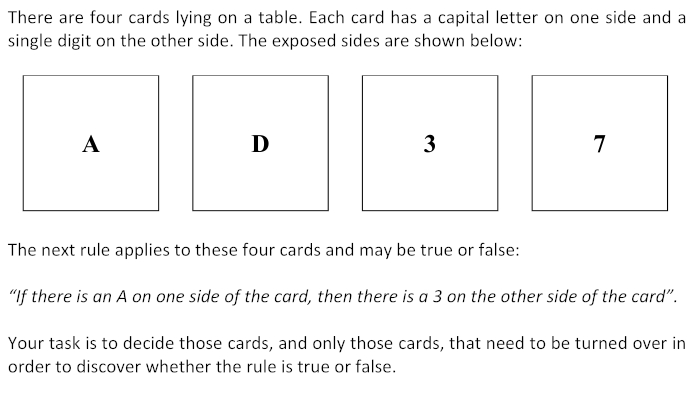
Figure 1: Abstract version of Wason´s selection task. Please click here to view a larger version of this figure.
From a logical point of view, a conditional statement if p then q, should be interpreted as a material implication, in a unidirectional sense. So, the correct solution is to select for turning over the A card and the card showing 7 (in general terms, p and not-q cards). The A card (p) should be selected because 3 (q) on the other side would confirm the rule, whereas 7 (not-q) on the other side would falsify the rule. The card showing 7 (not-q) should be chosen because it would falsify the rule if A (p) were on the other side.
In this abstract version (known as indicative), the first success rates from a formal point of view were extremely poor (around 10%). Most subjects systematically committed one of the following mistakes: they selected the card that represented the antecedent of the rule (A, or p card). Moreover, they frequently failed to select 7 (or not q), choosing the 3 (q card) instead. So participants tried to prove the conditional rule rather than falsify it (verification bias2). Another bias consisted of selecting those cards which were mentioned in the rule: A and 3; in general, p and q cards (matching bias3,4).
A question arises as to why intelligent adult subjects fail to solve it. The initial hypothesis of these results has been related to the abstract nature of the task (participants had to reason with letters and numbers). As a result, researchers soon started looking for thematic variations of the original problem, and initially, they registered better performance. The first explanations revolved around the so-called thematic facilitation effect5,6,7,8. Nevertheless, the following questions arise: (1) could these new specific versions of the original task affect the results obtained?, (2) Is subjects´ reasoning about the thematic problems different from the original abstract one?, (3) What´s more, are there different selection tasks?
One of the first semantic versions of the problem was based on a "postal rule" and it was designed by Johnson-Laird et al.9. In this task, subjects received the conditional sentence: "If a letter is sealed, then it has a 50 L stamp on it". Better results obtained in this version with respect to the original abstract were initially explained in terms of the thematic facilitation effect. However, in this new problem, some changes were included with respect to the first task, which were not considered at the time. These modifications could also modulate the results obtained in addition to the thematic content. Firstly, the postal task was included in a specific scenario (subjects were asked to imagine that they were post office workers sorting letters). Secondly, they were instructed "to select those envelopes that they definitely need to turn over to find out whether or not they violate the rule" (violation instructions). So, the experimental instructions were also changed with respect to the original true/false instructions10,11,12,13,14,15for some key investigations on the effect of instructions and thematic content on reasoning with the selection task.
In the same way, one of the thematic versions in which the highest percentages of correct responses were recorded was designed by Griggs and Cox16. In this problem, subjects had to imagine that they were police officers, and they had to check if the rule presented had been violated ("If a person is drinking beer, then the person must be over 19 years of age"). Specifically, in previous research, it has also been shown that the importance of the scenario and the experimental instructions on reasoning with the selection task17,18,19). In fact, if the research with the selection task is reviewed, it can be seen that an important part of the designed tasks that registered facilitation included deontic rules instead of the original indicative task20,21,22,23,24,25,26,27,28,29(see Table 1).
| Authors | Rule-Example | Result-Explanation |
| Johnson-Laird, Legrenzi & Legrenzi (1972)9 | “If a letter is sealed, then it has a 50 lire stamp on it” | Thematic facilitation effect |
| Grigs & Cox (1982)16 | “If a person is drinking beer, then the person must be over 19 years of age” | Facilitation by content-experience relationship. |
| Cheng & Holyoak (1985)20 | “If a passenger’s form says ‘Entering’ on one side, then the other side must include ‘cholera’.” | Facilitation by activation of permission rules. |
| Cosmides (1989)21 | “If a man eats cassava root, then he has a tattoo on his face” | Facilitation by reformulation of the rule as cost-benefit and application of cheater-detector algorithm. |
| Manktelow & Over (1991)22 | “If you tidy up your room, then you may go out to play” | Selection of cards which break the rule: Child: “p & not-q”; mother: “not-p & q”. |
| Gigerenzer & Hug (1992)23 | “If an employee works on the weekend, then that person gets a day off during the week” | Perspective effect and cheater-detector algorithm modulate the selection (employee: “p & not-q”; employer: “not-p & q”). |
| Love & Kessler (1995)24 | “If there are Xow, then there must be a force field” | Interactive effect instructions and content. Better performance in deontic versions. |
| Valiña, Seoane, Ferraces & Martín (1995)18 | “If a person is sitting in the front seat of a car, then that person must be over 12 years of age” | Better performance in thematic version. Facilitation of violation instructions. Individual differences. |
| Valiña, Seoane, Ferraces & Martín (1998)19 | “If a person is riding a motorbyke then he must wear a helmet” | Interactive effect instructions and content. Better performance in deontic versions. |
| Almor & Sloman (2000)25 | “If an employee gets a day off during the week, then that employee must have worked on the weekend” | Perspective effects depends on the linguistic interpretation of the rule in the context of the problem text. |
| Staller, Sloman & Ben-Zeev (2000)26 | “If a Hare Mantra child is at least 8 years old, then that child performs well the 8-years intelligence test” | Perspective effect does not require deontic context. Execution according to the activation of counterexamples. |
| Girotto, Kemmelmeier, Sperber & van der Henst (2001)27 | “If a person travels to any East African country, then that person must be immunized against cholera” | The context expressed in the text modulates the relevance to make inferences. |
| Thompson, Plowright, Atance & Caza (2015)28 | "If it is the first day of the month, then there must be pancakes for lunch”. “If the child takes a cookie then the child must have earned a gold star sticker” | Interaction type of problem (“cheater or non-cheater”) and parental connection with the child (existent or non-existent). |
| Lampinen, Dasgupta, Chan, Sheahan, Creswell, Kumaran, McClelland & Hill (2024)29 | Three types of content: realistic: “If the clients are going skydiving, then they must have a parachute”; arbitrary: “If the cards have plural word, then they must have a positive emotion”; nonsense: “If the cards have more bem, then they must have less stope”. | Significant content advantages for the realistic tasks compared to arbitrary ones. Spending longer on logical tasks can improve performance. Better reasoning about consistent situations with subjects´ world. |
Table 1: Review of key empirical investigations on Wason´s selection task from the beginning until now, in chronological order. Please click here to download this Table.
The deontic versions express obligation or permission, include explicitly or implicitly deontic modal terms such as "should" or "must" and subjects have to decide whether or not the rule has been obeyed or disobeyed. On the contrary, indicative versions state factual relationships that may be true or false30,31,32,33,34. Following Evans and Over31, indicative and deontic tasks could be considered two distinct forms of the problem, depending on what kind of conditions and instructions are included. Indicative conditionals state factual relationships that may be true or false, whereas deontic conditionals express normative rules that may be obeyed or disobeyed. In terms of Manktelow & Over32, theoretical reasoning about states of affairs is different from practical reasoning about actions and social or moral rules.
From distinct theoretical perspectives it has been defended that deontic versions have different correct answers and are easier than indicative task, for multiple reasons: (1) because people reason with knowledge structures based on permissions and obligations; (2) because deontic rules trigger the Darwinian algorithms that detect potential cheaters; (3) because people analyze the usefulness of the rule, depending on the perspective from which they reason; (4) because deontic conditionals evoke pragmatic implicatures licensed by world knowledge, etc.
If, as proposed, there are two distinct forms of Wason's selection task: do conditionals in deontic versions have the same logical form as in the indicative abstract task? Are the correct answers different in indicative and deontic problems? The answer to these questions is fundamentally important for understanding the process of inference.
The overall goal of this protocol is to analyze how people test hypotheses and make inferences from if-then conditional statements, using Wason´s selection task. Specifically, an ANOVA 3 x 2 x 2 was performed. The gist of the protocol implies: (1) manipulate within subjects the type of content: all participants will receive three Wason´s selection task, with different thematic relationship between the antecedent and the consequent of the conditional rule: neutral, permission and obligation; (2) manipulate between subjects the framing of the task (deontic versus indicative) and (3) manipulate, also between subjects, the inclusion or non-inclusion of the task in a scenario (presence versus absence).
So, all subjects solved three thematic selection tasks in each of the four experimental conditions: scenario-deontic framing, scenario-indicative framing, no-scenario-deontic framing, and no-scenario-indicative framing.
Access restricted. Please log in or start a trial to view this content.
Protocol
The studies involving human participants have been approved by the Bioethics Committee of the University of Santiago de Compostela. Moreover, written informed consent was obtained from the participants. The tasks will be presented in a paper-and-pencil format. It will only be necessary to use technology in the analysis of results (see Table of Materials).
1. Preparation of the stimuli for the three versions of Wason´s Selection Task
- Prepare the basic stimuli for neutral content:
- Elaborate on four cards.
- Write on each card the name of an animal on one side (cat, lion) and the name of a flower on the other side (rose, carnation), respectively.
- Place the cards on a table so that only one side of each card can be seen. The other side is hidden.
- Ensure that on the visible faces are written: cat, lion, rose, carnation, respectively.
- Elaborate a conditional rule that relates these cards: "If a card has cat written on one side, then it has rose written on the other side".
- Prepare the basic stimuli for permission content:
- Elaborate on four cards.
- Write on each card the name of a drink on one side (beer, coke) and a person´s age on the other side (22 years of age, 16 years of age), respectively.
- Place the cards on a table so only one side of each card can be seen. The other side is hidden.
- Ensure that on the visible faces are written: beer, coke, 22 years of age, 16 years of age.
- Elaborate a permission rule that relates these cards: "If a card has beer written on one side, then it has over 18 years of age written on the other side".
- Prepare the basic stimuli for obligation content:
- Elaborate on four cards.
- Write on each card the name of something to wear on the head on one side (cap, hard hat) and a job (bricklayer, chef) written on the other side, respectively.
- Place the cards on a table so that only one side of each card can be seen. The other side is hidden.
- Ensure that the visible faces are written: cap, hard hat, bricklayer, chef.
- Elaborate a conditional rule that relates these cards: "If a card has bricklayer written on one side, then it has hard hat written on the other side".
NOTE: Ensure that in all three tasks, the visible features of the cards represent the four cases related to the conditional rule: p, not-p, q, not-q.
2. Creating the deontic and indicative framing
- Deontic framing:
- Include the modal verb must in the conditional rule: "If a card has cat written on one side, then it must have rose written on the other side".
- Ask participants: "Which cards do you need to turn over to discover if the rule has been violated?".
- Indicative framing:
- Do not include the modal verb must in the rule: "If a card has cat written on one side, then it has rose written on the other side").
- Ask participants: "Which cards do you need to turn over to discover if the rule is true or false?".
3. Preparing the task scenario
- To create Scenario Condition, include at the beginning of the task, the next paragraph: "Imagine that you are a police officer on duty. It is your job to ensure that people conform to certain rules".
- To create No Scenario Condition, remove the previous paragraph from the task.
4. Elaborating on the booklets
- Prepare the general instructions about the experiment:
- Clarify the anonymity of the task, including the sentence: "the experimenter is interested in group responses, not in individual ones".
- Explain to the participants that they have three problems in the booklet. Each problem includes four cards placed on a table and a conditional rule related to the cards.
- Clarify to the subjects that the cards have something written on each side, but only one side of each card is visible. The other side is hidden.
- Explain to the subjects that their task is to decide the minimum cards necessary to turn over in order to check the specific instructions included in each problem.
- Emphasize that they should solve the problems one by one and should not move on to another task without having finished the previous one.
- Explain to the participants that it is very important that once each task has been solved and they have moved on to the next, they should not return to the previous one.
- Tell subjects that they will be able to work at their own pace and without a time limit.
- Elaborate on the three thematic tasks, with neutral, permission, and obligation content, for each experimental condition.
- Inside each booklet, place a first page with the above-mentioned general instructions, followed by the three tasks, presented in random order.
5. Experimental procedure
- Set up the experiment to perform in a laboratory.
- Randomly assign participants to one of the four experimental groups: Scenario-Deontic Framing; Scenario-Indicative Framing; No Scenario-Deontic Framing; No Scenario-Indicative Framing.
- Distribute the four types of booklets, depending on each experimental condition.
- Before beginning the experiment, read aloud the general instructions that the subjects have on the first page of the booklet.
- Reserve time for participants to ask questions.
- Once all participants´ doubts are resolved, allow them to begin the experiment.
- At the end of the experimental session, thank the subjects for their time.
NOTE: Examples of the tasks are presented in Figure 2, Figure 3, and Figure 4.

Figure 2: Thematic-neutral version of Wason´s selection task. This corresponds to the experimental condition: scenario and deontic framing. Please click here to view a larger version of this figure.
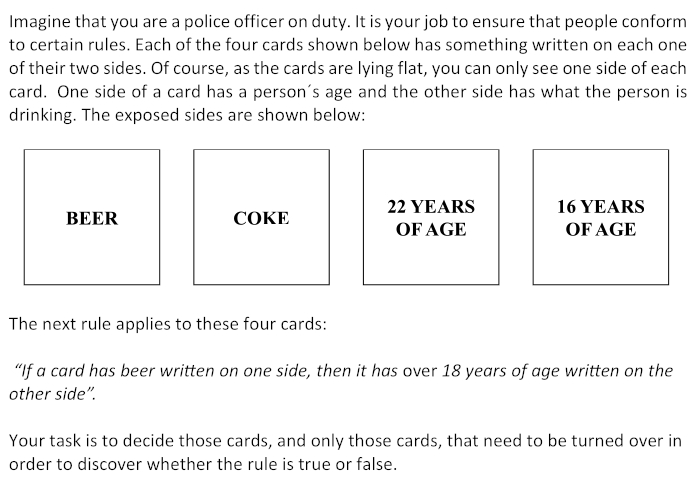
Figure 3: Thematic-Permission version of Wason´s selection task. This corresponds to the experimental condition: scenario and indicative framing. Please click here to view a larger version of this figure.
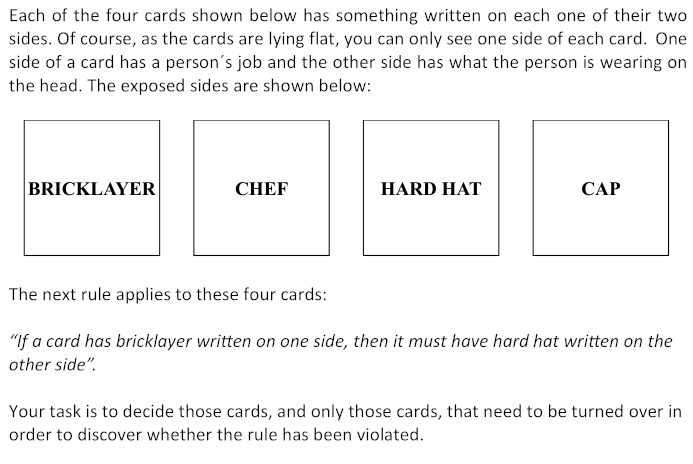
Figure 4: Thematic-Obligation version of Wason´s selection task. This corresponds to the experimental condition: no scenario and deontic framing. Please click here to view a larger version of this figure.
Access restricted. Please log in or start a trial to view this content.
Results
A Logical Index was computed as proposed by Pollard and Evans35. This one consists of scoring +1 for each correct card selected (+1 for the selection of p and +1 for the selection of not-q). So the correct selection had a score of +2. For each incorrect card selected, a score of -1 was given (not-p: -1 and q: -1). For this study, the main research issues focused on how the thematic content, the scenario, and the framing may affect the subjects´ reasoning with the selection task. Thus, a 3 x 2 x 2 ...
Access restricted. Please log in or start a trial to view this content.
Discussion
In this research, the experimental design has allowed one to analyze the role of thematic content, deontic framing, and task scenario in reasoning with the four-card task. Specifically, all subjects solved three thematic versions of the selection task, which included different empirical relationships between antecedent and consequent of the rules (neutral, permission, and obligation). As explained previously, from a formal point of view, the logical meaning of a conditional rule is only one: as a unidirectional material ...
Access restricted. Please log in or start a trial to view this content.
Disclosures
The authors have nothing to disclose.
Acknowledgements
The authors would like to express their gratitude for the helpful comments of the reviewers and the editorial team on a previous draft of this manuscript.
Access restricted. Please log in or start a trial to view this content.
Materials
| Name | Company | Catalog Number | Comments |
|---|---|---|---|
| IBM SPSS Statistics | IBM Corporation | N/A | Statistical package to analyze the data. |
| Thematic-Neutral version of Wason´s selection task | N/A | N/A | The task has been implemented using a paper-and-pencil format. |
| Thematic-Obligation version of Wason´s selection task | N/A | N/A | The task has been implemented using a paper-and-pencil format. |
| Thematic-Permission version of Wason´s selection task | N/A | N/A | The task has been implemented using a paper-and-pencil format. |
References
- Wason, P. C. Reasoning. New horizons in psychology 1. Foss, B. , Penguin Books. Harmondsworth, England. 135-151 (1966).
- Wason, P. C. Reasoning about a rule. Q J Exp Psychol. 20 (3), 273-281 (1968).
- Evans, J. S. tB. T. Interpretation and matching bias in a reasoning task. Br J Psychol. 24 (2), 193-199 (1972).
- Evans, J. S. tB. T. Matching bias in conditional reasoning: Do we understand it after 25 years. Think Reason. 4 (1), 45-110 (1998).
- Evans, J. S. tB. T., Over, D. E. If. , Oxford University Press. UK. (2004).
- Ragni, M., Kola, I., Johnson-Laird, P. N. On selecting evidence to test hypothesis. Psychol Bull. 144 (8), 779-796 (2018).
- Evans, J. S. tB. T. Wason selection task. Cognitive illusions: Intriguing phenomena in thinking, judgment and memory. Pohl, R. F. , Routledge. New York. 140-153 (2022).
- Valiña, M. D., Martín, M. The influence of semantic and pragmatic factors in Wason's selection task: State of the art. Psychology. 7 (6), 925-940 (2016).
- Johnson-Laird, P. N., Legrenzi, P., Legrenzi, M. S. Reasoning and a sense of reality. Br J Psychol. 63 (3), 395-400 (1972).
- Griggs, R. A. Memory cueing and instructional effects on Wason's selection task. Curr Psychol Res Rev. 3 (4), 3-10 (1984).
- Griggs, R. A., Jackson, S. L. Instructional effects on responses in Wason's selection tasks. Br J Psychol. 81 (2), 197-204 (1990).
- Platt, R. D., Griggs, R. A. Facilitation in the abstract selection task: The effects of attentional and instructional factors. Q J Exp Psychol A. 46 (4), 591-613 (1993).
- Wason, P. C., Shapiro, D. Natural and contrived experience in a reasoning problem. Q J Exp Psychol. 23 (1), 63-71 (1971).
- Yachanin, S. A. Facilitation in Wason's selection task: Content and instructions. Curr Psychol Res Rev. 5 (1), 20-29 (1986).
- Yachanin, S. A., Tweney, R. D. The effect of thematic content on cognitive strategies in the four card selection task. Bull Psychon Soc. 19 (2), 87-90 (1982).
- Griggs, R. A., Cox, J. R. The elusive thematic-materials effect in Wason's selection task. Br J Psychol. 73 (3), 407-420 (1982).
- Martín, M., Valiña, M. D., Evans, J. S. tB. T. The role of scenario, deontic conditionals and problem content in Wason's selection task. Bagnara, S. Proceedings of the European Conference on Cognitive Science, , Istituto di Psicologia. Consiglio Nazionale delle Ricerche. Siena. 259-264 (1999).
- Valiña, M. D., Seoane, G., Ferraces, M. J., Martín, M. Wason selection task: A study of individual differences. Psicothema. 7 (3), 641-653 (1995).
- Valiña, M. D., Seoane, G., Ferraces, M. J., Martín, M. The Wason's selection task: Content effect, instruction effect or both. Stud Psychol. 19 (60), 15-34 (1998).
- Cheng, P., Holyoak, K. Pragmatic reasoning schemas. Cogn Psychol. 17 (4), 391-416 (1985).
- Cosmides, L. The logic of social exchange: Has natural selection shaped how humans reason. Cognition. 31 (3), 187-286 (1989).
- Manktelow, K. I., Over, D. E. Social roles and utilities in reasoning with deontic conditionals. Cognition. 39 (2), 85-105 (1991).
- Gigerenzer, G., Hug, K. Domain-specific reasoning: Social contracts, cheating and perspective change. Cognition. 43 (2), 127-171 (1992).
- Love, R., Kessler, C. Focussing in Wason's selection task: Content and instruction effects. Think Reason. 1 (2), 153-182 (1995).
- Almor, A., Sloman, S. A. Reasoning versus text processing in the Wason selection task: A nondeontic perspective on perspective effects. Mem Cognit. 28 (6), 1060-1070 (2000).
- Staller, A., Sloman, S. E., Ben-Zeev, T. Perspective effects in nondeontic versions of the Wason selection task. Mem Cognit. 28 (3), 396-405 (2000).
- Girotto, V., Kemmelmeier, M., Sperber, D., van der Henst, J. -B. Inept reasoners or pragmatic virtuosos? Relevance and the deontic selection task. Cognition. 81 (2), B69-B76 (2001).
- Thompson, E. L., Plowright, C. M. S., Atance, C. M., Caza, J. S. Reasoning and relatedness. Evol Hum Behav. 36 (1), 38-43 (2015).
- Lampinen, A. K., et al. Language models, like humans, show effect on reasoning tasks. PNAS Nexus. 3 (7), 233(2024).
- Evans, J. S. tB. T., Elqayam, S. How and why we reason from is to ought. Synthese. 197 (5), 1429-1446 (2020).
- Evans, J. S. tB. T., Over, D. E. Rationality and reasoning. , Psychology Press. UK. (1996).
- Manktelow, K. I., Over, D. E. Deontic reasoning. Perspectives on thinking and reasoning. Newstead, S. E., Evans, J. S. tB. T. , Lawrence Erlbaum Associates. UK. 91-114 (1995).
- Beller, S. Deontic reasoning reviewed: Psychological questions, empirical findings, and current theories. Cogn Process. 11 (2), 123-132 (2010).
- Elqayam, S. Deontic reasoning in psychology. The handbook of rationality. Knauff, M., Spohn, W. , MIT Press. Cambridge, MA. 651-657 (2021).
- Pollard, P., Evans, J. S. tB. T. Content and context effects in reasoning. Am J Psychol. 100 (1), 41-60 (1987).
- Macchi, L., et al. Speak your mind and I will make it right: The case of "selection task". J Cogn Psychol. 32 (1), 93-107 (2020).
- Johnson-Laird, P. N., Byrne, R. M. J., Khemlani, S. S. Models of possibilities instead of logic as the basis of human reasoning. Minds Mach. 34 (3), 1-22 (2024).
- Bucciarelli, M., Johnson-Laird, P. N. Naïve deontics: A theory of meaning, representation and knowledge. Cogn Psychol. 50, 159-193 (2005).
- Johnson-Laird, P. N., Byrne, R. M. J. Conditionals: A theory of meaning, pragmatics, and inference. Psychol Rev. 109 (4), 646-678 (2002).
- Quelhas, A. C., Byrne, R. M. J. Reasoning with deontic and counterfactual conditionals. Think Reason. 9 (1), 43-65 (2003).
- Bucciarelli, M., Johnson-Laird, P. N. Emotion, belief, and the words of the law. Samuelson, L. K., et al. Proc 46th Annual Conf Cognitive Science Society, Rotterdam, , 4991-4996 (2024).
- Braga Pereira, L., Gabrig Fonseca, R., Cagnin, S. Effects of emotional content on human reasoning: A systematic review. Psicol USP. 35, e210052(2024).
- Wong, G., et al. Brain imaging investigation of the impairing effect of emotion on cognition. J Vis Exp. (60), e2434(2012).
- Evans, J. S. tB. T., Over, D. E. Human reasoning. , Cambridge University Press. UK. (2024).
- Stanovich, K. E., West, R. F. Individual differences in rational thought. J Exp Psychol Gen. 127 (2), 161-188 (1998).
- Berthet, V., Teovanović, P., de Gardelle, V. A common factor underlying individual differences in confirmation bias. Sci Rep. 14, 27795(2024).
- Valiña, M. D., Seoane, G., Ferraces, M. J., Martín, M. Conditional reasoning: The importance of individual differences. Mental models in reasoning. García-Madruga, J. A., et al. , UNED Varia. Madrid. 249-267 (2000).
- Ball, L. J., Butler, L. T., Sherman, S. M., St Clair-Thompson, H. Cognitive psychology in a changing world. , Routledge. London and New York. (2024).
- Jaegger, J., Riedl, A., Djedovic, A., Vervaeke, J., Walsh, D. Naturalizing relevance realization: Why agency and cognition are fundamentally not computational. Front Psychol. 15, 1362658(2024).
Access restricted. Please log in or start a trial to view this content.
Reprints and Permissions
