This protocol combines flow cytometry and single-cell RNA sequencing to isolate and characterize microglial cell states in the cerebellum of early postnatal mouse brains. It uses enzymatic dissociation, Percoll centrifugation, and immunostaining to reveal microglia heterogeneity and improve understanding of their roles in cerebellar development and disease.
Method Article
Flow Cytometry and Single-Cell Analysis for Characterizing Microglia Activation in Early Postnatal Mouse Brain Development
In This Article
Summary
Abstract
Microglia, the brain's resident immune cells, exhibit region and context-specific transcriptional profiles during development and disease. This protocol presents two complementary methods for studying microglial populations in mouse cerebellar tissue: flow cytometry and single-cell RNA sequencing.
As the first method used, the flow cytometry-based protocol is optimized for early postnatal brains, ensuring robust cell isolation and consistency across experimental conditions. It begins with tissue dissociation using enzymatic digestion, followed by myelin removal via Percoll density gradient centrifugation to yield a high-quality neural cell suspension, and a gating strategy based on CD45 and CD11b expression. Live/dead staining ensures cell viability, and fluorochrome-conjugated antibodies are used to profile the expression of selected surface markers on microglia. Compensating controls are performed using latex beads with validated gating strategies using fluorescence minus one (FMO) control.
The second method involves single-cell RNA sequencing using 10X Genomics, following the same upstream isolation steps, which enable transcriptomic profiling of microglia across conditions. Microglial clusters are identified using gene expression analysis, and differential expression analysis is conducted between experimental groups. A random forest classifier is applied solely to distinguish male and female samples when multiplexed.
Together, these reproducible and adaptable protocols provide a robust framework for investigating microglial diversity in the cerebellum during early brain development and its potential alteration following experimental perturbations.
Introduction
The early postnatal period is a critical phase for brain development, characterized by complex cellular and molecular processes that lay the foundation for cognitive, emotional, and behavioral functions1. However, this period is also marked by vulnerability, as disruptions can alter neurodevelopmental trajectories and lead to long-term neurological or psychiatric disorders. Microglia, the brain's resident immune cells, play a central role in shaping the developing brain through synaptic pruning, phagocytosis, immune surveillance, and responses to environmental insults2,3. These cells exhibit remarkable plasticity, adopting transcriptional profiles that vary according to brain region, development stage, and pathological context4,5.
Accurate analysis of microglia activation in the developing brain requires robust and repeatable methodologies capable of analyzing their dynamic phenotypes in the context of immature brain tissues. Flow cytometry provides a reliable solution, enabling the high-throughput characterization of cellular populations and marker expression6. However, its application in studying microglia from early postnatal brains is technically challenging due to the delicate nature of the tissue and the need for efficient cell isolation and enrichment protocols7,8.
The protocol presented here combines flow cytometry and single-cell RNA sequencing (scRNA-seq) to isolate and characterize microglia from early postnatal mouse brains, with a particular focus on the cerebellum from postnatal day 3 (P3) to postnatal day 30 (P30)9, a region and developmental stage for which detailed methodological references remain limited.
This workflow includes enzymatic dissociation, density gradient centrifugation for debris removal and cell enrichment, and immunostaining using a panel of extracellular and intracellular markers. To characterize microglia diversity, a range of surface and intracellular markers is employed10,11. Instead of assigning fixed labels (inflammatory or reparative), the protocol defines subpopulations based on discrete marker expression profiles. For example, microglia expressing CD80, CD86, and iNOS, CD206 and Arg1, CD86 and CD64, or CD163 and CD206 are identified and analyzed as molecularly distinct subsets. These markers reflect different activated microglia states10,11and are presented as expression profiles.
This multiparametric gating strategy enables precise identification of microglial subsets based on surface marker expression, offering a streamlined framework for analyzing immune heterogeneity during postnatal brain development. To extend phenotypic profiling and uncover transcriptional diversity, single-cell RNA sequencing is performed following cell isolation. This study establishes a consistent and scalable workflow to advance understanding of neurodevelopmental processes and the long-term impact of microglial activation. By integrating optimized flow cytometry and scRNA-seq within a developmentally and regionally informed framework, this protocol serves as a powerful tool for investigating early-life microglial biology and its relevance to neurodevelopmental outcomes.
Protocol
All animal procedures were reviewed and approved by the ethical committee of the CHU Sainte-Justine Research Centre and comply with the guidelines and policies of the Ste-Justine Research Center and the University of Montreal (Montreal, Quebec, Canada).
1. Cell isolation from the brain
- Following anesthesia/euthanasia procedures, quickly remove the entire brain from the cranial cavity and place it into a 15 mL tube containing microglial cell culture medium (see Table of Materials). Keep the tube on ice. Repeat the same procedure for additional mice if necessary.
All mice used in this study were derived from in-house breeding colonies in Dr. Tremblay's laboratory. The experimental mice were generated by crossing B6.129-Cx3Cr1CreERT2-EYFP/WT mice with B6-Rosa26iDTR/WT mice, both originally sourced from Jackson Laboratories. This breeding strategy produced offspring heterozygous for the IDTR allele, enabling conditional depletion of Cx3Cr1-expressing cells (primarily microglia) through a tamoxifen-inducible Cre-loxP system. Prior to tissue collection, mice were anesthetized via intraperitoneal injection of ketamine (150 µg/g) and xylazine (10 µg/g). Euthanasia was performed by decapitation under deep anesthesia, in accordance with institutional animal care and use guidelines. - Either preserve the whole brain or proceed with the dissection of specific regions if desired. Perform the dissection in a small Petri dish containing microglial cell culture medium (see Table of Materials) on ice to maintain cell viability.
NOTE: This protocol has been validated for the whole brain and the cerebellum from P1 to P30. - Remove the microglial cell culture medium and finely cut the brain tissue using a scalpel in a Petri dish.
- For the enzymatic digestion , transfer the homogenized tissue into 5 mL tubes. Add 2 mL of HBSS (1x) supplemented with 2 mg/mL collagenase D and 14 µg/mL DNase I (see Table 1). Seal the tube caps with parafilm. Incubate the tubes in a 37 °C water bath for 15 min, shaking the tube every 5 min. To stop digestion, place the tubes on ice.
- Pass the homogenate through a 140 µm metal mesh filter (see Table of Materials) to remove large debris. Use a glass pestle to dissociate the cells.
- Wash the filter multiple times with microglial cell culture medium (3 mL per wash).
- Collect the filtrate using a 10 mL pipette and transfer it into a 15 mL tube. Centrifuge the solution at 500 g for 7 min at 4 °C.
- Discard the supernatant by carefully inverting the tube. Resuspend the pellet by gently scraping on a rack.
- Add 10 mL of a 37% silica-based colloidal medium solution (see Table 1) to remove myelin and debris. Centrifuge the solution at 500 g for 10 min at 4 °C with minimal brake force.
- Aspirate the myelin layer at the top of the solution using a 10 mL pipette.
NOTE: Continuous aspiration prevents the myelin from mixing back into the solution. - Wash the cells by adding 10 mL of HBSS (1x) and centrifuge at 500 × g for 7 min at 4 °C.
- Discard the supernatant. Resuspend the pellet by gently scraping with a rack, then add 10 mL of fluorescent-activated cell sorting (FACS) buffer (see Table 1). Centrifuge the solution at 500 g for 10 min at 4 °C.
- Discard the supernatant, resuspend the final pellet, and retain the cells. The isolated cells are now ready for flow cytometry staining or single-cell RNA sequencing.
- For single-cell RNA sequencing isolation, count the cells under a microscope using benchtop-stable fluorescent reagents (see Table of Materials) to distinguish live and dead nucleated cells, along with Trypan Blue (see Table of Materials). Ensure the cells are in excellent condition, with viability up to 90%, and reach a concentration of 1000 cells/µL). The next steps are described in section 9.1.
NOTE: Keep tubes on ice throughout the protocol. All centrifugation steps must be performed at 4 °C with a maximum brake, except for the Percoll step, where a minimum brake is specified. For best results, perform the entire protocol on the same day. For the single-cell RNA seq protocol filter all solutions used for isolation, in step 1.11, use HBSS (1x) for the second wash, and in step 1.12, retain 70-100 µL of the cell solution.
2. Flow cytometry extracellular staining protocol
- Transfer all cells into a 96-well plate with a conical bottom (see Table of Materials). Centrifuge the plate at 500 g for 5 min at 4 °C.
- Quickly invert the plate to remove supernatant in one motion.
- Resuspend the cell pellet in 25 µL of blocking solution (see Table 1). Incubate for 15 min at room temperature (RT).
- To prepare the extracellular antibody staining mix (see Table 2), centrifuge antibody stocks at 10,000 × g to remove potential aggregates. Without disturbing the pellet, carefully aspirate the desired volume from the supernatant to prepare the staining mix and adjust the volume to 25 µL with FACS Buffer.
- Add 25 µL of the extracellular antibody mix to each well. Incubate for 20 min at RT.
NOTE: Prior to experimental use, all antibodies were titrated on cerebellar (or brain) single-cell suspensions to determine the optimal working concentration. Titration was performed by serial dilutions to generate a saturation curve, and the dilution corresponding to a signal plateau with minimal background was selected for the signal staging. - Without mixing, add 150 µL of FACS buffer to the wells. Centrifuge the plate at 500 × g for 5 min at 4 °C. Invert the plate to remove the supernatant in one motion.
- Resuspend the cell pellet in 200 µL of FACS buffer. Centrifuge the plate at 500 × g for 5 min at 4 °C. Invert the plate to remove the supernatant in one motion. Repeat the wash once more using 200 µL of FACS buffer under the same conditions.
3. Intracellular staining
- Resuspend the cells in 100 µL of saponin-paraformaldehyde (PFA) buffer (see Table 1) to fix and permeabilize the cells. Incubate for 10 min at RT, protected from light.
- Without mixing, add 100 µL of saponin buffer (see Table 1). Centrifuge the plate at 500 × g for 6 min at 4 °C. Invert the plate to remove the supernatant in one motion.
- Resuspend the cell pellet in 200 µL of saponin buffer. Prepare compensation controls by adding 20 µL of beads (see Table of Materials) to 11 empty wells. Centrifuge the plate at 500 × g for 6 min at 4 °C. Invert the plate to remove the supernatant in one motion.
- To prepare the intracellular antibody staining mix (see Table 3), centrifuge antibody stocks at 10,000 × g to remove potential aggregates. Without disturbing the pellet, carefully aspirate the desired volume from the supernatant to prepare the staining mix and adjust the volume to 50 µL with saponin buffer.
- Resuspend the pellet in 50 µL of intracellular antibody mix (see in Table 3). Add 1 µL of each antibody to the bead wells. Incubate for 30 min at RT.
- Without mixing, add 150 µL of saponin buffer to each cell sample well, and add 100 µL of FACS buffer to each well containing the compensation controls to wash the beads. Centrifuge the plate at 500 × g for 6 min at 4 °C. Invert the plate to remove the supernatant in one motion.
- Resuspend the cell pellet in 200 µL of saponin buffer and resuspend the compensating controls in 200 µL of FACS buffer. Centrifuge the plate at 500 × g for 6 min at 4 °C. Invert the plate to remove the supernatant in one motion. Repeat the wash once more using 200 µL of saponin buffer under the same conditions.
- Resuspend the cells and the compensating controls in 200 µL of FACS buffer. Transfer the suspension into a FACS tube and store at 4 °C until flow cytometry acquisition.
NOTE: Ensure all steps involving light-sensitive reagents are conducted in minimal light conditions. One bead well contains no antibody, which corresponds to the unstained bead tube.
4. Flow cytometry acquisition
- Turn on the flow cytometer and then the computer.
- Open the flow cytometer software, and initiate the fluidics startup by selecting Run under the cytometer tab.
- Create a new experiment folder by clicking New folder and assigning a name. Then click New experiment to name the experiment and select New tube to add a specimen and sample tube.
5. Set up compensation controls
- Prepare single-stained compensation beads for each fluorochrome used in the panel, along with an unstained control.
- Load the compensation tubes on the cytometer. Set the forward scatter (FSC) and side scatter (SSC) voltages to approximately 250.
- Adjust voltages for each fluorescent channel so that the negative population is in the first decade of the axis.
- Acquire at least 5,000 events per tube.
- Use the compensation matrix to adjust for spectral overlap until all positive peaks are clearly separated from the negative population and centered above 104 on the respective axis.
NOTE: Compensation controls must be performed for every experiment, as cytometer settings, or fluorochrome performance can significantly affect spectral overlap. Although cell-based compensation controls are recommended in some brain tissue applications, antibody capture beads were used in this protocol due to the lower number of microglia obtainable from P3 mouse cerebellum, which limits the feasibility of cell-based compensation. Antibody fluorescence was initially validated on brain-derived cells and found to be comparable to bead-based signals. Include an unstained brain-derived cell suspension during initial panel optimization to assess tissue autofluorescence and establish baseline signal levels. This control is essential to properly set negative populations in each fluorescent channel.
6. Prepare and acquire FMO controls
- For each key marker, prepare a fluorescence minus one (FMO) control that includes all antibodies except the one being tested.
- Run the FMO controls using the same acquisition settings as the fully stained samples.
- Use FMO plots to define gating thresholds for low or overlapping populations and to discriminate true positives from background noise.
NOTE: FMO controls should be performed during the initial panel optimization to define accurate and reliable gating boundaries, especially in tissues with high autofluorescence, such as the brain. If the staining panel, instrument settings, or experimental conditions are modified, FMO controls must be repeated. For subsequent experiments using the same validated panel and cytometer settings, previously defined gating thresholds can be reused to ensure consistency across biological replicates.
7. Prepare and acquire Isotype controls
- Stain the control sample with isotype control antibodies matched in fluorochrome and concentration to the test antibodies.
- Acquire data using the same cytometer settings.
- Use isotype controls only to assess potential non-specific binding, particularly in the case of intracellular markers or poorly characterized antibodies. Do not use isotype controls for gating, as they do not reflect the same binding kinetics as specific antibodies.
NOTE: Isotype controls are not suitable for gating and should not be used to define populations. Their use is optional and should be reserved for validating antibody specificity in selected cases.
8. Flow cytometry gating strategy
- Create the following dot plots for sequential gating:
FSC-A vs. SSC-A to exclude debris
FSC-A vs. FSC-H to select singlets.
FSC-A vs. Amcyan (viability dye) to gate live cells. - Identify microglia as CD11b+CD45+ using CD11b (FITC) vs CD45 (AF700).
NOTE: Due to the developmental stage (P3-P15), the inflammatory context, and the enzymatic digestion, TMEM119 and P2RY12 were not reliable for clearly separating microglia from other myeloid populations by flow cytometry. The CD11b+CD45+ gating strategy, previously validated in the postnatal brain, was therefore used to identify microglia populations while minimizing contamination. In control conditions, the typical yield ranges from 30,000 to 200,000 microglial cells per whole brain from P3 to P15. For experiments focusing specifically on the cerebellum, the average yield is approximately 5,000 microglial cells per brain. - Use FMO controls to define gating thresholds for activation markers.
- Identify microglia subpopulations based on the expression of immune-related markers:
CD80+ (Super Bright 436)
CD86+ (PE)
iNOS+ (PE-eFluor 610) - Further characterize microglia subsets by combinations of marker expression:
CD206+ (APC)then Arg1+ (PE-Cy7)
CD86+ (PE)then CD64+ (PerCP-eFluor 710)
CD163+ (Super Bright 600)then CD206+ (APC)
NOTE: Marker combinations are used to describe molecular heterogeneity within the microglial population. These subsets are reported based on marker expression alone and are not assigned specific functional roles, in accordance with the current standards recognizing microglial plasticity and context-dependent phenotypes. - Load experimental sample. Set FSC to 300 and SSC to 200. Use a low flow rate and record the desired number of events.
- After acquisition, wash the cytometer and export data as .FSC files for analysis.
- Analyze the data using flow cytometer software.
9. Single-cell RNA-sequencing sample
- Using the same cell isolation protocol described for flow cytometry (see step 1.14), resuspend the dissociated cells in FACS buffer. Use FACS buffer in collection tubes and all subsequent handling steps to maintain cell stability.
- Do not perform fluorescent-activated cell sorting (FACS) if the goal is to capture all cell types from a brain region. However, if the experiment requires enrichment for microglia, include a FACS sorting step prior to sequencing.
- Immediately assess cell viability using benchtop-stable fluorescent viability dyes and Trypan Blue (see Table of Materials). Count the cells under a microscope using a hemocytometer (see Table of Materials).
- Verify that the cell suspension exhibits a viability of at least 90% and adjust to a final concentration of approximately 1,000 cells/µL before proceeding with single-cell RNA sequencing.
- Keep all samples on ice and process immediately after dissociation to minimize cellular stress and transcriptional changes.
- Multiplex the samples in pairs following the manufacturer's instructions.
NOTE: One male and one female from the same experimental group were pooled to reduce experimental costs. - Prepare the scRNAseq libraries (see Table of Materials) and follow the recommended manufacturer guidelines.
NOTE: Library preparation was performed by the Genomics Platform of the Institute for Research in Immunology and Cancer (IRIC) at the University of Montreal. - Sequence the scRNA-seq libraries using a sequencing system to an average depth of 3200M reads per lane.
NOTE: Sequencing was performed at Genome Quebec in Montreal.
10. Single-cell RNA-sequencing analysis
- Perform unique molecular identifier (UMI) count analysis using 10X Genomics' Cell Ranger software (v8.0.0) with the Mouse GRCm39 2024-A reference genome. Use the Seurat R package (v5.1) for downstream analysis.
- Conduct quality control by excluding cells with mitochondrial RNA exceeding, for example, 30% of total RNA (Figure 1A), or a more stringent threshold chosen to remove cells with potential stress. Filter out low-quality cells with log10GenesPerUMI greater than 0.75 (Figure 1B), unique feature counts ("nUMI") below 500, and number of genes detected per cell ("nGene") greater than 300 (Figure 1C). Next, remove droplets with the "scDblFinder" package in R. With a correlation plot of the nUMI and nGene showing the thresholds, the filtering effect should now be visible (Figure 1D).
- Mitigate batch effects by identifying 2,000 highly variable genes per sample using Seurat's SelectIntegrationFeatures function.
- Integrate datasets using canonical correlation analysis (CCA) and perform principal component analysis (PCA) for dimensionality reduction. Use the RunPCA function with 50 principal components (PCs), scaling the data, and regressing out unwanted sources of variation (e.g., mitochondrial content). Evaluate the number of retained PCs based on the elbow plot and JackStraw analysis.
- Visualize clusters using the uniform manifold approximation and projection (UMAP) algorithm via the Seurat RunUMAP function. Identify cluster-specific gene expression profiles with the FindAllMarkers function. Annotate clusters based on transcriptional signatures by cross-referencing identified marker genes with curated single-cell resources such as PanglaoDB and CellMarker (Figure 2). Cell types, including microglia, are inferred from these transcriptomic profiles rather than from predefined surface marker.
11. Sex-based cell separation
- Identify male and female cells based on the expression of sex-specific genes: four female-specific (Xist, Tsix, Usp9x, Eif2s3x) and three male-specific (Eif2s3y, Uty, Ddx3y).
- Classify male and female populations by filtering cells expressing normalized UMI counts > 1 for any of these genes using Seurat's Subset function.
- Generate Seurat objects by subsetting male and female cells separately. Store and analyze these objects independently for downstream comparisons.
- Validate classification by visualizing sex-specific gene expression using the FeaturePlot and VlnPlot functions, ensuring a clear separation between male and female cell populations.
NOTE: Steps 12.1 and 12.2 should be performed only when the sample has been multiplexed by mixing one male and one female.
12. Statistical model-based microglia classification
- Build five statistical models in R (random forest, logistic regression, naïve Bayes, support vector machine, decision tree) using a training set of ~1,000 cells with known group labels.
- Evaluate model performance using 10-fold cross-validation and receiver operating characteristic (ROC) curves (Figure 3). Identify key genes contributing to classification using FindAllMarkers function in Seurat.
- Select the model with the highest area under the ROC curve (AUC). The random forest model was selected based on its superior AUC score.
- Apply the selected model to unclassified cells using the predict function from RandomForest R package. Merge the predicted classifications with previously annotated datasets in Seurat using merge.
- Validate classifications by visualizing marker gene expression with FeaturePlot and VlnPlot. To ensure the consistency of predicted cell identities, evaluate the enrichments of the marker gene set overlapping before and after adding the classified cells with an appropriate statistical test (e.g., Fisher's exact test).
13. Microglia differential gene expression analysis
- Perform differential gene expression (DEG) analysis between two specific groups of interest using the Seurat function "FindMarkers", with ident.1 representing the group of interest and ident.2 representing the reference group.
NOTE: The output lists genes that are differentially expressed in ident.1 relative to ident.2. In this context, upregulated gene are those with higher expression in ident.1 compared to ident.2, whereas downregulated genes show lower expression in ident.1. Their comparisons are used to generate volcano plots and interpret condition-specific transcriptional change. - Identify differentially expressed genes (DEGs) with an adjusted P-value≤ 0.05. For comparisons between two specific groups, use the FindAllMarkers function with the following criteria: genes expressed in at least 10% of the cells (min.pct = 0.1) and a log2 fold-change threshold of 0.25 (logfc.threshold=0.25). For multi-group comparisons across all microglia, use the FindAllMarkers function with the same parameters. Genes with an adjusted P-value ≤ 0.05 are considered significantly differentially expressed. To visualize DEG expression patterns, generate a volcano plot using the built-in function in the EnhancedVolcano package (Figure 4).
- Compare the flow cytometry results by first examining the cytometry markers used to find microglia, specifically CD45+ and CD11b+, which correspond to the genes PtprcandItgam. Confirm gene expression using the FeaturePlot functions in Seurat.
- Assess the markers commonly associated with distinct microglial states, including CD80andNOS2, as well as Mrc1,Arg1,Fcgr1, and CD163. Use the Seurat functions FeaturePlot and DotPlot to visualize their expression across cell clusters.
- Generate a dot plot using the DotPlot function in Seurat to summarize marker expressions and validate the population classification.
Results
This protocol effectively utilizes flow cytometry to characterize microglial cell populations in mouse brain samples, based on the expression of selected surface and intracellular markers. The following sections detail the results obtained from the key steps of the workflow, highlighting the distribution and heterogeneity of microglia subsets in response to experimental conditions.
Compensation and gating strategy validation
Compensation beads were used to calibrate fluorescence signals and correct for spectral overlap between fluorochromes. Positive and negative populations for each fluorochrome were clearly separated, allowing accurate compensation matrix generation. Gating thresholds were initially validated using Fluorescence Minus One (FMO) control during panel optimization to distinguish true signal from background, particularly for poor or overlapping markers. These thresholds were subsequently reused across experiments using the same staining panel and cytometer settings to ensure consistency. Isotype controls were included to monitor potential non-specific binding, particularly for intracellular markers, but were not used for gating decisions.
Microglial cell identification
The live/dead (Amcyan) cell-gating strategy successfully excluded dead cells. The gating strategy effectively isolated microglial cell populations based on CD45 (AF700) and CD11b (FITC) expression. The forward scatter (FSC) and side scatter (SSC) parameters were optimized (FSC = 300, SSC = 200) to center the microglia population within the dot plot (Figure 5).
Microglial cell phenotyping
Dot plot analysis enabled the identification of microglia subpopulations based on differential expression of surface and intracellular markers. Using specific gating strategies in FlowJo software, a subset of microglial cells expressing CD80 (Super Bright 436), CD86 (PE), and iNOS (PE-eFluor 610) was identified (Figure 6A). Double gating was also used to define subsets expressing CD206 (APC) and Arg1 (PE-Cy7) (See Figure 6B). Additional populations were characterized by co-expression of CD86 (PE) and CD64 (PerCP-eFluor 710), as well as CD163 (Super Bright 600) and CD206 (APC) (Figure 6C,D). These phenotypic profiles reflect marker-defined heterogeneity within the microglia population and demonstrate the capacity of this protocol to distinguish multiple transcriptionally and immunologically distinct subsets without inferring fixed functional states.
Microglia single-cell analysis
Uniform Manifold Approximation and Projection (UMAP) was used to visualize cellular heterogeneity and identify the microglial cell clusters among other brain cell types. Each dot represents a single cell, and cluster is color-coded based on transcriptional similarity (Figure 2).
Differential expression analysis was performed within the microglia cluster to identify genes modulated under experimental conditions. Genes with an adjusted P-value ≤ 0.05 were considered differentially expressed.
A volcano plot was generated to visualize these differentially expressed genes of microglial cells, highlighting those with both high fold change and statistical significance (Figure 4).
To compare these single cells result with flow cytometry data, the expression of microglia markers CD45 and CD11b (Ptprc and Itgam) was examined. A UMAP shows their expression within different cell populations (Figure 7).
Finally, the expression of selected immune-related markers was assessed to characterize transcriptional heterogeneity among microglial cells. A Violin plot displays the expression of genes such as CD80 and NOS-, as well Mrc1, Arg1, Fcgr1, and CD163 at the single-cell level (Figure 8). These marker expression patterns allow for comparison with flow cytometry-based profiling and highlight the molecular diversity of microglial subsets across experimental conditions.
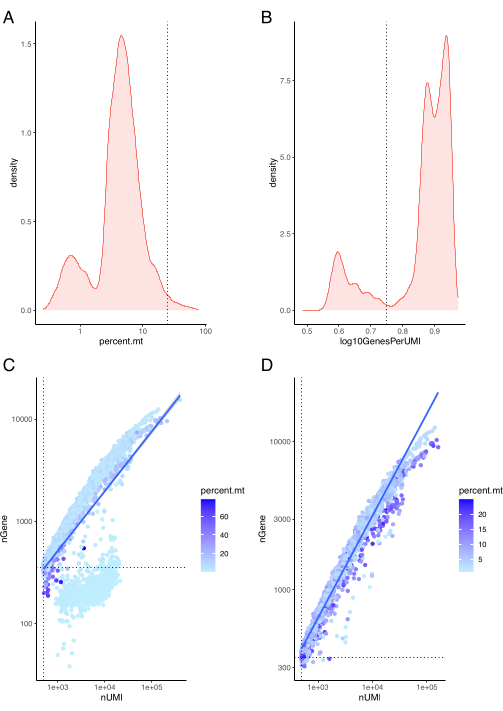
Figure 1: Quality control of single-cell transcriptomic data. (A) Distribution of mitochondrial RNA content across cells. Cells with >30% mitochondrial RNA were excluded to remove potentially stressed or dying cells. (B) Cells with a log10GenesPerUMI > 0.75 were filtered out to ensure a consistent gene-to-UMI ratio and reduce noise from low-complexity libraries. (C) Cells with fewer than 500 detected transcripts (nUMI) or more than 300 detected genes (nGENE) were also excluded to eliminate poor-quality or multiple cells. (D) Correlation plot of NUMI versus nGene illustrating the impact of filtering thresholds. Detected doublets were removed. Please click here to view a larger version of this figure.

Figure 2: UMAP visualization of single-cell transcriptomes. UMAP plot showing the distribution of single cells based on transcriptomic profiles obtained from two individual animals. Each dot represents one cell, color-coded by cluster identity. The microglial cell cluster is identified among other cell populations. Please click here to view a larger version of this figure.
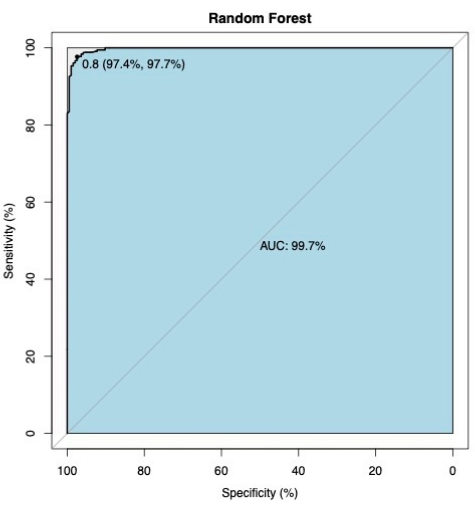
Figure 3: ROC curve of Random Forest classifier evaluated by cross-validation. Receiver Operating Characteristic (ROC) curve illustrating the performance of the Random Forest model used to distinguish microglia from other brain cell types based on gene expression profiles. The model was trained on a set of ~1000 cells with known labels and evaluated using 10-fold cross-validation. Among the five statistical models tested (Random Forest, logistic regression, naïve Bayes, support vector machine, and decision tree), the Random Forest model achieved the highest classification performance. The area under the curve (AUC) reflects the model's accuracy. Please click here to view a larger version of this figure.
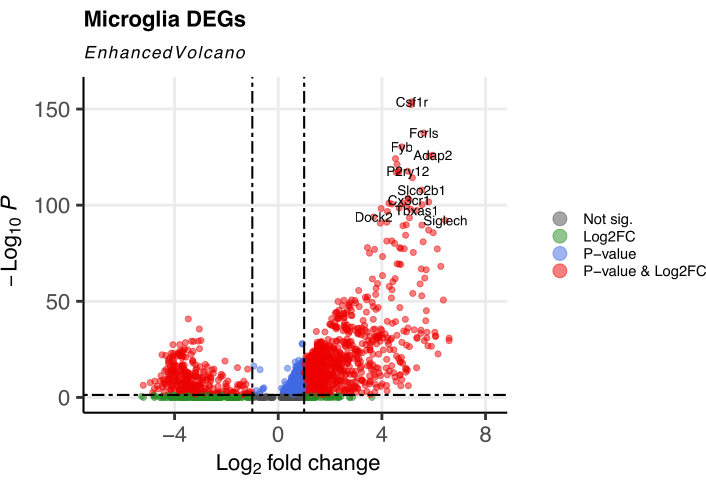
Figure 4: Differential gene expression analysis in microglial cells. Volcano plot representing the log2 fold change versus the adjusted P-Value for genes differentially expressed in microglia between the two experimental groups (control vs. cerebellar brain injury). Upregulated gene is more highly expressed in the group of interest (ident.1), and downregulated genes show reduced expression compared to the reference group (ident.2). Key significantly differentially expressed genes are labeled. Please click here to view a larger version of this figure.
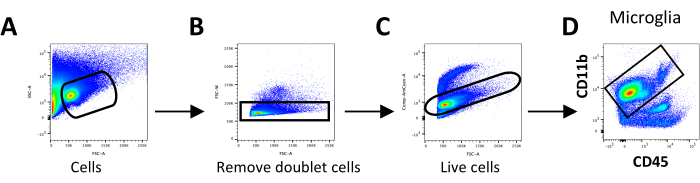
Figure 5: Gating strategy for microglia identification by flow cytometry. (A) Gating strategy applied to cerebellar cells from a control postnatal day 3 (P3) mouse. (B) Singlets were selected to exclude doublets. (C) Viable cells were identified using a viability dye; events with low FSC-A were excluded to remove debris and ensure analysis of intact cells. (D) Microglia were identified as CD45+ and CD11b+ with two distinct populations: CD45low-CD11bint for quiescent microglia and CD45int -CD11bhigh for activated microglia. Please click here to view a larger version of this figure.
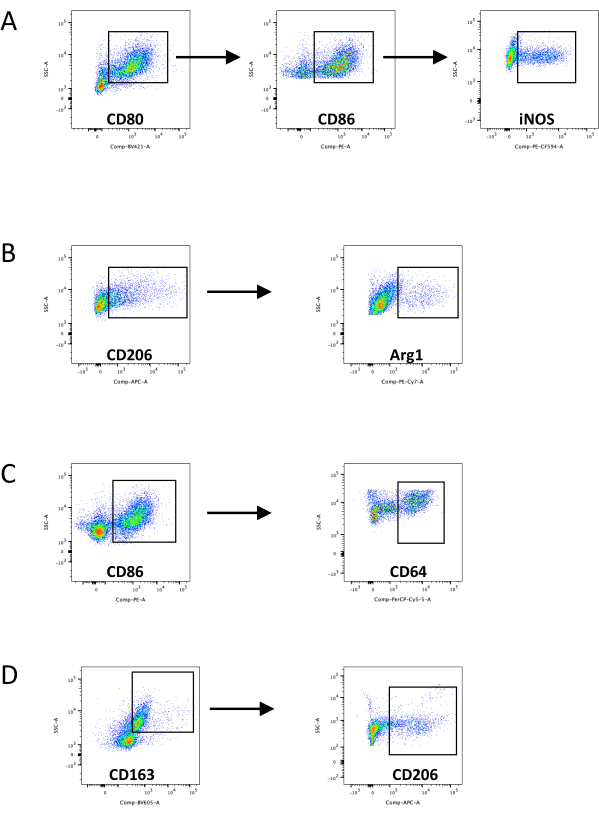
Figure 6. Characterization of microglia marker expression profiles by flow cytometry. (A) Sequential gating of CD45+ CD11b+ cells based on CD80, CD86, and iNOS expression. (B) Identification of a subset expressing CD206, followed by gating based on Arg1 expression. (C) Identification of a subset expressing CD86, followed by gating based on CD64 expression. (D) Identification of a subset expressing CD163, followed by gating based on CD206 expression. These gating strategies illustrate the phenotypic heterogeneity of microglia populations based on surface and intracellular marker expression. Please click here to view a larger version of this figure.
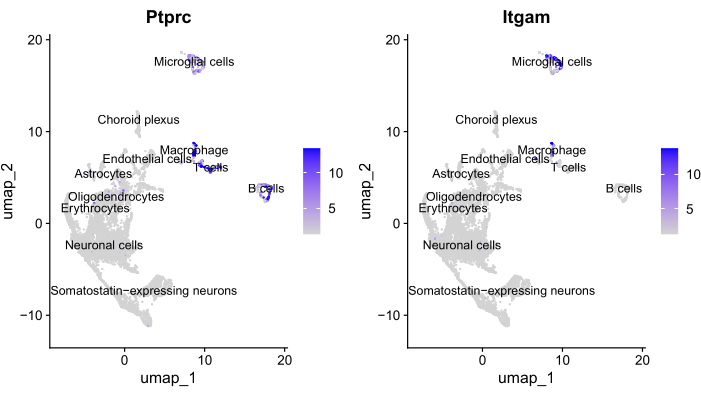
Figure 7: Confirmation of microglia identity using Itgam and Ptprc expression in single-cell RNA sequencing data. UMAP displays the transcriptional landscape of cerebellar cells at P15, with gene expression of Itgam and Ptprc overlaid across clusters. Co-expression of these canonical myeloid markers supports the identification of microglia populations and aligns with markers used in flow cytometry, providing cross-validation between transcriptomic and protein-level analyses. Please click here to view a larger version of this figure.
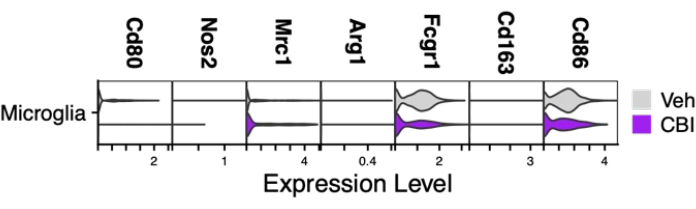
Figure 8: Expression profiles of selected immune-related genes in microglial cells identified by single-cell RNA sequencing. Violin plots display the distribution of gene expression for CD80, NOS2, Mrc1, Arg1, Fcgr1, and CD163 across individual microglial cells. These markers are commonly associated with immune-related processes and illustrate the transcriptional heterogeneity observed within the microglial population. Data are shown for both control and cerebellar brain injury (CBI) conditions. Please click here to view a larger version of this figure.
Table 1: Composition of solutions used for neural cell isolation and staining. This table provides a detailed composition of the solutions required for cell isolation and staining, including their respective concentrations and components. Please click here to download this Table.
Table 2: Antibody mix concentrations for extracellular staining. This table details concentrations of antibodies and live/dead solution used for extracellular staining, specifying the required volumes and dilutions for each antibody in the staining mix for one sample. Please click here to download this Table.
Table 3: Antibody mix concentrations for intracellular staining. This table details concentrations of antibodies used for intracellular staining, specifying the required volumes and dilutions for each antibody in the staining mix for one sample. Please click here to download this Table.
Discussion
This study presents a detailed and optimized protocol that combines flow cytometry and single-cell RNA sequencing (scRNA-seq) for the isolation and characterization of microglial cells during early postnatal brain development. While flow cytometry remains a cost-effective and accessible technique, its integration with single-cell transcriptomics provides complementary insights by linking protein-level marker expression with gene-level transcriptional profiles. The protocol addresses the technical challenges specific to immature brain tissue, including efficient dissociation, debris and myelin removal, and optimized immunostaining strategies, to ensure reproducibility and reliability in the analysis of microglial populations across key developmental time points.
Flow cytometry was used to identify microglial subsets based on the expression of selected surface and intracellular markers. Rather than inferring functional states, subsets were distinguished by their marker expression profiles, such as CD80+/CD86+/iNOS+ ; CD206+/Arg1+ ; CD86+/CD64+ or CD163+/CD206+ phenotypes. These marker-defined populations reflect molecular heterogeneity within the microglia compartment and provide a practical approach for high-throughput characterization. While these surface marker-based classifications may not capture the full complexity of microglia diversity, they remain informative, especially in contexts where high-dimensional molecular tools may not be available. Binary classifications such as the M1/M2 paradigm have been deliberately avoided, in recognition of the spectrum-like, context-dependent nature of microglial phenotypes, as described in recent literature12.
These observations are consistent with previous studies highlighting the role of microglia in both normal brain maturation and in response to environmental or pathological stimuli13,14. The ability to differentiate microglia heterogeneity offers valuable insights into how microglial cell polarization may contribute to neurodevelopmental disorders15,16.
Although single-cell RNA sequencing offers higher resolution and allows the identification of transcriptionally distinct microglial cell subpopulations, its cost and analytical complexity limit its accessibility. In the current dataset collected at postnatal day 15 following perinatal injury, the peak of inflammatory response is largely resolved, resulting in a low number of activated microglia. Consequently, dimensionality reduction techniques such as UMAP did not recover well-separated microglial subclusters, and cluster-level transcriptional analysis was not included in this protocol manuscript.
A significant innovation of this protocol is its optimization for isolating and characterizing microglial cells from the cerebellum during early postnatal stages (P3 to P30). This region and age-specific context present distinct challenges, including low cell yield, myelin content, and increased tissue fragility. To address these constraints, the protocol integrates an adapted dissociation workflow, efficient debris and myelin removal, and carefully tuned immunostaining conditions suited for small-volume cerebellar tissue. Despite the increasing recognition of cerebellar microglia as functionally and transcriptionally distinct from those in other brain regions, detailed protocols for their isolation and analysis remain limited. The current method offers a reliable and accessible workflow, particularly tailored for developmental studies of cerebellar microglia.
The main objective of this manuscript is to provide a reproducible and adaptable methodological framework rather than to report specific biological discoveries. The workflow is suitable for adaptation to other developmental stages or experimental models in which transcriptionally distinct microglial states may be more prominent. In such contexts, flow cytometry remains a valuable tool, especially when integrated with complementary assays.
One of the key strengths of this protocol is its adaptability across various developmental stages, ranging from postnatal day 3 (P3) to postnatal day 30 (P30). This allows for longitudinal analysis of microglia phenotype as brain maturation progresses. The combined use of flow cytometry and scRNA-seq makes it possible to study not only surface markers, but also intracellular signaling pathways and transcription factors involved in microglial cells.
Nonetheless, enzymatic digestion may affect the expression of some surface markers, necessitating careful optimization of digestion conditions for specific experimental goals17,18. Additionally, neither flow cytometry nor single-cell sequencing provides population-level data, which may not fully capture spatial and functional nuances of microglial cell interactions within their native environment. Incorporating single-cell spatial techniques could help address this limitation by preserving the spatial context of microglial cells. Future studies combining this protocol with imaging techniques, such as immunohistochemistry, in vivo imaging, western blot, or single-cell spatial transcriptomics, could offer complementary insights into microglial cell dynamics.
This method opens new avenues for investigating how early-life insults, such as inflammation, hypoxia, or environmental stressors, influence microglial cell phenotypes and contribute to long-term neurodevelopmental outcomes. By enabling precise and reliable characterization of microglial cell activation states, it facilitates the identification of therapeutic targets to modulate microglial responses in early life, aiming to prevent or mitigate neurodevelopmental disorders.
In conclusion, this protocol offers a robust and accessible framework for studying microglial cell diversity during early brain development. The combination of flow cytometry and single-cell RNA sequencing allows for flexible application across various developmental stages and experimental models, facilitating deeper exploration of microglia biology in both physiological and pathological contexts.
Disclosures
The authors have declared that no conflict of interest exists.
Acknowledgements
This work was supported by the Canadian Institutes of Health Research (487354) and the Fonds de Recherche du Québec (333845).
Materials
| Name | Company | Catalog Number | Comments |
|---|---|---|---|
| 140 µm metal mesh filter | Sigma-Aldrich | S3895 | |
| 15 mL tube | Sarstedt | 62.554.205 | |
| 5 mL tube | Sarstedt | 55.526.006 | |
| 96 well plate with conical bottom | Sarstedt | 82.1583.001 | |
| Arginase 1 - Conjugate Pecy7 - Clone : A1exF5 | Thermo Fisher Scientific | 25-3697-82 | |
| Benchtop-stable fluorescent reagents | Invitrogen | A49905 | |
| CD11b - Conjugate Fitc - Clone : M1/70 | BD Pharmingen | 553310 | |
| CD163 - Conjugate SB600 - Clone : TNKUPJ | Thermo Fisher Scientific | 63-1631-82 | |
| CD206 - Conjugate APC - Clone : C068C2 | BioLegend | 141708 | |
| CD45 - Conjugate A700 - Clone : 30-F11 | BD Pharmingen | 560510 | |
| CD64 - Conjugate PerCP-eF710 - Clone : X54-5/7.1 | Thermo Fisher Scientific | 46-0641-82 | |
| CD80 - Conjugate SB436 - Clone : 16-10A1 | Thermo Fisher Scientific | 62-0801-82 | |
| CD86 - Conjugate Pe - Clone : GL-1 | BioLegend | 105008 | |
| Collagenase D | Sigma–Aldrich | 11088866001 | |
| DNase I | Sigma–Aldrich | 10104159001 | |
| Fetal bovine serum (FBS) | Sigma–Aldrich | F1051 | |
| HBSS (Hank's balanced salt solution) 10x | Wisent Bioproducts | 311506CL | |
| Hemocytometer | vwr international | 82030-470 | |
| HEPES | Wisent Bioproducts | 330.050.EL | |
| iNOS - Conjugate PE- eF610 - Clone : CXNFT | Thermo Fisher Scientific | 61-5920-82 | |
| KCl | Thermo Fisher Scientific | BP366-500 | |
| KH2PO4 | Thermo Fisher Scientific | BP362-500 | |
| Live/Dead Amcyan | Thermo Fisher Scientific | L34957 | |
| Microglial cell culture media | Life Technologies | A12475-01 | |
| Na2HPO4 | Thermo Fisher Scientific | BP332-500 | |
| NaCl | Thermo Fisher Scientific | BP358-212 | |
| Paraformaldehyde | Sigma–Aldrich | P6148 | |
| Rat anti mouse CD16/CD32 | BD Biosciences | 553142 | |
| Saponin | Sigma–Aldrich | S7900 | |
| scRNAseq libraries | 10X Genomics | 1000121 | |
| Silica-based colloidal medium | Thermo Fisher Scientific | 45001747 | |
| Sodium azide | Thermo Fisher Scientific | BP922I-500 | |
| Trypan Blue | Gibco | 1525006 |
References
- Berardi, N., Sale, A., Maffei, L. Brain structural and functional development: Genetics and experience. Dev Med Child Neurol. 57 (Suppl 2), 4-9 (2015).
- Tremblay, M. E. Microglial functional alteration and increased diversity in the challenged brain: Insights into novel targets for intervention. Brain Behav Immun Health. 16, 100301(2021).
- Salter, M. W., Beggs, S. Sublime microglia: Expanding roles for the guardians of the CNS. Cell. 158 (1), 15-24 (2014).
- Michell-Robinson, M. A., et al. Roles of microglia in brain development, tissue maintenance and repair. Brain. 138 (Pt 5), 1138-1159 (2015).
- Nayak, D., Roth, T. L., Mcgavern, D. B. Microglia development and function. Annu Rev Immunol. 32, 367-402 (2014).
- Mehl, L. C., Manjally, A. V., Bouadi, O., Gibson, E. M., Tay, T. L. Microglia in brain development and regeneration. Development. 149 (8), dev200425(2022).
- Mastenbroek, L. J. M., Kooistra, S. M., Eggen, B. J. L., Prins, J. R. The role of microglia in early neurodevelopment and the effects of maternal immune activation. Semin Immunopathol. 46 (1-2), 1(2024).
- Menassa, D. A., Gomez-Nicola, D. Microglial dynamics during human brain development. Front Immunol. 9, 1014(2018).
- Srakocic, S., et al. Proposed practical protocol for flow cytometry analysis of microglia from the healthy adult mouse brain: Systematic review and isolation methods' evaluation. Front Cell Neurosci. 16, 1017976(2022).
- Akhmetzyanova, E. R., Rizvanov, A. A., Mukhamedshina, Y. O. Current methods for the microglia isolation: Overview and comparative analysis of approaches. Cell Tissue Res. 395 (2), 147-158 (2024).
- Walker, D. G., Lue, L. F. Immune phenotypes of microglia in human neurodegenerative disease: Challenges to detecting microglial polarization in human brains. Alzheimers Res Ther. 7 (1), 56(2015).
- Paolicelli, R. C., et al. Microglia states and nomenclature: A field at its crossroads. Neuron. 110 (21), 3458-3483 (2022).
- Hammond, T. R., et al. Single-cell RNA sequencing of microglia throughout the mouse lifespan and in the injured brain reveals complex cell-state changes. Immunity. 50 (1), 253-271.e6 (2019).
- Bernier, L. P., York, E. M., Macvicar, B. A. Immunometabolism in the brain: How metabolism shapes microglial function. Trends Neurosci. 43 (11), 854-869 (2020).
- Butovsky, O., et al. Identification of a unique TGF-β-dependent molecular and functional signature in microglia. Nat Neurosci. 17 (1), 131-143 (2014).
- Gosselin, D., et al. Environment drives selection and function of enhancers controlling tissue-specific macrophage identities. Cell. 159 (6), 1327-1340 (2014).
- Chometon, T. Q., et al. A protocol for rapid monocyte isolation and generation of singular human monocyte-derived dendritic cells. PLoS One. 15 (4), e0231132(2020).
- Skog, M., et al. The effect of enzymatic digestion on cultured epithelial autografts. Cell Transplant. 28 (5), 638-644 (2019).
Reprints and Permissions
