This protocol provides a method for the systematic global optimization of genetically encoded biosensors through automation-assisted genetic library generation and assessment. This is coupled with design-of-experiment methodologies to streamline experimentation and enable the selection of genetic components to tune biosensors to specific design outcomes.
Method Article
Efficient Sampling of Genetically Encoded Biosensor Design Space Enabled with a Design of Experiments and Automation Workflow
In This Article
Summary
Abstract
Genetically encoded biosensors are powerful tools for high-throughput information processing, enabling the transduction of environmental or chemical input signals into a variety of outputs. This allows dynamic sensing, direct control, and fine-tuned regulation of gene expression across a wide range of biotechnological applications, including enzyme optimization, strain development, and microbial process control. To make them fit for purpose, biosensor performance can be refined by modifying the stoichiometry of biosensor circuit components (e.g., transporters, input and output modules), and/or tuning associated host-biosensor intermolecular interactions (e.g., DNA-protein, protein-protein). However, here, the vast number of possible biosensor permutations creates a complex combinatorial design space, necessitating careful optimization of screening strategies to identify configurations that deliver the desired phenotypic performance. This complexity is further compounded by biosensor performance traits, such as tunability, which require effector titration analysis under monoclonal screening conditions. Consequently, the need to explore diverse sequences and experimental space makes fractional sampling methods particularly well-suited for this purpose. Underpinning this workflow are Design of Experiment (DoE) algorithms, which are well-positioned to allow efficient statistically-based structured mapping and fractional sampling of this combinatorial experimental design space.
Reported within is a combined high-throughput automation and computational approach to efficiently sample the design space of allosteric transcription factor-based biosensors to afford distinct configurations with both digital and analogue dose-response curves. The protocol begins with the creation and automated selection of promoter and ribosome binding site libraries. These libraries, and their corresponding expression data, are transformed into structured dimensionless inputs, allowing computational mapping of the full experimental design space. Fractional sampling is then performed using a DoE algorithm and coupled with effector titration analysis using a high-throughput automation platform. This workflow provides an agnostic framework for the development and optimization of future biosensor systems and genetic circuits, providing a regulatory toolkit for the synthetic biology community.
Introduction
The ability to regulate the expression of genes is an essential function in all forms of life, facilitating dynamic, real-time responses to both internal and external influences, ranging from chemical effectors to biophysical stimuli1. The myriad number of transcriptional regulatory systems found across nature has enormous potential in the augmentation and acceleration of metabolic engineering and biotechnological research enabled by synthetic biology. In prokaryotes, much of the regulation that occurs in the cell is controlled through one-component regulatory mechanisms driven by the interactions of allosteric transcription factors (aTFs) with a number of small-molecule effectors2. Typically consisting of an effector binding domain (EBD) and DNA binding domain (DBD), aTFs act as molecular switches upon binding to specific small molecule effectors, modulating the affinity of their DBD for specific DNA operator sequences located in the promoter regions of the genome, resulting in activation or repression of transcription3. This deceptively simple mechanism has given rise to a number of diverse regulations strategies, ranging from repression/de-repression systems to activators able to detect and respond to a staggering number of small-molecule effectors or environmental stimuli4. Consequently, synthetic biology has leveraged this diversity in order to construct genetically encoded biosensors capable of coupling a plethora of input signals into bespoke outputs, i.e., fluorescent reporter protein production and regulation of synthetic pathways. When applied in biotechnological workflows, such systems enable the real-time monitoring of intracellular concentrations of metabolites, dynamic regulation of pathways, and facile readouts aiding in the development of more efficient pathways, strains, and bioprocesses5,6,7,8.
Fundamentally, biosensors are characterized according to a number of parameters, including specificity, operational range, dynamic range, sensitivity, and slope, with the dose response curve of a biosensor describing these parameters through the output signal as a function of ligand concentration (Figure 1)9,10,11,12. The Hill equation can be used to fit the performance characteristics of a biosensor, providing semi-empirical evidence for each of the parameters described above, thus providing a means of characterizing the biosensor system whilst also enabling assessment of efforts required to tune the system toward application-driven outcomes. Specificity can be defined as the relative differences in signal output induced by one effector compared to an array of other potential effector molecules and is typically modulated at the EBD level of the aTF. Operational range is defined as the range of ligand concentrations that the biosensor is able to sense, dictating the range of concentrations to which the biosensor will be able to respond. Dynamic range, by contrast, describes the ratio of the highest measurable activation (ON) state to the inactivated (OFF) state and is an important parameter for ensuring the biosensor reliably reports effector concentrations above background auto-fluorescence10. Sensitivity for the effector molecule is described as the concentration required to elicit a certain output signal, measured by the half maximal concentration (EC50) of the effector13. Finally, the slope of the curve is denoted by the cooperativity (nH) of the aTF for its operator site at the promoter and results in a more digital or analog response output profile. Cooperativity arises from protein-protein interactions between ligand-bound aTFs forming multimeric complexes that strengthen affinity for the operator site, resulting in sharp increases in responsiveness of the circuit with saturating ligand concentrations and a more digital response profile14.
The dose response characteristics of a biosensor can significantly affect the suitability of its applications, and are often a 'make or break' point for any conceptual application. Biosensor performance can vary enormously from system to system, with the operational range typically varying from 0.1nM-10mM13, whereas dynamic ranges can be from 1.4-2000 fold15. Furthermore, whilst the number of effector compounds reported for aTFs is broad (metabolic products, amino acids, metals, antibiotics, quorum sensing, etc.)11, it is not all encompassing, presenting challenges to researchers when a suitable biosensor for their effector does not already exist in the literature. Synthetic biology enabled engineering of biosensors that address such challenges, permitting the tuning of effector scope and dose-response characteristics to more closely align with the research outcomes of the application, and has been used to address both aforementioned problems, respectively16,17. Two key areas for engineering are targetable via synthetic biology, the promoter region of the biosensor and the aTF itself, mediating their effects at the transcriptional and protein level. Approaches that focus on the genetic elements of the biosensor in order to modulate performance at the promoter level, include engineering of the RBS, operator sites, and -35, -10 (hexboxes) in order to tune sensitivity, operational and dynamic ranges, and are the focus of the methodology outlined in this manuscript (Figure 1). Alternatively, modifying the selectivity and sensitivity of the biosensor through analysis of its effector binding domain and mutation of residues involved in effector coordination (using sequence homology and/or structural biology) can modulate its response to a cognate effector18,19,20 or change it entirely toward a non-cognate effector of interest16,17,21. Such tuning efforts can then direct biosensors towards specific applications, with these commonly being metabolic controllers (feedback loops, control circuits), primary screening tools (Enzyme or strain discovery), secondary screening tools (enzyme variant screening, metabolic engineering), and transporter bioprospecting22,23,24. One such example involves the use of a muconic acid-responsive aTF, CatM, combined with an engineered promoter sequence to improve dynamic and operational range. This system was integrated with fluorescence-activated cell sorting to isolate the most effective muconic acid production strains based on GFP fluorescence following adaptive laboratory evolution25.
Whilst the success of the engineering strategies outlined above is self-evident, the interdependencies of the levers available to a synthetic biologist to tune biosensors can complicate the design process and prolong the period spent in biosensor development, which may dissuade some researchers from implementing biosensors into their own workflows. As illustrated in Figure 1, attempts to tune a biosensor towards a particular outcome through modifying the hexboxes may inadvertently attenuate other parameters, this interdependency being a recognized challenge in biosensor engineering12. Common approaches of biosensor tuning consist of rational design and directed evolution engineering, with the former relying on a priori understanding of the structural and mechanistic features of the system to focus experimentation on components with a high likelihood of success; whereas the latter relies upon randomized mutagenesis and natural evolution coupled to a high throughput screen to select for variants exhibiting optimized characteristics26,27,28,29,30. Whilst effective, both techniques also suffer from some drawbacks: targeted engineering, for example, through its focus on specific structural or functional elements, is prone to limited exploration of the full experimental space and may ignore allosteric or secondary effects30. Untargeted library generation and screening, whilst ideal for optimizing designs in an unguided manner, requiring little in the way of upfront design work (i.e., library design and generation), do require a bias toward useful mutation. Without such a bias, it is expected that a much larger percentage of mutations may be deleterious, requiring more screening31. As such, holistic approaches that consider not only the primary effect of constituent parts of the biosensor (aTF, RBS, operator sites and hexboxes) but also how these components interact with one another to influence biosensor parameters are highly attractive.
Structured multivariate experimentation and statistical modelling methodologies have been widely adopted in process engineering workflows in order to interrogate multidimensional experimental space using the minimum possible number of experiments. This approach, which combines experimentation and modelling, termed design of experiments (DoE), crucially allows researchers to optimize complex multivariable processes toward defined outcomes whilst not requiring extensive a priori knowledge23,30. Whilst typically applied to the optimization of continuous variables for which structured experimental exploration is more facile, DoE has also been used in the optimization of metabolic pathways at the genetic level31,32,33. This involves an initial screening step in which the factors thought to be most important to the desired outcome are selected, followed by an optimization step whereby the selected factors are adjusted to obtain the desired output, in this case to optimize specific biosensor parameters in order to increase their scope of application. Critically, this technique can be coupled to automated liquid handler platforms to increase the screening throughput up to mid-sized libraries of 103 - 104 to globally optimize biosensor performance on a data-driven basis23. Below, we describe a protocol for the implementation of a DoE driven approach to biosensor optimization, assisted with liquid handling robotics to streamline library generation, screening, and data collection for the global optimization of biosensor sensitivity.
Protocol
1. RBS/promoter part design
- Identify biosensor-specific regulatory elements that can be systematically tuned as continuous variables in the DoE process. Group these regulatory elements into distinct modules. This can include modules regulating effector transport, transcription factor expression, and/or output gene expression. Ensure that each module is adjustable at the transcriptional and/or translational level by a promoter or RBS (e.g., RBStrans, Preg, RBSout, and Pout, respectively).
- Determine key functional sites within selected promoter and RBS regions, such as hex-boxes, operator sites, and RBS sequences.
NOTE: Many characterised promoters and RBSs exist in the literature to create libraries from34,35,36. However, for uncharacterised promoter sequences (typically the Preg promoter), see below for further steps to locate tuneable genetic sequence elements if none are available in the literature.- Locate other operons containing the biosensor sequences of interest via BlastP searches of the aTF with the desired sensing input. Extract the intergenic region of the aTF and its regulated genes to obtain promoter sequences.
NOTE: The location and number of promoter sequences will vary depending on the class of aTF utilised.
- Locate other operons containing the biosensor sequences of interest via BlastP searches of the aTF with the desired sensing input. Extract the intergenic region of the aTF and its regulated genes to obtain promoter sequences.
- Use multiple sequence alignment tools and other motif software to search the putative promoters for conserved motifs such as hexboxes and operator sites. Based on promoter sequence analysis, select nucleotide sequences for randomisation with degenerate bases, e.g., N = anything, R = any purine, Y = any pyrimidine, etc.
NOTE: Readers are directed to the source publication for further details on promoter analysis and base randomisation23.
2. Part library assembly and validation
- Design and order primers that will specifically amplify the desired expression vector to allow insertion of promoter/RBS sequence variants upstream of a fluorescent marker (e.g., GFP). Dilute lyophilised primers upon arrival to a final concentration of 100 µM in sterile deionized H2O.
- Assemble the PCR reaction mixture on ice in PCR tubes according to the parameters of the specific polymerase. Ensure that a high-fidelity polymerase is used to prevent carryover of mutations into the backbone of the expression vector. Adjust annealing temperature and extension time according to the needs of the primers and the length of the desired PCR product.
- Analyse the PCR product via gel electrophoresis and purify the linearised vector using either PCR purification or a gel extraction kit. Measure the concentration of linearised vector DNA and store at -20 °C.
- Order the designed variant libraries (RBS or promoters) for insertion into the linearised vector as single-stranded degenerate oligonucleotides with 30 bp plasmid homology arms at both the 5′ and 3′ ends for targeted homologous recombination into the expression vector.
- Upon arrival, resuspend the lyophilised oligonucleotides to a final concentration of 100 ng/µl in sterile deionized H2O.
- Determine volumes for equimolar amounts of the linearised vector and variant library using online calculators. Ensure that the final volume of the reaction will amount to 20 µL and that a 2:1 molar ratio of insert to vector is used.
- Thaw an aliquot of commercial Gibson assembly master mix (X2) on ice and assemble the reaction in a PCR tube according to the volumes provided by the chosen calculator.
NOTE: Gibson master mix can also be made in the lab37,38. - Add 10 µL of 2x Gibson master mix to the DNA fragments and incubate for 1 h at 50 °C in a thermocycler or similar.
- Apply all 20 µL of ligation product to 200 µL of competent E. coli in a microcentrifuge tube. Incubate on ice for 30 min followed by heat shock for 45 s at 42 °C.
- Return the cells to ice for 2 min, add 800 µL of super optimal broth with catabolite repression (SOC) media to the tube, and allow cells to recover for 1 h at 37 °C in a shaking incubator.
- Spread 50 µL of transformed cells onto multiple 60 mm Luria-Bertani (LB) agar petri plates with relevant antibiotic selection. Incubate plates at 37 °C for 18 h.
- Thaw an aliquot of commercial Gibson assembly master mix (X2) on ice and assemble the reaction in a PCR tube according to the volumes provided by the chosen calculator.
- Check the plates for transformants, calculate the number of colonies that represent 3x the theoretical library diversity to capture sufficient representation of each variant. Optimize the isothermal assembly if the number of colonies is low/zero.
NOTE: Oversampling is required when considering an ideal library generated from high-fidelity reagents or synthesis. This is typically 3x greater than the total size of the library. For example, 4 positions of degeneracy (NNNN) = 44 = 256 unique sequences. Therefore, scrape ~768 colonies.- Scrape the required number of colonies into a single sterile 125 mL flask containing 25 mL of LB media supplemented with appropriate antibiotics. Incubate the flask at 37 °C for 18 h in a shaking incubator (180 rpm), ensuring that the culture is visibly dense after this time has elapsed.
- Use a plasmid midi-prep purification kit to purify the variant library from the prepared transformant culture. Determine the concentration of the plasmid library DNA; 1-10 µg is required for downstream steps. Ensure that library DNA is eluted using sterile deionized H2O.
NOTE: Steps beyond this point will focus on the cloning and validation of variant libraries in the Pseudomonas putida (P. putida) expression host; adaptation of the protocol to other hosts may require modification of incubation times, incubation temperatures, and transformation methods.
- Prepare an LB agar plate of the desired expression host P. putida by streaking from a glycerol stock and incubating the plate at 30 °C for 18 h.
- Pick a single colony of P. putida from the LB agar plate, inoculate 10 mL of LB media, and grow at 30 °C for 18 h, at 180 rpm shaking.
- Prepare the cells for electro-competency by centrifuging the grown culture at 4000 x g at 18 °C for 2 min. Pour off the supernatant, resuspend in 1 mL of sterile deionized H2O, and transfer the resuspended cells to a sterile microcentrifuge tube.
NOTE: P. putida cells should appear pinkish when pelleted. - Centrifuge the cells for 1 min at 4 x g in a microcentrifuge, pour off the supernatant, and resuspend in 1 mL of sterile deionized H2O. Repeat the centrifugation and resuspension steps 4 more times.
NOTE: Cell loss may occur when pouring off supernatant during washing; this is normal and should not affect yields. - Transfer 100 µL of washed cells to a 0.2 cm electroporation cuvette, add 1-10 µg of plasmid library DNA to the cuvette, and mix.
- Switch on the electroporator, ensure that the voltage is set to 2.5 kV for the 0.2 cm cuvette, insert the cuvette into the electroporation chamber, and pulse.
- Add 900 µL of SOC media to the cuvette, mix, and transfer cells to a sterile microcentrifuge tube. Allow cells to recover for 2 h at 30 °C in a shaking incubator.
- Spread 50 µL of transformed cells onto large square petri plates (230 mm) of LB agar supplemented with relevant antibiotic and incubate at 30 °C for 18 h.
NOTE: Ensure moderate colony density on library plates (2-3 CFU/cm2). This will depend on bacterial competency and plating volume. If too low, optimisation of the transformation, or successive rounds of transformation, may be used to increase colony numbers. - Select between 25-50 colonies from across all transformant plates for sequence validation. Use primers that amplify across the degenerate sequence, amplify the region by PCR, and send it for Sanger sequencing to evaluate sequence diversity, as well as polyclonality.
NOTE: If polyclonality becomes problematic, spreading transformations across multiple batches of cuvettes with 1 µg of DNA can help to reduce this effect.
3. Part library clonal screening - automation
- Liquid handler setup
- Create 7 programs on a liquid handler platform to ensure that pipetting-intensive steps are trivialized.
- Create a "MTP Liquid Transfer" program, ensure that the liquid handler is set up to pipette an adjustable volume from a prepared reservoir into empty microtiter plates (MTP) in its layout.
- Create a "Add glycerol to MTP" program, ensure that the liquid handler is programmed to pipette 100 µL volume of 50% glycerol into plates, ensure that the dispensing and aspiration speed is 5-20 µL/s.
NOTE: A separate program is created to account for the higher viscosity of 50% glycerol, which may lead to bubble formation, incomplete aspiration or cross-contamination of neighboring wells due to splashing if not controlled. - Create a "DWB Liquid Transfer" program, set up the liquid handler to pipette into deep well blocks (DWB) with an adjustable volume setting, and ensure that the liquid handler pipettes from a prefilled reservoir.
- Create an "Inoculate from Thawed MTP" program, ensure that the liquid handler is programmed to aspirate 5 µL from thawed MTP containing the selected colonies and transfer this into the corresponding DWB plates in the layout.
NOTE: Pay close attention to MTP and DWB arrangement in the layout, ensuring a logical order of events to avoid accidental double inoculation or missed plates. - Create a "Transfer to Assay DWB" program, ensure that the liquid handler is set to transfer 5 µL of cells from one DWB plate position to another DWB plate position. The program must then repeat this action 4 times with each transfer inoculating a different plate position, i.e., P1 -> P2, P1 -> P3, etc.
NOTE: This program ensures the seamless subculturing of 96 variants into different assay concentrations. - Create an "Assay Setup - PBS Resuspension (DWB)" program, ensure that the liquid handler pipettes each DWB in the layout with 500 µL of PBS, the program must also include a mixing step to ensure cell pellets are properly resuspended.
- Create an "Assay Setup - Cells and PBS Addition (MTP)" program, ensure this program includes a step to transfer 200 µL of the resuspended cells from one DWB plate position to an empty MTP position.
NOTE: For all steps of 3.1, programming and liquid handler layouts will vary; researchers should refer to manuals of specific commercial liquid handlers to modify the programs above to suit the capacity and needs of the experiment.
- Variant library culturing and barcoding
- Determine the theoretical library size and calculate the number of individual variants to ensure > 95% library coverage (3x library size recommended) (see the note for step 2.5.).
- Calculate the required volume of antibiotic-supplemented LB media according to the number of colonies that are to be screened (200 µL per colony + 10% over).
- Open the liquid handler software and click on Run next to the MTP Liquid Transfer program (see Supplementary File 1). Place the prepared media in the corresponding reservoir position and fill the deck with empty MTPs according to the layout. Set the program to dispense 200 µL of media. Click OK to confirm program start.
NOTE: Always ensure that reservoirs and tips are adequately supplied to the liquid handler platform before confirming program start to prevent disruption. - Repeat the program as many times as required, seal the filled MTPs with a breathable membrane to maintain sterility.
- Transfer filled MTP plates to a colony picker platform and unseal, also transfer the square plates of P. putida transformed with plasmid variant library DNA to the colony picker platform. Use the colony picker to inoculate each of the prefilled microtiter plate wells with a single colony from the transformant library plates.
NOTE: Ensure that the minimum depth of agar is 25 mL to avoid damaging the colony picker head. - Reseal and transfer the inoculated plates to a shaking offline incubator at 30 °C (800 rpm), ensuring humidity control is enabled at 75% to avoid culture evaporation. Leave these to grow for 16 h.
NOTE: After incubation, cultures will appear visibly dense to the eye, if this is not the case, recheck the media and antibiotic requirements. - Following 16 h of growth, return the grown plates to the liquid handler platform and unseal. Click on Run next to the Add glycerol to MTP protocol (see Supplementary File 1), ensure that the plate layout on screen matches that of the liquid handler dock. Click OK and allow the protocol to run.
- Once finished, seal the plates again and briefly mix in an offline shaking incubator (800 rpm) for 5 min before barcoding and storing at -80 °C.
- Repeat steps 3.2.7. and 3.2.8. until all MTPs have had glycerol added, have been mixed, barcoded, and stored at -80 °C.
NOTE: The protocol can be paused at this point to prepare for the characterization steps below. Furthermore, blocking of the plates into different experimental runs can be planned to suit the capacity of the liquid handler platform in use or to reduce workload in one sitting.
- Variant library screening
- Calculate the required volume of antibiotic-supplemented media for the number of DWB to be filled (~495 µL per well + 10% over).
- Click on Run next to the DWB Liquid Transfer program (see Supplementary File 1), ensure that media is added to the correct reservoir in the program layout. Ensure that empty DWB are added to the corresponding layout positions and that an adequate supply of tips is available. Set the program to dispense 495 µL of media. When ready, click OK to start the program.
- Seal the filled DWBs with a breathable membrane and transfer to temporary storage at 4 °C, repeat step 3.3.2. until the required number of DWBs have been filled with media.
- Click on Run next to the Incoculate from Thawed MTP program (see Supplementary File 1), ensure that MTP cryostocks and filled DWBs are transferred to the liquid handler platform according to the layout. Ensure that a sufficient supply of tips is provided. Click OK to initialize the program.
NOTE: Thaw stock plates on ice for 30 min, only when prerequisite programs and plates have been prepared to ensure optimum viability of cells. - When the program has finished, seal inoculated overnight DWBs with a breathable membrane, and transfer to an offline plate shaker incubator with 75% humidity control and allow to grow overnight for 16 h at 30 °C (800 rpm).
- Reseal, mix, and return cryostock MTPs to -80 °C freezer as per step 3.2.8.
- Repeat steps 3.3.4. to 3.3.6. as many times are required until the required number of overnight DWBs have been inoculated and transferred to the incubator.
NOTE: It is recommended to record when each batch of plates is added to the incubator to account for the time lag between runs during inoculation and to use the same order for downstream steps. - Calculate the required volume of media supplemented with different concentrations of effector and antibiotic according to the number of overnight DWB to be screened (495 µL per well + 10% over). Each effector concentration requires its own separate reservoir in the liquid handler.
NOTE: For initial characterization, such as ON/OFF screening, two effector concentrations are sufficient (e.g., 0 and 1000 µM final concentration). In order to generate dose-response data for more robust characterization, this range is increased to a minimum of four concentrations (e.g., 0, 1, 25, and 1000 µM final concentration). Repressor systems do not require the addition of an effector to ascertain function, whereas for activators, such as the system outlined, an effector is required. - Click on Run next to the DWB Liquid Transfer program (see Supplementary File 1). Ensure that reservoirs containing effector-supplemented media are in the correct positions, according to the layout. Add empty DWBs into the liquid handler platform. Ensure that sufficient tips are available to the platform. When ready, click OK to start the protocol to generate the assay DWBs.
- After filling, seal the assay DWBs with a breathable membrane and transfer to temporary storage at 4 °C, and refill the liquid handler platform with more empty plates.
- Repeat steps 3.3.9 and 3.3.10 as many times as necessary until the required number of DWBs are filled.
- Click on Run next to the Transfer to Assay DWB program (see Supplementary File 1). Ensure that unsealed assay DWBs containing effector-supplemented media are added to the correct locations in the liquid handler layout.
- Transfer and unseal the overnight DWBs containing grown P. putida inoculated in step 3.3.4. to the liquid handler platform, again ensuring that the layout is strictly adhered to. Ensure that sufficient tips are available to the platform. When ready, click OK to start the protocol.
NOTE: Transfer and arraying of subcultures into the assay plates will typically need to be done in batches depending on the size of the liquid handler platform. - After the program has finished, apply seals and transfer the assay plates to an offline incubator at 30 °C, with 75% humidity for 16 h (800 rpm), the final assay volume will be 500 µL at this stage.
- Discard the overnight DWBs after inoculation and repeat steps 3.3.12 to 3.3.14 as required until all required assay DWB have been inoculated and are growing in offline incubators.
- Remove DWBs from the incubator, transfer to a centrifuge and pellet cells at 4000 x g, 18° C for 5 min. Pour off supernatant and place the centrifuged DWBs onto the liquid handler platform.
NOTE: Cell pellet volumes may vary depending on effector concentration or variant, additionally some pellets may appear more visibly fluorescent to the eye than others. - Calculate the volume of 1x PBS required based on the number of DWB to be screened (500 µL per well + 10% over).
- Click on Run next to the Assay Setup - PBS Resuspension (DWB) program (see Supplementary File 1), set the dispense volume to 500 µL, ensure that 1x PBS is added to the correct reservoir, then array the centrifuged plates according to the layout of the liquid handler. Ensure that sufficient tips are available . Click OK to start the program.
NOTE: Washing of the cells is performed to remove residual growth media, which may produce some autofluorescence. - Reseal and remove resuspended plates from the liquid handler. Ensure that pellets are completely resuspended by checking the underside of the plate. Continue to transfer pelleted DWBs to the liquid handler and repeat step 3.3.18. until all plates have been resuspended.
- Click on Run next to the Assay Setup - Cells and PBS addition (MTP) program (see Supplementary File 1). Transfer the resuspended DWBs from step 3.3.18. into the liquid handler according to the suggested layout. Transfer empty MTPs into the liquid handler according to the layout. Ensure the dispense volume is set to 200 µL and that sufficient tips are available. Click OK to start the program.
- Transfer filled MTPs (final assay volume 200 µL) to an offline multimode plate reader, measure relative fluorescence at an appropriate excitation emission wavelength (e.g., sfGFP lEx/lEm = 488/520) and OD600 for each well in the plate.
NOTE: Excitation emission wavelength settings will depend on the choice of fluorescent gene encoded in the expression vector. Ensure gain settings on the plate reader are consistent throughout and enable discrimination between low and high variants without saturating the detector. - Repeat steps 3.3.20. and 3.3.21. until all assay DWPs have been transferred to MTPs and measured.
4. Data processing/transformation and differential ranking
- Perform a normalization of the collected data by dividing the recorded GFP fluorescence (RFU) by the recorded OD600 measurement for each variant for each of the assessed effector concentrations (0 and 1000 µM).
NOTE: Most plate readers can be programmed to automatically normalize fluorescence by OD600 during data collection. - Calculate ON/OFF to obtain the dynamic range of each variant by dividing the RFU/OD600 at 1000 µM (ON) by the RFU/OD600 at 0 µM (OFF). Plot all variant ON/OFF values as a scatter plot using the ON/OFF of the base biosensor construct to determine variants that exhibit activity above the base level.
NOTE: The ON/OFF of the initial biosensor construct used in the protocol was determined to be 3.6-fold based on initial characterization of the wild-type sequence23. - For in-depth characterization, fit the dose-response data using a Hill function with a variable slope to extract EC50 and/or Hill slope values using analytical software.
NOTE: To estimate sensitivity and EC50, collect at least four data points spanning the range where the response transitions from low to high activation, typically the steepest portion of the curve. While more data points improve resolution and accuracy, four points are sufficient for estimating the sensitivity ranking. - From the full set of variants, select a subset of variants (e.g., N = 100) ensuring balanced coverage of desired rankings, in this case EC50. To do this, identify variants that span a broad range in EC50, ensuring that highly ranked and low-ranked variants are proportionally represented. Remove variants that are redundant (e.g., those with similar rankings and minimal impact on distribution coverage).
- After selecting the final variant sample library (e.g., N = 100), transform the data using the following linear-logarithmic (lin-log) transformation equation (Eq.1).
Eq.1:
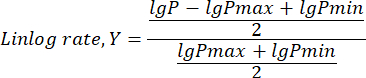
where,



- For EC50 values, assign +1 for the highest (least sensitive) and -1 for the lowest (most sensitive). A geometric average of 0 corresponds to intermediate expression levels.
5. Definitive Screening Design Generation/ DoE
- To systematically explore the biosensor design space, use a Definitive Screening Design (DSD). This design is preferred due to its ability to explore the design space efficiently while tailoring the study to specific system needs.
- Click on the DOE category and then select the Definitive screening design button in the statistical software (see Supplementary File 2).
- Define the experimental factors (e.g., RBStrans , Preg , RBSout , and Pout) as continuous variables by clicking the Continuous button and naming them, ensuring to set the Values to +1 and -1 (see Supplementary File 3).
- Define the desired responses (e.g., ON , OFF , ON/OFF , EC50 , Slope) by clicking the Add response button and customizing the name (see Supplementary File 4).
NOTE: Set the goal of the response by clicking on the goal drop down, select None or Maximize depending on the design's objective (e.g., exploration versus optimization). - Once the factors and responses are defined, click on Continue to open the design options tab. Select No Blocks Required, then click on the Make design button (see Supplementary File 5).
NOTE: Blocks can be added to insulate the design from nuisance factors (factors not of primary interest). This can add complexity to experiments; however, it is used at the discretion of the researcher. - The software will generate an experimental design table outlining the specific combinations of factors to be tested. The genetic parts from the corresponding lin-log transformed libraries will be used to generate the corresponding 17 constructs. Save and export the design table by clicking on Make table (see Supplementary File 6).
6. Repeat step 2 - Design and assembly of DoE-informed genetic designs
- Begin constructing the multivariable plasmids according to the Definitive Screening Design (DSD) plan.
- Identify an initial variable (e.g., promoter, RBS, etc.). Design and order primers to linearize the expression vector, ensure that the primers flank the targeted variable region, ensuring the removal of any pre-existing sequence elements.
- Design and order primers that will specifically amplify variant sequences corresponding to the predefined library levels (e.g., -1, 0, +1) for each regulatory node (Pout Preg RBSout RBStrans). Ensure each primer includes 30 bp homology arms that are complementary to the expression vector insertion site.
- Purify plasmid DNA from the relevant cryo-stock culture corresponding to the +1, 0, and -1 library levels for the identified variable via miniprep.
- Set up the PCR reactions for the linearised expression vector and library fragments on ice and determine the concentration of product as outlined in steps 2.1.1 and 2.1.2.
- Repeat steps 2.3 to 2.4 of the protocol to perform Gibson assembly of the linearised expression vector and library fragments. Ensure standard-sized petri dishes are used at this stage.
- Screen colonies using Sanger sequencing to confirm correct construct assembly for each of the suggested DSD designs, then proceed to transformation of P. putida (steps 2.5 - 2.6).
- Using PCR, confirm the presence of the correct plasmid in transformed colonies. Pick confirmed transformants and inoculate them into 10 mL of LB supplemented with antibiotic for overnight growth at 30 °C for 18 h (180 rpm). Create cryostocks (25% glycerol final) and store at -80 °C.
7. Screening and data rationalization
- From cryo-stocks, streak the P. putida transformed with the relevant DSD design constructs onto LB agar supplemented with antibiotic, incubate at 30 °C for 18 h overnight to grow colonies.
- Pick three single colonies from each plate corresponding to the suggested DSD designs and culture overnight in 10 mL of LB media supplemented with antibiotic at 30 °C for 18 h.
- The following day, load a DWB with a concentration gradient of effector ranging from 0 mM to 1 mM (final concentration) per row to a total volume of 50 µL per well. Dilute the overnight cultures 1/100 into fresh LB and add 450 µL of culture to the DWB across the concentration gradient.
- Manually repeat steps 3.3.14 and 3.3.16 to obtain grown DWBs, then skip to and manually perform steps 3.3.18, 3.3.20. and 3.3.21. to obtain RFU/OD data for each suggested variant.
- Fit the dose response (RFU/OD) data using a Hill function (with variable slope), extracting appropriate parameters (factors) for optimization, such as EC50, hill slope, dynamic range, or operational range.Transform the resulting data to log10 and input the extracted parameters into the DSD table for each of the tested designs.
- Perform a two-level screening analysis to identify significant factors affecting biosensor performance. Use Lenth's t-ratio and Half-Normal plot analysis23, 30 to determine which factor deviates from the expected distribution and to retain in the model. Maintain the effect of heredity, ensuring that any factor significant only in interaction is also included individually.
- Conduct standard least-squares regression (SLSR) modeling30 for each response variable independently, incorporating only the significant factors identified. Assess the regression model diagnostics, including residual plots, lack-of-fit tests, and R² values, to ensure proper data fitting.
- Use a response profiler to determine optimal factor settings based on desired biosensor characteristics. Define objective functions for each response (e.g., maximizing dynamic range while minimizing EC50) to generate factor settings that achieve the best balance across all responses while considering system constraints and trade-offs.
- Return to the variant libraries and construct the optimized biosensor according to the modules suggested by the response profiler, following steps 6.1 to 6.2 of the protocol. Validate the performance of the optimized construct via dose-response characterization.
Results
Initially, modules thought to impact biosensor function must be selected for variation; this can include regulation of transport proteins, which can affect the intracellular concentration of ligands and thus biosensor output, but also includes relative transcription and translation levels of the aTF itself, as well as the fluorescent reporter or output gene (Figure 1). Figure 2 demonstrates a typical workflow used in the development of a DoE-based experiment for biosensor optimization; beginning with the organization of regulatory elements into distinct modules amenable to manipulation via synthetic biology through changes at the sequence level, specifically in operator sites, hexboxes, or RBS' (Figure 2A). As such, the next step in DoE workflow is the randomization of sequence sites in order to generate libraries of variants (Figure 2B). The degree of randomization must be carefully considered, as the number of colonies screened should scale with the degree of randomization 4N, where N is equal to the number of randomized base positions. Treating each unique promoter or RBS sequence as a unique categorical variable in DoE would increase the number of required constructs to experimentally unfeasible levels, as such conversion to continuous variables through characterization of the libraries is a necessary triaging step to gauge the range of function acquired through randomization and to define the upper, middle, and lower bounds of functionality. This is first achieved through analysis of the libraries' output as a measure of the strength of the RBS or promoter variant through a reporter gene (Figure 2C). A lin-log transformation is performed, as shown, to discretize the continuous variables into levels that can be used by DoE to explore different combinations and to develop a model that describes the effects of these variants. A screening design is then implemented using 3 levels that describe the range of activity for each factor in a combinatorial fashion (Figure 2D). Through assembly and testing of the suggested designs, the experimental space is efficiently explored and the interactions between factors revealed. Statistical analysis of the resulting data is used to determine which combination of factors has the most significant effect on biosensor output, and SLSR is used to predict the behavior of the system under different criteria, facilitating optimization of the biosensor toward specific outcomes such as increased dynamic range or sensitivity (Figure 2D).
Figure 3 demonstrates the assembly and screening of an aTF-regulated promoter library. Isothermal assembly using a degenerate oligonucleotide was performed to create a plasmid-encoded library, whereby each plasmid is uniquely randomized at specific positions. The degree of library diversity will ultimately determine the number of colonies to be screened, with larger theoretical library sizes benefiting greatly from automation. Promoter sequence analysis of homologous operons to TphR provided a map of base conservation that was used to inform randomization locations, specifically bases that showed some degree of variation and therefore may modulate activity without being absolutely essential23. Three bases in each of the -35 and -10 hex-boxes were targeted for complete randomization in addition to six bases in the operator site (Figure 3A), resulting in a theoretical promoter library of ~500,000. The plasmid library was subsequently used to transform the host strain. At this stage, good transformation efficiency is crucial in order to obtain sufficient library coverage with common troubleshooting approaches shown in Figure 3B. Optimization of DNA concentrations, transformation method, and cloning design can significantly improve transformant yields. Figure 3C demonstrates a typical workflow upon obtaining transformants, individual colonies corresponding to unique variants must first be grown in media before any characterization work can begin. In order to cover the theoretical library size, a vast number of variants will need to be picked and arrayed into plates. Leveraging automated systems like liquid handlers and colony pickers can trivialize this labor-intensive step. Step 1 of Figure 3C illustrates the transfer of growth media into MTPs that have been manually loaded into the liquid handler dock, followed by automated inoculation by a colony picker. Some stages, such as sealing the plates and transferring them to offline incubators, are manual but can also be automated if desired. Following the growth of the cultures, liquid handlers can also be used to generate cryo-stocks through the addition of glycerol, as shown in Figure 3C. At this stage, barcoding of the plates will ensure that every picked variant will be linked to a specific plate and well location, enabling easy referencing for further downstream characterization. One of the major advantages of automated approaches, aside from the reduction of labor, is reduced human error, with mistakes at the stage of library preparation less likely to be carried forward. Step 2 of Figure 3C illustrates the automated characterization phase of library preparation. This begins via the filling of DWBs with media using the liquid handler platform, followed by inoculation using the barcoded cryo-stocks. Automation at this stage again ensures that pipetting errors and labor are minimized. The plates are then sealed and manually transferred to offline incubators for growth, at which point arraying of effector compounds into fresh deep well plates can be initiated. For the purposes of an initial screen of part libraries, a simple ON/OFF screen can be desirable as this can be used to prescreen non-functional variants that exhibit equal or worse activity than the base construct and enrich the variant pool for those that exhibit enhanced activity. This has the added benefit of reducing the material costs of tips and plates which can become prohibitive in large library screening protocols. However, where optimization of more complex biosensor performance metrics is required (e.g., EC50), additional effector concentrations will be required. Following the growth of the cultures, the plates are returned to the liquid handler platform, which begins to inoculate the plates containing effector compounds before being manually returned to the incubator once more for the duration of the assay. Figure 3D demonstrates the final automation step before data collection. Following the elapsed period for growth and biosensor activation, the plates are removed from the offline incubator and returned to the liquid handler platform. To remove residual growth media, which can interfere with fluorescence data collection, centrifugation, removal of supernatant, and washing of the cells with 1x PBS are required. The use of liquid handlers can again trivialize this process, with automated resuspension of cultures enabling rapid processing of the plates, including transfer of the washed cells to 96-well format MTPs for screening. Data collection can be performed in a manual or automated fashion, with some readers featuring plate stacks that can interface with liquid handlers to further automate the data collection process. By comparing the ratio of biosensor activation in the presence of effector (ON) to its absence (OFF) 5,000 variants were assessed using degree of biosensor activation (fold change) to determine biosensor function; only the variants with activity above that of the base construct (3.6-fold) were taken forward for further characterization as indicated by the red-pink shaded region of the scatter plot (Figure 3D). Based on the plate and well positions of the enriched variant pool, robust characterization using biological replicates or different effector concentrations can then be carried out by referring back to the original barcoded cryo-stock plates generated in Step 1 of the workflow.
Figure 4 demonstrates the screening of the triaged variants from the initial library screening aiming to develop a promoter library for optimizing sensitivity. Using the data from the 5,000 variants screened in the previous workflow, a triaged pool of 226 variants from the initial ON/OFF screen, determined to be more active than the parental sequence, were then further characterized and ranked according to their sensitivity, in order to act as levels around which a DSD could be designed. As a first step the categorical variables, in this case the Pout top variants, must be converted into continuous variables that span a wide sensitivity range. To screen sensitivity, dose response curves are required to obtain EC50 data from a plotted Hill function; this increases plating work dramatically and is well suited to automation using liquid handlers to simplify the process of assay setup and screening as shown in Figure 4A. Following the workflow established in Step 2 of Figure 3C, plate barcodes and well positions corresponding to the enriched pool of variants were used to inoculate DWBs filled with growth media and antibiotics. To enhance experimental robustness, variants were screened in biological triplicate. Following transfer of the plates to the offline incubator to grow, fresh DWBs were filled with 0, 1, 25, and 1000 µM effector-supplemented growth media using the liquid handlers to reduce labor. To reduce the number of plates required for the assay, a concentration range encompassing the bottom middle and top of the curve was chosen, with the mid-point concentrations revealing the relative sensitivities of each variant as illustrated in Figure 4A. After inoculation of the variant pools at each effector concentration and analysis of fluorescence and OD600, dose response curves were plotted, with non-linear regression analysis used to determine EC50. At this stage, a raw library of each variant with a unique EC50 value was generated, with the top 100 most robust variants taken forward as shown in Figure 4B in order to further reduce library size. Before this library can be used in DoE, however, conversion of the unique variants into a ranked library, representing the range of sensitivity contained within, must be generated. This was achieved by performing a lin-log transformation of the data, which ranks and rescales the data so that each variant is ranked from most sensitive (-1) to least sensitive (+1), as well as defining a mid-point value (0), which represents the geometric mean of the dataset Figure 4C. The transformation of the raw data produced the blue plot shown in Figure 4D, from which discrete Pout sequences corresponding to +1, 0, and -1 were taken forward into the definitive screening design as Pout factor levels.
Figure 5 demonstrates the complete workflow after library generation from DSD generation to modelling and global optimization of a biosensor based on the DoE assisted learnings. Figure 5A features a breakdown of a typical biosensor into 3 modules with either 1 (Transport and Regulator modules) or 2 (Output module) nodes of regulation. Following the example of Figure 4, RBS or promoter libraries will have been developed, and levels ranging from +1, 0, and -1 selected to encompass the greatest variation of each factor. The size of the screened libraries would typically determine the number of experiments required to fully explore the design space, for example, if each library were of size 22, this would equate to 224 (234,256) combinations. DoE aims to simplify experimental workload by reducing the number of combinations through structured screening designs. While many methodologies are possible, DSD is ideal for biosensor development as it allows identification of main factors and two-factor interactions whilst avoiding confounding second-order effects. Additionally, as DSD designs utilize 3 levels, it is possible to estimate curvature (non-linearity). Figure 5A demonstrates a typical DSD output where each of the 4 modules is set to different levels; as each level corresponds to a particular promoter or RBS variant, isothermal assembly is used to generate the genetic constructs corresponding to the recommended designs of the DSD. After assembling and transforming the host strain with the recommended constructs, dose response curves are then obtained using a full range of effector concentrations to provide more confidence in the performance of each of the constructs Figure 5B. As DSD dramatically reduces the number of constructs, this step can often be performed by hand or using automated liquid handlers if preferred. Figure 5C presents the output of the prediction profile obtained after constructing and testing the suggested combinations from the DSD screen and building predictive models based on the Hill coefficient (nH) and EC50 output of each tested combination. The aim of the experiment was to develop a biosensor construct that was globally optimized toward both nH and EC50 through modulation of the expression of the 4 regulatory nodes to maximize both parameters. Each regulatory factor is shown in its own column with the degree of expression indicated along the x-axis corresponding to the lin-log transformed promoter and RBS part libraries (-1 to +1). The effect of changing the expression of nodes on both EC50 and nH is indicated by the curves in the subplots. The profile plots highlight the often-unintuitive nature of biosensor optimization, whereby the tuning of one regulatory node can have opposing effects on output parameters. For example, RBStrans is shown to have no strong correlation with nH,however, it positively correlates with EC50 in a non-linear manner. Higher order (non-linear) interactions are also implied, in the case of RBSout an increase in strength will increase slope (higher nH) with a concomitant increase in sensitivity (lower EC50), resulting in a curve with a more digital slope and sharper response to increasing effector concentration. From these models, unintuitive facets of biosensor tuning can be rendered more clearly which enables the optimization of the regulation nodes towards a global optimum. The models were used to predict the global optima for both EC50 and nH , with the red lines in the plot indicating the optimal levels of each regulatory node (Figure 5C). Figure 5D demonstrates the dose-response profile of the initial parental biosensor construct (Blue) compared against the top-performing DSD design (Green) and the globally optimized construct (Lilac). Using the model to predict the ideal module strengths for maximizing EC50 and nH, avariant corresponding to RBStrans (-1), Preg (-0.7), Pout (-0.3), and RBSout (+1) strengths was assembled and characterized with the optimized construct showing enhancements in EC50 and nH (Figure 5D). Whilst both the DSD and globally optimized biosensors display similar EC50 (0.8 vs 0.7 µM), nH was significantly improved without compromising the EC50 gains that were already achieved. The results clearly demonstrate the advantages of data-driven design over intuition-based approaches and serve to validate DoE as a means of streamlining and simplifying the biosensor tuning process.
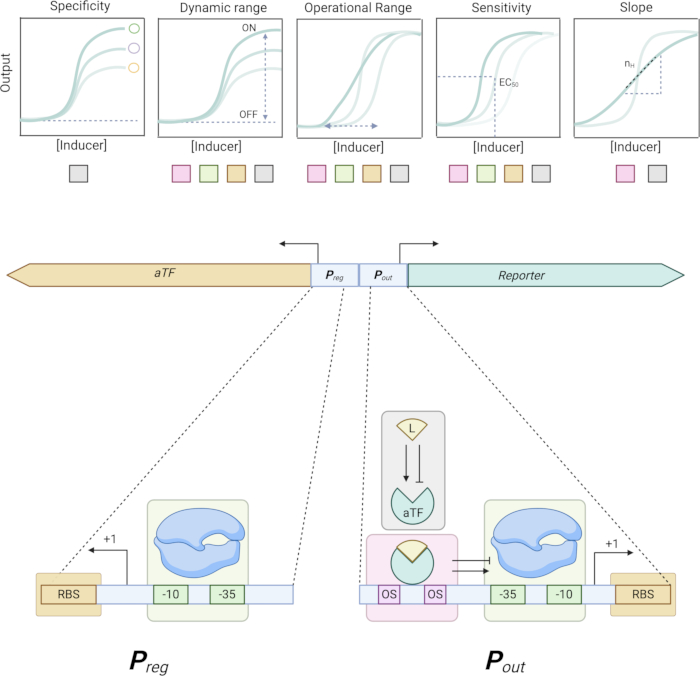
Figure 1:Tuning of genetically encoded biosensor parameters. Layout of genetic modules of a genetically encoded biosensor, including aTF, operator sites (OS), hexboxes (-35, -10), and RBS components. Colored boxes correspond to interactions that typically affect biosensor parameters such as: Ligand-aTF affinity (Grey), aTF-operator (Pink), RNAP-Hexbox (Green) and RBS (Orange). The effects of each parameter on dose-response characteristics are indicated within the representative graphs. Please click here to view a larger version of this figure.
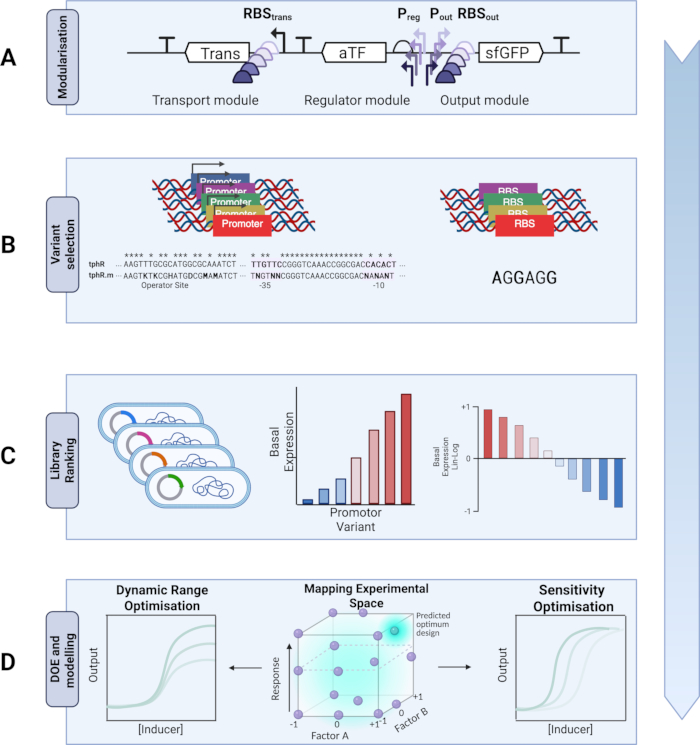
Figure 2: Overview of a typical DoE biosensor optimization workflow. (A) Overview of modularization of biosensor components showing a transport module encoding a transport protein to import the target effector, a regulator module pertaining to the aTF, and an output module which encodes for a reporter protein such as sfGFP. Also shown are nodes of regulation, such as RBStrans, Preg, Pout, and RBSout, which correspond to the genetic nodes that will be subjected to randomization in order to explore biosensor parameters. (B) A selection of sequence elements amenable to base randomization, including promoters and RBS'. The parental sequence of the promoter is shown on the top line, with the finalized mutant sequence shown below, stars indicate unchanged bases, whereas K, M, and N refer to Guanine/Thymine, Adenine/Cytosine, or any nucleotide, respectively. Promoters offer greater randomization potential through targeting hexboxes or operator sites and can also include duplication or modifying the spacing of sequences. RBS libraries offer more limited randomization options, however, they are significantly easier to screen owing to their smaller maximum diversity. (C) The expression levels of the variants are characterized and then converted to a ranked lin-log library to convert the categorical variant factors into 3 discrete levels that are more amenable to analysis via DoE. (D) Mapping of the experimental space is performed using multiplexed combinations of the three levels of each module to generate a model that can be used to inform design choices to tune biosensor performance towards desired outcomes, this could be towards dynamic range, or toward sensitivity. Please click here to view a larger version of this figure.
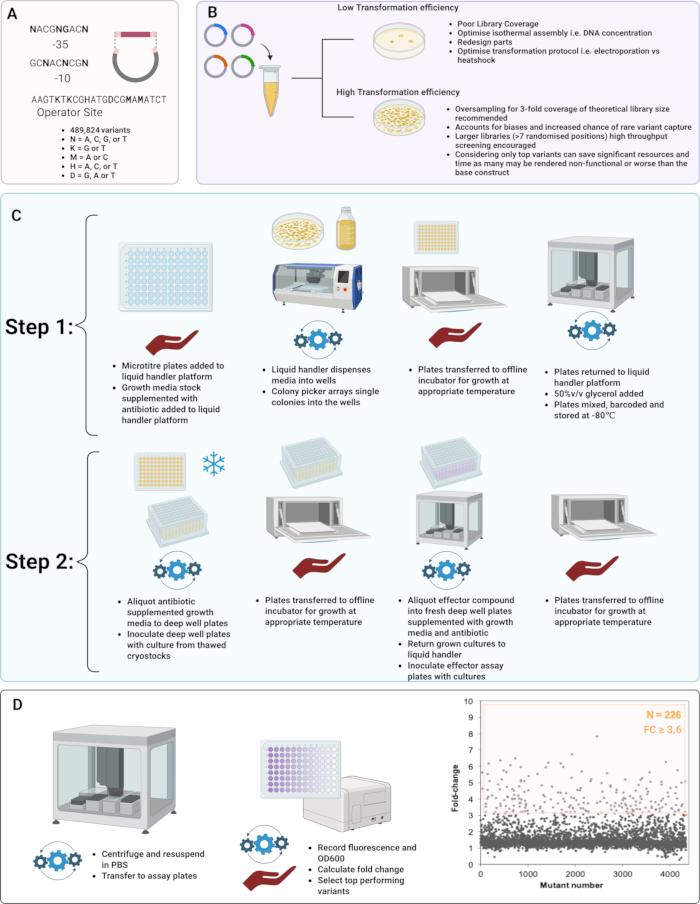
Figure 3: Biosensor modularization, promoter library construction, and automated workflow. (A) Example of randomization of specific sequences in the aTF promoter and insertion into the biosensor construct via isothermal assembly. Bolded letters indicate positions that were randomized in the operator site or hexboxes according to the provided key during degenerate oligonucleotide synthesis. (B) Panel describing the transformation of the resulting biosensor variant library into a cloning host such as E. coli, and next steps depending on transformant yield. Low transformation efficiency can result in poor theoretical library coverage and inadequate exploration of the design space. Troubleshooting at this stage is imperative to ensure a significant portion of variants is available for characterization, with common troubleshooting measures outlined. (C) Workflow of steps 1 and 2 as outlined in the protocol, with the red hand symbol indicating manual steps and the cog indicating automated steps. The step 1 workflow highlights key steps in the protocol from colony selection to cryo-stock generation. The step 2 workflow demonstrates revival and re-arraying of cryo-stocks for assaying by dose response curve. (D) The panel demonstrating the final procedure before screening, including washing of the cells and transfer to assay plates before measurement of fluorescence and OD. A screened variant pool of 5000 is shown in the panel, with the variants demonstrating ON/OFF in excess of the parental promoter sequence (3.6-fold) highlighted in the orange box. Many of the variants can be seen to cluster around 1, indicating poor performance and low variability, likely due to the randomization at the sequence level causing loss of function. The 226 variants shown boxed in the plot were taken forward for robust characterization. Data was adapted from the original publication by Alvarez Gonzalez et al23. Please click here to view a larger version of this figure.
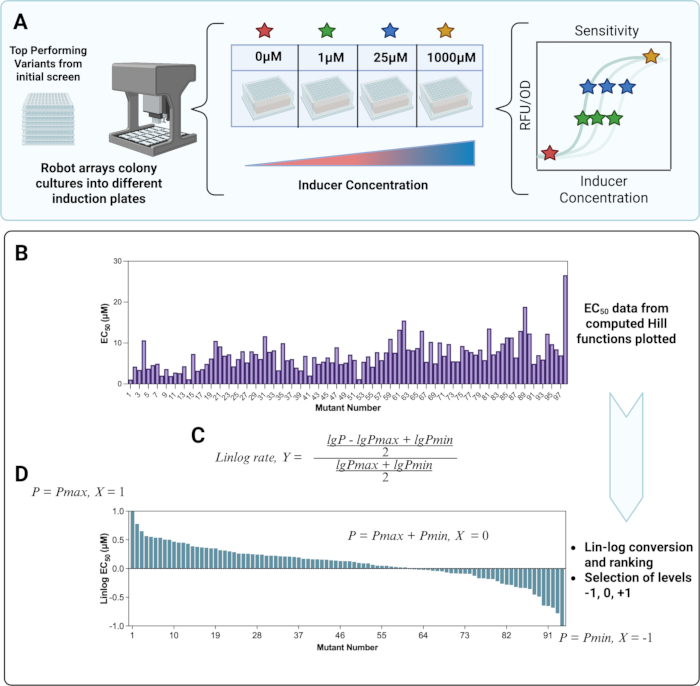
Figure 4: Promoter library top variant screening and discretization via lin-log transformation. (A) Outline of the standard procedure for generating expression data for an RBS or promoter library. Using the triaged variants that represent a good range of expression levels, liquid handlers are used to generate assay plates prefilled with predetermined concentration of effector from which to derive dose response curves of the triaged 226 variants. (B) After EC50 determination and further reduction of the characterized library to 100 variants, the data is plotted as a bar chart showing the mix of different sensitivities generated from the promoter randomization. (C)The EC50 data is transformed using the lin-log rate equation to convert the continuous data set into a categorical one more suited to factorization in a DSD. (D) The transformed EC50 variant data is shown now reduced to a simplified scale and ranked from high to low EC50 activity. From this, 3 levels corresponding to the top (+1) geometric mean (0) and bottom (-1) variants are selected and will be carried forward into the DSD to explore the experimental space. Please click here to view a larger version of this figure.
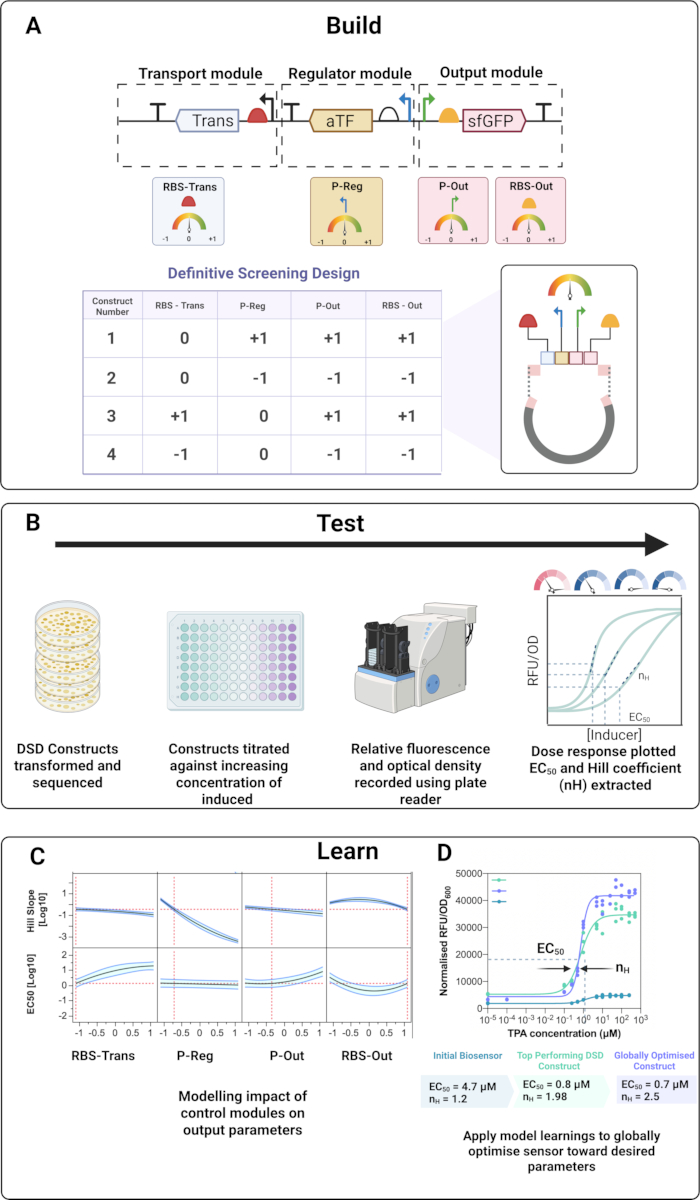
Figure 5: DSD experimental design, testing, and model-based learning outcomes. (A) Schematic workflow showing the generation of a DSD design table based on the lin-log transformed ranked libraries of the RBStrans, Preg, Pout,and RBSout modules. The DSD design table suggests the smallest number of combinations to efficiently map the experimental space. An example output is given wherein +1, 0, and -1 refer to top, middle, and bottom performing variants for each regulatory node as described by the lin-log transformations. These are constructed via isothermal assembly and confirmed by sequencing before being transformed into the expression host for characterization. (B) Following transformation, cells are grown up and assayed against a wide range of effector concentrations, and the fluorescent output is measured to generate dose-response curves. Various parameters, such as nH and EC50, are extracted from the dose-response curves and fed into the DSD to generate predictive models for each factor. (C) Using the models, predictions on the impact of modulating one biosensor parameter through changing the expression level of any regulatory module can be made. Importantly, global tuning of the regulatory nodes becomes possible, enabling maximization of one or more biosensor parameters simultaneously, indicated by the dashed red lines in each subplot. (D) Optimizing the model toward maximum sensitivity results in the globally optimized construct (lilac), the dose response curve of which is plotted against the top-performing DSD construct (green) and the parental biosensor construct (blue). Extracted nH and EC50 parameters are shown below the plot, demonstrating the improvement of both parameters above the top-performing DSD construct, validating the efficacy of the predictive models generated from the DSD. Data was adapted from the original publication by Alvarez Gonzalez et al23. Please click here to view a larger version of this figure.
Supplementary Figure 1: Automated liquid handling protocol steps used for biosensor library preparation and assay setup. Please click here to download this File.
Supplementary Figure 2 to Supplementary Figure 6: Step-by-step generation of a Definitive Screening Design (DSD). Please click here to download this File.
Discussion
Libraries of genetic elements encompassing broad genetic variability are crucial for the success of a DoE-based methodology. As demonstrated in Figure 2A, the number of theoretical variants increases with the number of positions to be targeted for mutagenesis as well as the degree of randomization, with this ever-increasing library size creating significant screening bottlenecks. Reducing the number of targeted positions or the degree of randomization can reduce the number of variants that need to be screened and is an attractive approach if a more targeted approach to tuning is required or if significant a priori knowledge of the system exists as a guide. In the case of systems like biosensors, however, which feature many overlapping features or may not have well-characterized genetic elements, it is difficult to circumvent the library size requirement. The usage of automated liquid handlers can trivialize the labor of picking colonies and culturing variants, specifically when increased data point collection is required for the plotting of more advanced functions like dose response curves vs two data point comparators, such as ON/OFF. Whilst it is difficult to specifically quantify time saved from including automated workflows, the major benefit of its implementation is in the time that can be devoted to other parallel experiments38.
Despite this, in many cases where library sizes exceed 104, even liquid handler-assisted methodologies become impractical39. In such cases, a preliminary screening of variants using flow cytometers is a highly attractive approach, with a much larger sorting capacity of up to 107 cells per h40. Using fluorescence-activated cell sorting (FACS) with two rounds of positive selection and at least one round of negative selection has been routinely employed in the triaging of the top-performing variants of biosensors before more extensive characterization16,26,42. The development and execution of such protocols utilizing FACS have been reviewed in detail elsewhere31. Initial triaging screens are possible using plate based liquid handler assays, as outlined in the above protocol; by comparing ON/OFF data using a single effector concentration as shown in Figure 3D, only variant biosensors with an appreciable gain of function (3.6-fold as provided in the methods) can be selected for further detailed characterization, streamlining library development and experimental run time. Both FACS and liquid handler platforms, however, come with significant capital investment for the lab and often require a level of technical expertise to operate and maintain. Agar plate-based screens provide a lower technical and financial barrier to entry, and have been used in combination with gfp or blue-white colony screening to select for RBS library variants as well as enzyme mutants based on the intensity of fluorescence43,44. These too, however, are limited in the number of variants that can be effectively screened, but also require a significant difference in fluorescence to be detectable44. As a compromise between fully combinatorial simultaneous mutation of multiple elements at once, a "divide and conquer" methodology instead aims to split large variant libraries into more manageable screening blocks41. Whilst a modularized approach may be pragmatic, it does not effectively explore the combinatorial design space, as the performance of biological components is known to be highly context dependent, especially in bacteria, where transcriptional and translational coupling is prevalent. This has the potential to result in design choices that target the local maxima instead of the global optima.
Transport and recognition of specific inducers represent another important feature of biosensor development that deserves mention, despite not being the main focus of the outlined protocol. A lack of an appropriate aTF for the target molecule represents a significant challenge for researchers. Rational selection of an existing aTF that binds a structural analog of the target effector can provide an ideal template on which to apply codon randomization in order to tune specificity of the aTF to the desired effector17. Alignment of the target sequence to solved structures or Alphafold predictions can enable identification of effector binding sites with suspected amino acid residues subjected to semi-rational randomization and ranking, adaptable to the protocol17. Similarly, selection and modulation of transporters responsible for the import/export of effectors can significantly alter biosensor dose-response characteristics. Transporter gene expression was found to be a significant player in biosensor response, with a diversified library of Ptac promoters and RBS controlling the expression of a MucK transporter used to stabilize its expression over multiple rounds of FACS, enhancing the robustness of biosensor response17. Similarly, screening of different transporter proteins themselves can modulate the specificity of biosensors, with screening of a putative set of PcaK transporters using a PCA-responsive biosensor leading to the identification of two transporters uniquely able to uptake 3,5-hydroxylated substrates, expanding the set of compounds detectable by that system24.
Automated platforms can become even more powerful tools for characterization and exploration when coupling DoE principles with deep learning models46,47. After first exploring the design space of a biosensor with a high-throughput platform, machine learning algorithms have been leveraged to predict the function of uncharacterized sequences with good accuracy 47. The methods outlined in this protocol could easily be applied in the testing of new language learning models for promoter design, akin to models that have been developed based on cross-RBS sequence prediction48. Furthermore, integration of such models can take advantage of sequence-function data contained within the non-functional promoter designs and provide critical insight into the broader functionality of the biosensor as a whole. Namely, this would have the potential to address a crucial limitation of the DoE workflow, that false positives, e.g., a non-functional promoter, do not necessarily equate to a measured output of zero, with phenomena such as spurious transcription or introducing an element of noise into DoE data, which is difficult to identify and control for. Crucially, in order to encompass the total experimental design space, any generated libraries must exhibit a broad range of activities, as an insufficient activity range will result in skewed design outputs and create unreliability in any statistical models generated from the dataset30. If low library variability becomes an issue, exploring other sequence elements or increasing the degree of randomization can be implemented, and the variation between the libraries can be compared until a suitable variant pool is attained.
A crucial aspect of the DoE process involves the correct estimation and selection of primary and secondary effects obtained from the DSD that will then be incorporated into statistical analysis. DoE, being a modelling-based approach, is highly prone to overfitting and bias, which can quickly complicate the optimization process through guiding iterative engineering efforts into suboptimal sections of the design space49. As such, it is critical to ensure that any designs are robustly insulated from such effects, both at the stage of conception and the analysis of data. At the initial screening design phase, centered runs where all factors are set to the geometric mean (i.e., 0,0,0,0) can help to reduce model bias by better accounting for non-linear interactions, whilst not adding significant experimental burden (1-3 additional runs)49. Additionally, including randomized designs can help to account for extraneous variables that are not included in the experimental design but could still influence the response variables that are being measured. In a biological context, randomization addresses issues like spatiotemporal effects, such as plate position, or batch-to-batch variation, preventing such effects from significantly affecting data interpretation. Attention to such details at this early stage can improve the robustness of models and lead to more reliable conclusions. After performing the DSD-suggested experiments, statistical analysis of the data is required to elucidate those factors that had a significant impact on output parameters. Half-normal plots offer an intuitive visual representation of effect magnitudes, with effects with no significance typically falling along a straight line, whereas effects with a significant impact will deviate from this line, enabling simple selection of the most important factors in biosensor optimization. With this in mind, a conservative approach to effect selection should be taken, as with all modelling, to reduce the risk of model over-fitting.
The ability to rapidly design and optimize biosensors and other genetic circuits will greatly accelerate the pace of research in the field of biotechnology, such as in strain and enzyme development, but also in real-time diagnostics. The emergence of DoE-based screening methodologies in this field is particularly promising, facilitating the efficient use of time and resources whilst exploring the maximum possible design space, and has already been used to great effect in the optimization of genetic circuits for metabolic pathways and for biosensors31,33,34,51. DoE is particularly well suited to multifactorial optimization problems in which many first, second or even third order interactions are at work which would be otherwise difficult to interrogate with the typical one factor at a time experimental design approach. Further, efforts to engineer one aspect of a biosensor often inadvertently result in the sacrifice of another parameter, such as improving sensitivity at the expense of dynamic range51. Through the ability of DoE to map such hidden interactions as well as create models that predict biosensor behavior, the build test learn cycle is greatly accelerated.
Disclosures
The authors declare no conflicts of interest.
Acknowledgements
GAG and PLR were supported by a BBSRC DTP grant (BB/M011208/1). MC was supported by a BBSRC Responsive mode grant (BB/P01738X/1). We would also like to thank The Henry Royce Institute for Advanced Materials (funded through EPSRC grants nos. EP/R00661X/1, EP/S019367/1, EP/P025021/1 and EP/P025498/1) for access to their facilities and the MBEC UKRI Engineering Biology Mission award (BB/Y00812X/1) for technical support and training.
Materials
| Name | Company | Catalog Number | Comments |
|---|---|---|---|
| 1000 µL CO-RE Tips, sterile non-filter | Hamilton | 235939 | |
| 2.2 mL 96 Deepwell Plate, Square Wells with V-Shaped Bottoms | Thermo | 11594754 | |
| 300 µL CO-RE Tips, stacked NTRs, sterile | Hamilton | 235985 | |
| 96 well clear bottom, black microtitre plates | Greiner | 655097 | |
| Agarose | Invitrogen | 16500100 | |
| Assembled Plasmid DNA | User Supplied | NA | |
| ClarioStar Plus Microplate reader | BMG | NA | |
| Dexynucloetide (dNTP) solution mix | NEB | N0447L | |
| Dimethyl Sulfoxide (DMSO) | Fisher BioReaggents | BP231-100 | |
| DNA Ladder 100bp | NEB | N3231L | |
| DNA Ladder 1KB | NEB | N3232L | |
| DNA Sequencing | Source Bioscience | NA | |
| DNA Synthesis | IDT | NA | |
| Escherichia coli DH5α Compotent Cells | NEB | C2987H | |
| Gel Loading Dye, Purple X6 No SDS | NEB | B7025S | |
| Gene pulser/Micropulser Electroporation Cuvettes, 0.2cm gap | Biorad | 1652082 | |
| Graph Pad Prism 10 | GraphPad | NA | |
| Hamilton Star Liquid Handler | Hamilton | NA | |
| HT multitron Plate Shaker Incubator | Infors HT | NA | |
| JMP Statistical Analysis Suite | JMP | NA | |
| LB Broth (Miller) | Miller | L3522 | |
| LB Broth (Miller) with agar | Sigma | L3147 | |
| MicroPulser Electroporator | Biorad | 1652100 | |
| NEBuilder HiFi DNA Assembly Master Mix | NEB | E2621S | |
| Q5 High fidelity DNA polymerase | NEB | M0491S | |
| QIAprep Spin Midiprep Kit | QIAGEN | 12143 | |
| QIAprep Spin Miniprep Kit | QIAGEN | 27104 | |
| QIAquick Gel Extraction Kit | QIAGEN | 28706X4 | |
| QIAquick PCR Purification Kit | QIAGEN | 28104 | |
| Qpix 420 Colony Picker | Molecular Devices UK | NA | |
| SOC Outgrowth Medium | NEB | B9020S | |
| SYBR Safe DNA Gel Stain | Invitrogen | S33102 | |
| TAE Buffer (Tris-acetate-EDTA, 50X) | Thermo Fisher | B49 | |
| UltraPureTM Dnase/Rnase-Free Distilled Water | Invitrogen | 10977015 |
References
- Yilmaz, A., Grotewold, E. Components and mechanisms of regulation of gene expression. Comput Biol Transcription Factor Binding. 23, 23-32 (2010).
- Ulrich, L. E., Koonin, E. V., Zhulin, I. B. One-component systems dominate signal transduction in prokaryotes. Trends Microbiol. 13 (2), 52-56 (2005).
- Nishikawa, K. K., et al. Highly multiplexed design of an allosteric transcription factor to sense new ligands. Nat Commun. 15 (1), 10001(2024).
- Hersey, A. N., Kay, V. E., Lee, S., Realff, M. J., Wilson, C. J. Engineering allosteric transcription factors guided by the LacI topology. Cell Syst. 14 (8), 645-655 (2023).
- Liu, D., Evans, T., Zhang, F. Applications and advances of metabolite biosensors for metabolic engineering. Metab Eng. 31, 35-43 (2015).
- De Paepe, B., Peters, G., Coussement, P., Maertens, J., De Mey, M. Tailor-made transcriptional biosensors for optimizing microbial cell factories. J Ind Microbiol Biotechnol. 44 (4), 623-645 (2017).
- Michener, J. K., Thodey, K., Liang, J. C., Smolke, C. D. Applications of genetically-encoded biosensors for the construction and control of biosynthetic pathways. Metab Eng. 14 (3), 212-222 (2012).
- Rogers, J. K., et al. Synthetic biosensors for precise gene control and real-time monitoring of metabolites. Nucleic Acids Res. 43 (15), 7648-7660 (2015).
- Brophy, J. A. N., Voigt, C. A. Principles of genetic circuit design. Nat Methods. 11 (5), 508-520 (2014).
- Rogers, J. K., Taylor, N. D., Church, G. M. Biosensor-based engineering of biosynthetic pathways. Curr Opin Biotechnol. 42, 84-91 (2016).
- Tellechea-Luzardo, J., Stiebritz, M. T., Carbonell, P. Transcription factor-based biosensors for screening and dynamic regulation. Front Bioeng Biotechnol. 11, 1118702(2023).
- Mannan, A. A., Liu, D., Zhang, F., Oyarzún, D. A. Fundamental design principles for transcription-factor-based metabolite biosensors. ACS Synth Biol. 6 (10), 1851-1859 (2017).
- Meyer, A. J., Segall-Shapiro, T. H., Glassey, E., Zhang, J., Voigt, C. A. Escherichia coli "Marionette" strains with 12 highly optimized small-molecule sensors. Nat Chem Biol. 15 (2), 196-204 (2019).
- Bintu, L., et al. Transcriptional regulation by the numbers: applications. Curr Opin Genet Dev. 15 (2), 125-135 (2005).
- D'Ambrosio, V., Jensen, M. K. Lighting up yeast cell factories by transcription factor-based biosensors. FEMS Yeast Res. 17 (7), fox076(2017).
- Machado, L. F. M., Currin, A., Dixon, N. Directed evolution of the PcaV allosteric transcription factor to generate a biosensor for aromatic aldehydes. J Biol Eng. 13 (1), 91(2019).
- Shin, S. M., Jha, R. K., Dale, T. Tackling the Catch-22 situation of optimizing a sensor and a transporter system in a whole-cell microbial biosensor design for an anthropogenic small molecule. ACS Synth Biol. 11 (12), 3996-4008 (2022).
- Snoek, T., et al. An orthogonal and pH-tunable sensor-selector for muconic acid biosynthesis in yeast. ACS Synth Biol. 7 (4), 995-1003 (2018).
- Jensen, E. D., et al. Integrating continuous hypermutation with high-throughput screening for optimization of cis,cis-muconic acid production in yeast. Microb Biotechnol. 14 (6), 2617-2626 (2021).
- Javanpour, A. A., Liu, C. C. Evolving small-molecule biosensors with improved performance and reprogrammed ligand preference using OrthoRep. ACS Synth Biol. 10 (10), 2705-2714 (2021).
- Xi, C., Ma, Y., Amrofell, M. B., Moon, T. S. Manipulating the molecular specificity of transcriptional biosensors for tryptophan metabolites and analogs. Cell Rep Phys Sci. 5 (10), 102211(2024).
- Chaisupa, P., Wright, R. C. State-of-the-art in engineering small molecule biosensors and their applications in metabolic engineering. SLAS Technol. 29 (2), 100113(2024).
- Alvarez Gonzalez, G., Chacón, M., Butterfield, T., Dixon, N. Tuning the performance of a TphR-based terephthalate biosensor with a design of experiments approach. Metab Eng Commun. 19, e00250(2024).
- Roy, P. L., Chacón, M., Dixon, N. Genetically encoded biosensor enabled mining, characterisation and engineering of aromatic acid MFS transporters. J Biol Eng. , (2025).
- Bentley, G. J., et al. Engineering glucose metabolism for enhanced muconic acid production in Pseudomonas putida KT2440. Metab Eng. 59, 64-75 (2020).
- Khoshbin, Z., Housaindokht, M. R., Izadyar, M., Bozorgmehr, M. R., Verdian, A. Recent advances in computational methods for biosensor design. Biotechnol Bioeng. 118 (2), 555-578 (2021).
- Vongsouthi, V., et al. A rationally and computationally designed fluorescent biosensor for d-serine. ACS Sens. 6 (11), 4193-4205 (2021).
- Szymanski, E., Calvert, J. Designing with living systems in the synthetic yeast project. Nat Commun. 9 (1), 2950(2018).
- Szymanski, E. A., Henriksen, J. Reconfiguring the challenge of biological complexity as a resource for biodesign. mSphere. 7 (6), e00547(2022).
- Berepiki, A., Kent, R., Machado, L. F. M., Dixon, N. Development of high-performance whole cell biosensors aided by statistical modeling. ACS Synth Biol. 9 (3), 576-589 (2020).
- Huttanus, H. M., et al. Targeted mutagenesis and high-throughput screening of diversified gene and promoter libraries for isolating gain-of-function mutations. Front Bioeng Biotechnol. 11, (2023).
- Zhou, H., Vonk, B., Roubos, J. A., Bovenberg, R. A., Voigt, C. A. Algorithmic co-optimization of genetic constructs and growth conditions: application to 6-ACA, a potential nylon-6 precursor. Nucleic Acids Res. 43 (21), 10560(2015).
- Xu, P., Rizzoni, E. A., Sul, S. Y., Stephanopoulos, G. Improving metabolic pathway efficiency by statistical model-based multivariate regulatory metabolic engineering. ACS Synth. Biol. 6 (1), 148-158 (2017).
- Zobel, S., et al. Tn7-based device for calibrated heterologous gene expression in Pseudomonas putida. ACS Synth Biol. 4 (12), 1341-1351 (2015).
- Elmore, J. R., Furches, A., Wolff, G. N., Gorday, K., Guss, A. M. Development of a high efficiency integration system and promoter library for rapid modification of Pseudomonas putida KT2440. Metab Eng Commun. 5, 1-8 (2017).
- Gibson, D. G. Enzymatic assembly of overlapping DNA fragments. Methods Enzymol. 498, 349-361 (2011).
- Gibson, D. G., et al. Enzymatic assembly of DNA molecules up to several hundred kilobases. Nat Methods. 6 (5), 343-345 (2009).
- Kaber, D. B., et al. Human-automation interaction strategies and models for life science applications. Hum Factors Ergon Manuf Serv Ind. 19 (6), 601-621 (2009).
- Aharoni, A., Griffiths, A. D., Tawfik, D. S. High-throughput screens and selections of enzyme-encoding genes. Curr Opin Chem Biol. 9 (2), 210-216 (2005).
- Georgiou, G. Analysis of large libraries of protein mutants using flow cytometry. Adv Protein Chem. 55, 293-315 (2001).
- Pardo, I., et al. Gene amplification, laboratory evolution, and biosensor screening reveal MucK as a terephthalic acid transporter in Acinetobacter baylyi ADP1. Metab Eng. 62, 260-274 (2020).
- Qian, S., Li, Y., Cirino, P. C. Biosensor-guided improvements in salicylate production by recombinant Escherichia coli. Microb Cell Fact. 18 (1), 18(2019).
- Tang, S. Y., et al. Screening for enhanced triacetic acid lactone production by recombinant Escherichia coli expressing a designed triacetic acid lactone reporter. J Am Chem Soc. 135 (27), 10099-10103 (2013).
- Kaczmarek, J. A., Prather, K. L. J. Effective use of biosensors for high-throughput library screening for metabolite production. J Ind Microbiol Biotechnol. 48 (9-10), kuab049(2021).
- Vaishnav, E. D., et al. The evolution, evolvability, and engineering of gene regulatory DNA. Nature. 603 (7901), 455-463 (2022).
- Kotopka, B. J., Smolke, C. D. Model-driven generation of artificial yeast promoters. Nat Commun. 11, 2113(2020).
- Zhou, Y., et al. Encoding genetic circuits with DNA barcodes paves the way for machine learning-assisted metabolite biosensor response curve profiling in yeast. ACS Synth Biol. 11 (2), 977-989 (2022).
- Ding, N., Yuan, Z., Zhang, X., Chen, J., Zhou, S., Deng, Y. Programmable cross-ribosome-binding sites to fine-tune the dynamic range of transcription factor-based biosensor. Nucleic Acids Res. 48 (18), 10602-10613 (2020).
- Moon, S., Saboe, A., Smanski, M. J. Using design of experiments to guide genetic optimization of engineered metabolic pathways. J Ind Microbiol Biotechnol. 51, kuae010(2024).
- Carbonell, P., et al. An automated design-build-test-learn pipeline for enhanced microbial production of fine chemicals. Commun Biol. 1, 66(2018).
- Dierkes, R. F., et al. An ultra-sensitive Comamonas thiooxidans biosensor for the rapid detection of enzymatic polyethylene terephthalate (PET) degradation. Appl Environ Microbiol. 89 (1), e0160322(2023).
Reprints and Permissions
