Circulating tumor cells (CTCs) are critical for the study of cancer progression and metastasis. This article presents a high-throughput, integrated protocol for CTC enrichment and single-CTC sequencing, improving capture efficiency and CTC purity while reducing contamination and sequencing costs, thereby advancing precision oncology research and clinical applications.
Method Article
Microfluidics-based High-throughput Circulating Tumor Cell Sorting and Single-cell Sequencing Technology
* These authors contributed equally
In This Article
Summary
Abstract
Circulating tumor cells (CTCs) serve as a promising biomarker for tracking cancer metastasis, progression, and recurrence. Liquid biopsy techniques centered on CTC detection have demonstrated considerable potential due to their non-invasive nature and ability to provide real-time monitoring of tumor dynamics. However, conventional bulk CTC analyses fail to capture the intrinsic heterogeneity among CTC populations, obscuring crucial insights into tumor biology. Single-cell RNA sequencing (scRNA-seq) enables high-resolution characterization of CTC heterogeneity, offering new opportunities for precision oncology and mechanistic studies of tumor progression. Despite these advantages, the existing methodologies for single-CTC sequencing tend to suffer from inefficiencies, including low recovery rates, labor-intensive workflows, and contamination risks associated with multiple manual handling steps. To address these limitations, we present an integrated microfluidic protocol that consolidates CTC enrichment, purification, and single-cell sequencing into a unified workflow. The method employs dynamically controlled magnetic capture within a herringbone-structured chip, where vortex mixing and cumulative immunomagnetic bead binding enable robust, high-throughput CTC isolation with minimal cell damage. Subsequent purification using a leukocyte antibody-coated microfluidic chip effectively removes the non-target cells, further enhancing CTC purity through negative selection. Finally, a high-precision single-cell sequencing chip, designed based on differential flow resistance principles, facilitates efficient single-cell capture and pairing with uniquely barcoded microbeads. This novel platform overcomes the limitations of Poisson distribution-based methods, improving CTC utilization while minimizing microbead consumption and sequencing costs. Our integrated protocol significantly enhances CTC capture efficiency, purity, and single-cell sequencing throughput, making it well-suited for clinical applications and large-scale cancer research. By enabling a more precise and scalable analysis of CTC heterogeneity, this method has the potential to refine early cancer diagnosis, treatment monitoring, and mechanistic studies of metastasis, ultimately advancing the field of precision oncology.
Introduction
Tumor metastasis is a complex and multi-phase process beginning with dissemination and then undergoing dormancy and colonization by tumor cells within the primary tumor. These cells progressively invade through the basement membrane into deeper tissues, and subsequently intravasate into blood vessels or lymphatics. Once in the circulation, these cells become circulating tumor cells (CTCs), which can travel to distant organs1. The emergence of CTCs is a critical step in the metastatic cascade, as they serve as the seeds for distant metastasis1. In recent years, CTC-based liquid biopsy technology has garnered considerable attention due to its merits, including the non-invasive and convenient nature of the procedure, as well as the capability for real-time dynamic monitoring. This technology facilitates precise, real-time, and comprehensive assessment of tumor biology, offering unique advantages in monitoring treatment efficacy, predicting recurrence, and guiding therapy2,3,4. Furthermore, studies have shown that CTCs are present in peripheral blood even during low tumor burden stages, such as early cancer, early metastasis, or recurrence5,6. Consequently, CTC liquid biopsy overcomes the limitations of traditional tissue biopsies, which are confined to imaging-detectable solid tumors7. It provides a novel perspective and technological support for early cancer diagnosis, recurrence and metastasis monitoring, treatment guidance, as well as elucidating the mechanisms of tumor initiation, progression, and metastasis. For instance, the number of CTCs in peripheral blood has been shown to serve as an independent predictorof both progression-free survival and overall survival in cancer patients, with higher CTC counts indicating poorer prognosis8. Dynamic changes in CTC numbers are also closely associated with disease progression and tumor burden following treatment9,10.
Recent studies have highlighted microfluidic-based technologies as transformative tools for the isolation of CTCs. These technologies can be broadly categorized into physical-based and biological-based approaches, each offering distinct advantages while facing specific challenges. Physical-based methods rely on differences in size and deformability to separate CTCs, enabling label-free sorting with high throughput. However, this non-specific separation strategy may compromise both capture efficiency and purity due to the inherent heterogeneity of CTCs. For example, Lu et al. reported a microfluidic chip that integrated a focus-separation and speed-reduction design with trap arrays, which outperformed most conventional physical-based techniques in terms of CTC enrichment and purification11. Nevertheless, the chip achieved only a 3-4 log depletion of white blood cells (WBCs), which remains insufficient for clinical applications. On the other hand, immunoaffinity-based CTC isolation strategies typically offer higher target cell recovery rate and purity. However, the binding interaction between capture molecules and CTCs often limits the throughput of such approaches12,13. Accordingly, an isolation method that balances both high enrichment efficiency and throughput is essential for effectively processing clinical samples with rare CTC populations.
Moreover, the substantial heterogeneity among CTCs poses a significant challenge for downstream analyses10,14,15, as conventional bulk CTC analyses frequently obscure individual cellular distinctions. Single-cell RNA sequencing (scRNA-seq) facilitates comprehensive molecular-level characterization of CTC gene expression heterogeneity, providing insights into the classification, state, and function of CTCs. This technology offers novel approaches for precision oncology and facilitates research into tumor initiation, progression, and metastasis mechanisms16. For instance, Fan et al. constructed a single-CTC transcriptomic atlas from various vascular sites in hepatocellular carcinoma patients, revealing spatial heterogeneity among CTCs and identifying key mediators of immune evasion17. Concurrently, Miyamoto et al. identified androgen receptor gene mutations and splice variants in CTCs of prostate cancer patients, thereby elucidating the mechanisms underlying drug resistance18.
However, the development of single-CTC transcriptomic sequencing has been progressing slowly. Existing methodologies suffer from deficiencies in automation and integration, resulting in low CTC recovery efficiency, complex procedures, and low experimental success rates19.For example, current protocols require a sequential process involving CTC enrichment, purification, single-cell isolation, and nucleic acid amplification.These steps are performed in separate centrifuge tubes, necessitating multiple pipetting and transfer steps. The labor-intensive procedures not only reduce efficiency but also increase the risk of CTC loss and contamination20. Conventional approaches, such as capillary-based cell picking, further limit the throughput and analytical efficiency during single-cell isolation21. Moreover, traditional methods are also constrained by the Poisson distribution, which is a statistical phenomenon describing the random encapsulation of cells. This results in a high proportion of empty droplets or multiple cells per droplet, thereby limiting capture efficiency. To address these challenges, researchers have developed integrated microfluidic chips for single-cell CTC transcriptomic analysis. These platforms consolidate multiple steps into a single-chip workflow, reducing contamination risks and improving analytical efficiency.For example, Euisik Yoon et al. developed the Hydro-Seq method, which employs fluid dynamics-based size selection to isolate CTCs into microchambers and efficiently pair individual CTCs with uniquely barcoded microbeads22. This approach enables high-throughput, parallel single-cell analysis of multiple CTCs.However, this method relies on size-based CTC separation, which often results in low CTC purity and limited throughput (10 µL/min), rendering it unsuitable for processing large-volume clinical samples.Therefore, there is an urgent need for the development of an integrated, high-throughput, low-volume, and contamination-resistant single-cell CTC analysis system.
Here, we describe a high-throughput and efficient protocol for CTC enrichment and single-cell sequencing, comprising three main components: CTC sorting, purification, and a single-cell sequencing chip (Figure 1). The CTC sorting microfluidic chip is designed based on the principle of dynamically regulated magnetic capture forces (Figure 2A). It enables high-throughput CTC enrichment through vortex mixing within the herringbone structure, as well as the cumulative capture by immunomagnetic beads. The non-destructive release of CTCs is subsequently achieved through precise modulation of the magnetic field. A purification chip is then employed, where leukocyte antibody-coated microchannels are used for negative selection, yielding highly purified CTCs (Figure 2B). Finally, a high-efficiency single-cell manipulation platform based on differential flow resistance was employed, successfully overcoming the limitations of Poisson distribution and enabling efficient single-cell/encoded microsphere pairing and capture (Figure 3A). It significantly enhances the utilization of CTC while reducing microbead consumption and sequencing costs.
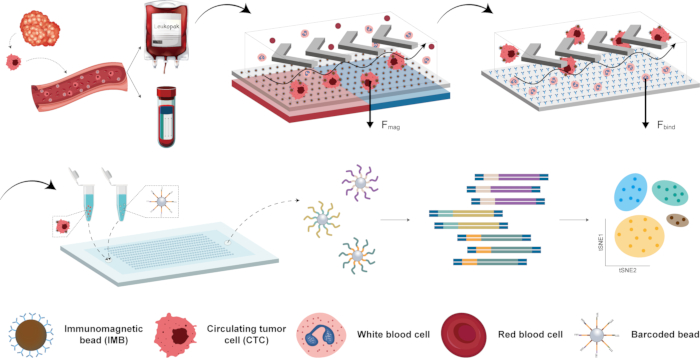
Figure 1: Schematic of the microfluidics-based CTC sorting and single-cell sequencing technology. This workflow illustrates the process by which tumor cells detach from the tumor lesions, enter the bloodstream, and form CTCs. Peripheral blood or leukopak samples containing CTCs are sequentially processed through the CTC capture, purification, and scRNA-seq chips, ultimately enabling transcriptomic sequencing and bioinformatics analysis of the CTCs. Please click here to view a larger version of this figure.
Protocol
1. Method 1: Microfluidic-based CTC isolation
- Herringbone-chip (HB-chip) fabrication
- Master mold preparation
- Prepare a clean silicon wafer and bake it at 135 °C overnight to remove moisture. After cooling to room temperature, treat the wafer using an oxygen plasma cleaner at 150 W for 1 min to activate the surface.
- Pattern the first layer of the chip to form a support pillar array (28 columns × 7 rows, numbered from #1 to #28 along the flow direction) using SU-8 photoresist. Set the spin coater to run sequentially at 500 rpm for 10 s, 2350 rpm for 55 s, and 500 rpm for 10 s. Ensure the height of this layer is 50 µm.
- Soft bake the first layer at 65 °C for 1 min, followed by 95 °C for 20 min to evaporate the solvent. Cool to room temperature.
- Expose the first layer using a photomask with the corresponding support pillar design. Set the exposure dose to 130 mJ/cm2.
- Perform post-exposure bake at 65 °C for 1 min, followed by 95 °C for 6 min.
- After cooling, dispense SU-8 developer onto the wafer surface to remove uncrosslinked photoresist and obtain the bottom layer. Allow it to puddle for 30 s, then rinse with deionized water.
- Spin-coat the second SU-8 layer on top of the first layer using the same spin parameters as in step 1.1.1.2. Pattern the second layer to form herringbone structures at a 45° angle to the channel wall, with a groove width of 100 µm, a pitch of 200 µm, and six ridges per cycle. Ensure the height of this layer is also 50 µm.
NOTE: A schematic diagram illustrating all relevant dimensions of the microstructure features (including the support pillar array and herringbone grooves) has been provided in Supplementary Figure 1. - Soft bake the first layer at 65 °C for 1 min, followed by 95 °C for 20 min to evaporate the solvent. Cool to room temperature.
- Expose the second layer using a photomask with the herringbone design. Set the exposure dose to 130 mJ/cm2.
- Perform post-exposure bake at 65 °C for 1 min, followed by 95 °C for 6 min.
- After cooling, use SU-8 developer to remove uncrosslinked regions and reveal the complete two-layer microstructure.
- PDMS replica preparation
- Formulate the PDMS mixture by combining the prepolymer and crosslinker at a weight ratio of 10:1. Prepare 10-15 mL of the mixture for a single chip.
- Pour the mixture into the master mold and eliminate trapped air by degassing. Cure the PDMS by placing the mold in an oven at 95 °C for 30 min.
- Remove the cured PDMS replica from the mold. Create one inlet and one outlet using a 1 mm-diameter PDMS puncher.
- HB-chip assembly
- Set the oxygen plasma cleaner to a power of 150 W for 3 min. Activate the surfaces by treating both the PDMS replica and the pre-bonded PDMS layer on a clean glass slide.
NOTE: Due to the abundance of Si-O bonds in PDMS polymer chains, plasma activation enables covalent bonding between PDMS and substrates such as glass, silicon, thereby facilitating chip sealing. - Align the treated PDMS structures and bond them together firmly. Confirm that the support pillar array and herringbone features are completely integrated with the glass substrate to finalize the HB-chip.
- Set the oxygen plasma cleaner to a power of 150 W for 3 min. Activate the surfaces by treating both the PDMS replica and the pre-bonded PDMS layer on a clean glass slide.
- Master mold preparation
- Preparation of immunomagnetic beads (IMBs)
- Incubate 25 µL of washed and resuspended streptavidin-modified magnetic beads (SA-MBs) (1 µm) (≈4 × 10⁸ beads per mL) with 1 µg of biotinylated EpCAM (Epithelial Cell Adhesion Molecule) antibody at room temperature with rotation at 20 rpm for 40 min to prepare the IMBs.
- After magnetic separation on a magnetic rack, remove the supernatant and resuspend the beads in 25 µL of Isolation Buffer (1% BSA, 2 mM EDTA, D-PBS).
- Isolation chip operation
- Pipette 20 µL of the magnetic bead suspension within 1-2 s, ensuring no air bubbles are introduced.
- Immediately place the chip vertically on a magnet and allow the beads to settle for 5 min without disturbance.
- Collect the blood sample (peripheral blood or experimental leukopak samples) and immediately draw 4 mL into a syringe, ensuring air bubbles are removed. Seal the chip's inlet and outlet with liquid to eliminate air bubbles. Insert the sample inlet and outlet tubes into the chip.
NOTE: Ensure that basic personal protective measures are in place when handling biological samples. - Inject the sample by syringe pump with a flow rate of 1.5 mL/h.
- After sample loading, inject 60 µL of D-PBS into the HB-chip at a flow rate of 0.2 mL/h to wash off the unbound cells.
- Remove the magnet and manually inject 1.5 mL of BSA (5% w/v in D-PBS) to wash the chip and release the captured tumor cells from the HB-chip.
2. Method 2: Microfluidic-based CTC purification
- HB-chip modification
- Prepare a (3-Mercaptopropyl) trimethoxysilane (MPTS) solution in ethanol with a volume fraction (v/v) of 10%. Immediately introduce 20 µL of MPTS solution to the HB-chip and incubate at room temperature for 1 h.
- Rinse once with anhydrous ethanol and dry at 100 °C for 1 h.
- Prepare a N-γ-maleimidobutyryl-oxysuccinimide ester (GMBS) solution in ethanol at a concentration of 0.5 mg/mL. Cool the chip to 37 °C, introduce the GMBS solution, and incubate at room temperature for 30 min.
NOTE: When using MPTS and GMBS, always wear gloves, a lab coat, and a mask. These reagents possess toxic and mucosal irritant properties and should be handled with care in a well-ventilated area. - Rinse two times with ddH2O, followed by two rinses with D-PBS.
- Immediately add 15 μg/mL streptavidin (SA), incubate at room temperature for 1 h or overnight at 4 °C.
- Rinse two times with D-PBS.
- Prepare the CD45 antibody buffer: 0.2% (w/v) BSA and 20 μg/mL biotinylated CD45 antibody, diluted to volume with D-PBS.
- Inject 20 μL of the CD45 antibody buffer into the HB-chip for negative selection of white blood cells. Incubate at room temperature for 1 h, then rinse with D-PBS.
- Add a blocking solution containing 3% (w/v) BSA and 0.05% (w/v) Tween-20, incubate at room temperature for 1 h. Rinse with D-PBS before sample loading.
- Sample loading
- Aspirate the sample using a syringe, ensuring air bubbles are removed. Seal the chip's inlet and outlet with liquid to eliminate air bubbles. Insert the sample inlet and outlet tubes into the chip.
- Inject the sample by syringe pump and set the flow rate to 0.6 mL/h.
- Collect the purified tumor cells from the outlet for counting and single-cell sequencing.
3. Method 3: Microwell-based single-cell barcoding and sequencing technology
- Preparation of reagents and materials
- Chip pre-treatment
- Add 200 µL of 1x D-PBS and 0.5% F-68 solution to the chip inlet.
- Perform water bath sonication while holding the chip. When bubbles are visible across the entire microporous region, continue sonication for 30 s to remove bubbles from the dual wells.
- Barcoded beads preparation
- Thoroughly mix the stock solution of barcoded magnetic beads and transfer 200 µL into a centrifuge tube. Apply magnetic separation until the solution clarifies, and discard the supernatant.
- Wash the barcoded beads twice with 500 µL of TE-TW (10 mM Tris-HCl pH = 8.0, 1 mM EDTA, 0.01% Tween-20).
- Wash and resuspend the barcoded beads in 200 µL of 20x TE (10 mM Tris-HCl pH = 7.5, 1 mM EDTA) and 50 mM DTT solution, then place on ice.
- Preparation of single-cell suspension
- Transfer the purified tumor cells to a 1.5 mL centrifuge tube and centrifuge at 400 × g for 3 min at room temperature. Wash and resuspend the pellet in 1 mL of 1x D-PBS.
- Perform cell counting and prepare the single-cell suspension accordingly. The sample loading volume should be 200 µL, with a total of 80,000 cells (400 cells/µL).
- Prepare the cell lysis buffer, which includes 1x Saline Sodium Citrate (SSC), 0.5 M LiCl, 0.6% Triton X-100, 10 mM EDTA, 5 mM DTT, and 1 U/µL RNase inhibitor.
- Chip pre-treatment
- Microfluidic chip operation
- Cell Capture
- Inject 200 µL of the tumor cell suspension into the chip (60000 dual wells), then shake at 10 rpm on a decolorizing shaker for 5 min to allow cells to settle into the capture wells by gravity.
- Gently pipette the cell suspension in the chip up and down twice. Then, place the chip on a decolorizing shaker at 10 rpm for 5 min to resuspend the uncaptured cells and allow them to settle again.
- Add 200 µL of 1x D-PBS and 0.5% F-68 solution through the inlet and aspirate the solution from the outlet. Repeat twice for a total of three washes of the chip.
- Barcoded bead capture
- Resuspend the barcoded bead suspension, then immediately inject 200 µL of the suspension into the chip through the inlet. Shake at 10 rpm for 20 s.
- Gently pipette the bead suspension twice, then shake at 10 rpm for 20 s. Repeat this step once.
- Withdraw the barcoded bead suspension from the outlet, add 200 µL of 20x TE (pH = 7.5) and 50 mM DTT solution, then withdraw the liquid from the outlet. Repeat this step twice, for a total of three washes.
- Cell lysis and mRNA capture
- Slowly add 200 µL of the cell lysis buffer to the chip through the inlet. Immediately after, slowly add 200 µL of mineral oil to seal the dual wells.
NOTE: Sealing must occur immediately to prevent contamination. - Remove the solution flowing out of the chip outlet into the waste reservoir. Place the chip horizontally and let it stand at room temperature for 5 min.
- Slowly add 200 µL of the cell lysis buffer to the chip through the inlet. Immediately after, slowly add 200 µL of mineral oil to seal the dual wells.
- Barcoded beads recovery
- After lysis, slowly add 200 µL of 6x SSC through the inlet, remove the waste liquid, and aspirate the remaining solution from the chip outlet.
- Slowly add 200 µL of 6x SSC to fill the chip. Hold a magnet close to the chip’s surface and slowly move it from the inlet to the outlet to gather barcoded beads from the capture wells. Then, quickly aspirate the solution as well as barcoded beads from the chip into a centrifuge tube preloaded with 6x SSC.
- Wash three times with 200 µL of 6x SSC, followed by once with 1x RT buffer (see Table of Materials).
- Cell Capture
- Reverse transcription (RT), exonuclease I treatment, and PCR
- RT
- Resuspend the barcoded beads in 100 µL of reverse transcription reaction mix, containing 1× RT buffer, 1 mM GTP, 1 mM dNTP, 5% PEG 8000, 2.5 µM Template Switch Oligo (see Table of Materials), 1 U/µL RNase Inhibitor, and 10 U/µL reverse transcriptase. Incubate the solution at 42 °C for 120 min.
- Exonuclease treatment
- After reverse transcription, wash the beads once with 200 µL of 1x TE-SDS (10 mM Tris-HCl pH = 8.0, 1 mM EDTA, 0.5% SDS), once with 200 µL of 1x TE-TW, and once with 200 µL of 10 mM Tris-HCl (pH = 8.0).
- Resuspend the beads in 100 µL of exonuclease mix, containing 1x Exonuclease I Buffer and 1 U/µL Exonuclease I, and incubate at 37 °C for 45 min.
- Second-strand synthesis
- Wash the beads once with 200 µL of 1x TE-SDS. Resuspend the beads in 200 µL of 0.1 M NaOH and incubate for 5 min at room temperature with rotation at 30 rpm to denature the mRNA-cDNA hybrid product. Then wash the beads once with 200 µL of 1x TE-TW and once with 200 µL of 10 mM Tris-HCl (pH = 8.0).
- Resuspend the beads in 100 µL of the reaction mix, containing 1x RT buffer, 1 mM dNTP, 5% PEG 8000, 0.5 µM second strand synthesis primer (see Table of Materials), and 0.125 U/μL of Klenow Fragment. Incubate the solution at 37 °C for 60 min.
- cDNA amplification
- Wash the beads once with 200 µL of 1x TE-SDS, once with 200 µL of 1x TE-TW, and once with 200 µL of 10 mM Tris-HCl (pH = 8.0).
- Resuspend the beads in 150 μL of PCR mix including 1x PCR Reaction Mix and 0.8 μM of ISPCR oligo (see Table of Materials). Set the PCR program as follows: 95 °C for 3 min; four cycles of 98 °C for 20 s, 65 °C for 30 s, and 72 °C for 3 min; eight cycles of 98 °C for 20 s, 67 °C for 20 s, and 72 °C for 3 min; 72 °C for 5 min.
- Purify the PCR product twice with 0.6x Solid Phase Reversible Immobilization (SPRI) magnetic beads for DNA purification according to the manufacturer’s instructions and elute in 20.5 µL of H2O. Measure the concentration of the purified PCR product using a fluorescence-based DNA quantification assay.
- Perform a second amplification of the purified PCR product using a PCR mix containing 1x PCR reaction mix and 0.8 μM of ISPCR oligo (see Table of Materials). Set the PCR program as follows: 98 °C for 3 min; five cycles of 98 °C for 20 s, 67 °C for 20 s, and 72 °C for 3 min; 72 °C for 5 min.
- Purify the PCR product twice with 0.6x SPRI magnetic beads for DNA purification according to the manufacturer’s instructions and elute in 20.5 µL of H2O. Measure the concentration of the purified PCR product using a fluorescence-based DNA quantification assay23.
- cDNA library construction
- Construct the library with a standard DNA library preparation kit (see Table of Materials) according to the manufacturer’s instructions.
- Amplify the library by PCR using primer pair N70X / P5 (see Supplementary Table). Set the PCR program as follows: 72 °C for 3 min; 98 °C for 30 s; twelve cycles of 98 °C for 15 s, 58 °C for 30 s, and 72 °C for 3 min; 72 °C for 5 min.
- Purify the library with 0.6x SPRI magnetic beads for DNA purification according to the manufacturer’s instructions and elute in 20 µL of H2O. Measure the concentration of the purified PCR product using a fluorescence-based DNA quantification assay.
NOTE: Generally, a final DNA library concentration of ≥ 2 ng/μL and a total amount of ≥ 50 ng is considered acceptable24.
- RT
Results
The assembly and release of the CTC-capturing interface can be evaluated by microscopy. A uniform distribution of the magnetic beads (MBs) at the bottom of the HB chip under a magnetic field indicates successful assembly, while minimal or no residual MBs confirm successful release (Figure 2C). This step is critical for determining the yield and purity of captured CTCs. To validate the capture efficiency of the CTC isolation chip, we performed a spike-in experiment. A small number of tumor cells with high EpCAM expression (PC3 or LNCaP) were spiked into PBS containing a large population of Jurkat cells, which exhibit low EpCAM expression, simulating the presence of abundant blood cells in circulation. The CTC isolation chip efficiently captured tumor cells from both 1 mL and 10 mL samples, demonstrating its high-throughput and efficient CTC sorting capability (Figure 2D). To assess the specificity of IMB-based capture, we used a control chip modified with SA-MBs lacking EpCAM antibody conjugation. The absence of significant tumor cell capture confirmed the specificity of IMB-mediated CTC isolation (Figure 2D).
In addition to capture efficiency, purity is another critical parameter for evaluating CTC isolation platforms. We compared the purity of tumor cells isolated using either the capture chip or the purification chip alone, as well as the purity achieved through sequential positive and negative selection (Figure 2E). Both chips significantly improved tumor cell purity compared to the control group, demonstrating their effectiveness in isolating CTCs. More importantly, the combined use of both positive and negative selection further enhanced the purity and yield of tumor cells compared to using a single method.
To further evaluate the performance of the CTC capture and sorting chips in clinical settings, we collected peripheral blood (PB) samples from six healthy donors and conducted spiking experiments. Given the extremely low abundance of CTCs in clinical samples, approximately 500-1000 LNCaP cells were spiked into each 10 mL of PB sample. The WBC counts in all collected PB samples were within the normal range (4-10 × 106 cells/mL). The results demonstrated that the CTC sorting system maintained high capture efficiency and purity of tumor cells, even when processing clinical samples (Figure 2F-G, and Supplementary Figure 2).
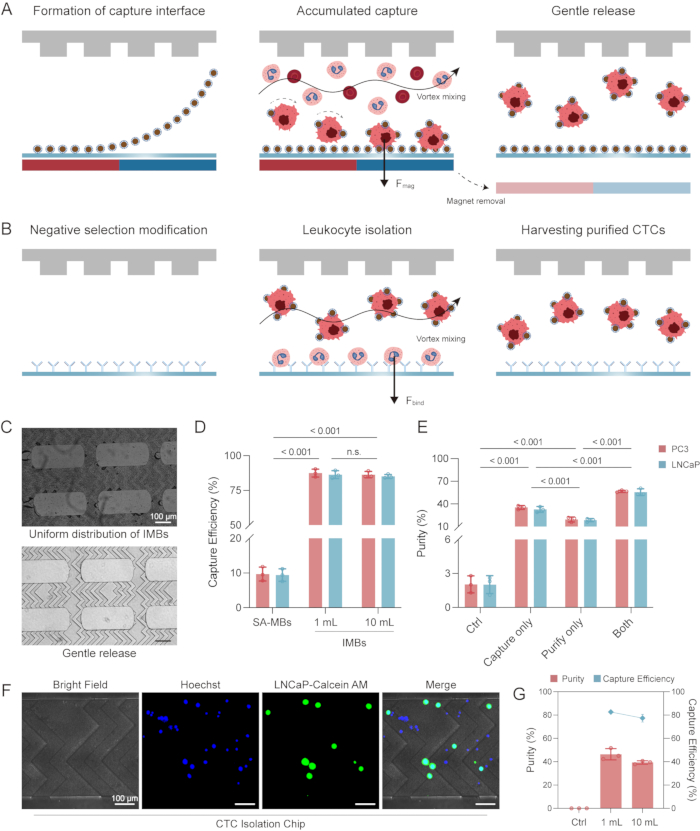
Figure 2: Herringbone-structured CTC capture and purification platform. (A) Workflow of the CTC isolation chip. First, a stable magnetic field and EpCAM antibody-conjugated IMBs assemble the capture interface. Next, vortex mixing within the HB-chip enhances mass transfer efficiency between CTCs and IMBs, facilitating accumulated capture. Finally, gentle release of CTCs is achieved by removing the magnetic field. (B) Workflow of the CTC purification chip. The HB-chip is modified with negative selection antibodies, and vortex mixing further facilitates leukocyte-antibody interactions, ultimately yielding highly purified CTCs. Scale bar, 100 µm. (C) Microscopic imaging demonstrates successful assembly and release of the capture chip. (D) Bar plots compare the CTC capture efficiency of the isolation platform across different sample volumes, using non-functionalized SA-MBs as a control. Error bars, mean ± SD, n = 3. (E) Bar plots compare the purity of CTCs obtained using only a single HB-chip versus those undergoing sequential capture and purification. The control group represents untreated CTC purity. Error bars, mean ± SD, n=3. (F) Cell identification in the CTC isolation chip. LNCaP cells were stained with Hoechst and Calcein AM, while blood cells were stained with Hoechst only. Scale bar, 100 µm. (G) Tumor cell purity and capture efficiency in spiking experiments using 1 mL or 10 mL of peripheral blood. Error bars, mean ± SD, n = 3. Please click here to view a larger version of this figure.
The isolated tumor cells were subsequently subjected to high-throughput single-cell sequencing. Our protocol incorporates a single-cell barcoding system consisting of 60,000 nested microwells (Figure 3A-B). The lower, square-shaped microwells serve to capture individual cells, while the upper microwells are designed for bead loading. Each lower microwell measures 25 µm in length, width, and height, suitable for most cell types. The upper hexagonal wells have an inscribed circle diameter and height of 50 µm to accommodate beads typically ranging from 30 to 50 µm. The system enhances cell capture efficiency based on cumulative capturing while avoiding cell doublets through the size-exclusion microwells. To optimize the cell loading protocol, we investigated the cell capture efficiency and microwell occupancy ratio under different cell input conditions (Figure 3C). The results showed that increasing the cell input did not diminish the capture efficiency; rather, it significantly enhanced the occupancy ratio. For the 60,000-well capture chip, the microwell occupancy ratio plateaued when the cell input reached 80,000, showing no further increase with additional input. To minimize the occurrence of doublets due to excessive cell loading, we selected 80,000 cells as the optimal input. As shown in Figure 3D, the single-cell barcoding chip achieved an 85.6% cell and 95.7% barcoded bead occupancy ratio, resulting in a pairing rate of 81.9%. In addition, multiple settlings were performed according to the protocol, which significantly improved the capture efficiency and pairing rate through the cumulative capture effect (Figure 3D). Notably, the observed difference in occupancy ratios between cells and beads is attributed to the greater density and mass of the beads compared to cells, which allows them to settle more efficiently into the microwells under gravity. Therefore, under optimized loading conditions, a pairing occupancy rate of approximately 80% is generally considered ideal.
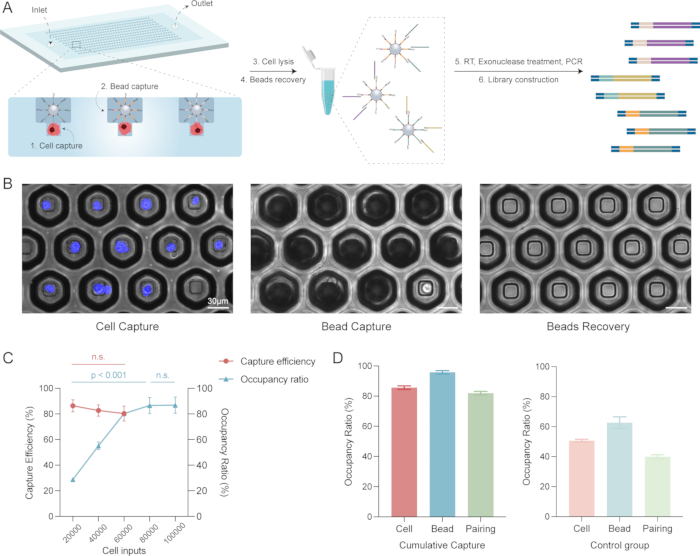
Figure 3: Microwell-based high-throughput single-cell barcoding and sequencing technology. (A) Workflow of the single-CTC sequencing protocol. (B) Microcopy demonstrates microfluidic single-cell/barcoded bead capture well structures. Processes of cell capture, bead capture, and beads recovery are shown from left to right. Scale bar 30 µm. (C) Line plots illustrate the cell capture efficiency and microwell occupancy ratio of the single-cell barcoding chip (60000 dual wells) under different cell input conditions. (D) Occupancy rates of cells and barcoded beads under optimized cell input conditions, along with the corresponding cell-bead pairing ratio. The left and right panels show the capture approach utilizing multiple settling attempts and single settling only, respectively. Error bars, mean ± SD, n = 3. Please click here to view a larger version of this figure.
Finally, to validate the integrated protocol for CTC sorting and scRNA-seq, we mixed PC3, LNCaP, and Jurkat cells at an estimated ratio of 1:3:4000 and loaded them onto the microfluidic chips for tumor cell capture, purification, and single-cell sequencing. Through the efficient tumor cell isolation platform, we obtained highly pure EpCAM-positive tumor cells (Figure 4B). Concurrently, the microfluidics-based scRNA-seq chip demonstrated precise cell-type profiling capability, with the results visualized through t-Distributed Stochastic Neighbor Embedding (t-SNE) analysis (Figure 4A). We successfully identified three distinct cell populations, each of which could be distinguished by unique markers (Figure 4C). In addition, the proportions of cells in the final output closely matched those of the purified input, confirming that the single-cell barcoding process was unbiased and contamination-free (Figure 4B). One cluster was identified as Jurkat cells based on the specific expression of TRBC1, IGLL1, CD1E, and CD3D (Figure 4D). Pathway enrichment analysis further confirmed the robustness of this classification (Figure 4E). Furthermore, the two prostate cancer cell lines were distinctly separated into individual clusters according to differentially expressed genes (DEGs) (Figure 4F-G). The PC3 cluster was characterized by high expression of microseminoprotein (MSMP), also known as PC3-secreted microprotein. On the other hand, the LNCaP cluster uniquely expressed markers related to cell adhesion, proliferation, and pluripotency, such as NEDD4, CTNNA1 (α-catenin 1), and RBBP7.
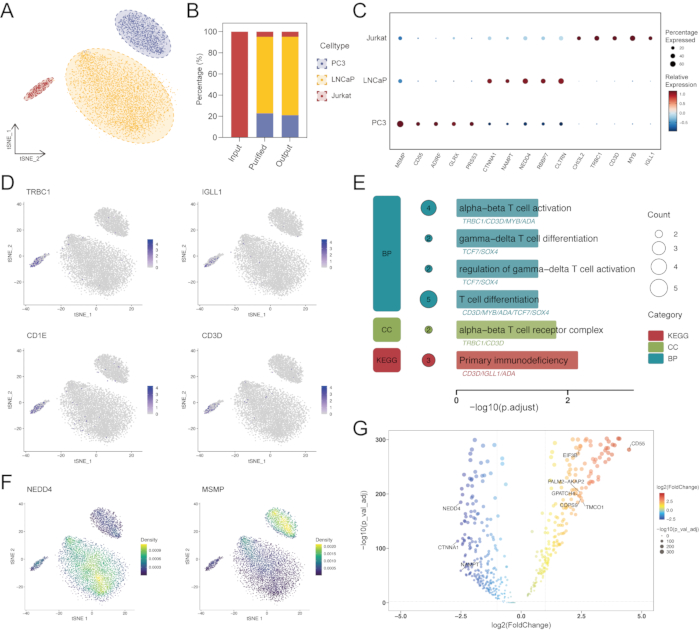
Figure 4: Validation of CTC sorting and single-cell sequencing using a spike-in experiment. (A) t-SNE plot showing cell type profiling of the captured and purified cells. (B) Bar plot depicting the proportions of the three cell types at three stages: initial input, post-purification, and final sequencing output. (C) Dot plot illustrating the expression of unique marker genes across different cell clusters. (D) Expression levels of TRBC1, IGLL1, CD1E, and CD3D across all cells. (E) GO and KEGG pathway enrichment analysis of differentially expressed genes (DEGs) in the Jurkat cluster. (F) Expression patterns of NEDD4 and MSMP in all cells. (G) Volcano plot showing DEGs between the PC3 and LNCaP clusters. Red dots represent genes upregulated in PC3; blue dots represent those upregulated in LNCaP. Please click here to view a larger version of this figure.
| Master mix | Reagent | Final dilution | Buffer type |
| 0.5% F-68 | F-68 | 0.50% | DEPC Treated Water |
| PBS | 1× | ||
| TE-TW | Tris-HCl (pH=8.0) | 10 mM | DEPC Treated Water |
| EDTA | 1 mM | ||
| Tween-20 | 0.01% | ||
| 20× TE (pH=7.5) | Tris-HCl (pH=7.5) | 200 mM | DEPC Treated Water |
| EDTA | 20 mM | ||
| TE-SDS | Tris-HCl (pH=8.0) | 10 mM | DEPC Treated Water |
| EDTA | 1 mM | ||
| SDS | 0.50% |
Table 1: Composition of reagent mix for single-CTC sequencing preparation. Shown are parts of the reagents required for scRNA-seq, which can be prepared in advance of the chip operation to ensure a fast and smooth process.
Supplementary Figure 1: Design for the HB-chip. (A) Schematic diagram of the two-layer microfluidic structure. Top: Top layer featuring the herringbone structure. An enlarged inset shows the detailed geometry of the herringbone, which is oriented at a 45° angle relative to the channel wall, with a groove width of 100 µm and a pitch of 200 µm. Bottom: Bottom layer composed of a support pillar array (28 columns × 7 rows), numbered from #1 to #28 along the flow direction. (B) Side view of the herringbone chip. The herringbone grooves have a width of 100 µm. The heights of both the herringbone structures and the support pillars are 50 µm. (C) Top view of the herringbone chip. Each support pillar measures 500 µm in width and 1150 µm in length, with a 550 µm gap between adjacent pillars. (D) Photograph of the fabricated HB-chip. Please click here to download this File.
Supplementary Figure 2: Representative image showing fluorescently stained tumor cells and blood cells present in the waste fluid collected from the outlet of the CTC isolation chip. LNCaP cells were stained with Hoechst and Calcein AM, while blood cells were stained with Hoechst only. Scale bar 100 µm. Please click here to download this File.
Supplementary Table: Oligonucleotide sequences used in reverse transcription and library preparation Please click here to download this File.
Discussion
CTCs serve as valuable biomarkers for cancer diagnosis, treatment guidance, and studies on tumor initiation, progression, and metastasis25. However, existing CTC isolation methods fail to achieve both high efficiency and high throughput26. Additionally, the low release efficiency of CTCs often results in low purity and high cell damage, limiting their compatibility with downstream analyses27. Here, we have proposed an integrated protocol for high-throughput CTC sorting and single-CTC sequencing, consisting of three main procedures: CTC capture, purification, and scRNA-seq.
This microfluidics-based platform offers flexibility and scalability. The number of parallel channels in the HB-chips, as well as capture wells in the barcoding chip, can be adjusted according to different sample requirements, thereby meeting high-throughput demands. In the CTC capture chip, IMBs can be optimized according to the specific cancer type. For example, in samples from prostate cancer patients, IMBs can be functionalized with a cocktail of EpCAM and PSMA antibodies to enhance capture efficiency. Moreover, relying solely on EpCAM-based capture may result in the loss of mesenchymal CTCs that have undergone epithelial-mesenchymal transition (EMT). To address this problem, additional antibodies against heat shock protein 70 (HSP-70) or cell surface vimentin (CSV) can be incorporated to capture CTCs at different EMT stages.
Since the HB-chips for CTC capture and purification are microfluidics-based, careful handling is essential during experiments. Before introducing reagents into the chip inlet, all air bubbles must be removed, and both the inlet and outlet can be sealed to eliminate trapped air. Additionally, reagents should be introduced rapidly (within 1-2 s), as trapped air bubbles can obstruct the passage of IMBs and cells, significantly reducing capture efficiency and purity. Furthermore, as previously mentioned, the uniform distribution of IMBs is critical for successful CTC capture. After loading the IMBs, the chip must be placed vertically on the magnet and fixed in position for at least five minutes to prevent changes in the magnetic field from disrupting IMB distribution. Notably, the cell loading flow rate specified in the protocol should be optimized based on different sample types. For instance, leukopak samples exhibit elevated levels of leukocyte concentration and viscosity. If the flow rate is too fast, it may hinder efficient interactions between CTCs and IMBs, preventing accumulated magnetic capture and thus reducing CTC purity. To evaluate the performance of our CTC isolation and purification platform in processing clinical blood samples, we collected PB from several healthy donors and spiked a small number of LNCaP cells (approximately 50-100 cells per mL) into the samples. Notably, although the platform exhibited high capture efficiency and purity for tumor cells in PB samples, its performance was slightly lower than that observed in the PBS-based cell samples (Figure 2D, Figure 2E, and Figure 2G). We speculate that this discrepancy is due to the higher viscosity of blood and the presence of abundant red blood cells and platelets compared to PBS. Therefore, when handling clinical blood samples, pretreatment steps such as red blood cell lysis or PBMC extraction may be considered to improve performance.
Similar to HB-chips, the microfluidics-based single-cell barcoding chip requires careful handling to prevent air bubble formation. Given the variety of reagents involved, some reagents can be pre-prepared before initiating chip operations (Table 1). When loading cells and beads, careful control of the injection speed is necessary to ensure uniform distribution, as cells have a lower density while barcoded beads are denser. Typically, the cell suspension should be added slowly over 3~5 s, followed by the rapid addition of the bead suspension within 1~2 s. After loading the cells and beads, perform two rounds of aspiration and dispensing, then place the chip on a shaker to complete the cumulative capture process. This step is critical for improving the occupancy ratio and pairing rate. During cell lysis, an oil-sealing method is used to isolate the microwell surfaces, preventing cross-contamination between wells. Notably, mineral oil should be added immediately after lysis without delay. After lysis, barcoded bead recovery is performed by slowly moving the magnet from the inlet to the outlet to ensure a high bead recovery rate. If necessary, this step can be repeated multiple times. Finally, the recovered magnetic beads in the centrifuge tube undergo RT, second-strand synthesis, PCR amplification, and library construction, followed by next-generation sequencing (NGS).
This integrated microfluidic platform holds significant potential for clinical applications. By enhancing the efficiency and throughput of CTC isolation, it increases CTC detection at low tumor burden stages, enabling the establishment of a classification model linking CTC count to tumor staging. This advancement provides a novel approach for cancer diagnosis, treatment monitoring, prognosis assessment, and recurrence prediction. Additionally, single-cell transcriptomic analysis of CTCs enables the identification of key molecular features, including essential gene pathways, interaction networks, and biomarker genes. This analysis provides insights into the critical factors driving early cancer metastasis and unveils the molecular mechanisms underlying metastatic lesion formation, offering potential therapeutic targets for patients with recurrent or metastatic cancer. Furthermore, this platform is highly scalable. It can be adapted to meet specific analytical requirements and expanded to support multi-omics analyses, including transcriptomics and genomics.
Disclosures
The authors have nothing to disclose.
Acknowledgements
This study was supported by the National Natural Science Foundation of China (Grant Nos. 82227801).
Materials
| Name | Company | Catalog Number | Comments |
|---|---|---|---|
| (3-Mercaptopropyl) trimethoxysilane | Sigma Aldrich | 175617-100G | MPTS solution |
| 20× SSC Buffer | Sangon Biotech | B548109-0200 | |
| 5× RT Buffer | Sangon Biotech | B610020-0500 | |
| Biotinylated CD45 monoclonal antibody | eBioscience | 13-0459-82 | Storage at 2°C to 8°C |
| Biotinylated EpCAM monoclonal antibody | eBioscience | 13-9326-82 | Storage at 2°C to 8°C |
| Bovine serum albumin (BSA) | Sangon Biotech | A600332-0100 | Storage at 2°C to 8°C |
| DECODER Cartridge chip | Dynamic Biosystems | 2203106 | Storage at 2°C to 8°C |
| DECODER Cartridge Reagent kits | Dynamic Biosystems | 2203206 | Storage at 2°C to 8°C |
| DEPC Treated Water | Sangon Biotech | B501005-0500 | |
| D-PBS | Sangon Biotech | E607009-0500 | Contains: NaCl 136.89mM; KCl 2.67 mM; Na2HPO4 8.10 mM; KH2PO4 1.47 mM. pH=7.2-7.4 |
| DTT | Thermo Scientific | R0861 | Storage at 2°C to 8°C |
| Dynabeads MyOne SA T1 | Invitrogen | 65602 | SA-MBs, 1 μm |
| EDTA | Sangon Biotech | B540625-0500 | 0.5 M, pH=8.0 |
| KAPA HiFi HotStart ReadyMix | Roche | KK2601 | 2× PCR Reaction Mix |
| Lithium Chloride Precipitation Soln. | Invitrogen | AM9480 | 0.2 µm filtered |
| N-γ-maleimidobutyryl-oxysuccinimide ester | Thermo Scientific | 22309 | GMBS solution |
| Pluronic F-68 | Sangon Biotech | A600749-0025 | |
| Qubit 1× dsDNA HS Assay Kit | Thermo Scientific | Q33231 | |
| SDS Solution | Sangon Biotech | B648118-0100 | 10% SDS |
| Streptavidin | Sigma Aldrich | 189730 | Storage at 2°C to 8°C |
| SU-8 photoresist | MicroChem | SU-8 3050 | |
| SYLGARD 184 Silicone Elastomer Kit | Dow Corning | 4019862 | |
| Tris-HCl (pH 7.5) | LEAGENE | NR0072 | 1 mol/L, pH=7.5, RNase free |
| Tris-HCl (pH 8.0) | LEAGENE | NR0073 | 1 mol/L, pH=8.0, Rnase free |
| Triton X-100 | Sangon Biotech | A600198-0500 | |
| Trueprep DNA Library Prep Kit V2 for Illumina | Vazyme | TD502 | DNA library preparation kit |
| Tween-20 | Sangon Biotech | A600560-0500 | |
| VAHTS DNA Clean Beads | Vazyme | N411 | Solid Phase Reversible Immobilization (SPRI) magnetic beads for DNA purification |
References
- Gerstberger, S., Jiang, Q., Ganesh, K. Metastasis. Cell. 186 (8), 1564-1579 (2023).
- Heller, G., et al. Circulating tumor cell number as a response measure of prolonged survival for metastatic castration-resistant prostate cancer: A comparison with prostate-specific antigen across five randomized phase iii clinical trials. J Clin Oncol. 36 (6), 572-580 (2018).
- Heitzer, E., Speicher, M. R. Digital circulating tumor cell analyses for prostate cancer precision oncology. Cancer Discov. 8 (3), 269-271 (2018).
- Bidard, F. C., et al. Efficacy of circulating tumor cell count-driven vs clinician-driven first-line therapy choice in hormone receptor-positive, erbb2-negative metastatic breast cancer: The stic ctc randomized clinical trial. JAMA Oncol. 7 (1), 34-41 (2021).
- Chang, K., et al. Combination of circulating tumor cell enumeration and tumor marker detection in predicting prognosis and treatment effect in metastatic castration-resistant prostate cancer. Oncotarget. 6 (39), 41825-41836 (2015).
- Grisanti, S., et al. Analysis of circulating tumor cells in prostate cancer patients at psa recurrence and review of the literature. Anticancer Res. 36 (6), 2975-2981 (2016).
- Underwood, J. J., et al. Liquid biopsy for cancer: Review and implications for the radiologist. Radiology. 294 (1), 5-17 (2020).
- Paterlini-Brechot, P., Benali, N. L. Circulating tumor cells (ctc) detection: Clinical impact and future directions. Cancer Lett. 253 (2), 180-204 (2007).
- De Bono, J. S., et al. Circulating tumor cells predict survival benefit from treatment in metastatic castration-resistant prostate cancer. Clin Cancer Res. 14 (19), 6302-6309 (2008).
- Tsao, S. C., et al. Characterising the phenotypic evolution of circulating tumour cells during treatment. Nat Commun. 9 (1), 1482(2018).
- Lu, C., et al. A novel microfluidic device integrating focus-separation speed reduction design and trap arrays for high-throughput capture of circulating tumor cells. Lab Chip. 20 (22), 4094-4105 (2020).
- Descamps, L., Le Roy, D., Deman, A. L. Microfluidic-based technologies for ctc isolation: A review of 10 years of intense efforts towards liquid biopsy. Int J Mol Sci. 23 (4), (2022).
- Xu, Y., Chen, B., He, M., Cui, Z., Hu, B. All-in-one microfluidic chip for online labeling, separating, and focusing rare circulating tumor cells from blood samples followed by inductively coupled plasma mass spectrometry detection. Anal Chem. 95 (37), 14061-14067 (2023).
- Reza, K. K., et al. In situ single cell proteomics reveals circulating tumor cell heterogeneity during treatment. ACS Nano. 15 (7), 11231-11243 (2021).
- Mohamadi, R. M., et al. Nanoparticle-mediated binning and profiling of heterogeneous circulating tumor cell subpopulations. Angew Chem Int Ed Engl. 54 (1), 139-143 (2015).
- Levitin, H. M., Yuan, J., Sims, P. A. Single-cell transcriptomic analysis of tumor heterogeneity. Trends Cancer. 4 (4), 264-268 (2018).
- Sun, Y. F., et al. Dissecting spatial heterogeneity and the immune-evasion mechanism of ctcs by single-cell rna-seq in hepatocellular carcinoma. Nat Commun. 12 (1), 4091(2021).
- Miyamoto, D. T., et al. RNA-seq of single prostate ctcs implicates noncanonical wnt signaling in antiandrogen resistance. Science. 349 (6254), 1351-1356 (2015).
- Kojima, M., et al. Single-cell DNA and RNA sequencing of circulating tumor cells. Sci Rep. 11 (1), 22864(2021).
- Chauhan, A., et al. A facs-based novel isolation technique identifies heterogeneous ctcs in oral squamous cell carcinoma. Front Oncol. 14, 1269211(2024).
- Yu, H., Yang, C., Tai, Q., Gao, M., Zhang, X. New method for counting and picking out single circulating tumor cells from microliter-volume samples for tumor progression surveillance and single-cell heterogeneity analysis. Anal Chem. 95 (12), 5232-5239 (2023).
- Cheng, Y. H., et al. Hydro-seq enables contamination-free high-throughput single-cell rna-sequencing for circulating tumor cells. Nat Commun. 10 (1), 2163(2019).
- Simbolo, M., et al. DNA qualification workflow for next generation sequencing of histopathological samples. PLoS One. 8 (6), e62692(2013).
- Ikeda, H., et al. Protocol for high-quality single-cell rna-seq from tissue sections with draql. STAR Protoc. 5 (2), 103050(2024).
- Yang, Y. P., Giret, T. M., Cote, R. J. Circulating tumor cells from enumeration to analysis: Current challenges and future opportunities. Cancers (Basel). 13 (11), (2021).
- Deng, Z., Wu, S., Wang, Y., Shi, D. Circulating tumor cell isolation for cancer diagnosis and prognosis. EBioMedicine. 83, 104237(2022).
- Wu, L., et al. Aptamer-based detection of circulating targets for precision medicine. Chem Rev. 121 (19), 12035-12105 (2021).
Reprints and Permissions
