Here, we describe a standardized protocol for motor mapping using nTMS combined with diffusion tensor imaging (DTI)-based reconstruction of the corticospinal tract (CST). The protocol is reproducible, clinically feasible, and readily integrable into routine clinical workflows, providing a robust and valuable framework for motor pathway assessment, neuroplasticity research, and rehabilitation planning.
Method Article
A Standardized Protocol for Functional Motor Mapping Using Navigated Transcranial Magnetic Stimulation
In This Article
Summary
Abstract
Navigated transcranial magnetic stimulation (nTMS) is based on the integration of individual brain imaging data to determine the precise positioning of the stimulation coil, thus enabling anatomically guided stimulation of cortical targets. The interest of neuronavigation systems is well recognized in the optimization of coil positioning during repetitive TMS (rTMS) treatments. Furthermore, nTMS is increasingly applied for functional mapping of brain regions in different applications, such as the identification and delineation of eloquent motor and language areas before tumor resection. Besides its usefulness in optimizing neurosurgical procedures, nTMS mapping can also be a tool for monitoring cortical plasticity and quantifying the integrity of the motor system in various neurological diseases. This methodological paper presents a standardized protocol for motor mapping using nTMS, in combination with diffusion tensor imaging (DTI)-based reconstruction of the corticospinal tract (CST). This approach allows for precise delineation of eloquent motor cortical regions and their subcortical projections, and the detection of functional reorganizations in patients with adjacent lesions. When integrated into presurgical planning, this method provides guidance for individualized surgical strategies aimed at maximizing lesion resection while preserving motor function. The protocol presented here is reproducible, clinically applicable, and suitable for integration into routine workflows. It constitutes a promising tool for neuroplasticity research and rehabilitation planning.
Introduction
Maximizing the extent of resection in motor-eloquent brain tumors while minimizing postoperative motor deficits remains a central challenge in neurosurgery. Intraoperative direct electrical stimulation (DES) mapping is the "gold standard" technique to provide reliable anatomo-functional information regarding the cortical and subcortical representation of motor pathways1,2,3,4,5. However, for preoperative planning, risk stratification, and optimal patient counselling, it is crucial to delineate the individual functional anatomy before surgery. The relationship between anatomy and function in cortical motor areas cannot be inferred from conventional structural brain magnetic resonance imaging (MRI), as brain tumors may induce significant anatomical distortion or plastic reorganization of motor networks.
Transcranial magnetic stimulation (TMS) was introduced as a non-invasive method to probe the motor cortex6 and was later adapted for functional mapping of the motor cortex7,8, including in preoperative testing by recording motor evoked potentials (MEPs) from different muscles with surface electromyography9,10,11. Early non-navigated TMS protocols were technically demanding and lacked anatomical accuracy. Subsequent integration with individual MRI data and electric-field-based navigation enabled precise guidance of stimulation sites, improving anatomo-functional accuracy12,13,14 and reproducibility15,16. By directly eliciting MEPs, navigated TMS (nTMS) provides millisecond-scale temporal resolution and sub-centimeter spatial localization of corticospinal output with good concordance with intraoperative DES17,18,19. Image-guided nTMS is safe, well tolerated20,21, and approved by the Food and Drug Administration (FDA) for presurgical functional mapping of the motor cortex for more than 15 years22.
In motor mapping, cortical representations are delineated by sampling MEP amplitudes across targeted stimulation sites to construct patient-specific motor maps23. Compared with task-based functional MRI (fMRI), nTMS shows closer spatial agreement with intraoperative DES24,25,26. While intraoperative decisions ultimately rely on DES when lesions abut or invade the motor areas, preoperative nTMS provides valuable complementary information by exporting stimulation-positive sites as seeds for diffusion tensor imaging (DTI) reconstruction of the corticospinal tract (CST). This approach is particularly useful to assess corticospinal integrity when tumors mainly affect the motor tracts in the subcortical white matter27,28. Moreover, preoperative nTMS motor mapping has shown good positive predictive value29,30 and high negative predictive value29,30,31, with improved surgical outcomes17,18,19,32. It has also recently been proven as an effective tool to assess postoperative motor function31,33. For these reasons, nTMS motor mapping is increasingly used for both preoperative evaluation and postoperative follow-up in neurosurgery. Methodological recommendations for cortical mapping with nTMS have been published in 201734. In light of these recent studies and the integration of modern imaging techniques, this methodology can now be refined to provide more accurate guidance for clinical and research practice.
In this paper, we present a standardized protocol for performing motor mapping with nTMS, combining different techniques to evaluate preoperative cortical and subcortical representations of motor pathways for tumor resection planning under real-life clinical conditions.
Protocol
This study was conducted in accordance with national and international ethics guidelines for human research. Retrospective analysis of anonymized patient data collected during routine care was performed with informed consent obtained at the time of care, in accordance with French regulations. Demonstration data from healthy subjects, who are co-authors of the manuscript, were included with written informed consent for participation and publication of data and images. This is the current protocol used in Henri Mondor Hospital (Créteil, France) and Aarhus University Hospital (Denmark) for preoperative planning in brain tumor surgery.
1. Acquisition of neuroimaging data for neuronavigation
- Verify the absence of contraindication to nTMS and MRI using medical records and patient interview, including intracranial ferromagnetic device, uncontrolled epilepsy, pacemaker, pregnancy, or breastfeeding35.
- Acquire a high-resolution anatomical brain image that includes both ears and cranial vertex (without folds or deformation from MRI headphones) to allow accurate brain reconstruction by the neuronavigation system.
- Use the following recommendation for the MRI sequence:
3D T1-weighted (T1w) anatomical gradient-echo
1-mm isotropic voxels (or less)
≥1.5-Tesla MRI system (3 T preferred). - Alternatively, use these acceptable sequences:
3D-FLAIR
Contrast-enhanced 3D T1w
- Use the following recommendation for the MRI sequence:
- Acquire diffusion-weighted imaging (DWI) before contrast injection for subsequent Diffusion Tensor Imaging (DTI)- based tractography36.
- Use the following minimum acquisition parameters37:
Isotropic 2-mm voxels
Diffusion-encoding directions: ≥ 25
b-value: ≈ 800 s/mm²
Non-diffusion-weighted images: ≥ 3 b0 volumes (b = 0 s/mm²) - Use the following recommended parameters (for improved tensor estimation and tractography):
Diffusion-encoding directions: ≥ 64
b-value: 1000 s/mm2
Higher spatial resolution (≤ 2 mm isotropic)
- Use the following minimum acquisition parameters37:
2. Prepare the subject
- Import the subject's anatomical MRI image into the neuronavigation system to generate a 3D brain reconstruction.
- Mark the key anatomical points on the MRI within the neuronavigation software (nasion, right ear, left ear).
- Use the root of the crus helicis for higher precision.
- Alternatively, use the tragus, but its larger surface can increase co-registration mismatch.
NOTE: To shorten the motor mapping, these preparatory steps can be performed before installing the subject in the room.
- Position the subject on a comfortable armchair, with a slight recline (20-30°) to reduce back tension38. Adjust the headrest to support the head and neck at the inion.
- Check for metallic objects in the head and neck areas (e.g., earrings, hairpins, piercings) and remove them before starting the procedure.
- Prepare the skin on the forehead for head-tracker placement.
- Clean the skin using alcohol pads or mild abrasive gel.
- Ensure the skin is fully dry before placing the tracker.
- Place the head tracker on the forehead so it remains stable throughout the stimulation session.
- Position it above the eyebrows and below the hairline.
- Place it either in the middle or slightly lateral.
- Fix the tracker using its adhesive surface or with an elastic band.
- Co-register the key anatomical points on the patient with the imported image in the neuronavigation software (see Figure 1).
- Use the digitizing pen to mark the anatomical landmarks.
- Ensure that earlobes are free from the headrest to avoid any displacement of the ear landmarks39.
- If the ear anatomy appears distorted on MRI (e.g., folded ear pinna), redefine the corresponding point on the image before digitizing.
- Once completed, the software validates the three fiducial points if the mismatch error is below 3 mm. If the mismatch error is too large, try the following steps in order:
- Digitize the key anatomical points on the patient a second time.
- Redefine the left and right ear anatomical points on the MRI.
- Digitize while gently pressing the helix of the earlobe, since MRI headphones may have displaced the ear by a few millimeters.
- Refine the registration by digitizing additional scalp points (scalp-surface matching).
- Validate the co-registration, with a co-registration error below 3 mm (2 mm preferred). If the mismatch exceeds 3 mm, repeat steps 2.7-2.9.
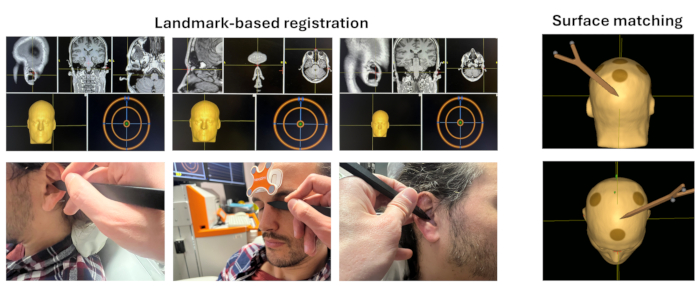
Figure 1: Co-registration of the patient's head with the anatomical MRI. Left side: Landmark-based registration. Upper panels: Identification of the anatomical landmarks on the MRI (left ear, nasion, right ear) within the neuronavigation software. Lower panels: Digitization of the landmarks on the patient using the digitizing pen.Right side: Surface matching refinement using additional scalp points. Please click here to view a larger version of this figure.
3. Preparation of mapped muscles
- Give earplugs to the subject and wear protective earmuffs during stimulation.
- Prepare the skin over the target muscle by gently scraping the skin with alcohol pads and/or cotton pads with mild abrasive gel.
- Place surface electrodes on the muscles of interest in a belly-tendon montage, as for routine clinical MEPs. Up to six different muscles can be mapped simultaneously.
- Place the ground electrode on a neutral site, such as the shoulder's stump, the dorsal hand surface, or the medial tibia surface.
- Connect all electrodes to the EMG amplifier.
- Start EMG acquisition to display continuous EMG of all channels and verify that the muscles are at rest.
- Check that EMG channels are free from excessive 50/60 Hz noise (< 50 µV). If the electric hum is excessive, try the following steps in order:
- Verify that the electrodes are firmly attached to the skin, without any detachment.
- Reposition the electrode cables inside the chair to avoid contact with metallic parts or with the floor.
- Move the distal part of the electrode leads away from the neuronavigation system and from AC power sources.
- Replace the electrodes and reapply them with a different cable orientation (see steps 3.7.2 and 3.7.3).
- Disconnect the chair from its power supply.
- Place the ground electrode on the same limb as the mapped muscles.
- Repeat the steps in order until the noise is reduced below the threshold.
- Once the 50/60 Hz noise is minimized, restart EMG recording to reset the baseline.
- Once these preparation steps are cleared, proceed with coarse mapping of the selected muscles.
NOTE: A standard mapping session should include at least one muscle per upper-limb segment and two lower-limb muscles. Table 1 lists the commonly mapped muscles, which should be adapted according to the lesion location and the patient's clinical presentation34.
| Limb | Muscle | Alternative(s) |
| Hand | First Interosseus Dorsal (FDI) | Abductor Pollicis Brevis (APB) |
| Abductor Digiti Minimi (ADM) | ||
| Forearm | Flexor Carpi Radialis (FCR) | Extensor Carpi Radialis (ECR) |
| Arm / Shoulder | Biceps | - |
| Deltoid | ||
| Leg | Tibialis Anterior (TA) | Soleus (SOL) |
| Foot | Abductor hallucis (AH) | Medial Plantar (MP) |
| Face | Orbicularis Oris | Nasalis |
Table 1: Suggested muscles for motor mapping.
4. Coarse mapping to identify the hotspot and determine the Resting Motor Threshold (RMT)
- On the rendered brain volume in the software, adjust the peeling depth between 15-25 mm deep to the scalp, case-by-case, to best reveal the cortical anatomy. The goal is to visualize the precentral and postcentral gyri, the central sulcus, and the superior and inferior frontal sulci.
NOTE: Identification of the precentral gyrus is easier when the subject presents an "omega-shaped" hand knob40,41. However, this landmark is inconstant42,43. In such cases, several methods are recommended to identify the precentral gyrus43,44,45. - Start the stimulator unit.
- Position the stimulation (figure-of-eight) coil tangential to the scalp (see Figure 2).
- Stabilize the coil with one hand on the handle and the other on the coil to keep stable contact with the scalp during repositioning.
- Use the neuronavigation assistance (coil-angle, coil-to-head distance, tilt indicators) to ensure accurate coil positioning over each stimulation site.
- Maintain a stable induced Electric Field (EF, V/m) by avoiding coil tilting.
- Adopt a comfortable posture as the coil can be heavy. Use a cable-holding arm to reduce cable tension while keeping the coil freely movable.
- Stimulate at an intensity adjusted to elicit responses within the 100-500 µV (peak-to-peak) amplitude range46.
NOTE: This is usually achieved between 35% and 45% of the Maximal Stimulator Output (MSO) for upper limbs and between 50% and 80% of the MSO for lower limbs. However, this range of values applies to healthy subjects and may be higher when the tumor infiltrates motor regions. - Note that the coil orientation for the coarse mapping (as well as the fine mapping) depends on the limb mapped (see Figure 3):
- For the upper limb and the face: keep a coil orientation perpendicular to the central sulcus (sulcus-aligned), to maintain an induced electrical current in a posterior-to-anterior direction47.
- For the upper limb: start stimulating over the upper part (shoulder) or the middle part (forearm and hand muscles) of the posterior wall of the hand-knob, facing the superior frontal sulcus.
- For the face: start stimulating over the posterior wall of the precentral gyrus facing the inferior frontal sulcus. Check the response latencies to ensure they originate from the corticobulbar pathways. Facial MEPs have a latency of 7-13 ms, whereas direct muscle response (jaw jerk) induced by nTMS has a latency of about 3-4 ms.
- For the lower limb: keep a coil orientation perpendicular to the sagittal midline, with an induced electrical current in a mid-to-lateral direction34. Alternative coil orientations include parallel to the sagittal midline48,49,50 and/or perpendicular to the folds of the paracentral lobule and the precentral gyrus.
- For the upper limb and the face: keep a coil orientation perpendicular to the central sulcus (sulcus-aligned), to maintain an induced electrical current in a posterior-to-anterior direction47.
- Perform stimulations over the precentral gyrus.
- Space stimulation points 1-2 mm apart, either visually or using a stimulation grid.
- When performed visually, sample three parallel lines across the gyrus. This is usually sufficient.
- Space each stimulation by at least 1.5 s, preferably with a randomized interstimulus interval.
- If no responses are obtained, increase the stimulus intensity by 10% relative to the starting value and repeat as before.
- Stop the coarse mapping once 20-30 responses per muscle are recorded.
- Review all MEPs to exclude contaminated recordings.
- Identify the "hotspot" for each muscle. The "hotspot" is the stimulating point that elicits the MEP of the largest amplitude. To ensure reliable hotspot definition51
- Display the recordings of each muscle using a normalized color scale.
- Locate the area containing MEPs of the highest amplitude.
- Sort MEPs by amplitude, from highest to lowest.
- Select the highest-amplitude MEP within this area, avoiding abnormally high single responses (usually the first 2 MEPs).
- For each muscle, select the hotspot to determine the resting motor threshold (RMT). This will save the coil position and orientation throughout the RMT determination process, ensuring reliable measurement52.
- Determine the RMT for each muscle separately, either using a threshold-hunting technique53 or by identifying the lowest stimulus intensity (% MSO) that elicits MEPs ≥ 50µV in 5 out of 10 consecutive trials (Rossini-Rothwell method)54. Use the RMT of each muscle as a reference for setting the stimulus intensity during the fine mapping.
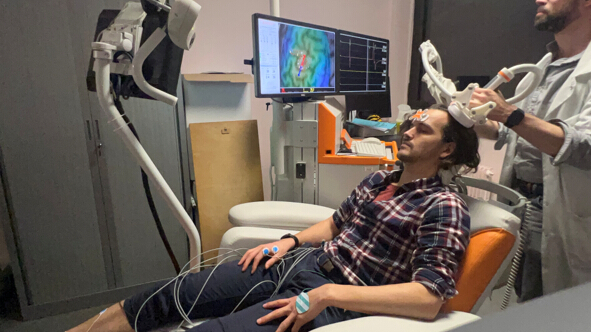
Figure 2: Experimental nTMS setup. The subject is seated with slight recline and arm support, with EMG electrodes placed over the target muscles. The operator holds the figure-of-eight coil stabilizing it to maintain tangential scalp contact, while monitoring the induced electric field (arrows: direction, circle: intensity) and the induced MEPs. Please click here to view a larger version of this figure.
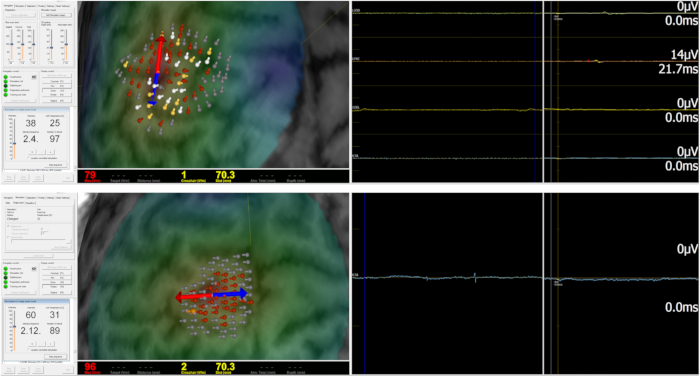
Figure 3: Neuronavigation interface during mapping. Real-time feedback on coil position (junction of the blue and red arrows), coil tilt, electric field direction (blue-to-red arrow) and field intensity (colored surrounding ring) ensuring accurate stimulation at each cortical site. Upper panel: Coarse mapping of the upper limb, with the coil oriented perpendicular to the central sulcus. Lower panel: Fine mapping of the Tibialis Anterior, with the coil oriented perpendicular to the sagittal midline. Please click here to view a larger version of this figure.
5. Fine mapping
- Ensure that the subject is fully relaxed, without involuntary muscle contraction.
- For each muscle, perform the stimulation at 105-110% of its RMT.
- Use the same coil orientation as during coarse mapping (see steps 4.5 and 4.6).
- Reduce the spacing between stimulation points (4-6 parallel lines per gyrus).
- Maintain an interstimulus interval ≥ 1.5 s, preferably randomized.
- Delineate functional motor maps as cortical areas where nTMS generates MEPs ≥ 50 µV (peak-to-peak).
NOTE: For lower limb mapping, an alternative is to start at 110% of the upper limb RMT, and to adjust the EF by steps of ± 10 V/m until consistent MEPs are obtained34. - Perform the stimulation until motor maps are bordered by one or two consecutive lines of negative sites that fail to elicit MEPs.
- If a clear negative border is not obtained, extend the sampling, maintaining the same spacing, until responses disappear reliably.
- If positive responses expand in unusual regions, check and adapt coil-angle, EF, and RMT.
NOTE: The number of points per muscle can vary (30 to 100 pulses) according to the muscle cortical representation and the degree of tumor-induced brain shift.
- Avoid coil orientations that generate abnormal MEP locations or amplitudes. In particular, a 45° orientation (relative to the midline) can produce upper-limb MEPs very anteriorly and may not be representative of accurate motor cortical representation47.
- Ensure that the motor maps are elliptic, with a few negative sites inside. For negative stimulation points within the motor map, perform additional stimulations at different moments during the evaluation to control for transient changes in motor cortex excitability.
- If many negative responses (<50 µV) occur during the mapping, try the following steps in order:
- Ask the subject to stay awake, since it often reflects a reduction in vigilance state.
- Check that the stimulation intensity has not decreased.
- Consider repeating the RMT, as the initial value may have been influenced by a transient hyperexcitability state.
- If many abnormally high-amplitude MEPs appear (> 1000 µV) and the map expands excessively, try the following steps in order:
- Ask the subject to relax the limb, even by showing ongoing muscle activity if necessary (signal feedback).
- If muscle activity remains, ask the subject to shake the limb or move it in a more relaxed position. If needed, apply a concentric passive movement on the tested muscle (e.g. with an object for the hand muscles and the abductor hallucis, or with the foot support for the tibialis anterior).
- Consider repeating the RMT, as the initial value may have been influenced by a transient state of motor cortex hypoexcitability.
6. Post-processing analysis of MEP data and export
- Review and adjust MEPs for each muscle.
- Open the MEP review panel or signal viewer in the neuronavigation software.
- Inspect each recorded MEPs to correct amplitude and latency and adjust markers if needed.
- Exclude artefactual or abnormal stimulation points.
- Open the stimulation list or mapping workspace in the software.
- Remove stimulation trials containing artefacts or incorrect coil positions (see Figure 4).
- Display the motor map for each muscle in a binary format (positive/negative; above/below 50 µV).
- Export the positive stimulation points at 15, 20, and 25 mm depth inbinarized DICOM format. Use these files for fiber-tracking to reconstruct the CST, using the positive stimulation points as seeds for the tractography.
- To measure other cortical maps parameters (center of gravity, map density, motor map size), export the data at the stimulation peeling depth or at 20 mm (standard peeling depth)25,55,56,57,58.
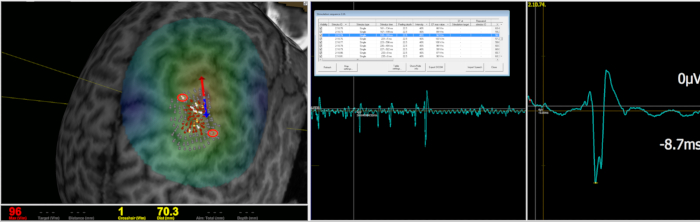
Figure 4: Post-processing analysis of MEP data. MEP traces are reviewed to correct amplitude and latency markers and exclude artefactual trials (right panel: example of a trial contaminated by ongoing EMG activity). The two stimulations (red circles) illustrate "abnormal responses" occurring in the negative area, likely related to coil-orientation effects. Please click here to view a larger version of this figure.
7. Post-processing analysis of motor mapping
- Import the DICOM of the motor maps into an image analysis software suitable for neurosurgical neuronavigation for brain tumor removal.
- Register the anatomical image (T1w) with the motor maps DICOMs and the DWI. Import and register additional images if necessary (e.g., FLAIRw, SWI, T1w-gadolinum enhanced).
- Generate objects from the motor map DICOMs and enlarge them by 1-2 mm to improve sensibililty59.
- Crop the motor maps to remove ears and nasion to prevent abnormal fiber reconstruction during fiber-tracking.
- Draw an ending ROI manually at the inferior pontine level, ipsilaterally to the mapped hemisphere.
- Perform the fiber-tracking, using the motor map ROIs as seeds, and the pontine ROI as the endpoint. Commonly used tractography algorithms include deterministic streamline tracking or probabilistic tractography depending on the clinical question and the fiber-tracking outcomes.
NOTE: When using open-source diffusion software, several preprocessing steps are required before tractography (denoising, Gibbs artifact correction, movement and distortion correction, B1 bias-field correction, tensor fitting, and FA map generation). - Adjust the parameters of the fiber-tracking on a case-by-case analysis. Recommended parameters are a minimum of 110-120 mm length, a maximum angulation of 30°, and a FA set at 75% the FA Threshold (FAT, corresponding to the FA at which the first CST fibers become visible)60,61.
- Segment the brain tumor on other images (e.g. FLAIR, gadolinium T1w) and create a corresponding object.
- Display the CST either for each limb's part (in different colors) or for the entire motor mapping.
- Integrate all the data (cortical seeds, CST, brain tumor object) into the OR navigation software for neurosurgery.
Results
We present representative steps and the results of motor mapping obtained in different healthy subjects and in patients who underwent motor mapping in a clinical environment, using our neuronavigated TMS system. CST reconstruction was performed using an imaging-processing software suitable for neurosurgery planning, capable of multimodal image registration and DTI-based tractography. The neuronavigation system integrates a navigated figure-of-eight coil, a stereotaxic camera, an EMG amplifier, and provides real-time visualization of the induced Electrical Field on the 3D brain reconstruction using an individualized multi-sphere head model.
Figure 5 displays the RMT determination at the hotspot determined from the coarse mapping. The coil position and orientation are maintained at the exact same location throughout the entire procedure with the help of the neuronavigation target. Figure6 displays a motor mapping of a healthy subject. The left lower limb (thigh, leg, foot), upper limb (shoulder, forearm, hand), and face were mapped. Positive stimulation sites (color-coded by MEP amplitude) and negative sites (gray) delineate the motor cortical representation. Figure7 displays the motor mapping and CST reconstruction in a patient with lung cancer metastasis involving the premotor region and revealed by an upper limb motor deficit.
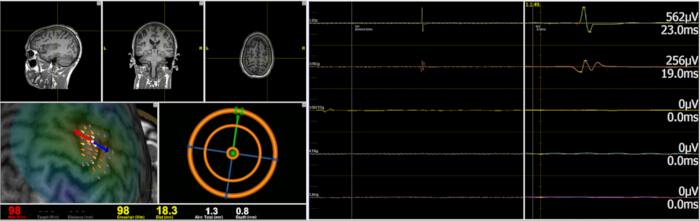
Figure 5: Coarse mapping and RMT determination at the hotspot (First Interosseus Dorsalis) in a healthy subject, using neuronavigated TMS. The hotspot, identified using coarse mapping (lower left panel), is selected as the target for the RMT determination. The coil position and orientation are maintained at the exact same location throughout the entire procedure, with the help of the neuronavigation target (lower right panel). Motor-evoked potentials (MEPs) are acquired with continuous EMG traces and epoch responses. Please click here to view a larger version of this figure.
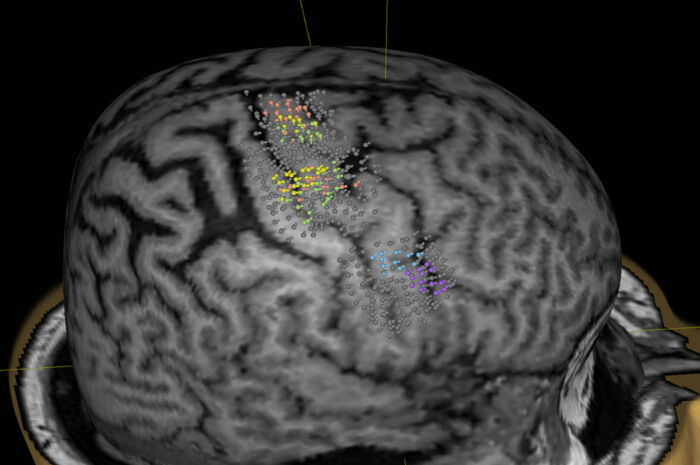
Figure 6: Motor cortex mapping of lower limb, upper limb, and face muscles using neuronavigated TMS. Muscles recorded in the lower limbs: quadriceps femoris (green), tibialis anterior (orange), abductor hallucis (yellow). Muscles recorded in the upper limbs: abductor digiti minimi (green), flexor carpi radialis (orange), deltoid (yellow).Muscles recorded in the face: Nasalis (blue), Triangularis (purple). Please click here to view a larger version of this figure.
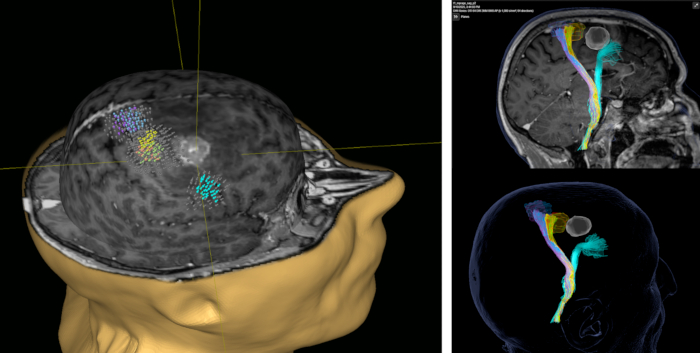
Figure 7: Motor cortical mapping and CST reconstruction for neurosurgical planning. nTMS-motor mapping (left panel) and nTMS-guided reconstruction of the corticospinal tracts (right panel) in a patient with brain metastasis (white) from lung cancer. Muscles recorded: abductor hallucis (purple), tibialis anterior (blue), deltoid (yellow), flexor carpi radialis (red), first interosseus dorsalis (green), orbicularis (cyan). Please click here to view a larger version of this figure.
Discussion
In this paper, we present a standardized and reproducible protocol for functional motor cortical mapping with nTMS directly applicable to preoperative surgical planning. By combining neuronavigation with the subject's anatomical brain reconstruction, this standardized protocol makes it possible to identify and delineate motor-eloquent cortical regions during an exam lasting less than 90 min, depending on the number of muscles studied. This approach is particularly relevant in patients with motor-eloquent tumors, where anatomical reconstruction of the CST is often limited by two factors: (i) anatomical displacement due to mass effect and/or edema and (ii) functional reorganization of motor representations. Anatomical seeding tractography based on fixed anatomical landmarks can therefore be misleading in localizing the cortical origin and propagating errors throughout the fiber tracking. Functional motor cortical mapping addresses this issue by using nTMS-positive sites as cortical seeds, thereby anchoring tractography to the patient's current motor map that drives corticospinal output. During post-processing analysis, the cortical ROIs derived from the motor maps should be enlarged by 2-3 mm to mitigate fusion-associated mismatch and to standardize ROI volume (0.9 ± 0.1 cm3), reducing operator and between-subject variability and improving CST tractography comparability59. Compared with landmark-based tractography, nTMS-seeded tractography yields more plausible and somatotopically consistent CST reconstructions, with fewer aberrant streamlines and lower inter-rater variability27,61,62. Compared with fMRI-based seeding, nTMS-based tractography also produces more plausible reconstructions and higher interrater consistency in patients with tumors adjacent to the CST25. It also allows the extraction of several metrics from the nTMS-motor mapping and the nTMS-seeded CST, which may serve as a predictive factor of postoperative motor outcome. At the cortical level, the presence of nTMS-responsive sites within the tumor has been associated with an increased risk of motor deficit, with a positive predictive value ranging from 50-90%30,63,64,65. In contrast, resection of nTMS-negative sites is considered safe, with a high negative predictive value ranging from 90-100%30,31,65. At the subcortical level, a tumor-to-tract distance <8-12 mm has been identified as a critical threshold associated with an elevated risk of post-operative deficit, as long as the tumor does not invade the precentral gyrus66,67,68,69,70,71. Additionally, microstructural alterations of the nTMS-seeded CST (decreased Fractional Anisotropy with increased Mean Diffusivity) have also been proposed as further risk factors for post-operative deficit70. Finally, the use of nTMS-based tractography has been associated with a greater extent of resection and prolonged survival while preserving motor function, supporting its integration into preoperative planning72.
During motor mapping, a key parameter that strongly influences the spatial distribution of MEPs and the interpretability of motor maps is the stimulation intensity (SI). Higher SI increases response probability and spatial spread (risking false positive responses), whereas insufficient SI increases the risk of false negative responses. To minimize this bias, the SI should be scaled relative to the RMT and, when possible, adjusted to maintain a stable target EF. In practice, near-threshold SI strikes a balance between sensitivity and specificity and provides conservative maps close to direct electrical stimulation mapping. On the other hand, choosing a supra-threshold SI (e.g., 120% RMT) can be justified when clinical safety prioritizes sensitivity at the map margins, acknowledging that higher SI systematically expands the motor map73. In the context of mapping multiple muscles, the use of a single SI may bias the mapping toward the lowest-threshold muscle, as adjacent muscles could have different excitability profiles. Accordingly, RMT should be estimated for each muscle74. On the other hand, significant changes in cortical excitability, reflected by unexpected changes in MEP amplitudes, may occur during a motor mapping session, requiring re-estimation of the RMT and adjustment of the SI.
The use of stimulation grids during motor mapping helps standardize spacing and facilitates map quantification (i.e., by counting active squares). However, grid size directly shapes the results: large squares may overestimate map size, whereas small squares increase the risk of undersampling. Recent evidence suggests that nTMS mapping can be performed without grids, using an anatomy-guided approach with denser stimuli near the anatomical landmarks and map edges75.
Several quantitative parameters can be derived from motor mapping, such as the center of gravity (CoG), motor map area, and volume. The CoG is defined as the amplitude-weighted location in coordinates which represents the center of the motor representation58. Serial examinations have shown shifts in CoG in brain tumor patients76,77,78, capturing evidence of functional reorganization over time in the motor cortex. Motor map area and volume represent the spatial extent of the motor representation. Area is commonly derived either by counting the active squares on a stimulation grid or by using spline interpolation in grid-free stimulation, which connects the positive stimulation points with smooth polynomial curves to generate continuous surface or volume56. These metrics can be monitored longitudinally (follow-up study or assessment of an intervention) or compared to the contralesional hemisphere to investigate cortical motor plasticity79,80,81,82. Quantitative motor mapping metrics have the potential to be extended beyond neuro-oncology, providing biomarkers of the motor system integrity and disease-related plasticity in neurological diseases55,83.
Although nTMS is now well established for preoperative motor mapping, several limitations should be acknowledged. First, the accuracy of co-registration and cortical mapping remains partly operator dependent. Proper training in coil handling, head-tracker stability, and prompt adjustment of stimulation are required to ensure reliability and reproducibility of the technique, although previous studies have shown that nTMS provides reliable motor topography with good inter-operator agreement between expert and novice examiners84. A second limitation relates to the influence of perilesional edema and mass effect on tractography. Excessive perilesional edema can reduce the accuracy of nTMS-based CST reconstruction, particularly in voxels adjacent to the lesion85. Similarly, discrepancies between preoperative datasets and the real intraoperative anatomy may occur due to intraoperative brain shift86,87. Because brain shift cannot be fully prevented - especially in tumors with important mass effect - the accuracy of nTMS-derived motor regions (both cortical and subcortical) may decrease during the later stages of resection. Several strategies can mitigate these inaccuracies, including limiting unnecessary cortical exposure, repeatedly checking superficial anatomical landmarks88, and using intraoperative imaging such as MRI, ultrasound, or CT, combined with brain deformation correction89,90,91,92. Finally, regarding safety, nTMS has demonstrated a favorable safety profile in patients with tumor-related epilepsy. In large series, stimulation-induced seizures are rare or absent during preoperative mapping93, supporting the safety of this technique when appropriate precautions are taken.
Overall, nTMS provides clinically useful functional information to surgical planning and opens the path to longitudinal studies of motor-system plasticity in various neurological or psychiatric diseases.
Disclosures
The authors have nothing to disclose.
Acknowledgements
This work was supported by the Independent Research Fund Denmark (Grant number: 3165-00230B), Aage & Johanne Louis-Hansens Foundation (Grant number: 25-1-17926), and Muskelsvindfonden (Grant number: 2025-0010)
Materials
| Name | Company | Catalog Number | Comments |
|---|---|---|---|
| Elements software | BrainLAB AG, Munich, Germany | Image processing software and OR neuronavigation software | |
| Neuronavigation TMS system | Nexstim, Helsinki, Finland | NBS 5.1 system | Navigated TMS system with figure-of-eight coil and EMG amplifier |
| Surface electrodes for EMG recording | Natus, Middleton, WI, USA | 9013L0453 | For EMG recording |
References
- Berger, M. S., Ojemann, G. A., Lettich, E. Neurophysiological monitoring during astrocytoma surgery. Neurosurg Clin N Am. 1 (1), 65-80 (1990).
- Kombos, T., Suess, O., Funk, T., Kern, B. C., Brock, M. Intra-operative mapping of the motor cortex during surgery in and around the motor cortex. Acta Neurochir. 142 (3), 263-268 (2000).
- Keles, G. E., Lundin, D. A., Lamborn, K. R., Chang, E. F., Ojemann, G., Berger, M. S. Intraoperative subcortical stimulation mapping for hemispherical perirolandic gliomas located within or adjacent to the descending motor pathways: evaluation of morbidity and assessment of functional outcome in 294 patients. J Neurosurg. 100 (3), 369-375 (2004).
- Duffau, H., et al. Contribution of intraoperative electrical stimulations in surgery of low grade gliomas: a comparative study between two series without (1985-96) and with (1996-2003) functional mapping in the same institution. J Neurol Neurosurg Psychiatry. 76 (6), 845-851 (2005).
- De Witt Hamer, P. C., Robles, S. G., Zwinderman, A. H., Duffau, H., Berger, M. S. Impact of intraoperative stimulation brain mapping on glioma surgery outcome: a meta-analysis. J Clin Oncol. 30 (20), 2559-2565 (2012).
- Barker, A. T., Jalinous, R., Freeston, I. L. Non-invasive magnetic stimulation of human motor cortex. Lancet. 1 (8437), 1106-1107 (1985).
- Cohen, L. G., Bandinelli, S., Topka, H. R., Fuhr, P., Roth, B. J., Hallett, M. Topographic maps of human motor cortex in normal and pathological conditions: mirror movements, amputations and spinal cord injuries. Electroencephalogr Clin Neurophysiol Suppl. 43 (1), 36-50 (1991).
- Levy, W. J., Amassian, V. E., Schmid, U. D., Jungreis, C. Mapping of motor cortex gyral sites non-invasively by transcranial magnetic stimulation in normal subjects and patients. Electroencephalogr Clin Neurophysiol Suppl. 43 (1), 51-75 (1991).
- Asakura, T., Tokimura, H., Hirahara, K., Baba, K. Identification of the cerebral motor cortex by focal magnetic stimulation: clinical application to neurosurgical patients. Stereotact Funct Neurosurg. 63 (1-4), 177-181 (1994).
- Krings, T., et al. Functional magnetic resonance imaging and transcranial magnetic stimulation: complementary approaches in the evaluation of cortical motor function. Neurology. 48 (5), 1406-1416 (1997).
- Krings, T., et al. Stereotactic transcranial magnetic stimulation: correlation with direct electrical cortical stimulation. Neurosurgery. 41 (6), 1319-1325 (1997).
- Krings, T., Chiappa, K. H., Foltys, H., Reinges, M. H., Cosgrove, G. R., Thron, A. Introducing navigated transcranial magnetic stimulation as a refined brain mapping methodology. Neurosurg Rev. 24 (4), 171-179 (2001).
- Lefaucheur, J. -P. Why image-guided navigation becomes essential in the practice of transcranial magnetic stimulation. Neurophysiol Clin. 40 (1), 1-5 (2010).
- Ruohonen, J., Karhu, J. Navigated transcranial magnetic stimulation. Neurophysiol Clin. 40 (1), 7-17 (2010).
- Gugino, L. D., et al. Transcranial magnetic stimulation coregistered with MRI: a comparison of a guided versus blind stimulation technique and its effect on evoked compound muscle action potentials. Clin Neurophysiol. 112 (10), 1781-1792 (2001).
- Cavaleri, R., Schabrun, S. M., Chipchase, L. S. The reliability and validity of rapid transcranial magnetic stimulation mapping. Brain Stimul. 11 (6), 1291-1295 (2018).
- Frey, D., et al. Navigated transcranial magnetic stimulation improves the treatment outcome in patients with brain tumors in motor eloquent locations. Neuro Oncol. 16 (10), 1365-1372 (2014).
- Krieg, S. M., et al. Utility of presurgical navigated transcranial magnetic brain stimulation for the resection of tumors in eloquent motor areas. J Neurosurg. 116 (5), 994-1001 (2012).
- Picht, T., et al. Preoperative functional mapping for rolandic brain tumor surgery: comparison of navigated transcranial magnetic stimulation to direct cortical stimulation. Neurosurgery. 69 (3), 581-588 (2011).
- Tarapore, P. E., et al. Safety and tolerability of navigated TMS in healthy volunteers. Clin Neurophysiol. 127 (3), 1916-1918 (2016).
- Rossi, S., et al. Safety and recommendations for TMS use in healthy subjects and patient populations, with updates on training, ethical and regulatory issues: Expert Guidelines. Clin Neurophysiol. 132 (1), 269-306 (2021).
- Cohen, S. L., Bikson, M., Badran, B. W., George, M. S. A visual and narrative timeline of US FDA milestones for transcranial magnetic stimulation (TMS) devices. Brain Stimul. 15 (1), 73-75 (2022).
- Nahas, Z. Handbook of Transcranial Magnetic Stimulation. J Psychiatry Neurosci. 28 (5), 373-375 (2003).
- Mangraviti, A., et al. Practical assessment of preoperative functional mapping techniques: navigated transcranial magnetic stimulation and functional magnetic resonance imaging. Neurol Sci. 34 (9), 1551-1557 (2013).
- Weiss Lucas, C., et al. Functional MRI vs. navigated TMS to optimize M1 seed volume delineation for DTI tractography. A prospective study in patients with brain tumours adjacent to the corticospinal tract. Neuroimage Clin. 13, 297-309 (2017).
- Weiss Lucas, C., et al. Invasive versus non-invasive mapping of the motor cortex. Hum Brain Mapp. 41 (14), 3970-3983 (2020).
- Krieg, S. M., Buchmann, N. H., Gempt, J., Shiban, E., Meyer, B., Ringel, F. Diffusion tensor imaging fiber tracking using navigated brain stimulation-a feasibility study. Acta Neurochir. 154 (3), 555-563 (2012).
- Picht, T., Frey, D., Thieme, S., Kliesch, S., Vajkoczy, P. Presurgical navigated TMS motor cortex mapping improves outcome in glioblastoma surgery: a controlled observational study. J Neurooncol. 126 (3), 535-543 (2016).
- Raffa, G., et al. Multimodal surgical treatment of high-grade gliomas in the motor area: the impact of the combination of navigated transcranial magnetic stimulation and fluorescein-guided resection. World Neurosurg. 128, e378-e390 (2019).
- Eibl, T., et al. Significance of navigated transcranial magnetic stimulation and tractography to preserve motor function in patients undergoing surgery for motor eloquent gliomas. Heliyon. 10 (6), e28115(2024).
- Seidel, K., et al. Postoperative navigated transcranial magnetic stimulation to predict motor recovery after surgery of tumors in motor eloquent areas. Clin Neurophysiol. 130 (6), 952-959 (2019).
- Picht, T., Schulz, J., Hanna, M., Schmidt, S., Suess, O., Vajkoczy, P. Assessment of the influence of navigated transcranial magnetic stimulation on surgical planning for tumors in or near the motor cortex. Neurosurgery. 70 (5), 1248-1256 (2012).
- Eibl, T., Liebert, A., Ritter, L., Schebesch, K. -M. Evaluating postoperative motor function using postoperative navigated transcranial magnetic stimulation motor mapping. Neurophysiol Clin. 55 (4), 103072(2025).
- Krieg, S. M., et al. Protocol for motor and language mapping by navigated TMS in patients and healthy volunteers; workshop report. Acta Neurochir. 159 (7), 1187-1195 (2017).
- Rossi, S., Hallett, M., Rossini, P. M., Pascual-Leone, A. Safety of TMS Consensus Group. Safety, ethical considerations, and application guidelines for the use of transcranial magnetic stimulation in clinical practice and research. Clin Neurophysiol. 120 (12), 2008-2039 (2009).
- Zolal, A., et al. The effect of a gadolinium-based contrast agent on diffusion tensor imaging. Eur J Radiol. 81 (8), 1877-1882 (2012).
- Sanvito, F., Kaufmann, T. J., Cloughesy, T. F., Wen, P. Y., Ellingson, B. M. Standardized brain tumor imaging protocols for clinical trials: current recommendations and tips for integration. Front Radiol. 3, (2023).
- Stinson, M. D., Porter-Armstrong, A., Eakin, P. Seat-interface pressure: a pilot study of the relationship to gender, body mass index, and seating position. Arch Phys Med Rehabil. 84 (3), 405-409 (2003).
- Nieminen, A. E., et al. Accuracy and precision of navigated transcranial magnetic stimulation. J Neural Eng. 19 (6), 066037(2022).
- Yousry, T. A., et al. Localization of the motor hand area to a knob on the precentral gyrus. A new landmark. Brain. 120 (1), 141-157 (1997).
- Caulo, M., et al. New morphologic variants of the hand motor cortex as seen with MR imaging in a large study population. AJNR Am J Neuroradiol. 28 (8), 1480-1485 (2007).
- Wu, R., et al. The new morphologic classification of the hand motor cortex with magnetic resonance imaging in glioma patients. Heliyon. 10 (7), e28548(2024).
- Berger, M. S., Cohen, W. A., Ojemann, G. A. Correlation of motor cortex brain mapping data with magnetic resonance imaging. J Neurosurg. 72 (3), 383-387 (1990).
- Boling, W., Olivier, A., Bittar, R. G., Reutens, D. Localization of hand motor activation in Broca's pli de passage moyen. J Neurosurg. 91 (6), 903-910 (1999).
- Kido, D. K., LeMay, M., Levinson, A. W., Benson, W. E. Computed tomographic localization of the precentral gyrus. Radiology. 135 (2), 373-377 (1980).
- Sartori, L., et al. Selective stimulus intensity during hotspot search ensures faster and more accurate preoperative motor mapping with nTMS. Brain Sci. 13 (2), 285(2023).
- Raffin, E., Pellegrino, G., Di Lazzaro, V., Thielscher, A., Siebner, H. R. Bringing transcranial mapping into shape: sulcus-aligned mapping captures motor somatotopy in human primary motor hand area. Neuroimage. 120, 164-175 (2015).
- Cacchio, A., Cimini, N., Alosi, P., Santilli, V., Marrelli, A. Reliability of transcranial magnetic stimulation-related measurements of tibialis anterior muscle in healthy subjects. Clin Neurophysiol. 120 (2), 414-419 (2009).
- Cacchio, A., et al. Reliability of TMS-related measures of tibialis anterior muscle in patients with chronic stroke and healthy subjects. J Neurol Sci. 303 (1), 90-94 (2011).
- Sondergaard, R. E., Martino, D., Kiss, Z. H. T., Condliffe, E. G. TMS motor mapping methodology and reliability: a structured review. Front Neurosci. 15, (2021).
- Reijonen, J., Pitkänen, M., Kallioniemi, E., Mohammadi, A., Ilmoniemi, R. J., Julkunen, P. Spatial extent of cortical motor hotspot in navigated transcranial magnetic stimulation. J Neurosci Methods. 346, 108893(2020).
- Julkunen, P., et al. Comparison of navigated and non-navigated transcranial magnetic stimulation for motor cortex mapping, motor threshold and motor evoked potentials. Neuroimage. 44 (3), 790-795 (2009).
- Awiszus, F. TMS and threshold hunting. Suppl Clin Neurophysiol. 56, 13-23 (2003).
- Rossini, P. M., et al. Non-invasive electrical and magnetic stimulation of the brain, spinal cord, roots and peripheral nerves: basic principles and procedures for routine clinical and research application. An updated report from an I.F.C.N. committee. Clin Neurophysiol. 126 (6), 1071-1107 (2015).
- Bardel, B., et al. Motor function in multiple sclerosis assessed by navigated transcranial magnetic stimulation mapping. J Neurol. 271 (7), 4513-4528 (2024).
- Julkunen, P. Methods for estimating cortical motor representation size and location in navigated transcranial magnetic stimulation. J Neurosci Methods. 232, 125-133 (2014).
- Sinitsyn, D. O., Chernyavskiy, A. Y., Poydasheva, A. G., Bakulin, I. S., Suponeva, N. A., Piradov, M. A. Optimization of the navigated TMS mapping algorithm for accurate estimation of cortical muscle representation characteristics. Brain Sci. 9 (4), 88(2019).
- Sollmann, N., Krieg, S. M., Säisänen, L., Julkunen, P. Mapping of motor function with neuronavigated transcranial magnetic stimulation: a review on clinical application in brain tumors and methods for ensuring feasible accuracy. Brain Sci. 11 (7), 897(2021).
- Weiss, C., et al. Improved nTMS- and DTI-derived CST tractography through anatomical ROI seeding on anterior pontine level compared to internal capsule. Neuroimage Clin. 7, 424-437 (2015).
- Frey, D., Strack, V., Wiener, E., Jussen, D., Vajkoczy, P., Picht, T. A new approach for corticospinal tract reconstruction based on navigated transcranial stimulation and standardized fractional anisotropy values. Neuroimage. 62 (3), 1600-1609 (2012).
- Ivren, M., et al. Comparison of anatomical-based vs. nTMS-based risk stratification model for predicting postoperative motor outcome and extent of resection in brain tumor surgery. Neuroimage Clin. 38, 103436(2023).
- Rosenstock, T., et al. Specific DTI seeding and diffusivity-analysis improve the quality and prognostic value of TMS-based deterministic DTI of the pyramidal tract. Neuroimage Clin. 16, 276-285 (2017).
- Muir, M., et al. TMS seeded diffusion tensor imaging tractography predicts permanent neurological deficits. Cancers. 14 (2), 340(2022).
- Moser, T., et al. Resection of navigated transcranial magnetic stimulation-positive prerolandic motor areas causes permanent impairment of motor function. Neurosurgery. 81 (1), 99-110 (2017).
- Raffa, G., et al. The role of navigated transcranial magnetic stimulation for surgery of motor-eloquent brain tumors: a systematic review and meta-analysis. Clin Neurol Neurosurg. 180, 7-17 (2019).
- Eibl, T., et al. Tumor-specific alterations in motor cortex excitability and tractography of the corticospinal tract-a navigated transcranial magnetic stimulation study. J Integr Neurosci. 23 (7), 132(2024).
- Ivren, M., et al. Comparison of anatomical-based vs. nTMS-based risk stratification model for predicting postoperative motor outcome and extent of resection in brain tumor surgery. Neuroimage Clin. 38, 103436(2023).
- Rosenstock, T., Tuncer, M. S., Münch, M. R., Vajkoczy, P., Picht, T., Faust, K. Preoperative nTMS and intraoperative neurophysiology-a comparative analysis in patients with motor-eloquent glioma. Front Oncol. 11, 676626(2021).
- Rosenstock, T., et al. Risk stratification in motor area-related glioma surgery based on navigated transcranial magnetic stimulation data. J Neurosurg. 126 (4), 1227-1237 (2017).
- Rosenstock, T., et al. Bicentric validation of the navigated transcranial magnetic stimulation motor risk stratification model. J Neurosurg. 136 (4), 1194-1206 (2022).
- Sollmann, N., et al. Associations between clinical outcome and navigated transcranial magnetic stimulation characteristics in patients with motor-eloquent brain lesions: a combined navigated transcranial magnetic stimulation-diffusion tensor imaging fiber tracking approach. J Neurosurg. 128 (3), 800-810 (2018).
- Weiss Lucas, C., et al. Surgery of motor eloquent glioblastoma guided by TMS-informed tractography: driving resection completeness towards prolonged survival. Front Oncol. 12, (2022).
- Kallioniemi, E., Julkunen, P. Alternative stimulation intensities for mapping cortical motor area with navigated TMS. Brain Topogr. 29 (3), 395-404 (2016).
- Nazarova, M., Novikov, P., Ivanina, E., Kozlova, K., Dobrynina, L., Nikulin, V. V. Mapping of multiple muscles with transcranial magnetic stimulation: absolute and relative test-retest reliability. Hum Brain Mapp. 42 (8), 2508-2528 (2021).
- Pitkänen, M., Kallioniemi, E., Julkunen, P. Extent and location of the excitatory and inhibitory cortical hand representation maps: a navigated transcranial magnetic stimulation study. Brain Topogr. 28 (5), 657-665 (2015).
- Bulubas, L., Sollmann, N., Tanigawa, N., Zimmer, C., Meyer, B., Krieg, S. M. Reorganization of motor representations in patients with brain lesions: a navigated transcranial magnetic stimulation study. Brain Topogr. 31 (2), 288-299 (2018).
- Conway, N., et al. Cortical plasticity of motor-eloquent areas measured by navigated transcranial magnetic stimulation in patients with glioma. J Neurosurg. 127 (5), 981-991 (2017).
- Forster, M. -T., Senft, C., Hattingen, E., Lorei, M., Seifert, V., Szelényi, A. Motor cortex evaluation by nTMS after surgery of central region tumors: a feasibility study. Acta Neurochir. 154 (8), 1351-1359 (2012).
- Cirillo, S., Caulo, M., Pieri, V., Falini, A., Castellano, A. Role of functional imaging techniques to assess motor and language cortical plasticity in glioma patients: a systematic review. Neural Plast. 2019, 4056436(2019).
- de Almeida, C. C., et al. Quantification of tumor induced motor cortical plasticity using navigated transcranial magnetic stimulation in patients with adult-type diffuse gliomas. Front Neurosci. 17, 1143072(2023).
- Moser, I., et al. Analysis of neuronal excitability profiles for motor-eloquent brain tumor entities using nTMS in 800 patients. Cancers. 17 (6), 935(2025).
- Onyiriuka, L., et al. Identifying functional cortical plasticity after spinal tumour resection using navigated transcranial magnetic stimulation. Ann R Coll Surg Engl. 107 (6), 446-450 (2025).
- Durner, G., et al. Mapping motor neuroplasticity after successful surgical brachial plexus reconstruction using navigated transcranial magnetic stimulation (nTMS). Neurol Int. 16 (1), 239-252 (2024).
- Zdunczyk, A., Fleischmann, R., Schulz, J., Vajkoczy, P., Picht, T. The reliability of topographic measurements from navigated transcranial magnetic stimulation in healthy volunteers and tumor patients. Acta Neurochir. 155 (7), 1309-1317 (2013).
- Henderson, F., Abdullah, K. G., Verma, R., Brem, S. Tractography and the connectome in neurosurgical treatment of gliomas: the premise, the progress, and the potential. Neurosurg Focus. 48 (2), E6(2020).
- Gerard, I. J., Kersten-Oertel, M., Petrecca, K., Sirhan, D., Hall, J. A., Collins, D. L. Brain shift in neuronavigation of brain tumors: a review. Med Image Anal. 35, 403-420 (2017).
- Romano, A., et al. Pre- and intraoperative tractographic evaluation of corticospinal tract shift. Neurosurgery. 69 (3), 696-704 (2011).
- Bello, L., et al. Intraoperative use of diffusion tensor imaging fiber tractography and subcortical mapping for resection of gliomas: technical considerations. Neurosurg Focus. 28 (2), E6(2010).
- Senova, S., et al. Case report: multimodal functional and structural evaluation combining preoperative nTMS mapping and neuroimaging with intraoperative CT-scan and brain shift correction for brain tumor surgical resection. Front Hum Neurosci. 15, 646268(2021).
- Morin, F., et al. Brain-shift compensation using intraoperative ultrasound and constraint-based biomechanical simulation. Med Image Anal. 40, 133-153 (2017).
- Valencia, A., Blas, B., Ortega, J. Modeling of brain shift phenomenon for different craniotomies and solid models. J Appl Math. , (2012).
- Chowdhury, T., et al. The role of intraoperative MRI in awake neurosurgical procedures: a systematic review. Front Oncol. 8, 434(2018).
- Tarapore, P. E., et al. Safety and tolerability of navigated TMS for preoperative mapping in neurosurgical patients. Clin Neurophysiol. 127 (3), 1895-1900 (2016).
Reprints and Permissions
