This study employs ERPs to investigate how agent type (human/AI) and language style (humorous/rational) influence ride-hailing service recovery satisfaction, aiming to uncover neurocognitive mechanisms.
A subscription to JoVE is required to view this content. Sign in or start your free trial.
Method Article
Humor or Rationality? The Neural Mechanisms of How Agent Type and Language Style Influence Satisfaction with Ride-Hailing Service Failure Recovery
In This Article
Summary
Abstract
In the ride-hailing industry, effective service recovery strategies following service failures are crucial for passenger satisfaction and platform reputation. However, how the combination of agent type and language style influences passenger satisfaction and the underlying neural mechanisms remains unclear. This study designed an event-related potentials (ERPs) experiment to investigate how two key factors in post-failure remediation -- service agent type and language style -- affect passenger satisfaction and its neural correlates. A 2 (Agent Type: Human/AI) × 2 (Language Style: Humorous/Rational) within-subjects design was employed. Using E-Prime software, participants were presented with five pre-selected, common ride-hailing service failure scenarios. Each scenario was followed by a standardized voucher compensation offer delivered by an agent, with the agent type and language style systematically varied across trials. The procedure involved simultaneous recording of 64-channel electroencephalographic (EEG) signals and collection of behavioral satisfaction ratings. Behavioral data indicated higher satisfaction ratings for human agent and the humorous language style. ERPs results revealed more negative N2 and feedback-related negativity (FRN) amplitudes elicited by the rational language style, whereas human agents and the rational style elicited more positive P300 amplitudes. This study details the standardized preparation of experimental stimuli, precise timing control of the experimental procedure, EEG recording preparation based on the International 10-20 system, and the complete methodological pipeline from data acquisition to preprocessing. This protocol offers high temporal resolution and good reproducibility. It is suitable for research in consumer neuroscience, human-computer interaction, and service management that requires precise quantification of the temporal dynamics underlying social cognition and decision-making processes.
Introduction
Ride-hailing, a flagship model of the sharing economy, has become an integral component of urban mobility ecosystems due to its fundamental reliance on real-time interaction and user experience1. However, service failures -- such as driver discourtesy, vehicle malfunction, or trip delays -- are difficult to eliminate entirely. These incidents are often unexpected and context-dependent, readily triggering passenger dissatisfaction and eroding trust2. In a highly competitive market, prompt and effective service recovery is not merely a necessary step to redress immediate shortcomings; it constitutes a strategic imperative for rebuilding user trust and sustaining long-term loyalty3.
Traditional research on service recovery has predominantly employed behavioral methodologies, such as questionnaires and scenario-based experiments4. These studies evaluate the effectiveness of different recovery strategies by measuring explicit indicators like satisfaction and repurchase intention. Although this research has generated substantial findings, it is largely confined to observing consumers' final behavioral outputs. Direct evidence is still lacking regarding the internal "black-box" process -- specifically, how the brain processes, evaluates, and ultimately transforms service recovery information into a decision. In other words, while knowledge exists regarding which strategies are effective, understanding of the underlying neurocognitive mechanisms remains limited. Several specific questions persist: Do differences between human and AI agents manifest during the early stages of information processing? How do humorous versus rational communication styles modulate the negative emotions elicited by service failures? What is the complete neural pathway -- from conflict detection to cognitive integration -- that underlies the final satisfaction decision?
While certain recovery strategies (such as monetary compensation or apology) are known to be generally effective, a deep understanding of why and how these strategies work at cognitive and affective levels -- as well as their underlying dynamic neural mechanisms -- remains limited. This methodological gap constrains the ability to design more precise, efficient, and personalized service recovery solutions. To investigate this "black box," the present study employs event-related potentials (ERPs) technology as its core methodological approach. By recording electroencephalographic signals time-locked to specific stimulus events, ERPs provides millisecond temporal resolution, enabling the non-invasive and continuous capture of instantaneous brain activity during cognitive processing5,6,7. Compared to functional magnetic resonance imaging (fMRI), ERPs offers a distinct advantage in temporal precision8. Relative to traditional self-report measures, ERPs can effectively avoid retrospective bias and social desirability effects, thereby directly revealing individuals' immediate and unconscious neural responses9. In the context of service failure and recovery, this means that ERPs allows for the precise separation and observation of a series of rapid, sequential psychological processes. These include early conflict detection (reflected in the N2 component), mid-term emotion and outcome evaluation (reflected in the FRN component), and late-stage higher-order cognitive integration and motivational appraisal (reflected in the P300 component)10,11,12,13,14,15. Therefore, ERPs serve as an ideal tool for elucidating the complex neural mechanisms underlying service recovery decision-making.
Based on the methodological considerations outlined above, this paper presents a systematic, rigorous, and reproducible ERPs experimental protocol. This protocol is designed to investigate how two key service recovery elements -- service agent type (Human vs. AI) and language style (Humorous vs. Rational) -- jointly influence passenger satisfaction and its underlying neural mechanisms following a ride-hailing service failure. The protocol recruits university students with prior ride-hailing experience. It employs a standard S1-S2 experimental paradigm and a 2 (Agent Type: Human vs. AI) × 2 (Language Style: Humorous vs. Rational) within-subjects design. Stimuli comprising service failure scenarios and subsequent recovery proposals are presented in a standardized manner using E-Prime software. The procedure involves simultaneous acquisition of 64-channel electroencephalographic (EEG) data and behavioral satisfaction ratings.
This study employs the protocol to examine behavioral responses and to uncover the distinct cognitive processing stages underlying service recovery effects from a neurodynamic perspective16,17. For example, the rational style might violate emotional expectations and thereby elicit stronger conflict signals and more negative feedback during earlytomid stages, reflected as more negative N2 and FRN amplitudes18,19,20. Furthermore, human agent could receive more positive motivational appraisal during the late integration stage because of their social attributes, indicated by a more positive P300 amplitude21. Meanwhile, the rational language style likely increases the cognitive resources required to resolve conflict, which may also be reflected in a larger P300 amplitude22.
This protocol offers high temporal resolution and good reproducibility. Its design rationale and methodological details are applicable not only to the ride-hailing service context but also provide a reference for broader research fields. These fields include consumer neuroscience, human-computer interaction, service management, and communication studies. Thus, it contributes to the precise quantification and understanding of dynamic information processing in the human brain across various contexts of social interaction and decision-making.
Access restricted. Please log in or start a trial to view this content.
Protocol
This research protocol has been approved by the local and institutional ethics committees and complies with the latest version of the Declaration of Helsinki. All participants provided written informed consent prior to participation and can withdraw from the study at any time to protect their rights.
1. Experimental stimuli
- Pre-selection of service failure scenarios
- Recruit 100 college students with prior ride-hailing experience.
- Ask participants to rate their level of dissatisfaction with ten common ride-hailing service failure scenarios using a 7-point Likert scale (1 = not dissatisfied at all; 7 = very dissatisfied). The scenarios should include: driver rudeness, vehicle breakdown, incorrect destination, driver arriving late, traffic accidents, poor in-car hygiene, driver taking detours, being charged before boarding, driver not assisting with luggage, and uncomfortable in-car temperature.
- Rank the ten scenarios according to their mean dissatisfaction ratings and select the top 50% of scenarios with the highest ratings as the formal experimental materials.
- Finalize the following five service failure scenarios for use in the experiment: driver rudeness, vehicle breakdown, incorrect destination, driver arriving late, and traffic accidents.
- Present each selected scenario to participants using brief textual descriptions accompanied by a "Service Failure!" prompt.
NOTE: In the present implementation, the selected scenarios showed a mean dissatisfaction rating of 6.6, which was substantially higher than the mean rating of the bottom 50% of scenarios (mean = 3.6). This difference indicates that the selected scenarios effectively elicited a perception of service failure, supporting the validity of the experimental stimuli.
- Design two language styles (humorous and rational) for Agents (Human Customer Service vs. AI Customer Service) to provide compensation and disclose information through text combined with images of customer service representatives. For instance, in a scenario where the driver's service attitude is poor, the humorous language style states, 'The driver is in a bad mood, and it’s contagious! Here comes a cash coupon, ensuring a smile next time!' The rational language style states, ' An apology is expressed for the driver's unsatisfactory attitude, and a cash coupon is provided as compensation. Future patronage is welcomed.'
- Process all experimental images using Adobe Photoshop 2022 to standardize the stimulus materials, ensuring their validity and consistency. Adjust the image dimensions uniformly to 2560 × 1440 pixels with a resolution of 72 DPI. Calibrate the brightness to a value of 85 and increase the contrast by +20 to minimize visual interference. Additionally, standardize and optimize the wording related to the stimuli to ensure clarity and ease of understanding, avoiding any ambiguities.
- Conduct a pilot study to collect participant feedback on all stimulus materials. Ensure that all service failure scenarios effectively elicit a perception of service failure. Confirm that materials in humorous condition are rated significantly higher on perceived humor than those in the rational condition, while showing no significant difference in ratings of appropriateness and naturalness. Also, verify that the 1250 ms presentation duration is sufficient for participants to read and comprehend the stimulus text.
- Match and balance the text length, measured by the number of Chinese characters, across the different language style conditions. Ensure no significant difference in text length exists between the humorous and rational conditions. Control for the confounding influence of text complexity on reading time and cognitive load.
2. Experimental procedure
- Adopt a 2 (agent type: human vs. AI) × 2 (language style: humorous vs. rational) within-subjects factorial design.
- Generate four distinct versions of the experimental sequence. For each version, combine the four experimental conditions (human-humorous, human-rational, AI-humorous, AI-rational) with the five service failure scenarios.
- Program 120 trials in E-Prime, divide them into 2 blocks of 60 trials, insert a mandatory 120-second rest screen between blocks, and structure each trial as follows:
- Display the fixation point at the center of the screen for 500 ms.
- Present a prompt indicating the failure of ride-hailing service for 1000 ms.
- Show a blank screen for 250 ms.
- Display information regarding the service agent's identity disclosure for 1000 ms.
- Show a blank screen for 250 ms.
- Provide the participant with an apology script delivered in a humorous/rational language style by the service agent for 1250 ms.
- Show a blank screen for 250 ms.
- Offer the participant compensation in the form of an equivalent coupon (a ride voucher equal to the cost of the service) for 1250 ms.
- Show a blank screen for 250 ms.
- Request the participant to evaluate their satisfaction with the proposed solution (1 = very dissatisfied, 5 = very satisfied); the evaluation interface will remain until the participant makes a selection.
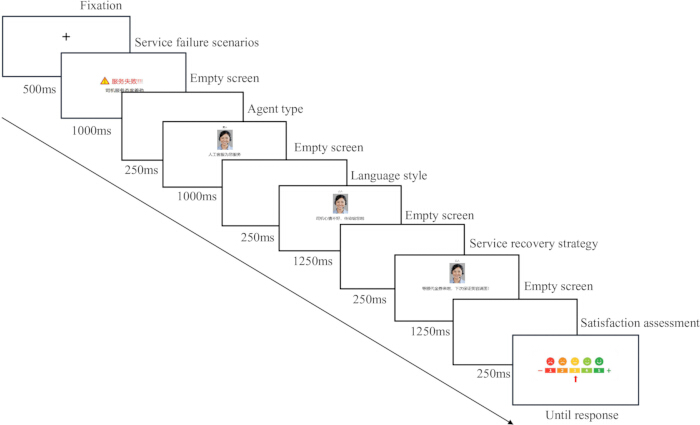
Figure 1: Experimental procedure. The event sequence and presentation durations for a single experimental trial are shown from left to right as follows: a fixation cross (500 ms), a service failure scenario prompt (1000 ms), a blank screen (250 ms), service agent type information (1000 ms), a blank screen (250 ms), language style (1250 ms), a blank screen (250 ms), a service recovery strategy (voucher information, 1250 ms), a blank screen (250 ms), and finally the satisfaction rating interface (displayed until the participant responded). Please click here to view a larger version of this figure.
3. Experimental preparation and electrophysiological recording
- Experimental Preparation
- Recruit 20 paid undergraduate and postgraduate students (8 female) from Harbin Engineering University according to the inclusion criteria: right-handedness, normal or corrected-to-normal vision, no history of psychiatric or neurological disorders, and no history of hair straightening or dyeing in the past six months. The participants were aged 18–28 years (M=23.25, SD=±2.23). Schedule individual experimental sessions for each participant. Exclude participants with excessive data artifacts from further analysis.
- After the participant arrives at the laboratory, conduct a preliminary briefing. Introduce the core equipment, materials, and the complete experimental procedure step by step. Clearly explain the specific requirements of the experimental tasks, the estimated duration, and important precautions. Ensure the participant fully understands the intensity of the experiment.
- Provide a written informed consent form to participants prior to the official initiation of the experiment. Require participants to read the form carefully and sign it before the experiment commences.
- Instruct the participant to wash their hair with a neutral shampoo in a designated area to remove scalp oil, dust, and other impurities that may affect conductivity between the electrodes and the scalp. Then, instruct the participant to use the laboratory-provided hair dryer to thoroughly dry their hair, ensuring no damp areas remain. Set the hair dryer to a medium airspeed (approximately 1600 W) and a constant temperature mode (approximately 50°C).
- Guide the participant into the dedicated EEG recording laboratory. The laboratory is professionally equipped with electromagnetic shielding and high sound insulation. Adjust the air conditioning and ambient lighting to ensure a room temperature of approximately 22°C and dim illumination. Instruct the participant to sit in the comfortable chair. Ensure the distance between the participant's eyes and the center of the screen is approximately 1 meter.
- Take 75% medical alcohol cotton balls and non-irritating facial cleanser. Gently wipe the specific areas of participants' faces with these items.
- Position the electrode cap, equipped with 64 Ag/AgCl electrodes, on the participant's scalp according to the International 10-20 system. Align the midline of the cap with the participant's nasion-to-inion line. Place the CZ electrode at the vertex of the head. Verify the cap positioning: ensure the Fp1 and Fp2 electrodes are located approximately 2 cm above the nasion, and the T3 and T4 electrodes are positioned approximately 2 cm above the ear tragus.
- Fill all electrode wells with conductive gel. Secure any external electrodes using medical tape. Place the reference electrode on the tip of the nose. Position the vertical electrooculogram (VEOG) electrodes approximately 1 cm above and below the left orbital socket. Place the horizontal electrooculogram (HEOG) electrodes approximately 1 cm lateral to the outer canthus of each eye. Position the recording electrodes (M1, M2) on the left and right mastoids, respectively.
- Adjust the chin strap of the electrode cap to a snug yet comfortable fit to prevent electrode displacement during the experiment. Then, verify the cap's final position to ensure it is not twisted or rotated.
- Switch the recording software to impedance check mode. Fill the wells of all electrodes in the cap with conductive gel using a blunt-tip syringe. Gently part the hair at each electrode site to ensure full contact between the electrode and the scalp. Continuously adjust the electrodes until the impedance for each channel drops below and stabilizes at 10 kΩ. Verify that the impedance values are displayed within the acceptable range (typically indicated by a blue or dark color on the impedance monitor).
- Inform participants that the experiment will be conducted in a closed and quiet environment. Instruct them to maintain a relaxed state, keep a stable sitting posture, avoid excessive body movements, and stay focused throughout the experiment.
- Present the stimuli using a 22-inch LCD monitor. Set the screen refresh rate to 60 Hz.
- E-Prime Software Operation Procedure
- Start E-Studio and Load the Project. Insert the E-Prime hardware key into a USB port on the computer. Double-click the E-Studio icon on the desktop to launch the software. Click File -> Open on the menu bar and select the project file for this experiment.
- Enter Participant Information. On the E-Run startup interface, accurately enter the Subject number (e.g., 001), Session number, and other required information.
- Execute the Practice Session. Click Tools -> E-Run, then select Run in the pop-up window. The program will first display the task instructions. Ensure the participant can clearly reiterate the experimental procedure and the correct response method. Subsequently, run the 10 practice trials. The structure of these trials is identical to the main experiment. After the practice session, ask the participant whether they were able to effectively read and understand the information presented in the stimuli.
- Initiate the Main Experiment. Upon completion of the practice trials, proceed to the instruction screen. Confirm the participant's readiness, then instruct them to press the spacebar to begin the main experiment. Ensure the main experiment comprises 120 trials divided into 2 blocks, with 60 trials allocated to each block. Insert a mandatory 2-minute rest period between the two blocks.
- Monitor the Session and Save Data. Monitor the session progress from an adjacent room via a monitor screen. Upon completion of the entire experiment, ensure that E-Prime automatically saves the data file.
- Debriefing and Compensation
- Save the EEG data and remove the electrode cap from participants. Instruct participants to clean the residual conductive gel from their hair and skin. Ensure no gel residue remains on their hair or skin. Confirm that participants have no discomfort after the cleaning process.
- Conclude the experiment and pay participants a remuneration of 30 RMB (approximately 4.50 USD).
- Data Preprocessing Procedure
- Inspect the Data. Visually inspect the EEG data. Exclude epochs containing significant baseline drift or severe noise artifacts from further analysis.
- Correct Ocular Artifacts. Set the vertical electrooculogram (VEOG) channel as the reference for ocular artifacts. Apply the ocular artifact reduction algorithm in the Scan software to correct blink and eye-movement artifacts.
- Epoch the Data. Segment the continuous EEG data into epochs time-locked to stimulus onset, using the event markers inserted by the E-Prime program. Define the epoch time window from -200 ms (pre-stimulus) to +800 ms (post-stimulus).
- Perform Baseline Correction. Define the 200 ms pre-stimulus interval as the baseline. Subtract its mean amplitude from the post-stimulus data using the baseline correction algorithm in the Scan software.
- Reject Artifacts. Reject epochs where the signal amplitude exceeds ±100 µV within the analysis window to eliminate contamination from muscle activity and other high-amplitude artifacts.
- Re-reference the Data. Compute the average signal from the electrodes on the left and right mastoids. Re-reference all channels offline to this computed mastoid average.
- Average Within Subjects. For each participant, average all artifact-free epochs belonging to the same stimulus condition to obtain stable, condition-specific ERPs waveforms for each individual.
- Apply a Filter. Filter the averaged ERPs waveforms using a 30 Hz low-pass filter (24 dB/octave roll-off).
- Create Grand Averages. Combine the individual averages for each condition across all participants to create grand average ERPs and obtain the group-level waveforms for each experimental condition.
Access restricted. Please log in or start a trial to view this content.
Results
As shown in Figure 2a, 2 (service agent: human vs. AI) ×2 (language style: humorous vs. rational) repeated measures ANOVA on satisfaction ratings revealed a significant main effect of service agent. Pairwise comparisons showed that satisfaction with the human agent (3.005) was higher than with the AI agent (2.750) . A significant main effect of language style was also found. Pairwise comparisons indicated that satisfaction in the humorous condition (3.018) was higher than in the rational con...
Access restricted. Please log in or start a trial to view this content.
Discussion
This study integrates behavioral measures with high-temporal-resolution ERPs technique to systematically reveal the multistage cognitive and neural mechanisms through which service agent type (Human vs. AI) and language style (Humorous vs. Rational) influence passenger satisfaction with service recovery. Behavioral results show that human agent and humorous language style individually lead to higher satisfaction ratings. A significant interaction effect was observed: satisfaction was highest when human agent was paired w...
Access restricted. Please log in or start a trial to view this content.
Disclosures
The authors have nothing to disclose.
Acknowledgements
This work was supported by National Natural Science Foundation of China (No. 72001055). We thank all colleagues in Lab 412 for their assistance in the experiment.ST, XY, and JY conceived and designed the study. XY and XZ conducted the experiments. XY analyzed the data and wrote the manuscript. ST reviewed the manuscript. All authors contributed to the article and approved the submitted version.
Access restricted. Please log in or start a trial to view this content.
Materials
| Name | Company | Catalog Number | Comments |
|---|---|---|---|
| NeuroScan Synamp2 Amplifier | Neurosoft Labs Inc., USA | SYN-2-64 | 1.Continuous EEG recording with bandpass filter (0.05–100 Hz) and sampling rate (1,000 Hz) 2.Equipped with Scan 4.3.1 software for impedance monitoring and data recording 3.Compatible with 64-channel electrode caps |
| 64-channel Ag/AgCl Electrode Cap | Electro-Cap International | EC-64 | Installation according to the international standard 10-20 system.Use the tip of the nose as an online reference. All channels were offline re-referenced to the average of the left and right mastoid references. The electrode between FPz and Fz was applied as ground. The vertical EOG and horizontal EOG were recorded by two electrodes located above and below the left eye 10 mm and lateral electrodes on the outer canthi of both eyes. All electrode impedances were maintained below 10 KΩ. |
| E-prime software | Psychology Software Tools | Used for designing experiments, initiating experiments, presenting stimuli, controlling the experimental process, and collecting behavioral data. | |
| Quik-Gel Conductive Gel | Compumedics Limited Australia | RP0002831 | Medical conductive gel. Its primary function is to be applied between the electrodes and the scalp or skin during electroencephalogram (EEG) neurophysiological examinations to reduce resistance, ensuring smooth conduction of electrical signals, thereby obtaining clear and accurate test results. |
| Nuprep | Weaver and company | 10-30 | Skin preparation (abrasive) gel. Prior to electroencephalogram (EEG) electrophysiological examinations, it is used to abrade and clean the skin, effectively removing oils and dead skin to reduce skin impedance, thereby ensuring clearer and more accurate electrode signal conduction. |
| BD 10ml Syringe | Becton, Dickinson and Company | REF309604 | Standard 10ml capacity syringe. Used to fill the cylindrical cavities of all electrodes in the electrode cap with conductive paste, ensuring sufficient contact between the scalp and the electrodes. |
| SalonShine Care ION+Dryer | PHILIPS | HP8206 | Quickly dries hair and utilizes negative ion technology to reduce static and frizz. |
| Bee & Flower Shampoo | Shanghai Bee & Flower Daily Necessities Co., Ltd. | GB/T 29679 | Mild shampoo. Effectively removes excess scalp oil and dirt, reducing interference with the experiment. |
| 75% Alcohol | Dezhou Chuangyi Medical Technology Co., Ltd. | 1378 | Reduces skin impedance. |
| 3M Transpore Surgical Tape | Minnesota Mining and Manufacturing Medical Devices (Shanghai) Co., Ltd. | 1527C-1 | Used to secure external electrodes. |
| LCD Monitor | Dell | E2219HN | Used to display the experimental procedure and stimuli, serving as an important interface for human-computer interaction. |
References
- Liu, Y., Jia, R., Ye, J., Qu, X. How machine learning informs ride-hailing services: A survey. Commun Transp Res. 2, 100075 (2022).
- Hien, N. N., Long, N. T., Liem, V. T., Luu, D. X. Customer responses to airline service failure: Perspectives from expectation disconfirmation theory. SAGE Open. 14 (2), 21582440241248334 (2024).
- Tahir, Z. Effectiveness of offline and online rewards in restoring satisfaction and trust. Span J Mark ESIC. 25 (3), 409-424 (2021).
- Shi, Y., Zhang, R., Ma, C., Wang, L. Robot service failure: The double-edged sword effect of emotional labor in service recovery. J Serv Theory Pract. 33 (1), 72-88 (2023).
- Helfrich, R. F., Knight, R. T. Cognitive neurophysiology: Event-related potentials. Handbook of Clinical Neurology. 160, 543-558 (2019).
- Beres, A. M. Time is of the essence: A review of electroencephalography and event-related brain potentials in language research. Appl Psychophysiol Biofeedback. 42 (4), 247-255 (2017).
- Donchin, E. . Cognitive Psychophysiology: Event-Related Potentials and the Study of Cognition: The Carmel Conferences Volume I. , (2022).
- Liu, T. T. Noise contributions to the fMRI signal: An overview. NeuroImage. 143, 141-151 (2016).
- Tivadar, R. I., Murray, M. M. A primer on electroencephalography and event-related potentials for organizational neuroscience. Organ Res Methods. 22 (1), 69-94 (2019).
- Duan, H., Wang, L., Wu, J. Psychophysiological correlates between emotional response inhibition and posttraumatic stress symptom clusters. Sci Rep. 8 (1), 16876 (2018).
- Fu, C., Zhang, Z., He, J., Huang, S., Qiu, J., et al. Brain dynamics of decision-making in the generalized trust game: Evidence from ERPs and EEG time-frequency analysis. Acta Psychol Sin. 50 (3), 317 (2018).
- Hauser, T. U., Iannaccone, R., Stämpfli, P., Drechsler, R., Brandeis, D., et al. The feedback-related negativity revisited: New insights into localization, meaning, and network organization. NeuroImage. 84, 159-168 (2014).
- Chen, Y. T., Yu, H., Zhang, T. T., Han, L. Z., He, Y. J., et al. Female sensitivity to opponents' emotional feedback: Evidence from subliminal emotional feedback. J Psychol Sci. 44 (5), 1026-1034 (2021).
- Polich, J. Updating P300: An integrative theory of P3a and P3b. Clin Neurophysiol. 118 (10), 2128-2148 (2007).
- Gao, X., Gao, L., Li, Y., Sui, X. The neural response process of cognitive decision making: An ERP study. Brain Sci. 13 (4), 648 (2023).
- Lee, W. L., Lau, P. L., Chan, S. L. Personal growth experiences of countertransference among Malaysian counsellors: A phenomenological study. J Health Transl Med. 26 (1), 96-104 (2023).
- McRae, K. Cognitive emotion regulation: A review of theory and scientific findings. Curr Opin Behav Sci. 10, 119-124 (2016).
- Amodio, D. M., Bartholow, B. D., Ito, T. A. Tracking the dynamics of the social brain: ERP approaches for social cognitive and affective neuroscience. Soc Cogn Affect Neurosci. 9 (3), 385-393 (2014).
- Li, M., Wang, R. Chatbots in e-commerce: The effect of chatbot language style on customers' continuance usage intention and brand attitudes. J Retail Consum Serv. 71, 103209 (2023).
- Slingerland, E. . Loss and ambiguity aversion and the willingness to pay for index insurance: Experimental evidence from rural Kenya. , (2017).
- Lu, J., Li, W., Xie, Y., Huang, Q., Li, J. Prosociality moderates outcome evaluation in competition tasks. Sci Rep. 12 (1), 11397 (2022).
- Yang, S., Shi, B., Wang, L., Wang, Z., Peng, S. Long-term cognitive tasks impair resource allocation in working memory: A time-frequency and ERP study. IEEE Access. 8, 211482-211489 (2020).
- Heßler, P. O., Pfeiffer, J., Hafenbrädl, S. When self-humanization leads to algorithm aversion: What users want from decision support systems on prosocial microlending platforms. Bus Inf Syst Eng. 64 (3), 275-292 (2022).
- Luo, X., Tong, S., Fang, Z., Qu, Z. Machines versus humans: The impact of AI chatbot disclosure on customer purchases. Mark Sci. 38 (6), 937-947 (2019).
- Xie, L., Cao, B., Li, Z., Li, F. Neural dynamics of cognitive control in various types of incongruence. Front Hum Neurosci. 14, 214 (2020).
- Leue, A., Lange, S., Beauducel, A. Modulation of conflict monitoring intensity: The role of aversive reinforcement, cognitive demand, and trait-BIS. Cogn Affect Behav Neurosci. 12 (2), 287-307 (2012).
- Pan, F., Lu, Q., Chen, Y., Wu, X., Li, Q. Emotional conflict occurs at a late stage: Evidence from the paired-picture paradigm. Transl Neurosci. 7 (1), 56-61 (2016).
- Yang, Z., Zhou, J., Yang, H. The impact of AI response methods on service recovery satisfaction after service failure. Sustainability. 15 (4), 3294 (2023).
- Chen, X. A systemic review of the brain mechanism of humor processing. Int J Educ Humanit. 15 (3), 65-70 (2024).
- Niu, Y. The intersection of technology and tradition: A comparative analysis of AI and live anchors in verbal expression. Stud Art Archit. 3 (4), 28-33 (2024).
- Weber, C., Bellebaum, C. Prediction-error-dependent processing of immediate and delayed positive feedback. Sci Rep. 14 (1), 9674 (2024).
- Ehsan, U., Harrison, B., Chan, L., Riedl, M. O. Rationalization: Generating natural language explanations for AI decisions. , 81-87 (2018).
- Adam, M., Wessel, M., Benlian, A. AI-based chatbots in customer service and their effects on user compliance. Electron Mark. 31 (2), 427-445 (2021).
- Al-Ezzi, A., Kamel, N., Faye, I., Gunaseli, E. Review of EEG, ERP, and brain connectivity estimators as predictive biomarkers of social anxiety disorder. Front Psychol. 11, 730 (2020).
- Liang, Y., Sha, Z., Li, K. Functional near-infrared spectroscopy in schizophrenia research: Progress, challenges, and future directions. Med Sci Monit. 31, e949491 (2025).
- Hay, L., Duffy, A. H., Gilbert, S. J., Grealy, M. A. Functional magnetic resonance imaging in design studies: Methodological considerations and recommendations. Des Stud. 78, 101078 (2022).
- Dimigen, O., Stein, A. A high-speed OLED monitor for precise stimulation in vision, eye-tracking, and EEG research. bioRxiv. , (2024).
- Spapé, M., Verdonschot, R., Van Steenbergen, H. . The E-Primer: An Introduction to Creating Psychological Experiments in E-Prime. , (2019).
- Michel, C. M., Brunet, D. EEG source imaging: A practical review of analysis steps. Front Neurol. 10, 325 (2019).
- Qin, Y., Zhang, Y., Zhang, Y., Liu, S., Guo, X. Application and development of EEG acquisition and feedback technology. Biosensors. 13 (10), 930 (2023).
- Clausen, M., Kyhn, M. P., Papachristos, E., Merritt, T. Exploring humor as a repair strategy during communication breakdowns with voice assistants. , 1-9 (2023).
- Jiang, T., Li, H., Hou, Y. Cultural differences in humor perception, usage, and implications. Front Psychol. 10, 123 (2019).
- Tung, P. H. Influence of personality traits on satisfaction with public service in Hanoi, Vietnam. Linguist Cult Rev. 5 (S4), 2341-2364 (2021).
- Klapprott, F., Kaestner, D., Gumz, A. Macht der Ton die Musik?. Die Psychotherapie. 68 (1), 13-20 (2023).
- Nguyen-Phuoc, D. Q., Su, D. N., Tran, P. T., Le, D. T., Johnson, L. W. Factors influencing customer loyalty toward ride-hailing taxi services: A case study of Vietnam. Transp Res Part A. 134, 96-112 (2020).
Access restricted. Please log in or start a trial to view this content.
Reprints and Permissions
