In this protocol, we detail the use of polyacrylamide zirconium hydroxide hydrogels (ZrOH hydrogels) as a non-destructive, in-situ method for sampling root-exuded carboxylates from intact soil-grown roots at different crop developmental stages. It also outlines subsequent localized mapping and quantification of these carboxylates using Ion Chromatography-Mass Spectrometry (IC-MS).
Method Article
Polyacrylamide ZrOH Hydrogels for Spatially Resolved Sampling of Carboxylates Exuded from Roots Growing in Soil
In This Article
Summary
Abstract
Sampling and reliable quantification of root exudates from undisturbed soil-grown plant roots remain challenging. We further developed a non-destructive method for the sampling, 2D mapping and quantification of seven carboxylates (aconitate, citrate, fumarate, lactate, malate, oxalate, succinate) exuded from rhizobox-grown plant roots. The method described here employs polyacrylamide zirconium hydroxide hydrogels (ZrOH hydrogels) that uptake all tested carboxylates and can be eluted with an efficiency ranging from 95.3% ± 3.12% to 111% ± 1.99% . The ZrOH hydrogels have a high binding capacity for carboxylates, up to 1.82 µmol cm-2, depending on the solution pH and carboxylate species, a concentration higher than that usually available in the rhizosphere. Moreover, the bound carboxylates on the ZrOH hydrogels remain stable and can be stored for several weeks at 4 °C before analysis. For the application, plants are cultivated in soil-filled rhizoboxes that allow for easy access with minimal disturbance to the root system. To sample root-released carboxylates, ZrOH hydrogels are carefully applied to the region of interest for 24 h. After retrieving the ZrOH hydrogels, they are cut for mapping purposes, and the gel pieces are eluted for subsequent carboxylate analysis (e.g., via Ion Chromatography-Mass Spectrometry). Our findings indicate that ZrOH hydrogels are effective for capturing and determining carboxylate concentrations in the rhizosphere. The novelty of this method lies in its ability to sample root exudates from intact soil-grown plant roots, as well as the possibility of time-resolved sampling, compared to traditional methods (soil-hydroponic hybrid approach) that are often destructive and allow only single-time sampling. Most importantly, it enables the generation of quantitative, high-resolution, millimetre-scale 2D images, facilitating the visualisation of carboxylate exudation along the root axis and its spatial distribution within the rhizosphere. Additionally, this method facilitates the sampling of root exudates at various growth stages during the growth cycle.
Introduction
Plant roots exude various compounds into the rhizosphere, shaping their physical, chemical, and biological properties1. When plants are exposed to abiotic and biotic stress conditions, root exudation is particularly triggered. Root exudates may, in fact, influence nutrient/metal availability and mobilization, microbial communities and activity, soil aggregate stability, and the defenses of plants against pathogens directly or indirectly1,2,3. Among the most important root exudates are carboxylates due to their roles in nutrient solubilization (including phosphorus (P), iron (Fe), copper (Cu), and zinc (Zn)), heavy metal tolerance, and enhancement of beneficial microorganisms in the rhizosphere2,3,4,5.
Notably, exuded carboxylates include citrate, lactate, oxalate, malate, succinate, and fumarate6,7,8. For instance, citrate plays a vital role in P acquisition by mobilizing P bound to Fe or aluminum (Al) (hydr)oxides7,9. However, accurately sampling and quantifying root exudates from soil-grown plants remains an experimental challenge, mostly due to the difficulty in gaining physical access to undisturbed soil-grown root systems and in obtaining root exudate samples10,11. Additionally, exuded compounds rapidly undergo microbial degradation (within minutes to hours)12 and strongly adsorb to soil mineral surfaces1,10. A further challenge in root exudation studies is monitoring exudation over time, as most collection methods disturb roots or require harvesting soil-grown plants, making it difficult to assess the same root again1,11. Therefore, accurate sampling, quantification, and monitoring of root exudates require a technique that captures spatial variation and facilitates repeated sampling during plant growth11.
In the current study, we present a non-destructive, in-situ method initially developed for citrate by Tiziani et al.12, which has now been further refined and applied for sampling, precise spatial localization, and quantification of six additional carboxylates (aconitate, fumarate, lactate, malate, oxalate, and succinate) exuded from intact plant roots cultivated in soil in rhizoboxes. The method utilizes zirconium hydroxide-based polyacrylamide hydrogels (ZrOH hydrogels) for sampling root exudates13. ZrOH hydrogels exhibit a strong binding ability for anions (including carboxylates) that can be easily eluted12,13,14. The ZrOH hydrogels (1) allow for sampling root carboxylates from soil-grown plant roots by simply placing the hydrogel onto the root system with minimal perturbation, (2) offer effective protection of bound carboxylates against microbial mineralization for at least 6 weeks, (3) the spatial distribution of carboxylates in the rhizosphere is preserved upon binding onto the gel, and (4) allow for mm-scale 2D mapping of carboxylates12.
Existing methods for sampling root exudates are classified as either soil-based techniques from soil-grown plants (i.e., root washing or soil-hydroponic hybrid, soil-root exudate collector (SOIL-REC) devices, micro suction cups, filter paper/agar sheets, exudation traps, and the RHIZOtest technique) or hydroponic exudate sampling methods. Root washing or soil-hydroponic hybrid approach involves careful removal of the entire plant from the soil, washing the root system, and then immersing it in the sampling solution to collect root exudates15. It is the most used method for sampling exudates from soil-grown plants due to its simplicity. However, extracting the roots from the soil poses a risk of losing root hairs and finer roots. Furthermore, thorough cleaning of the roots is required, which may damage the roots, compromise the quality and quantity of root exudates, and preclude time-resolved sampling8,11. The SOIL-REC method involves growing plants in a specially designed rhizobox system with roots growing between two porous nylon meshes (≤ 30 µm) and collecting root exudates using a root exudate collecting tool16,17. This approach preserves the root system, minimizes soil contamination, and enables repeated collection of root exudates. However, it has a complicated setup (with few replicates only), higher dilution of exudates from larger volumes used for sampling, and still requires optimization, as its replicability is challenging, and huge variations exist between replicates8.
The application of small pieces of resins, agar gel sheets, or filter paper capable of equilibrating with the surrounding solution or adsorbing exudates on the root segments of interest of accessible intact soil-grown roots (i.e., using rhizoboxes or root windows)18,19. This method enables time-resolved sampling and partial measurement of localized exudate composition, albeit with low spatial resolution. On the other hand, it is susceptible to artefacts from microbial mineralization and cumbersome to handle. Similarly, exudate traps are used to sample root exudates from individual root segments, where a single root is trapped in horizontal side chambers, with sealed Perspex rings containing the sampling solution, which are locally positioned8. The method is applicable to both hydroponic and soil-grown roots and allows localized sampling12. However, low volumes are collected, time-resolved sampling is almost impossible, and isolating individual roots is susceptible to mechanical stress, which could affect root metabolism and exudation8. Micro suction cups are used to collect soil solution in the rhizosphere, enabling in-situ sampling from soil-grown roots20. However, small volumes are collected, sampling is partially time-resolved, and the exudates are prone to adsorption and microbial degradation16. The RHIZOtest technique involves growing roots hydroponically in small cylinders with the bottom covered by a 30 µm nylon mesh and then transferring them to a soil disc, allowing solute exchange between the root and soil8,21,22. The exudates are collected by immersing the root mat in a sampling solution. This method maintains contact with roots and soil but employs artificial growth conditions. It is limited to short-term experiments and lacks time-resolved sampling. Among these methods, only resins, agar gel sheets, filter paper, exudation traps, and micro suction cups can be employed to determine spatial exudation patterns.
Hydroponic exudate sampling methods encompass hydroponics and semi-hydroponics techniques. Hydroponics is a frequently used and straightforward method for collecting root exudates, in which plants are grown in a nutrient solution, which is then replaced with a sampling solution (H2O, CaSO4, CaCl2, micropur) to obtain exudate samples15,23. The method is simple and imposes minimal mechanical stress on the roots. It is highly reproducible and sterile if needed, which increases the quality of root exudates and enables time-resolved sampling5,16. Nonetheless, it is a highly artificial system that can alter plant physiology, morphology (e.g., root hair development), and root exudation processes6,15. In Semi-hydroponics, plants are cultivated on glass beads, sand, or vermiculite with a continuously percolating nutrient solution, and the exudates are collected in the percolating solution8,18. This approach is slightly less artificial compared to hydroponics and allows time-resolved sampling. However, the system is almost fully water-saturated and thus requires plants that are tolerant to partially anaerobic conditions.
Compared with alternative approaches, the ZrOH hydrogel method offers several advantages. ZrOH hydrogels allow for sampling root exudates in soil-culture (close to natural conditions) with minimal disturbance to the root system, time-resolved sampling during the plant’s life cycle, and collection of root exudates for more than 24 h is possible due to decreased microbial degradation and high carboxylate binding capacity12. Furthermore, no biocide (e.g. micropur, NaN3) is required to sample/preserve the hydrogels, which have a potential effect on the analytical instrument in the long run and interfere with chemical analysis. This is because the carboxylates are chemically bound to the ZrOH hydrogel. Besides, the samples can be stored for several weeks to months prior to analysis, and hence, many samples can be collected from one experimental setup12 and this may be attributed to the antimicrobial properties of the Zr in the hydrogel24,25. Additionally, ZrOH hydrogels enable 2D millimeter-resolution mapping of exuded compounds and other anions in the rhizosphere, with the possibility of sampling the entire root system12,14,26. ZrOH hydrogels occupy less storage space in the refrigerator (4 °C) compared to the large volumes required by classic methods, which are typically stored in the freezer (-20 °C). The main limitation is getting accustomed to producing high-quality ZrOH hydrogels with minimal or no air bubbles, as well as the fact that rhizoboxes remain artificial growing environment systems. Another limitation is that the method has only been developed for seven carboxylates (aconitate, citrate, fumarate, lactate, malate, succinate, and oxalate)12, sulfonamides (sulfadiazine, sulfamethazine, sulfachloropyridazine, and clindamycin)27, and inorganic anions (sulfides and oxyanions of P, V-vanadium, As-arsenic, Se-selenium, Mo-molybdenum, Sb-antimony)14,26,28,29. The ZrOH hydrogel has also been used in combination with suspended particulate reagent – iminodiacetic acid for in-situ sampling and mapping cations (Al, Fe, Ca-calcium, Mg-magnesium, Mn-manganese, Ni-Nickel, and Zn-Zinc) in the rhizosphere28,29,30.
Here, we provide a ZrOH hydrogel-based method to enable time and spatially resolved, in-situ sampling of carboxylates from soil-grown root systems. We deliver a detailed description of how to perform a rhizobox experiment, including sampling and 2D mapping of root exudates using the ZrOH hydrogel technique. It covers hydrogel preparation, filling the rhizobox, plant cultivation, hydrogel application, retrieval and cutting, carboxylate elution from the hydrogel and analysis, and is followed by 2D image generation. Additionally, it provides notes on critical steps, such as carboxylate analysis using ion chromatography-mass spectrometry (IC-MS).
Protocol
1. ZrOH hydrogel preparation
NOTE: A clean environment and materials are required for gel preparation to avoid contamination. Only use laboratory grade I water (≤18 MΩ·cm) when preparing the solutions, gel rinsing, and hydration for quality assurance. Ensure that the toxic waste containers (liquid and solid) are already placed in the fume hood prior to starting the hydrogel preparation. Preheat the oven to around 42─45 °C for 1 h before starting to prepare the gels. Details on the materials and chemicals are listed in the Table of Materials.
- Glass assembly preparation
- Prepare a 10% (w/v) HNO₃ acid bath by adding 153.8 mL of 65% HNO₃ to 846.2 mL of laboratory grade I water in a fume hood.
- Soak the glass plates (6.1 x 17 cm), tweezers, Teflon U-shaped spacers (0.25 mm or 0.4 mm), and plastic clips in the acid bath for at least 4 h.
- Remove the glass plates, tweezers, plastic clips, and Teflon spacers from the acid bath and then wash at least three times with laboratory grade I water. Then allow them to air-dry thoroughly in a laminar flow or clean bench.
NOTE: The glass plates should be prepared the same day as gel preparation and avoid drying them with paper to minimize contamination. - Place the “U”-shaped spacer on the dry glass plate, add the second one, and secure them together using clips. Offset the glass plates by about ~1 mm to make pipetting easier (see Figure 1A).
- Place the glass plate assemblage on a clean plastic foil under the film hood prior to casting the gel solution.
- Polyacrylamide gel preparation31
- Gel solution: Prepare 100 mL gel solution by mixing 15 mL Diffusive Gradients in Thin Films (DGT) gel cross-linker with 47.5 mL laboratory grade I water in a clean plastic vial, and then add 37.5 mL acrylamide solution (40%). Stir the mixture thoroughly upon adding each solution. The gel solution can be stored in a refrigerator (4 °C) for at least three months.
NOTE: Ensure to pipette/weigh the correct amounts of each solution and use only acrylamide solution without bis-acrylamide, as this produces soft gels when placed in 2-(N-morpholino)-ethanesulfonic acid (MES) buffer. - Prepare a 10% (w/v) ammonium persulphate (APS) solution by dissolving 0.1 g APS in 1 g of H2O. Prepare the solution fresh each day and ensure it is completely dissolved before use.
- Prepare a gel cocktail by mixing 4 mL gel solution with 28 µL 10% APS, and then add 10 µL 99% N,N,N'N'-Tetramethylethylenediamine (TEMED) in clean plastic vials. Mix after adding each solution. The solution can be prepared for up to 3 gels as the mixture quickly polymerizes. The volume of a cocktail can be adjusted depending on the size of the plates and spacers to be used.
NOTE: Avoid bubbles and foaming when mixing the various reagents. - Slowly pipette the gel mixture between the glass plate assembly from the middle as shown in Figures 1B,C26. In case air bubbles are present, remove them by gently tilting the glass assembly or knocking on the glass plates with a pen.
NOTE: To obtain bubble-free gels, avoid using scratched glass plates and store them in an acid bath after use, washing them only before the next use rather than storing them in polyethylene bags. Use a 1 mL or 5 mL pipette with a small tip to cast the gel and add the gel cocktail slowly from the center so it spreads evenly while tilting the plates at a 45° angle. - Place the assembly in the preheated oven and maintain the temperature at 42─46 °C for at least 1 h to ensure that the gel completely sets (no liquid drips).
- Gently lever the assembly with the help of a clean, rust-free razor blade from the corners and wash the gels off the glass plates using laboratory grade I water in a wash bottle (Figure 1D–F). For easy removal of the gel, soak it with water for a few minutes and then wash it off into a 1-L beaker containing laboratory grade I water.
NOTE: Avoid pulling the gel with a tweezer in case it sticks to the plate, this can lead to gel deformation. After polymerization, any apparent bubbles are usually located between the gel and the glass plate rather than within the gel itself, which becomes clear once the plate is removed. - Change the water at least 3–4 times within 24 h of hydration (preferably at 2-h intervals after preparation) for washing off remaining polymerization chemicals. By repeatedly replacing the water during hydration, impurities like unreacted reagents are diffused out, and the pH is reduced, preventing charge accumulation within the gel.
- Store the gels in laboratory grade I water (for a short term of approximately 24 h) or 0.01 mol L-1 NaCl or NaNO3 in the refrigerator (4 °C) if the gel sheets are not immediately used for ZrOH precipitation. These gels can be stored in NaCl for up to 1 month before precipitation.
NOTE: We recommend precipitating the gels immediately after polymerization to minimize contamination that may be introduced during washing.
- Gel solution: Prepare 100 mL gel solution by mixing 15 mL Diffusive Gradients in Thin Films (DGT) gel cross-linker with 47.5 mL laboratory grade I water in a clean plastic vial, and then add 37.5 mL acrylamide solution (40%). Stir the mixture thoroughly upon adding each solution. The gel solution can be stored in a refrigerator (4 °C) for at least three months.
- Precipitation of ZrOH gels14
- Dissolve 3.22 g of zirconium dichloride oxide octahydrate (ZrOCl2.8H2O) in 40 mL of laboratory grade I water in a 250 mL plastic beaker.
- Place up to 4 gel sheets and fill up to 100 mL. Alternatively, dissolve 1.66 g of ZrOCl2.8H2O in 20 mL of laboratory grade I water, put 2 gels and fill up to 50 mL.
- Soak the gel sheets for at least 2 h to ensure even distribution of Zr in the gels.
- Transfer each gel into 100 mL of 0.05 mol L-1 2-(N-morpholino)-ethanesulfonic acid (MES) buffered at pH 6.7 (pH is adjusted with 1 mol L-1 NaOH) for precipitation. Stir the gel gently with a tweezer during the first 30-60 s in order to obtain homogeneous precipitation.
- Gently shake on a plate shaker at ≤100 rpm for 40 min for complete precipitation of Zr(OH)4 in the gel.
NOTE: Slower shaking speed is preferred to avoid the gels sticking to each other. - Place the gels in laboratory grade I water in a 1─2 L beaker for 24 h to remove Cl- ions and change water at least 3 times at 2 h intervals32. Thorough removal of the Cl- ions can be checked by measuring the conductivity of the rinsing solution or carrying out a chloride test.
- Store the gel in 0.03 mol L-1 NaNO3 or NaCl, but NaCl is preferred for soil experiments as nitrate quickly enhances soil microbial activity and is also a major plant nutrient13,32.
- ZrOH hydrogels have been tested for up to 60 weeks (stored in a refrigerator at 4 °C) and were shown to maintain their characteristics and good performance (±10% of the target values)32.
- Gel cutting
- Clean the unscratched plexiglass plate, tweezers, and a sharp, rust-free razor blade. In the absence of a plexiglass plate, any thick and strong glass plate can be used.
- Moisten the plexiglass plate with laboratory grade I water to help in spreading the ZrOH hydrogel sheets.
- Spread the ZrOH hydrogel sheet on the plexiglass plate using tweezers while ensuring that it lies flat with no bubbles. Identify the regions with holes in the sheets; these areas should be avoided when cutting.
- Precisely cut the ZrOH hydrogel sheets with a sharp razor blade to the desired size. Removing the water from the plate after cutting helps to clearly see the cut-out sections.
NOTE: For easier identification of the sides for 2D mapping, we recommend cutting ZrOH hydrogel pieces into a right-angled trapezium with the longest side located on the top left. - Store the ZrOH hydrogels in laboratory grade I water (for short-term storage and just before gel application) or 0.03 mol L-1 NaNO3/NaCl for long-term storage (>24 h).
2. Rhizobox experiment set-up
NOTE: The plants are cultivated in soil-filled rhizoboxes, which vary in design. We recommend using rhizoboxes equipped with a hole(s) at the bottom or back to facilitate watering and ensure uniform water distribution (see Supplementary Figure 1). Details on the materials and chemicals are listed in the Table of Materials.
- Rhizobox filling and water holding capacity determination26
- Sieve air-dried soil using a 2 mm sieve and homogenize the soil. We recommend using medium-textured soil, but sandy or clay soil can also be used, provided specific handling techniques are employed (e.g., rhizobox type, filling, opening, and watering).
- Weigh all the components of the rhizobox (empty) together with the clamps and plastic foil and record the weight (see Supplementary Figure 2C). Add 2–3 extra rhizoboxes to the required number for determining water-holding capacity (WHC).
- Estimate the mass of dry soil required to fill the rhizobox. Generally, the rhizobox is filled up to 2 cm below the top. The recommended bulk density is approximately 1.0–1.4 g cm-3.
- Depending on the type of rhizobox and the convenience of handling it, carefully fill the rhizobox with the dry soil. During and after filling, the soil can be levelled off using a flat plate without compacting it. Slightly moistened soil can also be used to fill the rhizobox, maintaining the soil structure, especially for fine-textured or heavy clay soils (see Wagner et al.26 for a detailed description).
- Alternatively, if the rhizobox is filled from the top, fix the plastic foil on the rhizobox, cover it with the front plate, and then clamp (see Supplementary Figure 2A–D).
- For convenience, install a nuclepore membrane during the filling process and ensure that it lies flat on the surface. A nuclepore membrane is needed when sampling root exudates.
- Record the weight of the soil-filled rhizoboxes together with the clamps. Calculate the mass of dry soil (mdry soil) for each rhizobox by subtracting the weight of the empty rhizoboxes from the soil-filled ones, and record the weight.
- Water holding capacity is determined by first saturating the rhizoboxes with deionized water and then allowing them to drain for ~8 h. Weigh the rhizoboxes and calculate the mass of water (mw) by subtracting the weight of soil-filled rhizoboxes recorded in step 2.1.7 from the current weight. Then determine WHC (g g-1) by dividing mw by mdry soil, the result is a ratio.
NOTE: Do not use rhizoboxes used for WHC determination for actual mapping, as water saturation may lead to anaerobia and thus redox artefacts. - The optimal water content for most plants during growth should be maintained at 50%─60% WHC (i.e., WHC factor, fWHC = 0.5─0.6), depending on the soil type and plant species. Estimate the amount of water to add (mw add) to each rhizobox as follows: mw add = WHC x fWHC x mdry soil.
- Water the rhizobox before planting with mw add. If watering is done through the holes, add 5-10 mL of water to the surface.
- Record the mass of the watered rhizoboxes, which are required for watering the plants during plant growth.
- Plant cultivation and management12,26
- Sterilize the seeds prior to germination or planting. A common practice is to place them in 70% ethanol for 3 min and then in 1% NaClO for 15 min to prevent fungal growth. Then rinse the seeds with deionized water (approximately 6─7 times).
- Pre-germinate the seeds between filter papers or germination rolls wetted with water or 0.05 mmol L−1 CaSO4 until the radicle emerges.
- Transfer one seedling to each rhizobox, place them close to the front plate, cover with a bit of soil, and then add some water.
- Wrap the rhizoboxes in Al foil to prevent photochemical reduction in the rhizosphere, prevent algae and other photosynthetic microorganisms’ growth, as well as avoid stressing the roots when exposed to light. Alternatively, black front plates that do not allow light to pass through are available and can be used in place of Al foil.
- Place the rhizoboxes on a rack to have the rhizoboxes tilted in the growth chamber or greenhouse with controlled temperature, relative humidity, and light intensity. We recommend a tilting of 25°─35°.
- Water the rhizoboxes gravimetrically at least 2─3 times a week, depending on the plants' needs. This is done by weighing the rhizoboxes, adding water to compensate for the difference from the weight recorded in step 1.2.11. However, when the plant's biomass is significant and water demand increases, the biomass should be accounted for, and the watering volume should be adjusted accordingly.
- Specific crop management practices (e.g., fertilization) are performed according to the experimental setup, soil characteristics, cultivated plant species, and prevailing needs for disease and pest control during plant growth.
- The growing period and root exudate sampling largely depend on the size of the rhizoboxes, plant species, and the objectives of the study.
3. Root exudate sampling12,26
NOTE: Here we provide details on non-destructive sampling of root exudates. Ensure that all the required materials are prepared prior to sampling and the experimental blanks are included during sampling. The details on the materials and the chemicals are listed in the Table of Materials.
- Slowly bring the water content of the rhizoboxes to 90%─95% WHC (80% for highly sensitive crops to oxygen stress) a day or at least 2 h before sampling. This can be accurately achieved by first calculating the amount of water to add (mw add) in step 2.1.9 using 90%─95% WHC, then recalculate the total weight of the rhizobox, wet soil, and an estimate of the plant weight. Using a balance, add deionized water until the rhizobox reaches the recalculated weight.
- Unwrap the Al foil from the rhizobox, identify and draw the region of interest on the front plate. This step is only required if only the root segments or young plants are to be sampled.
- Cut a plastic foil and ZrOH hydrogel (refer to step 1.3) into the specified dimensions according to the region of interest and the size of the rhizobox. If the nucleopore membrane was not installed during the filling process, cut it to the desired dimensions, slightly larger than the ZrOH hydrogel.
- Place the rhizoboxes on a flat stand with the removable front plate facing upwards and carefully open them (see Figure 2A). Slowly take out the plastic foil while ensuring the roots and the soil are not disturbed.
- Position a ruler on the area of interest and capture high-resolution pictures, which will be needed for subsequent processing of the data. A ruler serves as a reference for accurate size determination directly from the image during processing, especially if many rhizoboxes have to be sampled.
- Add a small amount of water to the target root area until a thin water film appears on the surface (See Figure 2B). A higher moisture content (preferrable 90%–95% WHC or 80% for highly sensitive crops to oxygen stress) of the soil facilitates good soil-gel contact during sampling. A higher moisture content is necessary to have a constant flow of molecules onto the hydrogel.
- Put the precut nuclepore membrane directly onto the soil surface/root region of interest and ensure that it lies flat on the soil-root interface (see Figure 2C).
- Place the ZrOH hydrogel directly and as flat as possible onto the nuclepore membrane in the region of interest and take a photo together with the ruler placed on the left side of the ZrOH hydrogel (see Figure 2D). The ruler can help determine the size of the ZrOH hydrogel and, in case of any changes in properties during sampling, the sampled area, and identify the sides during prolonged storage (>1 year).
- Protect the ZrOH hydrogel from the front plate by placing a plastic foil on the ZrOH hydrogel (see Figure 2D).
- Gently close the rhizobox to reduce the movement of the ZrOH hydrogel. Minimal movement of the ZrOH hydrogel when closing the rhizobox may also be achieved by attaching the gel sandwich (nuclepore membrane + ZrOH hydrogel + plastic foil) to a clean front plate of the rhizobox with vinyl electrical tape, as described by Wagner et al26.
- Wrap the rhizobox in Al foil again and put it back in the growth chamber/greenhouse for 24 h. Root exudates can be collected for longer or shorter periods, provided the gel does not dry out, and depending on the experimental setup and study objectives.
- After the application period, gently open the rhizobox, carefully remove the tape and the membrane, and retrieve the hydrogel. Place the hydrogel in a sterile airtight bag, add a few drops of water before closing, and then store in the refrigerator (4 °C) until analysis. Store blank gels in a similar manner as a control. For 2D mapping purposes, lift the ZrOH hydrogel together with a plastic sheet and mark the top.
- Remove the roots and determine the root's morphological parameters, fresh weight, and dry weight for exudate data normalization if no time resolution experiments are conducted.
- Close the rhizobox and place it back in the climate chamber or greenhouse if time-resolved studies are conducted.
4. Elution and Measurement of Carboxylates12
NOTE: Fresh laboratory grade I water, and analytical standards of high purity are required to prepare the blanks and standards. As quality assurance, certified quality control standards should be used. Ensure that the solutions (samples and standards) are free of particles by filtering the samples through 0.2 µm or 0.45 µm nylon filters prior to analysis to prevent tubing clogging. Details on the materials and chemicals are listed in the Table of Materials.
- Remove the loaded and blank ZrOH hydrogels from the refrigerator, measure the dimensions using a ruler, and then calculate the volume of each using a thickness of 0.4 mm for a 0.25 mm spacer and 0.64 for a 0.4 mm spacer. For 2D mapping, cut the ZrOH hydrogels into the desired size using a clean razor blade. Keep in mind that the lower limit is around 2 x 2 mm due to difficulties in cutting smaller pieces and handling the appropriate elution volumes.
NOTE: Instead of a ruler, use graph paper (millimeter graph paper) on one side of the plexiglass plate used for cutting, making it easier to cut the ZrOH hydrogels into near-perfect pieces. The thickness of the ZrOH hydrogels confirmed using a vernier caliper. - Place the ZrOH hydrogels or ZrOH hydrogel pieces in plastic vials, elute them by adding 0.5 mol L-1 NaOH following the ratio 1 mL eluent per 0.196 cm3 ZrOH hydrogel and shake on a plate shaker for 24 h at 150 rpm.
- In case the elution volume is low in case of a very small (e.g. 2 x 2 mm) ZrOH hydrogel piece, then add laboratory grade I water by weight to get to 45-60 µL, depending on the minimal volume needed for the analytical method which is used for the quantification of carboxylates (for instance IC-MS needs at least 45 µL of sample for the autosampler, depending on the instrument). Record the exact amount of water added to bring the volume to 45-60 µL, as this will be required for the dilution factor and actual concentration calculation.
- Filter the samples (0.2 µm or 0.45 µm nylon filters) and transfer them to vials. We recommend using 1.5 mL plastic IC vials since they can be frozen without breaking. 330 µL vials can also be used for smaller volumes, but care must be taken to ensure that no air bubbles are present.
- Quantify carboxylates in the elution solution by the preferred analytical method (e.g., IC-MS, HPLC). We recommend their separation using IC coupled with MS detection. Alternatively, high- or ultra-performance liquid chromatography (HPLC or UHPLC) can be employed in combination with various detectors, including advanced MS (e.g., time-of-flight or Orbitrap) or spectrophotometric detectors.
- At the end of the measurement, the samples, along with the standards, can be stored in the freezer. We recommend storing all solutions containing carboxylates at -20 °C for a maximum period of 1 year. For storage periods longer than 1 year, fresh standards can be prepared and measured as a quality check.
- Calculate the total amount of each carboxylate in the total volume of eluate (i.e., NaOH volume + hydrogel volume + added water) and normalize by root weight or root area and multiply by the elution efficiency factors: 0.94 for aconitate, 1.00 for citrate, 0.90 for fumarate, 1.02 for lactate, 1.05 for malate, 0.91 for oxalate and 1.00 for succinate (see Supplementary Table 1). Ensure that the dilution factors are taken into account if any were done during the elution and the measurement.
5. 2D-mapping
NOTE: There is no specific software for creating 2D images of the exudation data. The mapping can be done with Microsoft Excel and Python.
- Insert the data obtained in step 4.7 from each gel piece into its corresponding cell within the 2D grid (rows x columns). The grid is generated over the photos taken from the roots during sampling (see step 4.1).
- Define the size of the grids and verify that the data matches.
- Select the color scale and specify color codes representing the lowest and highest values.
- Specify the numeric data range for the legend to ensure it accurately matches the selected scale.
- Create a heatmap and ensure that it has no labels or gridlines. The heatmap can be easily created in R Software using the example R Script provided in Supplementary File 1.
- Process the image and position it adjacent to the photograph of the roots obtained during sampling in order to be able to interpret the spatial distribution of the carboxylates.
NOTE: Today, mapping can also be performed using artificial intelligence tools. The procedure is straightforward: simply copy and paste the numerical grid from Excel into the chat, then request a heatmap with the desired gel piece dimensions and color scale for the legend. Keep in mind that the output may not always be perfect on the first attempt, but repeating the process usually yields accurate results. This approach offers the advantage of being considerably faster than manual methods.
Results
The ZrOH hydrogel method was initially developed for sampling citrate from soil-grown plant roots and was successfully used to resolve the spatial distribution of exudation11. Before adopting this method for other carboxylates, we characterized ZrOH hydrogels to ensure that they are suitable for use with other carboxylates as well (see Supplementary Table 1). Additionally, we eluted and analyzed loaded stored ZrOH hydrogels from a rhizobox experiment conducted in 2019. The ZrOH hydrogels can take up 100% of loaded amount within 5 h (~0.2 µmol, 10 mL) for aconitate, citrate, fumarate, lactate, malate, oxalate, and succinate using the same elution parameters established by Tiziani et al.12 (1 mL, 0.5 mol L-1 NaOH). ZrOH hydrogels can bind up to 3.29 µmol cm-2 ± 0.40 µmol cm-2 of carboxylates (see Supplementary Table 1), much higher than those concentrations (often in the nmol range) usually found in the rhizosphere. Moreover, carboxylate-loaded ZrOH hydrogels remain stable and can be stored for several weeks before analysis, thereby minimizing microbial degradation during and after sampling.
The results in Figure 3 display a 2D visualization of the spatial distribution of citrate exudation along a cluster root of a soil-grown Lupinus albus L (lupin) plant cultivated in a P-deficient soil. The map comprises 48 individual measurements conducted on 5 x 2 mm gel pieces, into which the ZrOH gel was sectioned in August 2025 following citrate sampling in August 2019. Clearly, the ZrOH hydrogels effectively absorbed exuded citrate, with quantifiable results even on a small gel (0.10 cm2), without the need for preconcentration of the eluate. The highest citrate exudation rates were found in the cluster root regions (up to 2.8 nmol cm-2 gel h-1), translating to 67.2 nmol cm-2 gel day-1, while the lowest rates were observed on the gel pieces in contact with soil only. The cluster roots ranged in length from 0.2 mm to 15.6 mm, with a total length of 250 mm. These results confirm the suitability of the hydrogels for root-released carboxylate sampling for 24 h. The ZrOH hydrogels were also able to bind other carboxylates, such as lactate, fumarate, malate, and oxalate, in addition to citrate (Table 1). The detection of most of the carboxylates from the ZrOH hydrogels, which were stored at 4 °C for 6 years, suggests minimal degradation of the carboxylates. However, experiments are ongoing to gather significantly more information on the seven tested carboxylates from different plant species.
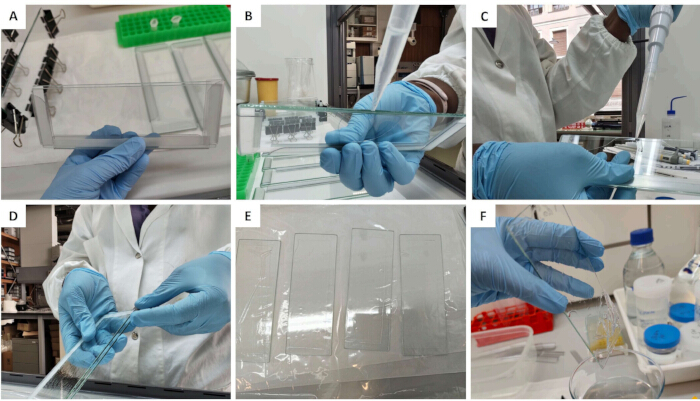
Figure 1: Polyacrylamide gel preparation critical steps. (A) Alignment of the glass plate assembly with ~1 mm offset. (B) Gel casting and (C) even spreading of the gel solution in the plate from the plate centre. (D) Levering the glass plate using a razor blade from the corner. (E) Soaking the gels to help detach them from the glass plate. (F) Washing off the gel into a beaker. Please click here to view a larger version of this figure.
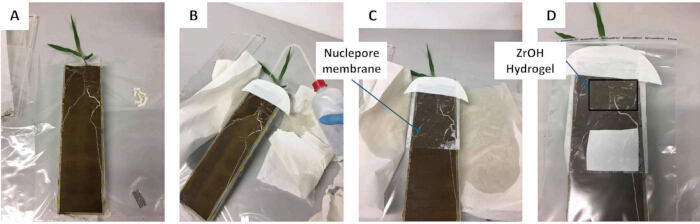
Figure 2: Root exudate sampling from a segment of rhizobox-grown plant root system using ZrOH hydrogels. (A) Open rhizobox after removing the front plate and plastic. (B) Appropriate wetting of the soil-root interface using deionized water in a wash bottle. (C) Nuclepore track-etch membrane attached to a wet soil-root interface. (D) Rhizobox with a ZrOH hydrogel applied to the region of interest, covered with plastic foil for gel protection against the front plate. Please click here to view a larger version of this figure.
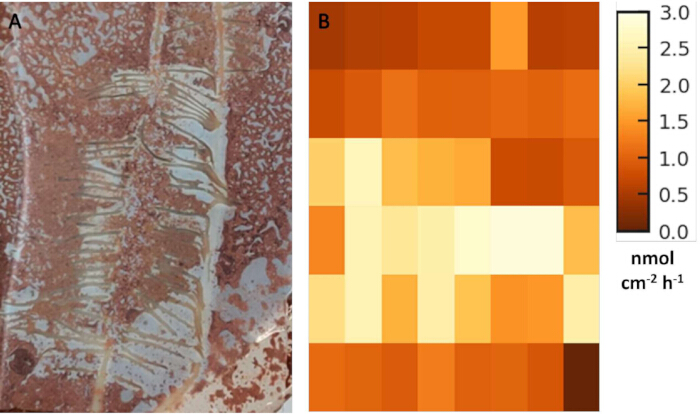
Figure 3: Root exudate sampling using ZrOH hydrogel and Millimeter-scale 2-D image of citrate exudation. (A) Photo of ZrOH hydrogel overlaid on the root region of interest during sampling to generate grids used for mapping. (B) Millimeter-scale 2D image showing the distribution of citrate exudation rate (nmol cm–2 gel h–1) a white Lupinus albus L. (lupin) cluster root grown in a phosphorus-deficient soil. Each grid represents a gel piece of 5 x 2 mm. Please click here to view a larger version of this figure.
| Plant | Treatment | Aconitate | Citrate | Fumarate | Lactate | Malate | Oxalate | Succinate |
| mg P kg-1 soil | nmol cm-2 h-1 | |||||||
| Lupin | 50 | 0.02 | 0.21 | 0.15 | 0.06 | |||
| Lupin | 250 | 0.02 | 0.4 | 0.17 | 0.02 | 0.2 | ||
| Lupin | 250 | 0.05 | 0.31 | 0.09 | 0.01 | 0.19 | ||
| Lupin | 0 | 0.03 | 0.21 | 0.15 | 0.02 | 0.1 | ||
| Rice (DJ123) | 250 | 0.01 | 0.24 | 0.04 | 0.02 | 0.1 | ||
| Rice (DJ123) | 250 | 0.01 | 0.39 | 0.12 | 0.1 | |||
| Rice (Nerica4) | 50 | 0.01 | 0.24 | 0.35 | 0.09 | |||
Table 1: Aconitate, citrate, fumarate, lactate, malate, oxalate, and succinate exudation rates of soil-grown Lupinus albus L. (lupin) and Oryza sativa L. (Rice) plants subjected to 0, 50, and 250 mg P kg-1 soil. LOQ is the limit of quantification
Supplementary Table 1: NaOH (1 mL, 0.5 mol L-1) elution parameters (elution efficiency and correction factor) and capacity of the ZrOH hydrogel for seven carboxylates. Data are means ± standard deviations of the mean (n = 4 for elution efficiency and capacity of individual carboxylates and n = 40 for carboxylate mixture).Please click here to download this file.
Supplementary Figure 1: Schematic representation of the recommended rhizobox for easier watering. The rhizobox consists of a rhizobox frame equipped with evenly spaced watering holes at the bottom and back to facilitate even water distribution during watering, and a removable transparent front plate for monitoring root growth during the experiment.Please click here to download this file.
Supplementary Figure 2: Rhizobox assembling and soil filling process. (A) Cover the holes on the back of the rhizobox frame with adhesive tape. (B) Attach a (nuclepore membrane), then plastic foil to the front or open side of the Rhizobox frame (ensure that it's tight enough and flat). (C) Place the front plate and clamp the rhizobox. (D) Fill the rhizobox while tilting it towards the front so that the finer particles fall on the removable surface to obtain a smooth surface, as in the picture. (E) Alternatively, fill the covered rhizobox frame (A) from the open side, level it with the removable plate, and then cover it with nucleopore membrane, plastic foil, and the front plate. (F) Final set-up of the Rhizobox, watered and planted. An alternative filling procedure is shown in Wagner et al. (2020).Please click here to download this file.
Supplementary File 1: The file includes details on the R script used to generate a heatmap.Please click here to download this file.
Discussion
The carboxylate sampling method described here employs ZrOH hydrogels, for which proper gel preparation and handling are critical. For handling ZrOH hydrogels, we recommend keeping them moist with a few drops of laboratory-grade water. During preparation, it is important to cast the gel promptly after preparing the gel mixture (step 1.1.3) and to ensure that no bubbles form between the glass plates. Bubbles located in the center of the ZrOH hydrogel are particularly critical, as they can interfere with sampling. In contrast, bubbles at the edges can be removed by trimming the gel before application. Furthermore, root-released carboxylates bind to the precipitated ZrOH in the hydrogels, making an even distribution of Zr during precipitation essential. Uneven Zr distribution within the gel can lead to lateral diffusion of carboxylates, which distorts their spatial distribution and compromises the reliability of 2D localization26. An even distribution of Zr can be accomplished by immersing the polyacrylamide gels in a ZrOCl2·8H2O solution for more than 2 h in a wider beaker and by placing fewer gels12 (step 1.2.3). Furthermore, Zr distribution can be verified using a scanning electron microscopy (SEM, S-3400N II, Hitachi, Japan) as recommended by Guan et al.14, who developed the ZrOH hydrogels. However, SEM is not feasible as a standard procedure for huge samples.
Another critical step concerns the rhizobox filling, nuclepore membrane application and watering before gel application for carboxylate sampling. Particular care must be taken when filling and handling sandy or heavy clay soils to ensure a uniformly smooth surface, which is essential for proper gel contact, while also maintaining well-drained conditions. A smooth surface is also essential for a proper attachment of the nuclepore membrane. It is crucial to establish good contact between the root and ZrOH hydrogel by ensuring that the nuclepore membrane correctly adheres to the soil surface with minimal air bubbles. Before the ZrOH gel application it is also crucial to saturate the soil properly so that the ZrOH hydrogel can be firmly attached, flat, and kept moist to preserve its integrity during sampling. When cutting the gel for 2D carboxylate mapping, achieving millimeter-precise cuts can be challenging; therefore, we recommend not going below a 2 x 2 mm resolution. Additionally, since the gels shrink upon drying, it is essential to keep them moist after sampling to preserve their integrity (step 3.12). The current method was adapted from Tiziani et al.12 who recommended the use of NaN3 as a microbial inhibitor to prevent the degradation of carboxylates. In this protocol, we do not use any microbial inhibitors, which are commonly used for sampling root exudates (NaN3 or micropur, an AgCl3-based material)23, due to their interference with the analytical methods and potential effects on the IC-MS system.
To date, the method has been validated solely for seven carboxylates (aconitate, citrate, fumarate, lactate, malate, oxalate, succinate), whereas the root exudome comprises a complex mixture of compounds (e.g., phenolics, amino acids, carbohydrates and carboxylates). These other important compounds are currently not accounted for in the method, nor have the ZrOH hydrogels been characterized for their sampling. The presence of other oxyanions in soil (such as phosphate, nitrate) may possibly affect carboxylate uptake, capacity and elution, as well as carboxylate quantification on IC or HPLC. Additionally, sampling very large whole root systems from bigger plants (e.g., trees or shrubs) can be very challenging due to the difficulties in producing very large ZrOH hydrogels (>30 cm). This is, however, an issue in all current exudate sampling techniques8. A further limitation is the use of rhizoboxes. Although plant growth in rhizoboxes is much more realistic than in hydroponic systems8, it remains an artificial setup, with limited three-dimensional space for root development33. Moreover, sampling occurs on a 2D surface, which could theoretically result in the loss of carboxylates exuded in other directions not in contact with the gels. However, this limitation could be mitigated by diffusion, a higher binding capacity of ZrOH hydrogels for the carboxylates, and the high-water content of the rhizosphere soil during application. However, additional validations are needed to determine these aspects.
The ZrOH hydrogel method of sampling root-released carboxylates offers several advantages over the commonly used methods (i.e., soil-hydroponic hybrid and hydroponic approaches). This novel approach allows in-situ sampling of carboxylates from undisturbed soil-grown root systems, time-resolved sampling (Santner, Mühlbacher et. al., unpublished data), and mm-scale 2D mapping. Besides, ZrOH hydrogels can be employed on roots for at least 24 h12. Also, repeated sampling of the same root segment over longer time-resolved periods should be possible. This method is much better developed and characterized than similar methods, such as the application of filter papers8. Sampling for a long period of time is possible with the ZrOH hydrogels due to a high gel capacity for carboxylates, for instance lowest at 0.44 µmol cm-2 ± 0.04 µmol cm⁻2 gel for malate to the highest of 1.66 µmol cm-2 ± 0.10 µmol cm⁻2 for succinate at pH 4.00 with a total of 3.29 µmol cm-2 ± 0.40 µmol cm⁻2 when the carboxylates are mixed (see Supplementary Table 1). Omitting the root washing step (which typically takes 20–30 minutes per plant) in the soil-hydroponic hybrid method significantly reduces root system damage and the associated bias, resulting in more realistic and representative data.
Notably, the loaded ZrOH hydrogels require no special storage conditions, only refrigeration, and we found no preconcentration necessary after elution in our applications so far. ZrOH hydrogels also bind other anions, which are eluted under the same conditions and can be analyzed by IC14,34. This allows linking carboxylate exudation to the spatial distribution of nutrients in the rhizosphere29.
In conclusion, this novel approach of sampling root-released carboxylates is a fundamental step for rhizosphere research. Since carboxylates play a crucial role in the mobilization and acquisition of plant nutrients (e.g., P, Fe)35,36, as well as the recruitment of beneficial microorganisms, this method could be used to screen varieties for root traits and plant breeding.
Disclosures
The authors declare that they have no known competing financial interests or personal relationships that could have influenced the work reported in this paper.
Acknowledgements
We acknowledge the financial support funded by the “Autonomous Province of Bolzano/Bozen – South Tyrol” (Joint Projects Südtirol-DFG 2023, D-SÜD, contract number 6/34, CUPI53C22003410003, DGT Exudates AG2222) and by the “Deutsche Forschungsgemeinschaft” (DFG, German Research Foundation, project number 525026426). We also acknowledge the financial support of the Open Access Publishing Fund of the Free University of Bozen-Bolzano. With profound sorrow, we also acknowledge the late Dr. Fabio Trevisan, whose dedication and expertise were essential in developing the analytical methods and advancing the DGT root exudates project.
Materials
| Name | Company | Catalog Number | Comments |
|---|---|---|---|
| Ethanol | Sigma-Aldrich | 70% | |
| Oxalic acid | Sigma-Aldrich | 194131-250G | 98% |
| trans-Aconitic acid | Sigma-Aldrich | 122750-25G | 98% |
| Zirconium dichloride oxide octahydrate (ZrOCl2 × 8H2O, 98%) | Thermo Scientific | A12342.22 | 98% |
| Citric acid | Sigma-Aldrich | C83155-500G | 99% |
| Sodium nitrate | VWR Chemicals | Lot No: 19H224150 | 100% |
| Nitric acid (HNO3) | Sigma-Aldrich | CAS-No: 7697-37-2 | >65% for analysis EMSURE® Reag. Ph Eur,ISO |
| Fumaric acid | Sigma-Aldrich | 240745-100G | >99% |
| Sodium hydroxide | Sigma-Aldrich | S8045-500G | ≥98% |
| Ammonium persulfate (APS_(NH4)2S2O8) | Thermo Scientific | 201531000 | ≥98.0%, extra pure, for electrophoresis |
| Succinic acid | Sigma-Aldrich | S3674-100G | ≥99% |
| 2-(N-morpholino)-ethanesulfonic acid (MES) Buffer | Sigma-Aldrich | M8250-250G | ≥99.5% |
| Sodium chloride | Sigma-Aldrich | 71376-1KG | ≥99.5% |
| Cross linker | DGT Research Ltd (Lancaster, UK) | na | 2%, agarose derivative |
| Plate or Horizontal shaker | Any | ||
| Ion chromatography or IC-MS | Thermo Fischer Scientific | na | Any high- or ultra-performance liquid chromatography (HPLC or UHPLC) can be employed in combination with various detectors, including advanced MS (e.g., time-of-flight or Orbitrap) or spectrophotometric detectors |
| pH meter | Any laboratory pH electrode can be used | ||
| Oven | Binder | na | Any small oven that maintain a particular temperature can be used, preferable a smaller one. |
| Nylon filters_13 mm 0.45 µM | GVS Filter Technology | Lot No: 7135431 | Bigger nylon filters can also be used, but smaller ones are preferred since the eluate volume is small. |
| Calcium sulfate dihydrate | Sigma-Aldrich | C3771-1KG /CAS-No: 10101-41-4 | CaSO4 can also be used. |
| Acrylamide solution, 40% | G-Biosciences | 786-508 | Do not use acrylamide solution that is mixed with Bis-acrylamide. Toxic compound that should be handled with care in a fumehood. |
| Rhizoboxes | https://www.rhizosphere.com/ | na | Our rhizoboxes are custom-made based on the design of the Rhizosphere.com |
| Polypropylene Vial kit, 1.5 mL | Thermo Scientific | 79812 | Plastic IC vials are preffered since they can be frozen without breaking. 330 µL can also be used but care must be taken to ensure that there is no air bubble |
| cis-Aconitic acid | Thermo Scientific | A16010.06 | tech. 85% |
| N,N,N’,N’- tetramethylethylenediamine (TEMED) | Sigma-Aldrich | Lot No: BCBN1173V | Toxic compound that should be handled with care |
| 250 mL PP vials | Sarstedt | Lot No:2406082 | |
| Aluminium foil | Local supermarket | na | |
| Beakers_1 L/ 2 L | |||
| Clamps | Local warehouse | na | |
| Glass plate (6.1 x 17 x 0.4 cm) | Local warehouse | na | |
| L-(-)-Malic acid | Sigma-Aldrich | M6413-25G | |
| Lactate standard for IC | Sigma-Aldrich | 07096-100ML | |
| Laminar flow bench | |||
| L-Lactic acid anhydrous | Thermo Scientific | L13242.14 | |
| Nuclepore Track-etch Membrane_0.2 µm | Cytiva | Lot No: A29983896 | |
| Plastic foil/plastic bags | Local warehouse | na | |
| Plastic tweezers | Semadeni | 602 | |
| Plexiglass plate | Local warehouse | na | |
| PP 30 mL vials | Aptaca spa | Lot No: 250552 | |
| PTFE spacer_0.25/0.4 mm | https://www.krishplasticindustries.com/teflon-sheet.html | ||
| Razor blades | Local warehouse | na | |
| Ruler | Local bookstore | na | |
| Sodium hypochlorite (NaClO) | CARLO ERBA Reagents | CAS-No: 7681-52-9 | |
| Syringes_1 mL | HENKE SASS WOLF (HENKE-JET) | Lot No: 22A17C8 | |
| Vinyl electrical tape | Local warehouse | na |