This study presents a spatial Trekker–CUT&Tag multiome protocol combining direct spatial barcoding of a tissue section with single-cell multiome analysis. This approach enables spatially resolved single-cell profiling of gene expression and the histone H3K27ac modification simultaneously, offering mechanistic insights into gene regulation in the context of tissue microanatomy.
Method Article
Spatially Resolved, Integrated Single-Cell Multiomic Profiling of the Transcriptome and Epigenomic Targets in Frozen Tissue Sections
In This Article
Summary
Abstract
Spatial multiomic technologies combined with single-cell profiling offer unprecedented opportunities to elucidate the molecular and cellular architecture of complex tissues. Combining spatial barcoding of nuclei within individual cryosections prepared from tissue blocks embedded in optimal cutting temperature (OCT) freezing medium with single-cell multiomic assays into a simple and efficient workflow can facilitate the annotation and spatially resolved molecular analysis of cells in tissue types. This study reports a spatial cleavage under targets & tagmentation (CUT&Tag) multiome approach that simultaneously profiles histone H3K27ac modification and gene expression in a single frozen brain section. Following spatial barcoding, single nuclei are isolated and subjected to CUT&Tag, combined capture of tagmented DNAs, RNAs, and spatial barcodes, library preparation, and sequencing. The workflow generates spatially annotated epigenomic and transcriptomic profiles from the same nuclei, enabling assignment of the multiomic information to anatomical coordinates. Integrating epigenomic information with spatial transcriptomic data increases the fidelity of cell-type identification and reveals spatially organized regulatory programs and cell-cell interactions within intact tissues.
Introduction
Spatial biology is a rapidly advancing field that maps the location, organization, and interactions of molecules, cells, and tissues within their native environments1,2,3. Unlike bulk or conventional single-cell methods that require tissue dissociation and result in loss of positional information, spatial approaches preserve the physical coordinates of analytes or cells/nuclei, enabling direct investigation of how tissue architecture influences cellular identity, intercellular communication, and biological function4,5,6,7. While spatial transcriptomics and spatial proteomics are currently the most widely adopted modalities, the field is rapidly expanding toward spatial multi-omic profiling3,8,9. Co-profiling gene expression and epigenomic states within the same tissue is especially powerful, as it directly links transcriptional output to regulatory mechanisms—such as chromatin accessibility and histone modifications—that govern gene activity and are known to vary across spatial domains10,11,12. Thus, integrated spatial epigenome and transcriptome analysis will provide critical insights into how regulatory programs shape cellular identity and tissue organization.
Several spatial multiomic strategies have been developed to enable simultaneous epigenomic and transcriptomic profiling. Deterministic barcoding in tissue sequencing (DBiT-seq) employs microfluidic channels to deliver spatial barcodes directly or indirectly, via stamping with gel slabs, to tissue sections, allowing for the spatial annotation of analytes. This approach facilitates spatially resolved co-profiling of epigenomic and transcriptomic features12,13,14,15. The Slide-tag method, commercialized as the Takara Trekker platform, directly introduces spatial barcodes into intact tissue prior to dissociation, allowing spatially indexed nuclei to be processed using standard single-cell workflows and computationally projected back to their original tissue coordinates16. In contrast, the spatial assay for accessible chromatin, cell lineages, and gene expression with sequencing (SPACE-seq) employs a target-out strategy in which poly(A)-tailed epigenetic targets and mRNAs are captured on a poly-dT capturing sequence in spatial transcriptomics tiles17.
Cleavage under targets & tagmentation (CUT&Tag) is a powerful tool for mapping interactions between DNA and histone or non-histone proteins from extremely low input samples18. CUT&Tag relies on Tn5 transposase-mediated chromatin fragmentation and DNA tagging (tagmentation), employing antibody-guided, protein A-conjugated Tn5 for locus-specific cleavage and molecular tagging. While the conventional CUT&Tag assay involves multiple incubation and wash steps, a simplified and streamlined CUT&Tag workflow was utilized to enhance CUT&Tag efficiency in downstream single-cell multiome applications19.
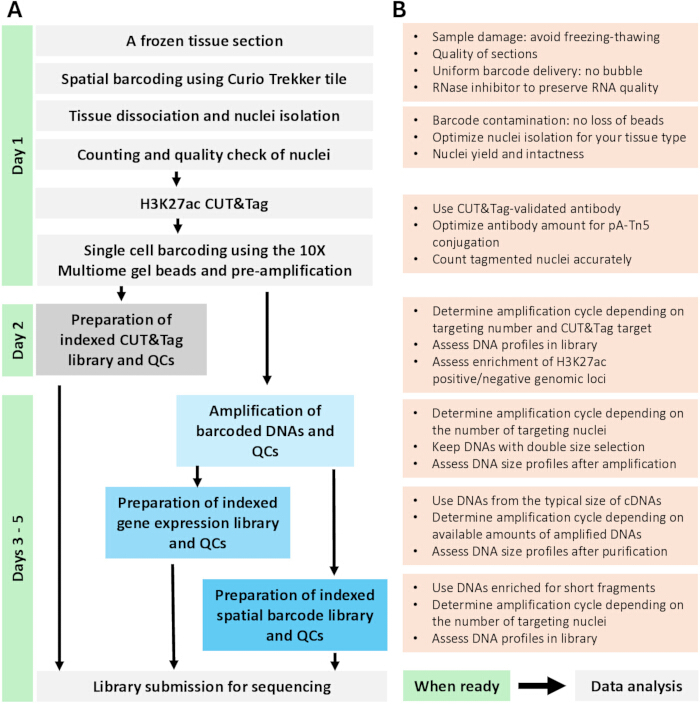
Figure 1: Workflow and quality control overview of the spatial Trekker–CUT&Tag multiome assay. (A) Schematic diagram of the spatial Trekker–CUT&Tag multiome workflow. A coronal section of fresh-frozen mouse brain tissue is mounted onto a Trekker spatial tile and subjected to spatial barcoding. Following tissue lysis, nuclei are isolated and assessed for yield and quality. Approximately 50,000 nuclei are used for H3K27ac CUT&Tag, and tagmented nuclei are subjected to single-cell barcoding by using 10x Genomics Chromium Multiome gel beads after counting. Single-cell barcoded DNA is pre-amplified and divided into two fractions. The indexed CUT&Tag library is generated directly by index PCR. For gene expression and spatial barcode libraries, pre-amplified DNA is further amplified and size-selected. Fragments corresponding to typical cDNA sizes are used for gene expression library preparation, while shorter DNA fragments are used to generate the spatial barcode library. Libraries are sequenced and mapped following 10x Genomics and Curio Trekker guidelines. The expected experimental timeline is indicated on the left. (B) Key quality control (QC) checkpoints and critical considerations throughout the workflow. Nuclei QC includes assessment of yield, intactness, aggregation, and debris content. Pre-sequencing QC includes evaluation of DNA size distributions and primer dimer contamination for all libraries. CUT&Tag library specificity is assessed by quantitative PCR (qPCR), measuring enrichment of target genomic regions over background. Please click here to view a larger version of this figure.
This study presents a spatial Trekker CUT&Tag multiome assay that simultaneously profiles histone H3K27ac modification associated with active cis-regulatory elements and gene expression in fresh-frozen tissue sections. This protocol provides step-by-step procedures for Takara Trekker spatial barcoding, tissue dissociation and nuclei isolation, nuclei counting and quality control, low-input CUT&Tag profiling of the H3K27ac modification, capture of molecular targets on 10x Genomics single-cell Multiome gel beads, and library preparation. The workflow was demonstrated using a coronal section of mouse brain tissue. Unlike the standard 10x Genomics Multiome workflow, in which chromatin accessibility is measured by assay for transposase-accessible chromatin with high-throughput sequencing (ATAC-seq), this protocol substitutes CUT&Tag-derived DNA fragments for ATAC fragments, enabling direct interrogation of histone modification landscapes at single-cell resolution. To link Trekker spatial barcodes with 10x Genomics single-cell barcodes, poly(A)-tailed spatial barcodes and mRNA transcripts are captured by the poly-dT sequences of the Multiome gel beads, while CUT&Tag DNA fragments are captured by the spacer sequences. This dual-capture strategy enables simultaneous recovery of epigenomic, transcriptomic, and spatial information from the same single nuclei. To our knowledge, this is the first spatial multiomic workflow that directly integrates barcode-in Trekker spatial annotation with a single-cell multiome assay to co-profile a histone mark’s genome-wide distribution and the transcriptome. The resulting spatially resolved multiome landscapes, integrating H3K27ac occupancy and gene expression data, enable projection of single-cell profiles back to their original tissue coordinates and provide a direct link between epigenomic regulatory mechanisms and transcriptional programs in relation to the intact tissue architecture.
Protocol
Adult mice were euthanized by CO2 inhalation (IACUC #: A48315-15-R24) before tissue harvest. Brains were removed in toto after sagittal craniotomy and removal of the halved calvaria. The reagents and the equipment used are listed in the Table of Materials.
1. Mounting a tissue section onto the Trekker barcode tile for spatial barcoding
- Prepare the following before starting.
- Equilibrate the optimal cutting temperature (OCT)-embedded tissue block in a cryostat before sectioning. Prepare the buffers for UV cleavage, tissue dissociation, and nuclei isolation.
NOTE: The optimal temperature for sectioning may vary depending on the tissue type. - For nuclei isolation, prechill the centrifuge with swing buckets for 1.5 mL tubes to 4 °C. Prechill a 12-well plate with a Trekker O-ring on ice.
- Set the UV meter to the max current limit (1.2 A) and max power.
- Equilibrate the optimal cutting temperature (OCT)-embedded tissue block in a cryostat before sectioning. Prepare the buffers for UV cleavage, tissue dissociation, and nuclei isolation.
- Record the spatial barcode tile ID (e.g., U0001_001) of the Trekker tile to be used.
NOTE: Each Trekker tile contains unique barcode coordinates. The tile ID is required to retrieve the correct file for spatial barcode mapping of the sequencing data. - Section the tissue. Coronal sectioning of 25-µm thickness at the approximate position of bregma -1 mm was performed at −18 °C (Figure 1A).
NOTE: The thickness may be increased to 30 µm when working with tissues of low cellularity. - Position the section (or the region of interest) onto the spatial tile and melt it by gently placing a finger on the bottom of the slide glass.
CAUTION: If necessary, check the procedures through the nuclei quality control measurements using the Trekker training tile. - Use tweezers to remove the tile from the clear adhesive and place it in a well of a 12-well tissue culture plate on ice on top of the Trekker O-Ring. Immediately pipette 30 µL of Trekker UV cleavage buffer onto the tile, making sure the entire tissue is covered in buffer.
- Place the UV lamp (1.2 A setting) on the plate directly above the well. Illuminate for 1 min to release the barcodes while keeping everything on ice.
CAUTION: Wear protective UV glasses when working with the UV lamp. - Turn off the UV lamp and incubate the tile on ice for 7.5 min. During incubation, take out a Trekker 10 x 10 wash chamber and fill chambers 1 and 2 with 400 µL of cold Trekker nuclei wash buffer for a sample on ice.
- Carefully pick the tile up with tweezers without touching the beads and wash the tile in chamber 1 for 5 s. Wash the tile in chamber 2 for 5 s. Carefully place the tile in a well in the 12-well plate on ice. The tissue section should be stained blue and easily visible.
2. Tissue dissociation and nuclei isolation
- Dispense 175 µL of Invent Minute buffer A aiming at the tissue. Repeat 3 more times to make a total of 700 µL. With each dispensing, aim at different parts of the tile to detach the entire tissue from the tile.
NOTE: Avoid bead contamination from scratching the tile or from beads falling off. - Continue to dissociate the tissue from the tile by aspirating the buffer from the side of the well and dispensing it onto the regions of the tile covered by tissue, keeping the plate on ice as much as possible. Repeat until no tissue remains on the tile. Once all tissue has been removed from the tile, carefully use tweezers to transfer the tile to an empty well.
- Use a P1000 pipette to mechanically dissociate nuclei with repeated trituration in the same well. Repeat until no visible tissue chunks remain.
- Carefully transfer the nuclei suspension to a filter cartridge with a collection tube from the Invent Minute single-nucleus isolation kit for neuronal tissues/cells. Incubate the tube with the cap open at –20 °C for 10 min. Cap the filter cartridge and immediately centrifuge at 13,000 x g for 30 s in a refrigerated microcentrifuge.
- Discard the filter cartridge and resuspend the pellet by gently pipetting 10–20 times. Spin the tube in the prechilled centrifuge with swing buckets at 600 x g for 5 min. Carefully remove the supernatant and resuspend the pellet in 200 µL of Trekker buffer C.
- Add 1 mL of cold Invent Minute buffer B to a 1.5 mL low-binding Eppendorf tube and carefully overlay 200 µL of nuclei suspension on top of the Minute buffer B by slowly expelling against the wall of the tube to avoid mixing of the layers. Spin the tube in the prechilled centrifuge with swing buckets at 500 x g for 10 min. Carefully remove the milky layer and supernatant.
- Gently resuspend the nuclei with 24 µL of Trekker buffer C and proceed to quality control measurements of isolated nuclei.
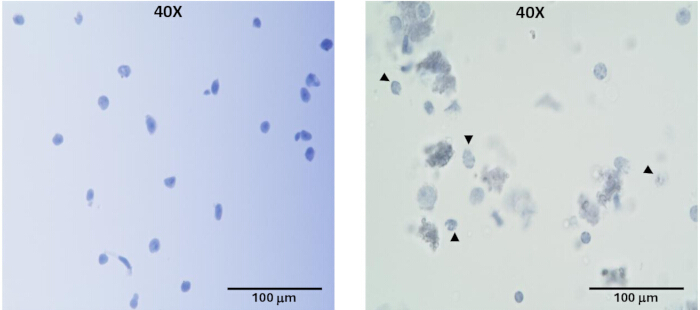
Figure 2: Quality control assessment of isolated nuclei. Representative brightfield images of isolated nuclei from mouse brain tissue. Nuclei were stained with 0.4% Trypan blue and imaged at 40x magnification to assess nuclear integrity and the presence of debris. The nuclei preparation shown on the left displays high-quality, intact nuclei suitable for downstream assays, whereas the preparation shown on the right illustrates poor-quality nuclei with partially lysed tissue aggregates. Damaged or ruptured nuclei are indicated by filled arrowheads. Scale bar is 100 µm. Please click here to view a larger version of this figure.
3. Counting and QC measurements of isolated nuclei
- For nuclei counting, take 2 µL of the nuclei suspension into 8 µL of Trekker buffer C. Mix 10 µL of the diluted nuclei suspension with 10 µL of AO/PI staining solution. Count the nuclei according to the manufacturer’s instructions.
- To assess the quality of isolated nuclei, dilute 2 µL of the nuclei suspension into 8 µL of 4% trypan blue solution. Examine the nuclei under the fluorescence microscope at 40X magnification, checking for intact morphology of nuclear membrane and non-nuclear debris content (Figure 2).
- Proceed immediately to single-nucleus CUT&Tag multiome (CUT&Tag on H3K27ac + gene expression) assay.
CAUTION: Proceed to the next steps if at least 30,000 high-quality nuclei are recovered.
4. CUT&Tag tagmentation on isolated nuclei
- Prepare CUT&Tag incubation buffer I. Place it on ice.
- Prepare primary antibody and transposase activated by guidance (TAG) enzyme conjugate.
- Add 46.23 µL of CUT&Tag incubation buffer I and 1.33 µL of TAG enzyme to a PCR tube on ice. Add an optimized amount of primary antibody to the tube. Slowly mix by pipetting 10 times.
NOTE: 2.43 µL of anti-H3K27ac antibody was added to the reaction. The antibody lot was validated for bulk and in-situ CUT&Tag assays. Optimize the amount of antibody for TAG enzyme conjugation by bulk assay. The optimal antibody was defined as the lowest concentration that achieved maximal signal-to-noise, as determined by qPCR at positive and negative target loci. - Spin briefly and place the tube onto an 18 rpm rotator. Incubate at room temperature for 1 h. The resulting mixture can be pre-made and placed on ice for up to 5 h.
NOTE: Antibody-TAG incubation may be performed concurrently with or in advance of nuclei isolation.
- Add 46.23 µL of CUT&Tag incubation buffer I and 1.33 µL of TAG enzyme to a PCR tube on ice. Add an optimized amount of primary antibody to the tube. Slowly mix by pipetting 10 times.
- Incubation of isolated nuclei with antibody-TAG enzyme conjugate.
- Spin the tube (Step 2.7) of isolated nuclei in the prechilled centrifuge with swing buckets at 500 x g for 10 min. Remove the supernatant without disturbing the pellet and leave behind ~5 µL of supernatant.
- Add 25 µL of CUT&Tag incubation buffer I (Step 4.1) and resuspend by gently pipetting 10 times. Transfer the nuclei to the tube (Step 4.2.2) containing antibody-TAG conjugate using the same pipette tip. Mix gently by pipetting 10 times and place the tube onto a gentle rotator.
- Incubate overnight at 4 ˚C.
- On the next day (Day 2), prepare 1X CUT&Tag nuclei buffer and place on ice.
- CUT&Tag tagmentation
- Retrieve the reaction tube (Step 4.3.3) from the rotator. Add 5 µL of CUT&Tag activator and transfer the mixture into a new 1.5 mL tube. Incubate for 1 h at 37 ˚ C on the ThermoMixer at 550 rpm.
- Retrieve the tube, add 20 µL of CUT&Tag quench buffer, and gently mix the reaction by pipetting 10 times. Centrifuge the tube in the prechilled centrifuge with swing buckets at 500 x g for 10 min. Remove the supernatant without disturbing the nuclei pellet, leaving ~5 µL of supernatant at the bottom of the tube.
- Add 100 µL of 1X CUT&Tag nuclei buffer and resuspend the nuclei by gently pipetting 10 times. Spin the tube in the prechilled centrifuge with swing buckets at 500 x g for 10 min. Remove 85 µL of the supernatant, leaving behind ~15 µL. Resuspend the nuclei by gently and slowly pipetting 10 times.
- Counting tagmented nuclei and determination of targeting number
- Add 1 µL of the tagmented nuclei suspension into 9 µL of phosphate-buffered saline and mix with 10 µL of AO/PI staining solution. Count tagmented nuclei as described in Step 3.1.
- Use 1.6x the target number of nuclei for single-cell GEM generation to obtain the desired number of captured nuclei.
- Spin the tube in the prechilled centrifuge with swing buckets at 500 x g for 10 min and carefully remove the supernatant, leaving a final volume of 8 µL.
5. Single-cell barcoding of tagmented nuclei and pre-amplification of barcoded DNAs
- Add 7 µL of ATAC buffer B to 8 µL of the tagmented nuclei with the expected number of targeting nuclei for your experiment.
NOTE: See more details on reaction setups and operation of the Chromium X instrument in the “GEM Generation & Barcoding” protocol of the Chromium Next GEM Single-Cell Multiome ATAC + Gene Expression Kit User Guide (CG000338 Rev G). - GEM generation and barcoding using the Chromium X instrument.
- Add 60 µL of GEM master mix to the tube containing tagmented nuclei. Gently mix by pipetting and load onto row 1 of the Chromium Next GEM chip J.
- Prepare Single-Cell Multiome gel beads and load 50 µL of Gel beads onto row 2. Dispense 45 µL of partitioning oil into the wells in row 3.
- Place the assembled chip J with the gasket into the tray of the Chromium X instrument and run the instrument.
- Slowly aspirate 100 µL of GEMs from the lowest points of the recovery wells in the top row 3. Slowly dispense GEMs into the new PCR tube on ice with the pipette tips against the sidewalls of the wells.
- Incubate the collected GEMs in a thermal cycler (lid temperature at 50˚C) with the following protocol: one cycle of 37 ˚C for 45 min, one cycle of 25 ˚C for 30 min, and 4 ˚C for hold.
- Add 5 µL of quenching agent and slowly mix by pipetting 10 times.
- Cleanup of post-GEM incubation and DNA purification
NOTE: See more details in the “Post GEM Incubation Cleanup” protocol of the Chromium Next GEM Single-Cell Multiome ATAC + Gene Expression Kit User Guide (CG000338 Rev G).- Add 125 µL of pink-colored recovery agent to the tube at room temperature and gently invert the tube 10 times. Centrifuge briefly. Slowly remove and discard 125 µL of recovery agent/partitioning oil (pink) from the bottom of the tube.
- Add 200 µL of Dynabeads cleanup mix to the tube and mix by pipetting 10 times. Incubate 10 min at room temperature. Place the tube on the magnetic stand until the solution clears. Remove the supernatant.
- Add 300 µL of freshly prepared 80% ethanol to the pellet. Incubate 30 s and remove the supernatant. Add 200 µL of 80% ethanol to the pellet, incubate 30 s, and remove the supernatant. Spin the tube briefly and place it on the magnet. Remove the remaining supernatant.
- Remove the tube from the magnet. Immediately add 50.5 µL of elution solution I. Mix by pipetting and incubate for 1 min at room temperature. Spin briefly and place the tube on the magnet until the solution clears. Transfer 50 µL of cleared solution to a new tube.
- DNA purification by paramagnetic beads
- Add 90 µL of paramagnetic beads (1.8X) to each sample and mix by pipetting thoroughly. Incubate 5 min at room temperature. Spin briefly and place the tube on the magnet until the solution clears. Remove the supernatant.
- Add 200 µL of 80% ethanol to the pellet. Incubate for 30 s. Remove the ethanol. Repeat this one more time.
- Spin briefly and place the tube on the magnet. Remove the remaining supernatant.
- Remove the tube from the magnet. Add 46.5 µL of buffer EB and mix by pipetting. Incubate 2 min at room temperature. Spin and place it on the magnet until the solution clears.
- Transfer 46 µL of purified DNAs to a new tube.
- Pre-amplification of barcoded DNAs.
- Add 54 µL of Pre-amplification mix to each sample. Pipette mix and centrifuge briefly.
- Incubate in a thermal cycler (lid temperature at 105 °C) with the following protocol: one cycle of 72 °C for 5 min; one cycle of 98 °C for 3 min; a total of 7 cycles of 98 °C for 20 s, 63 °C for 30 s, 72 °C for 1 min; one cycle of 72 °C for 1 min; and a hold at 4 °C. Store at 4 °C overnight.
- On the next day (Day 3), purify pre-amplified DNAs by paramagnetic beads (1.6X) as described in Step 5.3.5. Add 80.5 µL of buffer EB to the tube and mix by pipetting. Incubate 2 min at 22 °C (room temperature). Spin briefly and place the tube on the magnet until the solution clears.
- Transfer 80 µL of pre-amplified DNAs to a new tube. Use 40 µL to generate the CUT&Tag library. Store the remaining pre-amplified DNAs at 4 °C.
NOTE: 40 µL of the remaining pre-amplified DNAs will be used later for gene expression and spatial barcode libraries.
6. Library preparation for CUT&Tag, gene expression, and spatial barcodes
- Preparation of scCUT&Tag library
- Transfer 40 µL of pre-amplified DNAs to a new tube and add 60 µL of sample index PCR mix. Mix by pipetting and spin briefly.
- Incubate in a thermal cycler (lid temperature at 105 °C) with the following protocol: one cycle of 98 °C for 45 s; a total of 12 cycles of 98 °C for 20 s, 67 °C for 30 s, 72 °C for 20 s; one cycle of 72 °C for 1 min; 4 °C for hold).
NOTE: The optimal cycle number is dependent on the starting number of nuclei and the histone mark being profiled. Twelve amplification cycles were used for the H3K27ac mark in the experiment. - Double size selection and DNA purification by paramagnetic beads (0.6X, 1.55X)
- Add 60 µL of paramagnetic beads (0.6X) to each sample and mix by pipetting thoroughly. Incubate 5 min at room temperature. Spin briefly and place the tube on the magnet until the solution clears.
- Transfer 150 µL of supernatant to a new tube. Add 95 µL of paramagnetic beads (1.55X) to each sample (supernatant) and mix by pipetting. Incubate 5 min at room temperature. Place the tube on the magnet until the solution clears. Remove the supernatant.
- Add 300 µL of 80% ethanol to the pellet. Wait 30 s. Remove the ethanol. Repeat it one more time. Spin briefly and place the tube on the magnet. Remove the remaining supernatant.
- Remove the tube from the magnet. Add 20.5 µL of buffer EB to tube and mix by pipetting. Incubate 2 min at room temperature. Spin and place it on the magnet until the solution clears.
- Transfer 20 µL of purified and indexed CUT&Tag libraries to new tubes.
- QC check for CUT&Tag library
- Analysis of DNA size distribution in the library
- Mix 1 µL of purified library DNA with 1 µL of low TE buffer.
- Mix the diluted DNA with Fragment Analyzer working buffer and run on the instrument with the High-sensitivity HS NGS Fragment Kit (1-6000bp) (Figure 3A).
- Assess the enrichment of an H3K27ac-positive genomic locus before sequencing and mapping.
- Mix 1 µL of purified library DNA with 4 µL of nuclease-free water. Use 1 µL of diluted library DNA for qPCR measurements for three genomic loci.
NOTE: For H3K27ac CUT&Tag, the positive primer was designed from the Actb-TSS locus, while primers targeting the T1-TSS and an intergenic locus served as negative controls20 (Table 1). Mouse genomic DNA was used as an input control to normalize PCR efficiency (Figure 3B). - Prepare a total of 20 µL of the reaction mix as follows: 1 µL of diluted library DNA, 2 µL of 10 µM primer mix, 10 µL of 2X SYBR Green Master Mix, and 7 µL of nuclease-free water.
- Run the prepared qPCR plate on the CFX Opus Real-Time PCR System using the appropriate cycling program for SYBR Green detection.
- Mix 1 µL of purified library DNA with 4 µL of nuclease-free water. Use 1 µL of diluted library DNA for qPCR measurements for three genomic loci.
- Analysis of DNA size distribution in the library
- Amplification of cDNAs and spatial barcode DNAs.
- Transfer 35 µL of pre-amplified DNAs (Step 5.4.4) to a new tube and add 65 µL of cDNA amplification reaction mix. Mix by pipetting and spin briefly. The primer used for cDNA and spatial barcode DNA amplification is Feature cDNA Primers 2.
- Incubate in a thermal cycler (lid temperature at 105 °C) with the following protocol: one cycle of 98 °C for 45 s; a total of 8 cycles of 98 °C for 20 s, 63 °C for 30 s, 72 °C for 1 min; one cycle of 72 °C for 1 min; 4 °C for hold.
NOTE: The optimal cycle number must be determined based on the cell type, RNA content, and the starting number of nuclei. In this experiment, 8 amplification cycles were performed. - Purification of amplified cDNAs
- Double size selection and DNA purification by paramagnetic beads (0.6X, 2.0X) as described in Step 6.1.3. Add 60 µL of paramagnetic beads (0.6X) to each sample and mix by pipetting. Incubate 5 min at room temperature. Place the magnet on the solution until it clears.
- Transfer and save 75 µL of supernatant in a new tube without disturbing the pellet. Maintain at room temperature.
CAUTION: Do not discard the supernatant, as it contains DNA enriched for shorter fragments that will be used to generate the spatial barcode library. - Remove the remaining supernatant from the pellet. Wash with 80% ethanol two times as described in Step 6.1.3.
- Add 40.5 µL of buffer EB to the tube and mix by pipetting. Incubate 2 min at room temperature. Spin briefly and place on the magnet until the solution clears.
- Transfer 40 µL of amplified cDNAs to a new tube. Save it on ice to prepare indexed gene expression library.
NOTE: This fraction enriches the DNAs for typical size of cDNAs.
- Purification of amplified spatial barcode DNAs
- Add 70 uL of paramagnetic beads (2.0X) to 75 µL of the previously saved supernatant (Step 6.3.3.2. Mix by pipetting and spin briefly. Incubate for 5 min at room temperature. Place the tube on the magnet until the solution clears. Remove the supernatant.
- Wash with 80% ethanol two times as described in Step 6.1.3.
- Add 40.5 µL of buffer EB to the tube and mix by pipetting. Incubate 2 min at room temperature. Spin briefly and place on the magnet until the solution clears.
- Transfer 40 µL of amplified and purified spatial barcode DNAs to a new tube. Store at −20 °C for subsequent generation of the indexed spatial barcode library.
- Analysis of cDNA sizes by the Fragment Analyzer. Mix 1 µL of amplified cDNAs with 1 µL of low TE buffer. Run the diluted DNAs by Fragment Analyzer as described in Step 6.2.1.
- Preparation of indexed gene expression library
- Transfer 10 µL of amplified cDNAs (Step 6.3.3.5) to a new tube. Add 25 µL of buffer EB and 15 µL of fragmentation mix. Mix by pipetting on ice. Spin briefly and transfer the tube into the pre-cooled thermal cycler at 4 °C.
- Incubate in a thermal cycler (lid temperature at 65 °C) by initiating the following protocol: one cycle of 32 °C for 5 min; one cycle of 65 °C for 30 min; 4 °C for hold.
- Double size selection and DNA purification by paramagnetic beads (0.6X, 0.8X) as described in Step 6.1.3. Add 50.5 µL of buffer EB and mix by pipetting. Incubate 2 min at room temperature. Spin briefly and place on the magnet until the solution clears.
- Transfer 50 µL of sample to a new tube. Add 50 µL of adaptor ligation mix and mix by pipetting. Spin briefly. Incubate in a thermal cycler (lid temperature at 30 °C) with the following protocol: one cycle of 20 °C for 15 min and 4 °C for hold.
- DNA purification by paramagnetic beads (0.8X) as described in Step 5.3.5. Add 30.5 µL of buffer EB and mix by pipetting. Incubate 2 min at room temperature. Spin briefly and place on the magnet until the solution clears. Transfer 30 µL of the sample to a new tube.
- Index PCR of gene expression library. Add 50 µL of amp mix and add 20 µL of an individual dual index TT set A to each sample.
- Incubate in a thermal cycler (lid temperature at 105 °C) with the following protocol: one cycle of 98 °C for 45 s; a total of 11 cycles of 98 °C for 20 s, 54 °C for 30 s, 72 °C for 20 s; one cycle of 72 °C for 1 min; 4 °C for hold.
NOTE: The optimal cycle number needs to be determined based on the cell type, RNA content, and starting number of nuclei. In this experiment, a total of 11 amplification cycles was used. - Double size selection and DNA purification by paramagnetic beads (0.6X, 0.8X) as described in Step 6.1.3. Add 35.5 µL of buffer EB to the tube and mix by pipetting. Incubate 2 min at room temperature. Spin briefly and place on the magnet until the solution clears.
- Transfer 35 µL of purified and indexed gene expression library to a new tube.
- Analysis of DNA size distribution in the gene expression library. Mix 1 µL of library DNAs with 1 µL of low TE buffer. Run the diluted DNAs as described in Step 6.2.1. (Figure 3A).
- Preparation of indexed spatial barcode library
- Prepare a total of 100 µL of the sample index PCR mix as follows: 50 µL of Amp Mix (from GEM-X Single-Cell 3' Feature Barcode Kit, 25 µL of Buffer EB, 20 µL of primer from Dual Index Plate TT Set A, and 1 µL of purified spatial barcode DNAs (Step 6.3.4.4) diluted in 4 µL of EB buffer.
- Incubate in a thermal cycler (lid temperature at 105 °C) with the following protocol: one cycle of 98 °C for 45 s; a total of 7 cycles of 98 °C for 20 s, 54 °C for 30 s, 72 °C for 20 s; 72 °C for 1 min; 4 °C for hold.
- DNA purification by paramagnetic beads (1.2X) as described in Step 5.3.5. Add 35.5 µL of EB buffer to the tube and mix by pipetting. Incubate 2 min at room temperature. Place the tube on the magnet until the solution is clear.
- Transfer 35 µL of purified and indexed spatial barcode library DNAs to a new tube. Store at 4 °C for up to 72 h or at −20 °C for long-term storage.
- Check distribution of DNA sizes in the indexed spatial barcode library. Mix 1 µL of purified library DNA with 1 µL of low TE buffer. Run the diluted DNAs by Fragment Analyzer as described in Step 6.2.1 (Figure 3A).
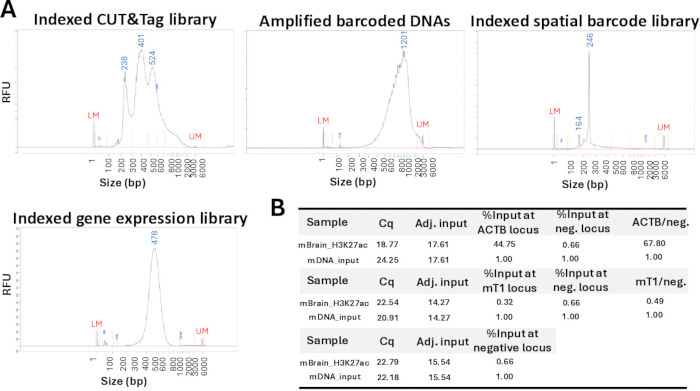
Figure 3: Quality control assessments of indexed libraries. (A) Size profiles in amplified DNAs and indexed libraries. DNA is analyzed by a Fragment Analyzer to assess DNA quality and size distribution. Shown are representative profiles for the indexed CUT&Tag library, amplified DNA used for gene expression and spatial barcode library preparation, indexed gene expression library, and indexed spatial barcode library. (B) The CUT&Tag library is analyzed by qPCR to assess the enrichment of an H3K27ac-positive genomic region (i.e., ACTB) over the H3K27ac-negative background signal (i.e., T1 and an intergenic locus). The fold difference between positive/negative regions is calculated as enrichment21. A fold enrichment greater than 10 is considered ideal in this assay20. Please click here to view a larger version of this figure.
7. Sequencing of the libraries
- Sequence the Trekker spatial barcode library at a depth of 5,000 read pairs per nucleus captured.
- Sequence the H3K27ac CUT&Tag library at a depth of 25,000 read pairs per nucleus captured.
- Sequence the gene expression library at a depth of at least 20,000 read pairs per nucleus captured.
8. Bioinformatics and data analysis
- Process gene expression and CUT&Tag reads using Cell Ranger ARC v2.0.2 with --min-atac-count=100 and --min-gex-count=1000. Integrate Cell Ranger ARC outputs with Trekker barcode information using Trekker pipeline v1.3.0 with default parameters to assign spatial positions.
- Perform quality control using Signac. Cells meeting any of the following criteria were removed from downstream analysis: for CUT&Tag, total fragment count ≥ 1,000,000 or ≤ 100, and TSS enrichment ≤ 2; for gene expression, total UMI count ≥ 100,000 or ≤ 1,000, and the total number of detected genes ≥ 10,284 or ≤ 200.
- Remove doublets using scDblFinder for gene expression and AMULET for CUT&Tag. Cells meeting any of the following criteria were classified as doublets: (1) scDblFinder score ≥ 0.6; (2) scDblFinder score ≥ 0.3 and AMULET ≤ 0.01; and (3) in clusters with a high % of doublets.
- Normalize gene expression data using LogNormalize and CUT&Tag data using TF-IDF. Compute RNA PCA and CUT&Tag LSI embeddings, using LSI dimensions 2–50 for the chromatin modality. Construct a weighted nearest neighbor graph using FindMultiModalNeighbors and generate UMAP embeddings based on the multimodal neighbor graph.
- Annotate post-QC Trekker data using Seurat label transfer based on FindTransferAnchors and a PCA projection mapping strategy with default parameters. scRNA-seq data from the ABC Atlas (version 20230630) were used as a reference. Cell type predictions inconsistent with known tissue anatomy were removed during manual curation.
NOTE: The scripts for bioinformatics analysis are available on GitHub: https://github.com/Liuy12/Mouse_Brain_Trekker_Multiome_Cuttag
Results
Using a coronal section (25 µm thickness, approximately 70% coverage of a 10 × 10 mm spatial tile) of fresh-frozen mouse brain tissue, the workflow described here consistently yielded 50,100 high-quality nuclei (SD = 12,200, n = 8), sufficient for downstream single-cell multiomic profiling (Figure 1). Following Trekker spatial barcoding of the tissue section, nuclei were isolated using gentle tissue dissociation and further purified with the Invent single-nucleus isolation kit. This procedure resulted in minimal debris and low levels of nuclear aggregation, producing nuclei preparations suitable for single-cell assays. Representative images of the isolated nuclei are shown in Figure 2.
For downstream single-nucleus assays, including CUT&Tag multiome profiling (CUT&Tag + gene expression), approximately 50,000 nuclei were typically processed here. To maximize nuclear recovery, a simplified, streamlined low-input CUT&Tag protocol was implemented by using direct antibody–pA/Tn5 targeting and tagmentation, thereby minimizing incubation times and wash steps19. Using this approach, approximately 25,000 tagmented nuclei were recovered, corresponding to an average yield of 48.3% (SD = 6.1, n = 3). These nuclei were subsequently used for single-cell barcoding with the 10x Genomics Chromium Multiome gel beads. For GEM generation, approximately 15,000 nuclei were targeted with the expectation of recovering ~10,000 spatially indexed nuclei after quality filtering. Based on Trekker spatial barcode decoding, 81.3% of nuclei (SD = 9, n = 3) from the single-cell dataset could be confidently assigned to spatial positions within the tile.
The spatial Trekker–CUT&Tag multiome workflow generates three indexed libraries: CUT&Tag, gene expression, and spatial barcode libraries. Pre-amplified barcoded DNA was divided into two fractions, each used for library preparation according to the capture chemistry of targets on the gel beads. CUT&Tag libraries were directly amplified from pre-amplified DNA and displayed fragment size distributions characteristic of CUT&Tag tagmentation corresponding to nucleosome-free and nucleosomal DNAs (Figure 3A). The library showed a good enrichment of the H3K27ac-positive Actb locus over the H3K27ac-negative genomic loci20,21(i.e., 68-fold difference, exceeding the 10-fold cutoff previously established for chromatin immunoprecipitation-sequencing analysis of H3K27ac20) (Figure 3B). For gene expression and spatial barcode libraries, pre-amplified DNA was first amplified following the 10x Genomics cDNA amplification protocol and then separated into two fractions based on fragment size using paramagnetic bead purification. The indexed spatial barcode library was prepared from the fraction enriched for shorter fragments and exhibited a sharp peak at the expected fragment size. Gene expression libraries showed a characteristic size distribution centered around amplified cDNA fragments (Figure 3A).
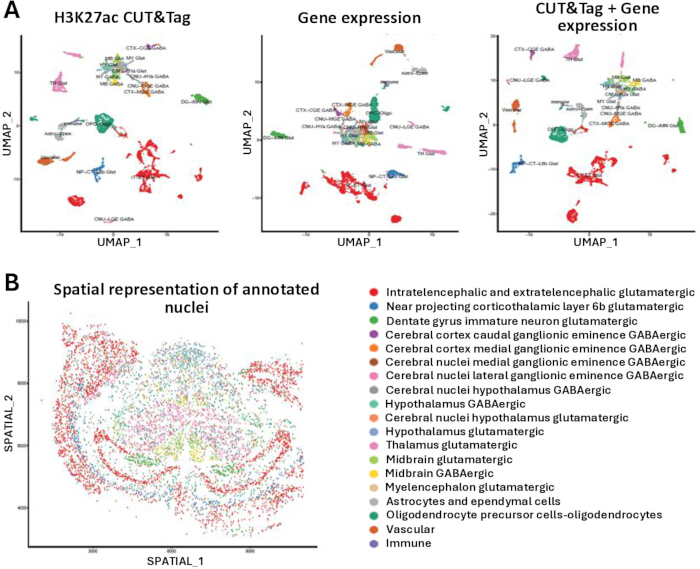
Figure 4: Single-cell and spatial representation of the spatial Trekker–CUT&Tag multiome assay in mouse brain tissue. (A) Identification of cell types by single-cell analysis. Uniform manifold approximation and projection (UMAP) plots show annotated cell populations derived from H3K27ac CUT&Tag alone, gene expression alone, and the integrated multiome dataset (CUT&Tag + gene expression). (B) Spatial representation of spatial Trekker–CUT&Tag multiome data. Nuclei from the integrated multiome dataset are assigned to spatial coordinates using Trekker barcodes, revealing anatomically organized distributions of cell types across the mouse brain tissue section. Please click here to view a larger version of this figure.
Sequencing and mapping of CUT&Tag and gene expression libraries were performed by using Cell Ranger ARC v2.0.2 following 10x Genomics guidelines, while spatial barcode libraries were processed by using Trekker v1.3.0 according to Takara Trekker recommendations. The suggested single-cell ATAC-seq mapping options were applied to CUT&Tag libraries. Single-nuclei datasets were generated for CUT&Tag alone, gene expression alone, and the combined multiome (CUT&Tag + gene expression). Cells with total UMIs for either CUT&Tag (≥ 1,000,000 or ≤ 100) or gene expression (≥ 100,000 or ≤ 1000) were filtered out by using Signac22. Doublet prediction was performed by using a combination of scDblFinder23 for gene expression and AMULET24 for CUT&Tag. Cells meeting one of the following criteria were removed: 1) scDblFinder.score > 0.6; 2) scDblFinder.score between 0.3 and 0.6, and amulet.score < 0.01. Cell type annotation was performed using Seurat’s FindTransferAnchors25 based on the reference data26 from Allen Brain Cell Atlas. For the gene expression library in this study, the median UMI count per cell was 15,378, and the median number of genes per cell was 4,378. For the CUT&Tag library, 11,860 cells were detected, with a median of 6,631 high-quality fragments per cell and a TSS enrichment score of 7.66. For the Trekker spatial barcode library, 92.43% of nuclei were assigned spatial positions, and 51.54% of nuclei were assigned to a single spatial location. Raw sequencing data and processed data from secondary analyses are available through GEO under accession number GSE327406. The final post-QC annotated Seurat object is available on Zenodo under accession number 19475899. Representative UMAP embeddings with cell-type annotations are shown in Figure 4A. By linking single-cell barcodes with spatial barcodes, individual nuclei were assigned back to their spatial locations within the tissue to generate a spatial map (Figure 4B). This map closely matches the anatomical features observed in adjacent sections and aligns with a coronal brain section in the Allen Brain Atlas27, a standard reference for mouse brain anatomy. Joint analysis of spatial gene expression and H3K27ac profiles at single-cell resolution enabled the identification of major brain cell types and revealed anatomically organized patterns of cellular distribution across the tissue section.
Discussion
This protocol describes a spatial Trekker–CUT&Tag multiome workflow that integrates spatial barcoding, low-input CUT&Tag profiling of H3K27ac, simultaneous capture of multiple molecular targets on the 10x Genomics single-cell multiome gel beads, and downstream library preparation for Illumina sequencing. By coupling spatial indexing with single-cell epigenomic and transcriptomic readouts, this approach addresses a fundamental limitation of conventional single-cell multiome assays, which lack native tissue context. This study successfully demonstrates the feasibility of spatial CUT&Tag multiome profiling (H3K27ac CUT&Tag + gene expression) and establishes a foundation for spatial co-profiling of gene expression and regulatory targets such as histone marks and chromatin-associated proteins.
Rigorous quality control at multiple stages of the workflow is essential for the successful implementation of this workflow (Figure 1). Although the procedure described here begins with post-sectioning steps, the quality of the tissue section itself is critical for optimal results. Section thickness should be adjusted based on tissue type and expected cellularity. During tissue dissociation and nuclei isolation, maximizing nuclei yield while preserving nuclear integrity is critical for the overall performance of Trekker-based single-cell multiome assays. Low nuclei yield may result from suboptimal tissue dissociation, inefficient nuclei isolation, or insufficient section thickness. Poor nuclear integrity can arise from excessive mechanical disruption, prolonged processing times, or overlysis. Nuclei isolation represents a major troubleshooting point for the successful implementation of the Trekker-based single-cell multiome workflow. Therefore, tissue-specific optimization of the nuclei isolation protocol is strongly recommended prior to initiating the Trekker-based single-cell multiome assay. Isolated nuclei should be assessed quantitatively and qualitatively. Nuclei counting using nuclear dyes provides an estimate of yield, while microscopic examination allows evaluation of nuclear membrane integrity, aggregation, and the presence of non-nuclear debris. Following library preparation, all libraries should be assessed for fragment size distributions and the absence of adapter dimers. For CUT&Tag libraries, enrichment of target genomic regions over background should be evaluated by quantitative PCR, providing an early indication of assay specificity and overall library quality prior to sequencing. Post-sequencing quality control is equally important for accurate interpretation of spatial multiome data. Metrics such as mapping rates, fragment counts per nucleus, transcription start site enrichment, fragment-in-peak scores for CUT&Tag, gene complexity, and per-cell read depth should be evaluated following the recommended guidelines from 10x Genomics and Takara Trekker. Joint assessment of these metrics across both epigenomic and transcriptomic modalities enables identification of technical artifacts and ensures reliable integration of spatial, epigenomic, and transcriptional information.
While the feasibility of the Trekker-based barcode-in approach combined with a single-cell CUT&Tag multiome assay is demonstrated in this study, the described approach also has limitations. For example, the method is currently restricted to fresh-frozen tissue, and its feasibility has only been demonstrated for the profiling of a single histone modification (H3K27ac) in a single tissue type (mouse brain) without biological replicates. Furthermore, the approach depends on two proprietary commercial platforms (Takara Trekker and 10x Genomics Next GEM Chromium Single Cell Multiome). Further evaluation across diverse tissue types and additional epigenetic marks will be necessary to assess the broader applicability, performance, generalizability, and reproducibility of this technology.
In summary, the spatial Trekker–CUT&Tag multiome protocol presented here demonstrates the capability for spatially resolved single-cell co-profiling of epigenomic and transcriptomic features. By combining spatial barcoding with established single-cell multiome chemistry, it enables mechanistic investigation of gene regulation within intact tissue architecture and offers a powerful platform for future spatial biology applications. Notable potential uses include the assessment of the impact of various experimental and environmental stimuli on the epigenetic control of gene expression in specific cell types—for example, the effects of nerve stimulations could be analyzed in specific neuron types in the central and peripheral nervous systems, or the impact on nearby cells of infiltrating pro- and anti-inflammatory immune cells could be revealed in inflammatory diseases and cancers.
Disclosures
The authors have nothing to disclose.
Acknowledgements
This work was supported in part by National Institutes of Health grants R01 DK142826 (T.O.), R01 DK121766 (Y.H.), R01 DK126827 (T.O.), R01 DK131455 (T.O.; MPI), P30 DK084567 (T.O.: Epigenomics and Spatial Biology Core, Mayo Clinic Center for Cell Signaling in Gastroenterology), and the Mayo Clinic Presidential Strategic Initiative Fund (T.O.). The funding agencies had no role in study design, data analysis, or manuscript preparation. The content is solely the responsibility of the authors.
Materials
| Name | Company | Catalog Number | Comments |
|---|---|---|---|
| 0.4% Trypan Blue | Invitrogen | T10282 | Diluted from 4% Trypan Blue solution (Invitrogen, T10282) |
| 10% Tween 20 | Bio-Rad | 1662404 | |
| 10X Genomics Chromium X instrument | 10X Genomics | 1000331 | RRID:SCR_024537 |
| 12-well plates | Thermo Fisher | 150200 | |
| 1X CUT&Tag Nuclei Buffer | 10x Genomics | Prepared using 20X Nuclei buffer | To make a total of 110 µL, mix 5.5 µL of 20X Nuclei Buffer (10X Genomics) + 8.25 µL of RNAse inhibitor + 1.1 µL of 100 mM DTT + 95.15 µL of Nuclease-free water |
| 20X Nuclei Buffer | 10x Genomics | 2000207 | |
| 4% Trypan Blue solution | Invitrogen | T10282 | |
| 5200 Fragment Analyzer | Advanced Analytical | M5310AA | |
| ABC atlas | open-source | N/A | Developer: Allen Institute for Brain Science (Seattle, WA) RRID:SCR_024440 |
| Activator | Epigenome Technology | CF1006 | |
| Adaptor Ligation Mix | 10X Genomics | Prepared using Ligation buffer, Enzyme, Oligos | To make a total of 50 ul Adaptor ligation mix, mix 20 uL of Ligation buffer + 10 uL of DNA ligase + 20 uL of Adaptor oligos |
| Adaptor Oligos | 10X Genomics | 2000094 | |
| Amp Mix | 10X Genomics | 2000047 | |
| Amulet | open-source | N/A | Developers: Ucar Lab (The Jackson Laboratory) RRID: N/A |
| Anti-H3K27ac antibody | EpiCypher | 13-0059 | The antibody lot is validated for bulk and in-situ CUT&Tag assay RRID:AB_3712075 |
| ATAC Buffer B | 10X Genomics | PN-2000193 | |
| Buffer EB | Qiagen | 19086 | |
| cDNA Amplification Reaction Mix | 10X Genomics | prepared using Pre-Amp Mix and Primers 2 | To make a total of 65 uL of cDNA Amplification Mix, mix 50 uL of Amp Mix + 15 uL of Feature cDNA Primers 2 |
| Cell Ranger Arc v2.0.2 | 10X Genomics | N/A | RRID:SCR_023897 |
| CFX Opus Real-Time PCR System | Bio-Rad | 12011319 | |
| Chromium Next GEM Chip J | 10X Genomics | PN 2000264 | |
| Chromium Next GEM Single Cell Multiome Gel Bead Kit | 10X Genomics | PN-1000231 | |
| Chromium Next GEM Single Cell Multiome GEM Kit | 10X Genomics | PN-1000232 | The kit includes the following items: Barcoding Reagent Mix, Barcoding Enzyme Mix, Template Switch Oligo, Reducing Agent B, Cleanup Buffer, and Quenching Agent |
| Chromium Recovery Agent | 10X Genomics | 220016 | |
| Cleanup Buffer | 10X Genomics | 2000088 | |
| Cryostat | Leica Biosystem | CM1860 | |
| DNA Ligase | 10X Genomics | 220110 | |
| DNA LoBind 1.5 mL tubes | Eppendorf | 22431021 | |
| Dual Index TT Set A | 10X Genomics | PN-3000431 | |
| Dynabeads™ MyOne™ SILANE to make Dynabeads Cleanup Mix | 10X Genomics | PN-2000048 | To make a total of 200 uL of Dynabead Cleanup mix, mix 182 uL of Cleanup buffer + 13 uL of Dynabeads Myone SILANE + 5 uL of Reducing Agent B |
| Elution Solution I | 10X Genomics | Prepared using Buffer EB | To make a totla of 100 uL Elution Solution I, mix 98 uL of Buffer EB + 1 uL of 10% Tween 20 + 1 uL of Reducing Agent B |
| Feature cDNA Primers 2 | 10X Genomics | 2000097 | |
| Fragmentation Buffer | 10X Genomics | 2000091 | |
| Fragmentation Enzyme | 10X Genomics | 2000090 | |
| Fragmentation Mix | 10X Genomics | Prepared using Fragemntation Buffer and Enzyme | To make a total of 15 uL of Fragmentation mix, mix 5 uL of Fragementation buffer + 10 uL of Fragmentation enzyme |
| Gasket, 6-pack | 10X Genomics | 370017 | |
| GEM Master Mix | 10X Genomics | PN-1000232 | From the Chromium Next GEM Single Cell Multiome GEM Kit (PN-1000232). To make a total of 60 µL of GEM Mater Mix, mix 49.5 µL of Barcoding Reagent Mix + 1.1 µL of Template Switch Oligo + 1.9 µL of Reducing Agent B + 7.5 µL of Barcoding Enzyme Mix |
| GEM-X Single-Cell 3' Feature Barcode Kit | 10X Genomics | PN 2000047 | |
| High Sensitivity NGS Fragment Analysis Kit | Advanced Analytical | DNF-474 | |
| Incubation Buffer | Epigenome Technology | CF1001 | To prepare a total of 100 µL of CUT&Tag incubation buffer I, mix 90.5 µL of Incubation Buffer (CF1001, Epigenome Technology) with 1.5 µL permeabilizer, 0.5 µL stabilizer, and 7.5 µL RNase inhibitor |
| Invent Minute buffer A | Invent Biotechnologies, Inc | BN-020 | From the Minute Single Nucleus Isolation Kit ( Cat. BN-020). To make a total of 800 µL of Minute buffer A, mix 786.4 µL Minute Buffer A+13.6 µL RNAse Inhibitor (Takara Bio) |
| Invent Minute Buffer B | Invent Biotechnologies, Inc | BN-020 | From the Minute Single Nucleus Isolation Kit ( Cat. BN-020) |
| KEYENCE Fluorescence Microscope | KEYENCE CORPORATION | BZ-X810 | RRID:SCR_025160 |
| Ligation Buffer | 10X Genomics | 2000092 | |
| Low TE Buffer (10 mM Tris-HCl pH 8.0, 0.1 mM EDTA) | Thermo Fisher Scientific | 12090-015 | |
| Minute Filter cartridges /collection tubes | Invent Biotechnologies, Inc | BN-020 | From the Minute Single Nucleus Isolation Kit ( Cat. BN-020) |
| Minute Single Nucleus Isolation Kit for Neuronal Tissues/Cells | Invent Biotechnologies, Inc | BN-020 | The kit includes the following items; Minute Buffer A, Minute Buffer B, Minute Filter cartridges /collection tubes |
| Nexcelom Cellometer K2 | Revvity | CMT-K2-MX-150 | RRID:SCR_025529 |
| Nuclease-free Water | Thermo Fisher Scientific | AM9937 | |
| Optimal Cutting Temperature (OCT) compound | Sakura Finetek USA | 4583 | |
| Partitioning Oil | 10X Genomics | 2000190 | |
| Permeabilizer | Epigenome Technology | CR1003 | |
| Pre-Amp Mix | 10X Genomics | 2000270 | |
| Pre-Amp Primers | 10X Genomics | 2000271 | |
| Pre-Amplification Mix | 10X Genomics | Prepared using Pre-Amp Mix and Primers | To makes a total of 54 uL Pre-Amplification Mix, mix 50 uL of Pre-Amp Mix + 4 uL of Pre-Amp Primers |
| Quench Buffer | Epigenome Technology | CF1007 | |
| Quenching Agent | 10X Genomics | PN-2000269) | |
| Reducing Agent B | 10X Genomics | 2000087 | |
| Sample Index PCR Mix for CUT&Tag library | 10X Genomics | Prepared using Pre-Amp Mix, SI-PCR Primer B, and index N | To make a total of 60 uL Sample Index PCR Mix, mix 50 uL of Pre-Amp Mix + 7.5 uL of SI-PCR Primer B + 2.5 uL of individual Sample Index N, Set A (PN-3000427) |
| Sample index PCR mix for spatial barcode library | 10X Genomics | Prepared using Pre-Amp Mix and Index Plate TT Set A | To make a total of 75 uL of Sample idex PCR mix, mix 50 uL of Amp mix + 25 uL of Buffer EB + 1 μL of amplified barcode DNAs + 20 μL of an Dual Index Plate TT Set A (PN-3000431) |
| Sample Index Plate N, Set A | 10X Genomics | 3000427 | |
| scDblFinder | open-source | N/A | Developers: Germain Lab (ETH Zurich / University of Zurich) RRID:SCR_022700 |
| Seurat | open-source | N/A | Developers: Satija Lab (New York Genome Center) RRID:SCR_016341 |
| SI- PCR Primer B | 10X Genomics | 2000128 | |
| Signac | open-source | N/A | Developers: Satija Lab (New York Genome Center) RRID:SCR_021158 |
| SPRIselect Reagent Kit, paramagnetic beads | Beckman Coulter | B23318 | |
| SsoAdvanced™ Universal SYBR® Green Supermix | Bio-Rad | 1725271 | |
| Stabilizer | Epigenome Technology | CR1005 | |
| T100 Thermal Cycler | Bio-Rad | 1861096 | |
| TAG Enzyme | Epigenome Technology | CR1018 | |
| Trekker 10x10 O-Rings | Takara Bio | LC036 | |
| Trekker 10x10 Reagent Pouch | Takara Bio | K009 | RNase Inhibitor |
| Trekker 10x10 Tile Masking Stickers | Takara Bio | LC023 | |
| Trekker 10x10 Wash Chambers | Takara Bio | RC002 | |
| Trekker buffer C (1 X PBS with 5% BSA) | Takara Bio | K008 | From the Reagent Box 1 (Cat. K008). To make a total of 300 µL Trekker buffer C, mix 245.7 µL 1X PBS +50 µL 30% BSA + 4.3 µL RNAse Inhibitor (Takara Bio) |
| Trekker Nuclei Wash Buffer | Takara Bio | K008 | From the Reagent Box 1 (Cat. K008) |
| Trekker pipeline v1.3.0 | Curio Bioscience | N/A | Developers: Ucar Lab (The Jackson Laboratory) RRID: N/A |
| Trekker Reagent Box 1 | Takara Bio | K008 | The Reagent Box 1 includes the following items; Nuclei Isolation Buffer, Nuclei Wash Buffer, BSA |
| Trekker starter kit bundle (UV lamp) | Takara Bio | K011A | |
| Trekker U 10x10 Tiles | Takara Bio | UP008 | |
| Trekker UV Cleavage Buffer | Takara Bio | K008 | To make a total of 36 µL UV cleavage buffer, mix 27 µL of Nuclei Wash buffer (box 1) + 9 µL of 0.4% Trypan Blue |
| ViaStain AOPI Staining Solution | Revvity | CS2-0106 | |
| Custom primer sequence | Comments/Description | Name | |
| 5'-CCCGGCAAGCCGAATAGGCA-3' | H3K27ac-positive | Ch-mActb-F | |
| 5'-ACCAGACGCTACGATCACGCC-3' | Ch-mActb-R | ||
| 5'-GAGACGCCGATCCGCCGAAG-3' | H3K27ac-negative | Ch-mT1-F | |
| 5'-ACTCTCCACTCCCACGCGCT-3' | Ch-mT1-R | ||
| 5'-CCTGCTGCCTTGTCTCTCTC -3' | H3K27ac-negative | Ch-mInter-neg-F | |
| 5'-ATGGCCTAGGGATTCCAGCA -3' | Ch-mInter-neg-R |
References
- Ståhl, P. L., et al. Visualization and analysis of gene expression in tissue sections by spatial transcriptomics. Science. 353 (6294), 78-82 (2016).
- Asp, M., et al. Spatial detection of fetal marker genes expressed at low level in adult human heart tissue. Sci Rep. 7 (1), 12941 (2017).
- Larsson, L., Frisén, J., Lundeberg, J. Spatially resolved transcriptomics adds a new dimension to genomics. Nat Methods. 18 (1), 15-18 (2021).
- Rodriques, S. G., et al. Slide-seq: A scalable technology for measuring genome-wide expression at high spatial resolution. Science. 363 (6434), 1463-1467 (2019).
- Moffitt, J. R., et al. Molecular, spatial, and functional single-cell profiling of the hypothalamic preoptic region. Science. 362 (6416), eaau5324 (2018).
- Kleshchevnikov, V., et al. Cell2location maps fine-grained cell types in spatial transcriptomics. Nat Biotechnol. 40 (5), 661-671 (2022).
- Liu, X., et al. Spatial multi-omics: deciphering technological landscape of integration of multi-omics and its applications. J Hematol Oncol. 17 (1), 72 (2024).
- Marx, V. Method of the Year: spatially resolved transcriptomics. Nat Methods. 18 (1), 9-14 (2021).
- Zhu, C., Preissl, S., Ren, B. Single-cell multimodal omics: the power of many. Nat Methods. 17 (1), 11-14 (2020).
- Klemm, S. L., Shipony, Z., Greenleaf, W. J. Chromatin accessibility and the regulatory epigenome. Nat Rev Genet. 20 (4), 207-220 (2019).
- Mimitou, E. P., et al. Scalable, multimodal profiling of chromatin accessibility, gene expression, and protein levels in single cells. Nat Biotechnol. 39 (10), 1246-1258 (2021).
- Deng, Y., et al. Spatial-CUT&Tag: Spatially resolved chromatin modification profiling at the cellular level. Science. 375 (6581), 681-686 (2022).
- Liu, Y., et al. High-Spatial-Resolution Multi-Omics Sequencing via Deterministic Barcoding in Tissue. Cell. 183 (6), 1665-1681.e18 (2020).
- Zhang, D., et al. Spatial epigenome-transcriptome co-profiling of mammalian tissues. Nature. 616 (7955), 113-122 (2023).
- Lee, C. N., Fu, H., Cardilla, A., Zhou, W., Deng, Y. Spatial joint profiling of DNA methylome and transcriptome in tissues. Nature. 646 (8087), 1261-1271 (2025).
- Russell, A. J. C., et al. Slide-tags enable single-nucleus barcoding for multimodal spatial genomics. Nature. 625 (7993), 101-109 (2024).
- Huang, Y. H., et al. Unified molecular approach for spatial epigenome, transcriptome, and cell lineages. Proc Natl Acad Sci U S A. 122 (16), e2424070122 (2025).
- Kaya-Okur, H. S., et al. CUT&Tag for efficient epigenomic profiling of small samples and single cells. Nat Commun. 10 (1), 1930 (2019).
- Xie, Y., et al. Droplet-based single-cell joint profiling of histone modifications and transcriptomes. Nat Struct Mol Biol. 30 (10), 1428-1433 (2023).
- Caride, A., et al. Titration-based normalization of antibody amount improves consistency of ChIP-seq experiments. BMC Genomics. 24 (1), 171 (2023).
- Zhong, J., et al. Enhanced and controlled chromatin extraction from FFPE tissues and the application to ChIP-seq. BMC Genomics. 20 (1), 249 (2019).
- Stuart, T., Srivastava, A., Madad, S., Lareau, C. A., Satija, R. Single-cell chromatin state analysis with Signac. Nat Methods. 18 (11), 1333-1341 (2021).
- Germain, P. L., Lun, A., Garcia Meixide, C., Macnair, W., Robinson, M. D. Doublet identification in single-cell sequencing data using scDblFinder. F1000Res. 10, 979 (2021).
- Thibodeau, A., et al. AMULET: a novel read count-based method for effective multiplet detection from single nucleus ATAC-seq data. Genome Biol. 22 (1), 252 (2021).
- Butler, A., Hoffman, P., Smibert, P., Papalexi, E., Satija, R. Integrating single-cell transcriptomic data across different conditions, technologies, and species. Nat Biotechnol. 36 (5), 411-420 (2018).
- Yao, Z., et al. A high-resolution transcriptomic and spatial atlas of cell types in the whole mouse brain. Nature. 624 (7991), 317-332 (2023).
- Wang, Q., et al. The Allen Mouse Brain Common Coordinate Framework: A 3D Reference Atlas. Cell. 181 (4), 936-953.e20 (2020).
Reprints and Permissions
