This bibliometric analysis used CiteSpace, VOSviewer, and Scimago Graphica to evaluate publication trends, collaboration networks, and emerging research hotspots in T-lymphocyte metabolic reprogramming research from 2016 to 2025.
A subscription to JoVE is required to view this content. Sign in or start your free trial.
Research Article
Bibliometric Analysis of Metabolic Reprogramming In T Lymphocytes Reveals Research Trends And Emerging Hotspots, 2016-2025
* These authors contributed equally
In This Article
Summary
Abstract
T lymphocytes are central regulators of immune responses, and recent studies have shown that metabolic processes influence T-lymphocyte activation, differentiation, and effector function in cancer and autoimmune diseases. This study performed a bibliometric analysis of publications from January 1, 2016, to December 31, 2025, retrieved from the Web of Science Core Collection. CiteSpace was used for co-occurrence, co-citation, and clustering analyses of references and keywords. VOSviewer was applied to analyze journals, authors, references, countries, and institutions, while Scimago Graphica visualized national collaboration networks and Excel was used to evaluate annual publication trends. A total of 1,882 publications were included. Annual publication output increased steadily, with notable growth observed in 2021 and 2025. China contributed the highest publication volume, whereas the United States demonstrated greater citation impact. Frontiers in Immunology was the most productive journal, while Nature showed the highest citation influence. Keyword clustering and citation analyses identified evolving research hotspots focused on T-lymphocyte metabolic reprogramming, glucose and amino acid metabolism, and emerging interest in immune-cell metabolic interactions. Overall, this bibliometric analysis demonstrates continued expansion of research in T-lymphocyte immunometabolism and highlights emerging thematic directions, including intercellular metabolic regulation and lipid metabolism.
Introduction
Naïve T lymphocytes primarily rely on mitochondrial oxidative phosphorylation (OXPHOS) to maintain their quiescent and low-energy metabolic state1. Upon antigen stimulation, however, activated T lymphocytes undergo a metabolic shift toward aerobic glycolysis to support rapid proliferation and effector function2. Effector T lymphocytes, particularly cytotoxic subsets, depend on glycolysis to meet the increased bioenergetic and biosynthetic demands associated with cytokine production and cellular expansion3. Although glycolysis produces less adenosine triphosphate (ATP) per glucose molecule than OXPHOS, its rapid metabolic rate supports the functional requirements of activated immune cells4. Excessive glycolytic activity may also contribute to detrimental effects within the immune microenvironment. Lactate accumulation can impair glucose-derived serine synthesis and alter intracellular redox balance, thereby suppressing T-lymphocyte proliferation and function5. In addition, elevated lactate levels disrupt glycolysis-dependent migration pathways and reduce the motility of CD4⁺ and CD8⁺ T lymphocytes6,7.
Cellular metabolism dynamically adapts to environmental and physiological stimuli through a process known as metabolic reprogramming8,9. Increasing evidence indicates that metabolic reprogramming plays a central role in regulating T-lymphocyte activation, differentiation, and functional plasticity10,11. These metabolic alterations are particularly relevant in cancer and autoimmune diseases, where changes in the immune microenvironment influence T-lymphocyte function and immune regulation12,13. Although several bibliometric studies have evaluated immunometabolism in broader contexts, including cancer immunometabolism and disease-associated immune metabolism, these analyses mainly focus on generalized immune-metabolic interactions rather than T-lymphocyte-specific metabolic reprogramming14,15. A comprehensive bibliometric evaluation dedicated specifically to T-lymphocyte immunometabolism remains limited, particularly with respect to research trends, collaboration networks, and evolving thematic hotspots within this field.
To address this gap, this study performed a bibliometric analysis of publications indexed in the Web of Science Core Collection (WOScc) from January 1, 2016 to December 31, 2025. CiteSpace, VOSviewer, and Scimago Graphica were used to quantitatively analyze publication output, collaboration patterns, co-citation relationships, and thematic evolution in T-lymphocyte metabolic reprogramming research. Unlike traditional narrative reviews, bibliometric analysis provides a structured and data-driven overview of the scientific landscape through citation, clustering, and keyword analyses. The objective of this study was to systematically characterize global research trends and emerging hotspots in T-lymphocyte immunometabolism and to provide an organized overview of the current knowledge landscape in this rapidly evolving field.
Access restricted. Please log in or start a trial to view this content.
Protocol
This study exclusively analyzed bibliographic data retrieved from publicly accessible databases and did not involve human participants, animals, or identifiable personal data; therefore, institutional ethics approval and informed consent were not required.
Data Collection and Search Strategy
Data were extracted from the WoSCC (https://www.webofscience.com/wos/woscc/) on January 27, 2026. The database editions selected were the Science Citation Index Expanded (SCI-EXPANDED) and Social Sciences Citation Index within WoSCC. The search was conducted using the Advanced Search interface. The search strategy was applied in the “Topic (TS)” field, and the complete search query and resulting records are presented in Table 1. The search period was restricted to publications indexed between January 1, 2016 and December 31, 2025 using the WoSCC “Timespan” filter. Only original research articles and review articles were included using the “Document Types” filter. The language was restricted to English, and no restrictions were applied regarding country, institution, or research area. All records were exported in plain text format with “Full Record and Cited References” selected during export. When the number of retrieved records exceeded 500, records were downloaded in multiple batches and subsequently merged into a single dataset prior to analysis. After retrieval, all records were imported into CiteSpace for preprocessing and bibliometric analysis. Duplicate records were identified and removed using the built-in deduplication function in CiteSpace based on bibliographic metadata, including title, authors, publication year, and source journal. When potential inconsistencies or incomplete bibliographic records were identified, manual verification was additionally performed to ensure data accuracy and consistency before analysis.
| Set | Results | Search Query |
| #1 | 252,461 | TS=("T cell*" OR "T-cell*" OR "T lymphocyte*" OR "T-lymphocyte*" OR "T-lymph*" OR "CD4+ T cell*" OR "CD8+ T cell*" OR "cytotoxic T cell*" OR "regulatory T cell*" OR "Treg*" OR "T helper cell*" OR "Th cell*" OR "naive T cell*" OR "memory T cell*" OR "effector T cell*") |
| #2 | 13,799 | TS=("metabolic reprogram*" OR "metabolic remodel*" OR "metabolic rewiring") |
| #3 | 1,882 | #1 AND #2 |
Table 1: Web of Science Core Collection search strategy used for bibliometric data retrieval. The table summarizes the detailed search strategy, keyword combinations, Boolean operators, and final retrieval counts used for literature collection from the WoSCC. Searches were performed using the “Topic (TS)” field in the Advanced Search interface. Wildcards (*) were used to retrieve multiple word endings and related terminology. The final dataset consisted of publications indexed between January 1, 2016 and December 31, 2025 after application of language and document-type filters.
Analytical Approaches
A multitool bibliometric approach was systematically implemented for data analysis. The analysis was conducted in a Windows 10 operating system environment. CiteSpace (v.5.7.R2) was used to analyze references and keywords by processing TXT-format data exported from WoSCC. The CiteSpace parameters were configured as follows: (1) time slicing was set from 2016 to 2025 with one year per slice; (2) selection criteria were configured using the g-index (k = 25); (3) pruning methods included Pathfinder, Pruning Sliced Networks, and Pruning the Merged Network to simplify network structures while preserving key relationships; and (4) clustering analysis was performed using the log-likelihood ratio algorithm16. This analysis generated co-citation networks, clustering maps, timeline visualizations, and burst detection maps for both references and keywords. In the visualization maps, node size represented frequency, link thickness indicated co-occurrence strength, and purple rings represented high betweenness centrality. Burst nodes reflected a sudden increase in citation or keyword frequency over time.
Subsequently, the exported files were re-saved in UTF-8 encoding using Windows Notepad and imported into VOSviewer (version 1.6.20) for bibliometric mapping, including co-authorship, co-citation, and co-occurrence analyses across authors, journals, institutions, and countries17. The full-counting method was applied, and normalization was performed using the association-strength method. Minimum occurrence thresholds were established according to dataset size (authors ≥ 5 publications; keywords ≥ 5 occurrences; institutions ≥ 3 publications). Network visualization was based on item weight and total link strength. For country-level collaboration analysis, GML files exported from VOSviewer were imported into Scimago Graphica (version 1.0.53), where nodes represented countries. Network visualization and clustering were generated using the default force-directed layout algorithm to represent spatial relationships and collaboration patterns among countries. WPS Excel was used for descriptive statistical analysis of annual publication trends and basic data summarization. Results were visualized using bar charts, column charts, and line graphs.
A supplementary time-sliced analysis was performed using the same search strategy described above, with the search restricted to publications indexed between January 1, 2025 and December 31, 2025. Within the same WoSCC query framework and analytical environment, recent publications and conference-related outputs were retrieved for contextual and descriptive purposes. This procedure was conducted entirely within the built-in analytical interface of the WoSCC. No independent dataset was created, and the retrieved information was not integrated into the primary bibliometric dataset or used for quantitative analysis. The overall study design and bibliometric analysis workflow are summarized in a flowchart (Figure 1).
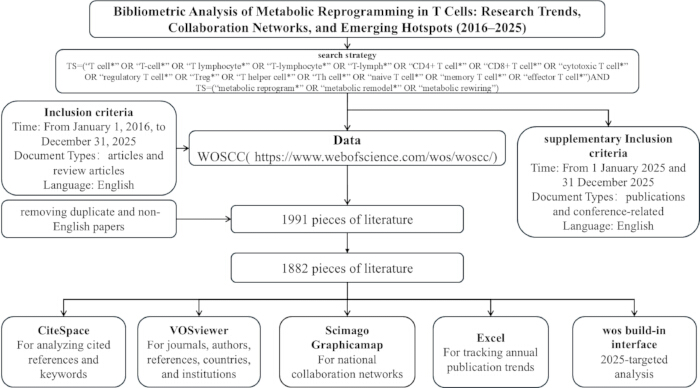
Figure 1. Workflow of the bibliometric analysis of T-lymphocyte metabolic reprogramming research. Schematic overview of the study design and analytical workflow used in this bibliometric analysis. Publications were retrieved from the Web of Science Core Collection (WoSCC) using predefined search strategies and inclusion criteria. Retrieved records were exported in plain text format and subjected to preprocessing, including duplicate removal and bibliographic data standardization. Bibliometric analyses were conducted using CiteSpace for co-citation, keyword co-occurrence, clustering, and burst detection analyses, and VOSviewer for collaboration network analyses among authors, institutions, countries, and journals. Scimago Graphica was used to visualize international collaboration networks, and WPS Excel was used to analyze annual publication trends and descriptive statistics. Please click here to view a larger version of this figure.
Access restricted. Please log in or start a trial to view this content.
Results
Publication Output and Temporal Trends
To characterize the temporal evolution of research activity in this field, a bibliometric analysis was performed using publications indexed in the WoSCC. A total of 1,991 records were initially retrieved over the past decade. After removal of duplicate and non-English records, 1,882 publications were ultimately included and analyzed, including 1,046 original research articles and 836 review articles. Annual publication and citation trends from 2016 to 2025 are p...
Access restricted. Please log in or start a trial to view this content.
Discussion
Our bibliometric analysis of metabolic reprogramming in T cells revealed a sustained increase in research output over time. A noticeable increase in publication and citation counts occurred in 2020, with 40 additional publications and 1,989 additional citations compared with 2019. This increase coincided temporally with several highly cited publications, including Glutamine blockade induces divergent metabolic programs to overcome tumor immune evasion (published November 22, 2019)18, whic...
Access restricted. Please log in or start a trial to view this content.
Disclosures
Conflicts of Interest:
The authors declare no conflicts of interest related to this work.
Author contrubutions:
Data collection and literature retrieval were performed by Yi Liu. Data preprocessing and bibliometric analyses were conducted by Yinping Yang. Visualization and figure preparation were performed by Xinyue Yang and Jinquan Li. The first draft of the manuscript was written by Yi Liu and Weihong Li. All authors contributed to manuscript revision and approved the final submitted version.
Acknowledgements
The authors gratefully acknowledge financial support from the Fundamental Research Funds for the Central Universities (2022-JYB-JBZR-037).
Access restricted. Please log in or start a trial to view this content.
Materials
| Name | Company | Catalog Number | Comments |
|---|---|---|---|
| CiteSpace | Drexel University | v.5.7.R2 | SCR_025121 |
| Microsoft Excel | Microsoft Corporation | v.2604 Build 16.0.19929.20136 | SCR_016137 (Microsoft Excel) |
| WPS Excel | Kingsoft Office | v.12.1.0.26375 | |
| Scimago Graphica | Scimago Lab | v.1.0.53 | Not available |
| VOSviewer | Leiden University | v.1.6.20 | SCR_023516 |
| Web of Science Core Collection | Clarivate Analytics | accessed on January 27, 2026; version not applicable | Not available |
| Windows Operating System | Microsoft Corporation | Windows 10 | Not available |
References
- Pearce EL, et al. Fueling immunity: insights into metabolism and lymphocyte function. Science. 2013;342(6155):1242454.
- Wang R, et al. The transcription factor Myc controls metabolic reprogramming upon T-lymphocyte activation. Immunity. 2011;35(6):871-82.
- Shyer JA, et al. Metabolic signaling in T cells. Cell Res. 2020;30(8):649-59.
- Gubser PM, et al. Rapid effector function of memory CD8+ T cells requires an immediate-early glycolytic switch. Nat Immunol. 2013;14(10):1064-72.
- Yuan Q, et al. Enhancing intracellular NADPH bioavailability through improving pentose phosphate pathway flux and its application in biocatalysis asymmetric reduction reaction. J Biosci Bioeng. 2022;134(6):528-33.
- Quinn WJ III, et al. Lactate limits T-cell proliferation via the NAD(H) redox state. Cell Rep. 2020;33(11):108500.
- Pucino V, et al. Lactate buildup at the site of chronic inflammation promotes disease by inducing CD4+ T-cell metabolic rewiring. Cell Metab. 2019;30(6):1055-74.e8.
- O'Neill LAJ, et al. A guide to immunometabolism for immunologists. Nat Rev Immunol. 2016;16(9):553-65.
- Almeida L, et al. Metabolic pathways in T-cell activation and lineage differentiation. Semin Immunol. 2016;28(5):514-24.
- Haas R, et al. Lactate regulates metabolic and pro-inflammatory circuits in control of T-cell migration and effector functions. PLoS Biol. 2015;13(7):e1002202.
- Chang CH, Pearce EL. Emerging concepts of T-cell metabolism as a target of immunotherapy. Nat Immunol. 2016;17(4):364-68.
- Ho PC, et al. Reenergizing T-cell anti-tumor immunity by harnessing immunometabolic checkpoints and machineries. Curr Opin Immunol. 2017;46:38-44.
- Von Meyenn L, et al. Targeting T-cell metabolism in inflammatory skin disease. Front Immunol. 2019;10:2285.
- Zhu H, et al. Trends and hotspots in research related to tumor immune escape: bibliometric analysis and future perspectives. Front Immunol. 2025;16:1604216.
- Zhang B, et al. Mapping research trends in immune-cell metabolic reprogramming in breast cancer: a parallel dual-database bibliometric study. Discov Oncol. 2026;17:724.
- Chen G, et al. Rheumatoid arthritis and fibromyalgia syndrome: a bibliometric and bioinformatics perspective on comorbidity research. J Multidiscip Healthc. 2025;18:6811-27.
- Wang Y, et al. Research trends and hotspots in JAK inhibitors for ulcerative colitis: a bibliometric analysis from 2015 to 2024. J Multidiscip Healthc. 2025;18:6755-71.
- Leone RD, et al. Glutamine blockade induces divergent metabolic programs to overcome tumor immune evasion. Science. 2019;366(6468):1013-21.
- Watson MJ, et al. Metabolic support of tumour-infiltrating regulatory T cells by lactic acid. Nature. 2021;591(7851):645-51.
- Xia L, et al. The cancer metabolic reprogramming and immune response. Mol Cancer. 2021;20(1):28.
- Miao S, et al. tRNA m1A modification regulates cholesterol biosynthesis to promote antitumor immunity of CD8+ T cells. J Exp Med. 2025;222(3):e20240559.
- Angelin A, et al. Foxp3 reprograms T-cell metabolism to function in low-glucose, high-lactate environments. Cell Metab. 2017;25(6):1282-93.e7.
- Huang SC, et al. Metabolic reprogramming mediated by the mTORC2-IRF4 signaling axis is essential for macrophage alternative activation. Immunity. 2016;45(4):817-30.
- Nakaya M, et al. Inflammatory T-cell responses rely on amino acid transporter ASCT2 facilitation of glutamine uptake and mTORC1 kinase activation. Immunity. 2014;40(5):692-705.
- Ma EH, et al. Serine is an essential metabolite for effector T-cell expansion. Cell Metab. 2017;25(2):345-57.
- Pearce EL, et al. Fueling immunity: insights into metabolism and lymphocyte function. Science. 2013;342(6155):1242454.
Access restricted. Please log in or start a trial to view this content.