This protocol assesses functional synaptic activity between defined neuronal partners in vivo in the central nervous system of Drosophila melanogaster larvae using genetically encoded tools. CsChrimson-mediated optogenetic stimulation of presynaptic cIVda sensory neurons induces calcium-dependent photoconversion of CaMPARI in postsynaptic Basin-4 interneurons.
A subscription to JoVE is required to view this content. Sign in or start your free trial.
Method Article
Functional Characterization of Individual Pre- and Postsynaptic Partners In the Drosophila Larval Central Nervous System Using CaMPARI
In This Article
Summary
Abstract
Connectome studies have greatly expanded understanding of synaptic connectivity in the nervous systems of various species. While characterization of synaptic partners using electron microscopy (EM) provides detailed anatomical information, functional aspects of neuronal networks require complementary approaches. Recent studies in Drosophila have revealed not only the complete connectome of the larval, as well as male and female adult central nervous system, but also the cellular components of neuronal networks that regulate specific behaviors, such as the larval nociceptive network. By the third instar larval stage, class IV dendritic arborization (cIVda) multidendritic sensory neurons (nociceptors) establish most synaptic contacts with Basin-4 interneurons. To assess the functional relevance of these anatomical connections, the genetically encoded calcium indicator CaMPARI (Calcium Modulated Photoactivatable Ratiometric Integrator) was employed in live, undissected third-instar larvae as an activity-dependent reporter to evaluate synaptic connectivity between cIVda neurons and Basin-4 interneurons. CaMPARI is a ratiometric fluorescent indicator whose emission spectrum changes in response to elevated intracellular calcium levels. Under baseline conditions, CaMPARI fluoresces green; in the presence of high calcium concentrations and upon exposure to photoconversion light (~400 nm), it irreversibly switches to red fluorescence. Because calcium influx into postsynaptic neurons is a hallmark of synaptic activation, CaMPARI photoconversion provides a readout of functional synaptic signaling. A step-by-step method is presented to immobilize third-instar larvae on a microscope slide for optogenetic activation of cIVda nociceptors using the red-shifted channelrhodopsin CsChrimson, combined with simultaneous CaMPARI photoconversion in Basin-4 neurons. Calcium-dependent photoconversion in Basin-4 neurons, despite internal movements and changes in focal plane, provides functional evidence of synaptic connectivity between these cells. This serves as proof-of-principle for the use of CaMPARI in combination with presynaptic optogenetic stimulation in intact, undissected Drosophila larvae.
Introduction
Identifying precise synaptic partners in the central nervous system (CNS) enables tracking of the formation and refinement of synaptic connections during nervous system development. Accordingly, efforts have focused on the use of volumetric electron microscopy (EM) to reconstruct not only complete connectomes in powerful genetic model organisms such as Caenorhabditis elegans1,2 and Drosophila melanogaster3,4,5, but also millimeter-scale EM volumes of complex mammalian brains, including the mouse primary visual cortex6 and the human temporal cortex7. These studies provide unique insight into the organizational principles underlying synaptic connectivity at the anatomical level. However, functional characterization of synaptic partners provides complementary insight into neuronal connectivity and is required to validate anatomical findings.
Drosophila offers numerous advantages for the study of neuronal connectivity, including the availability of complete connectomes for the larval3 as well as the female4 and male5 adult central nervous system, in addition to well-characterized neuronal circuits that regulate predictable behaviors8,9,10. The larval nociceptive network represents one such well-suited circuit for studying precise synaptic connectivity11. EM reconstruction of this network has revealed detailed synaptic partnerships required for processing nociceptive stimuli, leading to the characteristic escape behavior known as nocifensive rolling12,13.
Within this network, class IV dendritic arborization (cIVda) neurons14 function as primary sensory nociceptors responsible for pain detection11,12,13,15,16. Their cell bodies and dendrites are located peripherally in the body wall, while their axons project into the larval ventral nerve cord (VNC)15. Within the CNS, cIVda neurons arborize their axonal terminals in a stereotyped pattern and form the majority of their synaptic contacts with Basin-4 interneurons11,12,13,17. This defined synaptic relationship establishes cIVda neurons and Basin-4 interneurons as an ideal pair for functional assessment of synaptic connectivity in vivo. The development of methods to analyze functional connections between individually identified synaptic partners will facilitate the investigation of mechanisms underlying synaptic development and refinement, particularly in genetically tractable systems with stereotyped neural circuits.
CaMPARI (Calcium Modulated Photoactivatable Ratiometric Integrator)18 is a genetically encoded ratiometric fluorescent indicator whose emission spectrum shifts in response to elevated intracellular calcium levels. Under baseline conditions, CaMPARI fluoresces green; in the presence of high calcium concentrations and upon exposure to photoconversion light (~400 nanometers (nm)), it irreversibly converts to red fluorescence18. Because calcium influx into postsynaptic neurons is a hallmark of synaptic activation, CaMPARI photoconversion provides a readout of functional synaptic signaling19,20.
In addition to CaMPARI, neuronal activity can be visualized using reversible sensors such as genetically encoded calcium indicators (GECIs) including GCaMP or RCAMP21, as well as genetically encoded voltage indicators (GEVIs)22 such as Arclight23, Ace2N-mNeon24, or VARNAM25. While these fast, reversible sensors are well-suited for monitoring transient activity in real time, they are susceptible to movement artifacts during in vivo imaging. In contrast, the integrative and irreversible photoconversion properties of CaMPARI enable capture of activity over a defined time window, allowing detection of neuronal activation even when focal planes shift during imaging20. Additionally, CaMPARI photoconversion can be tuned by adjusting the intensity of violet light, enabling detection of reduced synaptic strength or subthreshold inputs26. These properties have enabled activity mapping in freely moving animals without head fixation or tethering, including studies in mouse cortex27, zebrafish brain28, C. elegans29, and adult Drosophila20.
A protocol is described for visualizing functional synaptic partners via CaMPARI photoconversion combined with presynaptic optogenetic stimulation using confocal microscopy in intact, undissected Drosophila larvae. In this approach, CaMPARI is used to detect postsynaptic calcium influx in Basin-4 interneurons following optogenetic activation of cIVda neurons in live third instar larvae. cIVda neurons express the red-light–activated channelrhodopsin CsChrimson30,31, while Basin-4 interneurons express CaMPARI. Exposure to red light selectively activates nociceptors, mimicking a nociceptive stimulus in a temporally controlled manner16,30. This strategy enables assessment of whether presynaptic activation induces calcium-dependent CaMPARI photoconversion in postsynaptic neurons, thereby providing functional evidence of synaptic connectivity.
Several technical advantages support the use of CaMPARI in combination with CsChrimson for analysis of cIVda–Basin-4 connectivity. First, cIVda dendrites form a complete, non-overlapping tiling of the larval body wall32, enabling optogenetic activation of intact sensory neurons without confounding effects from dissection-induced damage16. Second, although larvae are physically immobilized on a microscope slide, internal movements frequently alter CNS positioning and focal plane during imaging; CaMPARI photoconversion is less sensitive to such movement artifacts and provides a stable, time-integrated readout of neuronal activity. Third, the integrative and tunable properties of CaMPARI enable detection of synaptic activity even when synaptic strength or contact number is reduced, such as during early developmental stages, thereby supporting future studies of synapse formation and refinement.
Access restricted. Please log in or start a trial to view this content.
Protocol
All experimental procedures involving Drosophila melanogaster were conducted in accordance with institutional guidelines. The genotype w; Basin4-LexA/CyO-TwGFP; ppk-GAL4/ppk-GAL4 (obtained from recombining RRID:BDSC_5489912 and RRID:BDSC_3207916) was used to drive optogenetic and CaMPARI expression (using the line w-, UAS-IVS-CsChrimson.mVenus, LexAOp-CaMPARI2; Sp/Cyo obtained from recombining RRID:BDSC_81085 with second chromosome markers) in pre- and postsynaptic partners, respectively. The research tools used in this protocol are listed in the Table of Materials.
1. Preparation of larvae
- Set up genetic crosses between virgin females UAS-CsChrimson, LexAop-CaMPARI; CyO/sp (RRID:BDSC_81085) and males from a fly line containing two binary systems, for example, with the presynaptic neuron of interest driving GAL4 expression and the postsynaptic neuron of interest driving LexA33,34.
- Set genetic crosses in plastic vials containing standard cornmeal agar medium35,36,37,38 supplemented with 0.5 mM all-trans retinal (ATR) for CsChrimson activation30,33. Prepare parallel vials without ATR as no-ATR controls.
NOTE: Melt the cornmeal agar medium without boiling. Allow it to cool without solidifying. Prepare a 40 mM ATR stock solution (powder ATR diluted in 95% ethanol according to manufacturer instructions), then dilute to 0.5 mM in the medium and mix thoroughly. - Cover vials completely with aluminum foil to prevent light exposure.
NOTE: Maintain rearing conditions in constant darkness due to the light-sensitive nature of ATR and to prevent unintended neuronal activation. Although CsChrimson is most sensitive to red light (590–680 nm), it can also be activated by other visible wavelengths31,39. - Incubate vials at 25 °C and raise larvae to the third instar stage.
2. Larva immobilization
- Collect a third instar larva using a paintbrush. Wash the larvae in a three-well micro spot plate containing 0.1 M PBS to remove food.
NOTE: Do not remove excess PBS; it helps maintain hydration. - Place a small amount of modeling clay at each corner of a clean coverslip (18 × 18 mm). Place the larva in a drop of PBS on the coverslip and allow it to orient ventral side down.
NOTE: For imaging of the ventral nerve cord (VNC), mount the larva on its dorsal side so that the ventral surface contacts the coverslip. This orientation allows Basin-4 interneurons in the VNC to face the objective through the coverslip. - Place a clean microscope slide over the coverslip containing the larva.
- Secure the coverslip by applying additional modeling clay to the corners. Apply sufficient pressure to immobilize the larva while avoiding rupture of the larva or coverslip.
3. Stimulation, photoconversion, and imaging workflow
- Acquire a baseline z-stack of postsynaptic neurons expressing CaMPARI using simultaneous green (488 nm, 0.8% laser power) and red (~561 nm, 0.8% laser power) channels. Use a Z-step of 1 µm, 256 × 256 pixel resolution, line averaging of 2, bidirectional scanning and scan speed of 9 on a confocal microscope equipped with a 40×/1.2 objective. Perform all imaging in a dark environment. Maintain identical z-stack parameters throughout the experiment.
NOTE: Expect bright green cell bodies at stereotyped positions in the larval VNC and no detectable red fluorescence at baseline. - Stimulate the larva continuously for 30 s using simultaneous photoconversion light (405 nm, 0.5% laser power) and optogenetic stimulation light (594 nm, 0.8% laser power).
- Acquire a post-stimulation z-stack using the same parameters as in step 3.1 under both red (~561 nm) and green (488 nm) channels. Expect VNC cell bodies at similar positions as in the baseline. Detect red CaMPARI fluorescence in neurons activated during stimulation in ATR-fed larvae, with minimal photoconversion in no-ATR controls.
NOTE: Workflow and parameters are summarized in Figure 1.
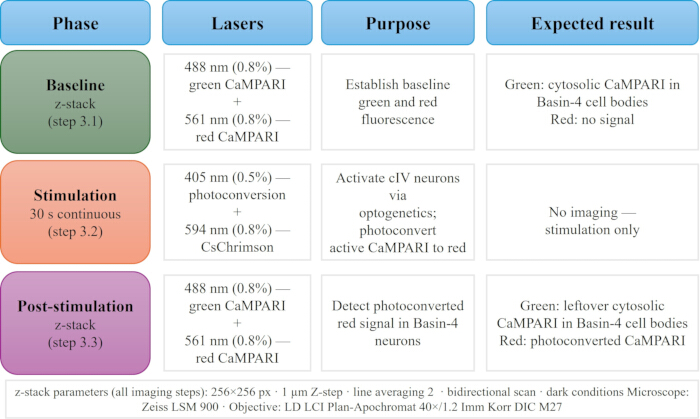
Figure 1: Workflow for stimulation, photoconversion (PC), and imaging. Three sequential imaging phases were used to assess calcium activity in Basin-4 neurons. During the baseline phase, z-stacks were acquired using 488 nm and 561 nm lasers to capture green and red CaMPARI fluorescence prior to stimulation. During the stimulation phase, cIVda neurons were optogenetically activated via CsChrimson (594 nm) while simultaneous 405 nm illumination photoconverted active CaMPARI from green to red fluorescence; no imaging was performed during this 30 s period. During the post-stimulation phase, z-stacks were reacquired using the same laser settings as at baseline to detect photoconverted red signal in the Basin-4 cell bodies. All z-stacks were acquired at 256 × 256 pixels with 1 µm Z-steps, line averaging of 2, and bidirectional scanning under dark conditions using a confocal microscope equipped with a 40×/1.2 NA objective. Please click here to view a larger version of this figure.
4. Imaging analysis
- Open z-stack images in Fiji (RRID:SCR_002285) with Bio-Formats enabled. Set Stack viewing to Hyperstack, Color mode to Composite, and enable Autoscale. Scroll through Z-planes and select the plane with optimal focus. Duplicate the selected plane (Image → Duplicate; Channels: 1–2; selected Z-plane).
- Split red and green channels (Image → Color → Split Channels).
NOTE: Adjust brightness and contrast using Image → Adjust → Brightness/Contrast → Auto for both channels. - Subtract background from both channels (Process → Subtract Background) using a rolling ball radius of 50 px.
- Configure measurements (Analyze → Set Measurements) to include Area, Mean gray value, Integrated density (IntDen), Standard deviation, and Min & Max gray values.
- Draw regions of interest (ROIs) around each cell in the green channel using the Freehand tool. Add ROIs to the ROI Manager and measure. Apply the same ROIs to the red channel and measure.
- Record all measurements in a spreadsheet, including larva and cell identifiers.
NOTE: Perform measurements for both pre- and post-stimulation images. - Calculate red-to-green fluorescence ratios using Integrated Density values to obtain (R/G)post and (R/G)pre for each cell. Average cell-level values per larva.
NOTE: Integrated Density (Area × Mean) allows comparison across cells of different sizes. - Calculate Δ(R/G) as (R/G)post − (R/G)pre using larval averages. Interpret positive Δ(R/G) values as increased postsynaptic calcium activity during photoconversion.
NOTE: Negative Δ(R/G) values may arise from noise or background asymmetry. Set negative values to 0. In this dataset, one larva showed a negative value (−0.008), which was set to 0.
Access restricted. Please log in or start a trial to view this content.
Results
Following this protocol, functional connectivity between cIVda neurons and Basin-4 interneurons was assessed in live, undissected D. melanogaster third instar larvae using CaMPARI (Figure 2). Prior to any stimulation with photoconversion (PC) light or optogenetic activation, Basin-4 interneurons displayed green fluorescence due to cytosolic CaMPARI expression (Figure 2A). No red fluorescence was detected under baseline conditions (F...
Access restricted. Please log in or start a trial to view this content.
Discussion
The protocol described here enables qualitative and quantitative assessment of synaptic connectivity between defined synaptic partners in intact D. melanogaster larvae. This approach leverages the combination of optogenetic stimulation of cIVda sensory neurons with CaMPARI-based visualization of activated postsynaptic Basin-4 interneurons to monitor synaptic activity in the central nervous system (CNS) of undissected larvae. Previous applications of CaMPARI in D. melanogaster focused primarily on adult ...
Access restricted. Please log in or start a trial to view this content.
Disclosures
The authors declare no competing interests.
Acknowledgements
The Marine Biological Laboratory (Woods Hole, MA) is acknowledged for hosting and supporting work on troubleshooting the described technique and protocol.
Access restricted. Please log in or start a trial to view this content.
Materials
| Name | Company | Catalog Number | Comments |
|---|---|---|---|
| 0.1 M Phosphate Buffered Saline (PBS) | Sigma Aldrich | P5368-10PAK | Chemical used in solution to hydrate and mount larvae |
| All-trans-retinal (ATR) | Sigma Aldrich | R2500-500mg | Chemical added to food to activate optogenetic tools |
| Confocal Microscope | ZEISS | LSM900 Confocal | Confocal microscope, Objective lens (40×/1.2 NA), Light/laser source (405, 488, 561 nm) |
| Coverslips (18x18mm) | VWR | 48366-205 | Used to mount animals for imaging |
| Ethanol (95%) | Sigma Aldrich | E7023 | Used as solvent for powder ATR |
| Fiji (ImageJ) | Open source | RRID:SCR_002285 | Used for imaging analysis |
| Prism version 10.4.1 | GraphPad Software Inc. | RRID:SCR_002798 | Used for statistical analysis |
| Microscope slides | VWR | 48300-041 | Used to mount animals for imaging |
| Modeling clay | Flinn scientific | FB0600 | Used to hold cover glass on microscope slide with larvae in between |
| Paintbrush | Genesee scientific | 59-204 | Used to transfer larvae between locations |
| Standard cornmeal agar medium | Genesee scientific | 66-123 | Food can also be prepared using similar standard recipes and ingredients |
| Standard Drosophila plastic vials (25mm x 95mm Drosophila narrow vials) | Genesee scientific | 32-109 | Large vials or bottles can also be used |
| Three-well micro spot plate | Electron Microscopy Sciences | 71561-01 | Plate used to separate and clean individual larva |
| Drosophila stock (genotype: w; Basin4-LexA/CyO-TwGFP; ppk-GAL4/ppk-GAL4) | Bloomington Drosophila Stock Center | RRID:BDSC_54899 & RRID:BDSC_32079 | Obtained from recombining RRID:BDSC_54899 and RRID:BDSC_32079 |
| Drosophila stock (genotype: w, UAS-IVS-CsChrimson.mVenus, LexAOp-CaMPARI2; Sp/CyO) | Bloomington Drosophila Stock Center | RRID:BDSC_81085 | Obtained from recombining RRID:BDSC_81085 with second chromosome markers |
Reprints and Permissions
