Laboratory rat and mouse ultrasonic vocalizations (USVs) are useful for studying vocal and neural function. This protocol describes a food-reward paradigm that reliably elicits appetitive USVs without mating-related confounds. It details animal conditioning, stimulus presentation, recording, and acoustic analysis, providing a reproducible method for studying affective-motivational and cranial sensorimotor function.
Method Article
Anticipatory Food-Reward Elicitation of Appetitive Ultrasonic Vocalizations in Laboratory Rats and Mice
In This Article
Summary
Abstract
Ultrasonic vocalizations (USVs) in laboratory rats and mice provide a valuable model for investigating vocal function, affective behavior, and the underlying neural mechanisms that drive vocalization. Many commonly used USV elicitation paradigms rely on mating or social interaction, which can introduce hormonal and behavioral confounds that complicate interpretation in studies of aging, neurodegeneration, and endocrine modulation. To address these limitations, this article describes a food-reward USV elicitation paradigm that reliably evokes appetitive 50 kHz vocalizations in anticipation of palatable food. It includes standardized procedures for animal handling, acclimation, and behavioral conditioning to establish consistent anticipatory responses to a palatable reward. Animals undergo repeated exposure to the recording environment followed by reward delivery to promote stable vocal output across sessions. USVs are recorded in sound-attenuated chambers under controlled environmental conditions to ensure a high signal-to-noise ratio and reproducibility. A structured workflow for automated detection and classification is provided, which enables the extraction of key acoustic parameters, including the total number of USVs, rate, frequency range, duration, maximum power, and complexity. The protocol includes quality control steps to verify detection accuracy and minimize artifacts. By eliminating mating-related variables and standardizing recording conditions, this method provides a controlled approach for eliciting and quantifying appetitive 50 kHz vocalizations across repeated sessions. The paradigm is well-suited for investigating affective-motivational processes and cranial sensorimotor function and can be adapted for diverse experimental contexts, including studies of neurological disease, neurodegeneration, and hormone manipulation, with appropriate study-specific validation.
Introduction
Ultrasonic vocalizations (USVs) in laboratory rats and mice are widely used as experimental measures of vocal behavior and affective state and provide a valuable model for studying vocal communication under controlled conditions. Rats and mice produce ultrasonic range vocal signals across a variety of biologically relevant contexts, including mating, distress signaling, play, and social communication1,2,3,4,5. As USVs reflect both physiological and behavioral states, they provide a sensitive and quantifiable outcome measure in studies of emotion, social behavior, and brain–behavior relationships5. Laboratory rats and mice produce communicative USVs at high frequencies ranging 30–90 kHz in rats and 40–120 kHz in mice, often referred to as “50 kHz USVs.” In rats, 50 kHz USVs are commonly associated with positive affective states, reward anticipation, and social approach behaviors2,5,6,7. Mice produce 50 kHz USVs in comparable social and affective contexts, but exhibit greater variability in structure and are strongly dependent on behavioral context and social cues8,9,10,11,12. As such, USVs have been widely used in psychosocial and psychobiological research to study emotional processing, social interactions, learning paradigms, and the effects of pharmacological manipulations on the nervous system5,11,13,14,15,16,17. More recently, USVs have also been adopted as outcome measures in studies investigating neurological disease, neurodegeneration, developmental disorders, and cranial sensorimotor dysfunction relevant to human communication disorders5,18,19,20,21,22.
USV production occurs within the larynx and requires precise neuromuscular coordination of the intrinsic laryngeal muscles housed within a cartilaginous framework23,24,25. Motor patterns controlling muscles such as the thyroarytenoid and cricothyroid regulate vocal fold position and glottal configuration during sound production26. Unlike human phonation, which relies on flow-induced vocal fold oscillation, USVs are produced through an aerodynamic whistle mechanism in which high-velocity airflow exits the glottis and interacts with laryngeal structures to generate ultrasonic sound23,24,25,27. Consequently, the acoustic features of USVs reflect coordinated neuromuscular control of the larynx, vocal tract configuration, and subglottal pressure supply rather than vibratory biomechanics of the vocal fold mucosa. For experimental measurement, USVs are primarily defined and analyzed based on acoustic features captured during recordings. These USV acoustic features, including frequency, duration, and intensity, can be extracted using automated or semi-automated analysis pipeline, which forms the basis for quantitative comparisons across experimental conditions5.
A substantial body of literature has used USVs to examine hormonal influences on vocal behavior across laboratory rats and mice. Many studies have demonstrated that reproductive hormones (e.g., estrogen and progesterone) modulate USV production and acoustic characteristics, particularly within mating contexts4,28,29. For example, estrous cycle stage, ovariectomy, and hormone replacement have been shown to alter USV rates and acoustic features in both female rats and mice, including modulation by estrous state and reproductive hormonal cues in mice28,30,31,32,33. However, these investigations have largely relied on mating-based paradigms, such as the presentation of an estrous female to a male rat or mouse, which robustly elicits vocalizations but introduces substantial variability related to sexual motivation, social experience, and endocrine state. While these paradigms are highly effective for eliciting large numbers of USVs, the behavioral and hormonal complexity inherent in reproductive contexts can complicate interpretation in studies focused on quantifiable vocal output or controlled experimental manipulation. As such, differences in social interaction, sexual receptivity, and motivational state may independently influence USV production, making it difficult to isolate the physiological variables under investigation.
Outside of reproductive USV elicitation contexts, fewer standardized approaches exist for examining USV production under controlled, non-social conditions in both rats and mice. Emerging work suggests that hormonal status can influence USV production even in non-reproductive contexts. For instance, estradiol replacement has been reported to alter USV acoustic features and rates depending on the social context in which vocalizations are recorded28,30. In one study examining USVs outside mating paradigms, the estrous cycle stage influenced acoustic parameters in both social isolation and dyadic interaction conditions28. However, variability across recording context, environmental conditions, and elicitation paradigms remains a major challenge for reproducibility and cross-study comparison.
Given these limitations, experimental paradigms that minimize social and reproductive confounds are important for studying USVs in a controlled and reproducible manner. Food-associated reward paradigms provide a useful alternative approach for eliciting appetitive 50 kHz USVs. Rats, and to a lesser extent mice, produce anticipatory USVs in response to reward-associated cues, including access to palatable food, reflecting motivational states and reward expectancy6,9,34. In this approach, animals are acclimated to the recording environment and conditioned to associate chamber exposure with a palatable food reward, resulting in consistent vocal output across sessions. Compared with mating-based paradigms, reward-driven elicitation enables precise standardization of environmental conditions, reduces variability related to social interaction or reproductive status, and can be applied across sexes and experimental models. Additionally, this approach is compatible with a range of ultrasonic recording systems and supports repeated measures designs. These features make this paradigm particularly well-suited for studies requiring consistent USV elicitation and quantitative comparison across conditions. This approach becomes especially important when trying to isolate relatively subtle changes in vocal output that would otherwise be masked by variability in social or reproductive behavior.
The overall goal of the present method is to provide a detailed and reproducible protocol for eliciting and quantifying appetitive ultrasonic vocalizations using a conditioned anticipatory food-reward paradigm. The protocol outlines procedures for animal handling, acclimation, and behavioral conditioning, followed by standardized USV recordings conducted in sound-attenuated chambers under controlled environmental conditions. A structured workflow for automated detection and classification is also described, enabling the extraction of USV-level acoustic parameters from each recording, including total USV number, rate, frequency range, duration, maximum power, and complexity. This methods-focused framework emphasizes reproducibility, standardization, and adaptability across laboratory settings and species, providing a practical pipeline for consistent USV data acquisition and analysis.
This protocol provides a standardized and reproducible approach for eliciting and recording appetitive USVs using an anticipatory food-reward paradigm, enabling detailed analysis of vocal behavior across experimental conditions. Although this protocol is applicable to both laboratory rats and mice, important species-specific differences should be considered. In rats, 50 kHz USVs are well-characterized and are commonly associated with positive affective states and reward anticipation. In mice, USVs are more variable in both structure and behavioral interpretation, are not reliably indicative of positive affective states, and should not be interpreted as direct proxies of emotional valence8,9. Additionally, acoustic features such as USV duration, frequency range, and modulation patterns differ between species, which may require adjustment of detection and classification parameters. Behavioral responses to conditioning may also vary, with rats generally exhibiting more robust and consistent appetitive vocalization in reward-based paradigms. Several steps in this protocol are critical for reliable USV elicitation (e.g., acclimation duration, reward pairing, and recording consistency), whereas other parameters (e.g., reward type, chamber type, and acquisition parameters) may be adjusted based on species, strain, or experimental design, provided that validation and parameter optimization are completed when adapting this protocol across laboratory rats and mice.
Protocol
All procedures involving animals follow the guidelines of the Institutional Animal Care and Use Committee (IACUC) at Purdue University and adhere to national standards for the care and use of laboratory animals. The following Purdue IACUC protocols were approved: 2008002069 (A53TSynGFP mouse), 0722002290 (Sprague-Dawley rat), 2111002220 (Long-Evans rat).
1. Animal preparation and housing
- Animal selection
- Select adult rats or mice at least 3 months of age or older of the desired strain, sex, and experimental condition. Ensure animals are age- and sex-matched across groups when possible.
- House animals in standard cages under a reversed 12 h light/dark cycle with controlled temperature and humidity.
NOTE: A reversed light cycle is recommended to align behavioral testing with the animals’ active (dark) phase, promoting consistent engagement and vocalization. However, recording may also be conducted under a standard light/dark cycle if testing is performed consistently and timing is maintained across all sessions. - Provide ad libitum access to food and water unless otherwise specified for conditioning and experimental manipulation.
- House animals in groups, when possible. If social housing is not feasible, provide additional enrichment in the cage and/or schedule socialization time to reduce stress in single-housed animals35.
NOTE: Adult animals were used in representative datasets to ensure stable behavioral responses and consistent USV patterns. This protocol can be adapted for younger or older animals; however, age-related differences in vocal behavior and conditioning response should be considered and validated within the specific study design. This protocol is not recommended for pre-weaning-aged mice and rat pups.
- Animal handling and socialization
- Handle animals daily for 5–7 consecutive days in the housing room under an animal transfer station. Perform all handling using appropriate personal protective equipment (e.g., gown and gloves).
- Acclimate animals to researcher interaction using standardized handling procedures. Low-stress handling methods (e.g., tunnel or tube handling) may be used to minimize stress, particularly in mice, provided the chosen method is applied consistently across animals and sessions. If direct handling is used, gently pick up and hold each animal for several minutes to acclimate it to the researcher and routine manipulation.
- Use a standardized handling procedure for all animals to ensure consistency (e.g., introduce hands into the cage and allow animal to sniff for 30 s, gently pick up and hold the animal for 10 s, repeat hold three times).
- Incorporate all experiment-specific handling techniques used for the experiment, such as lifting the animal into the test cage or holding the animal supine for injections, into the socialization procedure to habituate animals to the full experimental workflow and minimize stress-related variability during recording sessions.
2. Acclimation to the testing environment and behavioral conditioning
- Preparation for acclimation sessions
- Turn on all recording chambers and equipment before use. Clean polycarbonate behavioral cages with 70% ethanol and wipe thoroughly, ensuring all surfaces are dry before use.
- Transfer animals from the housing room to the recording room using a cart covered with a blackout curtain or sheet to maintain lighting conditions and minimize environmental stress.
- Chamber acclimation
- Place a clean polycarbonate cage without bedding in a recording chamber. Transfer each animal to a cage, with only one animal per cage per recording chamber. Close the chamber door securely.
- Leave the animal in the chamber for 10 min to match the duration of future recording sessions.
- Food-reward association
- Remove the animal from the chamber after the 10 min session and return it to its home cage.
- Provide a novel palatable food reward weighing approximately 0.1–0.4 g immediately upon return to the home cage.
- Alternate between 1–2 reward types across days (e.g., 1–2 pieces of Loops or Puffs, half-piece Garden Veggie Straw, one shelled peanut) to maintain novelty and motivation between sessions.
NOTE: Avoid using the selected palatable food rewards in other contexts to preserve anticipatory USV elicitation conditioning. Designate different palatable foods for other tasks, if needed. Animals are not subject to food restrictions for this paradigm. Standard ad libitum feeding is maintained in the home cage outside of reward delivery.
- Conditioning schedule
- Repeat acclimation and reward pairing once daily for at least 3–5 consecutive days.
- Perform conditioning and subsequent 10 min recording sessions at the same time each day (e.g., during the dark cycle between 0900 and 1200 h) using consistent personnel.
NOTE: Animals will exhibit reduced stress behaviors (e.g., decreased defecation/urination by 50%–100%) and the onset of anticipatory 50 kHz USVs across conditioning days. Mice may require more conditioning days than rats.
3. Ultrasonic vocalization recording setup
- Equipment conditions
- Conduct recordings in a darkened room or under red lighting to align with the animals’ reverse light cycle.
- Limit room entry and remain in an adjacent space during sessions to minimize acoustic disturbances.
- Recording chamber setup
- Use sound-attenuated recording chambers (outside: 60 cm × 60 cm × 82 cm; inside: 56 cm × 53 cm × 60 cm) designed to minimize external noise and electronic interference.
- Use multiple chambers (e.g., four total) and assign animals to chambers using a randomized and counterbalanced schedule across recording days and experimental conditions.
NOTE: Chamber assignments are structured such that animals from each experimental group are distributed across all chambers, and each animal is recorded in multiple chambers across recording sessions when feasible. This approach minimizes potential chamber-specific bias and prevents systematic confounding between chamber and experimental conditions. - Record chamber assignment for each session (e.g., animal ID, group, chamber number, date, session type) in a lab notebook or spreadsheet (e.g., Excel). Incorporate these metadata into downstream statistical analyses (e.g., as a random effect or covariate) to account for potential chamber-related variability.
NOTE: If using multiple recording chambers, implement strategies to minimize electrical noise and crosstalk between channels (e.g., spatial separation of chambers, consistent grounding, and use of shielded cabling where applicable). The sound-attenuating chamber also helps reduce environmental acoustic and ultrasonic noise, as well as external interference.
- Cage preparation
- Use clean polycarbonate cages within each recording chamber. Do not add bedding to the cages to minimize movement-related noise.
- Clean each cage thoroughly with 70% ethanol between animals and allow it to dry completely before the next recording.
- Recording system setup
- Turn on the recording computer and launch acquisition software. Ensure the multi-channel recording interface is connected and recognized.
- Create a new experiment by clicking File/Experiment, then New and input required metadata, including experiment name, species, and number of recording channels (e.g., up to four). See Supplementary File 1 for screenshots of the software interface.
- Conduct a brief test recording by clicking Record Ultrasounds, then Preview Ultrasounds, and the circle record button before each session to verify signal integrity, channel function, and acceptable background noise levels (Supplementary File 2).
- Create a test session by clicking Design Test Session, then New Test Session, and set the recording duration to 10 min by changing the timer (e.g., 00:10:00 for 10 min). Assign animal IDs to the appropriate chamber channels (Supplementary File 3).
- Verify all session information before starting recording, as settings cannot be modified after completion.
NOTE: All acquisition parameters are system-defined within Sonotrack and are not manually adjusted by the user between animals or sessions. Maintain identical chamber configuration and recording parameters across all animals and sessions to ensure data consistency. The following acquisition parameters are preconfigured with the system:
Sampling Rate: ≥250 kHz
Frequency detection range: 15–125 kHz
Microphone type: ultrasonic condenser microphones
Microphone placement: Fixed above the center of each cage (~13–100 cm from the animal)
Gain: Not user-adjustable; automatically controlled by the system and held constant across all recordings
Input dynamic range: ~10 mV (minimum detectable signal) to 10 V (maximum input) as specified by the manufacturer
File format: Continuous recordings exported as .WAV files and metadata as .DAT files
Although this protocol is implemented using an integrated USV system, the workflow is not dependent on a single commercial platform. The paradigm can be adapted to other ultrasonic recording systems provided that comparable acquisition parameters are used, including appropriate sampling rate and frequency range for laboratory rat or mice USVs. Similarly, other sound-attenuated chambers may be used if they effectively minimize acoustic interference and support stable behavioral testing conditions.
4. USV recording procedure
- Session initiation
- Place animals into recording chambers following the same procedure used during acclimation. Ensure correct chamber assignment.
- Close chamber doors and open the corresponding test session by clicking Design Test Session, then Open Test Session in the recording software (Supplementary File 4).
- Recording execution
- Start recording using the software interface by clicking Record Ultrasounds, then Execute Test Session, and circle record button (Supplementary File 5). Monitor signals in real time if desired.
- Allow the software to record continuously for 10 min.
- Session completion
- Allow the software to stop recording automatically at the end of the session. Save the recording immediately to prevent data loss by clicking X button, then Save (Supplementary File 6).
- Remove animals from chambers and return them to their home cages.
- Reward delivery
- Provide a standardized palatable food reward immediately after returning each animal to its home cage.
- Maintain consistency in reward timing across all sessions.
- Recording schedule
- Perform recording sessions once daily for 3–5 consecutive days following conditioning.
- Maintain identical timing, handling procedures, and environmental conditions across all sessions.
PAUSE POINT: Store and back up recorded files after each session for later analysis.
5. Post-session cleaning and shutdown
- Chamber and equipment cleaning
- Remove cages and clean all cages, lids, and inserts using soap and water after completion of sessions. Dry thoroughly before storage.
- Clean chamber interiors and surfaces with 70% ethanol as needed.
- Equipment shutdown
- Close all recording sessions and exit the acquisition software.
- Turn off recording chambers and ensure all chamber doors are closed.
- Animal transport
- Cover cages with a blackout sheet or curtain and transport animals back to the housing area.
- Return animals to their home cages and ensure access to food and water.
6. Ultrasonic vocalization detection, classification, and data export with software
- Load USV recording files
- Open the call classification software and allow the main menu to load.
- Select Load USV File(s) and choose either to upload native Sonotrack experiment files via Load USV data (Sonotrack files) or compatible waveform audio files via Import USV data (WAV files).
- Navigate in the computer’s directory to the file folder containing the recordings and select the desired experiment/session by clicking Accept.
- In the call classification software, select the appropriate experiment name, test session(s), and corresponding microphone channel(s), then load the data into the workspace by clicking OK.
- Verify that the recording(s) are correctly displayed in the software main menu with file name, session number, and channel information.
- Initialize classification settings
- Open the classification interface within the software by clicking USV Classifier.
- Select the Default values setting file for default classification settings provided within the software environment or edit and create custom classification settings via the USV Explorer & Settings menu on the main software interface page.
- Confirm the detection filters with the following parameters are listed in the Parameter list:
Frequency range: 25,000–99,990 Hz (optimized for rat 50 kHz vocalization). For mouse recordings, broader ultrasonic ranges (~40,000–120,000 Hz) may be required to capture full repertoire of vocalizations, depending on strain and context.
Minimum call duration: 4 ms (USVs shorter than this are automatically deleted)
Short-call classification threshold: 4 ms
Harmonic detection: enabled - Confirm the frequency modulation-based classification parameters are as follows:
Chevron and U-shape factor: 4 kHz
Upward and downward modulation factor: 2 kHz
Trailing factor: 2 kHz
Off-center tolerance of maximum frequency: 0.4
Step detection thresholds:
Left vs. right frequency difference: 35 kHz
Left vs. middle frequency difference: 32 kHz - Confirm the temporal and segmentation parameters are listed as follows:
Merge components if separated by <5 ms (time) or <6 kHz (frequency)
Remove overlapping components if the overlap exceeds 75%
Delay factor: 17
Undefined USV classification threshold factors:
Short: 1
Long: 7 - Confirm the preprocessing and artifact-handling rules are enabled:
Delete short components: ON
Merge close components: ON
Remove overlapping components: ON
Delete wrong calls: ON - Confirm the export summary and detailed data formats are listed as follows:
Result table format: CSV + Excel
Results images format: Only jpg
Record sound file: ON
Harmonics: With harmonics - Confirm that all detection and classification parameters are applied correctly as noted above, then click OK.
NOTE: Refer to https://www.metris.nl/en/products/sonotrack/CallClassification for links to a video tutorial of the call classification software interface provided by the manufacturer. Default settings are derived from established literature and are appropriate for most applications36. These parameters were used for all representative analyses. Custom settings can be created for specialized experimental conditions. When custom settings are used, all parameter values (e.g., frequency bounds, duration thresholds, modulation criteria, and artifact rules) must be reported alongside results to ensure reproducibility across studies.
- Execute automated detection and classification
- Select the Start Classification function to initiate automated processing.
- Allow the software to scan the full recording, detect ultrasonic vocalizations, and classify each USV.
- Monitor real-time progress indicators, including classification graphs (Figure 1) and tables that populate during processing.
- Allow the program to complete processing of all USVs within the recording.
NOTE: The automated detection and classification process may take several hours. The software detects USVs, extracts acoustic features, and classifies them based on frequency modulation patterns (e.g., upward, flat, complex).
- Export summary and detailed data
- After the software completes processing, select Exit USV Classifer and navigate to the computer’s directory to the file folder containing the classification data in order to view the spreadsheet outputs.
- Open both the summary and detailed datasets spreadsheet files (e.g., Excel or CSV) for each experiment, session, and channel.
- Open the summary outputs to confirm inclusion of total USV counts, category distributions, and percentage values (Figure 2).
- Open the detailed output to verify per-USV data, including start time, end time, duration, and acoustic parameters.
- Save all exported files and associated data using a standardized naming convention, including animal ID, session, and condition for downstream statistical analyses.
- Quality control
- During initial validation, randomly select 10%–20% of recordings across representative conditions (e.g., treatment groups and recording sessions) for manual review.
- Perform manual inspection of spectrograms and audio playback to confirm performance benchmarks as defined below:
Accurate USV detection (presence of true positives and absence of missed USVs)
Detection accuracy of at least 90% agreement with manual identification
Appropriate segmentation of individual USVs (noise or artifacts incorrectly detected as USVs)
False positive rate no greater than 10%
Correct classification of USV types based on frequency modulation patterns
Classification agreement of at least 85% between automated and manual USV-type assignment - Identify and document all common errors, including background noise or electrical artifacts detected as USVs, over-segmentation or merging of adjacent USVs, and misclassification of USVs.
- If performance does not meet validation criteria, adjust detection thresholds, frequency bounds, or classification parameters, re-run automated detection and classification for affected recordings, and repeat validation until acceptable performance is achieved.
- Once validated, store the finalized parameter set for all subsequent experiments. Routine quality control procedures thereafter are limited to targeted spot-checking of recordings when needed (e.g., software updates, parameter adjustments, or unexpected data or recording patterns).
- Store validated parameter sets, exported datasets, and quality control documentation in a secure format to ensure reproducibility.
NOTE: Full quality control is required only during the initial setup of the detection and classification pipeline. Once validated, the established parameters are applied consistently across experiments with quality control repeated only if methodological changes occur. USV analysis is not limited to a single software platform and can be implemented using alternative systems, provided the detection and classification criteria are clearly defined and consistently applied.
7. Safety considerations
- Animal handling
- Handle animals using appropriate personal protective equipment (PPE), including gloves and a gown.
- Follow institutional guidelines for safe handling and disposal of any animal waste.
- Chemical safety
- Use 70% ethanol in a well-ventilated area. Avoid inhalation and contact with the eyes.
- Allow ethanol to fully evaporate before placing animals into cages.
- Equipment safety
- Ensure all electrical equipment is properly grounded before use.
- Keep liquids away from recording equipment to prevent damage or electrical hazards.
8. Statistical analysis
- Perform all statistical analyses in R (v4.3.2) and GraphPad Prism (v10). Define the experimental unit as the individual animal. For longitudinal ultrasonic vocalization (USV) analyses, derive outcomes from repeated recordings collected across experimental time points. Present all data as mean ± standard error of the mean (SEM), with individual animal values displayed in all figures. Conduct all statistical tests as two-tailed unless otherwise specified. Define statistical significance as α = 0.05.
- For the rat hormone and hydration study, analyze USV outcomes using generalized linear mixed-effects models (GLMMs) to evaluate the effects of hormonal status, hydration status, time, and their interactions (Figure 3). Include random intercepts for animal ID nested within cohort to account for repeated measures and batch effects. Select model distributions according to outcome characteristics: use gamma distributions for duration and frequency range, linear mixed-effects models for maximum power, and negative binomial models for USV counts to address overdispersion. Evaluate fixed effects using Type III Wald chi-square (χ2) tests. Follow significant effects with planned post hoc comparisons using estimated marginal means (emmeans) with Tukey correction for multiple comparisons, restricting analyses to a priori hypotheses. Define statistical significance as α = 0.05 (two-tailed).
- For the A53T α-synuclein mouse vocal training pilot (Figure 4), assess group differences between control and training conditions using two-tailed independent-samples t-tests for each USV feature, including total number, duration, frequency range, and maximum intensity. Analyze simple, complex, and combined USV types separately. Apply Welch’s correction when variance assumptions are violated. Do not apply multiple-comparison corrections due to the exploratory nature of the pilot dataset and limited sample size. Define statistical significance as α = 0.05.
Results
Successful implementation of this USV recording and analysis protocol yields high-quality recordings with minimal background noise, optimized experimental conditions, enabling reliable visualization and extraction of individual USVs. Under these conditions, animals produce measurable USVs during the 10 min recording period that are clearly visible on spectrograms and can be detected and classified using Call Classification Software. Representative recordings demonstrate distinct USV contours with well-defined acoustic contours, including flat and frequency-modulated USV structures, enabling accurate extraction of acoustic parameters (Figure 1).
Quantitative outputs from successful experiments include total USV number, USV rate (USVs/min), frequency range, duration, maximum power, and USV complexity ratio (simple vs. complex). In well-conditioned animals, total USV counts are consistent across recording days, and USV rates remain stable within individuals. Frequency range and duration parameters fall within expected species-specific ranges (e.g., 30–90 kHz band for rat USVs and 40–120 kHz band for mouse USVs) and paradigm with clear separation between simple and complex vocalizations. The complexity ratio provides an additional measure of vocal behavior, with shifts toward either simple or complex USVs that may reflect effects of experimental manipulations. Figure 2 showcases representative outputs from a single recording session to illustrate the classification and distribution of USVs across simple and complex USV types, frequency modulation patterns, and duration bins, and to demonstrate the successful detection and analysis of vocal behavior using this elicitation method. Specifically, Figure 2A displays the total number of identified USVs categorized into various simple and complex types; Figure 2B shows the distribution of USVs across frequency modulation patterns (flat, upward, downward, and complex profiles); and Figure 2C presents the distribution of USVs grouped by total duration.
Representative datasets from successful experiments demonstrate variability between animals at baseline and across experimental groups or time points. Data shown in Figure 3 are derived from an independent published dataset using 5-7-month-old Long-Evan rats and demonstrate how physiological state (e.g., hormonal or hydration manipulations) can be reflected in quantifiable acoustic USV features, such as duration, power, or frequency range37. These results are presented as examples of how the protocol enables the extraction and analysis of exported USV datasets from the software rather than as definitive evidence of biological effects. In contrast, Figure 4 presents unpublished pilot data from a single mouse strain (A53T alpha-synuclein overexpression mice) and age range (3–5 months old) undergoing a vocal training paradigm, in which no significant differences were observed between control and trained groups. This example demonstrates the ability of the protocol to capture both variable and null outcomes, which underscores the importance of study-specific optimization and validation. Together, these datasets illustrate the analytical outputs generated by the protocol across laboratory rats and mice.
In contrast, suboptimal recordings are characterized by excessive background noise, reduced spectrogram clarity, or inconsistent USV detection. For this protocol, recordings are considered suboptimal when visual inspection of the spectrogram indicates background noise that substantially obscures USV structure within the 20–100 kHz range, or when noise artifacts (e.g., broadband noise or movement-related signals) result in false-positive detections exceeding ~10% of total detected events during manual review. Recordings are also considered suboptimal when signal-to-noise conditions prevent clear visual discrimination of USVs from background activity (i.e., inability to reliably distinguish USV contours from baseline noise across most of the recording). In these cases, sessions are excluded or reanalyzed following adjustment of detection parameters. Suboptimal behavioral conditioning may result in low or highly variable USV counts across sessions. Recordings producing markedly reduced USV output (e.g., >50% lower total USV count relative to the cohort median at baseline for a given experimental condition) are reviewed for potential acclimation issues or procedural deviation. In these cases, total USV number and USV rate are often reduced, and extracted acoustic parameters may fall outside expected ranges or show high variability. Additional indicators of suboptimal outcomes include incomplete or inaccurate classification of USVs, often resulting from inappropriate detection settings or poor recording quality. Misclassification may be present as an overrepresentation of simple/short USV types or failure to detect multi-element (complex) vocalizations. Recordings are flagged for reanalysis when automated classification shows <85% agreement with manual inspection in reviewed subsets. These issues can be identified during quality control by comparing spectrogram features with assigned classifications and by reviewing summary outputs for atypical distributions in cohort-level patterns.
Successful application of this protocol is confirmed by (1) clear visualization of USVs in spectrograms, (2) consistent detection and classification across sessions, and (3) stable or biologically interpretable variation in quantitative outcome measures. When these criteria are met, the method provides a sensitive and reproducible approach for assessing changes in vocal behavior and laryngeal function across experimental conditions.
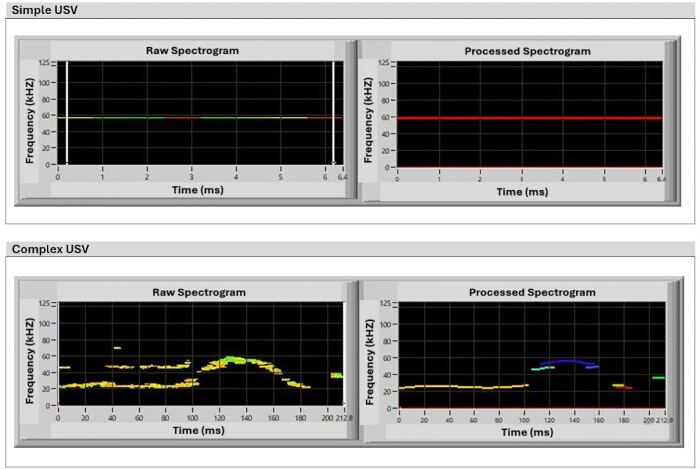
Figure 1: Example raw and processed spectrograms of representative USVs used for acoustic analysis. This figure presents unpublished pilot data from a rat aging study. Raw and processed spectrograms depict a simple (top) and complex (bottom) USV produced by a 15-month-old Sprague-Dawley female ovariectomized rat, generated using Call Classification software. X-axis = time (ms); Y-axis = frequency (kHz); color gradient = power (dB), with yellow/green indicating higher power. Please click here to view a larger version of this figure.
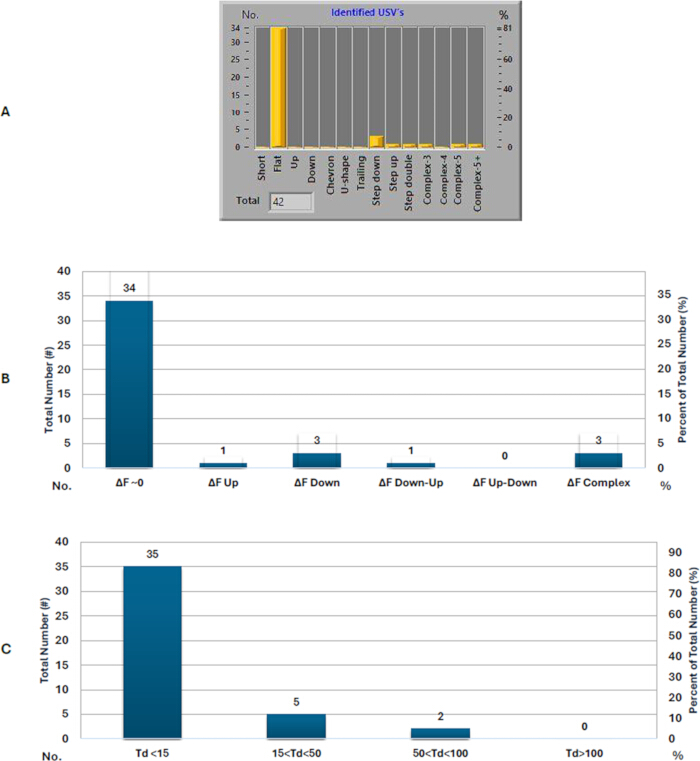
Figure 2: Example USV summary outputs from a single recording session. This figure presents unpublished pilot data from a vocal training feasibility study. Representative classification results from a 10-min baseline recording of a 3-month-old transgenic male mouse overexpressing alpha-synuclein from a vocal training pilot dataset. (A) Total identified USVs categorized by classification type, demonstrating the distribution of simple and complex USVs within the session (total USVs = 42). (B) Distribution of USVs grouped by frequency modulation (ΔF, kHz), including flat (ΔF ~0), upward, downward, and complex modulation patterns. (C) Distribution of USVs grouped by total duration (Td, ms). USV detection and classification were performed using software with parameters (including detection thresholds and classification rules) defined in the Methods/Protocol section. Please click here to view a larger version of this figure.
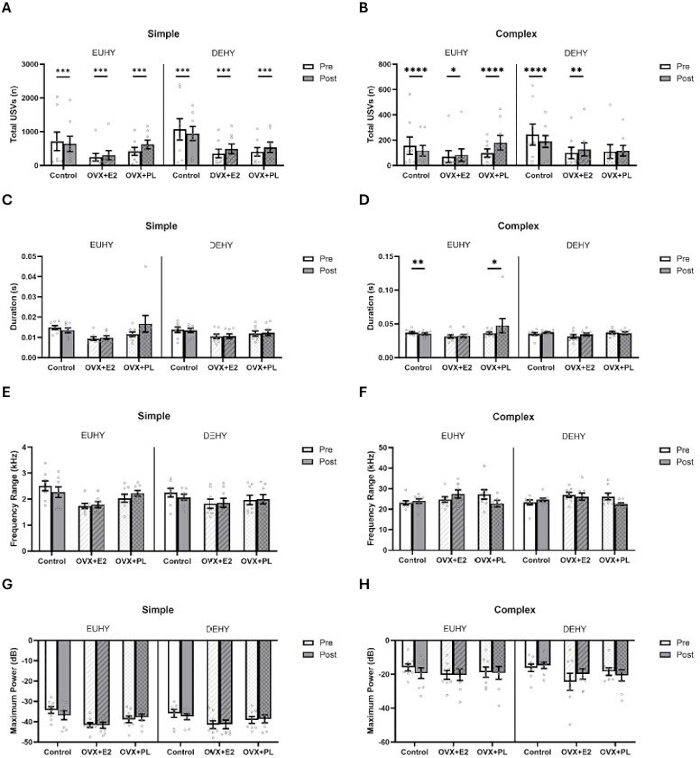
Figure 3: Representative USV results across Long-Evans rat hormonal and hydration manipulations. This figure is reproduced from data published in the Journal of Speech, Language, and Hearing Research37. USV measures are shown pre- and post-hydration challenge across three hormonal groups (Control; OVX + Estradiol [OVX + E2]; OVX + Placebo [OVX + PL]) and two hydration states (euhydration [EUHY]; dehydration [DEHY]) with N = 8 animals per group (age: 5–7 months). Simple (left column) and complex (right column) USV metrics are depicted: total USV number (A,B), duration (C,D), frequency range (E,F), and maximum power (G,H). Bar graphs represent group means ± SEM, and individual points depict values for each animal. Bar fill patterns indicate hormonal group: solid = Controls, slashed = OVX + E2, cross-hatched = OVX + PL. Statistical analyses were performed using generalized linear mixed-effects models (GLMMs) with Type III Wald chi-square tests to evaluate effects of hormonal group, hydration status, and their interaction. Post hoc comparisons were conducted using estimated marginal means (emmeans) with Tukey correction for multiple testing. Asterisks indicate statistically significant differences (*p < .05, **p < .01, ***p < .001). Please click here to view a larger version of this figure.
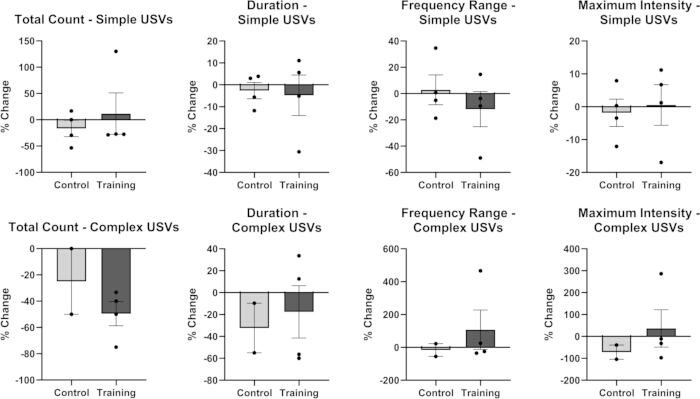
Figure 4: Representative USV results in A53T alpha-synuclein overexpression mice following a pilot vocal training paradigm. This figure presents an unpublished pilot dataset generated for a vocal training feasibility study. Data are derived from 8 mice total (age: 3–5 months), evenly distributed across groups (Control: n = 4; Training: n = 4) with balanced sex representation (two females and two males per group) and genotype distribution (Control: TG+ = 3, TG− = 1; Training: TG+ = 2, TG− = 2). USV metrics are shown as percent change from pre- to post-training for each genotype, pooled across sex. Simple (top row) and complex (bottom row) USVs are plotted separately for total USV count, duration, frequency range, and maximum intensity. Bar graphs represent group means ± SEM, and individual points depict values for each animal. Training consisted of a 5-day water-reward vocal conditioning paradigm in which mice underwent mild water restriction and were trained to emit USVs in response to water reward delivery within the recording chamber. Group differences between Control and Training conditions were assessed using two-tailed independent-samples t-tests (Welch’s correction applied when appropriate) on normalized change scores for each USV feature. No significant differences were observed between control and trained groups in this pilot dataset. Please click here to view a larger version of this figure.
Supplementary File 1: Ultrasonic vocalization (USV) software-setup.Please click here to download this file.
Supplementary File 2: Ultrasonic vocalization (USV) software-Test recording.Please click here to download this file.
Supplementary File 3: Ultrasonic vocalization (USV) software-Create test session.Please click here to download this file.
Supplementary File 4: Ultrasonic vocalization (USV) software-Open test session.Please click here to download this file.
Supplementary File 5: Ultrasonic vocalization (USV) software-Execute recording.Please click here to download this file.
Supplementary File 6: Ultrasonic vocalization (USV) software-Finish test session.Please click here to download this file.
Discussion
The present protocol provides a reproducible approach for eliciting appetitive 50 kHz ultrasonic vocalizations (USVs) using a food-reward paradigm, with several critical steps required to ensure consistent and interpretable outcomes. Foremost, animal handling and acclimation are essential for reducing stress-related variability in vocal output13. Daily handling under controlled conditions and systematic habituation to the testing chamber promote reliable anticipatory behavior and stable USV production across sessions. Behavioral conditioning to the food reward is another key step; inconsistent or insufficient conditioning can result in low vocalization rates or high inter-animal variability6,34. Maintaining consistent personnel and testing conditions, including recording during the dark cycle or under red-light conditions, eliminating environmental noise sources, and standardizing chamber setup, is equally critical for optimizing signal quality and minimizing artifacts5. Without these controls, it becomes difficult to determine whether changes in USVs reflect behavior or simply noise introduced by the recording environment.
This protocol is designed with flexibility to accommodate modifications based on specific experimental needs. For example, the type and novelty of palatable food rewards can be adjusted to maintain motivation across repeated sessions, particularly in longitudinal or disease-model studies. The duration of acclimation and recording sessions can also be modified depending on species, strain, or experimental constraints. Troubleshooting common issues primarily involves addressing low USV output or excessive noise. Low vocalization rates can often be improved by extending conditioning periods, increasing reward salience, or confirming that animals are tested during their active phase. Acoustic artifacts can be minimized by ensuring proper chamber cleaning between animals, eliminating bedding and extraneous materials, and verifying consistent microphone positioning and recording parameters. Additionally, randomizing animals across recording chambers helps mitigate potential chamber-specific variability and enhances experimental rigor.
A major strength of this method lies in its alignment with recent efforts to standardize laboratory rat and mouse USV methodologies, as highlighted by Shembel et al. (2025)5. Standardization across elicitation paradigms, recording environments, and analysis pipelines is essential to improve reproducibility and enable cross-study comparisons. This protocol directly addresses these priorities by implementing structured acclimation procedures, controlled stimulus presentation, and consistent recording conditions. The use of a food-reward paradigm supports reliable and repeatable elicitation of USVs and reduces behavioral variability associated with social or mating-based paradigms5,28. Recording during the animals’ active phase and minimizing environmental noise further aligns with best-practice recommendations to optimize signal quality and biological relevance5. In addition, the use of defined acoustic outcome measures, including USV number, rate, frequency range, duration, maximum power, and complexity ratio, supports transparent and standardized analysis practices, which are critical given the variability in classification approaches across the field5.
The interpretation of USVs also differs meaningfully between rats and mice and should be considered when applying this protocol across species. In rats, 50 kHz ultrasonic vocalizations are well-established markers of positive affect and reward-related states. In contrast, mouse USVs are more heterogeneous in both acoustic structure and behavioral context, and USVs within similar high-frequency ranges do not map as directly onto affective valence. Instead, mouse USVs may reflect a combination of social communication, arousal, and context-dependent behavioral states. Accordingly, the present protocol treats USVs as species-specific behavioral readouts rather than a singular affective marker across laboratory rats and mice. Despite the strengths, several limitations should be considered when applying this method. While the food-reward paradigm reduces hormonal and social confounds, it specifically captures appetitive, reward-driven vocalizations and may not generalize to other behavioral contexts such as distress or social communication. Motivation for food rewards may also vary across animals, experimental conditions, or disease states, potentially influencing vocal output independently of vocal motor function6,34. Importantly, the representative datasets presented here are derived from a single strain of laboratory rats and a single strain of laboratory mice, which limits generalizability. Although the protocol is designed to be applicable across laboratory rats and mice, species- and strain-specific differences in vocal behavior, conditioning response, and acoustic characteristics should be expected, and broader validation across strains and experimental contexts is warranted. Additionally, although automated classification software facilitates high-throughput analysis, variability in detection thresholds and classification algorithms may affect comparability across studies. The protocol is presented using an integrated system for reproducibility, but is intended to be broadly adaptable across ultrasonic recording platforms with equivalent specifications. Careful validation of analysis parameters and consistent reporting of acoustic features are therefore necessary to ensure data reliability. Finally, the requirement for specialized ultrasonic recording equipment and sound-attenuating chambers may limit accessibility for some laboratories.
Importantly, the representative results included in this protocol incorporate a combination of heterogenous datasets, including single-session exemplars, pilot training data, and illustrative experimental outcomes. These examples are intended to demonstrate the range of expected outputs and common analytical approaches rather than to provide definitive biological conclusions. As such, these datasets should be interpreted as methodological demonstrations rather than hypothesis-driven results. Additionally, references to in-press or unpublished datasets are included to illustrate potential applications of the protocol, but should not be interpreted as validated outcomes within the context of this methods-focused report.
The significance of this method lies in its ability to provide a controlled, non-social paradigm for studying vocal behavior while adhering to emerging standards for methodological rigor and reproducibility. By eliminating mating-related variables and standardizing elicitation and recording conditions, this approach offers clear advantages over traditional paradigms, particularly when the goal is to isolate physiological influences on vocal production independent of social context. The protocol is particularly well-suited for applications in neurodegenerative disease models, endocrine manipulation studies, and investigations of cranial sensorimotor function, where minimizing confounding variables is critical. More broadly, this method contributes to ongoing efforts to harmonize USV research practices and provides a standardized framework for eliciting and quantifying vocal behavior. While such standardization is a necessary step toward evaluating the potential of USVs as translational biomarkers of affective and sensorimotor function, the present protocol does not, in itself, establish biomarker validity. Rather, it enables the consistent data acquisition and analysis needed for future studies to rigorously test translational relevance.
Disclosures
There are no relevant conflicts of interest.
Acknowledgements
The work included in this paper was supported in part by the National Institute on Deafness and Other Communication Disorders (NIDCD) of the National Institutes of Health (NIH) under award number R01DC0020179, an American Speech-Language Hearing Foundation New Investigators Research Grant (A.J.S.), Collins Medical Trust Grants (A.J.S.), and startup funds provided to A.J.S. by Purdue University.
Materials
| Name | Company | Catalog Number | Comments |
|---|---|---|---|
| 70% ethanol | Fisher Scientific | BP28184 | Used to clean chamber between animals |
| Additional palatable treats (e.g., shelled peanuts) | Bio-Serv | F6711 | Optional reward variation to sustain engagement |
| Animal transfer station (if used) | NUAIRE | AllerGard NU-621 | Provides controlled handling environment during experimenter socialization (if applicable to your protocol) |
| Blackout curtain/sheet | Mainstays (Walmart) | https://www.walmart.com/ip/Mainstays-Super-Soft-Brushed-Microfiber-Bed-Sheet-Set-Rich-Black-King-4-Piece/12946065251 | Used to eliminate ambient light and external noise disturbances during transfer |
| Cart (transport) | Metro | 13-460-126 | Supports cages during transfer |
| Computer/acquisition interface | Windows | 10 Professional 64bit | Must meet Sonotrack software requirements; used for recording and data storage |
| Data storage device (external hard drive/server) | Glyph | BBPR4000 | For secure storage of large acoustic files |
| Fruit Loops | Kellogg's | 4119210032 | Palatable food reward to maintain novelty and motivation |
| Garden Veggie Straws | Sensible Portions | 829515300494 | Palatable food reward to maintain novelty and motivation |
| Laboratory detergent (mild soap) | Dawn | 91064 | Used for post-session cleaning of cages and inserts |
| Paper towel | ToolBox | 5520208 | Used with ethanol for cleaning |
| Polycarbonate recording cages (no bedding) | UNO Life Science Solutions | 31200260 | Used withing recording chamber to minimize noise artifacts |
| PPE: disposable lab gown | Fisherbrand | 12-893-005XXL | Prevents contamination and odor transfer |
| PPE: nitrile gloves | Ansell | 19-168-967D | Prevents contamination and odor transfer |
| Red lighting system | Kenall | https://kenall.com/Animal-Research-Lab-Lighting#:~:text=Red%20LED%20lighting%20is%20ideal%20for%20animal%20research,for%20nocturnal%20animals%20such%20as%20mice%20and%20rats. | Low-visibility lighting to maintain reverse light cycle while allowing experimenter visibility |
| Reese's Puffs | General Mills | 10016000275666 | Palatable food reward to maintain novelty and motivation |
| SmartChamber for Mice and Rats | Metris | SC-B100 | Sound-attenuating chamber for ultrasonic vocalization recording |
| Sonotrack Automated Call Classification software (v1.4) | Metris | ST-S400 | Used for USV detection, classification, and export of acoustic parameters |
| Sonotrack Base configuration | Metris | ST-R2P0-M | Data acquisition hardware for ultrasonic recording |
| Sonotrack High-end Ultrasound Microphone | Metris | ST-B200 | Frequency range ~15-125 kHz for rodent USV detection |
| Standard home cages | Innovive | M-BTM (Mouse); R-BTM-H (Rat) | Standard housing/transfer cages |
| Timer | Fisherbrand | 06-664-251 | Ensures standardized 10-min recording sessions |
References
- Brudzynski SM. Principles of rat communication: Quantitative parameters of ultrasonic calls in rats. Behav Genet. 2005;35(1):85-92.
- Johnson AM et al. Ultrasonic output from the excised rat larynx. J Acoust Soc Am. 2010;128(2):EL75-EL79.
- Kelm-Nelson CA, Lenell C, Johnson AM, Ciucci MR. Laryngeal activity for production of ultrasonic vocalizations in rats. In: Brudzynski SM, ed. Handbook of Behavioral Neuroscience. Vol 25. Elsevier; Amsterdam, Netherlands; 2018:37-43.
- Lenell C, Broadfoot CK, Schaen-Heacock NE, Ciucci MR. Biological and acoustic sex differences in rat ultrasonic vocalization. Brain Sci. 2021;11(4):4.
- Shembel AC et al. The role of ultrasonic vocalizations in rat laryngological investigations. Physiol Behav. 2025;294:114887.
- Brenes JC, Schwarting RKW. Individual differences in anticipatory activity to food rewards predict cue-induced appetitive 50-kHz calls in rats. Physiol Behav. 2015;149:107-118.
- McGinnis MY, Vakulenko M. Characterization of 50-kHz ultrasonic vocalizations in male and female rats. Physiol Behav. 2003;80(1):81-88.
- Chabout J et al. Adult male mice emit context-specific ultrasonic vocalizations that are modulated by prior isolation or group rearing environment. PLoS One. 2012;7(1):e29401.
- Mun HS, Lipina TV, Roder JC. Ultrasonic vocalizations in mice during exploratory behavior are context-dependent. Front Behav Neurosci. 2015;9.
- Simola N, Granon S. Ultrasonic vocalizations as a tool in studying emotional states in rodent models of social behavior and brain disease. Neuropharmacology. 2019;159:107420.
- Premoli M et al. Mouse and rat ultrasonic vocalizations in neuroscience and neuropharmacology: State of the art and future applications. Eur J Neurosci. 2023;57(12):2062-2096.
- Scattoni ML, Crawley J, Ricceri L. Ultrasonic vocalizations: A tool for behavioural phenotyping of mouse models of neurodevelopmental disorders. Neurosci Biobehav Rev. 2009;33(4):508-515.
- Venkatraman A et al. Stress-induced ultrasonic vocalization in laboratory rats and mice: A scoping review. Brain Sci. 2024;14(11):1109.
- Johnson AM, Ciucci MR, Connor NP. Vocal training mitigates age-related changes within the vocal mechanism in old rats. J Gerontol Ser A. 2013;68(12):1458-1468.
- Lenell C, Newkirk B, Johnson AM. Laryngeal neuromuscular response to short- and long-term vocalization training in young male rats. J Speech Lang Hear Res. 2019;62(2):247-256.
- Shembel AC, Lenell C, Chen S, Johnson AM. Effects of vocal training on thyroarytenoid muscle neuromuscular junctions and myofibers in young and older rats. J Gerontol A Biol Sci Med Sci. 2021;76(2):244-252.
- Brudzynski SM. Pharmacology of ultrasonic vocalizations in adult rats: Significance, call classification and neural substrate. Curr Neuropharmacol. 2015;13(2):180-192.
- Kelm-Nelson CA, Brauer AFL, Ciucci MR. Vocal training, levodopa, and environment effects on ultrasonic vocalizations in a rat neurotoxin model of Parkinson disease. Behav Brain Res. 2016;307:54-64.
- Grant LM et al. Noradrenergic receptor modulation influences the acoustic parameters of pro-social rat ultrasonic vocalizations. Behav Neurosci. 2018;132(4):269-283.
- Rudisch DM et al. Early ultrasonic vocalization deficits and related thyroarytenoid muscle pathology in the transgenic TgF344-AD rat model of Alzheimer’s disease. Front Behav Neurosci. 2024;17:1294648.
- Rodgers B, Schaser A. Alpha-synuclein overexpression does not cause vocalization deficits in a mouse model of Parkinsonism. Biol Open. 2025;14(9):bio062120.
- Caruso A, Ricceri L, Scattoni ML. Ultrasonic vocalizations as a fundamental tool for early and adult behavioral phenotyping of Autism Spectrum Disorder rodent models. Neurosci Biobehav Rev. 2020;116:31-43.
- Riede T. Subglottal pressure, tracheal airflow, and intrinsic laryngeal muscle activity during rat ultrasound vocalization. J Neurophysiol. 2011;106(5):2580-2592.
- Riede T. Stereotypic laryngeal and respiratory motor patterns generate different call types in rat ultrasound vocalization. J Exp Zool A Ecol Genet Physiol. 2013;319(4):213-224.
- Riede T, Borgard HL, Pasch B. Laryngeal airway reconstruction indicates that rodent ultrasonic vocalizations are produced by an edge-tone mechanism. R Soc Open Sci. 2017;4(11):170976.
- Inagi K, Schultz E, Ford CN. An anatomic study of the rat larynx: Establishing the rat model for neuromuscular function. Otolaryngol Head Neck Surg. 1998;118(1):74-81.
- Håkansson J et al. Aerodynamics and motor control of ultrasonic vocalizations for social communication in mice and rats. BMC Biol. 2022;20(1):3.
- Lenell C, Johnson AM. The effects of the estrous cycle, menopause, and recording condition on female rat ultrasonic vocalizations. Physiol Behav. 2021;228:113248.
- Lenell C, Sandage MJ, Johnson AM. A tutorial of the effects of sex hormones on laryngeal senescence and neuromuscular response to exercise. J Speech Lang Hear Res. 2019;62(3):602-610.
- Garcia AN et al. The effects of long-term estradiol treatment on social behavior and gene expression in adult female rats. Horm Behav. 2017;87:145-154.
- Matochik JA, White NR, Barfield RJ. Variations in scent marking and ultrasonic vocalizations by Long-Evans rats across the estrous cycle. Physiol Behav. 1992;51(4):783-786.
- Thomas DA, Barfield RJ. Ultrasonic vocalization of the female rat (Rattus norvegicus.) during mating. Anim Behav. 1985;33(3):720-725.
- Hanson JL, Hurley LM. Female presence and estrous state influence mouse ultrasonic courtship vocalizations. PLoS One. 2012;7(7):e40782.
- Opiol H, Pavlovski I, Michalik M, Mistlberger RE. Ultrasonic vocalizations in rats anticipating circadian feeding schedules. Behav Brain Res. 2015;284:42-50.
- Hinchcliffe JK, Jackson MG, Robinson ES. The use of ball pits and playpens in laboratory Lister Hooded male rats induces ultrasonic vocalisations indicating a more positive affective state and can reduce the welfare impacts of aversive procedures. Lab Anim. 2022;56(4):370-379.
- Wright JM, Gourdon JC, Clarke PBS. Identification of multiple call categories within the rich repertoire of adult rat 50-kHz ultrasonic vocalizations: Effects of amphetamine and social context. Psychopharmacology (Berl). 2010;211(1):1-13.
- Dwenger K et al. Impact of circulating estrogen and dehydration on ultrasonic vocalization in female rats. J Speech Lang Hear Res. 2026;1-21
Reprints and Permissions
