This study proposes the public IT adoption model, a prospect-theory-based perception-intention framework explaining how perceived gains and losses drive users’ acceptance or rejection of public IT services, such as airport biometrics. Two surveys, including one multinational survey, and expert interventions validated the model, supporting prospect theory across countries and contexts.
Research Article
Proposing Public IT Adoption with Its Theoretical Foundation and Empirical Findings
In This Article
Summary
Abstract
This research proposes a theoretical model of public IT adoption (PITA). Public information technology (IT) services refer to IT-based services that public institutions offer to all citizens, such as e-government portals, public health applications, and biometric systems at airports. Because of public IT’s unique nature, previously developed models that focused primarily on the individual and firm levels have been deemed insufficient to identify the critical mass of public IT adoption. To address this gap, a perception-intention framework based on prospect theory was proposed to explore users’ perceived losses and gains in adopting a new public IT service, suggesting that these perceptions were the antecedents of either rejecting or accepting a novel public IT service. Two studies were conducted, including one with survey samples from three nations (South Korea, the United Kingdom, and the United States). Five industry experts were also invited, through an intervention-based research approach, to qualitatively refine and validate the model so that it could be used within a practical scenario. The results showed that the total value of acceptance, that is, the aggregate perceived value required for users to accept the service, computed as the sum of the relevant path coefficients, was consistently greater than that of rejection. A similar finding was seen for perceived gain, which was a stronger predictor of both acceptance and rejection than perceived loss. Although the findings rely on cross-sectional, self-reported data, they provide strong support for prospect theory and contribute to a further understanding of the theory’s fundamental role in public IT adoption. Thus, by extending prospect theory to the public-sector IT context, PITA offers researchers a validated theoretical foundation and practitioners a practical tool for diagnosing the adoption of public IT services.
Introduction
Information technology (IT) has evolved over the past few decades into a dominant and pervasive tool for pursuing innovation and has significantly altered everyday life. Since the introduction of IT adoption models based on psychological perspectives1,2,3,4, the relationship between users and IT has been thoroughly researched at the individual and firm levels5.
Meanwhile, many public organizations have struggled to achieve operational efficiency under overwhelming societal demands, such as airport congestion, which harms the effectiveness and quality of public services. Enlarging physical infrastructures might yield immediate benefits but requires significant investments of time and money6. In contrast, innovative public service providers have approached this issue through IT-driven innovation7, integrating innovations with current infrastructures to secure service quality and operational efficiency8,9,10,11. Public organizations are now embracing novel IT (e.g., cloud services, cybersecurity, and biometrics) to revitalize core assets, which creates additional adoption challenges12. This problem might result from an inadequate understanding of real users: prior research has predominantly focused on factors driving acceptance while neglecting rejection. Without users’ active involvement, IT implementations in public institutions may not achieve practical adoption.
However, public sector IT adoption presents unique challenges distinct from private sector contexts. Although “acceptance” and “rejection” appear to be at odds as two distinct status quos13, promoting one could inhibit the other, so both sides of the countervailing effect should be considered. Earlier studies of public IT service innovation tended to emphasize positive outcomes10,11,14,15,16. This paper, therefore, examined “acceptance” and “rejection” together, converging psychology-based IS models (i.e., diffusion of innovation and innovation resistance) with behavioral economics (i.e., prospect theory).
The case of airport biometrics, in which biometric identification replaces document-based procedures, was selected because this public IT service is offered to all citizens, involves sensitive personal information, and confronts users with a clear accept-or-reject decision. Two research questions guided the study. RQ1: How do perceived gains and losses influence users’ acceptance and rejection of a public IT service? RQ2: Is the total value required for acceptance larger than that for rejection, as prospect theory predicts? Accordingly, a fresh theoretical framework was put forth and validated by industry experts through the IBR (intervention-based research) strategy17 (Figure 1). This study thereby integrates prospect theory with IS adoption models and offers actionable insights for public IT managers.
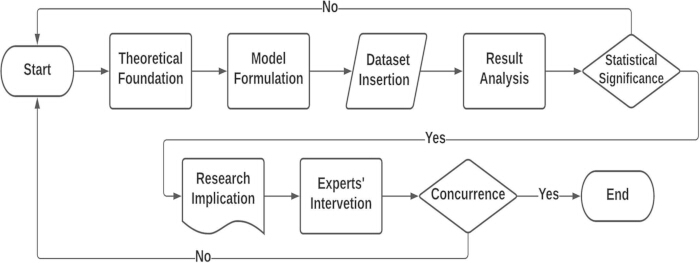
Figure 1: The research process of theoretical model framing and development. The diagram depicts the overall research flow, from theoretical model framing based on prior adoption models and prospect theory, through Study 1 and Study 2, each followed by an expert intervention, to the completion of the PITA model. Please click here to view a larger version of this figure.
IT adoption has been studied extensively: the technology acceptance model (TAM)2 and the unified theory of acceptance and use of technology (UTAUT)4 at the individual level, and the diffusion of innovation (DOI)1 and the technology-organization-environment framework (TOE)3 at the firm level, have spawned follow-up studies on augmented reality and language learning18,19, chatbots and digital payments20,21, mobility services22,23, and remote work24. However, these models have notable limitations for public IT: TAM assumes voluntary use, DOI neglects user resistance, and UTAUT was developed primarily for organizational settings, so their applicability to quasi-mandatory public IT services remains questionable. Studies of public IT adoption based on these models also exist, for instance, extending UTAUT to examine an online public grievance redressal system25 and applying TOE to human resource information systems in the public sector14; many further studies took similar approaches26,27,28,29,30,31,32,33,34,35.
However, IT adoption at the public level significantly differs from that at the individual or firm level (see Table 1): adoption entities and users are not the same, and users’ intentions are not obvious due to psychological inertia and the status quo of current services. The disruptive characteristics of IT may hinder restructuring existing systems36; adoption also requires changing users’ attitudes and behaviors, which demands a clear understanding of users’ perspectives. Given these characteristics, previous models emphasizing the individual and firm levels may not be adequate to pinpoint the critical mass for public IT adoption. Because IT-driven service innovation is critical for cost reduction and service enhancement37,38 and ultimately advances society39, a focused theoretical framework for public IT adoption is crucial.
| Individual-level | Firm-level | Public-level | |
| Adoption entity | Individuals | Firms (private) | Firms (public) |
| User | Individuals | Firm employees | Individuals |
| User intention | Certain | Certain (forced) | Uncertain |
| Psychological inertia | Negligible | Negligible (forced) | Prominent |
| Value perception | Indispensable | Indispensable(forced) | Indispensable |
| Main adoption purpose | Personal | Efficiency, cost-saving | Public interest |
| Relevant IT adoption models | TAM2, UTAUT4 | DOI1, TOE3 | This study |
Table 1: Different levels of IT adoption. The table contrasts IT adoption at the individual, firm, and public levels in terms of representative theoretical models, adopting entities, and users.
The existing literature has demonstrated that individuals and employees have an a priori (individual-level) or forced (firm-level) intention to use a specific IT service2,40, implying that adoption was predetermined4,41. However, not all users intend to use IT42, and only a few IS studies have identified the traits and justifications for rejection43,44. Accordingly, a new public IT service would deliberately be rejected until the innovation is either accepted or fails45.
Understanding users’ acceptance and rejection of a public institution’s IT service is the main goal of this study, examined through two value perceptions: perceived gain and perceived loss. Perceived gain was adapted from the diffusion of innovation model1,46; these constructs have been used extensively to examine perceptions favoring IT acceptance47,48 and show high validity across contexts40. In contrast, perceived loss includes the traits that explain why people preserve their current way of life despite pressures to adapt; grounded in innovation resistance42,49, this line of research examines why some people delay adopting an innovation or reject it outright49,50,51,52,53. A multidimensional approach captured these perceptions rather than treating loss and gain as general constructs.
Perceived loss was operationalized through five constructs53,54. Time loss (TIL) is the perceived time lost in learning and using the service, and when expectations are not met53. Social loss (SOL) is the risk of losing one’s standing in a social group by appearing foolish or out of touch54. Financial loss (FIL) covers potential monetary losses from purchase costs, fees, or personal-information theft54. Physical loss (PHL) is the perception that use could cause harm, discomfort, or exhaustion53,54. Performance loss (PEL) is the perceived decline in service quality or functionality compared with existing alternatives, including malfunction and failure to deliver the desired benefits53.
To explain perceived gain (PG), relative advantage, compatibility, trialability, and complexity were used1,46. Relative advantage (REA) is the degree to which an innovation is thought to be more advantageous than its forerunner; compatibility (COM), the degree to which it fits a potential adopter’s values, needs, and prior experiences; trialability (TRI), the extent of possible experimentation prior to adoption; and complexity (CPX), which is related to TAM’s perceived ease of use, refers to how difficult the innovation is to use and comprehend. Observability was excluded because it is too ambiguous to measure46 and because biometric outcomes in the public IT context are not readily observable by others.
The loss-gain framework was proposed to explain the perceived values that motivate reactions to a new public IT service. If the service is radical and threatens usual behavior, perceived loss was hypothesized to outweigh perceived gain, causing rejection; if this persists, rejection might become a constant aspect of behavioral intention42,49. Conversely, if perceived benefits outweigh anticipated losses, the user has few reasons to reject the service. Therefore, the following hypotheses were put forth:
H1. Perceived loss will have a positive influence on rejection.
H2. Perceived loss will have a negative influence on acceptance.
H3. Perceived gain will have a negative influence on rejection.
H4. Perceived gain will have a positive influence on acceptance.
Any IT-driven advancement in government services is intended to advance society (e.g., faster and safer boarding via airport biometrics), yet a recently launched public IT service is rife with risk and uncertainty, and users might not accept the benefits as intended. According to prospect theory55, people make such irrational decisions based on evaluations of alternatives, values, and attitudes toward uncertainty, judged relative to a reference point (reference dependence). The theory’s key insight is loss aversion, the tendency for losses to weigh more heavily than equivalent gains, together with diminishing sensitivity; this focus on gains and losses relative to the status quo aligns directly with the acceptance-rejection dichotomy examined here. Prospect theory has been used in recent IS and IT studies to explain irrational decisions under risk and uncertainty56,57,58,59,60, spanning contexts from AI-enabled work and digital health to public Wi-Fi and mobile payments. While these studies confirm the theory’s relevance, they focused primarily on acceptance intentions and neglected the rejection dimension central to the public IT context.
Users of public IT services act as though they decide to accept or reject the service based on the total values required (i.e., the sum of perceived gain and loss). No prior study on public IT adoption has investigated this phenomenon from this perspective. Accordingly, path coefficients (i.e., PL to REJ) were coded as values55, and the total values required for rejection and acceptance were calculated as follows:
V(R) = CLR + CGR (1)
V(A) = CLA + CGA (2)
where CLR, CGR, CLA, and CGA are the path coefficients of perceived loss to rejection, perceived gain to rejection, perceived loss to acceptance, and perceived gain to acceptance, respectively; these standardized coefficients yield V(R) and V(A) as composite values of the total influence of loss and gain. Because public IT services are designed to benefit users, while users weigh losses more heavily than gains when leaving the status quo, acceptance, the riskier choice, was expected to require a larger total value than rejection. Building on H1–H4, H5 tests the net balance of these effects:
H5. The total value required for acceptance, V(A), will be larger than for rejection, V(R). The resulting conceptual PITA (public information technology adoption) model is shown in Figure 2.
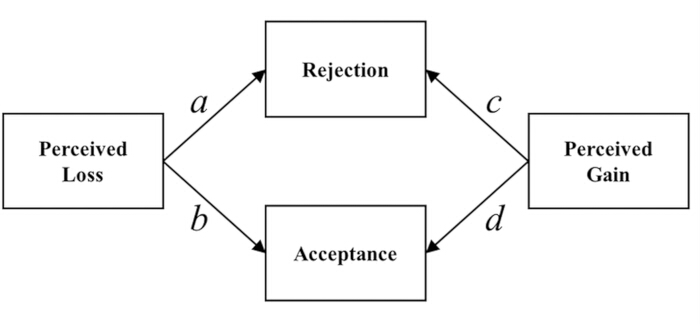
Figure 2: Conceptual PITA model. The diagram shows perceived loss (PL) and perceived gain (PG) as antecedents of rejection (REJ) and acceptance (ACC); the paths a, b, c, and d correspond to the coefficients used to compute the total values V(R) and V(A). Note: a = CLR, b = CLA, c = CGR, and d = CGA Please click here to view a larger version of this figure.
Protocol
All study procedures complied with the ethical principles applicable to research involving human participants at aSSIST University, Sungkyunkwan University, and Dong-A University. Because survey responses were anonymized at the time of collection and no personally identifiable information was gathered, the Institutional Review Board of aSSIST University classified the study as exempt from full ethical review. The participating institutions did not obtain separate IRB approvals, as they relied on the exemption determination issued by the Institutional Review Board of aSSIST University, which covered both the research design and the data-collection procedures. This determination was made in accordance with Article 15 of the Bioethics and Safety Act of the Republic of Korea and the exemption criteria specified in Article 13 of its Enforcement Rule (https://public.irb.or.kr/pt/pt01/PT0103/PT0103R01.do). Prior to accessing the Qualtrics questionnaire, all participants were shown an electronic informed-consent statement explaining the academic purpose of the research, the anonymous processing of responses, the use of the data solely for research purposes, and the absence of reasonably foreseeable risks. Only participants who explicitly provided consent were allowed to proceed with the survey.
Overview of studies
Two empirical studies and two expert interventions were conducted to test the five hypotheses and the proposed PITA model. The results are shown in Figure 3. Two-wave surveys were conducted prior to COVID-19 (2019 Q4) and during COVID-19 (2020 Q2-Q3) to measure constructs separately at different times, reduce the possibility of common method bias (CMB) in the data, and increase the generalization of the study61,62.
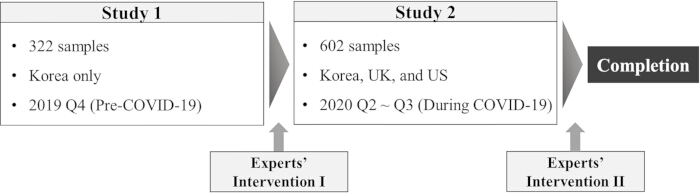
Figure 3: Overview of studies. The timeline summarizes the two-wave design: Study 1 (2019 Q4, before COVID-19, Korean sample, N = 322) followed by the first expert intervention, and Study 2 (2020 Q2-Q3, during COVID-19, Korea/UK/US samples, N = 602) followed by the second expert intervention. Please click here to view a larger version of this figure.
Study 1 model
The initial research model was created based on the developed hypotheses to reveal users’ intentions to accept or reject a recently introduced public IT service (i.e., biometrics at airports), as shown in Figure 4. The users’ opinions of public IT services were reflected in two second-order constructs, perceived loss (PL) and perceived gain (PG), each formed by its respective first-order constructs. These two second-order constructs serve as the antecedents of rejection (REJ) and acceptance (ACC), which represent users’ intentions to use public IT services.
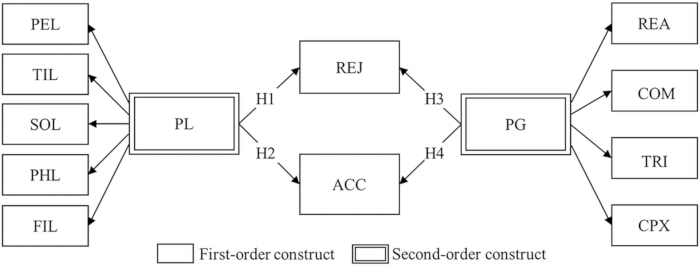
Figure 4: Study 1 research model. Five first-order loss constructs (PEL, TIL, SOL, PHL, and FIL) form the second-order construct perceived loss, and four first-order gain constructs (REA, COM, TRI, and CPX) form perceived gain; the two second-order constructs are modeled as antecedents of rejection and acceptance (H1–H4). Please click here to view a larger version of this figure.
Study 1 research data
The first data sample, which was based on a total of 322 Korean participants (female: 46.6% and male: 53.4%) who had experience boarding an aircraft at least once within the past year, was gathered from November 13 to November 18, 2019 (prior to the COVID-19 pandemic beginning). Definitions and examples of public IT services (i.e., biometric applications at airports) were provided in the survey introduction. The raw data for Study 1 are provided in Supplementary File 1. Flight frequency was measured in five mutually exclusive categories (FF1–FF5), corresponding to one, two, three, four, and five or more flights in the past year (Study 1: 138, 91, 34, 21, and 38 participants; Study 2: 174, 153, 109, 82, and 84 participants, respectively).
The predictor constructs were evaluated using a seven-point Likert scale that ranged from “strongly disagree (1)” to “strongly agree (7)” (see Supplementary File 21,46,53,54,63,64 for the study questionnaire). After a pilot test with 20 participants, the revisions were limited to wording-level refinements of the question items to improve their stability, applicability, and ease of interpretation; no constructs or items were added or removed after the pilot. The supporting document contains the entire questionnaire as well as relevant statistics and theoretical context. Confirmatory factor analysis (CFA) and covariance-based structural equation modeling (CB-SEM) analyses were performed.
Experts’ intervention for Study 1
Five experts with at least ten years of experience were invited to ensure objectivity and improve the caliber of this work, including two from international organizations (Airports Council International and International Air Transport Association), two from governmental organizations (Singapore Changi Airport and Korea Airports Corporation), and one from a private company that offers services in a public setting (Korean Air). This expert intervention was essential in providing feedback to enhance the model and domain knowledge of the target setting. Both qualitative (i.e., subjective feedback) and quantitative (seven-point Likert scale) evaluations were carried out. A revised version of the decision-report-characteristics questionnaire items (see Supplementary File 3)65 was adopted for the quantitative assessment and validated using the intraclass correlation coefficient66. In each intervention round, every expert completed the quantitative questionnaire individually and then provided open-ended qualitative feedback; the same panel, instruments, and procedure were used in both interventions to enable replication.
Study 2
To address the issues identified in Study 1 and improve the model’s generalizability, Study 2 applied the same model as Study 1. Study 2 included 602 participants (female: 42.3%, male: 57.7%, Korea: 200, UK: 201, and US: 201). Data were collected between July 23 and August 19, 2020 (during the COVID-19 pandemic). The raw data for Study 2 are provided in Supplementary File 4. With 33 observed indicators, this sample size provides approximately 18 observations per indicator, exceeding the commonly recommended criterion of 10 observations per indicator for CB-SEM, and also exceeds the widely used minimum threshold of 200 observations. KR, UK, and the US were chosen because they accounted for 29.1% of all air travelers worldwide (roughly 1.6 billion of 5.5 billion) from July 2019 to June 2020. The COVID-19 pandemic affected these countries at different times, beginning in Korea and later affecting the US and the UK. Additionally, the three nations offered a blend of Eastern and Western cultural traditions. Consequently, the combined dataset from these countries was used to examine users’ perception-intention framework for the novel public IT service (i.e., airport biometrics).
Experts’ intervention for Study 2
The same experts were invited, the same quantitative and qualitative evaluations were carried out, and their feedback was solicited to validate the findings in Study 2.
Results
Study 1
To assess potential CMB associated with self-reported data, the one-factor analysis was first carried out67. According to the test’s findings, one factor accounted for 36.56% of the variance; a single factor accounting for less than 50% of the variance indicates that CMB is not a concern62,67,68. The construct validity and reliability were then assessed. The findings in Table 2 suggested that average variance extracted (AVE, 0.585 to 0.836) and composite reliability (CR, 0.872 to 0.939) met the necessary minimum requirements69,70. Additionally, the square root of the AVE for each construct, shown on the diagonal, exceeded its correlations with the other constructs, supporting discriminant validity69.
| CR | AVE | MSV | MaxR(H) | PL | PG | ACC | REJ | |
| PL | 0.872 | 0.585 | 0.307 | 0.902 | 0.765 | |||
| PG | 0.902 | 0.705 | 0.599 | 0.97 | -0.38 | 0.839 | ||
| ACC | 0.927 | 0.809 | 0.596 | 0.941 | 0.554 | -0.67 | 0.9 | |
| REJ | 0.939 | 0.836 | 0.599 | 0.941 | -0.43 | 0.774 | -0.77 | 0.914 |
Table 2: Construct reliability and validity (Study 1). The table reports composite reliability (CR), average variance extracted (AVE), and inter-construct correlations for the Study 1 measurement model.
Next, the hypotheses were tested using SEM among perceived gain, perceived loss, acceptance, and rejection. As illustrated in Figure 5, the model demonstrated acceptable fit indices (CMIN/DF = 2.25, CFI = 0.936, SRMR = 0.075, RMSEA = 0.062), all meeting the recommended thresholds (CMIN/DF < 3, CFI > 0.90, SRMR < 0.08, RMSEA < 0.08), and the results are highly supportive of the developed hypotheses. The five driver constructs (PER, TIR, SOR, PHR, and FIR) for perceived loss and four driver constructs (REA, COM, TRI, and CPX) for perceived gain (PG) all showed substantial effects. The tests of hypotheses 1 and 2 found that perceived loss had a moderate positive influence on rejection (β = 0.357, p < 0.001) and a significantly negative impact on acceptance (β = -0.148, p < 0.001). Hence, both H1 and H2 are supported. On the other hand, the tests of hypotheses 3 and 4 found that perceived gain had opposite effects compared to perceived loss: a strong positive influence on acceptance (β = 0.721, p < 0.001) and a negative impact on rejection (β = -0.507, p < 0.001), respectively. Therefore, both H3 and H4 are supported as well. The overall summary of the research model testing results of Study 1 using SEM is shown in Table 3. The structural model explained 62.4% of the variance in acceptance and 52.5% in rejection (R2 = 0.624 and 0.525, respectively).
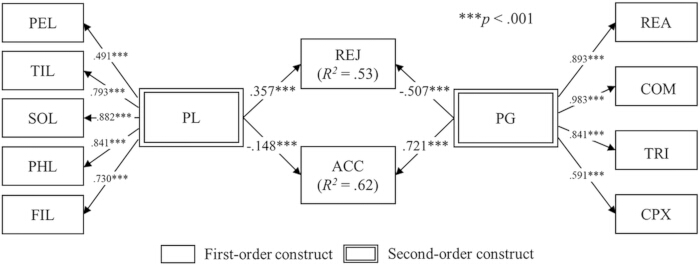
Figure 5: Hypothesis test results of Study 1. The diagram reports the standardized path coefficients and their significance levels for the structural model estimated on the Study 1 sample (N = 322); all hypothesized paths were significant in the expected directions. PEL = performance loss; TIL = time loss; SOL = social loss; PHL = physical loss; FIL = financial loss; REA = relative advantage; COM = compatibility; TRI = trialability; CPX = complexity; PL = perceived loss; PG = perceived gain; REJ = rejection; ACC = acceptance Please click here to view a larger version of this figure.
| Hypothesis | Path | β | t-value | p-value | Result |
| H1 | a: PL → REJ | 0.357 | 6.592 | *** | Supported |
| H2 | b: PL → ACC | -0.148 | -3.059 | *** | Supported |
| H3 | c: PG → REJ | -0.507 | -7.29 | *** | Supported |
| H4 | d: PG → ACC | 0.721 | 8.966 | *** | Supported |
Table 3: Overall results of Study 1. The table summarizes the standardized path coefficients, significance levels, and hypothesis-testing outcomes for Study 1. ***p < 0.001
Further, the total values required for REJ and ACC were calculated to test H5 and confirm whether the model is consistent with prospect theory55. In Equations (1) and (2), a corresponds to the path from perceived loss to rejection (CLR = 0.357), c to the path from perceived gain to rejection (CGR = -0.507), b to the path from perceived loss to acceptance (CLA = -0.148), and d to the path from perceived gain to acceptance (CGA = 0.721). The results indicated that V(R) = a + c = -0.150 and V(A) = b + d = 0.573; thus, V(R) < V(A), and H5 was supported.
Expert intervention results for Study 1
The findings indicated that the experts did not entirely concur with the claims; mean values ranged from 3.40 to 4.40 for the constructs measuring systematic orientation, quality, and problem statement sufficiency. The general negative affect construct also showed a range of 3.20 to 3.60 (ICC = 0.609, p = 0.008). The experts’ subjective assessments identified two additional areas for improvement: the dataset was not representative of the situational factor (it was gathered prior to COVID-19), and a Korean-only sample would not be adequate for generalization. These results laid the foundation for Study 2, which was carried out after the experts’ interventions to address these problems.
Study 2
A procedure parallel to Study 1 was followed in Study 2. First, the one-factor analysis was performed to assess whether CMB was a concern in the dataset67. The test results indicated that there was no substantial effect of CMB in the data sample, as a single factor explained 38.97% of the variance, below the 50% threshold of concern62,67,68. In addition to CMB, the results in Table 4 suggested that the model’s reliability and validity also met the requirements adequately69,70. In addition, all heterotrait-monotrait (HTMT) ratios were below the 0.85 threshold, providing further support for discriminant validity.
| CR | AVE | MSV | MaxR(H) | PL | PG | ACC | REJ | |
| PL | 0.861 | 0.56 | 0.364 | 0.885 | 0.748 | |||
| PG | 0.902 | 0.705 | 0.667 | 0.947 | -0.422 | 0.84 | ||
| ACC | 0.96 | 0.889 | 0.667 | 0.961 | -0.508 | 0.816 | 0.943 | |
| REJ | 0.942 | 0.844 | 0.659 | 0.957 | 0.603 | -0.745 | -0.812 | 0.919 |
Table 4: Construct reliability and validity (Study 2). The table reports composite reliability (CR), average variance extracted (AVE), and inter-construct correlations for the Study 2 measurement model.
The SEM test results of Study 2 with all three countries were CMIN/DF = 3.835, CFI = 0.945, RMSEA = 0.058. The CFI and RMSEA met the recommended thresholds, and although the CMIN/DF value of 3.835 did not meet the more stringent criterion of <3.0, it still indicated an acceptable model fit based on the less stringent criterion of <5.0. Therefore, the test results were highly consistent with the developed arguments and with the results of Study 1, as presented in Figure 6 and Table 5. Similar to the results in Study 1, the relations between PL and REJ (β = 0.345, p < 0.001) and PG and ACC (β = 0.767, p < 0.001) were significantly positive, while those between PL and ACC (β = -0.202, p < 0.001) and PG and REJ (β = -0.644, p < 0.001) were significantly negative. Hence, H1, H2, H3, and H4 were all supported. The structural model explained 76.0% of the variance in acceptance and 72.1% in rejection (R2 = 0.760 and 0.721, respectively).
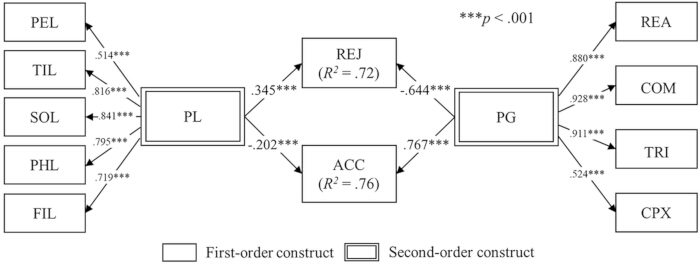
Figure 6: Hypothesis test results of Study 2. The diagram reports the standardized path coefficients and their significance levels for the structural model estimated on the pooled three-country Study 2 sample (N = 602); the pattern of results replicates Study 1. PEL = performance loss; TIL = time loss; SOL = social loss; PHL = physical loss; FIL = financial loss; REA = relative advantage; COM = compatibility; TRI = trialability; CPX = complexity; PL = perceived loss; PG = perceived gain; REJ = rejection; ACC = acceptance Please click here to view a larger version of this figure.
| Hypothesis | Path | β | t-value | p-value | Result |
| H1 | a: PL → REJ | 0.345 | 9.342 | *** | Supported |
| H2 | b: PL → ACC | -0.202 | -6.81 | *** | Supported |
| H3 | c: PG → REJ | -0.644 | -12.694 | *** | Supported |
| H4 | d: PG → ACC | 0.767 | 13.707 | *** | Supported |
Table 5: Overall results of Study 2. The table summarizes the standardized path coefficients, significance levels, and hypothesis-testing outcomes for Study 2. ***p < 0.001
Next, the total values required for REJ and ACC were examined further to test H5 and confirm whether the model supported the prospect theory argument55. With the same coefficient mapping as in Study 1, the results showed that V(R) = a + c = -0.299 and V(A) = b + d = 0.565; thus, V(R) < V(A). H5 was also supported in Study 2, and the difference between V(R) and V(A) in Study 2 (0.864) was greater than that in Study 1 (0.723).
Expert intervention results for Study 2
The results of the quantitative assessment were significantly positive (ICC = 0.960, p < 0.001); the range of mean values for the constructs measuring systematic orientation, quality, and problem statement adequacy was from 6.20 to 6.80, and for the construct measuring general negative affect was from 1.20 to 1.80. The high intraclass correlation indicates strong expert consensus on the model’s systematic orientation, quality, and problem-statement adequacy, and the experts did not raise any other issues in their subjective evaluation. It was therefore concluded that the research finally satisfied the requirements needed to complete the proposed PITA model.
DATA AVAILABILITY:
The data are uploaded as Supplementary File 1 (Study 1) and Supplementary File 4 (Study 2); the complete CB-SEM model outputs are provided in Supplementary File 5, and variable definitions and coding are documented in the data dictionary (Supplementary File 6). In the data files and CB-SEM outputs, the manuscript abbreviations PEL, TIL, SOL, PHL, FIL, and REJ correspond to the variable labels PER, TIR, SOR, PHR, FIR, and RES, respectively, and the second-order constructs PL and PG are labeled Perceived_Risk and Perceived_Benefit.
Supplementary File 1: Research data (Study 1) Please click here to download this file.
Supplementary File 2: Survey questionnaire Please click here to download this file.
Supplementary File 3: Intervention questionnaire Please click here to download this file.
Supplementary File 4: Research data (Study 2) Please click here to download this file.
Supplementary File 5: CB-SEM model output files Please click here to download this file.
Supplementary File 6: Data dictionary Please click here to download this file.
Discussion
This two-study investigation tested the PITA model of public IT adoption; across both studies, all five hypotheses were supported, and the gap between V(A) and V(R) widened in the riskier COVID-19 context, in line with prospect theory’s prediction that riskier choices require greater perceived value. A gap was found in the theoretical foundations of the IT adoption literature, including TAM2 and DOI1, which failed to adequately explain public IT adoption. Most importantly, these studies did not adequately account for users’ uncertainty when using public IT services. It was therefore asked what impact the perception-intention framework put forth by PITA has on the decision to adopt public IT services. A user must consider the advantages and disadvantages of the status quo option when presented with a new, innovative public IT service. If the new option is declined, the user resumes the previous state, making the new option unnecessary. The PITA model enables comprehension of the underlying value perceptions that influence such a choice. Additionally, this gave several suggestions for preventing such failures before investing in a new public IT service1,42. This study investigated how perceived gains and losses influence the acceptance and rejection of a public IT service; all five hypotheses were supported. Users’ perceptions of public IT services can be viewed from two perspectives, and it is likely that users’ negative perceptions will predominate. The findings, however, indicated that their favorable perceptions encouraged them to accept and lessen resistance. Relevant illustrations of perceived loss include inconsistent performance, unreasonably drawn-out procedures, resistance from users’ surroundings, physical harm caused by devices, and failures in financial transactions. Additionally, interchangeable functions, open-beta test events, and ease of use would serve as examples of components of perceived gains. The findings from both studies were consistent with earlier research on the innovation resistance model and the diffusion of innovations, for example1,42.
A significant discovery was that the overall worth of acceptance was almost five times greater than that of rejection. This large difference between V(A) and V(R) was driven primarily by the strong positive effect of perceived gain on acceptance (β = 0.721) and the negative effect of perceived gain on rejection (β = -0.507), suggesting that users’ perceptions of benefits, such as ease of use and interchangeable functions, play a more dominant role than perceptions of loss in shaping adoption decisions. For users to make the riskier decision to accept a new and unfamiliar public IT service, positive perceptions must substantially outweigh negative perceptions. Users may also decide against new public IT services at the expense of losses because decision-making may not be fully rational. This phenomenon may be explained by the strong attachment to the current service and the fact that public IT services are not intended for regular daily use. The users can maintain their current state if they find any inconveniences. Users will not attempt to overcome their psychological resistance to accept new public IT services if perceived gains are insufficient or perceived losses are greater than anticipated. In Study 2, which consistently demonstrated the same patterns in the users’ perception-intention framework within the context of a public IT service, a more concrete and broad corroboration was obtained for the theoretical model that was proposed. Additionally, V(A) was substantially higher than V(R), supporting the case for expanding prospect theory55.
The impact of the situational factor (COVID-19) on V(A) and V(R) was another intriguing finding in Study 2. The gap between V(R) and V(A) in Study 2 widened in comparison to that in Study 1. During a global health crisis, users may have perceived greater potential losses from infection while simultaneously recognizing greater potential gains from touchless service, and this dual effect amplified the value differential required for acceptance. This finding supports the attempt to advance prospect theory by indicating that the riskier option (accepting a novel public IT service in a riskier situation, COVID-19) requires greater value55. Inevitably, the evaluation findings from Study 2 supported those of Study 1 once more. The situational factor was a potential element that could have altered users’ decision-related values, as the experts predicted during the first intervention. Additionally, the results supported the validity of the model’s assumptions using larger samples for the airport biometrics case, giving it more robustness and generality. Nevertheless, the pooled multi-country analysis assumed that the constructs were interpreted similarly across countries; formal measurement invariance testing and country-specific comparisons were not conducted and remain a task for future research.
According to the analysis done using the perception-intention framework, users would not choose the status quo option if they believed they would receive a significantly greater gain from using the public IT service. This suggests that only when the perceived gains make the risky option of acceptance more alluring are users willing to leave their equilibrium. In retrospect, it makes conceptual sense that acceptance is more influenced by perceived gains than losses. The current service offered to the user is the secure, “risk-averse” option because it is a known entity with which users have prior experience, according to prospect theory55. This means that the user can anticipate getting the same result with no risk without adapting or changing any behavioral conditions. However, the risky option will probably be selected, diverging from the “risk-averse” option, as soon as the perceived gains significantly outweigh the perceived losses. It is interesting to note that these effects were stronger when a user encountered a riskier situation, the COVID-19 pandemic, which may have increased the need for value if they considered using the new public IT service. A consistent relationship was discovered between perceived gain and loss and the acceptance or rejection of public IT services. According to the data, a deeper comprehension of how users perceive potential benefits and how that understanding affects whether they choose to use a public IT service or not is necessary. It would appear that accepting a new IT service is significantly more difficult for any user when they are presented with a new option because they must fight against any psychological inertia that may exist. This was also shown by the fact that improvements within the framework of perception and intention needed to be more significant. These findings adhere to the fundamental idea put forth by prospect theory55: riskier decisions call for higher values than safer ones. Notably, the asymmetric pattern, whereby perceived gain predicted acceptance more strongly than perceived loss predicted rejection, suggests that decision-making in this context is not purely loss-averse but rather gain-driven, a nuance that extends prospect theory’s typical emphasis on loss aversion. These results also align with prior adoption research: the strong effect of perceived gain on acceptance is consistent with TAM’s emphasis on perceived usefulness2, while the significant effect of perceived loss on rejection supports the innovation resistance model’s assertion that barriers to adoption can outweigh potential benefits42,49. This study extends that literature by demonstrating that gains and losses simultaneously influence both acceptance and rejection rather than operating independently. The findings thus contribute to the theoretical understanding of what motivates users of public IT services to maintain the status quo (i.e., rejection) or increase their risk-taking (i.e., acceptance). The growing body of research on the opposition to IT adoption was furthered by this study. Rejecting and accepting IT were demonstrated to be distinct decision-making criteria, building on earlier work in the individual- and firm-level literature45,50,51. All users have a threshold42,49; however, no study on public IT adoption has examined what these thresholds might be. Therefore, the inclusion of perceived loss was a useful way to investigate this tolerance and significantly affected both the choice to accept or reject the public IT. These findings added to previous research that applies the same accept-and-reject principle by extending it in a new context51.
The findings have some significant managerial ramifications for public institutions. First, it is well known that these institutions struggle with change and that switching to digital infrastructure is difficult. Therefore, poor decisions made by public organizations when switching to an IT service can have long-lasting negative effects. Users are probably not ready to adopt the suggested IT service if they feel the loss is too great. In contrast, investments in the public IT service may be more successful if a public institutional manager articulates the factors that reduce rejection through perceived gains. By increasing the perceived gains and decreasing the perceived losses, managers can ultimately increase acceptance and decrease rejection by using PITA to try to find solutions that elicit a positive response. For example, a public airport implementing biometric screening could use PITA to assess user perceptions before investment: if V(R) approaches or exceeds V(A), managers might focus communication on tangible benefits such as faster processing (increasing perceived gain) or offer opt-out alternatives (reducing perceived loss). Because of the model’s simplicity, V(A) and V(R) can be calculated directly from survey data, providing managers with a clear benchmark for understanding users’ use intentions and determining the status of and chances of adoption for their proposed IT service.
This study has several important limitations. First, although the effects were similar in both studies, more research is needed to fully understand the less significant effects observed in the measurements of perceived loss, and the factors taken into account in this study might only partially explain the variance found in the model. Second, both studies employed cross-sectional, self-reported survey data from air travelers; this design precludes causal inferences, may introduce selection and social-desirability biases, and limits generalizability beyond this population. Formal measurement invariance testing across the three countries remains to be conducted. Third, the data were collected in specific periods (2019 Q4 and mid-2020), and user perceptions may have shifted as the pandemic evolved. Fourth, it was assumed that a manager would consider only one new potential option, with the current option serving as yet another restriction. Future work should consider various PITA technology options, because, according to the certainty effect, when there are several options with varying degrees of certainty, this encourages risk-taking behaviors71 and may be a worthwhile direction to pursue. Future research should also examine other forms and thresholds of innovation resistance63, extend PITA to other public IT services (e.g., e-government portals and public health applications) and to other domains in which perceived benefit and risk jointly shape adoption64, employ longitudinal designs to track how V(A) and V(R) evolve over time, and examine whether cultural dimensions moderate the relationships in the model. Overall, this study ought to contribute to a better comprehension of public IT adoption. By incorporating both perceived gain and perceived loss, the PITA model captures the dual nature of user decision-making: acceptance is driven by the allure of gains, while rejection is driven by the fear of losses. Before making an investment, managers can be guided in the right direction by making sound and accurate decisions during the early stages of identifying potential IT solutions. Managers should reconsider their IT service strategy if the total value of acceptance is insufficient because PITA gives managers a total of the value necessary for both acceptance and rejection. The finding that situational risk amplifies the value differential required for acceptance represents a novel contribution to both prospect theory and the technology adoption literature. PITA should therefore assist managers in finding a solution that offers a total value of acceptance that is greater than that of rejection: users are only then prepared to use a new public IT service.
Disclosures
The authors declare no conflicts of interest. During the preparation of this revised manuscript, a generative artificial intelligence tool (ChatGPT 5o) was used to assist with language editing and formatting. The authors reviewed and verified all content and take full responsibility for the manuscript; no AI tool was used to generate data, perform analyses, or create figures.
Acknowledgements
This work was supported by research funding from aSSIST University.
Materials
| Name | Company | Catalog Number | Comments |
|---|---|---|---|
| IBM SPSS Amos (CB-SEM software) | IBM Corp. (Armonk, NY, USA) | version 27; https://www.ibm.com/products/structural-equation-modeling-sem/ | Used for all covariance-based structural equation modeling (CB-SEM) analyses, including measurement model assessment (CFA: composite reliability, AVE, and discriminant validity) and structural model path analysis. |
| Prolific (Online Participant Recruitment Platform) | Prolific Academic Ltd | https://www.prolific.com/ | Online platform used to recruit survey participants. Participants were screened based on eligibility criteria (e.g., airport experience) and compensated according to Prolific's fair-pay guidelines. |
| Qualtrics (Online Survey Platform) | Qualtrics, LLC | RRID:SCR_016728 | Web-based survey platform used for questionnaire design, distribution, and response data collection. All measurement items were administered via Qualtrics using a 7-point Likert scale (1 = strongly disagree, 7 = strongly agree). https://www.qualtrics.com/ |
References
- Rogers EM, Singhal A, Quinlan MM. Diffusion of innovations. In: An integrated approach to communication theory and research. London: Routledge; 2014. p. 432-448.
- Davis FD. A technology acceptance model for empirically testing new end-user information systems: theory and results [dissertation]. Cambridge (MA): Massachusetts Institute of Technology; 1985.
- Tornatzky LG, Fleischer M, Chakrabarti AK. Processes of technological innovation. Lexington (MA): Lexington Books; 1990.
- Venkatesh V, Morris MG, Davis GB, Davis FD. User acceptance of information technology: toward a unified view. MIS Q. 2003;27(3):425-478.
- Jeyaraj A, Sabherwal R. Adoption of information systems innovations by individuals: a study of processes involving contextual, adopter, and influencer actions. Inf Organ. 2008;18(3):205-234.
- Balliauw M, Onghena E. Expanding airport capacity of cities under uncertainty: strategies to mitigate congestion. J Air Transp Manag. 2020;84:101791.
- Marjanovic O, Cecez-Kecmanovic D. Open government data platforms - a complex adaptive sociomaterial systems perspective. Inf Organ. 2020;30(4):100323.
- Kim C, Lee KC, Costello FJ. The intention of passengers towards repeat use of biometric security for sustainable airport management. Sustainability. 2020;12(11):4528.
- Morosan C. Voluntary steps toward air travel security: an examination of travelers' attitudes and intentions to use biometric systems. J Travel Res. 2012;51(4):436-450.
- Negri NAR, Borille GMR, Falcão VA. Acceptance of biometric technology in airport check-in. J Air Transp Manag. 2019;81:101720.
- Morosan C. An empirical examination of US travelers' intentions to use biometric e-gates in airports. J Air Transp Manag. 2016;55:120-128.
- Price A, Prusak A, Wright M. Tech trends 2021: a government perspective. Deloitte Insights; 2021.
- Samuelson W, Zeckhauser R. Status quo bias in decision making. J Risk Uncertain. 1988;1(1):7-59.
- Troshani I, Jerram C, Hill SR. Exploring the public sector adoption of HRIS. Ind Manag Data Syst. 2011;111(3):470-488.
- Cordella A, Bonina CM. A public value perspective for ICT enabled public sector reforms: a theoretical reflection. Gov Inf Q. 2012;29(4):512-520.
- Warkentin M, Orgeron C. Using the security triad to assess blockchain technology in public sector applications. Int J Inf Manag. 2020;52:102090.
- Oliva R. Intervention as a research strategy. J Oper Manag. 2019;65(7):710-724.
- Oyman M, Bal D, Ozer S. Extending the technology acceptance model to explain how perceived augmented reality affects consumers' perceptions. Comput Hum Behav. 2022;128:107127.
- Hsu HT, Lin CC. Extending the technology acceptance model of college learners' mobile-assisted language learning by incorporating psychological constructs. Br J Educ Technol. 2022;53(2):286-306.
- Balakrishnan J, Abed SS, Jones P. The role of meta-UTAUT factors, perceived anthropomorphism, perceived intelligence, and social self-efficacy in chatbot-based services? Technol Forecast Soc Change. 2022;180:121692.
- Wu B, An X, Wang C, Shin HY. Extending UTAUT with national identity and fairness to understand user adoption of DCEP in China. Sci Rep. 2022;12(1):1-11.
- Epstein B. Two decades of e-government diffusion among local governments in the United States. Gov Inf Q. 2022;39(2):101665.
- Hasselwander M, Bigotte JF, Fonseca M. Understanding platform internationalisation to predict the diffusion of new mobility services. Res Transp Bus Manag. 2022;43:100765.
- Ng PM, Lit KK, Cheung CT. Remote work as a new normal? The technology-organization-environment (TOE) context. Technol Soc. 2022;70:102022.
- Rana NP, Dwivedi YK, Williams MD, Weerakkody V. Adoption of online public grievance redressal system in India: toward developing a unified view. Comput Hum Behav. 2016;59:265-282.
- Alawadhi S, Morris A. Factors influencing the adoption of e-government services. J Softw. 2009;4(6):584-590.
- Chan FKY, et al. Modeling citizen satisfaction with mandatory adoption of an e-government technology. J Assoc Inf Syst. 2010;11(10):519-549.
- Weerakkody V, El-Haddadeh R, Al-Sobhi F, Shareef MA, Dwivedi YK. Examining the influence of intermediaries in facilitating e-government adoption: an empirical investigation. Int J Inf Manag. 2013;33(5):716-725.
- Mensah IK. Impact of government capacity and e-government performance on the adoption of e-government services. Int J Public Adm. 2020;43(4):303-311.
- Al Mansoori KA, Sarabdeen J, Tchantchane AL. Investigating Emirati citizens' adoption of e-government services in Abu Dhabi using modified UTAUT model. Inf Technol People. 2018;31(2):455-481.
- Mukred M, et al. The key factors in adopting an electronic records management system (ERMS) in the educational sector: a UTAUT-based framework. IEEE Access. 2019;7:35963–35980.
- Naranjo-Zolotov M, Oliveira T, Casteleyn S. Citizens' intention to use and recommend e-participation: drawing upon UTAUT and citizen empowerment. Inf Technol People. 2019;32(2):364-386.
- Toufaily E, Zalan T, Dhaou SB. A framework of blockchain technology adoption: an investigation of challenges and expected value. Inf Manag. 2021;58(3):103444.
- Amron MT, Ibrahim R, Bakar NAA, Chuprat S. Acceptance of cloud computing in the Malaysian public sector: a proposed model. Int J Eng Bus Manag. 2019;11:1847979019880709.
- Chatfield AT, Reddick CG. The role of policy entrepreneurs in open government data policy innovation diffusion: an analysis of Australian federal and state governments. Gov Inf Q. 2018;35(1):123-134.
- Dahabiyeh L, Constantinides P. Legitimating digital technologies in industry exchange fields: the case of digital signatures. Inf Organ. 2022;32(1):100392.
- Feller I. Managerial response to technological innovation in public sector organizations. Manage Sci. 1980;26(10):1021-1030.
- Dawson GS, Denford JS, Desouza KC. Governing innovation in US state government: an ecosystem perspective. J Strateg Inf Syst. 2016;25(4):299-318.
- Oliveira T, Fraga M. Literature review of information technology adoption models at firm level. Electron J Inf Syst Eval. 2011;14(1):110-121.
- Tornatzky LG, Klein KJ. Innovation characteristics and innovation adoption-implementation: a meta-analysis of findings. IEEE Trans Eng Manag. 1982;EM-29(1):28-45.
- Harrison DA, Mykytyn PP Jr, Riemenschneider CK. Executive decisions about adoption of information technology in small business: theory and empirical tests. Inf Syst Res. 1997;8(2):171-195.
- Ram S. A model of innovation resistance. Adv Consum Res. 1987;14(1):208-212.
- Lapointe L, Rivard S. A multilevel model of resistance to information technology implementation. MIS Q. 2005;29(3):461-491.
- Davidson E, Baird A, Prince K. Opening the envelope of health care information systems research. Inf Organ. 2018;28(3):140-151.
- Bradley L, Stewart K. A Delphi study of the drivers and inhibitors of Internet banking. Int J Bank Mark. 2002;20(6):250-260.
- Moore GC, Benbasat I. Development of an instrument to measure the perceptions of adopting an information technology innovation. Inf Syst Res. 1991;2(3):192-222.
- Agarwal R, Prasad J. The role of innovation characteristics and perceived voluntariness in the acceptance of information technologies. Decis Sci. 1997;28(3):557-582.
- Karahanna E, Straub DW, Chervany NL. Information technology adoption across time: a cross-sectional comparison of pre-adoption and post-adoption beliefs. MIS Q. 1999;23(2):183-213.
- Ram S, Sheth JN. Consumer resistance to innovations: the marketing problem and its solutions. J Consum Mark. 1989;6(2):5-14.
- Ellen PS, Bearden WO, Sharma S. Resistance to technological innovations: an examination of the role of self-efficacy and performance satisfaction. J Acad Mark Sci. 1991;19(4):297-307.
- Gatignon H, Robertson TS. Technology diffusion: an empirical test of competitive effects. J Mark. 1989;53(1):35-49.
- Weber EU, Bottom WP. Axiomatic measures of perceived risk: some tests and extensions. J Behav Decis Mak. 1989;2(2):113-131.
- Stone RN, Grønhaug K. Perceived risk: further considerations for the marketing discipline. Eur J Mark. 1993;27(3):39-50.
- Featherman MS, Pavlou PA. Predicting e-services adoption: a perceived risk facets perspective. Int J Hum Comput Stud. 2003;59(4):451-474.
- Kahneman D, Tversky A. Prospect theory: an analysis of decision under risk. Econometrica. 1979;47(2):263-291.
- Verma S, Singh V. Impact of artificial intelligence-enabled job characteristics and perceived substitution crisis on innovative work behavior of employees from high-tech firms. Comput Hum Behav. 2022;131:107215.
- Fadel KJ, Meservy TO, Kirwan CB. Information filtering in electronic networks of practice: an fMRI investigation of expectation (dis)confirmation. J Assoc Inf Syst. 2022;23(2):491-520.
- Choi HS, Carpenter D, Ko MS. Risk taking behaviors using public Wi-Fi. Inf Syst Front. 2021:1-18.
- Khan WU, Shachak A, Seto E. Understanding decision-making in the adoption of digital health technology: the role of behavioral economics' prospect theory. J Med Internet Res. 2022;24(2):e32714.
- Wong D, Liu H, Meng-Lewis Y, Sun Y, Zhang Y. Gamified money: exploring the effectiveness of gamification in mobile payment adoption among the silver generation in China. Inf Technol People. 2022;35(1):281-315.
- Tarafdar M, Maier C, Laumer S, Weitzel T. Explaining the link between technostress and technology addiction for social networking sites: a study of distraction as a coping behavior. Inf Syst J. 2020;30(1):96-124.
- Podsakoff PM, MacKenzie SB, Lee JY, Podsakoff NP. Common method biases in behavioral research: a critical review of the literature and recommended remedies. J Appl Psychol. 2003;88(5):879-903.
- Szmigin I, Foxall G. Three forms of innovation resistance: the case of retail payment methods. Technovation. 1998;18(6-7):459-468.
- Lee MC. Factors influencing the adoption of internet banking: an integration of TAM and TPB with perceived risk and perceived benefit. Electron Commer Res Appl. 2009;8(3):130-141.
- Aldag RJ, Power DJ. An empirical assessment of computer-assisted decision analysis. Decis Sci. 1986;17(4):572-588.
- Shrout PE, Fleiss JL. Intraclass correlations: uses in assessing rater reliability. Psychol Bull. 1979;86(2):420-428.
- Podsakoff PM, Organ DW. Self-reports in organizational research: problems and prospects. J Manag. 1986;12(4):531-544.
- Podsakoff PM, MacKenzie SB, Podsakoff NP. Sources of method bias in social science research and recommendations on how to control it. Annu Rev Psychol. 2012;63:539-569.
- Fornell C, Larcker DF. Evaluating structural equation models with unobservable variables and measurement error. J Mark Res. 1981;18(1):39-50.
- Kline E, et al. Convergent and discriminant validity of attenuated psychosis screening tools. Schizophr Res. 2012;134(1):49-53.
- Tversky A, Kahneman D. Rational choice and the framing of decisions. In: Multiple criteria decision making and risk analysis using microcomputers. Berlin, Heidelberg: Springer; 1986. p. 81-126.